 |
|
|
[Page 82]
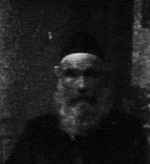
Our Rav, R'Alter Yehuda Zolyar, Z”TzL
by Yosef Ze'evi
Translated by M. David Isaak
|
Our Rabbi sat on the rabbinical seat in Luninyets from the day a Jewish settlement was established in the city until its destruction. Until his final day, he served and accompanied our community with love, faithfulness, and self-sacrifice. He came to Luninyets from Lakhva, where he served as a Dayan (rabbinical judge). A native of Volyn, his Yiddish had a Volhynian accent.
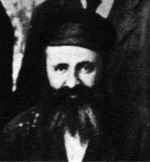
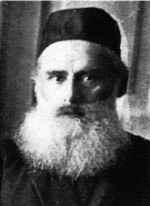
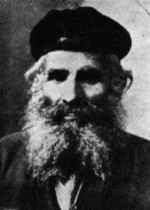
His image stands out before us with special clarity: short in stature, thin of body, his beard neatly kept, his eyes sparkling, and his gaze friendly and smiling. He was humble, managing his congregation with gentleness. In public affairs, he stood as if to the side, even though he took an interest in everything and gave his opinion on every matter. A lover of peace and a pursuer of peace, for this reason we all loved him–both old and young. Personable and involved with people, he knew how to capture every heart, sometimes with a light jest.
Zionists and Bundists alike paid him respect, even though he was far removed from worldly affairs. However, with his straight mind and clear logic, he always knew how to judge uprightly. In his spare time, he studied Torah. His home was always full of guests. Our Rabbi's influence was also very great on the younger, free-thinking generation. Through his noble traits, his influence was greater than others had through their sermons. He was not blessed with eloquence; his voice was raspy, and therefore he did not preach before his congregation on Sabbath days, on Shabbat HaGadol or on Shabbat Shuva, as was customary in Jewish communities in general and in Kozanhorodok in particular.
Even though he was pleasant with people and a pursuer of peace, he knew how to be flexible as a reed or stand firm as a cedar when necessary. (A story I heard from my late father: Two butchers came to him for a judgment, and the Rabbi did not issue a ruling immediately. A few days later, the two butchers entered the Rabbi's house and demanded that he issue their ruling immediately. One of them, a coarse man, pulled a knife from his boot and said: “Rabbi, today you will issue a ruling, and if not–a death ruling awaits me, go!” When the Rabbi heard these words from the coarse butcher, he raised his small hand, slapped the butcher on the cheek, and shouted in anger: “Get out of my house! You shaygitz [vile creature, (or gentile)]!” The people present in the Rabbi's house were shaken, and the whole town was in uproar; naturally, the butcher appeased the Rabbi and begged for his forgiveness).
Our Rabbi was one of the lenient ones–from the School of Hillel–both in his interpersonal relations and in answering questions of Halachic [religious dictates] rulings. I remember, the day before the holiday, a cow was slaughtered, and the ritual slaughterer was about to declare the cow treif not kosher]. The Rabbi was summoned, who was an expert at decisions regarding sirchot [lung adhesions]. With his small hands and delicate fingers, he labored and worked for three continuous hours and, in honor of the holiday, certified the cow as kosher.
In the early years, he served among us not only as a rabbi, but also as a Shochet [ritual slaughterer] and Mohel [circumciser]; he also knew the craft of a Sofer [Torah scribe], and with his own hands, he wrote a Torah scroll for himself. We, the youth, used to enter his home without any fear or dread. He would approach each one of us, converse with him, and pinch his cheek affectionately; his joy was immense
[Page 83]
when people came to him to request a letter of recommendation to enter a Yeshiva. There was no celebration in town in which the Rabbi did not participate: a bris [circumcision], a home dedication, or a wedding. His participation was warm, heart-felt, and unpretentious. Who among us does not remember his singing at a wedding: Keytsad merakdim… [“How does one dance before the bride, beautiful, graceful, and modest],” and his dance with his red handkerchief in hand? His jest is remembered: “Shtops zakh nit meydl, azoyl azoyl eyne eltemen khassene makhn” [“Don't push, young ladies, G-d willing, I'll make a wedding for all of you.”]. His livelihood was meager, to his embarrassment. Only in recent years, when leadership in the community passed to younger hands, was a monthly salary allocated to him. For decades he eked out a meager living selling chametz (leavened bread) and wine on the eve of Passover, and occasionally also from selling candles and matchboxes. There were years when every Saturday night, R' Avraham Hirsh the teacher would go from house to house with his notebook in hand collecting “dues for the Rabbi.” Despite all this, a complaint was never heard from his mouth. The Rebbitzin [rabbi's wife] and his daughter Risha at their head eschewed [fled from] honor, contenting themselves with little. The Rebbitzin, may her memory be blessed, was a quiet and pleasant woman. Our Rabbi's life was a long chain of troubles, distresses, and afflictions. It is a wonder how he was able to rise above the suffering and tragedies. His large family–almost all of them died in their father's lifetime, except for his eldest son Leibele, who went into exile to Siberia, and remained alive. Leibele joined the revolutionary movement in the years 1905–6; he did not bring honor to the Rabbi. The second son, Motel, drowned in the Vyand river. Chaim, the third son, who studied at the Kaminitz Yeshiva, was about 17 years old when he was killed. The fourth son, Itzel, was murdered together with members of the Tamarin family by the Poles during their retreat from Luninyets in 1919. The only daughter, Rishka, a real Daughter-of-Israel, served as an exemplary model of active charity for the benefit of the poor, died a few days before her immigration to Eretz-Yisrael. The youngest, last remaining son, was ill and died in his youth. Despite all of this, our Rabbi's dedication to the refugees of Israel is attested to by an article in the newspaper HaBoker, written by the writer Flinker, who found himself in Luninyets in his flight from the Nazi conquests. Our Rabbi was considered to belong to the Stolin Hasidim, but he was not zealous. In block letters he wrote a slogan on the Zionist flag in 1917. Among Gentiles he was famous as a wise and upright man. In their lawsuits with Jews, gentiles demanded to litigate before the Rabbi.
There was only one thing in which our Rabbi did not excel, and that was knowledge of the language of the state. He did not know Russian or Polish well. Various anecdotes recount that he would confuse the greetings. Entering the house of government and the governor, instead of “Zdravstvuyte” [Hello], he would say “Da svidaniya” [Goodbye]. When the Bolsheviks entered the town (during the Polish-Russian war), they took the Slavic priest and the Rabbi as well and put them into the prisoners' railcar. It was only with great difficulty that his daughter Risha, after many efforts and tears, managed to get him out of the hands of the Cheka [secret police].
Our righteous and upright Rabbi did not die a natural death, but was murdered together with his entire community. The gentiles who stood not far from the pit recounted that before the slaughter, the Rabbi turned to his community with words of comfort and said that Hitler's downfall was near, encouraging them to die as holy martyrs. During the gunshots, cries of “Shema Yisro'el” were heard.
The memory of our Rabbi will not fade from us, and his noble image will always hover before us. May his soul be bound in the bond of eternal life among the holy and pure ones of our community.
by Yaakov Kola
Translated by M. David Isaak
|
If you wish to establish a memorial monument for our town, to set up a lasting memorial for generations to come; if your son or your grandson should ever ask you about our bright past, and if you wish to impart to him an understanding of it – do not tell him about your beautiful town paved with roads, about the lovely gardens, about the fields of crops and fragrant flowers. Do not tell them about the town's outskirts or the bridge above the railway tracks.
Tell them and repeat describing the personalities who shaped the spiritual character of the town, the wonderful figures who bestowed their spirit upon the town and on its public, cultural, and economic life, its institutions, and its activities.
Let us dwell on a few figures whose lives were a fusion of Torah and Hasidism, within the framework of the Stolin and Karlin Hasidim:
The head of the group was the town rabbi, Rabbi Alter Yehuda Zolar of blessed memory, a scholar, eminent in Torah and fear of Heaven – wherever you find his greatness you'll also encounter his humility; a simple, pure Jewish man, well-integrated among people.
Reb Moshe Wolf Diatlovitzky – a proud Jew walking with head held high and erect posture, with a majestic countenance and an expression of firmness, commanding respect in his surroundings.
Reb Alter Levin, who dedicated all his days to Torah, prayer, and especially to acts of loving-kindness.
Reb Motel Shurtzman, who invested all his energy and time in sustaining the Karlin Yeshiva, the pride of the town.
But there was also another chain of elderly, pure, and upright Jews whose influence radiated light onto the traditional, spiritual, and public life of the town.
Among these figures, the noble and wonderful character of Reb Moshe the Shochet [Ritual Slaughterer], of blessed memory, stood out in particular. A beloved and respected man, acceptable to all, beloved by old and young alike, a blend of Hasid and Mitnagged [opposer of Hasidism], devout and free-spirited; his inner self reflected his outward appearance. His external beauty mirrored his inner beauty, a man of high virtues and noble traits, clean of hands and pure of heart. A wonderful charm resided in the man, an exceptional individual.
Reb Moshe conducted himself as a Hasid, set fixed times for Torah study, was as meticulous with minor commandments as with major ones; he educated his household in the path of Torah and Hasidism, yet with gentleness and ease – loving people and bringing them closer to Torah. Overlooking his personal feelings and ruling over his spirit, he did not get agitated or upset, but weighed every matter with his clear mind and sound judgment.
His love for Eretz Yisrael knew no bounds. He was devoted to his family. To this day, his name is remembered with holy reverence and admiration.
Truth was a lamp unto his feet [led the way], he distanced himself from controversy, doing everything to foster peace, brotherhood, and friendship among all members of the community.
[Page 85]
To the outward eye he appeared robust and healthy, yet all his days he suffered from a severe illness; but this did not dampen his spirit, nor did it overshadow the joyful expression on his face.
He welcomed guests generously. Who would pass by the house of Reb Moshe the Shochet and not stop and visit? Be it a rabbi, an emissary, a yeshiva student or simply a fellow Hasid.
Reb Moshe of blessed memory was privileged to pass away a short time before the Holocaust, on the 12th of Adar II 5702 [February 28, 1942].
by Asher
Translated by M. David Isaak
|
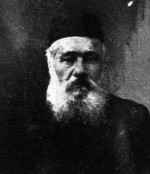
Rabbi Yisrael Peretz Holtzman! I always whisper and pronounce his beautiful name with trills of delight. With the initials Y-P-H [יפה, Hebrew for beautiful] he signed and marked the cover pages of the Talmud volumes and the rest of his books. Indeed, he was handsome and of majestic appearance, endowed with wisdom and sharpness of mind.
Our town was not among the ancient ones in the forests of Polesia and its swamps, but rather a renewed village, proud in its development–a town young and tender in years, a town of commerce and craft. Few were the “scholars” within it. Rabbi Yisrael Peretz was the glory of the town, its illui [prodigy]. His discourses in Halacha and Aggadah were pleasant and fluid, seasoned with casual conversation, pleasant, interweaving his sayings with humorous witticisms and clever insights.
A Hasidic archetype, a man joyful and energetic, he would dismiss with a wave of his hand the itinerant Maggidim [preachers], and the emissaries who used to flood our town on Sabbaths and weekdays, mixing words of homily and ethics. He could not tolerate the tones, soaked in grief, in the sermons of the Maggidim. He would respond with zealous inspection and detailed scrutiny of their words.
He also understood the spirit of the times, loved the Haskalah [Hebrew Enlightenment] movement and the poems of Adam HaCohen, Michal, and the poems of Y.L.G. [J.L. Gordon]; he delighted in the Biblical eloquence of their poetry. He refreshed his soul with stinging rhyming witticisms, over the Kotzo shel yud [Thorn of the letter ‘Yud’] and rhyming wordplays. He liked the novel “Religion and Life” by R. A. Braudes, and advised students to read it. In Haskalah literature, he saw new renditions of the poetry of medieval poets and scholars. In awe and reverence he would utter the name Abraham Ibn Ezra, especially when he succeeded in deciphering obscure places and enigmas in the commentary of Ibn Ezra on the Torah. In his Stars of Life he saw an image of his own life; in the poem Lefi Iddy [According to My Fate], he drew a comparison to his own life, not very successful and continued along its tortuous path.
Only a few in town knew of his proficiency in the literature of Kabbalah and the Zohar. And those who did know attributed several tragic events in his family to his involvement with these hidden, secret teachings during his youth. He himself strictly refrained from talking about matters of Kabbalah and Zohar. However, at times, despite his caution, an enlightening flash from the Holy Zohar on the weekly Torah portion would slip out in distraction. He was blessed with an illuminating explanation. For many years he was the teacher and rabbi of the Shas [Talmud] Association in town. Every evening Jews would gather and listen
[Page 86]
to a “lesson” from Rabbi Yisrael Peretz. He showed his strength especially at a Siyum [completion ceremony], during a moment of inspiration, after a few sips of whiskey. He knew that in a cheerful state of mind one can uproot mountains and grind them together. He did not study scripture once and translation once; he directed, guided the student toward independence. Rabbi Yisrael Peretz was like a beautiful, singing, legend to those who were under his charge, and therefore they remember his bright personality with a tear.
by Y. Z. [Yosef Ze'evi]
Translated by M. David Isaak
Besides the Stolin Hasidim, there were also Kozanhorodok Hasidim in Luninyets. Ahrele was the son of Rabbi R' B'erele – one of the rabbis of the Ginzburg family from Kozanhorodok. R' Aharele came to Luninyets during the First World War and became a permanent resident in the Zamd [sand], the Jewish neighborhood.
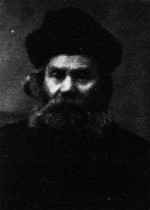
He was not an official rabbi, but he sat every day in the neighborhood synagogue and studied Torah with great diligence. The residents and the Kozanhorodok Hasidim supported him. He was handsome, had a majestic face, upright stature, a long black beard, and his tasteful clothing and grace gave him nobility. A special charm was spread over his refined face. When he walked in the street, Christians would look at him and say Krasivy rabin [Polish = a handsome rabbi]. Not only physically handsome was R' Ahrele, but also possessor of a beautiful soul, a deeply modest person, self-effacing and unassuming, living in poverty and hardship, for such is the way of Torah.
In the neighborhood synagogue, he was the central spiritual figure. He did not give speeches or sermons, but spread Torah in public and bestowed his spirit upon the worshippers and the neighborhood residents.
He perished together with all the people of our town.
by Y. Z. [Yosef Ze'evi]
Translated by M. David Isaak
Rabbi Avraham Tzvi Kutnik was known in Kozanhorodok and Luninyets as “Avraham Hershel the Melamed [Cheder teacher]” because he was engaged in teaching for decades. He was one of the advanced, spirited and enlightened teachers.
He strove hard to achieve his programs. Rabbi Avraham Tzvi took an interest in the theory of education and instruction. He was the first to bring into his room the study books that appeared in those days, from which they learned Hebrew and also Russian. He subscribed to Hachaim VeHateva [Life and Nature] for the children, taught Tanach [Hebrew Bible], grammar, proper writing, and arithmetic. He also tried to organize the teachers in Kozhanhorodok in order to improve their situation, to introduce order in accepting students, and to raise the stature of the Melamed which was at a low level. Thus, for example, he wanted to establish that the homeowners would hand over their children to a Melamed Association and not to the specific teacher they desired, and the teachers would divide the children into appropriate classes, and every teacher would have only one class in his room and not three or four, as was customary. However, the teachers did not agree to such a reform. Not one of them agreed to teach in the lower classes, because in their opinion there was a humiliation in teaching beginners. Only in one matter did someone succeed for a time. A teacher fell ill, and the students were idle from Torah, the
[Page 87]
other Melamdim accepted his students, and the tuition fee was designated for the sick Melamed. R' Avraham Tzvi was also caught up in the revolutionary movement, even though he was a devout Jew. He felt in his heart that the revolutionary movement was right in its war against the evil regime and against the rich.
When he moved to live in Luninyets, he was freer to carry out his plans. He established a library in Yiddish and in Hebrew. He guided his son Moshe in Zionist activities. His home in Luninyets was a center for active Zionists and Hebrew teachers. Most of all, he continued his public work when he moved to Detroit, in the United States. He was active in the Mizrachi movement there and also in the Working-The-Land-of-Israel movement.
The affairs of the oppressed worker were no less close to his heart than religion and tradition. In America, he became a writer, creating poems in Yiddish and in Hebrew. The writing eased his suffering and his grief over the death of his dear son Moshe, the apple of his eye.
by Y. Ben-Shaul
Translated by M. David Isaak
|
Who did not know R' Motshe the architect? Like most residents of Luninyets, he was born in Kozanhorodok. His father was R' Misha “der Einbinder” [the bookbinder], and hence the family name Perelchik (bookbinder in Russian). A patriarchal figure: his long beard, the yarmulke that peeked out beneath his hat in summer and winter, the unbuttoned coat, the glasses resting on the tip of his nose, the slowness of his walk, and the moderation in his speech gave him a special character.
Great was his contribution to the development of Luninyets. Many fine stone houses, such as the market buildings of Ephraim Yitzhak Rabinraut, the bathhouse, etc., were his handiwork. He designed and drafted the plans himself, the work of a true architect. He raised a young generation of construction professionals, among whom are veteran workers participating in building the country. But not only in the work of “clay and bricks” was he prominent, but he also knew a chapter in worldly affairs and spirituality, knew book-learning, and set aside time for Torah. He knew all the children of Luninyets by name. Of course he remembered the birth date of every circumcised baby. He was soulfully attached to the Land-of-Israel, and when his son Avraham immigrated, he left his two other sons and immigrated to the country as well.
Here too, he continued to take an interest in construction. More than once he approached a group of masons, natives of Luninyets, and watched those doing the work, and occasionally offered well-timed remarks on the subject. He said: the dedication of the pioneers to building the country atones for their heresy. Most of his time he dedicated to Torah. He was attentive to everything happening in the settlement. He felt respect and honor for the younger generation, and more than once expressed progressive ideas.
When the Italians bombed Tel Aviv during World War II, a bomb struck the synagogue where R' Mordechai was sitting, engrossed in a page of Gemara. He was injured and died the death of martyrs. He was brought to burial on the Mount of Olives in Jerusalem.
by Y. Ben-Shaul
Translated by M. David Isaak
|
In the Zamd neighborhood, which was inhabited mostly by Jews, there was no synagogue until 1910. The neighborhood residents prayed in minyanim [prayer quorums]; only a few veteran Stolin Hasidim went as far as the Great Synagogue, at the other end of the town. Two minyanim were held: at R' Yehoshua Kashtan's–where most of the worshippers were Stolin Hasidim, and a second large minyan at the home of R' Meir Kaplansky. Most of the worshippers in the minyan at the home of R' Meir Kaplansky were residents of the Zamd neighborhood, plain Jews, residents of Di Zamd. This large minyan existed for several years.
In his home there was also a grocery store, and besides Jewish customers, he had customers among the Christians as well. Even so, R' Meir dedicated the large room in his house to be a house of prayer. To this day, it is hard to believe that someone in our time would dedicate the large room in his house for a public institution. However, the hall was packed not only on Saturdays, but also on every day of the week for the morning, afternoon, and evening prayers. There were two entrances to it, but many of the worshippers preferred to enter specifically through the shop. Rainy days and winter brought mud and snow into the house. Yet, no complaint was heard, not only from the head of the family, but even from R' Meir's daughters, who had to clean the floor. R' Meir was not native to Kozanhorodok like most residents of Luninyets. His grandmother Etil brought her eldest daughter Bat-Sheva a groom from Lithuania, and managed to bring him under the wings of the Stolin Hasidim, but failed to make him a passionate Stolin Hasid, as was her soul's desire. The Lithuanian spirit remained imprinted in R' Meir's soul. Just as he lived, I see him now: tall, with a golden-yellow beard, quiet. He distanced himself from public involvement and criticizing others, and even to lead prayers before the ark he only agreed after many entreaties. He was not a scholar, but he was diligent and set aside regular times for Torah study.
He gained a friend whose knowledge was superior to his, R' Avigdor Katzman, a Lithuanian himself, quiet and very wise–together they sat and studied a page of Gemara in the new synagogue built in the neighborhood. His influence on his sons was great, and when one of his sons would try to play a prank in the study hall, R' Meir would simply glance at him from afar, and the son would immediately drop from the “pranksters.”
He was warm-hearted, and his hand was open to all. I remember, in 1917, we came to him to sell him shekels; at first, we doubted whether to go to him because he was devout and most devout Jews were indifferent to Zionism. And how surprised we were! R' Meir bought two shekels, one for himself and one for his wife. From then on, his contribution to Zionist funds was never lacking. Their house was open to every poor and needy person. Until the synagogue was built, the poor, the itinerant magiddim [preachers], and general guests who were Torah scholars who prayed in the minyan came to his house, where they found food and lodging. R' Meir was engaged in the timber trade and apparently did not succeed at it. The store was managed mainly by his wife, Bat-Sheva, a woman of fine appearance, who knew how to direct the affairs of her house with modesty and quietness.
by Achi-David
Translated by M. David Isaak
|
Among the first and last residents of Luninets. In the year 1898, he left his hometown of Kozanhorodok and settled with his entire household in Luninyets. Tall in stature and robust, with a long beard. All the years of his life, until old age, he lived by the toil and labor of his hands. He raised seven sons and three daughters, and in his old age, only one son and a daughter remained with him, supported at his table. Most of them scattered to the four corners of the earth. Among the Hasidim of Horodok and gabbaim [managers] of the local Chevra Kadisha [burial society]. In the years before the First World War – an active member of the Artisans' Association. A simple Jew, observing commandments both minor and major. In winter, when the cold raged fiercely, he would rise at dawn and, before going to the study hall for morning prayers, managed to complete the entire book of Tehillim [Psalms] as well as chapters of Ma'amadot, which he knew by heart.
I remember, on one Sabbath night, the lamp ran out of oil; he sat in the dark and recited Psalms. He cherished Torah scholars and rabbis. Great was his joy when rabbis from Horodok consented to stay at his home. In his old age, he devoted himself with all his strength and soul to collecting donations for yeshivas in general, and for the Beit Yisrael yeshiva in Luninyets in particular. He received an honor and gratitude certificate for his dedicated work from Rabbi R' Chaim Ozer Grodzinski of Vilna. He died in the ghetto of Luninyets.
by Y. Z. (Yosef Ze'evi)
Translated by M. David Isaak
In the days of Nicholas II, the Jews suffered various and unusual decrees. It was accepted in Russia: “Rights for everyone, except for Jews”. But the Holy One, Blessed be He, did not abandon His people and prepared the cure before the blow–bribery. Jewish money was acceptable even to the most meticulous haters of Israel. In the big cities, there were prominent shtadlanim [intermediaries], and among them were men of fame. But in the field towns, the shtadlanim were ordinary people, who were close to the authorities and mediated by giving bribes and getting decrees canceled.
The elder of the group was R' Itche Shulman, from Sadowa Street, a tailor of men's clothing. The tailoring workshop was managed by his son Avremke Schulman, while the old man only received the work and handed it over, but most of his time was dedicated to shtadlanut [intercession]. And the wonder was; this old Jew, short in stature, with a long and yellowish beard, who didn't even know how to sign his name in Russian, was involved with officials of the authorities, mainly with the Nadzorateli, the police commander. And if a Jew committed an offense in matters regarding a shop or illegal purchase, or if someone was arrested for draft evasion from military service, everyone knew that first they had to go to R' Itche, who would advise what to do. R' Itche already knew how much money “hush money” had to be slipped into the pockets of the small and big officials. Sometimes, if the matter was severe, it lasted for weeks until they reached a “mutual understanding” and the accused, after settling the formal procedures for appearance's sake, was acquitted and released. The bribe was not always given in actual cash, but in a suit and coat, as a “gift”. And many were the Jews who held R' Itche in high regard, for embodying the commandment of “redeeming captives.”
In his old age, his two sons died, and he had to care for their children–his grandchildren. While still alive, he bought himself a plot next to his wife's grave. He died in old age and “full of days.”
[Page 90]
by Y. Z. (Yosef Ze'evi)
Translated by M. David Isaak
|
R' Ever came to Luninyets from the nearby village Vulka. A villager, tall and robust, yet in his character and manners he was the aristocrat of our town. Nicely dressed, with a properly groomed beard–the figure of a leader among his people. His home was beautiful, spacious, and furnished, with a modern, built-in sukkah [tabernacle], a main entrance, and steps. The yard and barn were all fixed and organized like that of a landowner.
R' Ever was an expert in trees and forests–a timber expert. Forest merchants and landlords consulted him as an expert–what quota of trees could be logged in a forest, what was their quality, etc. Until the outbreak of the First World War, he worked as a supervisor and inspector for large forest merchants. All week long, and sometimes for consecutive weeks, he spent his time away from home. And only with the outbreak of the war, when the timber trade practices ceased did he become a permanent resident in town and his public activism began.
He was one of the few figures in town who understood the spirit of the younger generation. In his home I once found “Divrei Yemei Olam” [World History] by Kalman Schulman of Vilna and the textbook “Gan Sha'ashu'im” [Garden of Delights] by Rosenfeld, as well as other books, evidence pointing to the spirit of the Haskalah [Jewish Enlightenment]. With the Polish occupation, he extended a helping hand to Zionism and was a Keren Hayesod activist. in his day, he was involved in establishing the Hebrew school through an attempt to purchase the large house of the landowner Szczyt. During the rule of the Poles, he was a representative on behalf of the Jews and a magistrate in the municipality. He passed away before the Holocaust, on Friday, 6th of Shevat, 5701 [February 3, 1941], during the Soviet occupation.
|
|
JewishGen, Inc. makes no representations regarding the accuracy of
the translation. The reader may wish to refer to the original material
for verification.
JewishGen is not responsible for inaccuracies or omissions in the original work and cannot rewrite or edit the text to correct inaccuracies and/or omissions.
Our mission is to produce a translation of the original work and we cannot verify the accuracy of statements or alter facts cited.
 Luninyets, Belarus
 Yizkor Book Project
 JewishGen Home Page
Copyright © 1999-2026 by JewishGen, Inc.
Updated 29 Oct 2026 by JH