 |
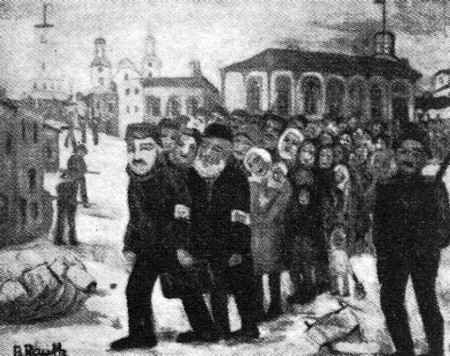
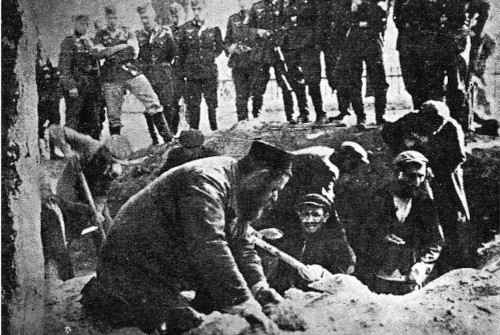
Jews dig a mass grave in Chełmno
|
[Page 277]
By Golde Danilevitch-Kalisky
Translated by Janie Respitz
Two family members were already missing from our house: my younger brother Moishe – Hersh who fell in battle behind Lentshitz and my older brother Yisroel who was sent with a transport to Poznan. From the closest relatives, Avrom Danilevitch, my father.
When they hung a new list of people who had to go the labour camp, among others, the name of my older sister Baltche appeared. I decided to replace her because her leaving the house would have been a huge blow for the family, she was the bread winner.
On the decided day and the prescribed hour all the girls called for turned up. We received a day off to prepare for the trip. The next day, the Gestapo led us to the House of Study. That's where the transports left from.
Standing leaning against the window, my elderly grandmother approached the building carrying a pot of food. My mother also came with a message, that my elder sister will come replace me “so we could spend the last night together”. The guard at the door was Moishe Shapshovitch, and he allowed me to go home.
My parents watched over me in my bed all night. Lying there with closed eyes I heard my father recite psalms and my mother whisper prayers. I urged them to calm down.
In the morning I parted with my dear ones. Their heartfelt cries accompanied me into the street. As we approached the House of Study my sister said to me: “Look what's happening here, we must run away!”
We went up to the boulevard, crossed the bridge over the water and arrived at Electrowina. We rested there for a bit
[Page 278]
and went home. When we found out what was happening at home, we hid at our neighbour's.
At the gathering place they checked the list and saw we were missing. The police came in a panic to our parents and demanded the victim. As a punishment they took our mother and aunt Mindl and her child. The tortured them ordering them to reveal our hiding place. They said absolutely nothing.
The girl's march began, they led them to the train. When our father returned from prayers, he did not find mother. He went to look for her at the new marketplace and from there to Warsaw Street. There he saw the column of girls. He entered the corridor of Bunker's house in order to hide. The murderers from the work authority captured him and beat him until he bled.
Through a crack I saw my bloodied father and heard him say: “Kill me and leave my children alone!”. I then decided to go out because it was better to go with the transport then live like this.
When my sister heard my decision, she held me back: “I feel they are tearing you away from us forever” …I could not tolerate the torturing of my parents.
Two Nazi's fell upon me on the street and beat me. Nevertheless, I did not leave without parting kisses which covered my bleeding father. They tore me away from him with force. The route to the train was hurried. When I stopped to rest, they beat my body. This was a Tuesday. Peasants were standing on the road with mockery in their eyes, watching how they chased a Jewish girl, and business continued like on any market day. At the train station they counted us and it did not take long before the train began to move.
In the evening we arrived at Polvork Berenbush. The dwelling was a loft, the floor, covered in straw. We were to remain there and work. This was a work camp. Our overseer was a Pole named Tadeusz Kaspruzhak, a former guard in the Vrank prison.
The enslavement began the next day. They sent the girls to the field commanding them to dig out carrots. On a dry day it was difficult for those who never
[Page 279]
in their lives did any agricultural work, and even harder on the rainy days. In the morning we froze from the cold winds; by noon, we were soaked by the rain. In short: the very difficult days had begun.
Contact with our parents and relatives was once a week. The letters which were censored, to ensure, God forbid, we did not tell the truth. Libe Fogel once smuggled the following sentence in a letter: its going very well and this week we had a black Tuesday which everyone will remember”.
The repercussions of this letter were unimaginable: It tossed a fear on those who were still in Koło and they immediately informed the work director. We all felt his revenge. When we arrived to work on Thursday he said: “Today I will make your Thursday black!”. We were chased into the field barefoot, we had to gather stones in baskets and when they broke, we had to put he stones in our clothes. Anyone who did not carry out the order perfectly was beaten. We returned from work miserable, and the cries could be heard in all corners. Khaytche Stal interrupted the tears and said: “Children, don't lose hope! The gallows were prepared for me and I am alive! Children, don't worry, keep your heads up and your feet down!”.
Thanks to her influence the mood changed. A few of the girls, including Genia Lifshitz tried to sing and dance to uplift the rest of the girls.
This is how the days continued, weeks and months, without a ray of hope. A false light glimmered when the daughter of the Polvark inspector came to us and told us that soon we will be going home. Everyone was very happy but this announcement ended with bitter disappointment. It was only a dream. A supplement to this disappointment was when they broke off contact with our parents. We stopped receiving letters. Our hearts felt something terrible occurred and we afraid to speak about it. Our terrible premonition was confirmed. From Mikhal Viltshinsky we received the news: Chelmno is a place no one returns from.
The overseer did not give us a free minute to think.
[Page 280]
There was no time to grieve. The work continued day in and day out. A person became a machine. Everyone tried to be useful because the weak were sent away and we knew what that meant. Among those sent away were Pepa Grinboym and Nastke Rozental. The youngest and strongest stayed until the end of seasonal work.
The second station, more correct, camp, was in Inovuratzlav. Once again there were difficult days and hard work. The only luck was a neighbouring men's camp where there were a few men from Koło: Binyomin Rozental, Moniak Lisak, and Shloyme Rzheshevsky and his son. From time to time they helped us by sending food. The overseer Zshintaro noticed one day that girls were bringing food from the men's camp and for this “sin” they beat the food carriers terribly. They needed medical aid. I received 25 lashes for allowing Khaytche Himl to put a raw potato in my pocket.
From there they sent us to Auschwitz. When we asked “where are we going?' they replied with sadism: “To make fat from you for the soap factory!”.
Late at night we arrived in Birkenau. The bandit Hesler, the director of the Auschwitz camp awaited our transport. There was an immediate selection among the weak. They were removed. Those remaining were tattooed, taken to the bath house and had their heads shaved. We received clothing from killed Russian prisoners. The stifling filthy barrack prepared victims for the burning crematoria.
The first victim was Khaya Grados. Her nerves did not last and she threw herself on the electric wires of the camp fence. This incident shook everyone and embittered our mood even more. The group of girls grew smaller and smaller. Beside me on the bunk lay Zashia Brukshteyn (the daughter of Yishaye Brukshteyn). When she developed a high fever the Kapo did not allow her to remain in the barrack. Zashia breathed her last breath at roll call. She lay there with open eyes.
All girls without selection went to the “Dead Barrack” number 25. We waited to die.
[Page 281]
Noisily, the camp director Tauber entered and counted 25 of those present and told them to go out. Fortuitously, I was included.
This was the only time people left there alive.
From then on bloc 8 was our quarters. We worked in the ammunitions factory “Union” until they evacuated the camp.
And what next? Terror crawls through our skin when we remember the “death march” which began after the evacuation. The tired and weary, lagging behind, received a bullet in the head. The S.S on motorcycles turned the white snow red with spilled Jewish women's blood.
If not for Latka Tchaplitzka who strode beside me, who knows if I would have remained alive. She encouraged me and did not permit me to stop. Her warm words gave me strength to continue the march until Ravensbrik.
Here we were put to work at an airfield. The conditions were no better than before and in addition there were bombings from the artillery forces. One day they sent all the women to the forest. We were sure this was the end. However, a miracle happened. As we were awaiting death, the murderers were interrupted by Soviet army forces who were approaching Berlin. We were actually freed by them.
After liberation we began to weave and new life and, in our hearts, the graves and memories of those killed.
Translated by Janie Respitz
Already in the first days of the German occupation, there was an order which forbid Christians from selling food to the Jewish population. Much attention was given to the peasants from the villages, who would come, twice a week, Tuesday and Friday, to bring butter, eggs, chickens and other products to town.
From that time on it was difficult to earn a living. Even those who had money felt it. When hunger tormented,
[Page 282]
people tried, in various ways and with various means, to buy something from the villagers. They also tried to get milk products for the small children.
One time, Khaytche Stal went to a female peasant and tried to buy something. The woman told her the Germans did not permit them to do business with Jews. Khaytche forgot where she was and shouted:
“The Germans will die and the Jews will live forever!”.
This was immediately brought to the attention of the Gestapo and Khaytche was arrested and sentenced to death. There were efforts made to intervene to lessen her sentence. The requests from influential people helped and they changed the death sentence to sending her to a work camp.
At that time, it was impossible find out how she was living in exile. We also did not receive any letters. She was the first victim from among all the girls. Everyone who knew her believed she would emerge and escape all danger.
In 1942 I met Khaytche in a work camp in Vratslav. She was cheerful and energetic. She had a lot of experience and taught me how to bear the difficulties:
“Golde, head high, feet firm on the ground! We must endure! The German defeat must come!”.
These words were said with such firmness and assuredness, the were engraved in my heart. Other Jewish girls who met her were also influenced by her. Disregarding the fact that the angel of death frolicked nearby, the will to live was great, in spite of the enemy.
One day a group of Jewish girls were sent to hard labour. Among them were: Irke Lisak, Hinde Shvartz, Lata Tchaplitsky, Khaytche Stal and me. The work director was Zintaro. With calculated intentions, which at first, we did not understand, he distanced himself from the workplace and was absent for a long time. The hour approached to go home and he still was not there. The girls did not wait for an order and allowed themselves to go to the peasant houses in the area. Perhaps they would be able to buy some food to quiet their permanent hunger. I went with Lata Tchaplisky.
[Page 283]
Returning to the camp we had a premonition that something bad awaits us. We went to the window of the barrack and heard the work leader shouting at the house supervisor:
“Where are the girls Tchaplitska, Danilevtich and Stal?”
“Most certainly at the Ubikatsia![1] ” she replied.
Lata Tchaplisk was the first to enter the barrack. In response to the question posed she replied as the house supervisor did. I went in next and brought the prepared reply. Then the work director flew into a rage:
“I searched for you everywhere and could not find you!”
“It's possible you did not see us because you are short-sighted”. I blurted out this stinging observation. (He was really myopic). He beat so mercilessly for these words that I fainted.
Then Khaytche Stal entered. Not even asking why she was late, he attacked her so brutally and for so long, that her eyes fell out of their sockets. We were as if frozen and could not even help her. This beastly anger was so terrible, we could not even breathe. It is impossible to describe in words the wildness of this work director.
She lay there like a cripple, without the bright shine in her eyes. The next day she was brought to me blind, with black holes in her face. When I spoke to her, she fortified herself and said: “you will survive, I believe this. Golde, you will talk about everything you did. The murderers will not silence you; they will never be forgiven!”
I am carrying out her last will with my head bent in anguish.
Translator's footnote:
by Michael Podchelbnik
Translated by Mira Eckhaus
In late December 1941, the city of Koło was attacked by German units.
The Jews were rushed from their homes to the Judenrat building, which was next to the synagogue. Cars arrived and Jews emerged from the building, they and their families, with bundles in their hands. At the exit there was a table, and an SS officer sat next to it, holding a list of all the Jews living in Koło, and anyone whose name was called was ordered to enter the cars. About forty people were put into each car. The bundles were loaded onto a trailer. The guards and the members of the Judenrat said that the passengers would be taken to work on the railroad. The two freight cars that transported the Jews were driven by Germans. During the day, about a thousand people were taken out. Among the escorts was the Volksdeutsche Siuda from Kościelz, who was serving in the military police at the time. He told the Jews: “Don't be afraid, we are taking you to the Barlogi station and from there you will go east”. The Jews, the city's residents, knew him and believed his words. Each car passed by 10-12 times during the day, and this added validity to our hypothesis, that indeed the Jews were being led not far from Koło.
I was not among those being transported because at that time I was registered in Bugay, near Koło, and I was not on included the list of Koło Jews at all. I brought my father, mother, my sister with her five children, my brother and his wife with their three children to the car. I helped them pack their belongings and load them onto the trailer. I would have gladly travel with my parents and family, but I was not allowed to do so. I witnessed the efforts of one Jew, named Goldberg, a sawmill owner in Koło, who, after his son was sent away, pleaded with the German authorities to appoint him as the camp director for the Jews of Koło. They promised him the position.
One day, a young man happened to come to the Judenrat and said that the Jews were not being taken to Barlogi but to Chełmno – and he had seen it with his own eyes. The Germans replied that they only sorted the Jews there, and the stronger ones were sent to work in the West. This calmed the situation down. The sick people were taken out on the last day. The drivers were given instructions to drive slowly and carefully. The Aktsia, in Koło lasted four or five days.
At the beginning of January 1942, I don't remember the exact date, but it was the sixth day of the week, I worked for the Jewish Committee in Bugay dismantling a cowshed. I was taken to the police station with fourteen other Jews and arrested on charges of the escape of my cousin Mordechai Podchelbnik. Gendarme Scheflit, a Volksdeutsche from Babiak, who had a former
[Page 285]
dispute with a Jew named Dankowski, also from Babiak, said at the time of his arrest: “This one won't live much longer”. Dankowski was among those arrested.
On Saturday at four in the afternoon, a truck arrived with fifteen Jews from Izbica. At the same time, a passenger car arrived with an S.S. officer, who I recognized from the time of the Aktsia in Koło (he was the one who deleted from the list the names of those who were being taken into the cars). They put us on a truck and, together with the Jews of Izbica, we were taken to Chełmno.
I would like to point out that all the Jews in the car were strong, capable to perform the hardest work. We arrived at the park area near the palace in Chełmno. The entire area was fenced off with a recently erected wooden fence, about three meters high. The fence was dense and nothing could be seen through it of what was going on inside. The gate opened and the car entered and stopped near the palace. As we entered the courtyard, I lifted the tarpaulin a little and noticed a pile of used clothes. We got out. Between the rows of S.S. men, we were led to the basement, while they were prodding us with rifle butts and shouting. They counted us and locked the basement door behind us. As we passed between the rows, they beat us with clubs, shouting “Faster, faster!”
During the first day, nothing happened. We were locked inside the basement with nothing to do. A bedpan, that was intended for defecation, was taken out by one of us under heavy guard. One thing I could have noticed was that there were heavy guards everywhere.
There were many inscriptions on the walls of the basement. Among them was an inscription in Yiddish: “Anyone who comes here – will never leave alive again”. We no longer deluded ourselves as to what awaited us.
On Monday morning, thirty of us were taken to work in the forest. Ten men, and I Among them, remained in the basement. There was a small fixed window in the basement, but it was completely boarded up. At eight o'clock a car arrived at the palace. I heard the voice of a German addressing those who came. Among other things, he said: “You will travel east, there are many jobs there. All you have to do is change your clothes into the ones we will give you and take a shower”. Applauses were heard. After a short while, we noticed bare feet running in the basement corridor, near the place where we were being imprisoned. The voices of the Germans also reached us: “Hurry, hurry!” I understood that the Jews were being taken through the corridor into the inner courtyard. Suddenly I heard the creak of a car door being closed. There were shouts, banging on the side of the car. Then I heard the car engine was being started, and after six-seven minutes, when the shouts died down, the car left the courtyard.
At that moment, we, the ten Jewish workers, were called upstairs to a large room on the floor of which were men's and women's clothes, coats, and shoes. We were ordered to quickly take them out to another room, which was already overflowing with clothes and shoes. We arranged the shoes in a special pile. When our work was finished, we were taken back to the basement. And again, a car arrived, and everything repeated itself exactly as described above.
[Page 286]
I noticed that more often cars were entering from outside than they were leaving. On this basis, I came to the conclusion that the cars leaving Chełmno had a larger capacity. I should note that in the room where the Jews undressed, there were two well-heated stoves.
In the evening, when the friends returned from their work in the forest, they said that they had buried the Jews of Kłodawa in a large mass grave. The bodies were taken out of large, black-painted cars, inside which the Jews had been killed, as it turned out, with poison gas. The bodies were all wrapped in underwear, and towels and pieces of soap were rolled up inside the car. This strengthened my hypothesis that after they undressed, the Jews were given towels and soap and brought to the basement to “wash” themselves, so to speak. Three or four of the group of workers in the forest did not return that day: they were not satisfactory enough and were shot dead on the spot.
The next day I was also among those going out into the forest. When I came out, I noticed large cars parking at the edge of the courtyard with their rear side towards the palace. Their doors were open and boards were laid out to make it easier to enter them. I noticed that there was a wooden grate on the floor, like those found in baths. We, thirty workers, were put into two cars, one for freight and the other for passengers, and were driven to the forest behind Chełmno. We had about thirty S.S. men to guard us. There was a dug trench in the forest, the large mass grave for the murdered Jews. We were ordered to dig the trench and extend it, and for this purpose we were given picks and shovels.
At about eight in the morning the first car arrived from Chełmno. When its doors opened, dark smoke erupted. At that time, we were forbidden to approach the car, not even to look at the opening doors. But I noticed that as soon as the doors opened, the Germans quickly left the car. It is difficult for me to determine the nature of the gases that burst from inside the car. We were standing at a considerable distance and the smells did not reach our noses. We did not use gas masks. Three or four minutes later, three Jews got into the car and threw the bodies out of it. Inside the car, the dead were lying on top of each other in confusion, filling about half of its space. Some were holding their loved ones in their arms; some were still alive, and the S.S. men shot them in the head or in the back of the head. After all the bodies had been taken out, the car returned towards Chełmno.
Two Jews would hand the bodies to two Ukrainians (I don't remember their names). They spoke Polish and were dressed in civilian clothes. At first there were three Ukrainians, but the third one accidentally got into the car and was poisoned with gas. They tried to save him, used artificial respiration, but they were unsuccessful. I witnessed that incident.
The Ukrainians pulled out the gold teeth from the mouths of the dead, removed bags of money from their necks, removed rings and watches, etc. They examined the bodies carefully, perhaps gold had been hidden in some organ. During the examination, rubber gloves were not used. The jewelry and other valuable objects
[Page 287]
Were put in the suitcase. The S.S. men carefully supervised the work of the Ukrainians.
After the search, they placed the bodies in the trench, layer upon layer. The head of one corpse at the feet of another corpse. The corpses were laid side by side with their faces to the ground. The underwear was not removed from the dead. The trench was six meters deep and about six-seven meters wide. In the bottom layer were five-six corpses, in the top up to thirty corpses. Sand was poured over the layers to a height of one meter. I noticed several times, the day after the burial, that the sand did not cover the corpses. The area was apparently not guarded at night. When I worked at this place, the length of the trench was about twenty meters. During the day, about a thousand people were buried in it.
The car in which the people were poisoned had room for eighty-ninety people. During my stay in Chełmno, two cars were used. A third one was parked in the courtyard without a wheel. Twelve to thirteen shipments were taken to the forest area every day. The number of those who were poisoned by gas reached a thousand.
One day, it was the third day, a third shipment was brought to the forest area. Among the corpses that were taken out of the car, I saw my wife and two children, a seven-year-old boy and a five-year-old girl. I lay next to my wife's corpse and asked to be shot. One of the S.S. men came up to me and said: “This guy can still work well”. He hit me three times with his club and forced me to continue working.
At noon we were given food. We were ordered to get out of the trench without the shovels and line up in a circle. The S.S. men were also already arranged in a second circle. We were given black coffee and the food that the Jews had brought with them in their bundles. That evening, after work, Kszywaczki, a man from Kłodawa, and another Jew whose last name I do not remember, hanged themselves in the basement. I wanted to do the same, but I was persuaded not to do so.
I worked in Chełmno for ten days. Every day – and the same order of extermination of Jews.
During those days, the Jews of Bugay perished, and then the Jews of Izbica. On the sixth day, Gypsies were brought from Łódź. On Saturday, the first transport from the Łódź ghetto arrived. At the same time that the Jews from Łódź arrived, a selection was made in our group of workers. Twenty of us who were found weak were killed; their places were taken by Jews from Łódź. At night, we talked with our new friends, who were imprisoned in the basement next door. They asked if the camp was good and if we are given a decent ration of bread. I told them how things were here, and they replied: “We, of our own free will, signed up to work in Koło”. At first, I would persuade my friends to escape, but they were so depressed that they were unable to decide and act.
While we were driving to work, I noticed that one window of the car could be opened. I told my friend Wiener from Izbica about it and suggested a plan for escape. We decided to do it the next day: while driving to work, we would jump out the window and escape into the forest. The next day, when we got into the cars, they separated us – I was put in a truck, and he, Wiener, in a bus. I decided to escape alone. When the car was already
[Page 288]
in the forest, I asked the guard accompanying us for a cigarette. When I received the cigarette, I flinched, and the friends surrounded the guard one by one, also asking for cigarettes. In a sudden, quick movement, I cut with a knife I had with me, the tarpaulin on the right side of the driver and jumped out of the car. They shot at me several times and missed. Fortunately, there was no bus behind us, so they only fired from the truck.
The absence of the bus gave me the idea that Wiener had run away and that was why the bus had stopped on its way. As I ran in the forest, a civilian on a bicycle tried to stop me by shooting with a gun. I escaped. I sneaked into a barn and hid in the hay. In the morning I heard the sound of people near the barn, standing and talking that the Germans were looking for Jews who had escaped. After two days that I didn't eat anything, I sneaked out of the barn and set off towards Grabów. On the way, I stopped at the house of a farmer (I don't know his name) and he gave me a peasant's hat, shaved me and showed me the way.
In Grabów I found Wiener from Izbica.
From Grabów I went to Washow, my ties with Chełmno were severed. Wiener was lost, apparently, in the Zamość area, in 1944.
|
Testimony taken from Michael Podchelbnik of Koło, aged 38, on June 9,
1945. He gave his statements to the investigating judge of the
Łódź District Court, Władysław Będz. The protocol
was published by the judge in his book “The extermination camp in
Chełmno on the Ner River”. The book appeared in Polish at the Warsaw
State Institute Publishing House, in 1946.
|
|
|
|
Jews dig a mass grave in Chełmno |
by Andrzej Miszczak
Translated by Mira Eckhaus
Testimony taken from Andrzej Miszczak of Chełmno, 49 years old, farmer, Polish, Catholic, on June 14, 1945 in Chełmno, by the investigating judge of the Łódź District Court, Władysław Będz.
I am a permanent resident of the village of Chełmno, Koło district. My house stands opposite the palace garden (on the side of the Ner River). When the palace existed – you could see the palace windows through the windows of my house. I have 5.5 hectares of land and I run a garden farm.
In mid-November 1941, a group of Gestapo men, led by Lange, came to Chełmno. At the same time, the “Lenadrat” from Koło (I don't know his name) came. They thoroughly inspected the entire palace and even its basements. At the end of the month, they began transporting building materials and began setting up a camp.
The palace grounds were surrounded by a tight wooden fence about two and a half meters high. Only on the river side was a small area fenced with wires. The palace stood on a mountain, so that erecting a wooden fence on the river side, that is, at the foot of the mountain, would not have been able to hide what was happening in the palace courtyard.
In addition to the palace, the “Sonderkommando” S.S. Kulmhof (this was the name of the company that came to establish the camp) seized the priest's house, the committee house, the hostel, and the homes of farmers in the village of Chełmno. The farmers, whose homes were confiscated, were transferred to other villages, or were attached to other farms. At first, we did not know what the camp was for.
On December 9, 1941, the first seven hundred Jews from Koło arrived by cars. They were brought in the evening, and they were held in the palace all night. In the morning, they were taken in “dark cars” (which we later called “inferno cars”) in the direction of the forest near Chełmno. The cars would return about an hour later, taking with them additional shipments of Jews from the palace. We noticed that piles of clothing had accumulated in the courtyard. In the evening, a new shipment arrived from Koło, which remained overnight in the palace, and in the morning was also transferred to the forest near Chełmno. This repeated itself for several days.
Then there was a change. The Jews were brought to the palace in a freight car, put inside, and then taken out and transported in an “inferno cars”. Rumors spread that these cars were used for poisoning by gas. Despite the lack of any contact between the gendarmes and the local population, news reached people about what was happening in the palace.
Our sources of information were Jewish workers who worked in auxiliary work, Poles (eight in number), who were brought from Poznań, from the “7th Fort”, who also worked in auxiliary work, and local women and girls who worked in the food warehouse (cantina) and in the kitchen. Then came a change
[Page 290]
in the relationship between the gendarmes and the population, and more than once it was possible to learn a lot from them about what was happening in the extermination camp area.
In the “death camp” in Chełmno, operated three “inferno cars”, one large and two smaller ones. I cannot describe their dimensions and construction, because I have no knowledge in cars, and they did not even allow us to approach these cars. Later, I heard more than once from the gendarmes that one hundred and fifty people could be put into the large car, and about eighty to hundred people into the small car. At first, they would bring a thousand people to Chełmno every day. The common saying among the gendarmes was: “One day, one thousand”.
The baggage was taken from the Jews, partly while still in the camp and partly in Chełmno. The Jews would take off their clothes in the palace, and would get into the car only wearing underwear, because they would deceive them and tell them that they were going to take a bath. After the “inferno car” drive, they would throw the clothes out the window into the courtyard, and then a company of Jewish workers had to move them to the general pile of clothes, which was in the garden. This pile was three to four meters high and at least ten to fifteen meters long. The gendarmes would rush the Jews, who were working on arranging the clothes, and beat them brutally. Only after the area was cleaned would a new group of Jews be brought into the palace. I saw the Jews, who were working on removing the clothes, many times.
The gendarmes themselves talked about deceiving the Jews, telling them that they were going to bathe. They thought that this was a good invention, because it saved them the trouble of dealing with the victims.
The clothes were transported to Łódź. The drivers were Poles. They were not allowed to enter the palace grounds. They were ordered to wait on the road. German drivers would bring the cars into the courtyard, where they would unload them. Then they would return the cars to the road and hand them over to the Polish drivers. I spoke with the drivers many times and learned that they were Poles from private businesses. The S.S. men distributed many items among the local Germans.
In the spring, a committee from Berlin came to the camp, including a fat citizen, whom the Jews said was the head of the Łódź ghetto. The committee demanded from Sonderkommando Kulmhof to accept larger shipments of Jews. These shipments amounted to one thousand to two thousand people. These shipments were always brought in cars.
When it got hot, the bodies in the mass grave began to rot. “The ground moved”. The air was poisoned by fumes over a wide area. Cases of typhus increased. The Germans stopped receiving shipments. Two furnaces were quickly built (the chimneys could be seen), and they began burning the bodies. They dug the mass graves and ordered the Jews (from the special enlarged company – the “Forest Company”) to burn the bodies in the furnaces. As I heard, they would fire the furnaces with wood. After the bodies were burned (the break lasted
[Page 291]
about two months), they began to receive shipments of Jews again. I note that I knew about the cremation of bodies not only from the words of the Jews who worked there, but also from the fact that the furnaces emitted smoke and no shipments were brought.
The Jews began to be brought by rail to Powiercie in the summer of 1942. There they were taken off and taken on foot to the mill in Zawadki. They would spend the night at the mill, and in the morning, they would be taken by cars to the palace. From then on, the order of operations did not change. I cannot determine the number of transports that arrived by rail; however, according to my calculations, each transport contained about a thousand people. In addition to the regular transports by rail, there were also transports by cars.
This situation continued until April 1943. Then they began to liquidate the camp and cover up its traces. They dismantled the fence, removed the objects, etc. On April 7, 1943, they blew up the palace, sowed grass on the graves (they asked me to lend them tools for sowing grass, and the Wachtmeister Lenz borrowed a rake from me). They dismantled the furnaces, and the bricks were moved to another location. On April 11, 1943, the Sonderkommando S.S. Kulmhof left. A small company of gendarmes remained there, guarding the “killing site”. These gendarmes were from the local patrols. The commander was a gendarme from Sompolno. When Sonderkommando S.S. Kulmhof left, he took with him the Poles, who played auxiliary roles. They were: (7 names were mentioned here). There was another eighth Pole, called “Marian”, who was mistakenly put into the car and poisoned with gas. This was in early January 1942. He was buried separately in the palace garden. These Poles first dug the common grave in the forest, then they were sent to other jobs, such as repairing the cars, carrying things, unloading the cargo from the cars. I did not hear that they would examine the bodies. I did not hear of any Ukrainians.
In addition to the S.S. men, gendarmes and criminal police (for criminals) worked in the Sonderkommando Kulmhof. In total, 120-150 Germans were operating in Chełmno at the time; later their number increased to approximately 180. At first, Lange (I do not know his rank or name) served as the commander. Later, Oberleutnant Lange, transport commander Bahm.
In the spring, there was a change in the camp command. Hans Buttmann was appointed as the commander of the camp, replacing Plata. I remember the names of the following Germans who worked in the “death camp”: 1. Hefele, a Wachtmeister (I don't remember his name) ran the household department; 2. Lenz (who was called “Doctor” – he was the cruelest of all the Germans in Chełmno; this sadist had to kill at least one Jew with his own hands every day); 3. Birstinga (here comes the details) – looked after the valuables and jewelry.
The members of the Sonderkommando S.S. Kulmhof initially treated the local population badly: they would force them to go to work with the threat of sticks, etc. However, relations later improved and became completely normal. The S.S. started to use
[Page 292]
the telephone in the village committee. The secretary of the village committee, Kashinsky, probably knew too much due to this, because he was arrested and executed. Kashinsky sent a letter to a diplomatic representative in which he described what was happening on the place. The letter was apparently intercepted. Apart from Kashinsky and his wife, no one from the local population was exterminated.
I have not heard that the S.S. Sonderkommando Kulmhof had Polish mistresses from the surrounding population; their mistresses were German women from Koło or from nearby villages.
First, Jews from nearby towns were brought to the extermination camp, and then from the Łódź ghetto. Jews from all over the world were also brought here: from Hungary, Yugoslavia, Czechoslovakia, France, and Greece. After such a shipment arrived, the gendarmes would have cigarettes from the country from which the shipment came. In most cases, the Germans would pay for food with cigarettes, so we could know where the shipments came from. By the way, the gendarmes would not hide these facts. I remember they would say that a shipment of “rich Jews from Vienna” and “rich Jews from Hamburg” had arrived. The people in these shipments had a larger baggage and they were better dressed. The Jews who were being led to their deaths would sometimes throw notes. I once picked up such a note. The first words in it were: “We are Jews from Lviv”. The Jews would tear up banknotes and securities and throw them on the road. They did not know the truth about their fate until the last moment; therefore, there were no uprisings.
There were also shipments of Poles. We knew that shipments of Poles were about to arrive, since the guards were increased these days. Such cases were frequent. Apparently, once they brought a group of nuns, another time 12 Polish officers, a large group of Polish children and more. I myself did not see these shipments – women who saw them (Helena Krol, Viktoria Kuznetska) told me about them. After the explosion of the palace, crosses, medallions, etc. were found among the ruins. The Germans would demonstratively place a cross on the palace's balcony.
Apart from the large shipments, individual people were also brought to the palace in buses. These people were attached to their shipments. The Poles were brought back in 1942. I remember that the driver “Toni” once said (in January 1942): “A Polish car is ready”. Apparently, some larger operation was carried out with respect to the Poles. I also saw gypsies, who were brought in cars from the direction of Koło.
In the middle of 1942 (I think so), a committee came from Berlin, which included three or four Gestapo men. They received them with great respect and showed them the whole area. The Pole Szczypczynski told me that when he was putting gasoline in the car of these Gestapo men, one of them laughed at him. The next day it was learned that they were not Gestapo men,
[Page 293]
but “foreign espionage”. The gendarmes said: “…we thought these were ours, but they were not our people”.
The Germans kept an accurate list of the people murdered in Chełmno. The Jewish communities were required to pay four German marks for the transfer of each Jew to Chełmno. Each driver had a list of Jews he was transporting. In the winter of 1942, the Schalek apartment burned down. After the fire was extinguished, M. Ludwitki and I were ordered to guard the burned place, so that the fire would not flare up again. Then I found a file (Ludwitki did not see it) of the driver, who was called Tony, and whom we called “Koltoniaz” (stupid). The file contained various lists concerning the transfer of Jews. I do not know the German language; therefore, I did not understand what was written in the lists. I burned the file for fear that the Germans would find it with me.
In March 1944, Sonderkommando S.S. Kulmhof came to Chełmno again. These were the same Germans who had been here for almost the entire year of 1942, from the spring until the camp was liquidated. Many of them did not return. The commander, as before, was Buttmann. Hefele said that “He was somewhere in Greece”. A high wooden fence was again erected around the entire area of the garden. Barracks were brought in. Two barracks were erected in Chełmno (where the clothes were kept), and two in the Chełmno forest. This time the Jews were brought straight to Chełmno. They were locked up overnight in the church, and in the morning, they were taken by car to the Chełmno forest. There they were put in one of the barracks. On it hung a sign with the titles “Doctor” and “Bar”. There the Jews would take off their clothes. Then they would put them in a “inferno car” and tell them that they would be taken to a third barrack. Here they would lock the doors, and the engine would start. The car would drive towards the furnaces. There they would throw the bodies and the car would return to bring another shipment.
Forty Jews were permanently employed in the forest; they were called “Waldkommando” (Forest Company). From them we learned what methods the Germans had been using lately. They would send Jews to me to bring vegetables, so I had constant contact with them. The Jews lived in a barn, where there were also tailors' and shoemakers' workshops. The Jewish tailors were kept shackled on the second floor of the barn. Lately there were forty-seven Jews in Chełmno, before that there were about eighty-ninety Jews. At that time, they would borrow a small mill to grind the bones from Powiercie, as well as a locomotive from Powiercie.
A few months later (around July 1944), they began the liquidation of the camp. As the Jews said, 15,000 people were destroyed this time in Chełmno. It is difficult for me to say whether this number is true. Now the transports would come mainly from abroad, across the Czech border, possibly through the Łódź ghetto. This time the Jews would be treated decently, so as not to cause any resistance. The clothes that were in better condition would be transferred to Łódź, and the worn-out ones would be torn up with a special machine brought for that purpose, and the torn pieces would be sent to Łódź. The furnaces were destroyed and the bricks thrown into the forest. The mill was returned
[Page 294]
to Powiercie. At first (in 1942/3) they used hand-held mortars to crush the bones.
The Poles, who had previously worked in the camp, did not return this time. The gendarmes said that three of them (here their names were mentioned) were not alive and three (here the names were also mentioned) had been sent to Auschwitz.
As the Soviet armies approached, they proceeded to eliminate the last Jews. They were taken out in groups of five. They were ordered to lie on the ground and shot in the head. This time the Jews rebelled. One of them, Meichslav or Max Zhurevsky, who was armed with a knife, broke through the line of gendarmes and fled. The gendarmes were unable to find him. The Jewish tailors broke down the door that led downstairs. When two Germans (including Lenz) entered there, the Jews killed them. The Germans aimed machine guns at the barn door and began shooting inside. At the same time, they set the barn on fire.
This is how the last Jews in Chełmno were destroyed. In addition to Zhurevsky, the Jew Shimon Srebrenik was saved, whom the Germans shot in the head and thought was dead. The wound was not fatal, and Srebrenik was saved. I do not know the addresses of Srebrenik and Zhurevsky. I did not see the car which was at Otrowski's factory. Hartner from Powiercie often came to Chełmno, he would take suitcases full of belongings from there. In 1944, Greiser came to Chełmno for supervision. I think he came in 1942 as well. The area of the “death camp” in Chełmno was strictly guarded. The password was changed every day and sent from Poznań.
This ended the protocol, and after reading it, it was signed by the following:
| (-) Andrzej Miszczak | (-) W. Będz, investigating judge |
|
|
|
The deportation from Koło to Izbica Lubleska |
By Yakov Shultz
Translated by Janie Respitz
The town drummer Levandovsky, on Thursday June 10th 1941, carried this order from the German occupiers through all the streets: “All Jewish men between the ages of 12-60 must present themselves for work in Yakov Roykh's courtyard in the Warsaw suburb.”
The next day, when everyone showed up at the prescribed hour, they were surrounded by a gang of S.S men. They pushed the large crowd into the Jewish centre and closed them into the House of Study. It was clear this was not for local work.
The House of Study was overpacked. It was difficult to breathe. The severity of this edict was quickly evident in the attitude toward us: those detained were separated from the outside world. No one from outside was permitted to approach us. When Avrom Volkovitch's grandchild asked the guard for permission to see her uncle Izik, she was viciously beaten by the brutal Nazis.
What will happen to us? During the torturous hours we heard various versions. In this tense situation, a gendarme officer entered and ordered everyone to sing. You can imagine the mood in the crowdedness, and the sense of helplessness. Who wanted to open their mouths to sing? The gendarme forced people with beatings. When the pressure became even stronger, Mikhal-Asher Engel suggested he sing solo. The German agreed. Engel sang the Yiddish folksong “Once in a Lifetime”. He did it with so much emotion, there were tears streaming form everyone's eyes. The German beast forgot himself, or made a gesture, and offered the singer a cigarette…
We lay in the House of Study all night and Saturday morning a business agent came to us from “Human Hands” and took us to Poznan – Eichenwald.
[Page 296]
This was the first camp. This is where they divided the people into groups and everyone was sent to a different job. A group of 25 were sent to build a firing range. That first night only 10 men returned. And the rest? A few died while working, a few were brought on wagons, beat up, bruised, unrecognizable. Among them were: Kenig, Moishe Khaim, Shaye Brukshteyn, Mroz. The second day no one wanted to go to that job. Not because it was difficult and unsuitable, but because of the hateful attitude. If we are to be killed, they explained, it is better to die in the camp. The command was: one group must go! Then, a few men, myself included, physically healthy, announced our readiness.
When we arrived at the range, we were greeted with a hail of beatings and curses. I then suggested to the S.S man: treat us like workers and we will carry out the most difficult assignments. It helped a bit; the beatings were less frequent. We toiled beyond our strength., however the Nazi beasts could not hold back and once again applied their sadistic inclinations, beatings and torture. We suffered like this for 6 months. One day we heard some news: “A list will be made of people who can return to Koło!” This announcement evoked joy in the camp. Who did not want to return home? There were people who gave away everything, or saved valuables and money, in order to get their names on the list. The following went to great lengths for that purpose: Daytch, Lentshisky, Kletshevsky, Izralevitch, Gehrman and others. They younger ones longed for home. They were not capable of enduring this bitter tortured life.
Trucks with S.S men gathered the people according to the list and took them away. We never received any more information about them. We later learned; this was the first transport of Koło Jews to the extermination ovens.
The remaining Koło Jews were taken to Remo- Poznan. There they were kept together and did various jobs. The living conditions were very difficult: the dwelling was unsanitary and the food, scarce. These conditions obviously gave rise to a typhus epidemic and the weak fell like flies.
[Page 297]
Every day wagons would come to remove the dead. There were cases when they took the gravely ill and dying and tossed them in the wagons with the corpses. This is how the Nazis brought live people to their graves.
The sick were locked in a cellar, in horrible unsanitary conditions. To add to the problems, the water pumps and plumbing wheels were broken. Who wanted to go down to the cellar and fix it and risk his health and become infected with typhus? I was among those who fixed the plumbing and got infected with this terrible disease.
More than one thousand people died at this time. I will list a few typhus victims from Koło: Shmuel Grados, Menkhe, Kenig and his two sons. The Nazi bandits exploited the epidemic toward their devilish plans: every day they sent transports from the camps to Remo and Eichenwald. We called them “Idle Transports”. Those sent away were never seen again[a].
I happened to pass by a terrifying scene, loading people into the trucks. They cried spasmodically and begged: “Let us remain here!” The S.S did not show any compassion. I cannot forget the tragic parting between the two brothers Ozer and Bersih Mendlson when they sent them away. They said to me: “What did we enjoy in life?”. My heart was ripped from sorrow. Until today I hear their question in my ears.
Those who remained in the camp continued to work. Some became familiar with the surroundings. Occasionally they were successful, through bartering of various valuable items, in receiving food products from outside. One time, a group of barterers were caught committing this “great” crime, bringing food into the camp. The guards could not forgive themselves for their weak “guarding” and all the camp inmates were called to the place of punishment. Three gallows were set up. Everyone had to watch the execution of six who were sentenced. They were: Izik Volkovitch and Mikhalevitch from Koło; Tapinsky from Izshvitz; Engel from Turek
[Page 298]
and two Jews from Lodz. While the first three were being hanged, the others who were sentenced had to watch and wait their turn. After, the “spectators”, according to the command of the Nazi scoundrels, had to run around the gallows. They called it the “Death Dance”. The disgrace was not left at that: there were beatings and abuses to no end.
We lived a nightmare of gallows and beatings. Once again, the inmates were called together, including some from Koło. A group of men were ordered to step out of line. They gave us new clothes and told us to get ready to leave. What was happening? Where to? We knew nothing.
It is easy to imagine what kind of night we experienced. The question “Is this already my end?” preoccupied my thoughts. There was no strength to react. We remained speechless. We were prepared for the worst.
Very early in the morning a black S.S truck arrived and the chosen group was pushed into the truck. There were four of us. The trip took a long time. We were travelling and did not know where. A prison was the new station. The first welcome was: “Dogs, what crime did you come here for?”. I replied: “To work!” and immediately received a smack.
They took us to a large hall where many dead bodies were lying with signs of sadistic torture. Next to the bodies were large boxes. There was a command: “According to German precision: two heavy bodies or three light ones in one box!”
As we later learned, these were bodies of political prisoners who had been tortured to death. They tried to extract various bits of information through torture, until they died. For many hours we loaded the filled boxes and rode with them to the crematorium, to the specially prepared electric ovens.
Generally, they did not allow us to go to the crematorium, it was underground. One time, when our supervisors were busy with another job, they asked us to carry the boxes down. The workers there were from Poland. They ran seven electric ovens, which worked non-stop. They laid the corpses on metal roasting pans, using every bit of the surface. When a pan was not full, they would chop off a piece of a body with and ax fill it to fill the space.
[Page 299]
We were forced to do this hellish work and we did it for a few months without a break. Every other day we saw new heaps of corpses which we had to take to the crematorium.
A short time later, the group was taken to Lehner Camp. Here our troubles were repeated. There was one difference: the work was done at night. This continued until the end of 1943.
One day (I don't remember the date) they took all the workers from the camp to the train station and put us in train cars. We travelled for two days without eating or drinking. When the train stopped, we saw bright lights, after, wired fences. It extracted the terrifying word: Auschwitz.
As soon as the train wagons were opened, curses were hurled at us, as well as beatings and shootings. It felt like we fell into the world of chaos. The weak, who could not get down on their own, were immediately loaded onto trucks and sent to the gas chambers. Our group was taken to the camp where they stripped us naked and tattooed numbers. We remained all day without clothing under the open sky. My brother-in-law Fishl Cohen was also in this group.
In Auschwitz life was intolerable: filth, tortures and beatings. From early until late, they chased and beat us. People disappeared every day. They took them away and we never saw them again. The fear of being among those who disappeared destroyed our nerves. Everyone tried, with all his strength, to stay on his feet.
It was also very hard to bear the Jewish Kapos, even those from Koło. I remember this scene: the Koło Kapo beat Mroz's son-in-law. The beaten man begged for mercy: “What do you want from me? You can see I'm barely alive!”. The Kapo answered him in a murderous tone: “Die you animal! You can't work so why should you live?”. He beat him so badly they took him away barley alive.
These contemptible people thought the Nazi beasts would like them more. The end was, they too were not spared
[Page 300]
the fate of extermination. They were burned with all the other victims.
The phantom of death always stood before our eyes. There were slim prospects of being saved. A bit of salvation came with the announcement they were sending us to Yavarzhniye to work in the coal mines.
This is how it looked going to work and returning. Every group of twenty men was locked to a chain. The guards, the S.S men chased us and set howling dogs upon us. The work proper in the coal mines is a chapter unto itself. I am not able to recount how much torture and suffering we endured. We got used to everything, including the hard labour in horrible conditions.
We endured this work until January 18th, 1945.
The Red Army marched toward Poland, advancing to the west. The Nazis did not want to leave us in the area which was near the battle field. They took us away from work in groups and took us to less dangerous regions. At that time, the last death struggle played out.
The news concerning a great German defeat on all fronts increased their sadism as they took out their bitterness on the Jews. They beat is mercilessly and tortured us for the smallest transgression.
On the eve of redemption, many of our close ones who had endured the stages of hell and the horrors, died. Zindl Abramovitch (Zatchere) uttered one word and a bullet put him away on the spot. He was laying there dead. The same thing happened to Tankhum Danilevtich, Hirsh Prushnavsky and many others.
With every day that passed the chances to survive increased. We began to feel and see our approaching salvation. Precisely at this time, the storm around us grew stronger. How do we survive this? How do we emerge from this in one piece?
Many people hid and were successful. We were taken to Blechhamer. For two days we collected the dead bodies and buried them in a mass grave. From Blechhamer they took us to Groys- Royzn and from Groys-Royzn we were sent, in wagons, to Buchenwald. From there to Yunkerveg near Magdeburg.
On May 1st, 1945 a group of inmates managed to escape. We hid in a forest. Germans captured us and brought us to the leader of the closest village. He stood there helpless not knowing what to do with us. The situation disoriented him.
He then commanded: “Take them out of the village, let them go!”. We won our freedom but our lives still hung from a thread. The war was still taking its course and every reckless step brought death. The situation was not yet decidedly clear for us, even though the Germans were already kaput.
We hid in a haystack and from fatigue slept all day and night. When we crawled out, we saw the Red Army approaching.
A few days later I arrived in Berlin, and attended the large parade at Alexander -Place. It was led by Marshal Zhukov.
I began to think about travelling to Koło. It was very difficult to get there. The roads were very dangerous. However, I could not stop myself: perhaps I will be lucky and see relatives who survived.
After a long journey, I arrived in my hometown and found the total destruction of Jewish Koło. Jewish homes were taken over by local Poles. All the gangsters were wearing Jewish clothing. I met a few Christian acquaintances and asked them in wonder: “Have any Jews remained? Did the Germans not kill everyone?”
My hometown which I loved was now strange to me. I searched for my loved ones, no one was there! I decided to go to the new Jewish home, the true home, to the State of Israel.
Original footnote:
By Khaim Eliezer Shultz
Translated by Janie Respitz
A. The Brener Brothers
June 19th 1941 was two years after the Nazi hell began in our town and the beginning of inhumane suffering. A small portion of the Jewish population remained in town. During the previous phases of the mass deportations two thousand Jews were deported and now we were awaiting a third deportation.
The remaining, humiliated and tortured Jews, were in the ghetto. The boundaries were: Novogradzko, the new marketplace, Pinte Street, Blandkovo and the street of the bathhouse. Pressed into these arbitrary standards to which we were forced to conform, we lived with the hope: perhaps those remaining will survive the horrible persecution, the war.
The only source of income was illegal trade. The peasants from the region came to buy textiles, shoes, leather and more, and paid with food products. The barter was associated with great risks. We did not only have to protect ourselves from the Germans, but from the Poles as well, making sure they would not carry out denunciations. When we ran out of merchandise and needed more, the source was Lodz. The Polish medical doctor Vitkovsky, for large sums, distributed permits. The content of these little papers read: “the “patient” must go see a doctor” …
You no longer saw Jewish businesses open in town. Remaining merchandise lay buried in cellars, or hidden with friendly Poles who received recompense for their graciousness. Two of them must be remembered for their kindness: Shindler and Pshibilsky. In the majority of cases, the Gentiles exploited Jewish hardships and at certain opportunities appropriated money, merchandise and jewellery. For example: the barber Shimonkievitch took 100,000 zlotys from Aron Ritshke which he deposited. When the owner Ritshke asked him to return a portion of his money he informed the Gestapo, terror etc.…
[Page 303]
There was no public or social activity in town. The rabbi, the local rabbinic authority, Moishe – Dovid Zilber -Margolis fled to Warsaw. His son-in-law, Moishe – Nokhem, was not an authoritative person. The German authority could not count on him and he could not manage to obtain any privileges. He was sent to forced labour along with all the other Jews. He was seen in the old marketplace sweeping the cobblestones. When the German beasts dragged him from his home, he was standing and praying, wrapped in his talis and tefillin (prayer shawl and phylacteries). This is how he cleaned the streets.
The Jewish community council was the last orphan-candle in town. Until the last deportation the following were active: Pinkhas Brener, Moishe-Leyb Fuks, Engl, Moishe-Mendl Halter, Leyb Brukshteyn, Mikhal-Shmeul Hantvurtzl and Lialek Varmbroyn. They educated the “Judenrat” and were the liaison between the Jews and the occupiers. They could not accomplish great things nevertheless they did manage to do something. More than once, they saved a repatriate, a wandering Jew who returned from a nasty life and bribed a policeman for a service order.
The “price” for a bribed soul was: a new pair of boots or a fur pelt. At times you could bribe with a package of food. The German police would send the food package to his family in Germany.
As already mentioned, the third phase of liquidating the Jews from Koło began on June 19th 1941. There was a big “raid” on the Jews and a few hundred men were captured. Everyone knew, they were preparing a transport for forced labour in Poznan. Among those captured and detained in the House of Study was Avrom Brener.
Young and old, lying on a pile of rags, they waited for a miracle. Perhaps the edict will be repealed. Among them was the brother of the communal activist Avrom Brener. Meanwhile, they were not allowing anyone to approach those captured, not their wives nor their children. A strong guard surrounded the building. The only privilege was, we were allowed to bring them food. They, the Nazi slaves, needed strength to lead the German economy.
Around noon, Pinkhas Brener suddenly entered the House of Study.
[Page 304]
As a member of the Jewish community council, he had access to places forbidden to ordinary Jews. We, the captured, thought he was coming to tell us some good news. To our great disappointment he stretched out his arms helplessly, non of his efforts brought any results. Finally, he said they were allowing him to remove only his brother. Immediately there was opposition and an outcry: “We will not permit this!”.
Pinkhas tried negotiating with a few close friends, appealing to their consciences persuading them to honour his wish. When he saw how everyone was decidedly against him, he went up to the podium, banged his hand on the table and said:
“Abraham our forefather led his only son to the alter. God's justice prevailed and at the last minute he was saved. We will not live to see this; our fateful sentence is signed: in masses and individually we will be killed. There is not a lot of time left to suffer. I, one of those sentenced to death am asking you: let me choose my last wish. My desire is to die with my only brother Avrom (Abraham)”.
The hearts hardened from terror and cruelty suddenly softened. No one uttered a sound. This was the quiet agreement: take your brother and may your final road not be accompanied by the hateful curse on us, those being sent to labour camp or death camp.
The next day Gestapo trucks took us to Poznan. Avrom Brener was not with us.
B. What can Hardship Achieve?
Among those transported to Poznan was the grain merchant Notte Goldberg who lived in Mania Shmerlovska's house. Many of us were envious of him: he was with his son. Not everyone had this good fortune, one could help the other at a difficult moment.
The main work in the labour camp was: regulating the river banks, paving streets and laying train tracks. In short, hard physical labour. The hard work began with the early morning light and ended in the evening darkness. The Hitlerites only thought about
[Page 305]
how to make our work more difficult. We walked ten kilometres in the morning and evening, never receiving a truck.
Food provisions were very poor: one bread for 5 men, a small piece of margarin and rotten carrots. Anyone who had a bit of money bought what he could. Clearly, when buying food, you put your life in danger. One was not allowed to see those enslaved possessing a penny.
Contagious diseases, especially typhus, were a daily occurrence. All the inmates were physically weak and suffered greatly from lack of nourishment. Among those who actually died from lack of strength was Notte Goldberg. He endured diseases, did not lose his dignity and died from hunger.
Notte Goldberg's son decided to “assist” himself for a short time when the tragedy which occurred. He realized, he can obtain a bit of salvation from his father's death, benefit from the “inheritance”. For a piece of bread, the son hid the corpse of his deceased father. He hoped, the house leader would not denounce him to the “Remo” director and take the piece of bread. In the worst case, he would share the piece of bread with him…
For three days he managed to hide the corpse. He covered the deceased with a blanket from the bed where he had slept. Only when the body began to smell of rot did he bury him…
C. Meir Krystal in the Role of a Gentile
Meir Krystal from the suburb Warsaw “lucked out”, he had the face of an Aryan. Before the outbreak of the Second World War, he was a grain merchant and his acquaintanceship with the peasants and their way of life helped him in these difficult times to pass as a Gentile. His face alone was not enough. He obtained “documents” and was not afraid to walk about freely.
During the first deportation in our town, one thousand Jews were sent to Izhvitz. Meir took advantage of his ability to move freely and brought food to those in need. Every week he rode with his peasant wagon to Izhvitz and helped families who had been split up stay in touch.
[Page 306]
After this success he dared bigger things. He reached Warsaw, snuck into the ghetto and looked for our town's folk. He helped the righteous man from Koło, Reb Shloyme Rotfeld and Heziye Frenkl. [a]
Meir Krystal lived in Koło the whole time as a neighbour of the Berthold brothers. He gave them a lot of hush – money and brought them the finest things. They became very rich. It was all worthwhile. His work was like a mission. He saved dozens of Koło families from hunger. They gave him coats and he sold them in the villages for food.
Each day he returned from a trip was a big celebration in town. Besides the direct help, he brought greetings from parents, cousins and children. These greetings, learning that relatives were alive provided great comfort during these bloody days. His main station in the Koło ghetto was at Avrom Vaynboym's. The exhausted and needy would come there at night for help. They sat in the cellar and absorbed every word he brought from the outside world.
Meir was not destined to see the end of Hitler. A few months before the end of the war he died tragically: one of the peasants who he put back on his feet, shot him. His skeleton did not even receive a Jewish burial.
Meir Krystal was lonely his entire life, he did not leave a wife or children. May these lines serve as a memorial.
D. When the Heart Opens…
During the first deportation, the Jews of Koło did not lose their minds. Although they lost almost everything, their possessions were not forsaken: they would not leave everything for the Nazis, nor for the ethnic Germans and certainly not for the Poles. It was a known fact that the majority of the Polish population was pouring oil on the fire.
Those sent away left keys with their neighbours and said: take everything and keep it until we see each and if not,
[Page 307]
the enemies should not profit from it…They could have set everything on fire, leaving burnt ground, leaving the town as it was before the Jews came and built it up, however, they had to think of the survivors.
The situation of those who remained was not any easier, those who were not yet forced to leave town. The German occupiers looked at the Jews with an evil eye, seeing who was adapting to the new conditions, exchanging their money for Deutschmark, and looking for a way to somehow get by in these difficult times.
The order, that one was forbidden to have more than 100 marks in their house was like a knife at the throat. Everyone in fact, had much more since money was the only means of bribery in times of trouble. In the order there was a threat: “anyone who is caught with more than 100 marks will be shot!”.
The Jews of Koło opened their savings and distributed their money among the needy. Many people distributed loans, looking for a way to rid themselves of large sums. Some buried money in cellars and fields outside their homes. However, there were people who were not frightened by this edict, went to those fearful and put out their hands, among the names were relatively wealthy people.
The smoke from the chimneys in many homes told how they “liquidated” their possessions, how banknotes transformed into ash: let the Gentiles not enhance their comfort. Many items were burned and destroyed, things they could not take or give away.
The precautions taken by those sent to Izhbitz were necessary. In the two concentrated places where they were brought before deportation (in the House of Study and the Warsaw suburb) the Gestapo searched them well. The unlucky people who were found with hidden valuable metals and money were beaten.
Poor people had the opportunity for the first time to enjoy “loans”, which were given with an open hand and perhaps also with an open heart.
[Page 308]
E. The “Kaddish” (Memorial Prayer) for Yourself
One hundred Jews from Koło were sent to Auschwitz in August 1943. When we arrived at the death camp, they shoved us into a room and gave the command: “Strip naked!”.
Our clothes, packs, the last things we possessed, were taken from us and thrown in a big heap. No one was allowed to go near it. Barbers shaved our heads, maybe someone was hiding something in his hair. Then everyone received “new things”, a shirt, a pair of pants and a jacket. Tall people received short wide clothes and small people, long clothes. This is how they sadistically made fun of us. They did not give us shoes. Why would people sentenced to death need shoes?
At first, we were placed in quarantine. With me were: Mendl Nasak, Dovid Futer, Leybl Luksnburg, Shmuel Strkovsky, Yodef Shvartz, Shmuel Batshan and others. There were two selections, who will live and who will die. For the selection they did running tests and after every running test the Gestapo doctor wrote something in a notebook. No one knew what pleased him. No one knew if they found favour with him.
A few got their clothes back after the test (we ran naked), and those who remained naked received the sentence: the crematorium. After the second run, Mendl Nasak and Dovid Futer fell. Mendl knew his hours were numbered. He turned to us and said in these words: “brothers, Jews from Koło! Today I am leaving this world. Let us all stand here, where we are, and pray the evening prayers. I will recite the memorial prayer for myself”.
His last wish was fulfilled. We never saw him again.
F. Leybl Luksnburg's Last Journey
February 1944, in Yavorzne – special team, Auschwitz.
Dozens of deportees in the camp could not bear the torturous hell and every day of forced labour was a day of worrying about death: Neither here nor there. Some fell while working and the curses and beatings from the Kapos brought them back to work. There was not the slightest chance that the next day would bring relief. Groups of those still standing voluntarily informed the supervisor that they wanted to be sent to the crematorium, to end their lives sooner than later…
Among the group from Koło were: Leybl Luksnburg, Montchik, Yakov Menkhe, Khaim Shalodovsky, Meir Shtayer, Moishe Levkovitch, Yakov Lask, and Mitlman (the son of the Jewish blacksmith).
Leybl Luksnburg was my neighbour on the bunk. We spoke often of our suffering, and an ear that listens is a form of comfort. Leybl could not forgive himself for not emigrating to Israel. “I sent dozens with the Second Aliyah and I remained here”. His only hope was: that his family would not be erased; his brother and sister were in Israel.
The last day before he died, he said to me:
“My feet are swollen; the beatings have broken me physically and morally. I no longer have the courage to ask my work brothers to do some of my work. They themselves are barely alive. I do not want to be a burden”.
Then again, he began to speak about Israel and said:
“If you have the privilege to…”
They took him from me in the middle of speaking together with other men from our town and he never returned.
Original footnote:
|
JewishGen, Inc. makes no representations regarding the accuracy of
the translation. The reader may wish to refer to the original material
for verification.
JewishGen is not responsible for inaccuracies or omissions in the original work and cannot rewrite or edit the text to correct inaccuracies and/or omissions.
Our mission is to produce a translation of the original work and we cannot verify the accuracy of statements or alter facts cited.
 Koło, Poland
 Yizkor Book Project
 JewishGen Home Page
Copyright © 1999-2026 by JewishGen, Inc.
Updated 14 Apr 2026 by OR