 |
|
|
[Page 247]
|
|
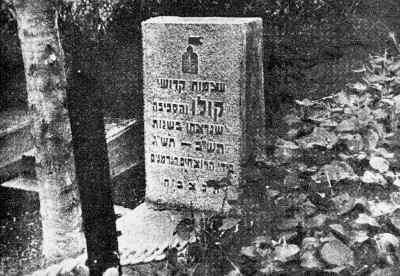
| Memorial stone for those who perished in the cemetery in Haifa |
[Page 248]
By Tola Maskol – Shultz
Translated by Janie Respitz
|
I would like to remember here those painful times Those overflowing with terror, hard labour and sadness; Days of great longing, superhuman suffering, When the hangman lay in wait for our lives.
I see me dear town again, like it was
I talk to my little sister, my love, my little one,
The years of war arrived, and angry winds
They broke my home, robbed my parents
In this false world, where I must now live, |
By Avrom Harap
Translated by Janie Respitz
My own experience, survived, recorded for generations.
At the Communal Grave in Chelmno
…in the summer of 1945, when I returned to Koło after the miserable war and death camps, I found 40 saved Jews. Each one lonely and orphaned, without a home or a future. I received a document from them about Chelmno, written by a Pole named Andjei Mishtshak.[a]
After reading it, I could not find a place for myself. I went to the place which was sanctified through indescribable difficult suffering, searching for the vestiges of fathers, mothers and children. As a last memorial of the murderous means of extermination, there remained a mute gas – car, which originally stood in the courtyard of Ostrovsky's factory.
At that spot there was an oppressed silence, as if a life was cut off in the middle. Half carbonized trees stood not far from where the ovens stood. Trees with black, naked branches, like hardened arms. They are silent witnesses of Hitler's night.
Long rows of communal graves, without names, one row after another. Pieces of bricks like blood stains from the blown-up crematoria. Iron furnaces, similar to the Buchenwald kilns. There too they burned human bodies, there too, fat dripped from under, raw material for “reef” soap…
Heaps of thousands of martyrs, mixed with rags, smoke, tossed out boxes with wires, and a lot, a lot of scrap. I searched and rummaged through garbage, wanting to find something of our own, from those exterminated. A child's shoe turned up, one shoe remained from tens of thousands of slaughtered children and a bit further, bones, a heap of human bones! Perhaps among them are also
[Page 250]
the bones of my dear ones? In front, on the first field, a small communal grave. On it lies a wreath laid there by the remnants of Koło Jews. Near the wreath, a cane, a cane of a murdered old man…
After a long hour of loneliness and sorrow, with my head bowed down, I left the large cemetery. In my hands, as sacred objects, a few bones which I removed from an open pit. I returned to the empty mute town with a huge tear in my heart which will never heal.
This is How it Began
I dedicate these lines to my brothers-in-law, friends and acquaintances who were killed in the Poznan camps.
We heard three whistles and a command with a wild voice: “Get up you dogs! Roll call!”.
This is how that day, June 22nd 1941 began, and the fateful journey from which thousands never returned. This was the morning after our arrival at the Poznan “labour camp” Eychvaldau (Dembnik). Five hundred Jews ran, not dead, not alive; some were barefoot as they did not manage to put on their shoes, a few with their pants in their hands and all with fear in their eyes. The camp leader was already standing in the courtyard in a black S.S. uniform and a stick in his hand. Beside him, the head guard Miller who we soon gave the nickname “Devil”.
Accompanied by beatings with the stick and kicks from the feet of both murderers, we, on command, lined up five in a row. After a few times of counting and registering, there was another command in the familiar wild voice: “Breakfast!”
There was already a racket in the kitchen. Everyone was given a bit of black ersatz coffee. We had to wait for bread. It had to arrive on the cook's wagon. Approximately twenty men were chosen by the Polish civilian cook, to help him bring the bread to the warehouse. While working, the chef looked around on all sides checking for German terrorists and confided a secret: they are shooting strongly from the east and added that the day before war began between Germany and the Soviet Union.
[Page 251]
The information spread quickly among the Jews and everyone commented in his own way. The majority believed that within a couple of weeks the Russians would make dust and ashes out of Hitler. And then, of course, we would all go home. Others expressed their doubt saying: “who knows how long this will last?” For everyone it was clear why they brought us so suddenly and hastily to the camp.
At this time there was not yet a ghetto in Koło. True, the Jews only lived on a few side streets, but they were able to move around freely enough: going to and from work. The work places were situated in various parts of town. This was forced labour. All men aged 14 and older had to “give their hides”. Many women had to work as well. This edict came out during the first day of the occupation like in many other cities.
At 7:30 in the morning the Jews had to be at the new marketplace, at the spot past the theatre, lined up in rows of five and wait. Then the representatives of the S.S garrison arrived from the half military formations such as: N.S. K.K (National Socialist Power Corps), S.A.D.A.L and civilian Germans, hired for military and communal positions. There was also no shortage of Polish bootlickers and collaborators. Each “superman” chose a few Jews, as many as he needed, and left.
In the evening the Jews returned to their homes. At first the forced labour was run by the city gendarmerie, but later the responsibility was placed upon the Jewish community. It was organized in such a way that each one had to report only three times a week. Eventually people had to do something for themselves in order to earn a living. The decreased number in forced labour days naturally were the result of good bribes. Also, in the difficult slave days, were not free of the authority's chicanery. We suffered like all other cities and towns from “vertigo”.
A few words about the very beginning.
The deportations of the Jewish population in Koło, those of the wealthiest social class, were sent to Izhbitzie Lubelsko, at the end of 1939. Then, in the second round,
[Page 252]
500 souls were sent to a village 18 kilometers from Koło.
Jewish businesses were handed over to Baltic Germans. Jews were immediately removed from their large beautiful houses. The attitude toward the Jews got worse and more brutal day by day: Jews were not permitted to walk on the sidewalks. They had to walk on the cobblestones on the streets, where horses pulled wagons. Everyone was also obligated to wear yellow armbands on their left arms. Then, a yellow star of David on their chests and backs. It was also forbidden to set foot in a store belonging to Poles or Germans. One could only buy food in a Jewish community cooperative.
The Jewish community council itself also had a rough time: every 48 hours it had to provide two different Jewish boundaries. At the same time, they arrested all teachers and intellectuals who had remained in town. The teachers who hid were captured and sent who knows where, or shot in the open, in order to spread great fear- psychosis for all the Jews. The majority of the youth left immediately for eastern regions, where the Russians had marched in. Those who remained lived off unskilled labour or worked in German firms as porters and professionals. It continued like this until June 1941.
In that year, from Passover on, motorized German military units advanced through all the country roads and highways in our region. The noise was heard constantly, day and night. They were all heading toward Warsaw. We expected something to happen but no one knew why such a large military force was advancing eastward. Monday, June 16th 1941 all the Jewish men in town were gathered in the courtyard of the work authority. Everyone was put on a work list and returned home. They got away with just a shudder which crawled up their skin. However, the solution to the riddle came two days later: on Wednesday the chief of the D.A.F arrived from Poznan, the Nazi Noyman, who was the head commander of the Jewish labour camps, and with him, trucks and a significant number of defense police. They went to the Jewish community and demanded 300 new workers. A transport of 219 men left for the Shtaynek (Kominka) camp in Poznan.
From that time on the Jews who remained in the city did not know of any rest. On Friday they called people for another registration.
[Page 253]
Those gathered were surrounded by Germans and taken to the House of Study.[b]
What played out that Sabbath in front of House of Study surpasses all the horrors that occurred until then. The abovementioned Noyman and his helpers ran around like wild men, beating and shooting, not respecting any women and children who came to say goodbye or bring their loved ones a package of food. Disregarding the danger of death, mothers and children did not want to retreat. The cries and screams were heard in all the streets as if wrapping the town in shouts of anguish. Noyman and his gang loaded up 250 people and took them away.[c]
A small number of people, a few dozen, for whom there was no room on the trucks, remained in the city. We believed they will not experience any more deportations. However, a few days later they were brought to us in the camp. Together with them, hundreds of Jews from Turek, Uneyuv, Izhbitzie-Koyavsk and Pshedetch near Vlotzlavek. The Poznan camps actually began during Passover 1941 when the Nazis brought the first one thousand Jews from Lodz and Agarkov and locked them up in the “Stadium” Poznan camp. This is where the head command functioned, the centre of all Jewish civilian forced labour from the Poznan region.
The mass deportations which began then at a fast tempo, were, as we later learned, a result of fear which befell the Hitler beasts on the eve of the German-Soviet war. In order to strengthen security, they cleaned out the hinterland of Jews who may have helped the enemy.
Poznan, Eychnvaldau, from June 22nd on. Difficult, exhausting work. The road to work was 18 kilometers. We had to go there and back on foot. The food, watery soup and a piece of bread. There were terrifying beatings from the German and Polish overseers. Non-stop chicanery by the Polish guards, who took us to work.
[Page 254]
The supervision of the camps was run by “The Guard and Lock Society of Poznan”, led by commander Shlivinsly, the brother of the former Polish mayor. The guards, like their leader, were also mainly Poles, former members of the Poznan N.D[d] party.
In camp, filth, lice and various forms of torture, death-beatings. All signs pointed to the fact that we were sentenced to extermination. Also, the dwellings themselves imposed fear. The building where we “lived” was a broken-down house, a former prison camp for the British. Living under such conditions was of course a disaster for the 700 Jews in the camp. The first two victims of the raging dysentery were Jews from Koło: Tzorndorf (blind Yakov's son) and Moishe Yudkovitch.
A few weeks later, three Jews from the camp were sentenced to death. The first execution was carried out by hanging. The “crime” committed by the camp inmate Halter from Khodetch, was leaving the workplace to buy a pack of ersatz honey at the kiosk. The sin of the other two, distancing themselves from the workplace.
On a sunny, lovely Sunday afternoon they called together a few hundred camp Jews and brought them to the courtyard of the main camp “Stadium”. Gallows was already in place. Guests were invited to the “spectacle”, representatives of various German organizations. They appeared in uniforms in a variety of colours: grey, brown, green and black. There was also no shortage of civilians and at the head of it all, the armed Gestapo (S.D.).
The three Jews were brought to the gallows. Noyman the engineer brought the rope and three Jewish camp police had to place the nooses to hang their own brothers. The gathered the camp inmates and, under a hail of beatings, made them around the gallows, facing those being hanged while the guests smiled and watched this sadistic horror show.
[Page 255]
This is how the days continued, like poisonous snakes, days of grief and anger. They left their deep stamp on everyone, suppressing every feeling of freedom or hope. The edicts continued without end. After barely two months, more news: the Gestapo doctor Zibert[e] came to us, to carry out the first selection. With a swindler's promise he deceived the sick and weak standing for roll call asking the question: “Who wants to go home?” And who among the languishing did not want to be “sick” and “weak”? Who did not want, after months of being separated from their loved ones to see them again? It was therefore no surprise, how long the list of candidates was. However, the doctor did not do everyone this favour. He allowed of them to bribe him, taking large sums of money (from what they brought from home and hid). I knew two people, Avrom Zilberberg from Koło and Zhelinsky from Izhvitz who gave him a huge “ransom”. The result of the swindle was, from all the Poznan camps, he took more than a hundred people, young and old, held them for a short time in isolation at the so-called camp hospital where their suffering was indescribable. However, this is just the prologue. It did not last long before the “Solution” arrived: The Gestapo led all the “home candidates” in an unknown direction. Until today we do not know where their skeletons are. Among the unfortunate deceived were two of my close relatives: Hersh Notte Kinstler and Ruven Izraelovitch.
The number of Jews in the camps became smaller and smaller. The frequent executions, the tragic conditions, the suffering, were all aids to the angel of death. Killing a person became a simple event. The sword of Damocles hung over our heads and came down on many of us without any reason. Begging a passerby for a piece of bread was punishable by death. If you asked someone for a few potatoes,
[Page 256]
you received beatings, if you left your place of work, annihilated, and for the smallest offense, hanging.
The Zibert affair continued. Every month he came to get his victims. We knew where he brought the ones he “saved”, however, it was difficult to avoid his traps. Each time he showed up with different lies. The weak, the so-called “placards” were already indifferent.
A while later, they took the people from our camp and brought them to a new place – the former mustard factory “Remo”. The living conditions there were better, but this did not minimize the mortality. The atmosphere remained as it was before.
From time to time we were visited by women from Koło. They came to their husbands. For large sums we elicited a “certificate” from a doctor in Koło to travel to Poznan to “be cured by a specialist”. Mrs. Dunkelman visited her son a few times in the camp. She told us that many women were trying to bring their husbands and children home. For this, the engineer Noyman took a pretty penny. When everything was fixed and ready and Mrs. Dunkelman came to take care of the last formalities, the camp commander announced that the entire effort was futile. A decision had been made that in a short time, all the remaining Jews in Koło will be deported.
This decision had a connection with the visit from Vartegau – Gauleiter in the Koło region. They wrote to me from Koło saying there was a registration of all the Jews, without exception. A commission sat in front of the church and registered the last remaining Jews without rights. They were divided according to the German alphabet: A, B, C and so on. What? Where? When? No one knew who will live and who will die.
How Did Koło Become Cleansed of Jews?
Saturday, December 8, at 8 o'clock in the morning, the Gestapo S.D Eynzatz commando units showed up at Jewish homes and began to chase out the Jews according to the alphabetical list they had. Trucks were waiting.
This time, not like previous raids, was carried out by external terrorists. The local ones, so to speak,
[Page 257]
only supervised the order. The locals, bribed by the members of the community, comforted their “clients” saying that the last few will be brought to Chelmno and from there they will be taken to agricultural work in the occupied eastern regions. For a nice reward, naturally, it was decided the respected communal members would go on the last day, Thursday or Friday. When the community wanted to send one of their own, Moishe Mateh, as a supervisor with the group on the first day, the police held him back claiming it was not necessary. “We will do everything as orderly as possible” they said. The night before the departure the community organized a ball for the local police commandant and the big shot local Germans. The latter took their gifts and promised the Jewish communal leaders would remain in Chelmno and retain their positions. This is how they were blinded until the end…
In February 1942 a horrible typhus epidemic broke out in the camps killing half of the inmates. Noyman's death factories brought victims daily to the crematorium which was installed in a Poznan suburb. The non-Jewish boy Vatzek, on his dung wagon pulled by two white horses, barley managed to deliver all the corpses.
Summer 1942, the Gestapo postponed a sudden visit in the “Remo” camp. A denunciation or a coincidence? After the revision they took the Jewish elder, his representative, two Jewish policemen, the Polish camp director, the cook and two guards. The last three were Poles. They were tortured for a few weeks in a cellar on Riter Street in the fort “7th Paro”. The four Poles were freed and the four Jews were sent to the gallows. The Jewish police were hung publicly at the “Stadium” place. The names of those killed were: Koyfman Mikhalovitch, Ayzik Volkovitch (Kolo), Itzik Engl (Turek), Moishe Yosef Shapinsky (Izhbitz).
As the situation became more catastrophic, we obviously saw we were all rolling toward the abyss. The mortality took giant steps and the large camps became small courtyards. To our great shame, to that end, gave rise to a part of
[Page 258]
the camp Jewish administration who with beatings and chicanery, finished the Nazi's work. (The majority of them were killed in Auschwitz).
The decrease in the number of people in the camps due to liquidation campaigns is the reason behind the merger of two camps into one. The lightning speed in the decrease of the number of people opened the eyes of the Hitler beasts: they were in danger of remaining without working hands…they began to distribute more food. They began controlling the Yotzer Mesharetim[1] around us, and it showed that they stole food, divided the revenue among themselves and let the Jews starve to death.
In March 1943 they gathered together the weakest and mentally deficient and brought them to “Remo” camp. They kept them there for two weeks and then sent them to Lodz. The infamous Jewish leader Rumkowsky did not want to accept them. They only let in individuals who had close relatives in the ghetto. The rest were transported to the great hell, Auschwitz.
Our camp was unravelling. Those who were still strong and able to work were taken to smaller camps. The attitude toward Jewish inmates, naturally, did not change. The situation did not improve. Those who still smoldered a spark of hope decided to escape: what will be will be! The end was, they increased the number of victims. Almost all were captured since on all roads there were enemies of the Jews from the local population. The unsuccessful were brought back to the camp and publicly hanged. There was nowhere to run or be saved. The area around was already cleansed of Jews. There were informers everywhere, Poles and Germans. An exhausted inmate, wearing frayed clothing, with a bowed head, was easy to recognize. Only two young men from Koło, Kutztog and Kutzer managed to escape and hid in Koło until the last deportation. Among those who escaped from the camp were: Hersh Tshan (he was never heard from again); the youngest son of the Daytch family (Gavriel Gatzman's son-in-law) – he later lived in Radom
[Page 259]
as a Christian and worked in a Tishler factory and yet, did not survive;
Avrom Naymiler escaped from Shteynek, arrived in Lodz and hid until the end (today he is in Israel). Among those who failed was one of the Izhbitze brothers, they caught him, brought him back to the camp and he and his brother had to pay for his “sin”. They were hanged together.
In the camp Shveyningen (Svorzhants), in the Poznan region, there was a wild German camp director, a horrible sadist. If someone went to urinate at night behind a tree or near a fence, he would bury them in a pit, up to his neck and keep him there for 10 hours. It was rare for anyone to come out of the pit in decent shape. Starvation and beatings were his lighter punishments. He was also the angel of death of the ritual slaughterer from Turek: one time, after a difficult work day, which was accompanied as usual with beatings, the abovementioned ritual slaughterer withdrew form the workplace. He was caught and brought to the camp. On that day there was a disinfection. There was a large steam kettle in the courtyard on four wheels where they disinfected the clothes. This sadistic Nazi told the young ritual slaughterer to strip naked and threw him into the kettle and closed the door. The next morning, they removed pieces of his disintegrated body from the kettle. (Witnesses of this event live in Haifa).
In the region of Poznan there were also women's camps. They were not spared savagery. The German principal applied everywhere: “Work as long as you can, then die!”. When news reached us that in the women's camps “Malta” and “Season” women were being tortured I felt the pain as if I was being tortured. We fortuitously met a few women. They had the opportunity to pour out their bitter hearts to one of their own, but it was not possible to help them. The camp director Vafner, from Port Radzshiboil, stripped naked the female prisoners who “sinned”. All the other women had to stand and watch as he beat the naked skin of an elderly or young woman with a strap or a stick. Such sadistic acts were not rare.
Summer 1943. The German authority decided to liquidate the Poznan camps.
[Page 260]
It is possible that this was brought this about because of the uprising in the Warsaw ghetto. Our group was sent from camp to camp until we were relegated to the “Haman” firm. We worked at digging ditches and colonizing reservoirs for Poznan. The Polish professionals and masters told us we would remain there until the end of the war because we were doing very important work. A few days after the Ninth Day of Av they told us to pack our belongings and take our bags. After “Shabbat Nachamu”, the Gestapo, S.S and other terrorists, armed and accompanied by bloodhounds, took us to the Poznan train station.
We walked for 6 kilometers, loaded with our bags and accompanied by beatings. We threw away many things as we did not have the strength to run with our bags. The Nazis shot a few times to urge on the tired. Among others, the Jew from Azarkov, Parzhentchevsky died on the road. Before daybreak we arrived and were immediately pushed onto wagons. Every hour they brough another transport of Jews, among them, women. At dawn, the train began to move toward Auschwitz.
With that ends the sad chapter “Poznan Camps”, where thousands of Jews breathed their last breath, young and old, men and women, the elderly and children. Very few survived. Those who did survive should remember with gratitude the Jews from the camp administration who risked their lives to help their fellow sufferers.
The further fate and road to horror was Landesberg, Auschwitz, Birkenau, Yavarzhne, then the death march through Groysrazn, Buchenwald, and the final liberation. And then, after liberation, new problems as displaced persons, drudging on roads and trails, tormented in the post war camps until leaving the unclean ground of Hitler's murderous realm.
Where does one find the strength to describe all of this? Can one even find the words to describe it?
Until the end of the Poznan camps I, more or less, noted the events according to chronological order. Of the later problems I noted individual episodes, fragments of nightmarish scenes. It is hard to believe that I experienced all of this.
When I remember familiar Jews from Koło who died,
[Page 261]
I think about their feelings of brotherhood, and I remember the tragic death of two “common” people from Koło: Yakov-Leyb Tchayniak and Moishe Eyman.
It was 1942, in Aychnvaldau camp in Poznan. This is where they sent the mentally deficient from the camps, to their “end”. Yakov-Leyb Tchaynial and Moishe Eyman lay together on a plank of wood. In their final moments they snuggled together to warm each other on that frosty day. They died intertwined, frozen together in one piece. Such horrific scenes were not few and far between.
From a Whole Loaf of Bread
In memory of Tankhum Danilevitch
He, raised among the Bundisits, and I, in the Zionist socialist youth organization “Frayhayt” (“Freedom”).
There was a large abyss between us in our youthful years. Hitler erased the ideological differences and packed us both into the “Remo” work camp in Poznan. We did not sleep in the same room, nor did we work in the same column, but we ate (if you can call it eating) from the same pot and received beatings from the same whip.
He was not especially remarkable, a small, dark haired thin guy. He did not shove with his elbows, always in the shadows, however, you always noticed him, heard him and saw him.
He lived in house #3, worked in “column” 21. When his column returned from work, he went straight to the kitchen. After the soup, everyone buried himself in his plank bed, absorbed in his own problems. It was then we noticed how Tankhum took out a piece of paper, a bit of newspaper which he brought from the workplace. He would look around, protect himself from a secondary eye (and there were a few) and together with his bedmate, a bit of an intellectual from the “Labour Zionist” (left), he would study the newspaper. In the morning, at hard labour, he could tell his friends a bit of good news. He always brought something, a tiny drop to refresh and uplift. Even if it was a lie, his listeners thought it was an encouraging lie. Where did he get the newspaper? Where did this news come from? No one was really interested.
[Page 262]
At the workplace, when some wandered among the civilian non-Jews and workers in order to “unload” a shirt, they would often see his small silhouette. Did he manage to buy a piece of bread? I doubt that. A bit of a newspaper, this is what he did bring. Those who worked in the workshop, in the kitchen or police, had more food and were able to think better. They knew who to go to for information about Hitler's defeats on the eastern front and other important news. “Don't worry”, he always said, “we will one day eat a whole loaf of bread again”.
During the transports from camp to camp he was one of the first to be sent to the worst places. Being small and thin the whip never reached him. As soon as he sunk his teeth into a new workplace, he began to bring good news. He never lost hope, starving but courageous. When he fell into the Kreyzing camp, near Poznan, his confidence was shaken. He suffered there for a short time and then was sent to Auschwitz.
A few months later, when I arrived at the death camp, in commando Yavarzhne, I saw, Tankhum is here! He's alive! I want to say a blessing “Blessed be the resurrected” (even at the worst times there was some humour), and he laughed at me: “You'll see” he said, “we will outlive them and take a slice from a whole bread!” …
In the camp he “felt well”, worked in the coal mines and felt a bit of satisfaction. How often did he fight for equal rights during the time of Poland's independence, for Jews to be allowed to work for the state, even in the coal mines. “I have become a worker in heavy industry” he wisecracked.
In the evening, when his team returned blackened and miserable from the depths, his eyes shone through his darkened face.
Tankhum once brought something to sell: a shirt, a pair of long underwear (he made two pairs from one long pair). He gave the shirt off his back for a few slices of bread and at the same time received a small piece of the newspaper.
In 1944, when the German army retreated on all fronts, he really became alive. God in heaven! Where does such a small person get so much strength and so much faith?!
[Page 263]
On the 16th of January they evacuated all of us from the camp. With the start of the Russian winter offensive the S.S displayed their last acts of cruelty, driving out the camp inmates on the infamous death marches. A few people from Koło stayed together in a few rows. Among us was: Tankhum; he marched with an entire loaf of bread which he held under his arm, he held it so tight, as if his dream was becoming reality. The whole time he was saying: “Friends, hold on, it won't be long!”.
We held on until the night of January 19th 1945, when we came out of the deep snow and marched toward Oybershlezien, to the Blechhamer Camp. The S.S, angry and feeling desperate wanted to play with us: they chased the weak and tortured thousands of Jews as they were annoyed that we were alive and the Nazi regime was dying. They shot at the marchers. We heard Tankhum shout “Oy”. A murderous bullet put an end to his optimism and dream. He fell with an entire loaf of bread.
When they brought the corpses to be buried in a communal grave, some people from Koło recognized him. The most courageous in the worst of times, he had the honour to see the first shine of the days of redemption.
|
|
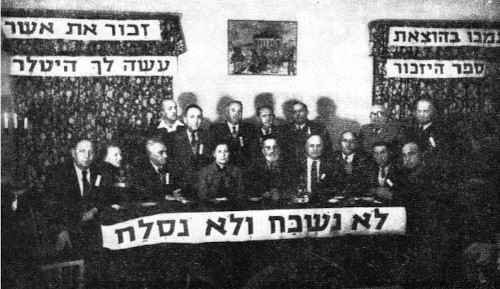
| Memorial evening in Haifa for Koło Jews who were killed in the war |
Original footnotes:
Editor's footnote:
Translated by Janie Respitz
I lived in Koło.
Chanukah 5701 (December 1940) a deportation took place in the form of a selection and I was among those sent to Izhbitzia (Izbica) on the Viepsh River. We lived in Izbica for a year and a half in the region allocated to Jews. The younger people had to work in teams. Beginning on April 15, 1942 they sent regular transports of Jews to Sobibor, an extermination camp near Vlodava, in the Lublin district. The camp had existed from the beginning of 1942. I was sent in one of these transports with my closest family members numbering 20 people.
The transport I went with numbered six thousand Jews. The Germans shoved 120-140 people into a 20-15-ton wagon. When I arrived in Sobibor I immediately had a sad welcome. A Jewish team which was called “the train company” loaded the “merchandise”. All the children, the elderly and handicapped were thrown onto lories and taken, as we later learned to graves to be burned. Then the Germans called forth the healthy young men, the co-called competent workers. Most of them were artisans. This group was comprised of 40 Jews. I was sent with two other Jews to the tailors' workshop, two Jews were sent to the carpentry workshop and the remaining 35 Jews were sent for unskilled labour, like servicing the bath house, the gas ovens, sorting clothes while simultaneously checking every piece of clothing to find gold, money or other valuables. Their task was also to pull out gold teeth from people who were gassed. These unskilled workers worked so long until they were tortured to death. And then, when
[Page 265]
a new transport arrived, they were sent to the gas ovens and in their place new victims were chosen.
The remaining 6,000 Jews from the transport were gathered in one place. The Oberscharfuhrer (Senior squad leader) Shtroybl gave a speech. He said: “you are all receiving land in Ukraine where you will work and live-in peace. Your clothing must be changed and before receiving new clothes everyone must write a letter to his family saying that you arrived safely with the transport, you are working and you are happy”. (It is important to mention that dead and crushed bodies were removed from each transport wagon). After the speech of the head of the camp people were led to the bathhouse and from there to 5 gas ovens. The gassed bodies were burned in four large prepared graves. Theis work was done by 300 S.S.
The torturing at roll call and the special prepared “pieces” by the senior squad leader Weis are indescribable. For example, every day after work the people were lined up according to blocs from 1-8. One was dressed a Moses: a long beard, a long robe, a Jewish hat and a stick in his hand. He would get up on a table and with everyone, sing the special made up song from the abovementioned squad leader.
Moses! Moses! Where have you taken your brothers
To the narrow gutters
When the Jews are already there?
Close the flap
Then all nations will be calm.
Everyone at that place had to fall to the ground and say: Amen.
They also often sang this so-called “Gypsy song”:
How joyful is our life,
They give us food –
Faria! Faria!
In the green forest,
Where everything lingers,
It is better for us than at home.
Faria! Faria!
[Page 266]
We suffered different problems in the summer. In May the squad leader Weis ordered every worker to deliver a set number of worms from the so-called Polish “Chrabantches”. Anyone who did not deliver the said amount received 25 lashes. Everyone strove to bring the prescribed amount which often led to blows among the workers, something this same squad leader enjoyed immensely.
In 1942 the idea of an uprising awakened in us. We realized that in the end, the same death awaits us. We began to organize an uprising according to a worked-out plan. There were 40 Jews involved in the plan. It is worthwhile mentioning that the commandants would intentionally send Jews from various countries to the same work place so they would not be able understand one another due to language differences.
It was decided the uprising would take place on October 14, 1943 at exactly 4 o'clock in the afternoon. The work was divided in two groups, each with 20 people. One group, to which I belonged, worked in the tailor workshop, where the S.S would enter the rooms to be fitted or take their ordered goods. People from this group took it upon themselves to kill, by various means, sixteen S.S. and take their weapons and uniforms. After completing this task, they would meet with the second group which was also comprised of 20 people who worked in the ammunition stores. They were to receive more weapons from this group and then escape to the neighbouring forests. One of the 40 was chosen as the liaison. His mission was to provide information to the other workshops on how the work was going. The Jews in the tailor workshop told the S.S. who left work with them to come on the 14th at 4 o'clock in the afternoon to be fitted or pick up their goods.
Thursday, the first day od Sukkot 5704 (October 14, 1943) at 4 o'clock in the afternoon the invited S.S arrived at the workshop (They always came at the exact decided time but they had even more reason: if the work was not ready, they would immediately send the artisan to the gas chamber). Me and my friend Leon Lerner (today lives in Bayreuth Bayern)
[Page 267]
killed 2 S.S: the lead squad commander Greyshitz and his underling Blatt. Carrying this out took place in the following manner: While they were trying on their uniforms, with their backs turned to us we chopped off their heads with 2 sharp axes which we had prepared earlier. The liaison quickly ran to the other rooms of the workshop to tell them we were successful. He delivered the information so efficiently, by ten after four all sixteen S.S were dead.
We quickly changed into their uniforms and with weapons in hand ran to free the other work teams who were already waiting for us. We had already discussed meeting at the roll call place. When we arrived there, we shouted to the Ukrainian positions: “Hurray, the war is over!”. The German guards who were also guarding the gate were stunned. However, this lasted for a short time. A few minutes later the Germans reoriented themselves and began shooting at us. Because we were a small number, it was not possible to begin a battle with the Germans. It was better for us to run from the camp. We tore through two rows of barbed wire and a water canal. Many of us were killed by mines which had been laid in the canal. The group that worked in the ammunition stores was captured. They did not succeed in coming to the pre-determined spot. From six hundred workers, one hundred Jews escaped to the Partzev Forest which is on the road between Lublin and Zamosc.
In the forest we organized a partisan group. We had plenty of weapons from the camp. We repelled many attacks on us from the Germans and Ukrainians. We endured lots of trouble from the A. K bands (Armia Krayova), the Polish nationalists. They allegedly wanted to take us to do shared work, but they were tricking us and looked for means to kill us. One time they tried this: we went together to attack a German post. The A.Ks told us to go first. However, when we moved forward, the A.Ks
[Page 268]
opened fire on us. We soon figured out what was going on and ran away. Unfortunately, from this event 8 were killed from our small family.
Close to one hundred Jew who managed to escape from Sobibor camp during the uprising spread to many different places. After liberation we met. In total, 20 people.
|
|
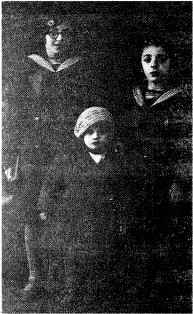
| The daughters of H. Hirshbeyn and the son of Shloyme Fudkhlebnik, killed in Sobibor |
[Page 269]
By Tola Maskol – Shultz
Translated by Janie Respitz
Autumn 1941. A beautiful golden Polish fall. The days are clear and bright, but the soul is dark. Every Jewish heart is trembling at the appearance of S.S beasts. They are showing up more and more often in the streets. Like wild animals they look for new victims for the god “Moloch”. The war machine demands countless work hands in order to hastily destroy human production of generations. They do not care about the cries of children, the pained shouts of remaining parents and lonely women. We constantly prepare ourselves for new orders.
It is quiet in town, like an omen of the advancing storm. On the pale faces of dear ones, the seal of fear and worry. What will the oncoming Days of Awe bring? No vestige of holiday spirit can be felt, to the contrary, what's next? Growing gloom and sadness. Someone is already missing from every home. We do not know where they were taken.
We no longer hear the songs emanating from the synagogue. Blackened walls, the remnants from the beautiful synagogue building jut out from the ground, like hands reaching up to heaven, demanding punishment for the Nazi vandals who burnt it down. Horror hovers over Jewish house. Children in their cradles, curled up and gloomy, read from their parents' pale twitching faces that things are not as usual. In houses where miraculously men have remained, you can hear whispered prayers: God, decrease our suffering!
The eve of Yom Kippur. I go with my younger sister to our grandmother Esther, wishing her well for the new year and receive her blessing. My grandmother barely managed to hug us when my uncle Daniel came in frightened and shouting:
“Run children, faster! Hide! They will capture Jews again today”!
My eyes fell on my grandmother's pale face and saw how her eyes were damp with tears. She looks at us helplessly,
[Page 270]
she is not able to help us. She hugged us even tighter and whispered: “May God save you from enemy hands”.
Running from this terrible information we went to our aunt Golda on our way home and told her the bitter news. As soon as she heard what we said she decided: the two of us and her daughter Mina will hide in the cellar.
The entire night we lay huddling and afraid that at any moment something can happen, the Nazi kidnappers will track us down. When day broke, I expressed my wish to go out for a while, look around and find out what the situation was. They agreed.
I closed the door behind me. Suddenly, as if from underground, two Gestapo emerged and immediately ordered me to go with them. My little sister, hearing the argument, forgot about the danger she was facing and emerged from the cellar. She grabbed me around my neck and began to scream and cry. Her intention was to release me from the kidnapper's hands.
The Gestapo decided to take my sister as well. I forgot about my own troubles and begged them: “Leave her alone! She is barely 12 years old!”. They let her go. A push on my back separated us. They took me to the House of Study, the gathering spot for all transports.
There, at the House of Study I found many girls from our town. What awaited all these young blossoming lives? Where will they send them for extermination? I sunk into tormented thoughts and did not notice what was happening around me.
After I calmed down a little and adjusted to my surroundings, I saw the detained girls beside me. Besides them, divided by a partition were parents of children as well. They were brought here because they refused to divulge where their daughters were hiding. I looked at them: their faces, lifeless, ash-grey.
The Gestapo tortured the parents wanting to extort information. In order to get rid of the heart rending cries they forced these poor souls to sing. Whips flew up and down. Those who fainted
[Page 271]
were beaten and had boiling water poured on them. Among those tortured was my aunt Tova.
When she wanted to adjust her spoiled hairdo (she always had well coiffed hair, like a crown) a Gestapo scoundrel ran to her and pulled her hair until she lay powerless with a bundle of hair in her hand from the degenerate. I stood there helpless. I could not help her. From agitation due to my powerlessness, I bit my fingers until they bled. The evil deeds and helplessness squeezed my heart so tight I was sure I would collapse.
The news that parents were being tortured because they would not divulge where their daughters were hidden spread to all corners of town. Young girls came on their own to the House of Study as not to see their parents suffer more.
The hours seemed endless. Once again, I sunk into deep thoughts. A woman's quiet crying tore me away from my thoughts: the cries were from my beloved grandmother Esther. She snuck over to the open window to catch one more glimpse of me. With a voice saturated with tears she said: “My darling child, my heart tells me I'll never see you again”! She grabbed my outstretched hand and lovingly caressed it, as if she could soften my pain. A Gestapo saw this and with beastly strength dragged her from the window.
From all the events and fatigue, I fell on a bench and fell asleep. When I woke up it was humming around me like a beehive. Standing beside me were: Tseshia Vaynboym, Toybe Shmerlovsky, Fradl Frayman, Genia Fogel, Adela Brand and others. I learned from them that they were planning to send this transport to Germany.
My uncle Daniel raced to the window and called to me. (He was wearing an armband of the Jewish militia). He whispered to me that he was making great efforts to free me at the train station. My little sister Gutka was with him. Her face was weird, yellow like wax. She stood stiff. Suddenly she fell on me with a heart-rending cry: “I want to go with you. What happens to you will happen to me!”. I absolutely disagreed and explained that in such circumstances she must remain with our grandmother.
[Page 272]
(The Germans sent our father to the Gostin ghetto, our mother had died young).
After parting ways with her I stood there confused and crushed and did not hear the command “enter!”. A strong push from an S.S man reminded me where I was. I got into line and the girl's train moved. We walked toward the train station. Behind us were the parents who after all the torture did not disclose the hiding places of their children. Gestapo with loaded guns, as if they were taking criminals, guarded us.
The girl's train was accompanied lengthwise along the highway by the remaining distressed parents and family members. There cries could have moved a stone but not the hearts of the Nazi murderers. With wild cruelty, they pushed the half-conscious young girls beating their parents murderously with rifle butts, who with outstretched arms accompanied their emaciated daughters.
It seemed to me I was going to my own funeral. I said goodbye to every house and every street in my hometown where I spent my beautiful childhood.
At the train station they placed the parents on the side and pushed the girls onto train cars. Suddenly, my uncle Daniel came running. Before he managed to say a word to me, he was thrown out of the car. Then he shouted to me: “Be well my darling[1]. I did not succeed in rescuing you from the hands of the devil!”. When the train began to move the sorrowful cries drowned out the noisy wheels which banged to the beat: Forever! Forever! Forever! My hometown Koło!
Translator's footnote:
By Shultz
Translated by Janie Respitz
1943, the beginning of winter, Birkenau camp.
A few girls from Koło, myself among them, were taken to bloc 19, which we called “The Market of Death”.
My place on the bunk was beside Tseshia Vaynboym, Avrom's daughter, who was full of life. At the worst moments, she found
[Page 273]
a way to free herself and not give in, never ceasing to believe the sun will rise.
Ignoring our age difference, we understood each other well, shared our bite of bread, often the last, and helped one another with advice. It reached a point, that simply with a glance, we understood each other when necessary.
On one of those difficult days Tsehsia found her younger sister Layke in Birkenau. I am not capable of describing the joy of these two sisters who found each other after two years of separation. I will never forget their meeting: they cried and laughed from joy, they kissed and hugged, I joined them.
Since Layke lived in another bloc, we only saw her at night, or working in the field.
The situation in the women's camp grew worse and more terrible. The light clothing on the cold autumn days left their mark. We felt the bitter cold during the long roll calls. Various diseases attacked the weak, the worst of which was typhus. People fell like flies at the end of summer. Standing during roll call, knees collapsed all around, people fell and expressionless eyes stared at you, as if they were asking for help, and after a short time, closed eternally. And we, those still alive, are forbidden to even offer a hand to the fallen, because for the smallest movement during roll call, you will be beaten on your head by the murderous S.S. Happy were those who fell and did not struggle with death, who did not have a prolonged death and immediately gave up the ghost.
We, the girls from Koło, stayed together. Every night we would gather on the bunk. Each one looked after her friend because no one was sure what tomorrow would bring: would we meet again at work? Who will be missing and who will remain? Every day brought changes, surprises and…victims.
With me in the camp were: Khaytche Podritska, Lyusha Blum (Maruz's grandchild), Dosha Shteynberg, Soreh Valkovitch, Hanka Gatzman and Dita Lantzman. Dita as the first to die, the first victim from among the Koło girls. On a cold morning when I came out of the barrack, I saw her lying on a heap of corpses, lying there with half-opened eyes. This wrenched my heart, tears poured from her eyes
[Page 274]
and her fists were clenched ready to attack her killers with her last bit of strength. Many questions demanded answers, some did not want to budge: will there ever be an end to these partners of the angel of death? While thinking these thoughts bizarre crying suddenly interrupted my thoughts and I saw this horrifying scene: girls running from place to place looking for somewhere to hide. Their faces full of fear. Their eyes, wide open with dread. Everyone was running, running, running…a nightmare. A tragedy was approaching. I stood frozen and saw: they were throwing the sick out of the bloc, half dead, and then I heard the horrific camp word: “Selection”.
Like an arrow from a bow, I ran to Tsehia Vaynboym. I knew she was sick with typhus and was burning up with fever. Like lightening I asked her the painful question: How could she go to roll call? Will she not fall standing in line?
We had to leaved the bloc at all cost! That was my decision. Standing in line is less dangerous than remaining in the bloc. I ran to her and she came to me, running. I grabbed her by the hand and together we stood in line at roll call. Her face was yellow and waxen. Her eyes, foggy. Pressing close to me she asked:
“Tola, how do I look?”“Very good Tsehsia! Be strong and God will help!”
“But I can't stand on my feet!” she complained.
“Stand!!!” I shouted at her, not knowing where I found that tone of voice.
I was not lacking my own problems: I was swollen from hunger and even more exhausted than on other days.
The selection began; they dragged girls out of the line-up and the S.S, with laughing faces wrote down the numbers. They tore sisters apart, daughters from their mothers. Some wanted to go with those dragged out in order to end their lives with their dearest and nearest. The beasts did not even allow this to happen.
The void became filled with heart -wrenching cries from the new victims of the selection. Tseshia whispered in my ear: “Tola, we're lost!”.
[Page 275]
At that same moment the murderers were beside our row. My heart was pounding like hammers, my feet trembling. Each minute could decide, life or death. I don't want to die. Even after all these horrible experiences the flicker of hope had not been extinguished. My mind was working: let them leave! And…at that moment they tore my dear friend Tseshia from me. I try to hang on to her tightly with my hand. But we receive the command: “To the right”! – Tseshia distances herself from me and says: my premonition told me…it's better like this, because I have no more strength…
The “lucky ones” were sent to bloc 8, and the selected victims, to bloc 19 with Tseshia among them. She was taken to the “Market of Death”.
Those held in bloc 8 were not allowed out until dark. My unrest called me there, I felt a need too see my friends to whom I had become attached. In the evening they told me that they had not yet taken away the unlucky ones. They made them suffer in loneliness and filth, providing false hope: maybe they would remain alive…
I did not go to them with empty hands, but what I did bring was poor and not enough: a pot of coffee, what more did I have?
Arriving at the bloc the blood in my veins froze. Who can describe this horror-scene which unfolded before my eyes? At the threshold lay a pile of corpses, ones that died during the day. It was not happier inside: on the bunks I saw shadows of people. A few, resigned, others indifferent, some withdrew when I entered, from fear or perhaps from hope. Maybe a miracle will save them? The first one I saw was Tseshia and offered her the pot of coffee. She took the warm drink with yearning hands to her thirsty lips. She took a long sip and left the rest. She was burning with fever. When she got a bit of strength back, she said:
“Tola, it is not a pity that I'm leaving this ugly world. I'm going to my death like to a dance party in Yazhvinsky's Hall. Finally, I'll be rid of this unbearable suffering. What really hurts is the fate of my sister Layke. Again, she remains alone. Tola, take care of her, help her as much as you can!”
[Page 276]
After a short break she said:
“When they take me to the crematorium and you will later see the chimney smoke, I want you to know, that the deaf skies that did not hear our pleas for help, took me away…”
My eyes teared up and no words came out of my mouth, I did not have the courage to comfort her. I was distracted by my own unknown fate: who knew if tomorrow the same would happen to me.
It was hard to leave. Suddenly, I heard from a distance, the voice of Dasha Shteynberg: Tola, give me a drink, I'm burning up! I fulfilled her request. There was still a bit of coffee in the pot. Then Soreh Volkovitch called out to me. She said to me with naivete: “I don't know if they will be able to gas me, after all I have such a healthy heart!”
I could not remain there any longer: you could go crazy. How can one withstand this? Such young lives being cut off so early. They look the angel of death in his face, waiting for death and maybe something worse than death.
I said goodbye to each of them and barely left alive. I stood at the door and looked around. Their stares followed me and I never saw them again.
The last road before going to the crematorium was the march to bloc 25.
The next day, at noon, through my little bloc window, I saw them being led to the gas ovens. Sounds of “Hatikva” (the Zionist anthem, later the anthem of the State of Israel) and the prayer Hear o Israel carried through the void. It was soon quiet again.
This is how young fresh lives were taken. It is hard to conceive how those who remained handled the pain of parting. None other than the feeling of revenge gave us the strength to live, subsisting until the end.
After a certain amount of time, I passed the bloc again. It was empty. Our beloved girls from Koło were no longer there. They left with the smoke and the wind spread their ashes over the false and cruel world which silently permitted their extermination. Their protests and cries ring in my ears until today, which unfortunately no one heard.
Translator's footnote:
|
|
JewishGen, Inc. makes no representations regarding the accuracy of
the translation. The reader may wish to refer to the original material
for verification.
JewishGen is not responsible for inaccuracies or omissions in the original work and cannot rewrite or edit the text to correct inaccuracies and/or omissions.
Our mission is to produce a translation of the original work and we cannot verify the accuracy of statements or alter facts cited.
 Koło, Poland
 Yizkor Book Project
 JewishGen Home Page
Copyright © 1999-2026 by JewishGen, Inc.
Updated 29 Jun 2026 by LA