 |
|
|
[Page 151]
[Page 152]
By Sol Marisan
Translated by Janie Respitz
Even before the destruction of the Jewish community of Poland, the Polish population was infected with anti-Semitism which appeared in many forms. The Poles in our city were no exception in this respect.
Even in the good days of King Zygmunt the First, our forefathers had a rough time. The false accusations against Jews in Great Poland did not skip Koło. Documents from 1531 tell us that King Zygmunt restrained the baiting campaigns through an order which forbid the accusation of Jews in Great Poland of ritual murder[a].
In 1564 – we read in documents – King Zygmunt August issued a decree permitting the Jews in Koło to take part in wholesale and detail business, except honey. The same king placed a tax on the Jews which amounted to half of the general tax. However, the Jews who paid the tax had equal rights with the non-Jewish citizens of Koło. Of course, the Jewish community at that time was very small, not even half of the general population. The above-mentioned tax fell like a heavy burden with the aim of ruining the Jewish economic position.
With the emergence of Poland in 1918 the flames of anti-Semitic fire reemerged. The Poles could not find a better opportunity to attack the Jews. The sadly famous “Hallerchikes” (a Polish military regiment led by General Haller) went wild in the region of Koło, cutting and plucking Jewish beards and delivering murderous beatings. However, the anti-Semitic outbreak in the land took on a lighter form in our region.
[Page 153]
Two years passed relatively quietly. There were efforts made to make themselves understood and bring about mutual rapprochement with the non-Jewish population, but there were no results.
In 1920 the organized boycotts against Jewish business in Koło took on a harsher character. This was the result of an incendiary appearance in “Yazhvinsky Hall” of the anti-Semite Khamietz. The “Razvoy” (“Robbery”) organization preached ant-Semitism; on the walls of the house the following slogans appeared:[b] Posters defiled the Jews and the wave of provocation grew stronger from day to day.
A change for the good took place in 1925 when Marshal Yosef Pilsudsky took over. The turn around in the attitude toward the Jews was also felt by us. Unfortunately, this favourable turn around did not last long. New attacks on Jewish existence erased the milder months. Restrictions on various domains were aimed at the Jews and accompanied them like a dark shadow at every step. Of course, they were inspired by the government and methodically carried out by the municipal organ. At first, they began “work” with the tax office which who hired a patriotic type, as if he was striving to help the quick rebuilding of the state. They began to milk the “Jewish cow” as much as it would allow. The taxes were unbelievably high.
The vivacious Jewish business, the energetic and industrious Jewish artisan, were a thorn in the side of the anti-Semites. They looked for ideas and ways to cut down the tree in a legal manner. In the following lines we will describe the process.
Three mills in Koło belonged to Jews.[c] The Christian landowners in the region could not tolerate the fact that that such an important production branch was in Jewish hands. With joint funds they built a new large mill near the train station. They thought, with that, they would disrupt the high position and a crisis would ensue. The status of the Jewish mills did not change much, the new mill made their existence difficult, but did not
[Page 154]
result in complete ruin, as they planned. The new mill lasted barely a few years and then went bankrupt. Their mean plans were disturbed. The end of this great undertaking is interesting: the Polish mill was transferred into Jewish hands. Until the outbreak of the war, the above-mentioned mill was owned by Jews.
A chapter on its own was the fight against Jewish education.
The Hebrew High School in town, which strove to plant a national cultural inheritance in the young generation was a thorn in the side of the anti-Semites. What didn't they do to try and shut down the school? Regardless, the worry of supporting this institution fell exclusively upon the Jews. The Jew haters did not stop their provocations and denunciations. Finally, they got what they wanted: the trustees in Lodz ordered the closer of the Hebrew High School and stated their motive as the building was ostensibly about to collapse…
Obviously, the closure was a blow to the Jewish population. It made the path for Jewish youth to receive a high level Jewish and secular educating more difficult.
The building stood strong for many years, until the
|
|
[Page 155]
bombardment in 1939. A part of the building, formerly classrooms, was taken over by the Jewish National Bank.
The only high school in Koło, the “Oshviata Gymnasia” or the technical high school, made it difficult to accept Jewish students. There were times when Jewish students who excelled in learning were not accepted to the first academic year of graduation exams. Jewish students were persecuted in various ways. This was done to prevent the growth of a Jewish intelligentsia.
After the closing of the Hebrew high school the Hebrew elementary school remained open.
One bright morning an edict was decreed to close the Jewish cemetery. One may as well take the corpses and burn them. As with every edict there was a motive provided: it is too close to the residential centre. (There was a Russian Orthodox cemetery in the same suburb). They began to demand the repeal of the edict but the chances for success diminished from day to day. Every time there was a funeral, they had to get special permission, otherwise the gravedigger did not open the gate which was locked by the authorities.
At the same time the police “could not” find the band of hooligans who romped at night through the cemetery, damaging tombstones and defiling graves. The Jewish cemetery continued to exist until the great catastrophe when the majority of the Jewish community found their deaths in the death camps.
Jewish Livelihoods
Koło was not an industrial centre. It did not belong to the tangled developing regions in Poland and yet the Jews established some industrial undertakings which created stable work places. We are providing a list of factories which were established by Jews:
One factory of agricultural machines; two electric mills; one soda water and lemonade factory; one cotton wool factory; one wax factory;
[Page 156]
one brickyard; two candy factories; one glue factory; one knapsack factory; one paper factory which belonged to Reb Khaim Fogl.
The smaller establishments: a few small knitting factories; two printing houses; one sock factory. The foundation of the economic base of the Jews from Koło was trade and crafts, a large part in the development of the town.
Trade in fruit, soap, haberdashery and clothing was in Jewish hands. Government factors helped non-Jews establish, in order to penetrate the pre-existing trade enterprises. Instead of founding new enterprises, they tried to disrupt those already in existence. The wholesale and detail trade began to feel the Polish competition as well as the boycott provocations. Polish retailers appeared in the markets and with kosher and non-kosher means pushed the Jews out of their positions.
Jewish businesses and stores were concentrated in two main places: the old and new markets. Every Tuesday and Friday animated business took place with peasants from nearby villages. Besides these two business days, fairs took place which brought lively business to our city.
Among the ousting plans which targeted the Jews, there was a plan to reform the appearance of the city. The Polish restaurant owners brought forth a suggestion that the “markets” (the places for business with the village population) should be in a suburb of Warsaw. Their intentions were clear: there the non-Jews would establish new businesses and cut off contact between the peasants and the Jewish shopkeepers. Of course, at the city council meetings they gave “esthetic” arguments. The fate deciding suggestion was strongly opposed by the Jewish representative as it implicated the main branch of Jewish livelihood. However, the Polish councilmen carried out their plan: a decree was passed stating the peasant's wagons must stop at a special place in the Warsaw suburb. Cattle trade would also take place there which formerly happened at Kavalsky Place. In short, places of trade were now beyond the Jewish territory.
A glance at another list shows evidently, how rooted
[Page 157]
the Jews of Koło were in many branches of trade. We are providing here just a few of the larger undertakings:
42 - grocery stores; 20 – haberdashery and shoes; 12- garment fabrics; 6- porcelain and glass; 5 – coal and lime; 3- old iron; 8- leather and shoemaker supplies; 3 – watchmakers and jewelers; 4 – iron and paints; 4 – bakeries; 2- bookkeepers; 2 – electrical materials; 1 – radio operator; 3 – soap; 3 wood warehouses; 2 – sausage factories; 4 – candy stores; 1 – whisky; 1 – cigarette shop; 1 – salt shop; 3 – butter leather; 2 gasoline stations.
Not on this list are dozens of market travelers, butchers, transporters, chicken and egg merchants, as well as owners of hotels.
Intellectual Professions and Artisans
Leading the intellectual group:
Three medical doctors; one dentist; two dental technicians; one lawyer; one engineer; one midwife; two medics; thirty teachers; ten clerks in communal institutions; one photographer; six hairdressers.
Tailoring and shoemaking took first place among Jewish trades. Therefore, they did not work only for the local market, but for export as well. Goods from our town went to Pomer and Poznan. Unfortunately, we do not have exact numbers of those who worked in these fields.[d]
Hundreds of families, at least, earned a livelihood from the following professions: shoemaking, harness making; tanning; hat making; carpentry; house painting; tinsmith; mechanics; knitting; hairdressing; upholstering; transport; wagon drivers and others.
Lending institutions played an important role in supporting the struggling Jewish economic undertakings. Two Jewish banks – “Spuldizhelniye” and “The People's Bank” and well as the interest free loan society, helped support the unstable merchants and artisans. The retailers and artisans also created cash boxes which more than once, through loans, helped but people back on their feet.
[Page 158]
|
|
According to the government's official count, in 1933 there were 119,370 people living in Koło. Of them, 9,783 Jews. The list also provides the following statistics: 5,039 women; 4,744 Jewish men. The majority gave Yiddish as their mother tongue, 300 said Hebrew.[e]
A Bad Dream for the Jews of Koło
The sad pogroms in Przytyk and Zagurov stimulated the local anti-Semites and they prepared a “spectacle”. This time they did fundamental work – they stimulated the poor peasants, organizing them to steal and kill. They chose the code word – “market day”. They chose a day, which would not cause suspicion, a day when the villagers came to town. They Jewish organizations knew about the planned pogrom and did not sit by idly. A self defense was quickly organized. The police commissioner at the time, Kviatkovsky, displayed insight and looked for ways to put an end to the wild dream. He assured the representatives of the Jewish community that as long as he will be in this position,
[Page 159]
acts of terror would not occur. On the eve of the pogrom, he carried out arrests among the Endek leadership led by Rutkovsky. Police enforcers came from surrounding cities on the decided day and took up positions in all sections of the city. The peasants arriving over the Warsaw and Kalisz bridges were searched. Many of them arrived that day with sticks and sacks, prepared to rob and beat up Jews.
These characters were immediately sent back to their villages accompanied by a warning…Naturally, after these exceptional measures the day passed quietly. People lived in fear and anguish but no pogrom took place.
The failure of the anti-Semites did not break them. A few weeks later they called a meeting of the Endeks in Koło. One Sunday, a thousand incited men and women marched in the streets, shouting hateful slogans at the Jews and carrying agitating banners. The Jewish residents distanced themselves from the dangerous streets. That day Yosef Roykh came to the bridge. The Endek hooligans wanted to throw him into the Warta River. When he called for help the police came and saved him.
The results of the gathering were seen a short time later. Merchants[f] from Poznan opened businesses in Koło and were able to attract non-Jewish customers. The new “Polish” shopkeepers organized an exhibition beside the large church of “pure Polish products”. They did not allow Jews to come to the exhibition.
This was still not enough for them. The Poznan weekly anti-Semitic newspaper “Pod Prengiesz” published a special Koło edition. On the first page of this filthy leaflet there was a picture of the city council surrounded by Jewish dwarfs. Another Polish newspaper which was published in Poznan sent a regular correspondent to Koło to describe the agitation.
On April 1st, 1938 Koło joined the Poznan Voivodship (county)[g]. The new “patrons” did not spare them any troubles.
[Page 160]
They harmed the Jews with edict after edict. One of them: on every sign a Jewish shopkeeper had to write his full name so every gentile would know who he is buying from. A second edict: tear down the small houses on Akulna Street where the Jewish poor lived. The argument was: “They are not esthetic! They are about to collapse…!” a building commission from city hall visited the alleged wired street and ordered the residents to leave their dwellings. Obviously, they did not provide them with new accommodations. Even before they managed to find a roof over their heads, they were sent into the street. Groups of Polish workers accompanied by the police came and began to tear down the homes, building by building. By causing tragedy for the Jewish poor, they made their town more beautiful!
The Jewish councilmen on city council with the alderman Leyb Luksenburg from the Labour Zionists (right) carried out a bitter struggle for Jewish rights and had to endure blazing troubles from the Endeks and “Azanovs”. They had not yet digested one edict when another crept up: Jewish ritual slaughter – limiting the number of animals which could be slaughtered kosher. The goal of all the edicts: destroy Jewish incomes.
Since Koło joined the Poznan County public cultural activity of Jewish organizations was limited. It was difficult to receive permission to organize public meetings, lectures, performances etc. Yiddish theatre troupes who until this time were regular guests, now, due to the new harassments, had their performances limited.
In 1936 the relentless anti-Semite Kubiak issued a pamphlet in Koło[h]. In this brochure he provides a fantastic dream of a Catholic from Koło named Sava. Sava wanted to persuade everyone that there was a kernel of truth in the legend, that every day at midnight a knight emerges from the Koło castle and rides along the shores of the Warta River.
Sava strides through the streets and twinges over the poverty of the non-Jews and gnashes his teeth seeing the Jewish wealth.
On page 3 we read: “…suddenly Sava does not see one Polish knight, but many, an entire gang…and suddenly – a great chop and noise.
[Page 161]
Signs from Jewish businesses are flying and the Jews are running away from Poland. Poland and Koło are free of Jews” …
This dream – phantom was a Koło Haman the wicked. With this type of “literature” they prepared the population for the days of the great Jewish catastrophe.
In 1939, at the beginning of the Second World War, there were approximately 6000 Jews in Koło. Their main occupation was business and trade. The conditions were not ideal. Despite the difficult pressure they clung to their acquired positions. While trade and business were the backbone, a few worked in agriculture.
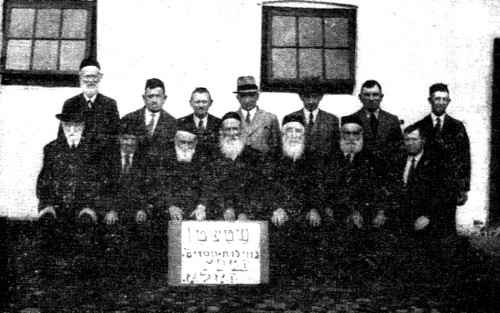
The committee members:
Support for your charity under the name of “Gemilas Chasodim” I. Szwarcman's Express Printing House in Koło |
The appeal was published in 1928.
Original footnotes:
by Binyomin Shtern
Translated by Janie Respitz
Koło before the European holocaust was a city of Jewish tailors. The production branches which were exclusively in Jewish hands included clothing production.
It is interesting to remember that hundreds of families earned their living in this field, employers and journeymen. This work was year-round, winter and summer. They worked 16 hours a day – however, poor salaries.
There were around 10-12 clothing stores in town, but most of what was produced was sold at fairs. The clientele was farmers who looked for cheap clothing for themselves and their households. First place was occupied by the tall Kahn who they called “Kohen Godel” (High priest). He and his sons had a large business in Borukh Zhulovsky's house, on the corner of Synagogue Street. The second was Gnatchik and the third, Zalkind. They were the big shots in this business from 1930-1935.
The large warehouse keepers gave work to artisans working from home. In the month of July, in the hottest days of summer, the machines hummed as they were already sewing winter coats, cotton jackets and fur pelts. The large entrepreneurs returned from Bialystok and brought large balls of woolen cloth; fur skins and other sewing accessories were brought from the large fair which took place in Loyvitch; cotton was provided by Pshedetsky's factory.
They worked vigorously. There was no time to eat or sleep. Those who worked from home and their apprentices gave their all: another jacket, another suit, and with every finished product the salary grew – their children will eat until satisfied and there would be enough to pay tuition. It is no wonder, that from early in the morning until late at night the machines were working.
[Page 163]
Selling the clothing was not easier than making them. A small maker of ready to wear clothes, who did not have his own capital and took everything on credit, had to, after sewing five dozen jackets or suits, hit the road. Together with a few colleagues, he would rent a covered wagon and travel from fair to fair, working very hard all week and at the end of the season, calculating the total, he saw that from all the racket and commotion, nothing remained. The trips swallowed most of his earnings.
On more than one occasion, the promissory notes which they gave the merchants from Lodz were protested, and when the wholesaler from Lodz came with an excuse, others interfered and the matter was reconciled: wiped and smeared. Travel on…
The clothing industry also felt the effects of strikes. The apprentices began to organize and carry out strikes. It would happen that the son of an employer would lead the strikers, like what happened to Zalkind: Gedalye was a thorn in his father's side…As a result he had the honour of holding a respectable position in the “Labour Zionist Organization” (Left). He was always on the side of those exploited.
Two characters in the ready to wear business were very popular: the first was Gavriel Markovitch the treasurer of the “Clothing Confection Bank”. Truthfully: this was not a bank compared to other banks. It did not have a premises, nor a stamp nor a bookkeeper. The ready to wear workers collected a few hundred zlotys (they never reached one thousand) and gave out loans to those in need, those who needed to finish on time for the transport. The borrowed sum was paid back, and then they borrowed again. This is how they carried the burden of earning a living. They raised children, married them off and did not let go of the reins.
I remember until today a meeting of the “bank”. During heated discussions, whether they should confirm a loan of 30 zloty or reject the request, Gavriel let out a scream like a dictator: “if you do not listen to me, I will fly off the cuff!” – that meant – he would resign. Then his father appeared with a response and he splattered all present with his words (that is why they called him Gavriel Shpritzer (the spitter) because he splattered everyone with spittle while speaking). What he did not achieve with objective arguments,
[Page 164]
was aided by spittle. He imposed great fear that at any moment inundation would occur.
Tuesdays and Fridays, market days, those who made ready to wear clothes and did not have shops, went to the marketplace and set up canvas tents or stalls. The peasants went from stall to stall with the members of their households looking for appropriated clothing. Selling a jacket or a pair of pants required creativity. It was not easy for the peasant to spend a few groschen. One had to have the patience of Hillel and the strength of Samson. After the peasant tried it on and was ready with a price, he claimed regret. The intent was to bring down the price. He then left to a second merchant and as if he was an expert checked the accessories, the type of fabric, and played the big shot. However, the experienced seller did not release any customer. He would literally hypnotize him, measuring the piece of clothing and obtaining “sweets” or in tailor lingo – “the wisdom”.
Also, those who made “successes” often lost a day in the week. However, when the Sabbath arrived, it was the Sabbath. They gathered and prayed together and felt as if they were in their own kingdom. The parties dictated what they should do, enthroning and dethroning kings, running the politics of the world. After an afternoon nap they studied the Torah portion of the week and the rabbi was the one who made it all kosher, a true Jewish scholar.
Obviously, the younger generation celebrated the Sabbath differently: one had a pint of beer, and some in the social halls.
Let us remember, at least, three quorums in this line of work: Khaim Khmielnik, Aron Rotbard, Avrom Yakov Zalkind, Simkhe Zalkind, Mikhl Fuks, Shmuel Kryer, Moishe Kryer, Noteh Nayman, Sinai Shtern, Uziel Zilber (Puntshiuk, Avrom Bayrakh, Yisroel Markovitch, Moishe Lentshitsky, Shmuel Lentshitsky, Yitzkhak Cohen, Avrom Gnatchik, Gavriel Markovitch, Khaya, Shloyme, Yishaye and Moishe Yarmush, Shmule Gatzman (Prazhukha); women's coats were sewn by: Yitzkhak Tsorndorf, Avrom Shloyme Lupe and Dovid Strikovsky.
There were no anthems for them. This folksong would be more appropriate:
“We are what we are, however, we are Jews” with a small change: “We are what we are, however, we are workers”. Honest Jewish workers, “common folk – tailors”. How much vitality did you bring to Jewish Koło!
by M. Alter
Translated by Mira Eckhaus
A. The Settlement of the Land
The whistling of the approaching train pierced the evening peace. In the distance, the heavy breathing of the locomotive was heard. A trail of bright light poured onto the tracks, like grains of sand.
The train approached the station at a slow, steady pace. The small, lonely station awoke to the sound of the long beep, and the electric lamps in front of it suddenly lit up. Dormant windows opened and looked out in amazement at the long line of carriages.
Two passengers got out of one of the carriages. The policeman who was walking in front of the train station cast a puzzled look at the faces of the strangers: Who are these people, and what business do they have here? He examined the young man of medium height from head to toe: one eye scanned his short leather jacket, his wide trousers and his sports socks, and the other eye peered under his hat: “Zhid” – and yet so similar to a young Gentile boy from the village. The face is rough, the cheeks are sunken and the eyes are alert. From bottom to top he looked at the young man's companion. Her whole outfit - her worn, dark blue overcoat, the beret pulled down over her eyes and the large, rough shoes - for some reason he did not like her. He wanted to go up to them and stop them, but the sureness of their steps stopped him.
From afar, the town could be seen, wrapped in the white snow of the early winter. The roofs were covered in white stripes, like old grandmothers wearing white hats, and tiny lights twinkled from the windows. The young man bent down, adjusted his shoelaces, and slightly lifted the backpack on his back, as if preparing to set out on a long journey. At that moment, his companion was shivering with cold and pondering the distance between the station and the town.
You see, Hannah, said the young man, we are coming to a town like ours, from which we fled.
A coachman dressed in a simple peasant fur coat stood near the train station, waiting for a good start. When he saw the arrivals, he invited them in his hoarse voice:
-Fifty pennies to the city!
The two strangers did not accept his invitation and set off on their way on foot.
A wind pushed them from behind, until they reached the road that wound up the mountain.
[Page 166]
Due to the weight of the bundles they carried with them, they became a little warm and their shirts stuck to their backs. All those things they had heard about wandering in the distance, about friends who had wandered the roads, they now began to feel themselves. And so, they walked and walked until Hannah stopped the silence and the monotonous creak of their steps in the snow:
- Mendel, where shall we start?
Mendel knew what other “settlers” started with. First of all, they wanted some kind of occupation for themselves. But what answer could he give her now? When they arrived at the place, they would see what had to be done.
How can I know? Maybe as lumberjacks.
Hannah received this answer with joy and said in a voice filled with pride:
You know, at Kibbutz “Shachariya”, the girls work in the sawmill, next to the circular saws, just like the boys.
She saw in her mind the sawmill in “Shachariya”: girls dressed in work pants walk among piles of planks, and their clothing differs from that of the boys only in the headscarf they wear.
Hannah knows that in the first few days it might be necessary to start with the “serving” and she wanted to tell Mendel openly that she was not comfortable with that. She would like to work in a vegetable garden like in Grochow or Czestochow. You plant a plant and grow it until it bears fruit. You see the seedling as it grows and develops, and that in itself is a reward. If you crave for asparagus – you will grow asparagus. If it's cabbage – grow cabbage, onions, carrots, everything! But she knew that it would be necessary to start with something else.
- I would gladly work in the kibbutz kitchen! - she said after reflection.
These words, her confident voice, her desire to withstand the test - encouraged Mendel. Hannah was serious, fit for the settlement of the Land.
The silence around and the crunch of snow underfoot prompted thought. The pure whiteness that spread around accelerated the racing of ideas in his mind. To make the walk more pleasant, Mendel began expressing his thoughts aloud:
- I heard that there is a strong party[b] in the town, there is a branch[c].
Hannah looked at him in surprise. She was surprised that he also considered all the Histadrut groups. At Kibbutz Borochov, where they were for a short time, Mendel became known as a man of valor, a guy who didn't need the help of others. Now she hinted to him about this in a subtle way:
- One who still has his own strength should not rely on his father-in-law.
A second coachman, returning home with an empty carriage, blocked their path. He stood across the road and invited them to get on:
[Page 167]
- Hey, hey, for twenty pennies!
Hannah and Mendel did not accept his offer. They continued walking. Indeed, in her heart Hannah was sorry that they had not accept the coachman's offer, because her fingertips were already starting to freeze. She was ready to give up eating as long as she did not suffer from the cold, which pricked like thin needles. But Mendel was thinking about something else at that moment. If a coachman asks for only twenty pennies to transport two passengers to the city, the poverty here must be great - and where would he arrange a training company here? And really, where would he start? He bit his lower lip, as he always did when dealing with a serious issue.
The road suddenly began to slope downward and eventually stretched out in a straight line. They reached a path that was well-trodden by pedestrians.
In the last kilometer the wind was blowing against them, constantly slapping their faces and pushing them back. Mendel and Hannah turned their backs to the wind and began walking backwards. But they could not make much progress in this walk. So, they turned around with their faces to the wind again and walked bent and hunched.
The lanterns on the sides of the road multiplied. Low country huts emerged from the snow, and tiny lights flickered in their small windows. The snow lay peacefully on and around the houses, and above the white snow was the silence of the night.
Afterwards they saw squares of plots, surrounded by faded fences, and then the gloomy town houses appeared, with yellow light flickering in their windows, the smokestacks of factories that did not emit smoke, and their large black and terrifying square window holes. The town lay before them, alien and alienated, withdrawn into itself.
Lumberjacks
The kibbutzniks got their first job from Yoel the baker as lumberjacks. They didn't easily manage to get it. Yoel regretted it many times during the negotiations he had with Mendel. The baker's son, a pioneer, stood by Mendel's side and he was also the one who obtained tools.
At dawn, Hannah and Mendel woke up and set out for their work. Mendel walked proudly with an axe tucked into his belt, and Hannah walked beside him. She carried with her food and a pot of tea, their daily meal.
Yoel the baker's yard, a vast lot, was public property. Everyone had a foothold in it. True, It was fenced in front and back: on one side a brick wall rose, on the other - a wooden house, and a fence ran along its length, and yet there was a lot of traffic there. The water well and the pump in the yard attracted the neighbors of the street, who came morning and evening with their buckets and pots. Even the three chestnut trees growing in the yard, the remnants of a garden, drawn people to rest under their shadow on the stifling summer evenings. Yoel the baker did not dare to scold them even a single harsh word. A baker must be comfortable with people, because his livelihood depends on his good relationship with people.
[Page 168]
Like experienced lumberjacks, the kibbutzniks set to work. Mendel looked at the piles of logs from all sides, and the spirit of work came over him. He took off his coat, hung it on the fence, and set up an anvil from a large log. Hannah arranged the logs according to their thickness and length.
Mendel held the handle of the axe and began to chop leisurely, raising the axe and lowering it, raising and lowering it - until he found the right rhythm. The axe began to dance under his hand: up and down, up and down, and the axe never disappoints: it was stuck in the place marked by the eye, and with each thrust, the log split in half.
A Jew with a thin beard, who had returned from Shacharit prayer with his tallit under his armpit, stood watching the work of the lumberjacks. He picked up a piece of wood and, as a grain merchant would, felt it in his hand. He wanted to examine it, as if it were a grain of wheat. He asked himself: What is the difference between a piece of wood that came out of the hands of a Jew and one that was cut down by a Gentile? He could not possibly understand what a young Jew like him saw in engaging in rough work that did not involve mental effort.
An old woman, with a limp neck and trembling jaws, came out of the bakery and entered the courtyard. She saw the lumberjacks and shook her head:
- Children of wealthy families, now work as lumberjacks. Beautiful times have arrived!…
A neighbor, who had just come out of the pen, asked one of the bystanders:
- Who is this girl helping this brat? And she pointed to Hannah, who was throwing the wood chips into the basement.
- She's a member of the group, a pioneer! - the grain merchant, who observed what was happening, replied.
From afar, Antonova, the janitor's wife, peered out the window. She wanted to go out and get a closer look at a sight she had never seen before: Jews chopping wood. She wrapped herself in her coat, went out, and joined the curious crowd, listening to their conversation. She couldn't stay quiet and added her own touch, half Polish, half Yiddish:
- Kapskia chasi, broit ferdinan![d]
The number of those gathered and amazed grew. When one left, two came to replace him. Even the Torah scholars, who were among the town's idlers, elegant in their colorful ties, came and looked at the lumberjacks with wondering eyes.
Mendel, his face red and sweaty, felt that the bystanders looked at his handiwork - And his enthusiasm for work only grew stronger. He was not only splitting the trees, but was destroying and shattering the barrier that separated the pioneers from the townspeople. This work would be decisive in the establishment of the kibbutz!
Among the bystanders was also Gedaliah Bish Gada, a tall, slender Torah scholar with a squint in his right eye. He was engaged in the retail sale of salted fish and was familiar with hunger. His power was great in the advice he gave to many people. He pulled the baker's son aside and asked him in a whisper:
[Page 169]
- These gypsies, did they come from across the river?
He felt the sting and replied:
- They didn't come, God forbid, to compete with your poor livelihood!
Gedaliah fell silent for a moment, feigned innocence, and justified himself:
- I didn't mean to be disparaging. Perhaps they would have done better if they had thrown themselves into the water before starting this business…
The wood cuttings were not piled up in piles, because Hannah immediately threw them into the basement. When half the logs were out of sight, Mendel stuck his axe into the anvil, signaling the lunch break.
The lumberjacks threw their coats over their backs, brushed the dust off the stone threshold, and sat down to eat. With gritted teeth and great appetite, they chewed the dry bread and sausage. Mendel ate slowly: he bit off the bread and took a sip of the cold tea in the tin cup. Hannah ate a roughly and her face was filled with satisfaction: he did half the work and she did half. True, this work is hard for her, but little by little she will get used to it!
Those standing around stared at the mouths of the eaters. They were like complete Gentiles, working and eating - eating with great appetite. A compassionate Jewess was found who wanted to reward them with a warm cup. But the others explained to her that the pioneers would refuse to accept a free gift. And one Jew even joked:
- Apparently, they are among the most meticulous ones. They don't want to eat from the slaughter of our rabbi!
At the end of the meal, Mendel and Hannah rubbed their hands in snow flakes and returned to their work. Like fuel for the fire, the meal boosted their energy. The axe split the logs exactly where Mendel hit it and the logs become fewer and fewer.
Yoel the baker, who had just woken up from his sleep after a night's work, came to see what the lumberjacks were doing. He approached them with a sloppy walk, surveyed the wood chips with his eyes, and his mind was at ease: You don't have a better wood chip for heating than this! He ran into Avraham Kolasky and said to him in the tone of a winner:
- Well, who first engaged them?
Avraham was silent. His conscience tormented him for rejecting the stubborn pioneers, and not helping them. In his heart he decided to correct the wrong: he would try to get ten kibbutzniks into the mill, into the sawmill. The members of the branch would catch inconsequential people for them and he would give them important people… They would still need him.
The curious and the beggars kept coming to the courtyard, one after another. They looked for a while and then left, full of wonder and admiration. Then they grabbed Avraham Kolasky and praised Mendel:
- I heard they say he is a student!
[Page 170]
- A man who speaks well, a person who knows how to sweep others after him!
- And she, the virgin, a woman of valor, a magnificent person!
- With God's help, they will find their livelihood here. After all, they work like complete Gentiles!
The Zionist activist, Mr. Brightman, A person with presence, also appeared in the courtyard. He asked Avraham Kolasky how he feels, and asked to have an urgent conversation with him and also with the kibbutzniks. He waited a while, until the crowd dispersed so that they cannot listen to the conversation.
- What will you say to them? - Abraham wondered about his intentions.
- Well, if Jews want to chop down trees, a blessing will come upon them – he replied - but, in my opinion, training for the Land of Israel relates only to cultivating the land itself, as it is written: “Every man under his own vine and fig tree” - planting, pruning, and weeding…
Towards evening, Mendel cut also the last logs that were left by the anvil. They didn't pick up the wood chips that fell on the ground. The janitor's wife collected them for her oven.
The evening arrived. The chestnut trees by the well began to shed drops of darkness. Hannah and Mendel left the courtyard. Many accompanied them as they left, proud of them. Avraham also now pinned great hopes on them and predicted a good future for them. Just as they had succeeded in cutting down trees, so they would succeed in everything they do!
Mendel had already drafted two letters in his mind, one to the “Hachalutz” Center and the other to the secretariat of Kibbutz “Borochov” with the same content: “send more members!”
Original footnotes:
by Gedalyahu Zvicalsky
Translated by Mira Eckhaus
My memories of the past are connected to the beginning of a regular intercity bus service in the Koło district. My grandfather, Reb Anshil Wilczynski, was one of the pioneers of this transportation. He was among the respectable residents of the city, served as the synagogue gabbai, and I remember that he used to wear a “top hat” on his head on Shabbats and holidays.
When I was a little boy, I would come to his yard and see two passenger carriages, each drawn by four horses. His “line” was the area between the cities of Koło and Kalisz, with intermediate stops in the towns of Turk and Ceków.
Merchants, dealers, Jews and Christians, as well as priests, would come to his house to get a place to ride in his carriages. Places were limited and first come, first served. Many would also come from surrounding towns such as Sompolno, Izbica, and more. Most of them were merchants. The carriages left twice a week, back and forth on the aforementioned route.
My grandfather also dealt in mail delivery and package transport. His carriages still appear before my eyes to this day. They were special carriages in their type and shape. The entrance was from the back. Inside, there were two padded benches, end to end, with sixteen seats. During the cold winter, straw was spread on the floor to warm the passengers' feet. There were cheap seats outside. The carriage driver was Shimon Wolf Trittelevich. From my mother I heard that he served in this position for about thirty years, about half a human life. The carriage driver before him was a man named Chaimel. If I am not mistaken, his last name was Milevsky.
As mentioned, the mail was also transported in carriages. The carriage driver would honk his horn as he passed through the city streets, to notify the public of his arrival and departure, or of the sending and receiving of deliveries.
Several families - the carriage owners, the carriage drivers, the postman, and the porters - found their livelihoods in this form of transportation. As the cities grew, so did the chances of this transportation's expanding. My grandfather's carriages did not meet all the demands. My grandfather was followed by Ber-Nachman Bornstein (Tuvia Yashek's son-in-law), who also bought him a passenger carriage.
Upon the passing of my late grandfather, the business passed to my father, Moshe Zvicalsky, who sought to revolutionize this service. First, he set up accounting in the business, diligently recorded the names of the passengers, and in 1910, he operated an “Orion” model bus, which was brought from Switzerland. The speed of this car was fifteen kilometers per hour, a great achievement in those days. The bus was divided into
[Page 172]
three classes. The seats in class A were upholstered and covered with velvet and a mirror hung there. In class B - regular benches, and in class C, in the corridor - there were standing places and the ticket prices were cheap. There were several innovations on this trip: the fare was not given to the carriage owner or the driver; the passenger had to buy a ticket in advance, before the car set off. The driver was a Swiss man; Shlomo Mishliborsky, the son of the “calach Yedana”, served as the inspector.
The fierce competition hurt this industry: Eliezer Ruszewski and his uncle, Yaakov Ruszewski from Kalisz, had trespassed and the livelihood dwindled. My father then began to develop new lines, bought a car in partnership with a man named Munitz, and operated it between the cities of Konin and Kalisz. They were not so lucky: a fire broke out in the car and it was taken out of service.[a]
The authorities put obstacles in the way of the development of private transportation. They found an excuse that the weight of the car was too heavy and caused damage to the roads. Their claim was a false claim. Imagine in your mind the damage that a car traveling at a speed of fifteen kilometers per hour could cause!
With the outbreak of World War I, in 1914, our service was stopped. The bus was confiscated in Kalisz by the Russian government. When Kalisz was occupied, my father wanted to get his property out of the hands of the occupier, Commander Pruisker. He went to him and literally risked his life.
Those were days of emergency. Pruisker treated the occupied Kalisz with great cruelty. Without any excuse, he executed the city's citizens. Jews and Christians alike began to flee in great panic. They loaded their bundles onto carriages, and when they reached the railroad tracks, the Prussian army fired on them, killing many.
My father did not sit idly by and during these dangerous days he went to Kalisz to save his property. He arrived at the residence of General Pruisker with a request written in clear and large letters. He held the sheet in his hand so that all the army guards would see it and not harm him. So, he would not be suspected and would not be counted among the civilians who are hostile to the new authority (a false rumor was spread among the occupying army that civilians had shot German soldiers).
His efforts and tricks were in vain. He was left with only freight cars and that was his livelihood. In the years 1914-1918, we opened a new line, Koło - Lodz, and the city's merchants used this service. The main transportation was flour to the city of Lodz (from Moshe Bornstein's flour mill which was in the village of Powiercze) and fabrics from Lodz to Koło. The car station in Lodz was at 16 Konstantinowska Street, near the Jewish Theater. A new passenger service company was founded in 1917. A Christian, born in Koło, returned from America and, together with his father and Mr. Pearl from Kalisz, bought a car that operated on the Koło - Lodz line. Intermediate stations were in the towns of: Dombia, Uniow, Poddębice and Aleksandrow. This bus was more sophisticated and had a speed of thirty kilometers
[Page 173]
per hour. This partnership did not last long either, because the stressed competition. Peshdetsky brought a “Ford” model car to Koło, whose speed exceeded that of our car. It goes without saying that the passengers often traveled in the new car.
Large freight cars that my father had at his disposal were put into operation again. Small merchants, with little money, traveled in the freight cars, which also transported their goods.
In 1925, my father z”l passed away and left us his business. The competition in the transportation industry took its toll on us. The family was increasingly inclined to sell the freight cars, but my mother did not agree to this. She was burdened with the worry of making a living and did not know where her help would come from. We were in dire straits, sometimes she could not provide us with a single piece of bread.
At that time, Aharon Schulz joined the transportation industry, and he had a freight car that was put on the Koło - Lodz line. The driver was a man named Zelikowitz, a former dancing teacher and also an engraver. People would joke about him that he “makes the horses dance”, but the joy among the workers in this industry - was beyond them. The competition intensified everyday…
My desire to immigrate to the Land of Israel was fulfilled in 1935. I joined the scout group, which was organized by “Hapoel” in Poland, and it set out on a motorcycle journey from Warsaw to Israel. The journey was completed successfully.
|
|
Original footnote:
by H. A. Schultz
Translated by Mira Eckhaus
Our city was a supply center for all kinds of goods, which were brought to towns in the surrounding area. Many Jewish families made their living from transportation by carriages and freight cars. The wholesale merchants, who would bring their goods from Warsaw, Lodz and Kalisz, did not use freight trains, but rather the aforementioned means of transportation. Until the outbreak of World War I, there was no rail transport from Warsaw to our city. The goods were brought by train to Kutno and from there in freight cars to Koło. From Lodz and Kalisz, the goods were brought only in freight carriages.
The transport workers did not enter each other's territory; each of them operated in his own “line”.
During the years of World War I, this industry was almost silent. The Germans confiscated the horses and restricted trade. With the rebirth of Poland, transport began to recover. The first place in the transport industry was taken by trucks.
The following people were involved in the transportation industry: Meir Schulz, Bar Nachman Bornstein, Yosef Schulz, Avraham Kaufman, Wolf Lifschitz, Moshe Schwartz, Avraham Schwartz, Yitzhak Gutman, Beinisch Menke, Falek Schulz, Aharon Schulz, Meir – the son of Falek Schulz, Avraham Mendel Menke, Chaim Prokhanovsky, Falek Prosk, Lemel Landsman, Wolf Zelink, Hirsch Mendel Kaufman, Mendel Stern.
|
|
JewishGen, Inc. makes no representations regarding the accuracy of
the translation. The reader may wish to refer to the original material
for verification.
JewishGen is not responsible for inaccuracies or omissions in the original work and cannot rewrite or edit the text to correct inaccuracies and/or omissions.
Our mission is to produce a translation of the original work and we cannot verify the accuracy of statements or alter facts cited.
 Koło, Poland
 Yizkor Book Project
 JewishGen Home Page
Copyright © 1999-2026 by JewishGen, Inc.
Updated 12 Feb 2026 by JH