 |
|
[Page 133]
By Rabbi Yaakov Litman-Avtalion
Translated by Shira Hannah Fischer
|
|
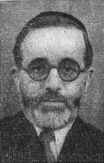
| Rabbi Yaakov Litman-Avtalion z”l |
Even if I live many more years I shall not forget the celebration of the Bikkurim [first fruits] ceremony in the year 5694 (1934). It was the first Bikkurim celebration in the schools in Poland. It started with a very impressive procession of hundreds of students, all carrying baskets of fruits decorated with flowers and flags. At the head of the procession were horse riders and following them were bicycle riders and the musical band. Behind them marched hundreds of young people from the youth groups in the towns nearby, every group carrying its flag. Masses joined them and marched to Goldberg Square, in one of the Kalisz suburbs.
The celebration took place on a spacious field. The ceremony included songs and dances. The income from the Bikkurim was designated for the Jewish National Fund (Keren Kayemet LeYisrael). Mr. Rosenthal, an eighty-year-old gentleman who had just returned from a visit in Eretz Yisrael, broke into tears of happiness, seeing such an authentic celebration even in the Diaspora. They said then, “Anyone who did not see this joyful celebration has never seen a true Jewish celebration in the Diaspora, in all his life.” [This quote paraphrases a Talmudic quote about the joy of the Sukkot celebration in Jerusalem].
The play Simchat Bet Hashoeva [rejoicing of the water libation ceremony, in the Temple of Jerusalem] that was prepared by the teachers and students and performed in the city theatre won a never-ending applause. The students proved that their level of knowledge of Hebrew was high. The artistic performance was praised by all.
In 5696 (1935-36), when the principal of the school went to Eretz Yisrael with his family, thousands of people accompanied him to the train station. The gentiles asked about the reason for this enthusiastic demonstration, and they were answered: “This is the way we express our deep spiritual connection with the land of Israel!”
By Sara Butzker-Neumann
Translated by Yocheved Klausner
It was common practice in Koło: when a Jewish boy reached the age of six, he was sent to the “Cheder” [religious school for young children], where he generally learned until he became Bar Mitzvah, at age thirteen. For a girl it was different: the rule was “whatever was possible” – that is, she was sent to learn at any place that was available. The biggest problem was tuition. Families blessed with children had to consider seriously how to save on expenses: tuition for three or four children was no small matter.
With the revival of Poland, the authorities established several elementary schools in town, where Polish and Jewish children studied together, without restrictions or discrimination. The families that could not afford to send the girls to the special School for Girls of the Chernozhil family found these government schools a great help. In the discussions among parents the excuse was often heard: in both schools Jewish subjects were not taught – neither Hebrew nor Yiddish!
I remember well the Polish elementary school, where I studied from the age of seven. It was located in a small building near the Warsaw Bridge, not far from the German Evangelical Temple.
The school was in poor condition. Compulsory education was a law on paper only. The parents, Jewish or Gentile, who fulfilled the obligation to give their children a proper education were few. No wonder, then, that the number of pupils was very small: the Jews did not often send their girls to school, especially schools that belonged to the “Goyim.” The poles had schools in their own Polish neighborhoods.
I remember a conversation between my parents: “After she finishes school we shall call the “melamed” [teacher of Jewish studies] and he will teach her a little to read the prayer book [sidur] and to write a Jewish letter.” This was the “spiritual heritage” of a Jewish girl.
I had never imagined, at the time, what was awaiting me in that school, where I felt like a prisoner among “goyim.” Only two Jewish girls were in the first grade, and most of the teachers were Polish Christians.
Since the number of pupils was small, two or three grades occupied the same classroom. One teacher would be in charge, guiding the pupils like the conductor of an orchestra. While two grades were busy practicing – writing, drawing etc., the other grade would listen to the teacher's lesson.
I was happy to have the opportunity to learn, but my happiness was marred by the frequent anti-Semitic remarks by my teacher, Ms. Kraschewska. The Jewish girls felt humiliated at every step. We suffered from the Polish pupils, who provoked us and we had no means of retaliation. We expected the teacher to protect us, but no help came, in spite of the poem we would always recite, with the beautiful line “The same sun is shining on all the inhabitants of the earth” – I think by the poet Stanislav Yachowitz. Every day and every hour we felt that we are in exile.
The Jewish children made every effort to study diligently hoping to earn sympathy. Indeed we were among the best students.
The afternoon hours, after school, were really boring. Our parents were busy with the worries of making a living, and our older sisters were busy doing their homework.
Teacher Kraschewska had a very interesting method in education: when she wanted to show her Polish pupils what discipline meant, she would call on a Jewish girl to serve as her “guinea pig,” would call out “show your hand!” and her wooden ruler would hit the fingers with a hard blow. Tears and protest produced another blow.
One day I came home sad and agitated. Al my desire to study was gone. I must admit that Ms. Kraschewska was not a bad teacher – she had opened my eyes to see things that I never knew existed, but… how can I experience joy in learning when it is accompanied by suffering and humiliation? I did not dare ask my parents to transfer me to another school, I was aware of their financial situation – they had to pay tuition for my older brother and sister.
Finally I managed to overcome my anger and frustration and I told my parents the entire story. They listened silently and I was hopeful. But after long moments passed, their verdict was:
“We all are in exile [“Galut”] and the Jewish children must bear their share of suffering! From this day on you will not annoy your teacher and you will make yourself invisible, you will not say a word unless you are asked!”
|
|
| The Government [public] Elementary School “Pawshechne” |
This did not seem very fair to me but I had no choice. I turned into a quiet mouse, wary of any unusual sound. Even when the teacher addressed a question to the entire class and I knew the answer, I did not open my mouth, for fear that the other pupils might get angry.
I avoided eating onion or garlic, because the children would laugh at the Jews “who smell of garlic.” I tried to ignore the cruelty of my neighbors in the classroom.
The situation became a little easier when we relocated to another building, not far from the railroad. There were 7 classrooms and the atmosphere was calmer. There were Jewish boys in the school as well, and sometimes they protected us, the girls. A “cold war” was going on between the Polish and the Jewish boys and threats were heard every day. Yet we tried to appease them: we helped them in their studies, we let them copy the answers from our notebooks and so on – but to no avail.
At first we were allowed to stay home on Saturdays. Later we were exempt only from writing on the Sabbath but we had to go to school. We were also allowed to be absent from the “Catholic Religion” class and we had heated discussions among us how to use this free time in the best way. For several months we had during these hours a Jewish teacher, Mr. Goldberg, who taught us Jewish history, but he soon left.
The principal of the school, who was a kind man, tried to obtain from the Jewish community a scholarship for the talented Jewish students, which would enable them to continue their studies at the Teachers College and join the “educational force”. He even organized in his home a preparatory program for a small fee, but all plans and hopes were called off and abandoned.
Graduation from the elementary school meant only more confusion for the girls. “What now?” was the frequent question. We could learn a trade, but we would be admitted only to sewing, embroidery and millinery courses. Household help was not appealing – we did not see a future in cooking and cleaning house.
Public and municipal institutions did not admit Jews. Only one in a thousand women could obtain a job at the Jewish institution – “The Merchants' Bank.”
When we finished the seventh grade we were unoccupied, idle. We would spend mornings in our homes helping out with housework and in the afternoon we would go “for a walk” on the famous Juzjinski walkway. We would also spend time reading novels.
However, the Zionist movement and the economic condition soon changed the attitude and outlook of the adolescent girls. A new way was in sight: immigrate to any country that would be ready to accept you, first of all to Eretz Yisrael, even if it would mean to break the blockade and endanger our own lives.
Announcement [Yiddish]
|
Invitation Dear friend! These days, when the struggle for the revival of the Jewish culture and tradition is continuing in the entire Jewish world, we cannot remain indifferent here. Moreover, lately we can feel intensely the weakening of the Jewish cultural ties and the increasing assimilation, especially among the younger generation. We call, therefore, on the Jewish public to join the struggle and help in the effort to restore and re-establish the Jewish and general cultural endeavors. We invite you to the first meeting that will take place in the hall of the Jewish Library, on Saturday 6 August at 3 p.m. On the agenda: 1. Our cultural work; 2. Report by Naftali Weinig: “Roads and Side-Roads of Modern literature.”
|
By I. Manoach
Translated by Mira Eckhaus
More than fifty years have passed since when, as a young man approaching his Bar Mitzvah, I walked from my hometown of Babiak to the provincial city of Kolo, a journey of twenty-two kilometers, in order to study Torah there. I went to study with Rabbi Meirel, whose name was famous far and wide.
I don't remember today what I took with me on my journey. And perhaps I had nothing with me except the prayer siddur and the tefillin that I was about to put on in a short time. My parents were poor and they could not afford to equip me particularly, and besides this I was like a fugitive from home - my soul was longing for Torah.
After a day or two, I huddled in the cheder of Reb Meirel, who saw in me nothing more than a desire to study, and left me with him until my parents would come and take care of all the arrangements for me. And indeed, so it was. A few days later, my mother, may peace be upon her, came, visited her relatives, and arranged for me meals provided by host families. And the week after that, my father z”l appeared and offered the Rabbi three rubles for tuition instead of at least five rubles that others paid. The Rabbi agreed. He believed him, my father, that even three was more than he could afford.
I remember my father's stance and I remember the things he said to me and to the Rabbi. According to my situation, he said, I should have been sent to “Talmud Torah”, where the study was at the expense of the community, but since he was my father and was obligated to teach me Torah, it would be better for him to cut down on food for himself and his family in order to pay the tuition fee, provided that he did not need the charity fund. The echo of the words and the way they were said were engraved in my memory and will never be erased from there. The Rabbi was apparently impressed as well, and a kind of closeness between him and my father. He always treated me with affection.
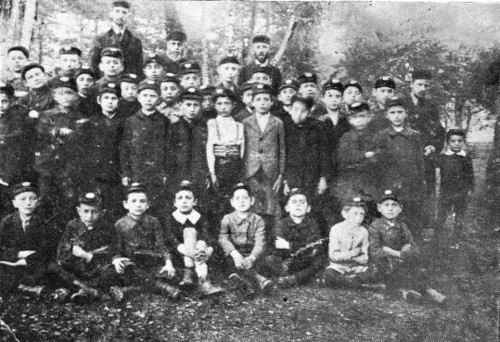
We were thirteen students in the cheder. I still remember some of them by name: Feibel Baharav, Yehuda Langens, Shmuel Eliyahu Schlesinger and Moshe Wolkowitz. We were a bunch of great mischievous children. Except for Moshe Wolkowitz – all of us were one united cheerful bunch, and we performed endless pranks and tricks. We did not reveal any secrets and did not speak evil of one another. Whatever happens, come what may.
The Rabbi's apartment was at the end of the street, on the second floor of a wooden house, belonging to a Polish farmer who grew pigs. At the entrance, we crossed a large yard surrounded by a high, sealed wooden fence. In this yard, which had several apartments and a toilet, we played our games in the dusk time, when Rabbi Meirel went for a short time to pray “Mincha” and talk to his friends about Torah, or when he was invited before noon for the “pidyon Haben”, because he was a Cohen. In this yard we prepared the snowball at the beginning of winter when the first flakes began to fall.
[Page 139]
from the sky; in this yard we climbed the high fence and split from it, at all its height, to the street sidewalk. We stood, in a line, bent to half the body, leaning with both hands on the right leg, we jumped, flew and slid, one by one, over their bowed heads, with laughter, gaiety and joy filling the space.
This is the place to praise the Polish gentile, the owner of the apartment. We troubled him quite a bit. Every time twelve brats like us went down the wooden stairs it was like an earthquake, as if a cart of stones were being overturned from a great height. And he bore it. The Rabbi, who apparently had remorse from our wild descending the stairs, often delayed us at the exit and made sure we went down one by one, one after the other, but we would linger downstairs, waiting until the last one arrived and the Rabbi entered his room. Then we would climb the stairs on our toes and “boom”!!! - a crazy slide. Rabbi Meirel also did not have a license to manage the cheder. And often when an inspector or a random policeman approached, the gentile would call out to him from below: “Meir, close the Gemaras”. And this was a warning sign and we would happily dodge and disappear with a quiet laughter.
There were two cheders in Kolo that could be called in today's terms: “secondary cheders”, one was managed by Reb Ephraim Shlumper and the other by Rabbi Meirel Salzman. The latter was known as the leading cheder and the most important and honorable.
The table which stood at the corner and was surrounded by benches on which we sat, filled a considerable part of the cheder. At its end stood Rabbi Meirel, half of his body leaning forward a little, bent, as if standing above the students. He was of medium height, and his modest face was surrounded by a thin black beard. I spent two study sessions in his cheder and I never remember him sitting down. He always stood with an expression of expectation on his face, listening intently. When he read his lesson and explained it, in a deep inner voice, and his eyes darted from student to student - more than he concentrated on the heads of the students who were focused on reading the Gemaras, he was concentrated in himself, in the voice that emerged from within him and took him completely captive. Every topic he would recite to our ears, the Talmudic dialectical discussion that seemed complicated to the ear, he would present simply; he would speak as if to himself, memorizing and enthusiastically and enjoying himself. Teaching was not a profession, an occupation from which he made a living. No! It was something sublime, it was a thing of great importance, on which the existence of the nation of Israel was depended, and he was privileged to deliver it to all the people. He did not teach for money, God forbid. He received a compensation for loss of productive time, but not compensation for teaching the Torah. Raeb Meirel considered the study of Torah as a mission, as a great commandment that gave meaning to his life. And indeed, he did his work with faith, love, and great devotion.
I will not forget how he suggested that I come to him early in the morning, before the others arrived, at five or six o'clock in the morning. This is how a loving boy suggests a meeting with his beloved girl. There was temptation in his voice and a promise. And indeed, I came. I remember his shining eyes and how happily we sat
[Page 140]
on a summer morning and we delved into the depths of studying the Gemara. And that joy returned every day. Always with open arms and the same appealing voice. It seemed as if he thanked me for allowing him to share with me his great love for Torah studies. Studying the Gemara in its pleasant and overflowing melody, which was full of desire to the unknown, swept with it all who come in its presence; truly - Rabbi Meirel was its most distinguished representative. He walked around the cheder, moving half of his body, while his hands are folded behind his back and his voice, which spread in the room, was filled with longing for higher worlds, a place where goodness and righteousness are faithful companions to all who engage in Torah for its own sake and with joy. And when we repeated the lesson, he stood still with his mouth slightly open, tension spread across his face and he was almost holding his breath. He was completely attentive, ready at any moment to jump in and instruct, correct, guide and explain, or curiosity mixed with joy replaced the tension: the soft voice of a well-behaved boy repeating the lesson caressed his hearing and his soul was filled with contentment. And so, it went on day after day, week after week, month after month. Such a state of mind, such constant readiness, cannot be bought with money. Because learning, teaching others, was his great love. He served the Creator with it, out of humility, happiness and modesty.
After about eighteen years, I came to Kolo again, as a representative of the Jewish National Fund. As I delivered my speech in the synagogue on Shabbat, between Mincha and Maariv, my friends from the cheder stood around me on the stage. When crowded and dense, they showed me their abundance of warmth, pride, and love.
The evenings I spent in Kolo brought back memories of those happy days. Where are those dear ones today?
I went to visit Rebbetzin Traina, of course, because Rabbi Meirel was no longer alive. She had moved to an apartment on the Fisherman's Street. She reminded me of how she used to stand at the entrance to the cheder, and I, seeing her, understood that she needed some help. I would immediately go out as if to go to the toilet (the Rabbi did not allow us to help the Rebbetzin), and she sent me to the store to buy some groceries, or to get a bucket of water from the pump at the church. One evening, after filling the bucket, I began to walk around in a circle with it at breakneck speed, excited by the fact that the water did not spill out of it. In the process, the bucket fell from my hand and broke. Of course, I did not return to the cheder, but ran fast to the shop of Chaim Wolf, a relative of my mother, on Beit Midrash Street, broke into it, grabbed a bucket and ran away. When they started chasing me, I shouted: “My mother will pay for it!”
We sat for a long time and talked about Rabbi Meirel and his passion for studying the Gemara, and his disdain for material things, until he didn't notice the shape of a coin. How happy the Rebbetzin was when she heard that his student had affection, admiration, and respect for him.
Kolo is preserved in my memory as a typical Jewish town with its old marks
[Page 141]
and its new marks. Jews of all kinds and shades on the street. Chassidic and dissenters, and also Zionists, and for them - a place of prayer called “Chevrat Zion”, and Moshe Kot was the head of the speakers. I would go there with Dudi Michael to pray every Shabbat morning.
On Shabbat afternoons we would walk to the grove beyond the bridge, in the direction of Kunin, led by Itzik Goldman and Falek Wolkovitz, members of “Hatchiya” society as members of “Tzei'rei Zion”.
I remember how I copied pamphlets in blue ink and they were distributed in the Beit Midrash, in stores and on the street. I no longer studied with Rabbi Meirel, but in the Beit Midrash, self-studying, and I continued to eat meals provided by host families. Suddenly I received a letter from my father z”l that my brother was sick and I should come visit him. I went to Babiak. They were very happy I came home and my father did not allow me to return.
Later I learned that when Rabbi Meirel noticed my alleged Zionist activity, and recognized my handwriting in the pamphlets, he quickly informed my father that I had drifted into bad culture, and that I had associated with bad company. The Rabbi, like my father Shlomo Shimon, and many others like them, believed that it was forbidden to rush the end and that: “You were sold for nothing, and you shall not be redeemed with money”, and they considered every Zionist act as apostasy in religion, heaven forbid.
Quite a few paid with their lives for this innocent and pure faith.
By Henekh Hirshbeyn
Translated by Janie Respitz
The teachers in Koło, the first well from which our generation drank and drew Torah and knowledge should not be forgotten! For the majority of the youth, they opened the door to Jewish knowledge and some planted their very good traits in the hearts of the Jewish pupils. The “Cheder” was simple and poor, but this was not the fault of the Melamdim, the teachers. Their livelihood was scant and the small tuition was never paid on time. The atmosphere surrounding them was not warm and their only joy in life was the pleasure of learning and they learnt together with the Cheder boys.
Today we cannot hold a grudge against their methods. This is what the parents wanted. They were against every innovation; they feared every little wind of change, thinking it may tear the children away from Torah and our city.
The teachers and their Cheders were divided in levels. The passage from one teacher to another was like transitioning to a higher class. The first class, in fact the beginning, was taught by grammar teachers.
The nicknames in the in the following list are not, God forbid, to diminish the honour of certain teachers, but we mention them because sometimes the nickname was more popular than their actual names.
Teachers Who Taught How to Read Hebrew
Yidke – taught girls and boys to read Hebrew, for example: to read the Siddur (Prayer book). Many girls learnt from him how to write a letter in Yiddish.
Reb Shmuel Itzik Roytbakh (the cotton teacher) – taught the alphabet and how to read.
Moishe Roytbakh (in the same house near the reiver) – taught the alphabet and how to read. Anshl Podamsky (Anshl the ox) – taught the alphabet, how to read the Siddur and the beginning of the Chumash (Pentateuch, Five Books of Moses).
Reb Fayvish Ber (Fayviye the hunchbacked) – Taught how to read the Siddur and the beginning of Chumash.
Chumash – Rashi Teachers[2]
Reb Avrom Yehuda Roytbakh: Reb Yisroel Goldman (The Warsaw teacher);
[Page 143]
Henekh (the mute Henekh): Efraim (Efraim summer tail); Yakov Zalmen Moladek: (taught in a sing-song).
Chumash – Rashi and Gemara[3]
Reb Hirsh-Ley: Kasriel Shaladovsky (his specialty was Bible and grammar); Reb Yosef Akiva Hirshbeyn – his specialty: Mishna (the first section if the Talmud with commentary and Gemara; Reb Tuvye Vilfred; Shimon Volf Erkher; Dobre teacher (the blond Kashtan)[4]; Ozer Tsorndorf – Cheder Metukn, (a more modern religious school beginning in the late 19th century), he taught Hebrew in Hebrew; Shike.
Gemara and Commentators on Jewish Law
Reb Meir Zatlzman (See the article by Yehoshua Manuakh); Reb Yisroel Vays; Efraim Shlumper (slob), Reb Yakov Aron Engel – Sofer; Reb Notteh Himl the Cohen.
The last few acquired reputations as scholars; they prepared their students for Bar – Mitzva, they taught literal interpretation, non-literal biblical interpretations and thought deeply about Talmudic lessons.
A few of them taught heads of the family in the evenings or on Saturday afternoons.
|
|
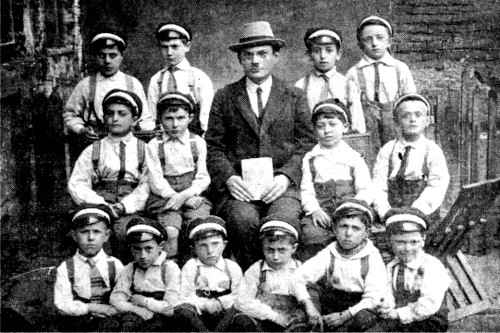
| The “Tree of Life” School |
[Page 144]
|
|
|
Seated (Below): –––, Volkovitch, –––, Zilberberg, Podkhlebnik, Levin Seated (Middle row): Kenig, Sol Makharovsky, Gliksman the teacher, –––, Dimant Standing: Shultz, Kenig, Raykhert, ––– |
|
|
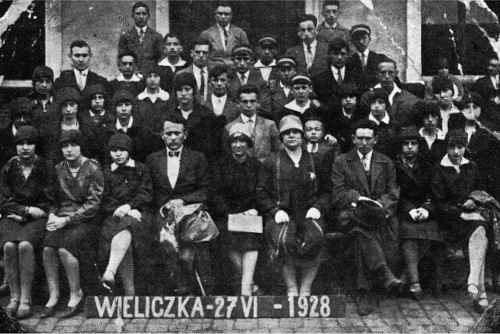
| Students visiting from the Hebrew High School in Vielitchke, 1928 |
Translator's footnotes
By H. Hirshbeyn
Translated by Janie Respitz
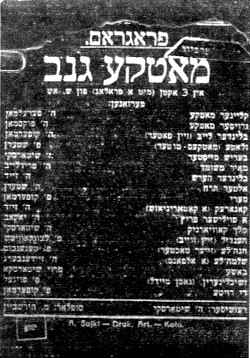
Purim plays: “Achashverosh”, “The Sale of Joseph”, and similar shows were performed in our city by Yeshiva boys and householders. The income went to various charities.
The beginning of the drama club and amateur performances is connected to the name Khaim – Ber Babiatsky. This was at the beginning of the 20th century. Babiatsky organized a group of theatre lovers and created an amateur group which performed mainly historical operettas like “Bar – Kochba”, David in the Desert”, “The Destruction of Jerusalem” and others.
Each performance was a celebration in town. No one refused to support or help however they could. The props were brought from all over town. A plush blanket was used as a king's toga, an armchair covered in gold paper – a throne. Of course, those who supplied those objects had free entry to the performance.
The second phase of the drama club began with a competition between two drama clubs, one was called “Aristocrats” and the other – “Democrats”. The main actors in the first one were: Levkovsky, Reslekh, Hella Cohen and the director was Leyb Brzhustovsky; the main actors in the second group were: Yakov Zayd (with the sidelock), Mikhl-Shimshon Brukshteyn, Malka Levkovitch and Shmuel-Leyb Firsht, the director – Dovid-Itzik Levkovitch.
Both drama clubs, as it happened in large theatres in town, prepared the tragedy “Medea”. Both did the same play. The population was divided in two camps: one with the first drama club, and the other with the second. They actually quarreled: who will perform this theatre piece better? In the end, the theatre was packed for both, the performances – magnificent. They would say: The Jews of Koło love theatre and cantorial music. In Koło, even the cobblestones sing…
[Page 146]
It is worthwhile to single out the director Dovid-Itzik Levkovitch (Yukif Matis) and praise him:
Dovid-Itzik was a simple man. His main income can from traveling to fairs selling ready made clothing. Despite his difficult financial situation, he never missed a rehearsal: in the heat of summer, autumn rains, winter frost, he would show up on time, among the first. Tired from the fair and worried: where would he find money to pay his outstanding promissory note? Nothing stopped him.
During rehearsals he was all eyes and ears: he listened with all his senses to every sentence said by an amateur, watched every movement and made corrections while providing instruction. He did his director's work with passion and simplicity.
The same Dovid-Itzik could be found Saturday afternoon in the House of Prayer, where he listened to every word spoken by Reb Khaim-Yosef Nasak, or Reb Bersih Shaladovsky and others who taught the ordinary Jews “Legends” and “The Life of Man”, explanations of Jewish law.
One time, I was present at a general rehearsal the night before the performance of “Medea”. His young daughter Malka, recited a piece pf “prose” and did not emphasize a sentence as she should have. It seemed to me; she did not say it with enough heart. Dovid-Itzik jumped at her and slapped her out of great agitation. This is how much he worried about the theatre.
Professional actors who spent some time with them gave all they had. The brilliant actor from the “Vilna Troupe”, Yakov Vayslitz, spent quite a bit of time in Koło, attracting the best talents and influencing them. His first production was “The Village Youth”. The following participated in the performance:
Yehuda and Soreh Barkovsky, Frankovsky, Mikhl Shimshon Brukshteyn, Nitchinsky, Henekh Hirshbeyn, the Raykhnshteyn sisters, Sokhochevsky, Rauf and others. The impression was colossal. The play was performed 10 times and also presented in surrounding towns. Vayslitz developed a love for art and encouraged better theatre among the amateurs.
The actor Ayzikovitch from America came to visit his relatives in Koło and stayed for a while. The following plays were performed under his direction: “Othello”, “Shylock”, “The Black Hand” and others. The biggest success was the “Black Hand”. It was also performed in surrounding towns: Dombia, Sampolna, Izhbitzia, Klodova and others.
[Page 147]
Stationary drama clubs were founded by the “Labour Zionists” (Left) and the “Bund”. The first was the best, rising, pulsating theatre, thanks to the entrepreneurial spirit of director Yehuda Barkovsky. A short time after it premiered in the Warsaw Yiddish Theatre, we performed it. In this respect, no one could be compared to him. Among the plays that attracted an audience with their freshness were: “The Dybbuk”, “The Sanctity of the Name”, “The Prince”, “Seven Hung”, “Innocent – Guilty”, and others. The drama club of the “Bund” under the direction of H. Hirshbeyn performed: “Two Hundred Thousand”, “The Robbers”, “Urial Acosta”, (before the performance a short lecture was given by M.H) as well as historical operettas.
From time to time the drama clubs united, combined efforts and performed a holiday fund raiser. Among the joint performances were: “Shabtai Zvi”, “The Hero in Chains” and others.
There was an effort made by individuals to create a private drama club, which had purely financial goals. The initiators of the “business” were: D.A Levkovitch, Yakov Zayd, the Raykhnshteyn sisters, and Shmuel Leyb Firsht. Given that the did not have periphery behind them, this drama club did not last long. They performed historical operettas and Yakov Gordin's dramas. The audience, which had tasted better theatre, took no interest in this drama group.
From “Wandering Stars”, half amateurs and half professionals, we must mention the Kruk couple. They lingered in town for a while and at first they were splendid. They performed light works which attracted an audience like: “Tzike Fire”, Khantche in America”, and heart wrenching melodramas. The theatre goers were looking for something different, they couldn't digest this repertoire. By the end the troupe was performing for half empty halls.
The best theatre troupes in the country came to play guest roles in Koło, in Yiddish and Polish. The city had a reputation of loving the theatre. A poster announcing performances by A. Marevsky, Zygmunt Turkov, Yanas Turkov, Ida Kaminska, aroused great interest. On the day of a performance, it was impossible to buy tickets as they had been presold. The same was with recitation evening with Rokhl Holtzer and other stars.
[Page 148]
The youth loved theatre. At gatherings it was the axis of conversation. They would retell and re-sing various theatre scenes. A master at this was Noteh Noyman (Notekhe Shpivak). When he allowed his voice to ring out freely in the middle of the street people came running in awe, people were enraptured by his singing.
When the common folk, manual labourers, would gather on a Saturday afternoon for a beer, they would take great pleasure in singing cantorial pieces: “The King”, “Sanctity”, “Sabbath Program” and the like. The main specialists were: Mendl Shtern (Mendl Sine's), Khaim Khmielnik (Shmuel Tcharniye's), Gavriel Markovitch (Popcorn), Shmuel Modolinsky (Shmuel the devil) and others.
These sincere simple folk, ordinary Jews, are no longer with us. They were tragically murdered by the Nazis.
|
|
||||||||||||||||||||||||||||||||||||||||||||||||||||||||||||||||||||||||
[Page 149]
|
|
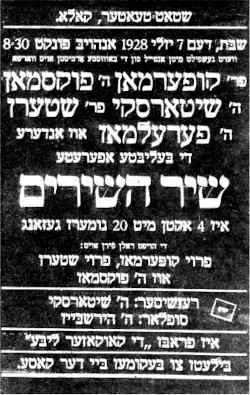
| A theatre poster from 1928 |
|
Municipal Theatre, Koło
Saturday Juli 7th 1928 Beginning exactly at 08:30
Mrs. Kuperman and Mr. Fuksman
Song of Songs In 4 Acts with 20 songs Playing the lead roles are:
Mrs. Kuperman, Mrs. Shtern and Mr. Fuksman
Director: Mr. Shitarsky Prompter: H. Hirshbeyn In rehearsal: “The Caucus Love” Tickets at the box office. |
[Page 150]
|
|
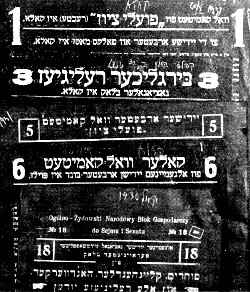
| Election poster for the Jewish parties |
|
|
JewishGen, Inc. makes no representations regarding the accuracy of
the translation. The reader may wish to refer to the original material
for verification.
JewishGen is not responsible for inaccuracies or omissions in the original work and cannot rewrite or edit the text to correct inaccuracies and/or omissions.
Our mission is to produce a translation of the original work and we cannot verify the accuracy of statements or alter facts cited.
 Koło, Poland
 Yizkor Book Project
 JewishGen Home Page
Copyright © 1999-2026 by JewishGen, Inc.
Updated 12 Feb 2026 by JH