|
|
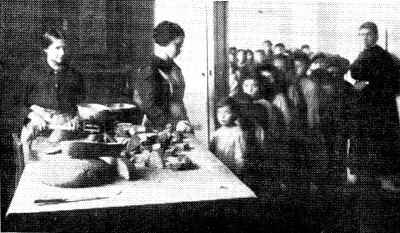
At right: Teacher and caregiver Sonia Starodub |
|
|
[Column 198]
Translated by Guillermo Levrio
1. A Year of Calamities, Accusations, and Deportations
In the first days after the outbreak of the First World War, government institutions were evacuated from Grodno. The families of officials and military personnel departed, and about half the city's residents left with them. Life in Grodno came to a standstill. Industrial enterprises ceased operating, and the banks closed. Some were entirely unable to return their customers' deposits and never reopened, among them the Landau brothers' bank, where ordinary people had deposited more than one million rubles.
Many Jews, particularly shopkeepers, artisans, and workers, lost their savings. Only the Jewish popular loan and savings association, with more than two thousand members, continued striving to repay depositors a portion of what they had entrusted to it.
Nearly all Jewish social-welfare institutions closed because their buildings were requisitioned as military hospitals. Most of the orphans and elderly residents of these institutions were taken away from borderland Grodno and moved eastward to Slonim.
[Columns 199-200]
Educational institutions closed entirely or curtailed their work, and the Hebrew pedagogical courses were transferred into the Russian interior.
The cost of living rose because transportation and imports had become difficult, and the sellers–the Jews–were blamed. Accusations against the Jews intensified and multiplied as the Russian army retreated from Suwałki and Augustów and refugees streamed into Grodno.
The Jews, embittered against the Russian tsarist regime because of its discrimination and persecution, indeed sympathized with the Germans and hoped that they would finally bring the longed-for equality of rights. Nevertheless, they remained entirely loyal to the wartime laws of the state. Some even believed that Jewish distinction on the battlefield would at last earn equal rights under Russian rule itself; among these were people who displayed excessive patriotism.
The terrible defeats of the tsar's army, however, demanded a scapegoat, and one was found in the “treacherous” Jews. Rumors spread among Grodno's Christian masses that the son of the industrialist Shereshevsky had been captured in a German airplane shot down over the city and that a search of the manufacturer's premises had uncovered an enormous sum supposedly intended for the Germans. Another fabricated tale claimed that an underground telephone linked to the German camp had been discovered in the home of Grodno's government-appointed rabbi.
Several months after the war began, the military authorities ordered Grodno residents “without permanent employment,” as well as women, children, and elderly people, to leave the city. When those affected did not hasten to become refugees bound for unknown destinations, the authorities threatened forcible deportation and tried to persuade the rabbis to encourage voluntary departure.
The beloved rabbi, R. Moses Judah Rabinowitz, delivered a sermon before the people in the Great Study House about the necessity of setting out on the road. Trembling and sobbing, he opened the Ark and cried in supplication before it: “Master of the Universe, take my soul, but save the people!” He collapsed and never rose again.
In 1915, a considerable portion of Grodno's Jews were indeed deported into the Russian interior. Some had first gone to nearby Minsk, but most were transported to distant provinces, particularly Voronezh and Penza, and some to Elisavetgrad, now Kirovograd, in Ukraine.
Those who remained in Grodno began to be conscripted for forced labor at the fortress and for cleaning army camps–tasks to which most Jews were unaccustomed. When some proved unable to withstand the backbreaking work imposed upon them, they were pointed out to the non-Jewish laborers as lazy and indolent.
Grodno's Jews did much that year to help the many refugees from the surrounding area who crowded into the city and filled its synagogues and every place in which they could be housed. An inexpensive kitchen was opened for refugees and the poor, and assistance was provided to the families of mobilized soldiers in addition to what they received from the government.
Grodno's Jews awaited the coming days with great fear. Reports arrived from places that the Russian army had evacuated and later retaken, telling of Cossacks and retreating soldiers running wild and abusing the local Jews. When the Russians began evacuating Grodno and battles raged near its fortress, a rumor spread among the soldiers that Jews were sheltering German scouts in their homes. Cossacks from units covering the retreat thrust their lances into cellars identified as belonging to Jews. Residents had sought shelter from the gunfire in those cellars, and in some cases Jews were dragged from their hiding places and killed.[1]
On September 2, 1915, the German troops of Kaiser Wilhelm II captured Grodno.
2. The German Occupation
The Occupation Regime, Distress and Hunger, and New Livelihoods
After the German Kaiser's army captured Grodno, its Jews breathed more freely. The nightmare of constant fear for their physical safety had been removed, and they had been delivered from a regime that had discriminated against and oppressed them for generations.
According to the occupiers' figures for 1916, only 24,451 inhabitants remained of the approximately 63,000 who had lived in the city before the war. For a time after the Germans entered, municipal affairs and the militia were administered by a Citizens' Committee of residents, which had not been chosen in any election.
For the first time in the history of Grodno's Jewish community, Jews now participated in the city administration and civil guard in large numbers and on an equal basis. The deputy chairman of the Citizens' Committee was also Jewish: the dentist Dr. Mordechai Anzelowitz, mentioned earlier. For several years he held powers and responsibilities of great importance in the life of Grodno Jewry. Born in 1868, he died in America in 1925. The occupiers also displayed a friendly face toward the Jews, with whom they could, to a considerable degree, find a common language in the literal sense.
Yet a harsh regime immediately took hold in the city, as throughout the occupied territory. Forced labor was imposed upon everyone not employed in essential work; there was a strict curfew, movement was restricted, food could neither be brought into the city nor taken out, and severe shortages arose in food and the most
[Columns 201-202]
essential commodities.
Prices soared. Anyone who still had monetary savings was stripped of them when residents were ordered to exchange their money for worthless paper notes. Trade stopped because goods disappeared from the market or were hidden for speculation, smuggling, and the black market. Private and institutional houses and apartments were requisitioned without limit for the occupying army. Residents were ordered to “sell” the new authorities, for worthless pennies, every household object made of copper and other metals, including kitchen and eating utensils.
Various restrictions and humiliating decrees were imposed upon the “local” population, including the requirement to remove one's hat before every German officer and yield the sidewalk to anyone in uniform. Before long, disease and epidemics caused by hunger and poor nutrition struck Grodno, particularly its poorest people, and claimed victims.
Alongside all this, the German occupation brought several positive developments. Hundreds of Grodno's Jewish refugees who had remained within the occupied territory were returned to their homes in a city where only about forty percent of the population remained. The new authorities also opened employment to Jews in fields from which the tsarist regime had always excluded them.
Large numbers of Jews found work on the railway, provided they were suitable, and were sometimes even given a degree of preference because they could communicate with the Germans in their language. Others worked in the postal service, army warehouses, power station, waterworks, and elsewhere. Jews who knew some German were employed particularly as clerks, interpreters, and foremen in German-run municipal institutions, various government offices, and the militia.
In time, some Jewish industrial enterprises that had stood idle since the occupation resumed operations, chiefly to serve German needs. The cigarette factory, sawmills, Feingold's foundry, and flour mills, including Asher Kosovsky's large mill, reopened. The military authorities also established a jam factory employing many Jewish men and women. Some Jews went to nearby towns, where they found plots of land to cultivate, while eventually Jewish workers were also invited to work in Germany itself.
On the other hand, many Jews developed a clandestine “home industry,” strictly forbidden but highly profitable because it served the black market. It included tiny flour mills, grain grinders, oil presses, stills for spirits, and improvised tanneries. Smugglers and black-market speculators multiplied in the city. “Cafés,” establishments previously almost unknown in Grodno, also proliferated. They served as places for dubious dealings with German guests, who not infrequently sought the company of young women whose livelihood depended on this new “branch” of commerce.
Against the background of general impoverishment, a new class of wealthy men soon began to emerge. Unlike the city's former prosperous families, who had departed, these newcomers inherited none of their predecessors' generosity.
Wartime conditions, especially during the German occupation, also contributed to a partial breakdown of traditional life among sectors of Grodno Jewry. Some were compelled, and others became accustomed, to working on the Sabbath, particularly in essential and military services.
The Committee of the Jewish Community and Devotion to Relief Work
Within a short time, the administration of the city's internal civil affairs passed entirely to the district authority of the occupying army and its commanding officers, who in practice allowed nothing to be done without their knowledge, order, and supervision.
Even the nominal status of the Municipal Citizens' Committee, soon supposedly reconstituted “from all classes and occupations of the inhabitants” and including eleven Jews, had little real value. Its name was reduced to Municipal Advisory Committee, and its composition left it unable as a body to raise its voice or present demands displeasing to the severe military authority.
The Jewish members of the Advisory Committee, in alphabetical order, were Dr. M. Anzelowitz; Golda Olga Volkobstein; Eliezer Gelgor; Dunsky; Moses Halperin, representative of the “suburb”; the lawyer Abraham Zadai; B. Sakheim; Joshua Sukhovlansky; Leib Slutzky; Dov Klempner; and Moses Isaac Krikstansky.
On their behalf, Rabbi Abraham Gelbord approached the occupation authorities shortly after they established control over the city and asked permission for the Jews to elect a communal representation that would care for their special needs. The military authority agreed on condition that it be a temporary committee administering charitable arrangements and Jewish religious requirements.
The establishment of this appointed “temporary committee” in effect laid the cornerstone for a Jewish communal authority in Grodno recognized by the government–a representative body that would eventually also be elected.
Jewish public opinion, however, was dissatisfied with the composition of an appointed community committee. After some time, complicated elections were held, resulting in a body called the Committee of the Jewish Community of Grodno. It was elected by “electors” representing the regular worshippers in the prayer houses and by
[Columns 203-204]
additional representatives of the intelligentsia who did not belong to that category.
The committee's membership was later reduced, its authority curtailed, and its name changed to Great Charity, with Dr. M. Anzelowitz as chairman. This purported substitute for an elected representation of the Grodno community endured until the end of the German occupation.
Although most veteran activists and intellectual leaders had left the city, new and devoted public forces now emerged among Grodno's Jews, particularly from working circles and the younger generation. They found a broad field for action, principally outside both the community committee and the advisory committee.
The entire system of Grodno's social institutions had been destroyed: their buildings and equipment were requisitioned by the army, while their philanthropic supporters had moved into the Russian interior. New institutions had to be established and means found to sustain them.
Within a fairly short time, a low-cost public restaurant, a workers' kitchen, and a consumers' cooperative organized by workers were established. The cooperative undertook to distribute rationed goods and supply several additional necessities without adding a profit.
A Children's Shelter, popularly called the Kinderheim, was founded to rescue abandoned infants and small children from refugee and prisoner families and from among the poor. The finest members of the educated Jewish youth, many of whom had previously been distant from the affairs of their people, now volunteered wholeheartedly for this noble rescue enterprise and for its establishment and maintenance.
The Children's Home opened early in 1916 at the initiative of several women, and a special association was soon formed to care for it. Through its efforts, the institution later moved into a spacious, attractive house surrounded by a garden on Alexander Street, later Jagiellońska. The number of children housed there reached 220.
|
|
At right: Teacher and caregiver Sonia Starodub |
The children received generous and devoted nourishment and care and were occupied with lessons and games. Municipal institutions and the German military rabbi, Dr. Erich Winter, also provided assistance, but the institution owed most to the faithful devotion of its many supporters.
Those who distinguished themselves in their work for the Children's Home included Samuel Osterinsky, J. Sukhovlansky, both of whom later occupied central positions in the city council and elected communal administration, and the medic Samuel Garber.
The teachers and caregivers included Penina Pasha Rabikov, who founded Grodno's first Hebrew kindergarten in 1911; the physician and public worker Dr. Rachel Gershuni; and, among the younger people, Baruch Kasin, mentioned above, Sonia Starodub, later the well-known actress Altboim-Domb, and others.
The relief association Shaarei Ha-Ezra had also been active in Grodno since 1915. It supported afflicted and needy families with money and bread and indirectly through the institutions it established: a free-loan fund, a bakery, and a consumers' cooperative. Through these, the association guaranteed those it assisted their full ration of goods and supplies, together with a small supplement, and saved thousands from starvation.
Its activists, drawn from local householders' circles and including many Zionists, worked to secure regular donors, arranged performances and other benefit events, and obtained assistance from the Hilfsverein der deutschen Juden in Berlin.
R. Moses Isaac Krikstansky, a merchant who rose to public prominence during these years, was chairman and one of the founders of Shaarei Ha-Ezra. As mentioned above, he served on the Municipal Advisory Committee and at the same time was deputy chairman of the community committee. The printed source gives his dates as 1947–1945.
In time, the home for the elderly and the orphanage were also restored, though on a reduced scale.
A Revival of Jewish Cultural Life
A great transformation occurred during the German occupation among the Jews of the occupied territory, and in Grodno in particular, in linguistic and cultural life. The city's advocates of Russification were the first to leave for territories now beyond the front. Those who remained were cut off from the Russian source of inspiration and, as the war continued, no longer appeared likely to return to it.
Educational and cultural institutions and the public libraries that had disseminated Russian culture were closed. Among them was the municipal library, successor to the public library once established by Grodno's Jewish maskilim, which was now plundered.
When the Germans later established a system of elementary classes for
[Columns 205-206]
Jewish children, they prohibited the teaching of Russian. Instruction was conducted in Yiddish, although the occupiers tried to introduce the influence of German language and culture among the teachers, some of whom were new to the profession.
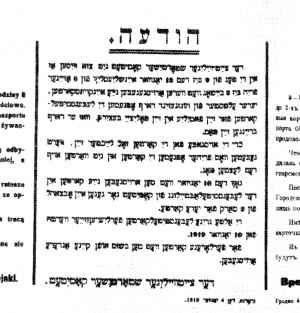
The authorities published their notices and orders not only in German but also in Polish and Yiddish. The official local newspaper, the Grodner Zeitung, appeared in those same three languages.
Yiddish, the people's language, had always been regarded by most Jewish national circles as an important bulwark against assimilation. It now received favorable external support as well, for the Germans correctly regarded it as a means of weakening Russian influence among the Jews and, as the occupiers believed, of opening avenues toward Germanization.
One of the first innovations marking the altered status of the people's spoken language was the presentation of plays in Yiddish. The occupation authorities now allowed occasional performances for the benefit of Great Charity, the Children's Shelter, and similar charitable purposes. This continued an experiment begun under the tsarist government, when attempts to stage Yiddish plays in Grodno had been crushed in their infancy by the authorities.
Two Jewish amateur companies were now organized simultaneously. One presented operettas and included Kadish Hash and Michael Trilling among its actors. The second presented drama under the leadership of S. Garber, later deservedly known as the “father of Jewish theater in Grodno.” Garber fell at the end of 1942 in a battle in the Lipiczany forests of Belarus when the Jewish partisan unit to which he belonged was attacked.
Beyond their linguistic novelty, the performances offered an opportunity to gather somewhere other than a house of prayer and provided a little diversion from the gloom weighing upon the Jewish public under the severe curfew and other burdens of the occupation regime.
Several later well-known figures of Yiddish theater emerged from these companies, among them Shimon Finkel of Habima and Sonia Altboim-Domb of the Kaminski troupe.
Literary Circles, the Jewish Art Association, and the Kibbutz
Young people now displayed a welcome and innovative initiative of their own. With winter and its long nights, they were confined to their homes by a curfew beginning in the early evening. They suffered isolation and hunger–both literally and figuratively–for culture and spiritual experience, thirsted for some form of entertainment, and had little opportunity to read because the libraries were closed and their homes remained dark.
Several young people, including former students of the Grodno yeshiva and Isaac Levinstein, later one of the pillars of Tseirei Zion in the city, therefore began secretly organizing nonpartisan Youth Literary Circles. Groups of ten met once a week in the home of one of their members.
Within a short time, four circles were formed for young men and women over eighteen, followed by three for adolescents. An additional circle operated in the suburb Across the Niemen.
These young people could breathe more freely. Timidly and reverently, they came one at a time to the appointed place and hour to attend a supposed “birthday celebration” on a weekday evening or enjoy “Kiddush” on the Sabbath, while a faithful lookout stood guard against the evil eye.
They now “sanctified” their gatherings through a reading by one member from the works of Peretz, Nomberg, Abraham Reisen, or another Jewish writer, followed by the assembled company's “commentary” on the work and its author. Sometimes the meeting was devoted to a lecture or conversation prepared by one of the members on a public question that occupied them, generally one of the great issues of Jewish life: antisemitism and its causes, the future of the nation in light of its past, the language question among the Jewish people, and similar subjects.
When a lecturer addressed a controversial question, as happened fairly often, disputes piled upon disputes and sometimes became heated and passionate. Everything was conducted–in itself an innovation among educated Jewish youth–entirely in the people's spoken Jewish language, Yiddish.
Each meeting ended with a “news section” from the Jewish world, presented by the member responsible for the chronicle. This was a youth whose German exceeded that of his companions and who drew what he considered relevant from an important Berlin newspaper or from a sparse, censored Yiddish daily that arrived from Vilna or distant Łódź and happened to reach his hands.
From time to time, the circles also held a general gathering disguised as a “wedding” or “engagement ceremony.” At Hanukkah and Purim, such celebrations continued under an especially strong “security guard” until morning, when the curfew ended. They included poetry recitations, Jewish folk melodies, and a “living newspaper.” Its climax was a witty satirical section about the “wedding,” improvised and created on the spot by “special correspondents” and edited by the “groom” himself, Isaac Levinstein.
By early 1917, however, the day of the literary circles was drawing to a close. The adolescent groups had gradually crystallized through their
[Columns 207-208]
ideological debates, defined themselves as Tseirei Zion, and sought to engage in actual movement work. They separated into their own association.
In addition, a broad, legal framework for Jewish cultural activity now arose in the city: the Association for Jewish Art. Members of the circles also joined it.
The Youth Literary Circles had flourished during a period of social and public paralysis. They offered their members spiritual pleasure, broadened their knowledge, drew them together, and brought them into the concerns and problems of their people. Above all, they provided a training ground for a substantial reserve of young activists in Grodno Jewish social life, especially in the leadership of the city's Bund, including Chaim Dvorzhetsky, Leib Schiffert, and others, and among those who founded and developed the renewed Tseirei Zion movement.
After much labor and effort, a group of activists from Grodno's popular Jewish intelligentsia, headed by the late Dr. Mordechai Boroditzky and Noah Bass, who later perished in the Holocaust, obtained permission from the occupation authorities to establish an association for presenting Yiddish plays “for charitable purposes.” This became the signboard of the new institution, Yidishe Kunst–the Association for Jewish Art–known to the public simply as Kunst. It was also permitted to open a club and, under certain conditions, arrange lectures and other activities consistent with its stated purpose.
The association's attractive premises opened in March 1917 at a central location on the corner of the main street, Sobornaya–later Dominikańska–and Masons' Square, later Batory Square. The very establishment of a Jewish club, especially in the city center, was a surprising innovation for Grodno's Jews, as was its entire arrangement.
The visitor's first impression was created by portraits dear to the Jewish heart looking down from the walls: illuminating photographs of Sholem Aleichem, I. L. Peretz, Mendele, Frug, and other Jewish writers, together with works by the painters Pinchas Minkowski, Samuel Hirszenberg, and other Jewish artists who gave expression to the life, hardships, and bitter fate of their people.
A reading room was arranged in the club. It carried every important general newspaper from Germany and the few Jewish newspapers published in the occupied territory and in Germany. There was even a corner for chess. Everything was well lit and conveyed a warm atmosphere that invited visitors to linger, enjoy a little recreation, and meet without fear to discuss public affairs.
After a time, a substantial library was also established, containing the best Yiddish books–and later Hebrew books–that could be obtained. It was then the city's only Jewish public library.
The Association for Jewish Art began its public work by presenting popular evenings in the municipal theater for the benefit of Great Charity. Their programs included dramatic sketches by Jewish writers performed by the drama company sponsored by the new institution.
The association earned particular distinction when it decided to invite the Vilna Troupe to Grodno. This celebrated theater, founded in the Jerusalem of Lithuania, had begun touring other cities with plays by Peretz Hirschbein, Leon Kobrin, Sholem Asch, David Pinski, and other Jewish dramatists. For Jewish audiences, its appearance was an event and even a revelation: proof that the nation had indeed produced a drama theater of a high standard, presenting the creations of its people in their own language.
That same season, the association also began systematic, continuing work to publicize Yiddish literature–and later Hebrew literature–and draw the public toward it. Every week, a weekday evening or Sabbath night up to the curfew was devoted to a Jewish writer and his works. In time, these literary evenings encompassed the finest creators of Yiddish literature.
The program opened with a lecture on the evening's subject. Selections from the author's stories or poems were then read to the audience; poems that had been set to music were sung; and from time to time the evening concluded with Jewish melodies played on the concertina by Reuben Vigdorovich, a teacher trained in the Hebrew pedagogical courses who later perished in the Holocaust.
The association knew how to draw excellent lecturers and readers from among Grodno's residents and visitors who were well versed in Yiddish literature. They included the inseparable pair, the writer and poet Abraham Zak and the late poet Leib Nidus. At the end of 1916, even before these evenings began, the two had published in Grodno a small literary collection entitled Nieman, printed by J. Milakhovitz and edited by Nidus.
Both men presented the association's audience with their own writings, particularly their latest work, reading it themselves from the stage with expressive intonation. Abraham Zak also lectured frequently on Yiddish literature and its writers.
Leib Nidus, born in 1890 and deceased in 1918, came from a well-to-do family and grew up on the Kostin estate near Kuznica. He was the cherished child of Jewish Grodno: handsome, captivating, and overflowing with life in his everyday manner and in his poetry, which embraced the world and soared toward the heavens. Richly jpgted and one of the great creators of rhyme in Yiddish poetry, he brought into Yiddish literature the beauty of Japheth and
[Columns 209-210]
the fragrance of the fields.
The Jewish youth of Grodno gathered around Nidus in the halls of Kunst. They especially delighted in his melodious singing as he accompanied himself at the piano, drawing Jewish dance tunes–a kosher tantz, a dance of feigned anger, and the like–from the treasury of his beloved grandmother. At such moments, the entire circle of young people seated around him was swept up by the rhythm of his melodies. Yet Nidus himself, who gave so much pleasure to others, lived in straitened circumstances. To the sorrow of his admirers, he died in the flower and fullness of his powers, without having received during his lifetime, because of wartime conditions, the recognition he deserved.
|
|
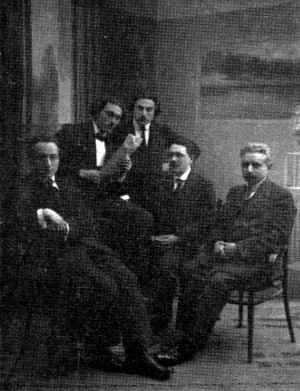
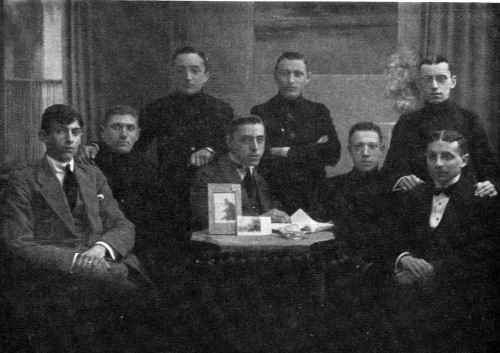
From right: Noah Bass, Dr. Mordechai Boroditzky, Abraham Zak, Leib Nidus, and Baruch Kasin |
Alongside its literary evenings, the association arranged lectures for the public on literary subjects and general questions of Jewish public life, delivered by speakers of distinction. Some were local residents, among them Dr. Mordechai Boroditzky, one of the Zionist leaders, and Dr. Wolf–Abraham–Lipnik of the Bundist school, who had returned from Russia and had already been active as a revolutionary in Grodno at the beginning of the century, initially also in the P.P.S. At a later period, speakers representing various currents were invited from outside the city. They included the late men of broad learning Dr. Herman Frank and Shimon Rawidowicz, as well as Joseph Yashunsky, who perished in the Holocaust, and may they live long, Jacob Pat, Jacob Zerubavel, and others.
In time, the association also introduced a lecture series on science, philosophy, and literature. Particularly prominent were exponents of Marxist doctrine: Samuel Kaltzky, one of the Bund's intellectuals in Grodno; Dr. Rachel Gershuni, born in 1878, who likewise guarded the ramparts of that movement and whose life ended during the Great Aktion in the Grodno ghetto in January 1943; and Samuel Osterinsky, a teacher and public activist from the United Party, which had arisen from the union of two formerly socialist-territorialist groups after they abandoned territorialism as an immediate demand. These lecturers spoke about political economy and concepts belonging to, and inspired by, historical materialism. By contrast, the Hebrew Zionist Hillel Isser Janowski presented chapters from Jewish history.
The crowning achievement of Kunst's program, however, was its periodical “Living Newspaper.” In addition to literature and poetry, it contained a public-affairs section and, above all, a humorous one that became the center of the audience's attention. Frequent contributors to the literary section included, besides Nidus, who also used the name Leonardo, and Abraham Zak, who wrote as Alpha, the delicate late Karina Eckstein, later Lustig, daughter of the rabbi of Kuznica, who died in Ramat Gan; Zvi Tarlovsky, who wrote as Tar-ski and later perished in the Holocaust; and others.
In those days, the public-affairs and especially the humorous section had exceptional importance as an expression of free Jewish public opinion on matters that could not be raised in the censored local newspaper. Representatives of the authorities–German Jews loyal to Germany–were indeed present in the hall when the “newspaper” was read, but they did not scrutinize it too severely. Nor did they always grasp the deeper meaning of a parable or a sharp, telling, and richly allusive phrase in popular Grodno Yiddish, through which the writers aimed their arrows. What was said from the Kunst platform quickly spread among the broader public and sometimes even influenced those at whom it had been directed.
The sections of the “Living Newspaper” generally had regular contributors. Among them were Alpha, with his column “The Week's Landscape”; Nidus, with satirical and humorous verse; and the teachers Jacob Domblansky, who wrote as R. Yedidya, and Spearstein, with their feuilletons.
Jacob Domblansky was born in Eishishok in 1876. He studied at the Slobodka yeshiva, where he received rabbinic ordination. He devoted himself to education and taught in the Hebrew Pedagogical Courses in Grodno and in the city's schools during the First World War. He also wrote and published feuilletons under the name R. Yedidya.
Beginning in 1920, Domblansky taught at the Real Gymnasium in Kovno and, in the evenings, at the Tarbut seminary. He continued to write feuilletons and articles on educational subjects, as well as stories, and composed Hebrew textbooks. He perished in the Holocaust after the Nazis entered Kovno.
Under pressure from the Hebraists among its members, the Association for Jewish Art eventually opened evening classes in Hebrew. It also founded a Gymnastics League, which later formed the basis for Maccabi and the other Jewish sports organizations that arose in Grodno.
As hunger intensified in the city and speculation and distress spread ever further, Kunst established an important social-economic institution as well. In spacious new quarters that it rented–the Bergmann house, later the Margalit house, on Batory Square, which under Russian rule had served as an assembly house for the nobility–the association opened, at Noah Bass's initiative, a cooperative restaurant for the middle class. In practice, it principally served members of the intelligentsia. It saved many from the shame of hunger by making it possible for those who did not engage in profiteering to obtain a midday meal at a reasonable price.
During the more than two years of its existence, the Association for Jewish Art gathered around it a devoted and active circle of public workers and writers. In addition to those already named were Baruch Kasin and Isaac Levinstein, who devoted much of their energy to the institution's library; Tanchum Greenshpan; Samuel Garber; the brothers Mordechai and Nahum Krinsky; Benjamin Weller; and others.
With more than five hundred members, Yidishe Kunst thus became the center of Grodno's cultural life at the time: a meeting house for the intelligentsia and the young, a voice for democratic Jewish public opinion in the city, and in a broader sense a true people's house.
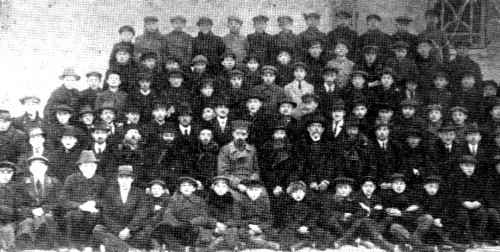
Traditional Grodno–the Grodno of Torah scholars deeply immersed in learning–did not stand still during the German occupation either. At its outset, yeshiva students stranded in the city and unable to return to their places of study joined local young men and several learned householders to lay the foundations of an outstanding Torah institution: the Great Yeshiva, Shaarei Torah. Later, when Rabbi Shimon “Breinsker” Shkop assumed its leadership, it became one of the foremost yeshivot in Lithuanian Jewry.
[Columns 211-212]
|
|
Seated in the second row from the bottom, from right: 1, unidentified; 2, Moshe Salman; 3, unidentified; 4, teacher Yakir Lande; 5, Isaac Vasilishsky; 6, unidentified; 7, R. Y. M. Z. K.; 8, unidentified; 9, the German army rabbi Dr. Erich Winter; 10, the head of the yeshiva, Rabbi Moses Wolfson; 11, R. Joseph Leib Nendik, the yeshiva's spiritual supervisor; 12, Liubitz, one of the trustees; 13, the founder of the yeshiva, R. Reuben Soloveitchik Fifth from the left in the bottom row: Peretz Sandler Standing sixth from the right in the third row from the bottom: Moshe Bezalel Shapira, later a minister in the Government of Israel |
At this stage it was a kibbutz, a gathering of young men who devoted their time to the study of Talmud, its commentaries, and the legal decisors. They had been educated in the yeshiva tradition and wished to continue their studies and broaden
[Columns 213-214]
their knowledge.
“The institution is administered by a committee of the students themselves together with several householders,” wrote “A Citizen”–Hillel Isser Janowski–in a report entitled “From Jewish Public Life in Grodno,” published in the Warsaw Ha-Tzefirah on January 16, 1920. “More than one hundred young men study there, receiving bread and one meal at the institution's expense. The young people endure the disgrace of hunger and, in its wake, illness.” It was, as noted, a tender sapling destined to flourish into a magnificent tree. More will be said of it later.[2]
3. The Russian Revolutions and the German Revolution
In Days Pregnant with World Events
The year 1917 brought fateful changes to the world at large and to the Jewish world alike.
At the beginning of March came the joyful surprise: revolution in Russia. The tsarist tyranny was overthrown, and the Jews there attained equal rights. Fresh, reviving spring winds began to blow across the eastern front into the German-occupied territory and to leave their mark upon its inhabitants.
In November the Bolshevik Revolution broke out. By the middle of December, it had brought an armistice with Soviet Russia.
For some time, indirect reports had been filtering through from Eretz Israel about the hostile designs of the Turkish commander Jamal Pasha against the Jewish Yishuv and, later, about the expulsion from Jaffa. At the same time, word arrived of a Jewish battalion fighting the Turks on the Gallipoli Peninsula, most of whose soldiers were Jewish volunteers expelled from Eretz Israel.
In November, considerably delayed, the Berlin Zionist newspaper Jüdische Rundschau brought heartening news to the Jews: the Balfour Declaration, announcing Great Britain's favorable view of establishing a national home for the Jewish people in Eretz Israel and England's promise to use its best endeavors to facilitate that objective. At the same time, it became known that the British Army had captured Jaffa and was advancing toward other parts of the country.
Great joy spread among the people. To many, it seemed that the messianic days were approaching–days of complete redemption for Israel both as a nation and as human beings.
Yet after the armistice, a question began to trouble and agitate the minds of Grodno's Jews: under the rule of which state would they ultimately find themselves once the peace treaty was concluded? Rumors and conjectures multiplied.
Meanwhile, beginning in August 1918, groups of residents who had left or been expelled from Grodno and spent the war years in Russia began returning to the city. Not long afterward, prisoners of war and civilians who had until then been employed at forced labor in Germany also came home.
The difficult conditions then prevailing in Grodno–unemployment, shortages of food, and exorbitant prices–are vividly revealed by reports published only after the German Revolution brought a fundamental change of government and censorship was relaxed to some degree. Two accounts appeared when the newspaper Nashe Utro, Our Morning, resumed publication early in 1919: V. D-B's “Grodno in 1918” in the first issue of January 1, 1919, and Samuel Kaltzky's “The Terrors of Hunger” on January 16.
At precisely the time when the city's population was increasing from day to day, the Germans began liquidating enterprises established for wartime needs that had employed many people. Unemployment spread throughout Grodno on a large scale. The returnees were the first to suffer: most arrived destitute and could find no economic foothold.
At the same time, food and other necessities became ever scarcer, and the prices of the tiny quantities still available rose without limit. Germany itself was then suffering an acute shortage. Its authorities not only ignored the local population's cries for provisions but accelerated the removal of what little remained in the occupied territory to the German homeland. German officers responsible for the residue sold it to the highest-bidding profiteers, who hid their purchases and, above all, smuggled them out of Grodno and its surroundings to places where even more severe shortages offered still greater opportunities for easy enrichment.
The outcry of the masses grew so intense that the rabbis at last intervened, employing the gravest weapon in the traditional Jewish arsenal: a ban of excommunication against food smugglers, profiteers, and their accomplices. The ban was proclaimed publicly, with all its customary rites and legal forms, in a ceremony unlike any the Jews of Grodno had witnessed in their generation.
On October 7, 1918, the Grodner Zeitung reported, all work ceased and every shop closed at four in the afternoon at the rabbinate's call. An immense crowd, young and old, streamed toward the Great Synagogue, rapidly filling it and its courtyard. Some even climbed onto the roof to witness the rare event. Inside, the lighted chandeliers were draped in black, and two biers stood beside the Holy Ark.
Three rabbis preached at length about the deprivation, hunger, distress, and death inflicted upon the people through the sins of those who raised prices. When they finished, the shofar sounded. In the presence of the entire congregation, the “Rabbinical Court of Justice of Horodna, with the consent of the townspeople and the agreement of the rabbis of the district,” imposed a severe ban
[Columns 215-216]
and excommunication for one year, until the coming first day of Elul, upon the offenders: “May all the curses fall upon them and upon their heads, and may they be set apart and excluded from all the sanctity of Israel in this world and the world to come,” and so forth.
Meanwhile, uncertainty about the city's political future deepened. Neighboring peoples that had established, or imagined that they would establish, states of their own coveted control of Grodno and its surroundings. The Poles were particularly eager. They based their claim upon “historic rights” and could also draw upon their position among the city's local Christian minority.
At the end of October, persistent rumors spread that, for the first time since the Russians had left Grodno, threatened the physical security of its Jews. It was widely asserted that the Poles intended to stage a street demonstration accompanied by attacks upon Jews. Registration for a Jewish self-defense force was even announced.
At that very time, the Jews returning from Soviet Russia sang the praises of a wondrous new world. Jewish young people listened enviously, especially to stories of educational institutions at every level whose gates had not only been opened wide to all, but whose aspiring students received assistance from the authorities. Quite a few Grodno Jews, chiefly among the young, consequently set out eastward for the land of the Soviets.
A “Grodno Republic”
A highly significant change occurred in Jewish public life in Grodno after revolution broke out in Germany on November 11, 1918. With the fall of the Kaiser's government and entourage in the homeland, general authority in Grodno passed to the Soldiers' Council of the local German garrison. Internal government was entrusted to a Temporary Municipal Committee composed of representatives of all the city's national groups, together with a substantial workers' delegation.
Zvi Tarlovsky, then involved in the city administration, later related in Unser Grodner Express, April 18, 1929, that when the revolution began, the local German Soldiers' Council first decided to leave Grodno together with the rest of the occupied eastern territory known as Ober Ost. On instructions from the German general staff on the eastern front, however, German troops remained in the city for many more months. The command feared that forces still stationed in Lithuania and Poland might be cut off from Germany and unable to return home should Poland refuse them passage through its territory. Grodno therefore became a kind of German enclave even when Bolshevik forces that had occupied Vilna and Lida approached from the northeast and Polish legions advanced from the south as far as nearby Sokółka.
With the change of government, the occupiers' pressure upon the population lost much of its force. The way opened for public and party activity and for organization. It seemed that true days of freedom had finally arrived for the Jews of Grodno. Democratic elections were announced for a local Jewish representative body, the community committee, and for institutions representing the population as a whole, the city council and its executive.
Workers organized an international trade-union movement in which the predominantly Jewish membership exercised the principal influence. Later, a general Council of Workers' Deputies was also established, aspiring to govern the city and likewise containing a Jewish majority. Parties and public currents in the Jewish street now organized openly and energetically appealed to the public, particularly the young.
According to an announcement by the new military authorities published in the Russian-language local Nashe Utro on January 3, 1919–the paper had now resumed publication, partly in Yiddish, after an enforced suspension of three years and four months–the Germans transferred to the Temporary Municipal Committee “several branches of administration, such as food supply, charity, taxation, hospitals and schools, construction, as well as food stocks and several enterprises.” The military authorities recognized the committee “as the sole representative of the local population and, in that capacity, entitled to military protection.” The announcement added that until the German Army's complete evacuation, executive authority, including in municipal affairs, would remain exclusively in German hands.
Grave problems now confronted the Temporary Municipal Committee, which was to serve until the permanent city council was elected in March 1919. Sixteen of its thirty-six members were Jews: Leon Abramsky, Samuel Osterinsky, Noah Bass, Dr. Mordechai Boroditzky, Hillel Birger, Ephraim Weiss, Moses Waldman, Bernard Sakheim, Shlomo Yanovsky, Abraham Jaffe, Abraham Menas, Aryeh Marder, Joshua Sukhovlansky, Israel Sokolovsky, B. Kasin, and M. I. Krikstansky.
Personal security in Grodno deteriorated first of all. The German garrison had been reduced and no longer possessed its former authority. Robberies and even murders became frequent on the outskirts of the city and especially along the roads leading to it. This further complicated the already precarious supply of food and other necessities.
[Columns 217-218]
|
|
of food-ration cards |
The stream of people returning to Grodno had not ceased, and the shortage in the city grew steadily worse. To these difficulties were added all the problems arising from the transfer of the municipal economy and its various administrative systems out of the occupation government's hands.
The workers' faction occupied an important place on the Temporary Municipal Committee. It had been elected at a meeting of representatives from factory workers' committees, trade unions, and socialist parties. Its Jewish members–Dr. Wolf Lipnik, Aryeh Marder, Abraham Menas, Hillel Birger, Reuben Smolichansky, Israel Sokolovsky, and Abraham Sheikovsky–were all Bundists.
The committee was headed by Edward Listowski, a Pole who had served as mayor under the tsarist government and had also gained the confidence of the Jews. Hillel Birger, supported by the strong workers' faction, now joined him as an active deputy chairman.
Following a plan drawn up by Birger, a municipal militia was organized to preserve internal security and ensure execution of the Temporary Municipal Committee's instructions in specified areas. Jews again received important appointments: Jaffe became deputy commander, Bernard Sakheim secretary, and others district officers. Most members of the militia were Jews.
The Temporary Municipal Committee thus began to carry out the other comprehensive tasks of internal government, work later continued by the city's permanent elected administration.
From the beginning of the committee's existence, friction arose between the representatives of the Polish minority, who demanded preferential rights in the city administration, the militia, and other bodies, and the Jewish members, who insisted upon their rightful share. The dispute delayed an orderly transfer of the municipal economy from the Germans and effective treatment of the urgent problems of unemployment, distress, the high cost of living, and speculation. These conditions worsened continually and weighed most heavily upon the poor and the working public.
The workers' faction therefore called upon laborers to establish an organization of their own at a higher level: a Council of Workers' Deputies modeled upon those formed in Vilna and other cities during the revolutionary period.
On December 18, 1918, representatives of all the socialist parties–among the Jewish parties, the Bund, the S.S., and Poalei Zion–together with delegates from trade unions, industrial workers' committees, and other bodies met for consultation in the former Officers' Club, now a meeting house for workers of the various revolutionary currents. A nine-member organizing committee was elected. Its Jewish members included Hillel Birger, Samuel Osterinsky, Abraham Menas, Reuben Smolichansky, Epstein, and Leib Schiffert.
On January 28, 1919, the international Council of Workers' Deputies held its festive inaugural meeting in the municipal theater. One hundred and three delegates from all the bodies mentioned above represented 4,400 voters, including prisoners of war, former soldiers, and unemployed workers. The socialist parties also received additional representation.
The delegates' political mood can be judged from the affiliations declared by eighty-three of them: twenty-five were Communists and six more Communist sympathizers; twenty-five belonged to the Bund, then divided into two wings over their attitude toward the Communist regime; six belonged to the S.S.; and two to Poalei Zion.
When the Council of Workers' Deputies elected its executive, it included four Communists; three Bundists, one of whom was a Communist; one Socialist Revolutionary; and one representative of the S.S. On February 4, 1919, the council declared that its purpose was to prepare itself to become the city's sole administrative and judicial authority. It also resolved to introduce the eight-hour working day in every workplace in Grodno. This second decision was subsequently carried out in practice.
In the meantime, however, the military authorities prohibited the council from operating legally and prevented it from attaining the principal objective it had set itself.
Founding the Democratic Jewish Community
Meanwhile, elections to the Jewish community committee were conducted with great preparations on December 29 and 30, in full accordance with democratic principles.
[Columns 219-220]
Eight lists competed for the Jewish voter's confidence and support. Together they offered 101 candidates. The lists, their leading and elected candidates, and several of the other candidates were as follows:
Greetings were delivered by Grodno's senior and veteran rabbinic judge, Rabbi Abraham Gelbord, followed by representatives of associations, parties, and institutions. Among them were the teacher Chaim Gornitzky, owner of the Tushiyah school, who spoke in Hebrew on behalf of the Hebrew teachers; Isaac Berl (Dov) Rabin for Tseirei Zion; Reuben Vigdorovich for the Gymnastics Association; Samuel Garber for the Children's Home; Aba Tarlovsky for Hechalutz; Nofech for the Hebrew Speakers; Brobarsky for the Construction Workers' Union; Jacob Domblansky for the Teachers' Union; Guta Epstein for Poalei Zion; and Moses Trop for the Commercial Employees' Union.
When negotiations began over the composition of the community committee's executive, all the internal difficulties created by the election results immediately became apparent. Two powerful wings confronted each other: the Zionist and Orthodox delegates on one side, and the Bund together with the United Party and Poalei Zion on the other. The balance was held by the three artisans' representatives, who lacked a consolidated political and public position on the basic questions before the committee. The inaugural meeting was therefore forced to adjourn without result.
The committee's composition continued to shape its work after its officers and commissions were elected at subsequent meetings. Dr. Abraham Lipnik of the Bund was chosen chairman; M. I. Krikstansky, an Orthodox Zionist, first deputy; and N. Palnitzky of the artisans, second deputy. The Zionist Hillel Isser Janowski and Zvi Tarlovsky of Poalei Zion were elected secretaries and members of the executive. Its other members were Noah Bass; the Bundist Reuben Smolichansky; the Orthodox Moses Wolfson, later elected the community committee's first treasurer; and Eliyahu Kaplan of the United Party.
The principal commissions–finance, welfare, education, and communal property–were also appointed. The last was responsible for the building in which the committee was now housed after the Germans vacated it. The education commission consisted of Noah Bass; Dr. Mordechai Boroditzky; Moses Wolfson, who also worked on behalf of the yeshiva kibbutz; the jurist Abraham Zadai; the Bundists Chaya Lipnik and Abraham Menas; and Joshua Sukhovlansky of Poalei Zion.
The committee set about repairing the condition of the community, introducing order, and restoring its ruined institutions. When it took up the most urgent problem, education, however, it again divided into two camps. A hard and prolonged struggle developed over the place of Hebrew in the curriculum of the community schools. A compromise was finally reached: instruction would be conducted in Yiddish, while at least nine hours a week would be devoted to Hebrew.
The question of education and responsibility for its burdens was also bound up with the community's fundamental autonomous status. At one of its first meetings, the community committee resolved to demand that the Temporary
[Columns 221-222]
Municipal Committee–the city's recognized internal legislative and administrative body–transfer to the autonomous Jewish community all matters concerning culture and welfare among Grodno's Jews. It also demanded a portion of the authority required to administer those matters and the administrative and practical means necessary to carry them out.
Before the Temporary Municipal Committee could consider the Jewish community's demand, elections were held for the permanent city council.
The Elected City Council
Grodno's city council elections were conducted according to democratic principles on February 27, 1919. Of the thirty-six members elected, twenty-four were Jews, corresponding to the Jews' share of the city's population. According to a census conducted by the Germans and later published in a statistical survey of Grodno for 1924–1926, the city's population in 1919 was 23,491: 15,504 Jews, or 66 percent; 7,110 Poles, or 30 percent; and, among the remainder, 449 Russians and Belarusians.
The Jewish lists together received 8,741 of the 13,037 votes cast. The United Socialist Bloc–the Bund, Poalei Zion, and the United Party–received 4,182 votes and twelve seats: Dr. Abraham Lipnik, Hillel Birger, Joshua Sukhovlansky, Samuel Osterinsky, Israel Sokolovsky, Shalom Epstein, Abraham Menas, Judah Lipnik, Zvi Tarlovsky, Isaac Beresh, Abraham Sheikovsky, and Leib Schiffert. Other candidates included Ephraim Kopelman, Chaim Dvorzhetsky, Abraham Zak, Samuel Kaltzky, Abraham Kimchi, Eliyahu Kaplan, Moses Adin-Lipnik, and Kobrinsky.
The Jewish Democratic Bloc received 4,151 votes and eleven seats: Dr. Mordechai Boroditzky, M. I. Krikstansky, the dentist Helena Lubitz, Abraham Epstein, Moses Halperin, Noah Bass, Chaim Mordechai Kimchi, Shlomo Yanovsky, Nahum Palnitzky, Judah Kron, and Bernard Sakheim. Other candidates included the attorney Leon Abramsky; Dr. Zachariah Wisberg, formerly physician to the Hebrew Pedagogical Courses; Abraham Pomerantz; and Abraham Jaffe.
Tseirei Zion, few of whose members were old enough to vote and only a handful old enough to stand for election, received 232 votes and one seat: Leib Goldschmidt, later Aryeh Gad. Other candidates were Isaac Levinstein, Aaron Zandman, Sheime Amdursky, and Benjamin Schiffert.
The list of Jewish prisoners of war and soldiers received 176 votes but no seat.
The city-council election was conducted in the city's three languages: Polish, Yiddish, and Belarusian. When the result became known, the Polish delegates demanded decisive authority in the municipality and the office of mayor. The Jews refused to surrender their rights as the decisive majority of Grodno's residents, especially because their share among municipal taxpayers was greater still. For the sake of peace–and doubtless also because of their assessment of who would govern the city after the Germans departed–they nevertheless agreed to elect a Polish mayor, Edward Listowski, who had also headed the Temporary Municipal Committee and enjoyed the population's confidence. With no alternative, the Polish delegates likewise accepted the arrangement.
Joshua Sukhovlansky was elected deputy mayor. Two municipal secretaries, one Polish and one Jewish–Zvi Tarlovsky–were also chosen. Two other Jews, Hillel Birger and Shalom Epstein, became members of the municipal executive, and several Jews were appointed directors of departments responsible for municipal services, economic affairs, and education.
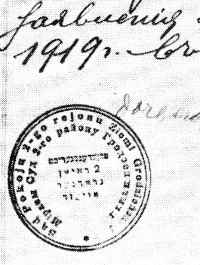
The Jewish councilors spoke Yiddish at meetings, while the others used Polish and Belarusian. All official documents and forms were prepared and published in both Polish and Yiddish, and the municipal seal likewise bore both languages.
As the democratically elected representative of the population of an isolated Grodno, dependent upon no sovereign national government of its own, the city council now fulfilled many functions of a state. In addition to the municipal militia, it established its own courts with elected judges and assumed control of part of the local prison. In principle, the city council was also responsible for importing goods into the city, exporting them, and imposing duties upon them.
The people's courts established by the municipality received jurisdiction over criminal proceedings formerly tried in the district court before a jury, as well as over civil matters. Each tribunal consisted of one professional judge and two lay judges. The number of judges and arbitrators reached eighty-five, forty-five of them Jews.
|
|
| Seal of the District Magistrates Court in Grodno, January 1919 |
The first trial took place on April 4, 1919, when a
[Columns 223-224]
German soldier was prosecuted for robbery. It was an exceptional event. At the opening of the proceedings, it was noted that for the first time after an interval of twenty-five years, locally elected judges were sitting on a Grodno court and that, for the first time ever, one of the judges was a woman: the jurist Helena Epstein.
The chief judge and organizer of Grodno's courts was the attorney Augustin Steinberg, one of the city's oldest and most popular jurists. He provided legal assistance to the poor and defended them in court without expectation of payment.
Steinberg was born in Brisk in 1852 and settled in Grodno in the late 1870s after receiving his degree in St. Petersburg. He practiced there until his death in 1924. Among other cases, he helped defend the attorney A. Z. Hillerson, who was prosecuted for a forceful speech against the tsarist authorities following the 1906 Bialystok pogrom. Hillerson's case was heard in the Grodno district court. Steinberg was active in several Grodno charitable associations and headed some of them.
During this period, the Grodno municipality financed the budgets of both Jewish and Polish educational and welfare institutions, and elementary education was provided free of charge. The community schools then had 1,500 pupils. Street names were inscribed on signs at every corner in Yiddish as well. Many Grodno Jews believed that the dream of equal communal life alongside the gentiles in the Diaspora, and the vision of extensive Jewish national autonomy, had become a reality in their city.
The Organization of the Workers
Immediately after the revolution in Germany, feverish activity toward trade-union organization arose in Grodno, and unions were founded one after another. Within several months, nine trade unions embracing about two thousand workers, including industrial employees, were active in the city.
Among the largest unions–whose members were overwhelmingly Jewish and some of which had existed clandestinely even before the German Revolution–were the tobacco workers, including employees of Shereshevsky's factory, with 300 members; metalworkers, including those at Feingold's foundry, also with 300; bindery workers, including employees of Langbord's factory and of Lutenberg's box factory, likewise with 300; commercial employees and clerks in public and municipal institutions, the largest union in the service sector and the leaven in the dough of the trade-union movement; and the needle workers. Among the principal activists of the commercial employees' union were Samuel Garber, Reuben Smolichansky, Moses Trop, and Jacob Borda.
The unions in the leather, printing, and baking trades were smaller. Teachers also formed a separate union. Its first committee consisted of Shmaryahu Badilkes, Elke Bass, Reuben Gordon, Chaim Gornitzky, Greenshpan, Jacob Domblansky, Levin, Joshua Sukhovlansky, and Miss Zuckerman.
The unions worked vigorously to introduce the eight-hour day. They also won substantial economic improvements, particularly wage increases of 100 to 150 percent for tobacco workers, bakers, needle workers, and clerks.
On its own initiative, the union of commercial employees and municipal and public workers established a central bureau, a kind of federation of the city's trade unions. Its purpose was to make strikes possible even in less developed trades or those employing few workers, to organize new unions, and to develop Grodno's trade-union movement.
As related above, union members were highly active in political and municipal life, particularly through the election of the workers' faction to the Temporary Municipal Committee and the creation of the Council of Workers' Deputies.
In the cooperative sphere, attempts were made to organize short-lived working collectives in the leather and needle trades. Workers' consumer cooperatives continued to operate, and efforts were also made to establish a federation of all the city's cooperatives, including those belonging to the artisans and to Shaarei Ha-Ezra. A temporary five-member bureau was elected. Its members included Moses Trop, the driving force of the workers' cooperative; Reuben Smolichansky; and N. Palnitzky of the artisans.
The workers' consumer cooperatives then operating in Grodno were as follows:
The Workers' Cooperative, with its own bakery, had been founded in 1916 at the initiative of several Bund members and had reached 1,300 members by 1919. It did much to ensure honest distribution of rationed goods, provided its members with an additional bread ration, and maintained the stated price of every commodity. It also established its own butcher shop to distribute meat and attempted to develop cultural activities.
The workers at Shereshevsky's tobacco factory maintained a cooperative shop and bakery. Their cooperative also leased a plot of land on which to grow potatoes for its members.
A cooperative workers' restaurant was likewise in operation.
[Columns 225-226]
The strongest of the Jewish socialist workers' parties in Grodno during the period under discussion was the Bund. Its large share in the workers' representation on the Council of Workers' Deputies, in the workers' faction of the city council, and on the community committee has already been noted.
At the same time, however, a rising wave of Communist activity could already be felt among Jewish workers and young people, particularly students. As noted above, the local Bund itself also contained a Communist wing.
The group gathered around the United Party, principally members of the intelligentsia, was active as well. Its activists did much in municipal affairs, welfare, and culture. Among them were Samuel Osterinsky and Abraham Zak. Leib Nidus had also belonged to this circle, while Joseph Rubinroit was one of the activists of the Workers' Cooperative.
Members of Poalei Zion, who will be discussed further below, were also active.
The Zionist Movement Emerges from the Underground
After the German Revolution, the Zionist Organization was reestablished in Grodno and, for the first time, began operating legally and openly.
During the harsh years of the occupation, only Tseirei Zion had been active in practice and in secret. At first its association consisted solely of boys and girls aged eighteen and under who broke away from the Youth Literary Circles and founded their organization early in 1917. They chiefly engaged in cultural work–studying Zionism and its problems, acquiring knowledge of Eretz Israel, and similar subjects by their own efforts–and worked on behalf of the Jewish National Fund.
They established contact with the Zionist Organization in Germany and widely distributed its newspaper, Jüdische Rundschau, and the monthly Der Jude, edited by Martin Buber. In 1917 they also laid the foundation of a tiny and likewise secret Zionist library. It became the nucleus of Grodno's important Hebrew and Zionist library, where J. H. Brenner would later read from his works.
Their first representative body, the committee of these young founders of Tseirei Zion, consisted of eight members. Half came from the fifth Youth Circle for Jewish Literature, which had led the ferment through which several of the literary circles crystallized into Tseirei Zion groups. These four were Judah Stolarsky-Sneh and Israel Schiffert, together with Chaim Pasmanik and Dov Rabin, the last survivors of the secret Zionist boys' circle Metulla, which had already existed in Grodno in 1914.
The other half consisted of two members of the seventh circle–the late Shlomo Volikov, who perished in the Holocaust, and Isser Kulik–together with the late Joseph Eisenstein-Barzilai and Alexander Kasin. All except Schiffert and the late Volikov later became pioneers of the Third Aliyah.
In time, several supposedly older young people joined them, among them the late Isaac Levinstein and Aryeh Goldschmidt, as well as the Hebrew teacher Joseph Draznin.
Aryeh Goldschmidt-Gad, born in 1896 and deceased in 1952, later became one of the leaders of the Ein Harod community in Eretz Israel. Among his many accomplishments were his work for the security of the Yishuv and his part in organizing the food convoys to Jerusalem during the siege.
Joseph son of Menachem Ha-Levi Draznin was born in 1878 in a village near Skidel. The oldest member of Tseirei Zion in Grodno at the time, he was a jpgted and enthusiastic teacher who loved Zion and Hebrew with all his heart and soul and wove ambitious dreams of communal life in Eretz Israel and of the road leading there.
He had studied at the Grodno yeshiva and in the city's Hebrew Pedagogical Courses and taught in elementary schools and the orphanage. In the early 1920s he emigrated to Argentina, where he became a pioneer of Hebrew education and instruction, particularly at the Jewish colony of Moisés Ville. There he established and directed a teachers' seminary inspired by the pioneering ideal. He died there in 1953.
Important new forces were soon added to the enlarged Tseirei Zion association formed in 1918, which developed energetic and enthusiastic Zionist activity, especially among the young. They came from students returning from Soviet Russia, who increased the movement's strength and standing, deepened its consciousness, and invigorated its intellectual life.
Among them, particular mention should be made of Tuvia Zamkov, who later perished in the Holocaust and devoted himself to developing the physical strength of Jewish youth through sport; and Isaac Izersky, who quickly endeared himself to members of the movement in Grodno and its vicinity through his qualities as a person and companion, as an educator and broadly learned orator, and as an exponent of popular socialist Zionism. He later became one of the leaders of Poalei Zion in England.
During that summer, Dr. Luba Helprin, another of those who had returned to Grodno from Soviet Russia, achieved great success in explaining the movement's ideas and foundations and raising its standing among the young. He returned to Russia a short time later.
The first committee of the enlarged Tseirei Zion association included the late Joseph Draznin, chairman; Aryeh Goldschmidt; Isaac Levinstein; and Miriam Schiffert-Gornitzky, together with Joseph Zeitzel-Ben-Artzi, Aba Tarlovsky, and Dov Rabin.
[Columns 227-228]
|
|
From right: Joseph Eisenstein-Barzilai, Alexander Kasin, Isser Kulik, Chaim Pasmanik, Dov Rabin, Israel Schiffert, Judah Stolarsky-Sneh, and Shlomo Volikov, who later perished in the Holocaust |
Sheime Amdursky, Benjamin Weller, and the teacher Zeidel Tchernichovsky were also elected to the committee but did not accept their positions.
The vision of Tseirei Zion was to immigrate to Eretz Israel at the first opportunity. By the beginning of 1919, a Hechalutz association had already been established in Grodno on the initiative of the Hebrew teacher Benjamin Krainovich and through the efforts of members and supporters of Tseirei Zion. It became the reserve from which Grodno's Third Aliyah to Eretz Israel would be drawn.
Benjamin Krainovich was born in Szczuczyn in 1896. He studied at the yeshiva there and afterward at Mir, settled in Grodno, and taught at the Tushiyah school. For a period, he lived with his family in the nearby town of Oziory. Several years later he returned to Grodno and remained there until the Holocaust.
Among Tseirei Zion's other achievements was the renewal of Poalei Zion activity in Grodno. Tseirei Zion sought to win for Zionism and immigration to Eretz Israel not only the young and those lacking any secure economic standing, but also Jewish industrial workers and other manual laborers established in their trades.
Those workers who belonged to trade unions, however, had grown accustomed to hearing from their spokesmen and activists nothing but condemnation of the national revival movement and Eretz Israel. Tseirei Zion therefore believed that an explanation formulated in the spirit of Poalei Zion might draw these laborers toward the urgent questions determining the Jewish people's historical destiny and toward the message of the new Hebrew Eretz Israel. This was so even though many members of Poalei Zion at the time generally placed little immediate urgency upon the “Palestinism” of their distant vision, and still less upon immediate, voluntary pioneering immigration.
At Tseirei Zion's initiative, a meeting to found a Poalei Zion association was therefore convened on October 18, 1918, and a branch of the party was established in Grodno.
The new association's principal undertaking was the establishment of a club called Borochov House on Zamkova Street. Lectures were held there from time to time, generally by visiting speakers from the centers of the
[Columns 229-230]
movement.
As related above, Poalei Zion also took an active part in the elections to the community committee and the city council.
Its activists included veterans of the movement such as Benjamin Weller, Abraham Rebykov, and Zvi Tarlovsky, who had once participated in the Jewish self-defense unit organized by the party at the beginning of the century. They were joined by several younger members of Hechalutz, among them the teacher Saul Kalko, later the noted Hebrew grammarian Dr. Bar-Kelay; the association secretary Joshua Pomerantz, the late Yiddish writer and poet Alexander Pomerantz, who died in the United States; and Akiva Shklarsky, who perished in the Holocaust. Mordechai Feder was also active, and later Gershon Gershuni, subsequently Dr. Gershuni, one of the spokesmen for the Ahdut Ha-Avodah-Poalei Zion party in the State of Israel.
Circles of Orthodox young people also organized an active association called Tevunah. It arranged lectures on religious and Torah subjects at its club, which included a reading room and a corner for chess. One of Tevunah's leaders was the late Berl Krikstansky.
Berl Krikstansky–later Rabbi Dov Maayani, rabbi of the settlement of Magdiel–was born to R. Moses Isaac and Rivka née Shapira in 5663 and died in 5712. He studied at the Hafetz Hayim yeshiva in Radin and, after immigrating to Eretz Israel in 5685, at the Slobodka yeshiva in Hebron, where he was known as Berl Grodner and distinguished himself as an outstanding student. He also studied at the Rabbinical Seminary in Berlin.
In 5695 he was appointed rabbi of Magdiel, where he established a Talmud Torah and a yeshiva that he headed. A jpgted speaker and Agudath Israel activist, he became known for his humility and for quietly assisting the poor and destitute–qualities inherited from his mother.
During this many-sided wave of organization, secondary-school pupils also established associations. They had been preceded by young students who in 1917, with permission from the German occupation authorities, organized a cultural society called Di Yidishe Tsukunft, The Jewish Future. It too conducted its work in Yiddish, in a club established in a basement beside the Horodniczanka stream in the middle of Muraviev Street, later Orzeszkowa Street. One of its activists was Samuel “Molye” Hurwitz, later a farmer in Motza Illit.
The changing times now brought these young people an invaluable jpgt. Not only did the city's secondary schools, closed throughout the war years, reopen, but Jewish public workers simultaneously established two coeducational gymnasia without the decades-old ten-percent restriction of the tsarist numerus clausus or the other evils that had accompanied Jewish study in Russian gymnasia. One of the two new Grodno schools followed a scientific curriculum. The other was humanistic and called the Jewish Public Gymnasium of the Community Committee. Its directors were Moses Waldman and his wife Lyubov, née Ostrogovsky.
Ironically, the very flourishing of Grodno's many associations, each with its own current and purpose and with vibrant life in its premises–from the Casino, formerly a recreation place for tsarist army officers and now the central meeting house of the workers' unions and parties, to the Center, home and club of the city's Zionist institutions–caused the Association for Jewish Art to lose its luster.
Most of its supporters had now found centers of activity in the urgent spheres of public life, and the halls of Kunst steadily emptied. A faithful group, including Samuel Garber, Abraham Zak, Isaac Levinstein, Milishkovsky, David Sofer, Nahum Krinsky, and others, continued to labor to preserve the Association for Jewish Art, but its dissolution had already become inevitable.[3]
Original footnotes
|
|
JewishGen, Inc. makes no representations regarding the accuracy of
the translation. The reader may wish to refer to the original material
for verification.
JewishGen is not responsible for inaccuracies or omissions in the original work and cannot rewrite or edit the text to correct inaccuracies and/or omissions.
Our mission is to produce a translation of the original work and we cannot verify the accuracy of statements or alter facts cited.
 Hrodna, Belarus
 Yizkor Book Project
 JewishGen Home Page
Copyright © 1999-2026 by JewishGen, Inc.
Updated 17 Nov 2026 by JH