 |
|
[Page 160]
By Ze’ev Finkelstein, Melbourne
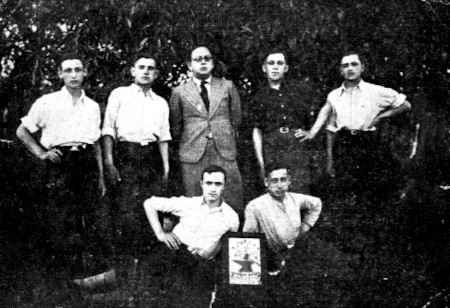
I was born in Frampol, and lived there for my whole life until the outbreak of The Second World War. I was active in the community, in the Zionist Organization and in ‘HeHalutz’, together with an array of other friends.
On September 1, 1939, when the war broke out, we did not succumb to so strong a panic. Frampol was located far from the large city centers and principal roads, of train crossings. Optimists believed it possible the storm of war will pass by the shtetl, not touching it. Pessimists however, argued that a brutal and terrifying war is drawing near, and in contrast, The First World War would seem like child’s play.
As soon as the order came out to make the place dark, groups of Jews and Poles gathered on the streets and discussed the nearing danger. We, the Jews, knew that our Polish neighbors are weaving dark plans against us, as they get ready, in the height of the fire of war, to settle ‘old debts’ with us, being infected with anti-Jewish incitement and hate.
The panic caused by the war nevertheless burst into the shtetl when waves of refugees entered from western Poland, both Jews and Poles. The management leadership committee members of the community – Shmuel Joseph Kestenbaum (President), Chaim-Yehuda Harman (a grandson of the Rabbi of Frampol), Abraham-Lejzor Lichtfeld and others, whose names I cannot recall at this time, looked after viding order for the mass of incoming Jews and sent them to a variety of Jewish families in the shtetl. The situation, however deteriorated, when the stream of refugees got larger, especially when the retreating Polish military stopped in and around Frampol in larger numbers. It appears that the German Air Force knew this – and on Wednesday, the Eve of Rosh Hashana, lived through a frightening bombardment from the air by the Nazi pirates. Entire streets were incinerated. Only two streets, where Poles lived, were saved. As a result of this murderous bombardment, the entirety of the shtetl residents fled into the nearby villages.
For us, this was a very sad Rosh Hashana. It is true that more Jews beseeched God with greater ardor, but the minyanim were on alien soil, far from the home that had been destroyed, where a day earlier we felt so secure. But not much praying was possible. The community elders, and the Rabbi permitted (and even ordered!) first to bury the tens of victims of the bombardment. A larger part of the Frampol Jews returned to the shtetl, in order to bury the dead – refugees and local people, such as Itcheh’leh Judkowicz, known better as Itcheh’leh Manesses’ Israel Yitzhak Leiter, who for all these years, was the Gabbai of the city synagogue, and others.
Interment was carried out before the blowing of the Shofar, because observant Jews were of the opinion that the mitzvah of generosity of truth and giving a proper Jewish burial to the deceased, was more important that hearing the blasts from the Shofar.
The Jewish residents in the villages also did not feel safe. The fact that one was left homeless, without a stable force and protection, let loose the hands of the robbers and hooligans, who began to fall upon Jews, beating them and taking away whatever they could. This situation compelled the search for a new refuge – and most of the Frampol Jews again left for the unknown in such places, such as Goraj, Graiec, Turobin and Szczebrzeszyn. In these places, with a larger Jewish population, one hoped the situation to be calmer and safer.
[Page 161]
This illusion quickly was shattered. After capturing all of Poland, and when the German forces there had been made sufficiently firm, they began to seize Jews to do work. Such controlling the masses were then carried out through the entire Lublin Voivode and reached [even] our far-flung places. I also was ripped away to do forced labor, together with Berisz Dinburt, Simcha Aszenberg, and others – to dig pits in Belzec, along the one time line of demarcation between Germany and Russia.
I was taken from Frampol to Belzec, where the majority of the shtetl Jews, who in the spring of 1940 had returned from the nearby places. Understand that all we ran into were destroyed places. But the will to live was stronger than everything else. A building movement began. With put up pieces of metal, bricks wood and waste material, small stores were set up, barracks and a variety of buildings, where large families entered. I remember, that among these building workers, there were about fifteen family members from Frampol such as: Shmuel Jaegerman, Mekhl Frieling, Chaim Brezel, Akiva Kestenbaum, Zelik Rosenberg, David Walman, Moshe Weltczer and the writer of these lines, with his parents, wife, child, and two brothers-in-law.
They lived off whatever merchandise they dug up, and things that were hidden from the bombardment. If the things were still in a good condition, they were exchanged for products that the peasants had – and thereby sustained their lives. But not everyone was fortunate enough to be in possession of merchandise. Many other Jews had returned to the shtetl, impoverished, and they were threatened with death by hunger. It led to having those with assets give a sort of tax to the Judenrat treasury, which distributed bread strictly. But the principal provider of food was the peasantry of the surrounding villages, where a shirt could be exchanged, a suit, a pair of shoes – for a bit of potatoes, flour or grain.
With the return of many Jews to Frampol, we received a demand from Bilgoraj, our district capital, issued by the Gestapo, to create a Judenrat. The president of the Bilgoraj Judenrat, who was officially responsible for organizing Jewish life in the Powiat, had to carry out this order. In Frampol, the first Judenrat consisted of five people: Zelik Rosenberg (President), Chaim-Yehuda Harman, Mordechai Waldman, Akiva Kestenbaum and Yekhezkiel Hoff.
The central objective of the Judenrat was first and foremost to follow up on the constant German demands, contributions and fines, before engaging with the fate of the Jewish population. Furs, boots, money and gold – had to be presented at the demand of the Gestapo. And apart from the official contributions, several Gestapo officers would travel from Bilgoraj to the home of Zelik Rosenberg and each time demanded something different: ten kilograms of butter, meat and strong drink. It is understood that there was no talk of refusal or to go complain to a higher authority.
The previous police chief from the Polish days was the one who looked after the order and peace in the shtetl, with the same Commissar and the same policemen. They also served the occupiers faithfully in the matter of harassing Jews.
[Page 162]
It should be understood that the Polish ‘Gronatowa’ policemen helped the Germans in their murdering work against the Jews. In the years 1940/41 it had not taken on the extent of a mass-murder character until later, during the general extermination, but sporadic Aktionen and murders did take place. German gendarmes or Gestapo staff, and even soldiers, in traveling through the villages in the vicinity Frampol, suddenly stopped, asked about the Jews, about which the peasants were glad to point out with pleasure. After this, the murderers took a few of them away and shot them on the spot. Whether it was for sport, or amusement, or simply to quench the bestial sadistic instincts [they had] – is hard to say. But Jews were murdered at every opportunity and circumstance. We lost out the following brethren this way: Yossl’eh, Yeshaya and El’keh Zitrinbaum (the latter was a member of HeHalutz), Moshe Weltczer, Yoss’leh Frampoler, Moshe-Yossl Geist, Pesach Weiss and Hochrad, who was shot in the village of Kacudza.
These single murders bred unrest in Frampol. If an auto just appeared, people immediately fled to various hideouts, whether amid the wreckage, or whether in the fields and pits. But the feeling was the enemy is going to be everywhere; they would be running into the enemy for a long time – when they could not [flee].
In the month of August 1942, the Judenrat received an order to have 1,200 Jews gathering ‘for work’ in Frampol and the surrounding vicinity. Everyone felt and knew what this meant, because we had news from other small towns about the liquidation from the ghetto. There was not yet any ghetto in Frampol. The Judenrat was responsible for the Jewish populace and the previously mentioned gathering, and [also] three Jewish policemen (Skomsky, Lash’keh and Lukaszik). When the order came to get the transport ready, the Judenrat let the people know about this, and give the residents an explicit communication to flee Frampol.
On Saturday afternoon, autos appeared in the marketplace containing Gestapo-murderers and their Ukrainian helpers. But apart from the Chairman of the Judenrat, Z. Rosenberg and Chaim Harman – they didn’t find anyone in the shtetl. The two calmly informed the Germans that the Jews of the shtetl had fled… the murderers were not satisfied with this answer and began to search the shtetl itself. At that time, they found a number of families in the wreckage and shot them on the spot. Among the victims in that Aktion I recall Mekhl Ehrter, Shia Levinger and others. Six Jews were killed at that time.
Difficult for me to grasp, how the Germans, after the arranged ‘presentation’ of theirs for 1,200 Jews, left the shtetl and did not impose any severe sanctions against the Judenrat and against the Jews. But the pursuit of individuals or groups of Jews in the vicinity, continued, but even with greater sharpness and brutality.
During the Holidays of the year 1942, the Jews of Frampol had heard so much about these Aktionen, relocations, and murders in the surrounding towns, that they already harbored no illusions regarding their own fate.
[Page 163]
We became aware that Josepov near Bilgoraj, Szczebrzeszyn, a bit further from Frampol by about 20-30 kilometers – had become Judenrein. The Germans spread the word that are stubbornly held to by the Poles, that the removal and transportation of the Jews from all of these places, is punishment for the joining of Jewish youth in the partisan-divisions, together with the Poles. They seized two Jewish girls from Szczebrzeszyn who were carrying food for the partisans. This was supposed to serve as it was, as an expression for the punishment imposed on three towns with Jews,
During the Sukkot Holidays, the Germans elicited a fire in Goraj. The two principal streets where the Jews lived went up in smoke. The murderers had a reckoning, despite the fact that they are assaulting all the Jews of Goraj, to get them moved over to Frampol, someone drops a word that ‘the slaughterer wants all of them in one slaughterhouse.’ The Germans send a special expedition to Goraj, in order to brutally, and with murder, carry out this relocation.
This event did not bode well for the Frampol [Jews]. The indecision and confusion grows. One does not know what to do. During this difficult period several members of the Poalei-Tzion come together to assess the situation. This was the last meeting of party members in Frampol, which took place in the home of our comrade, Moshe Guttmakher. We discussed the questions of posting a night watch, which could alert whether or not the Germans are coming, in order that the people can hide themselves, and those who want to – should go off to the nearest forest and most important – provide themselves with ammunition.
On the 22nd of Heshvan – what was terrifying took place, even a day earlier, on Sunday, November 1, when we noticed a group of Poles arranging themselves secretly and waiting tensely for something to happen… and take pleasure. And they waited until the next morning, Monday at 6AM in the morning, when the last liquidation for the Jews of Frampol began. German murderers, Ukrainian bandits, Polish thugs – all of them got together to exterminate a community of Jews, with whom they had lived together as neighbors for centuries.
The midday hours, when the human beasts had already assembled most of our brethren and sisters, peasants came from the surrounding towns with their horse-drawn wagons, in which the hapless Jews were transported to the nearest train station, Zwiezhiniec, and from there – to Belzec. Later, the peasants, not held back – were allowed to plunder and rob the abandoned assets, whose owner and been sent to a crematorium.
Eight months after the liquidation, a number of Jewish families who survived blundered and wandered about in the nearest vicinity. Some found protection from a peasant, others in the field with partisans, who happened to be – Poles. My family of seven people could be found among these [human] remnants.
We lie hidden in the Komadzhionker valleys, but we are not allowed to move out of our hiding places. The entire vicinity is surrounded by Germans, who are looking for grain and livestock for the contingent. Hunger is killing us, which is especially felt by the four-year old child, who does not stop crying and demanding what is his. In taking a glance at the situation, my two
[Page 164]
brothers-in-law and I – 18 year-old Joseph and 16 year old Herschel, decided to crawl out of the hiding place, in order to generate some food from the area peasants. Said and done: at 9 o’clock at night we went to the village of Deszdrekowa, 4 kilometers away from us. We come to the poor peasant Pyotr Jargelo. He helps is with two small bottles of milk, a fresh bread and several onions. Happy, we turn back to the valley. Everyone is seized by the heart (touched by the sight).
We satisfied the first hunger, then my mother-in-law ע”ה proposes that the three of us distance ourselves from our current location, because we can hear the Germans moving around. We crawl into a dense cornfield – and we sleep there. It is two o’clock at night.
I do not know for how long we slept. We suddenly hear a command: ‘Aufstehen!’ It is still dark, but we can distinguish several ‘Granatov’ police with Volksdeutsche, who raise their rifles and threaten to shoot, if the command is not obeyed. My two brothers-in-law are handcuffed, while I am bound with a strap, which one of the bandits ties up my hands and leads me like a dog. About seven o’clock in the morning we arrive at our hometown of Frampol. The Poles are satisfied that a few additional zhids have been seized. They are happy about this event and speak loudly.
We are taken to municipal arrest (‘kozeh’). My younger brother-in-law (after they had tied his hands) tore up his [paper] money that he had with him. As a result he is beaten frightfully by a policeman. Bloodied and groaning, he is thrown into the cell, where I was squeezed in with my second brother-in-law. All three of us are lying on the cement floor, without a drop of water and nothing to eat. We know what is going to happen to us, but my thoughts are with the woman and child not wanting to present themselves in Frampol. ‘Why don’t they get killed?’ – I ask myself the whole time. Tensely and in waiting, I listen to the noise in the corridor, and I know, they are not going to keep us here long.
When it got good and dark, the unlocking of the door to our room can be heard. An order is given that one of us should come out. My brother-in-law is the first one out of the room. The door locks itself behind him. A few minutes go by – and I hear a shot. I have no doubt, that Joseph fell at the murderous hands. The door opens again: ‘jeczejeden!’ (‘another one’) – an order is heard. I go out and I am satisfied, that finally there will be an end to this situation. I am led into another room, where there my brother-in-law lies in a pool of blood. He is dark. I am ordered to undress. I remain standing in my underwear. There is a report from the rifle. I fall down, but my mind is still working, and my thinking is clear. The shooter, and the other one, leave the death room, so that in a minute, they can return with the second brother-in-law, their third victim. I clearly hear the same order that I heard before: ‘undress yourself!’ Again there is a shot – and a body falls on top of me that has blood streaming out of it. I am soaked in blood – but I have clear consciousness. I am lying between two dead people and I hear one of the murderers say:
– The wagon is already here, they have to be taken to the cemetery…
They call the wagon driver, his name was Antug. In the shtetl he was known for his half-dead sheep, because he used to move clay, sand and lime there.
Antug, assisted by the two policemen lay the three bodies on the wagon and where it was improved and an addition was built.
[Page 165]
As we lay in the death room, meaning – I being between both of my brothers-in-law. I hear how one of them is gurgling in his last act before death. He is still alive, but his voice grows weaker and weaker… Antug goes out in front, and he pulls the horse by its harness, because it cannot go in the correct direction by itself, and up the mountain – certainly not. The two policemen follow in the rear, all the time, one of them turns on an electric lamp and lights up the wagon containing those who were shot. My mind is working in one direction: to flee, flee from death. But how? Should it be now to slide and jump off the wagon, when it is dark – or to allow myself to be covered with dirt in the grave, in order to later get out of there. Perhaps the pit will not be a deep one?
It took about another half-hour to get from the jail to the cemetery. During this time, I thought about fleeing, but I did not see any possibility to do this. I knew the entire way very well, and knew when we rode into the cemetery. The two policemen now went over to Antug, and had a discussion with him. I free myself from the yoke that lies on top of me, and I carefully slide myself down from the wagon – and I hide myself in the nearby cornfield. Several minutes later, after the creaking wagon stopped, I hear a tumult, people running, by the electric lamp I see how they are running back part of the way, looking and searching , cursing and – come back to the grave, into which they placed two corpses. The third had vanished – and also they are leaving, for certainly deciding not to tell anybody the secret, that one corpse was lost along the way…
This ‘corpse’ meanwhile sat in the field an entire night. When dawn began to break, one way or another I dragged myself to the hiding place of the Wine family. Who was in a position to write down the encounter with people close to them, after a night of terror and pain? The telling of my experience rang for them like unfortunate history, some sort of a mystery, which if it were true, could only appear in that sort of an endeavor.
But this satisfaction did not last very long with my wife, both children and mother-in-law. One evening, I go out to a village with my mother-in-law in order to bring back something to eat for the five hungry mouths. Returning with a little bit of edibles, a frightful picture appears before our eyes: my wife and both children are lying shot, their bodies still being warm, but no sign of life. It was the Poles who uncovered them, and murdered them in cold blood. A theory is, that they have spied on them for a long time and they found their hiding place.
The loss of her daughter and grandchildren was too severe a blow for my mother-in-law. On the spot, she had an attack of hysteria, lost her mind and went off to exact revenge in Frampol – and she herself fell as a victim of those murderous hands.
After a whole year, it happened that I managed to survive seven fires of Gehenna, until I lived to see the liberation in the year 1944, when the Red Army captured the entire area.
By Dora Bryk (Kislowicz), Ramat-Gan
When the war broke out on September 1, 1939, I was 9½ years old. For me, just as it was for all children my age, the war was an ‘attraction’ a play from which we even derived happiness. ‘bendzhewina!’ – we shouted. This meant that we were waiting for extraordinary experiences and changes.
I was born in Frampol, my parents – Yaakov and Chava had a small soda water shop in the marketplace. In the year 1937, my father decided to relocate to Warsaw, and for the time being turn over the little shop to others. But he fell sick and was bedridden for several months. As to the plan to permanently leave Frampol – nothing came of it. My father turned back to the shtetl and until the outbreak of the war, he was already working as a tinsmith.
It is now difficult for me to reconstruct, in my memory, what I lived through during those first September days. I do know that, on the Sabbath, the morning after Hitler’s attack of Poland, my entire family left Frampol, and went off to a village, not far from the shtetl, on foot. My parents and four brothers (Zelig, Shimon, San’eh and Leibl) and myself, took a few things and went off to the village. My oldest brother, Abraham, was in Warsaw, and it was there that the war overtook him.
After several hours of wandering, we arrived at the place of a peasant known to us. During the day, we were in the orchard, and at night we slept in a bar. This is the way it was for two week’s time. [This persisted until] discussions in the village indicated that the Germans were already in Frampol. And how long will it be, before they will come to our village?
My parents decide to flee further. To return to Frampol,made no sense. Firstly, the Hitlerist murderers were already there. Secondly, the shtetl was burned by the frequent bombardment. So we went off toTarnogrod, where we had our relatives. They received us well. The town of Tarnogrod projected an image of an ideal temporary lodging place for refugees. But – not for long. Two weeks later, the Russians came here and we decided to travel to Zamość, to a dwelling at Staszica 19, which was given us by the Soviet authorities.
Here, we were awesomely overwhelmed. By luck, my father ran into a Soviet Nachalnik, who recognized him as a soldier of the First World War, when they fought on the Austrian front. This Nachalnik strongly convinced my parents to travel to Russia, and we will want for nothing there, and most importantly – he is ready to help us make the trip.
My parents let themselves be talked into this, especially since the situation in Poland at that time was such that one wanted to put as much distance as possible from the fever and chaos of war. We had already packed our meager belongings and were ready to leave Zamość – until my father encountered a friend of his from Frampol, Aszenberg, who began to strongly attempt to dissuade my parents from traveling to Russia. Aszenberg argued that it made no sense to travel such a long distance with five
[Page 167]
children – and leave one son in Poland. It would be better to remain in Zamość, the war will end, as well as our uncertainty coming to an end.
My father let himself be convinced – and nothing came of the whole plan to travel to Russia.
A week later, the boundary line between Germany and Russia had been settled. The Red Army pulled back to the second side of the Bug [river] – and the Germans entered Zamość.
We could not even think about leaving the city now.
Immediately on the second day, when the flag with the swastika began to flutter in the city, the anti-Semitic pursuits began. Every Jew found in the street was assaulted and beaten by the Germans. They were hit for being derelict in removing their hats, not going in the right way, for not bowing enough to the German. After the chicaneries, the troubles first began. It did not take much time, and they began to seize young Jews for forced labor. Along with this, they were not stingy with beating and abusing them.
My father, who knew German and Polish very well, worked as a translator in the German office. The salary he received was nowhere nearly enough to feed the family, especially in those times, when the Germans implemented a strict regulation of food. The foodstuffs that they permitted the Jews to take according to the allocation, were, to begin with, creating hunger for everyone.
In those days, we went through with a little bit of happiness. Unexpected was our older brother, Abraham, who came traveling from Warsaw. Jews could not freely ride the trains, and so he counterfeited a Polish document, and used it to return to his parents and family. We were able to be happy to have him for two days – and he was then taken away to do forced labor.
The food situation went from bad to worse. If the Poles could still buy something for themselves, despite the fact from the outset, they had to stand in long lines – this method (of distribution) was denied to Jews. Since, as a child, I did not have to wear a yellow patch that all the adult Jews had to have sewn on the front [of their garments], so from 5 on Friday, in the frosty cold, I placed myself in the line for a bit of bread, and possibly a bit of salt.
A new trouble befell us, while unable to rid ourselves the daily concern for a piece of bread, or that the children not be taken away for forced labor, or to avoid all these blows and harassments: Germans and Volksdeutsch began to go over the Jewish houses, extracting older people and children – and sent them off. At that time we did not know where they were being sent… but also, in that time, they vanished permanently before our eyes.
The work of extracting Jews from the houses was not difficult for the Germans. As of that time, they had driven the Jews out of the central streets in Zamość and crammed them into a living quarter, in
[Page 168]
crowded, filthy side streets. Thanks to the action of my father, we were able to occupy the Staszica [House] and not take part in the fate of the other Jews, who were urgently packed into several side streets. But a moment arrived when even we had to leave our place – and my parents felt, that our fate will not be better than that of the other Jews. They decided at that time to give me, their youngest child, to a Christian family in one of the suburbs in Zamość.
You must understand that turning me over to a Christian family was connected to a payment. At the same time, a row of Poles approached the German authorities, requesting that they be allowed to retain children to do support-work in a house, or in a shop. I babysat a child, peeled potatoes, washed floors, chopped wood – but I was content, for having gotten out of the ghetto and that every Sunday I can visit my parents and be happy with them.
A ghetto was created in Zamość in the Fall of 1941. My parents were permitted to travel to Komarov, where no ghetto existed yet. But in my case, I was deprived of the possibility of seeing them. I suffered a lot from this, especially every Sunday. At that time, I cried a great deal. So my father arranged a place for me with a peasant not far from Komarov, such that I could even get there on foot and meet with my parents.
Later on, a ghetto was created in Komarov. My father still worked in the office, but lived in the ghetto and suffered along with everyone else. I would spend every Sunday in the ghetto, and bring a few potatoes with a little bit of fat, or kasha and flour for my family. The peasants, where I was living, related very well to me. But after every get-together with my parents I did not want to leave. I complained to them:
– You want to let me live. But what will happen to all of you?
At the end of 1942 unsavory rumors spread around about ‘vishedleniehs’ and exterminations at the location in a variety of towns of the area, such as: Szczebrzeszyn, Bilgoraj, and others. Now, certainly, this column will come to Komarov.
On that wintery day, on a Sunday, I went off to the shtetl. The day was nice, the sun shined. It was only in the Komarov ghetto that there was darkness, sadness, and desperation. I encountered my parents in tears, confused. My youngest brother, six years old begged me:
– Dodka,wezhmnia za sobon, Ja Chcenzicz!… Dodka take me with you, I want to live!…)
My father croaked:
– What did you come here for? You are risking your life…
And my mother added:
[Page 169]
– I mean that this is the last time you are seeing us. I will not live any longer, get dressed and travel back to the gentile.
I could not control myself, and I broke out into tears:
– I will stay, I want to die with all of you.
My father seemed to consent to this, but only asked that I should travel back, I have my things there. He made me aware, that tomorrow, Monday there will be a great ‘odpust’, the peasants are coming to the shtetl, I will be able to return to Komarov.
I was still too young at that time, to have enough will to confront and refuse my father’s request. I went back to the village, to my peasant. I did not sleep that night. Bad dreams and hallucinations followed me for the whole night.
I finally came to the start (of the day). Outside the dawn was breaking. Shooting and screaming reach my ears, mixed in with a high wailing and weeping. After this the Soltis came, and related that Komarov was surrounded, and he must send me away from here…
The peasant says to me:
– Dodka, mozheszodiszcz!… (Dodka, you may go away…).
I ran from the village like a crazy man. I am drawn to the shtetl which was burning, there, where my parents and brothers are. Suddenly I hear a shout, and a warning in Polish:
– Stay, where are you running to child? Go back, the entire shtetl is burning. The Jews are being driven out…
(I am standing like an automaton. I don’t even look around to see who was talking to me and warned me. I find myself in the middle of a field. I see a bale of hay and crawl inside of it. I lay there until the night.
When it became dark, I decided to crawl out of the house and get on the road again. I encounter a little girl of my age, Rivka from Komarov. She makes me happy,
– You are alive? Me too…. my brother is not far from here, in a village.
We go for the entire night. At dawn, we arrive at a village and met the girl’s mother with her three brothers, who had fled the Komarov ghetto. I am pleased:
– Do you perhaps know anything about my family?
[Page 170]
– No, nothing!
– I beg of you to take me along with you wherever you are going. I am still a child. With you I will feel more secure.
They refused. It never occurs to them to assume such a burden, that of having another child. Having no alternative, I go away and continue wandering. It is already late at night, I draw near to a farm and see a few farmers. I ask for a night’s lodging from them, and then show me the way to Komarov. One of these workers responds:
Listen, child, can one let in a mad dog? The same is true of you! You are after all a Żyd. Get out of here while you are still in one piece.
I leave, but not far. I crawl into a bale of straw. It should only get light, then I will go back to the city, to death … I hear German being spoken:
– Hier sind Juden?
I look out through the straw. The owner of the farm answers the Germans, saying that he is not holding onto any Jews on his property. If they don’t believe – let them search.
The bale of straw is pierced in a couple places with bayonets. They leave – and meanwhile I stayed alive.
Suddenly I hear someone poking around in the straw. The same worker who had driven me out, finds me in the bale of straw and shouts out:
– Jesus and Mary, are you still alive? Lie here for a bit more, and afterwards you will go, once the Germans leave.
He went away, but I did not believe him wanting to do good by me. He has an opportunity to give me up. As soon as he vanished, I crawled out from the bale – and went to the nearby forest, sat down under a tree and sat resigned for many hours, confused feeling this way about everyone.
After sitting this way for several hours, it became evening, and I hear Yiddish being spoken. I went off in that direction and encountered a number of Jews from Komarov, among them – the little girl’s family, that I sat with. I strongly implore them to take me along, or take me out to the road. Now they do not answer at all, but one of the brothers begins to beat me murderously, and I spit out two teeth… how long was I in this condition – I do not know. When I came to a bit, I feel my face lit up by an electric lamp. Three Poles bend down towards me – and one happily says:
– We found a Jewess. Ten kilos of sugar.
[Page 171]
With a weak voice I reply: ‘kill me on this spot. Why turn me over to the Gestapo?’
The older Pole of this group asks me to get up. He says:
– This sort of a child?! Let her go. What is she guilty of? I will take her to me. I will give up my part of the sugar…
The two young remain in the forest, apparently to continue their pursuit of Jews. My rescuer and I take off for the road. We walk this way all night. He gave he his coat to wear, and took me on his shoulders several times. Finally we reached a hut.
– It is now dangerous to go into a house. Meanwhile go up to the attic and lie down there. I will think up a story, then we will see.
He thought up a scheme naming me as a Pole, an orphan, the storm of the war brought her here. Seeing that they have no children, he will negotiate with his wife to keep me in the house. Meanwhile he gave me a pillow to take up to the attic, two apples with a knife, bread. He promised that in the morning he will take me into the house.
I don’t remember what the opportunity was, but I told the peasant’s wife I was a Jewish girl. She no longer wanted to hear anything about holding on to me. This was especially so, because the Soltis had consistently warned against hiding Jews.
Winter came closer. The frost and cold drove the Jews out of the forest, they sought protection in the village. The unlucky ones left their footprints in the snow. My homeowner, just like all the other peasants in the village, having gotten afraid of the Germans’ acts of vengeance. He says to me:
– Child of mine, you will have to go away from here. As soon as it gets calm, I will take you back. Now, however, your situation is dangerous. Here is my food to eat on the way, not far from here a forest, hide yourself there. Afterward, either come by yourself or I will look for you. But be careful, there are hungry Jews in the forest, and they can take the food away from you.
I barely dragged myself to the forest – and again sat under a tree. I hear footsteps and Yiddish spoken. This came from a mother and her child who were blundering around in the forest (both from Frampol, but I do not remember their names). The mother looked like she was dying, and one could barely hear what she said. The little boy recognized me, but instead of expressing happiness, he burst out crying while wailing.
– Dorkeh, why have you come here?!
I croaked…
[Page 172]
– You know your brother is alive! He is here in the forest. I am calling him now – the little boy said.
In 15 minutes the emotional contact took place between me and my brother.
– Please take me along… – I say confusedly.
– I cannot.
He takes out a picture and one hundred Zlotys from his wallet.
– Go to Zamość, maybe you will get a chance to be saved there.
He hears a whistle. My brother gets out of here quickly and vanishes. [He went off] in the direction from which he came…
I remain alone in the forest. It gets dark. It makes no sense to go on.
I want to wait until morning; once again, I sit under a tree. As several clouds circle in the sky, one can hear the occasional clap of thunder, and from time-to-time, lightning. Suddenly a strong rainpour down. It falls this way from the sky for several hours. I am completely soaked. One tooth is chattering against another. Before dawn, the sun began to shine and brought warmth with its rays. I raise myself with the firm decision: I am going to Zamość.
I see a small girl near me. Shivering, she asks me:
– Where are you going?
– To Zamość.
– I am also going there!
And we both start out on our way. We hear a deep groan near us and afterwards – gurgling. I ask the girl what does this signify? She answered that her father is dying here in the forest, not far away. She wishes to remain with him until the last minute, and am I prepared to wait with our departure, until… the father will die, and she cannot leave him this way. I made her understand that every minute in the forest we are threatened with a thousand dangers, and if she had decided to go off to Zamość – she has to do it now, together with me. The girl approaches her dying father gives him a kiss on the forehead and runs away in tears.
We go walking along as best we can, acting like two little gentile girls. The way to Zamość leads through Komarov and we are afraid to go into the shtetl. While still in the forest we heard that the dead still are lying in the streets, but there is no other way.
[Page 173]
Along the way every time, a different peasant took pity on us, and threw us a small carrot, a small beet, a bit of bread. Approaching Komarov, I say to my companion:
– Let us part. If we come out appropriately from the shtetl, we can again find each other in the field and continue to march together. However, here it is dangerous to be found together.
The little girl agreed, and we parted.
The street of the shtetl – dead people, the stench of the dead gets into every house. We now see that first, a couple of days ago a great slaughter took place and a relocation. With tightness in my heart, I go over to the cemetery of the shtetl. Suddenly a German approaches me from the opposite direction with a large dog.
– Jude, Żyd?
I answer him in Polish by saying that I was sent from the village to bring something from the shtetl. The dog sniffs me over – and has no reaction. The German lets me go away. After going several steps, I hear three shots. This can be nothing but the murderer having shot the girl whom I had an arrangement with to meet outside of the city.
My trek to Zamość on foot lasted two weeks. What I had to endure on this long road – is impossible to describe in writing. I arrive in the city as Hania Dubielovna. As far back as our first encounter, my brother said to me, that at Staszica 19 the Frampol woman Reizl Aszenberg was living as an Aryan. I did not know her gentile name, but I recollected that in the same house there is a Christian service lady of a Jewish family, who, in 1940, traveled off to Russia. Her name was Wladislawa Karabbinuvna. She was pleased to see me, and heartily took me in, prepared a bath, gave me something to eat and declared:
– You can stay with me as long as you want to.
She orders me to lie down in bed, but added that she was leaving at nightfall. She will lock me up from the outside: if someone should happen to knock – I should not react, just as if there was nobody home.
When I awoke in the morning, I see that nobody is in the house. A little at a time, I start reminding myself where I am. I had barely gotten myself dressed – and my lady rescuer arrives. Without any ceremonies, she declares:
– I am very sorry, but you will not be able to stay with me. Don’t ask why. You speak a good Polish, identical to a Pole – you will be able to get yourself out of any of these troubles. Go, my child – and succeed…
[Page 174]
I left Zamość. I arrived at a small village, knocked on the first door and asked for – work.
– You are such a child and already you want to work? Except, we don’t have enough to eat ourselves, how can I rear you? We give everything away for the contingent. The Germans take everything away.
I decide to take off for Bilgoraj. My cousin, Chana Boxenbaum lives there. But how can I get there? I reach the main road. A freight truck comes along with Volksdeutsche in it. I ask them to take me along to Szczebrzeszyn. Without asking anything they pull me up into the vehicle. We come into the city. It is dark already and cold. The thought of continuing on my way never enters my mind. I knock on the [door of a] house, and I ask for a place to spend the night. The Pole agrees to this, but he has to go to the police. His wife chimes in:
– Leave it, you can see she is just a child.
She told me to spend the night. In the morning, I got a pair of socks from her, a sweater, a satisfying breakfast – and the home owner took me for part of the way. I take off for the train station. Suddenly we come across several Poles and one shouts:
– Żyd, szienkrenczi (A Jew is loitering about).
One leaps toward me and asks:
– Are you Jewish?
I don’t lose my composure and audaciously reply:
– Do I look like one?
– Where do you come from, and where are you going?
– I am traveling back to Bilgoraj, I live there. I was in Zamość.
– We already have six Żydzi, she will be the seventh… come with us. We will telephone to Bilgoraj, to determine if you are telling the truth.
Several steps before the German office, a young Pole shows himself at a small side street, and he ceremoniously takes me in his arms, is intensely happy and calls out joyfully: Oh, my kolezhanka, I haven’t seen you in such a long time. Come with me to my house, and we will be joyful.
He takes me by the hand, and we go away. The Poles that detained me are standing stunned, and do not react. The unknown young Pole is satisfied that we are alone, and he says to me:
– Come I will take you to to bus going to Zamość.
[Page 175]
He keeps his word. On the way, he does not ask me if I am Jewish, how did I get here and why did he rescue me from certain death. I have no words with which to thank him. I travel to Zamość.
Arriving in the city, I know there is nobody I can go to. But I had good luck. Knocking on a door, it was opened, let me come in, and too me to work. I busied myself with a small child. I was with this family for two weeks.
At that time, the Germans began to carry out the relocation of the peasants of the Zamość vicinity, in order to replace them with German families and ‘germanize’ the region. My house owners had to leave the city. I was prepared to leave with them, because these were very good people. Regrettably, they refused to do so, and so I went off to a farm not far from the city, that belonged to the Pole Czopek. There, they were principally occupied with raising tobacco, and manual workers were very much needed. The owner of the farm, a lady Volksdeutsche, took me in, but she had no faith in my being Polish. She called over to her husband:
– What she says, that she has no one – is unclear. Let us take her for the time being, but tomorrow morning I will listen to her reciting the ‘Pacierzh.’[1]
I was not familiar with the ‘Pacierzh,’ and it was impossible for me to learn it in the room where I slept, because there was another girl from the village with me. So at night, I went to the kitchen, found an old prayer book with Catholic prayers – and began to learn. This took hours, and I felt that nothing is sticking in my mind. I fall asleep – and in the morning I am back up on. The snooty lady asked me to come into the salon, to kneel on a small divan, opposite a picture of the Virgin Mary. My heart was beating, and who knows if I will be able to last through the examination. Nevertheless, it went my way. The lady Volksdeutsche no longer doubts that I am Polish and Catholic. I remain to work.
However, for my young energies, this was very hard work. I had to pasture about 30 head of cattle, and milk half of them. My obligations also included taking care of the swine, cook food for them and feed them. On top of this – I had no clothing, no shoes, and one had to be on one’s feet chasing around from 18-20 hours in a 24-hour period.
The thick flesh on my feet became frozen. I could not hope for a doctor or even a feldscher. In addition, one had to withstand insults, verbal abuse and occasionally – beatings. And this is way the Gehenna went for four full months.
The women peasants who worked together with me on the farm, not once showed me any compassion for this solitary child or to utter a good word, having rags to wear, because they go about as poor people and had nothing to eat to satiety. One of them said the following to me on one day:
[Page 176]
– There is no place for you here. We found a childless couple in Zamość who are decent people who are prepared to take you in. Go into the city to the Polwarczna Street number 33, to Tomasz Galaszkewicz. Say that you come from the farm.
I was again disoriented, but I could not deal with it. I go off to the Galaszkewiczes. The greet me well, and immediately declare that they are prepared to adopt me as their child, and I will not have to work. Even more – they wish to enable me to learn.
After living in their home like their own child, I concluded that this is the highest cultured Polish family, who came back from America in 1938, because of their longing for the ‘alter haym.’ Behind Zamość, they also had a farm, managed by an administrator. First of all they called a Doctor to see me, who cured me of my frozen feet and other problems. The relationship of them to me was indeed very much like that of parents to their own child.
The Czopak wife in those times was in other positions. She was very disappointed that I had left her in this condition – and she complained about it, that I am Jewish… On one evening, sitting by the table my new house mother says to me:
– The Czopkov lady said, that you (meaning me) are a nice Jewish child.
– Czoczu (Aunt), I can leave and go away…
No, you stay with me. I have thought through the fact that we can legalize you, and you understand, not as Jewess. Tomorrow, you will go to the lagor office, I can depend on you, that you will know how to convince the employees, and be offered the necessary document.
I was not the only claimant in the labor office that day, but to me, it looked like everyone’s glances were directed at me, and that we were examined the longest, and by the largest number of employees.
– Where were you born?
– In Warsaw.
I knew that in the bombarded and wrecked city, she will not be able to do a search.
– From where are you coming here?
– When the war broke out, we ran away from Bilgoraj.
About 20 employees quizzed me for a full two hours. They asked me to enumerate the names of several streets in Warsaw, and even took note, that I stumble over words with my tongue. My excuse was that I am only a child, and am telling the truth. There was also a priest there, and he put a
[Page 177]
crucifix on me around my throat. I receive a document – and I see that everyone is satisfied. And me as well…
After the legalization through the labor office, the balabusta says to me:
– Honyu your becoming 12 years old very quickly. You must take on Holy Communion, and afterwards confess to the priest.
On a certain Sunday in one of the churches of Zamość, the ceremony of ‘Oplatek’ from the Holy communion was carried out. I had to swallow the Oplatek, which was previously dipped in sanctified water. It was now, after a week, that I had to go and ‘confess’ [to the priest.] – on the ‘Spowiedzh’ the priest asked me:
– Is this the first time? You are kneeling before Christ? Do you go with children? Did you at anytime hit a brother of yours? And a few other questions. At the end, I kissed the cross – and got through the process.
I lived in the home of the Galaszkewiczes quietly and peacefully live through the last half of the War years. Even thought the wife was an open anti-Semite, she wanted to believe that I am really a Polish girl. The husband by contrast, was a good man – and I was drawn to his gentleness in some time later.
When his wife was not in the house, he asked for bread, bologna and other foods – And I had the thought that he was carrying the food to the attic…
On a certain Sunday, he took me along to his farm, where grain was being threshed. He wanted me to help out with this work. I stood in the attic of the barn, bound up the sheaves, which was taken to the threshing machine. Suddenly, an auto with Germans in it came riding up. The machines stopped, the soldiers ran off to look for tobacco, which my master should have, so-to-speak, hidden.
When the Germans search in the barn, somebody fell out of the attic. The senior [soldier] asked whether he was one of the workers, and does anyone know him. Everyone is silent, because he had first come to hide here last night. The German shouts: – Jude? The stranger answers: ‘Yes!’ He tells how it was first last night that he had come here to hide, having escaped from a camp. The German wants to know is someone else hidden. The Jew says that there is a second barn. He is taken there, but the young man starts to run, the soldiers shoot at him, and none of the bullets hit him, but it happened that one of the peasants tried to capture the Jew. The Germans led him off to Zamość – and killed him there.
After this occurrence, my master, or as I called him – ‘Wojtek’ (Uncle), began to get drunk. Being under the influence of alcohol, he once told me, that it is already 8 months that he had hidden this young man, a son of a Jewish friend, with whom he corresponded, when he lived in America. He knew what the risk was to take in and hide a Jewish child – Nevertheless he was prepared for
[Page 178]
everything. The fact that the young man was uncovered and then shot – dissembled him. He cannot calm himself down, and that is why he began drinking, and even vanishing often from the house.
With the entry of the Soviet Army, I was still another four months in hiding. At his reprimand, I simply said that I had ‘forgotten’ that I was a Jewish child… It never entered my mind that I would have to leave these good people. Once, in eating the evening meal, an invited Polish guest said to my balabusta
– You know Pani Galaszkewiczova, that in the Altstadt of Zamość, many Jews are now living…
This talk elicited a wave of new feelings and deep experiences. Other than that, I was not recognized, but in me, a fierce fire burned and an enormous desire raged inside of me to more quickly see my brothers and sisters. I did not sleep for the entire night, but only thought about how to go to the Altstadt, so that the home owners will not stand in my way. I thought: Sunday morning, everybody would have readied themselves to go to church, and so I started to complain of a severe headache, that I cannot go, but I am staying in the house. And remaining alone, I immediately departed for the Altstadt. On the way, I encountered a Polish girl and asked her:
– Gdzie mieszczanin Żydzi? (Where are there Jews to be found?)
– What do you need Jews for? – she asks me, and adds: where Jews live, I do not know, but on the Peretz Street Number 6 a Polish family lives about which I heard tell, that in their neighborhood rescued Jews and the like had come back from Russia.
It was now, on the second Sunday, using the same excuse of some malady, I did not go to the Russian Orthodox church, but went to the Peretz street number 6, entered the house, where I saw a woman, embracing the Jews, kissing them and telling them of my experiences – they only became hysterical, and began to shout and cry:
– I am not a Jewess! What do you want from me? Leave me alone! I am not a Żyd!…
Suddenly a young man asks me:
– Are you not Dor’keh Bryk of Frampol?
– No, I don’t want to – leave me alone…
– Chana Bryk is not a member of your family? She works in Zamość, in a Soviet kitchen.
But I don’t want to hear anything. The people calm me down, and begin to talk about various things. This lasted for a few hours, until I calmed down. It was only then that I first went off to the Soviet kitchen. My cousin Chana saw me through a window on the third floor. She nearly jumped out of
[Page 179]
the window. That Sunday night I stayed and slept with her for the entire night, and no eye was taken off of me, all we did was talk and cry. There were no themes to leave out.
|
|
In the morning I decided to go home and tell my ‘aunt’ and ‘uncle’ that I had found a cousin, a Christian, in order not to frighten them suddenly.
After the visit, in parting, Chana says:
– The time has come to show all of the cards, tell them that you are Jewish, and that you will no longer remain with gentiles…
Two days later, Chana Bryk came with Aharon Kislowicz (my husband now) – and they told the Galaszewski couple that I am Jewish… The Christians fainted. When they came to, she shouted that she does not believe anyone, they are fooling her, and they want to extract the child from her. By contrast the [male] Pole did not hide his satisfaction that he had given shelter to a Jewish daughter. Both were ready to take my cousin and myself to them, the point being – they should not lose me.
However we were drawn to the essence, to being with our own people. When Chana and I were married in Zamość, this couple came to the wedding, and came practically every day to visit us in our dwelling and took an interest in every detail of our life’s experience. When we traveled away from Zamość, and also Poland on the way to the Land of Israel, the Christians said to us in parting:
– I wish you much, much good, but if God Forbid, it will also be bad – come back to us, here you will have a home…
Translator's footnote:
|
JewishGen, Inc. makes no representations regarding the accuracy of
the translation. The reader may wish to refer to the original material
for verification.
JewishGen is not responsible for inaccuracies or omissions in the original work and cannot rewrite or edit the text to correct inaccuracies and/or omissions.
Our mission is to produce a translation of the original work and we cannot verify the accuracy of statements or alter facts cited.
 Frampol, Poland
 Yizkor Book Project
 JewishGen Home Page
Copyright © 1999-2026 by JewishGen, Inc.
Updated 25 Mar 2026 by JH