 |
|
[Page 139]
By Shmuel Mahler, Haifa
In the autumn of 1942, there were few Jews in the Lublin voievode. Among those who remained, Jews could be found who came from Bilgoraj, Tarnogrod, and Frampol. The Jews of Bilgoraj were transported to Frampol first. The extermination aktionen perpetrated by the Hitlerists against the Jewish populace, were carried out with the strictest military tactics. The cities and towns were encircled by the military, divisions of gendarmerie and local Poles.
On October 30, 1942 the gendarmerie came from Bilgoraj to Frampol to the Judenrat, where the following people were located: Chaim-Yehuda Harman, Yekhezkiel Hoff, Zelig Rosenberg, Ze'ev Finkelstein, Chaim Hoff (was the commandant of the Judenrat police).
On that day, the gendarmerie demanded that they be given several portions of leather and other valuable goods. According to the tone of the Hitlerists, the members of the Judenrat understood that they are preparing for an aktion – and singly left the Judenrat. Later, the gendarmerie traveled back to Bilgoraj. The Jews in Frampol once again saw themselves in a bind. No one slept in the houses anymore, only in the previously prepared bunkers. A part also went to Christians whom they knew.
Our family divided itself into three groups. Not everyone spent the night in one place. My mother Liebeh and the two sisters, Sima and Gittl, went to a bunker in a different dwelling. The sister, Shayndl, went to Nechama Kestenbaum. My father, Yehoshua, my sister, Aydl, and I went wet to a certain Antek Kurtlik.
The bunker in the house consisted of two cellars, one separated from the other with a wall, through which there was no entrance from one to the other. By contrast, in the floor, there was a secret entrance to the cellar.
At the Kurtliks, we were hidden in the cellar under the barn. On November 1, 1942, I attempted to come out of our hiding place, in order to get myself home. But at the same minute, I heard heavy gunfire coming from the shtetl and went right back into the hideout. It did not take long, when we heard Golda Hoff come into the barn along with Ze'ev Finkelstein's wife with her child. At that point I made an opening from our hiding place and took them into us.
The gunfire lasted a whole day, as on the front, but this time – against us, the Jews. At a specific moment, underneath the barn where we were hiding, Aydl Weistuch (a daughter of Sholom Weistuch) came running. The Germans detected her, and wanted to shoot her. The peasant's (Kurtlik's) wife begged the Germans that they should not shoot, because I could incinerate the grain. And then she went to Aydel'eh telling her to come out of the barn, since the Germans will not shoot.
[Page 140]
During an entire day, in the shtetl, peasant wagons rode around and collected the murdered Jews. In our hideout, we heard the poisonous remarks of the Poles, who busied themselves with the collection of the killed people. There was no place to run. Even those, who managed to get out onto the fields – they fell there from the gunfire.
In the evening the Master of the barn came in to us. Kurtlik, and said that we have to leave the hideout. Having no choice, out in the direction of the fields. Along the way, we ran into the night watchmen who informed us, that they had not yet gathered up all of the murdered Jews. They wished us success in [our undertaking] to traverse the dangerous path we were on. We wanted to pay them something, but they didn't want to take anything.
We arrived at the Marg Forests and met up with an additional thirty people. Staying for several days in the forest, we decided to return to Kurtlik's, and implore him that he should take us [back] to himself. He agreed, and even took some money. However, in a few minutes, he returns and tells us that one of his neighbors had taken note of us going into his house and therefore – he cannot take us in. At the same time, I noted that he had concluded an agreement with the family of Yaakov Mordechai Lichtfeld, took their money, and led them into the hideout.
Being in the forest, we heard that they had prepared pits in the cemetery. I went there, and saw pits that had been dug out, everyone about two and one-half meters long and a half meter wide.
A few days later I went into the shtetl again, and ran into Yaakov Mordechai Lichtfeld with his family. They asked me what am I thinking of doing, because they had no strength left to go wandering and to hide themselves. They are prepared to present themselves to the police, where they will be detained for a couple of days and after that, the end will come. I declared to them that I am committed to fight further for my life and will do everything in order not to fall into the hands of the murderers.
Being in the forest, we often saw armed Poles coming there and they shot into the air, in order to frighten us. A fright fell upon us. One time they even took me away from my father and sister, led us deeply into the forest, and demanded that I turn over my money. They complained to me: 'When you fall into German hands, they will take away everything; better that your money remain in our hands.' They threatened me, that if they found money on us – they will shoot us. Better to turn it over in a peaceful way.
Arriving close to the shtetl again, I heard a discussion between Yeshayahu Hassman and a Christian, where he told him he would give away his overcoat and his boots, for which he will get in return a pair of torn shoes – and then present himself to the police. For this reason, the Christians must provide him with food and arrest, until the gendarmerie will come and take him away.
[Page 141]
Returning to the forest, I encountered the Pole, Tuszuk, who lived in Frampol, on the Janow Road. I made an understanding with him, that he would hide us. He led us into the village of Morgis into a house which was uninhabited (this house belonged to him, but he had abandoned it). We gave him several hundred Zlotys. He promised to bring two loaves of bread – but he did not keep his word. We stayed for two days in the new hiding place, without a bite of bread and no water. We were certain, that he is sending police to seize us. So we returned to the shtetl, to the Christian lady Szymienowa, who once ran a whiskey business, in the house of Chaim Hochrad. There we saw a construct of four poles with a cover, where there was straw. We then crawled into that space and buried ourselves in the straw, so that we could not be seen. Since a snow was falling at the time, he covered us entirely. From time-to-time he would stick out his hand, take a bit of snow and massage his fainting heart. It seems that someone had seen us, when we arrived there. It didn't take long, and we heard voices, who were asking about Jews who had hidden themselves here. These were the local firemen whose objective was to expose and seize all hidden Jews. The owner of this dwelling was also with them. She climbed up on the ladder up to the little roof, looked around a bit in the straw, but noticed nothing. She said:
– It is not true, there are no Jews here.
The leader of the firemen, Juzhek Zalewa also crawled up, and began to search more vigorously. I saw him say that he will not uncover anyone, and that he should come by night – and we will pay him well for this. Then he leapt down from the high point where he was, so he would not be distracted, because there is nobody here. At night, he indeed came back and led us to his house and hid us there. We talked over and agreed, that at night he will lead me to our house, there, I will take several hundred dollars, which we had hidden in a wall. We were with Zalewa for two full days and nights. At night, he came back and and said to us, that we must leave his house, because tomorrow they are going to shoot those Jews that are under arrest. For this reason, he was afraid to keep us there.
We returned to the Morg forest, where we met Zvi Wortman (a son of Nathan Wortman), who told us that a sister of ours was alive and can be found at a village near Kaszuwa. On the second day he came again and brought the sister with him. Our happiness was great when we saw her to still be alive. She told us that our mother with the sisters were buried alive, and covered up [with dirt] a mass grave, together with 200 other people, each of whom was shot a number of times and afterwards thrown into the pit. She hid herself in the bunker of Nachman Kestenbaum with other Jews. David Kestenbaum with his wife and children, all from Czarnistok, were there also. On one occasion, a small child began to cry. The father wanted to stuff a cloth into the child's mouth, but his wife would not let him do it. She said: 'you will be better served if you take my life rather that kill a child.' It did not take long, and the hideout was discovered. My sister fled the place under a hail of bullets, taking along three small children from the Steinbergs.
After we had gone away into the forest, we were surrounded by armed Polish men who fell upon us and beat us. We ran off in different directions, hiding ourselves among the trees, in the bushes.
[Page 142]
They were able to catch my sister, the Rabbi and his wife and twenty more people. At the same time we heard the gendarmerie shoot the family of Dov Dinbart.
We left the forest and went in the direction of the shtetl, to the brick making factory. I, along with my father and youngest sister Aydl, hid in the forest for a few days, and then also went to the brick factory. Even there, one was not certain of life, because the Christians in the shtetl knew that Jews were hiding in the brick factory. But where [are we] to go?
It was a frosty Friday nightfall. The cold possessed all of us. Before dawn, we drew nearer to the brick factory and went into a kiln containing burned bricks. We were relieved by the warmth. My father recalled that in The First World War he was in the vicinity of Harbin, together with the Rabbi of Frampol, who at the time said that it is a privilege to make Kiddush. Accordingly, my father recited the prologue to the Kiddush, 'Yom HaShishi' and wept intensely…
When dawn began to break, the local firemen surrounded us, and made an escape impossible. First they searched us to make sure we carried no weaponry. In truth, they intended to take away all that we possessed. They took us along the Goraj Road to the school. Along the way, my father said that our lives had ended. We constructed houses in which Poles lurked, they want to exterminate us, and be heir to our possessions.
Along the way, the following fled the columns: my youngest sister Aydl, and Abraham Steinberg (son of Moshe Steinberg). This was done almost at the last minute, when we saw the dug-out pits that had been prepared in advance for us in the cemetery.
Approaching the school, the guards began to joke around, counting those who had remained alive and who didn't. We covered our faces, not wanting to look at their disgusting faces. We went into the school, with thoughts of a death that grows nearer…
In one wall to the side, I noticed a door, that leads out to the Radecyn Road. I tried to tear it open, but it was solidly fastened, and on the outside, propped up with board. Despite this, I got the door open – and I fled. This took place in the middle of the night. I fled to the Polish cemetery. Lying there, I made the sorrowful assessment. My mother with the two sisters were killed while suffering frightfully: In addition – a sister [was lost] in the forest. What did I have left to do? I looked around, and concluded that for me this also was no place to live. I decided that I would confront death head-on.
Along the road, a Polish woman encountered me, Glombicka, who began to argue with me, saying that I should not lose the hope to stay alive. I told her what I had lived through, and what was left of my large family – and that is why I had decided to confront death, together with my father and sister. To this she replied, that it certainly will not be easier for my father to die when he sees that I am going to my death. She proposed that I go with her, and she will buy me bread. I asked her to make a deal with the guard, Stach Wnuk that when he was leading the arrested people to jail, he should make it possible to flee, and thereby shout that they have fled. I promised to give her a little bit of jewelry.
[Page 143]
I sent a letter to my father with this woman, who answered that it might be better to attempt to flee through Stach Sobczak. She went off to him – he was agreeable. Seeing him from afar, I did not recognize him and I began to flee. He shouted to me that I should not be afraid, he is Sobczak. I went up to him and asked, can he work out with the guard Wnuk, that my father with my sister can run away and not be arrested? Sobczak made me understand, that he cannot guarantee this for two people, but only for one. Because if Wnuk will raise his voice, that two people have fled together, the arrested people who want to live, demand that they should be set free, and he, the watch man, would be threatened by the Gestapo… and if the Gestapo does not come in the evening, they will be let free. Then you have to come to me. And I will hide you together with seven other Jews, who are here at my house.
My beloved child! I forgive you and I hope God will also forgive you. I leave this world as a sacrifice for you, hoping that you will overcome and continue to live on. Adasz Wonczyk who transported the bricks to us at the time we were building our house, came to see me. Through the gates of the school I conversed with him. He proposed to me, that you should come to him, and he will support you and live through these bad times with him. He said to me, that it is a greater loss, that all of us did not come to him. Were we to have come to him, we could have hidden ourselves and remained alive. See to it that you eat and drink in order that you be able to outlast the tribulations. Don't get chilled.This is the sort of letter that my divinely inspired father asked me to send from his place of arrest, where he awaited death.Perhaps it will still come to pass, that we will be able to get out of being arrested and that I will have the privilege of continuing to live. These are the last words of your father who is going to his death as a sacrifice on your behalf, so that you will survive and continue to live.
Yehuda
(After this, I visited Adasz Wonczyk. He admitted to me that he had indeed promised my father to take me into his ambience, but he was very much afraid Meir Knoblich was hidden with him, and he also needed to be taken out of there, because Wonczyk's wife was sick and therefore there can be no discussion about taking anyone into his house).
In my hideout in the cemetery I heard how an automobile traveled into the city. This is certainly the Gestapo. Afterwards, I heard shouting and crying and noticed how two murderers were leading arrested Jews.
At night, I saw how Poles with lit lanterns were standing at the Jewish cemetery, near open graves. I then went off to the city to Sobczak, but at the last moment I was seized by a fright and I decided to go back to the cemetery.
[Page 144]
On the second evening I once again went into the shtetl. In a small side street I suddenly heard a shout: 'Halt!' I remained standing. Someone approached me with a small electric lamp. This was Anton Kurtlik. I worked for him before the war, at which time he would say: 'what is going to happen to me – that is what will happen to you.' And later, during the war: 'If I remain alive – you will also live… I don't promise this for the family, but I will hide you.'
I did not believe him, because I knew who he was from the first day of the aktion. Now he looked me over from all sides and asked, why have I become so fat? He patted me to determine if I was wrapped in merchandise… I explained to him in a definitive tone, that I am now going to the barn and I requested that at the ski location that had a food store, 10 pieces of sugar for 10 Zlotys. He went immediately to the ski location, but in coming back, he no longer found me. I fled the location. He first saw me again two years later. At that time, I was certain, that if I remained with him even for a day – I would not be alive.
I went off to Stach Sobczak. It was already late at night. Sobczak's wife provided me with a ladder and I went up to the attic that had straw. Here, I encountered the children of Moshe Steinberg, Nachman Kestenbaum, Moshe Zimmerman, Shmuel Honigman with his wife, Chava, Moshe Zaltz from Goraj. Sobczak used to say that, for hiding a Jew, one risks a death sentence, and for this reason, ten Jews – one gets the same sentence. It was hard to procure food for ten and the same – with taking away [refuse] from these same ten…
In the morning he would bring a large pot of cooked potatoes with a small pot of kasha, or something else. Two of the men divided up the food, so that everyone would get an appropriate portion.
Some time later, Moshe Zaltz brought in his sister from the forest. We lived this way for six months in the attic, under cement rooftops. The thickness of the walls (made of wood) was one compensation.
Sobczk suspected that his neighbor, Wach, was following him around. Accordingly, he took us to a bunker under the bard. The bunker took up the entire length of the barn. It was there that twelve people were hidden the entire time – until the liberation.
After a year of staying in a bunker of Sobczak's he gave us an understanding of his situation: He would very much like to be free of us for at least a month. He strained once to get a peaceful sleep at night. He is always stressed, and this must be why his waking up he barely makes it. As to us, the Jews, a death sentence was carried out, but he, Sobczak, voluntarily took on the burden to help. A mother always has patience for her ten children, but when she, herself, becomes sick and it is necessary to relieve her of cleaning, in the end, it becomes unsavory for the children…
This was also the same time when the German gendarmerie often came into the city and spent the night at Sobczak's. At that time, they made up their complicated situations. It was not only once that the gendarmes desired to sleep in the barn, however Sobczak never let them do so. He then showed himself to be a staunch human being, with iron nerves. If the gendarmes would part of the time say,
[Page 145]
that they heard voices from the barn, he opened the door quietly, and answered loudly, that it is not true… during the time that the Germans were at his place, he personally led his cattle out of the barn and in their place he led in the horses of the Germans. He led his cattle back into the barn, in order to provide us with food and other necessities, even when the Germans were there. For this purpose, he broke out an opening in the pig sty. The Germans did not want to keep their horses in the stall, preferring the barn. Sobczak did not permit this, and he serviced us through the opening in the pig sty.
A rumor circulated that all the men will be mobilized to do work in Germany. Sobczk thought about possibly fleeing. In the barn, we overheard a discussion between him and his wife. He said to her, that for there is no other way out except to hide himself, in order to avoid the trip to Germany to do work. He requests of her that in his absence that she should take care of the cattle and also of the people who are located in the bunker. His wife answered him categorically that she will not do this. If he must flee – then he should take the people along with him.
After this answer from his wife, he made peace with his destiny and took care of us along with everybody else. This all took place during the days when the gendarmes were in his house.
Chana Honigman fell ill four weeks before the liberation. Up to the last minutes of her life she was clear-headed. During her illness we first saw how good and attentive this woman was. In the bunker, deeper into the ground, we dug a grave and gave her a Jewish burial, according to all the Jewish law. We sewed shrouds for her, and she is in this grave to this day…
We would often speak of Chana Honigman, who [at least] was privileged to receive a proper Jewish burial. Who will deal with us should we die? We were not certain that we would await the liberation. There could be no talk of Sobczak involving himself in dealing with our corpses.
Among us, we decided that. So long as the wall from the neighbor will not burn – we will not stir from this place. Sobczak would say the same thing, adding that, if he is observed to have lost his nerve – he should be calmed down and afterwards let him return to normal…
On a certain day, Sobczak comes to us, and tells us there is a fire. We quickly exited the bunker. But even before we went outside, we heard that the Russians are already in the forests behind Frampol. We had already seen the Germans in retreat, with staves in their hands, tired and without ammunition, they slogged through Sobczak's rear alley, in the direction of the school, where their headquarters were. At night the house of Michalewski burned. Sobczak became terribly afraid and ordered us to go out on his fields and hide ourselves in the wheat stalks. We calculated that, if one of Sobczak's neighbors saw us it would be better to distance ourselves from Sobczak's fields. In the valleys, Nachman Kestenbaum remained behind. This took place on July 26, 1944. Instead of hiding himself,
[Page 146]
he began to call out: 'Shmuel, Abraham!' The A.K [1]. people restrained him. We began to search for him, seeing that he has fallen into the hands of the Polish A. K. Bandits. They started to shoot at us. The children of Moshe Steinberg: Abraham, Zvi, Hinde and Gittl, as well as Nachman Kestenbaum were seized by them, and we five fled from their bullets. We dragged ourselves around in the fields for the whole night and did not know where we were. To begin, morning arrived, and we perceived that we are here in the city. Accordingly we again fled to Sobczak's fields. There was gunfire on all sides. We sat in the field for nearly the entire day. There continued to be gunfire on all sides. While we sat in the field for a whole day, towards nightfall, the gunfire subsided. We thought that the silence was temporary in order to clean up the dead. The German cannons stood near us, they could literally be touched by sticking out one's hand. For the entire time we lay in the grain, and hid ourselves, we heard the German language [spoken]. After it became quiet, we suddenly heard a different language. We swept a bit of the straw away where we were holed up, and we saw Russian soldiers who were looking for Germans. They came up to the school and began to shoot from there. This was an indication that the Germans had already retreated from that place. Immediately afterward, regular military divisions of the Red Army began to arrive. Nevertheless, we still remained hidden in the straw, fearing to stir from our location. The Russian military began to put down their cannons at the same place where the Germans were just yesterday. We got out from the bits of straw, and we raised our hands high. The Russians took us and led us to the school, to their headquarters, and immediately set free. However, we were compelled to leave the city, because German airplanes continuously were shooting at Frampol. But we did feel lucky, seeing how the Russians were leading German soldiers to prison. We went up to them, and with careful aim, spit into their ugly faces.
The Poles? They cast eyes of wonder upon us and indicated: 'Come and you will see them!' They did not understand the fact that we had survived…
We did not forget our experience with the A. K., who killed five of their own Jews, and it was frightening to think about spending the night at the headquarters.
We stopped a Russian officer and told him what we lived through during the past two years. We also told him about the A. K. who in the past night had murdered our five men. Seeing that the military goes on ahead of us, there is a real danger that the Poles will murder us all. He gave us a note to the headquarters from the Red Army.
In our state of confusion, we did not even look at what was written on the little piece of paper, that he had given to us. Being outside the city, a military man on horseback chased us and called us back to the city. The Poles came running together to hear what questions were being asked of us. To the question 'who killed the five people, I could not provide an answer, because the Poles were standing around. The officer said that these certainly were bandits, because the Poles were working together with the Red Army. He wrote down the name of the Soltis of Frampol. This was Jaszylski. He called him over and warned him that if anything happened to us, the city will be held responsible…
[Page 147]
This, however, did not calm us down, because how will his writing help us, if this military division continues forward, to the front, and we will remain here. They will certainly try to kill us.
We stopped a military auto and asked of the soldiers to take us along with them. They answered that they were riding to the front. We agreed to ride along with them, because we did not want to die at the hands of the Poles. Outside the city we got out of the auto and hid ourselves in the fields, like we did when there were Germans. After a day of hiding, we returned to Sobczak and entered the bunker. In the morning we called for Sobczak, who told us that there were Jews from Bilgoraj in Frampol. He called over Jewish Soviet officers to the bunker along with a nurse, who gave us clean underwear and 50 rubles apiece. It was then that we emerged from the bunker, together with the Soviet military divisions, and we ate from their military kitchen.
Five months after the end of the war, a band of A. K. People came into Sobczak's and beat him severely for hiding Jews, taking way his wagon and a pig.
Regrettably the remaining Jews, that Sobczak had saved from their murderous hands, while risking his own life, the present people forgot to thank their rescuer.
I want to add a few details of our life in those frightening days about Sobczak's character:
After the discovery of Nachman Kestenbaum's bunker, where my sister stayed for a period of time, literally at the last minute, she was able to flee and let herself into Sobczak's cellar through the hole where they would unload the potatoes. She fled together with Steinberg's children, had no money, and additionally was almost without clothing (this happened because we had calculated, that if she had a lot of clothing, the Poles could get the idea that there was money sewn into the clothing). A Volksdeutsch lokator named Klemens, lived at Sobczak's house also took part in the help that was extended to Jews. He shared the last of the food with Sobczak, in order to sustain the life of the Jews in the bunker, or if they were not far from the shtetl, in the forest. Klemens also had a friend named Morzhek, a former policeman in the Polish police force in the little shtetl of Goraj. For the Hitlerists, he served as a criminal-policeman from the S. S. This Morzhek wanted to learn from my sister, where my father and me could be found. She answered all of his questions with 'I don't know.' In truth, she knew about the hiding place at Sobczak's (we had no relationship with these people, who were scrupulous in believing that another Jew will be lucky enough to save himself from certain death. In any event, we were not threatened to reveal anyone, if we were not wanted to be taken into a hiding place). Because of this type of mood, Morzhek drove my sister out of her hiding place and she was compelled to wander about by herself for a number of days in the forest. After that, a Jew brought her to me in the bunker. Sobczak also took her in.
An hour later after my sister had left the forest, we were told that the Poles had surrounded the forest, and apprehended about thirty Jews, who were found there. Among them also was – the Rabbi of Frampol.
[Page 148]
There is a desire in me to write more about the life of the bunker inhabitants together. First, there everyone exhibited their [true] character with bloodiness. We were exposed to the evil of a few people, who tried to save themselves at someone else's expense. The same also held true for food, which we obtained from our rescuer Sobczak. And it was specifically those, whom Sobczak cared for with extra attention, and can today be found in Israel or America who have forgotten him and do not even want to answer his letters.
Translator's footnote
By Stanislaw Sobczak, Frampol
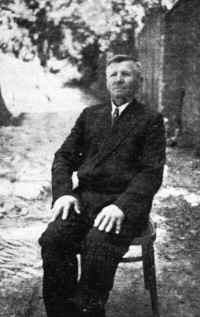
| The writer of the following recollections, Stanislaw Sobczak, a Pole from Frampol, did not lose his humane posture during the terrifying years of the occupation, and risked his life and that of his family in rescuing the Jews of Frampol and Goraj. Several days before the gunfire, everyone in Goraj was driven to Frampol and hid themselves during the time of the shooting. Having his own life threatened, and that of his family, he hid twelve people from Goraj in his house. To this day he is in contact by written correspondence with a row of Frampol scions in Israel. Learning about the Yizkor-Book for the shtetl, he sent along his short bit of memories for that period to the address of our landsman Shmuel Mahler, in Haifa. |
|
|
November 1, 1942. On that day, the Germans attacked defenseless people of Jewish origin. Twelve Jews from Frampol and Goraj hid themselves at my house. A few days before the shooting, all the Goraj residents were driven to Frampol, and these hid themselves at my house during the time of the gunfire. Being threatened for my own life, and the lives of my family, I took in these very same people not for any compensation but because my conscience did not let me abandon these hapless people to the discretion of the murderers. Here are the names of the people who were under my roof:
From Goraj: Moshe Zaltz with his sister;
From Frampol: Abraham Steinberg and his family of 4 people; Moshe Zimmerman, Nachman Kestenbaum, Lena Hoff, Shmuel Honigman and his wife, Shmuel Mahler. Honigman's wife died a natural death while being by me.
[Page 149]
I placed all people in a special hideout in the barn, where there were two floors. I found it difficult to feed them, and take them in. I could not approach them during the day, because I had to be wary of my neighbor, with whom I did not live in peace, and he constantly shadowed me. Once when by happenstance, my neighbor came into my yard, he noticed that a Jew wanted to hide himself with me, and my neighbor told the Germans about this, who had just entered the city. For this reason, I was arrested, and I was exhausted by them for several days. At my side, a certain woman helped me, who had fled Silesia, who knew German, and she testified on my behalf that the accusation was false.
I could only approach the hidden people at night, so it shouldn't be something suspicious. It was then that I carried out the night-vessels and gave them food. During this time, when they were with me, I had no rest, and did not sleep at night, living in constant worry and fear, that as soon as the thing would be uncovered the matter would have ended as a catastrophe for me. I could not decide whether to tell these hapless people that they should leave me, and search for another place. My conscience did not allow me to do that. On one occasion, the Soltis came to tell me that German soldiers are going to be quartered in my barn. For how long, he does not know. I took this notification up seriously. Well, let them quarter themselves! And before you know it – they were here already. I was overcome by a frightful panic. I did not know what to do. Even now, when I write this down, I get pale from fear. I alternated between feeling hot and feeling cold. The Germans are in the barn and there is no way to reach the people under the floor. But I figured out another way to get in, with which I could reach the hiding place. How I did this – is very difficult to describe in writing.
There was an occasion when the Soltis came to me, escorted by Germans, at the same time that I let out two people into the small room. My daughter saw the Soltis and the soldiers, and sought to delay them, and began to call out for me loudly:
– Father, the Soltis is calling for you!
This moment was used by the hiding people and they jumped into the cellar. The Soltis, meanwhile stuck his head into the yard. It was truly a miracle, that everything transpired peacefully…
One time, an unpleasant event occurred to those in hiding: Moshe Zaltz had said that concealing a person is worth many millions. He took note of the fact that Shmuel Mahler had money. And since this Moshe Zaltz was not from Frampol, but from Goraj, he wanted to make use of this, and threw himself at him, practically choking him to take away his money (by the way: I wrote a brief letter to Moshe Zaltz, and he didn't answer me).
When the front drew nearer to us, and the Germans began to ignite everything, I feared that this will bring misfortune to those hidden in the cellar. I therefore ordered them to come out of their hiding place. They wanted to give me everything they had, but I did not want to take anything from them, because it all came in handy. I told them to go through my field, in the direction of Zhieszonki. But they didn't listen to me, and went through the 'dolless,' and it was here that they encountered Polish partisans who killed part of them and plundered everything. The partisans found out later that I had
[Page 150]
supported them. About 20 A. K. Partisans assaulted me afterwards, and read a judgement to me, that because I had committed this violation and hidden Jews, I deserve a punishment. They ordered me to lie down, and beat me so furiously that I was bedridden for two whole weeks, not having the capacity to move either a hand or foot. All of this was seen by the daughter of the local dentist. The partisans took away the horse and wagon, the swine, and everything that they could take with them…
By Tema Weinstock (Rotman), Haifa
I was born in Frampol and was a student in the local school for only four years. Because of anti-Semitism and needs that I had in life, I halted my schooling in the year 1937. We were 9 children at home, and because of this, I had to help out in the house shop. My mother was a seamstress and my father dealt with fruit that he bought from the local fruit growers, and then sold in the city.
The house in which we lived was supported by stilts, because it was close to falling down. The Gmina forced us to leave this very house, giving us a different dwelling: one room with a kitchen. This was in the year 1938.
My childhood was a sad one. I had no form of entertainment, constantly being overburdened by housework, and the (other) children. Every night that we lived through being in that wreckage of a house was full of danger, and perpetual fear. It was also not good in our new domicile, because other people lived there.
In September 1939, when the war broke out, the Germans entered Frampol. Immediately, at the start, we fled to the village of Walia, to peasants whom we knew, because one was not able to guarantee one's life in the shtetl. We lived there for several weeks, and afterwards went to the village of Khzeszyn. We managed to sustain ourselves for one year with the peasant. The entire family was occupied in the shop, doing all manner of work.
Together with my brother we began doing business. We transported eggs and butter to sell, and used the money to buy thread, buttons, small pieces of goods, which the peasant women needed. Together with the peasant women, we went barefoot into the city, dressed in a village-like dress, that is why I was not searched or pursued. The Germans patrolled the roads, often looking in the cheese vessels. But I had good luck, they did not touch me.
From this business, I supported the entire family.
In the year 1941, the Jews in the village of Goraj were moved out. There, four families lived in one house. A ghetto was organized in the village of Bukowiec, to where all the Jews from the
[Page 151]
surrounding villages were driven. I did not go into the ghetto, but stayed with the peasants by myself. It was dangerous to go into the city with goods. I then began to take up tailoring and to sew on folk scenes in linen, and in this way earning a living. I went from hut to hut, where for these goods, I was fed, and sometimes– lodging for the night. There was plenty of work. Every Sabbath, I went off to my parents in the ghetto, bringing them bread, flour and other products, that I had earned through my work. The Jews in the ghetto were then suffering hunger, because the food rations we received on the Judenrat cards were very meager. This is how we lived for several months, until the Jews were again driven to a different place. This time – to the ghetto in Szczebrzeszyn, a small shtetl.
Everyone driven out in this way was permitted to go on the road with a small sack, because we were forbidden to take any more. Also, my family went away there, but I remained in the village of Czarny Stok, because here I had stable work. I befriended the peasants, even though they knew that I am Jewish, but I was shielded and they told no one that I was doing business in their homes.
In the meantime, rumors spread through the village about the mass assaults against the Jews by the Germans and their helpers. Every day – other orders. On one occasion they took the young, so to speak, and led them off to work – and they never returned. Older Jews were also taken off to work, and from there sent to unknown places, later – in the camps from which they no longer returned. Nobody knew how the bodies got there. Even the peasants, who moved about freely everywhere, did not know where the Jews were being taken. They would say: 'the Jews are traveling to their death.'
At that time, in the entire vicinity, ghettoes were erected in a variety of places, to which Jews were moved from the surrounding villages and small towns. These moves were from place to place, which used to repeat themselves cost much in the way of health, assets and – human sacrifices. We were driven from place to place like cattle, under an escort of a German with a few Ukrainians. Many times, permission was given to make the trip alone to the designated place. But, in this case, it was frightfully hard to find a corner where one could lie down, because such a place could only be with a Jewish family, where the crowding was already great. Incidentally, the owner of such a house did not take a count even for himself, that he as well will not have very much more time to be in this dwelling, since everyone's fate, whether it was people who already lived there, or having been driven there – is sealed. Also the number of ghetto inhabitants continuously got smaller, because movement had begun towards the death camps. It was just the local Jew who wanted to profit from the newly arrived people, and demanded high prices for a room. Even if this wandering out took place, as said before, with just little sacks in hand, part of the Jews still had hidden money, or precious items, with them, with which they helped themselves in a time of need.
At the end of 1942, when the Jews in the ghetto were liquidated, I lost contact with my parents, because I did not go out into the street and could not travel anywhere, being afraid of the Germans. I did not know much about the fate of the Jews, my single sources of news were the peasants who told: 'the Jews have already all been murdered, they were led off into the forest and buried half-alive in pits, after being shot with machine guns.' A strong longing for my parents and brothers and
[Page 152]
sisters, seized me. I cried at night, and didn't even have anyone to talk out what was on my heart. I worked for the peasants from early day until late at night, and anyway, they were filled with fear to employ me, because the Germans threatened burning the business and kill the peasant where a hidden Jew would be uncovered. There were instances where peasants, for a good price, did hide Jews with them – but only after taking away either gold or money, turning them over to the Germans or murder them by themselves.
Several months flew by. Once, on a wintry day, my brother Israel came to me. He had the opportunity to leap from the wagon when Jews were being taken to a [concentration] camp. I was very happy, but regrettably, it was not possible for me to hide my brother at the home of my boss. We went out to the meadow near the forest, and sat there for a few hours. I learned from him what had happened to our family: my grandfather died of hunger, he had nothing to eat. My parents hid themselves in an attic for a few days, but they were discovered there and transferred along with the whole family. As already said, my brother Israel was able to leap of the wagon and saved himself that way.
My second brother, Moshe, searched for us also at that time. He knew all the peasants in the vicinity who helped us. But nobody wanted to hide all three of us. We were stymied. Those who kept me at their place, gave us work, food and a roof over our heads – chased us away. Some did so with polite words, some were verbally abusive. But all of them were afraid of the Germans and their neighbors lest they be informed upon. One lady peasant, who was afraid to have us stay with her overnight, gave us a large loaf of bread and a pot of cooked kasha, advising us to hide in the forest. Not having any alternative, we left her house and went to the forest. There, on a swampy tract, all three of us lived through three whole months. One of the brothers was barefoot, and had no shoes on his feet. During nights, we would go to the peasants and beg for something to eat. Not everyone gave something, and there were those that opposed giving assistance. The cold, at that time, was bitter, we warmed ourselves by rubbing each other on the body. The shoes were switched, in order that the barefoot brother should not be impeded by the cold.
On one occasion, the peasant woman, Koczart, took pity on us, when, on a darker and colder night I came to ask for a bit of water. She invited us into her home to spend the night, and gave us warm milk to drink. My brother Moshe fainted after drinking the hot drink. We became very fearful, essentially – it was our homeowner, because he thought that this incident would expose him to his neighbors. The one who fainted quickly came to. A theory is that he had lost control of himself due to deprivation and hunger, as well as the fact that his digestive tract had not been used to warm food for such a long time. Now we slept in a bed and felt like the luckiest men in the world. In the morning, we had to leave the hut. Each of us went in a separate direction. Israel – into the forest, Moshe – back to the shtetl, where there were still Jews left. He wanted to find out any news. I did not see him after this ever again, I do not know how he was killed.
[Page 153]
A hard and bitter life then began for me. I was not permitted to lodge with anyone. I was hungry and frozen, exhausted and frightened. I did not know what the immediate hour would bring. Like a stray dog, I searched everywhere for a hiding place, to at least get a few hours of rest. I looked at the village girls of my age in envy, who went into the church, played with each other, were warm and dressed and laughed merrily. All of this, while death wafted past my eyes.
Many times I would spend time in a barn, without the knowledge of the peasant who owned it – slept the night there and remained there for a day, or more. Many times, it happened that a peasant disclosed me and did a good job breaking my bones. It was not only once that they threatened me with murder, or to turn me over into the hands of the Germans. With a tightened heart and with pain from the beatings I received, I once again, set out on the road. The uncertainty hovering over the barns, yards, and huts, pursued and harassed everyone – continued further. How long will this last?
I went off to the peasant Wladek Olekh and begged him for food and help. He too, started to beat me and threatened me with death, if I did not immediately leave his house. A Jewish woman of means was hidden with him, who brought him a lot of manufactured goods. He did not want to have any sort of witness, that a Jewish woman is hidden with him. And so, I went to the hut of Aniela Cimel – a widow, who lived with her sister and elderly father. At no charge, I one wove a dress for the little girl. The widow lived in very bad conditions – nevertheless, she took me in and hid me. During the day, I lay in a corner near the oven, nobody could see me. I sewed and patched underwear. At night, when the neighbors came to visit, or have a bit of discussion with the balabusta, I hid myself underneath the bed, lying there without moving. The slightest movement, or an attempt to change my uncomfortable position, would have ended in a catastrophe: this would have advised of my savior, that she would have paid with her life, along with me, for her good act. I lay there like I was lame, not apparent, and not groaning… this is the way I lived there for a half year – until the end of 1943.
Despite the fact that by that time, various partisan groups existed in the vicinity, to one of which my brother Israel belonged, I did not go the partisans. I wandered from peasant to peasant for a whole year, and in the hut of each of them, I had to live through a variety of pain and suffering, even when they consented to take me in and give me lodging and some food. I spent a frightening night once, with the peasant woman Putima. It was winter, after the Christmas holidays. Putima hid me in the attic, in the hay. I helped out in the house shop. She was a widow, and had a foolish helpless daughter. She was thankful to me for the advice that I gave her, that the wheat and corn should be hidden underneath the floor, in order that the Germans not confiscate the grain for a contingency. I did all sorts of work for her, so long as she would retain me for a bit of time, so I could sleep on a warm bed and eat to my satiety. Suddenly the Germans came knocking at her door, they had come to search for hidden Jews. On the oven, they found bread and my kerchief. After entering, they shot the dog, who barked vigorously against these uninvited guests. I lay in the attic, and could hear how the Germans beat the mother and daughter, and demanded that they produce the hidden Jews. Both of these peasant women wailed, cried and screamed: 'kill us, do not exhaust us anymore, we know
[Page 154]
nothing, we are soon to die, Holy Mother.' I was as if paralyzed and did not know what to do. Even if I now descended to the Germans – not only will I cause my death, but also that of the good-hearted peasant woman and her daughter. I sat all bunched up, not moving, not breathing, but this spectacle came to an end. The Germans departed. I went down to the two women, they had been beaten, bloodied, with blue marks all over them. And after this night, these two good, decent peasant women did not drive me out, or beat me, like others used to do, but permitted me to remain for two whole days afterwards. After this, I had to leave.
Where to go? What to do? Everyone in this village knew who I was. I knew about a few good peasants, but there were also many enemies. The latter argued that the żidowka needs to be driven out, or shot like a dog, because why are we standing up for her? But I wanted to live – so I went away to the peasant woman Ducherka, begging for overnight lodging. She took pity on me, but didn't allow me to spend the night with her, but told me I should go to Cimelowka, who has better accommodations in which to hide me. It was however impossible to stay with Cimelowka, because this was a poor peasant woman, she was barely able to sustain herself with much trouble. Having no choice, I went away to the village of Cit and went up to the attic with hay, where I lay for three days and nights. I still had a bit of bread that Ducherka gave me. I moistened my throat and mouth with snow. One of my feet became useless because of the cold, I could not walk. Descending during the day into the yard, I saw that with the peasant there were many sons. They were all around: on the attic, in the stall, in the rooms. It was dangerous to remain here. I decided to leave this place.
Limping on one foot, I went (back) to Cmilowa. Again, this time she showed her good nature – she hid me. My foot was frozen. The peasant woman did not know how to heal the foot and also lacked the appropriate medicines. Three toes had been frozen, and because of this, they spread a bad odor about, and also from the rags, with which she had wrapped the foot. The neighborhood women who would come into Cmilowa, always grabbed their noses and asked from where such a stink is coming. The answer from the balabusta was, that her kraut had rotted, but it is a loss if she were to throw it out…
I suffered frightfully then, because I could not work and help my savior. She didn't drive me into the field or the forest for work, even though it was hard for her by herself. Inspections took place in the village often also, and we lived through much fear and travail. Despite this, I stayed with her for three whole months.
We now heard about frequent partisan attacks of the richer peasants. Also, the residents of the village did not leave their homes at night. The partisans skipped over my peasant woman, knowing of her poverty. And this really was one of the reasons that I decided to leave her. For the trip, she wrapped my foot with rags and gave me straw shoes, so that I not go barefoot. With an unhealed foot I left this good peasant woman.
Once again the question day and night wafted before me since the war started: Where to go? To whom to go? There was no sense to look for new addresses, also the old would mislead you… my
[Page 155]
sick feet got me to the peasant woman Ducherka. I beg her for help. She takes me in for three days. She smears the frozen foot with egg and fat. This eased my pain considerably. Ducherka talked me into going to the partisans in the forest, there they have means to move and eat. But I did not want to go there. I feared the partisan aktionen and the nights, when they took food from the peasants, or being punished for working with the Germans.
But now I did not know what to do. I was scrawny and entirely helpless. It was beyond my power to exhaust myself anymore. I raged for life, not wanting to die. This invigorated me, and I crawled into every hole where I felt I could hide. Living another night, another night in hiding. A three-day stay with someone I thought of as a great piece of luck. If I saw a peasant's yard in my wandering, where the little door was open, it was where I found God's Hand, his generosity that he had bestowed upon me, so I could save myself. This was how I wandered from place to place, but did not meet anyone who offered to take me in. Again I went off to Cmilowa, even though I knew she is poor and does not even have a bit of grain for her own use. I would help her at night to steal from the well-provided peasants, who in those times did not pay attention to heavy noises, out of fear of the partisans. It was from such 'night aktionen' that we provided ourselves with bread for several months, and my peasant woman was very satisfied with this. We dug a pit, and hid our treasure there.
Once, it happened to me that I had to live through a frightening night. I was sleeping in the attic, and all of a sudden I hear three partisans have entered the house of my rescuer and demanded that she turn over the żidowka that she is holding. Janka, Cimelowka's daughter categorically denied that a Jewish woman could be found in her house. The partisans did not believe the girl, she was thrown onto the bed and raped. The girl cried and pleaded with the partisans – but with no success. The thugs went away, leaving Janka sick and broken. This event had a bad effect on me as well, because the sick daughter and the poor mother did not present only on that because of a żidowka that have to suffer so much. At this opportunity, they offered a new complaint, that I do not pay for being kept, like other Jews, I do not bring any jewelry, like the others – only troubles and worries…
I went back to Ducherka, who was afraid to let me spend the night with her. Then, in the course of three nights, inspections took place in the neighborhood huts of her brothers – but they did not find me, because I was well concealed in straw. But I had to leave Ducherka's house/ A neighbor of hers, Franciszek took pity on me, and hid me for three nights, also giving me something to eat. Here, I sat in the attic. Being again without a roof over my head, I went off to Cimelowa. She had a good heart and also loved me. I always counted on her good, sensitive soul and was never turned away. The daughter Janka also loved me and always helped me.
I lived for three months at the Cimelowa house in the attic, under very severe conditions, in cold and in hunger. In that time, a number of peasants were gathered together to do work in Germany. It was not only one peasant woman that was left without a husband and her sons. I applied myself to all types of village work and could offer myself advice, especially because I was employable. But they knew me well in the village, and for this reason it was impossible for me to show myself in the yard,
[Page 156]
or on the potato field. My rescuer therefore had no use for me. I told them about my so-called hiding places of mine, a sewing machine and promised to pay – yet they still wanted to get rid of me. I was an unwanted burden to everyone, which disturbed the peace. I wept constantly and did not see a way out of my predicament.
But also this time, there was a miracle: they began to move the Poles out of the neighborhood. Out of a fear of being sent to Germany, the peasants fled to a variety of locations. In such a circumstance, nobody paid any attention to me, because each person had their own troubles. But not everyone successfully fled and many residents of 'my' village were sent off to Germany. I was also among the people that were sent away.
We are now going through a thick forest. I find myself near Ducherka. They call her 'żidowska czatka' (a Jewish aunt), because the residents of the village knew that she is involved with me. Ducherka suffered a great deal because of this help. In pain, she had to observe how a group of boys beat me, while yelling that they don't want me to go with them. I have to remain here in the forest, confused and afraid of possibly having touched one of them a Tomek Doller, who advised me to hide myself in the chapel, under the roof, which was not far from here. Since I had a little bit of food, that I used very sparingly, I went off to the chapel – and there I found some rest. I did not want to think about what would happen tomorrow. Now I was good, nobody demanded anything of me, or beat me, and I don't have to beg for a night's lodging.
I ran out of food, and it was not possible to sit more in the little chapel. I went fearlessly into the thick forest. And here, I encounter two young Jewish men, and our happiness is great. They talk me into joining the partisans to which they belong. But I did not follow their advice. We part – and each of us goes their own way. I come to a hut. A child hands me a piece of bread, by the old father who then came by beat me and drives me off his property. Blundering around like this some more. I came upon a good peasant, who allowed me to spend overnight in his barn, but in the morning, he chased me out of there. With a second peasant, there was work going on in the field, and so they took me on to help and therefore gave me something to eat. The girl with whom I was working, stealthily, so her parents would see, gave me bread. But I could not swallow it, being accustomed not to eat. After finishing the work, I went back to the village.
Here I encountered Cmilowa. Because she had not been relocated. Regrettably, this time she did not want to take me in. I went off to the peasant Mikhal Turlipo, he was a liaison with the partisans in the forest. There, I also encountered my brother, to whom additional food was given. We were very happy. My brother very much wanted to take me to the partisans – but I did not want to go. A sharp dispute broke out between us. They even threatened me with vengeance…
I encountered the teacher Bukhovski who had threatened to kill me. He was the liaison with the A. K. group in the forest. My cousin would come to this peasant for food, who was hidden not far away in a bunker together with his wife. I was very happy to see him, being certain that he would take me to his bunker and I will be able to cease blundering and wandering over field and forests. I begged
[Page 157]
him and cried for him to take me with him, not to leave me alone among negatively disposed people – but he refused.
Neighbors of Tulipo, the Stachs, took me in for two days. They were afraid to keep me any longer because of the inspections and the suspicion that they were helping Jews in the forest. So I went off to the peasant Popa, who took me on for a whole month. Now I was in a house, and I had it good, but I lost my health because of an inability to eat, and I vomited a lot, suffered from intense headaches and could not work.
Pop'keh sent me to a peasant woman in Kyntawka, who lived with her husband, but had a retarded daughter. It was very hard for her, but she could not allow herself to accommodate workers. The house of the Niedzhwiezhka was on that side, and therefore it was not searched and inspected like other houses. This woman did not fear taking me in, but food consisting only of milk and potatoes. She ate the bread with her daughter and did not want to give me any.
1944. It was discussed that the Soviets are coming more quickly, the front now being quite close. The Germans are retreating. It was not bad for me at the home of Niedzhwiezhka, but my health was not in order. With considerable strain, I would get up in the morning and go to work. I learned how to milk cows, feed them and also cook food for the house creatures. The house was always clean and fit for balebatim and they were satisfied with me. She even told the Soltis and the priest, that she was holding on to a Jewess, and these two praised her for her act and proposed that she prepared me for conversion…
My peasant woman would often travel to visit her relatives and friends, leaving the entire shop to me. Were it not for me, she could not undertake her trips of this kind, the retarded daughter was not capable of carrying the yoke and the responsibility for everyone. She had a great deal of faith in and understanding of me, knowing that I would not steal anything and take it out of the house. From my side, she did what she wanted to, being fortunate in knowing that I have a secure and warm dwelling and could eat my fill. But she still did not give me any bread. For this item, her neighbor Karlowa provided for me out of pity.
At night, various people would come to us from the forest and then I went off to the cellar under the floor – but it was forbidden to reveal me… Many times the local people would come to my balabusta, who knew about me. They was confused many of those times – and I went to the hideout. But later, when they stopped bothering me, I no longer was afraid.
The work in the house was monotonous and lengthy, but I did it well. But now I grew afraid of the front that was drawing near. What will happen after the liberation? Will it no longer be necessary to go into hiding? Yes, at one time I had a home, parents… but now everything is so distant, so unclear.
Meanwhile we lived for each day, worked hard and dreamed of something to eat to satiety… which was always missing.
[Page 158]
In the summer of 1944, I once went to the priest to bring 'Holy Water' for my balabusta. At this opportunity, the priest also sprinkled me with water, said several prayers and called me by the name Teresa. Nothing different – the priest converted me. Some of the peasants joked about this: What is the difference, she is after all still a żhidowa. But the priest did not jest and stressed that this was a valid act for the Catholic Church. At that time, I already felt better, the wounds on my feet had healed.
Once, in a dream, I saw my mother, dressed exactly in the same dress she wore on the day that we parted three years ago. Very vigorously she entered the room and declared, that not for very much longer will we have to exhaust ourselves against the Germans, because the Soviet Army is going to come to our village on July 23, and we will be freed. I told my balabusta about this as well as my neighbors, but they made fun of this. But I remembered the dream very well, my mother was alive – but after they had joked about this, I personally began to be drawn to this matter as if it were a dream.
I was twenty years old at the time, but I had the feeling of being much older. I had gone through so much, the concern for a bit of bread even back when I was a child, the work in the village, the parting with my parents, the homelessness during these poor three years – all of this left an imprint on my character and mentality. Now, I no longer believed that I would have a home of my own, to eat till satiety… this is why I waited for July 23, even though I was skeptical about the date. Nevertheless the miracle came to be. Exactly on July 23 the first Soviet patrols rode into our village and the neighboring villages. After this event, many peasant women came together to see my balabusta, and they called me 'Holy Teresa'… they invited me into their homes, literally almost tore my hand off, gave me food from the best and nicest that they had, and argued with each other about the honor to be in their house.
To tell the truth, at that time, I too believed in miracles. When one spends so many years in a village, among peasants, and take over all of their seats and dwellings – I also had the belief that maybe I really am a Saint… someone else until now…
The peasant Francziszek, in whose house I lodged for three nights, now took me to his home. His wife was at forced labor in Germany and he had need of a balabusta. This was a neighbor of the Ducherka, who knew that I was hidden by her. Now, just like all the others, bragged and was proud of having hidden me. I was fortunate, I was lucky to stop being someone who was chased about and being harassed. Francziszek immediately gave me clothing, gave me food, he was good to me, and satisfied with my work. I left my current supplier of bread, who had a lot of work to do because it was tailoring season, but from time-to-time I went off to help her, with Francziszek's permission.
Sometime later, my brother came back from the forest, discarded the life of a partisan and settled in the village with a Jew called Heschel'eh Altman, who did not want to travel into the city, being
[Page 159]
afraid of the A. K. bandits, who now under the Soviets began to murder the surviving Jews. But even this Jewish man did not avoid the tragic fate, even after the liberation. He was murdered by anti-Semitic Poles – and my brother moved over to be in the city.
I felt good at Francziszek's home, but his daughter, who would often come to him, only had complaints, as to why the żhidowa is still here. I could not cook and bake the holiday food, because the Christmas holidays were drawing near. The house needed to be plastered and wash everything. There was no lack of work. So Francziszek asked his daughter to help prepare for the holiday, but she refused with the excuse 'do you need this for the Jewess?!' He remained stubborn about this, and everything was prepared as in past years.
Francziszek was a drunkard, and would often come home drunk, but he never touched me. The neighbors warned me that he will yet kill me, but I was not afraid. It was good for me there, he permitted my prior balabusta to visit me almost daily and that she should help out in the shop.
A half year had passed since the liberation and I still had no plan as to where I might go. After having lived in a village for so many years, I could not come up with the thought that somewhere else that will afford me the opportunity to stay in the attic.
On one occasion, Francziszek's old mother came to him and then remained living here. Now, she completely changed my situation. The old lady continuously criticized me and even accused me of being a thief, and she even accused me of stealing a pair of pants and taking them out of the house. My oaths and tears did not help. She even told the Soltis about the theft. Out of great aggravation, I offered a curse: 'let the fingers fall off whoever took the pants away.' In two weeks, the old mother lost three fingers, when she was processing grain. She saw God's punishment in this for the misdeed that she had done to me – and once again, the village spoke of Teresa, who is followed by either the devil or some higher power…
After this incident, my brother had the opportunity to change my mind. I began to leave the village often, visiting the city, finding myself back among Jews, until I decided finally to go back to my people. In order to provide for me, we took to selling, even though the longing for the field and for the village was generally very great.
In the year 1946 I got married, and began to lead a normal life. Some time later, I made aliyah to Israel.
|
JewishGen, Inc. makes no representations regarding the accuracy of
the translation. The reader may wish to refer to the original material
for verification.
JewishGen is not responsible for inaccuracies or omissions in the original work and cannot rewrite or edit the text to correct inaccuracies and/or omissions.
Our mission is to produce a translation of the original work and we cannot verify the accuracy of statements or alter facts cited.
 Frampol, Poland
 Yizkor Book Project
 JewishGen Home Page
Copyright © 1999-2026 by JewishGen, Inc.
Updated 25 Jan 2026 by OR