[Page 272]
Writers and Artists
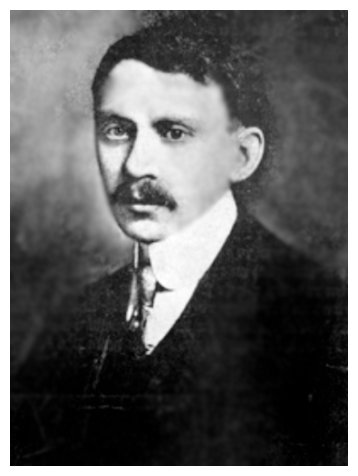
Hersh-Dovid Nomberg
by A. S. Safra
Translated by Sara Mages
 |
|
Among the well-known people, former residents of Radomsk, who became famous in the Jewish world in its Diasporas, is the writer and journalist Hersh-Dovid Nomberg.
Hersh-Dovid Nomberg was one of the leaders of the second generation of new literature. A lyrical writer with a penetrating eye, a brilliant journalist and an eminent figure in the Polish Jewry for the first thirty years of our century, was the son of Jewish Radomsk, flesh of its flesh and bone of its bones.
Hersh-Dovid Nomberg was born in 1876 in the small town of Amshinov [Mszczonów] and arrived in our city at a young age. He was educated in Radomsk where he spent the days of his youth.
Here he married and raised a family, and here he experienced a family tragedy that left a significant mark on his work and the rest of his life.
Nomberg was about ten years old when he came to Radomsk. He was brought to our city by his mother, who divorced her husband and married the wealthy man, Reb Itshele Szternfeld.
Jewish Radomsk, in our time and before its destruction, was teeming with Hasidim of all kinds who flocked after various dynasties and courts from near and far. This city, in Nomberg's days, was the stronghold of Polish Hasidut.
Besides the Radomsker dynasty, the House of “Tiferet Shlomo,” which reigned gloriously in the city and was a prominent point in its Jewish landscape. Apart of this dynasty, Radomsk had dozens of houses of worship and shtibelekh of various Hassidim. There were Hasidim from Ropshitz, Strykow, Radishitz, Ger, Amshinov, Aleksander, Sochaczew and mor and more.
Reb Itshele, Hersh-Dovid's stepfather, was a Gerrer Hasid, the strongest and most prominent sect among the Hasidim of Polish Jewry. As a typical and passionate Hasid, he had done everything in his power to ensure that his talented stepson would follow in his footsteps.
Nomberg's path of education was the accepted path of the time. He studied in the cheder and in Omstov [Mstów] Yeshiva and quickly became famous as a genius.
While he was still young, they begun to arrange his marriage. Reb Mordechai Szpira, of the city's riches, a Gerrer Hasid and owner of an iron supply store, won the young genius for his beautiful daughter.
Reb Mordechai Szpira promised his son-in-law that he would support him for several years, and then a rabbi's position in one of the towns. In the meantime, Nomberg was revealed to be an idler immersed in reading, in the game of chess and cards, and after a while Reb Mordechai Szpira stopped supporting him and opened for him a store for colonial goods. But neither Nomberg, who was absorbed in reading most of the day, nor his wife who was far from being a capable woman, were able to run such a store... The store was later handed over to Shlomo Yitzhak Rabinowicz, who made a decent living from it. The store was located at Herschel Banker's house, near the train station.
|
Hersh-Dovid, the alert and talented, with a lyrical soul and a penetrating eye, began to wonder about his surroundings and was not content with the dry and sterile study.
As a man who was involved with people and accepted by them, he had a wide circle of acquaintances. He befriended the city's intellectuals like Reb Mendel Feinzylber, Shlomo Krakowski, Avraham Rodis and others. With their encouragement, he began to correspond with Warsaw's writers who expressed their appreciation for him and urged him to move to them.
The opportunity was not long in coming. Before Rosh Hashanah, on his way to the rabbi to spend the holiday there in holiness, he remained stranded in Warsaw. He spent the holiday there in conversations and debates in the company of his new friends,
[Page 273]
who rejoiced over him as if they had found great spoils. The new environment was so enchanting to Hersh-Dovid that he postponed his return home day after day.
The holiday was over, the yeshiva students returned home from the rabbi, and Hersh-Dovid was not seen. In short, after inquiry and investigation, his father-in-law and his wife learned the whole truth. Reb Mordechai rushed to Warsaw to get him out of the defilement he had fallen into, but a surprise awaited him there. Hersh-Dovid refused to change his mind. It turned out that the man had completely changed, become a heretic. He no longer believed in the Gerrer Rabbe or any other rabbi.
After persuasion, Nomberg returned to Radomsk. Reb Mordechai hoped that his son-in-law would recover under his influence. However, when he saw that he would not give in and change his mind, he stood up and demanded that he would give his daughter a divorce.
According to another version, given by one of the elders of Radomsk, the reason for Nomberg's departure from Radomsk was more prosaic: after Nomberg lost his store and his dowery, and he was already the father of three children and had to return to his father-in-law's house, he came home one night after playing cards to a late hour. A fight broke out between him and his father-in-law, then the latter kicked him out of his house and Nomberg fled to Warsaw.
Nomberg and his wife loved each other. They loved their three children and refused to comply with Reb Mordechai Szpira demands. The struggle between the young couple and the father lasted for months. During these months, Reb Mordechai and his associates took every measure to force Hersh-Dovid to agree to grant the divorce, until he finally surrendered.
With a broken heart he parted from his wife and his city Radomsk. He moved to Warsaw, became a famous writer and a popular figure, and even reached a seat in the Polish Parliament. However, the memory of his beloved wife and the memory of the city of his youth did not leave him, as if his unhappy divorce from his wife had left a wound in his soul that would never heal.
*
The image of one of the humble yeshiva students or our city, who over time became a famous personality in the Jewish world, lives on in the treasure of memories of our townspeople. Even though the generation that lived with him and knew him in his youth is no longer alive, those who left us naturally and those who perished in the great massacre, among many of us, the people of Radomsk, the memories of Hersh-Dovid Nomberg live on.
Many of us have seen the title page of tractate Niddah, on which Nomberg wrote the story about the Six Orders of Mishnah and Talmud. It was given as a gift to the Gerrer Hasidim Shtiebel by one the important homeowners in the city.
And the story goes as follows:
On the eve of Tisha B'Av, Reb Hershel Grossman entered with one of city's most important homeowners to Reb Mendel Lifshitz's house, the sharp Gerrer Hasid who lived in Market Square. Reb Mendel sat and ate fried fish for the last meal before the fast. To the guests, who were not Gerrer Hasidim, it seemed that they had caught Mendel in his sin - eating meat on the first nine days of the month of Av, something they had long suspected. The two hurried and announced in the city what they had seen. This caused a stir, and the matter was brought for arbitration before the city's rabbi.
After hearing the claim, it was clarified that there is not a shred of truth in it. There was a mistake in the evidence, and the rumor was false. In the ruling, the rabbi imposed a large fine on Rev Hershel Grossman and his friend, according to which they had to give all Six Orders of Mishnah and Talmud to the Gerrer Hasidim Shtiebel. The entire story, peppered with literary concepts, was purposely written by Hersh-Dovid's in Tractate Nedda, as the letters N. D. H prove the name of the writer, Nomberg Dovid Hersh....
In the memory of our townspeople Nomberg lives as a friend of our city. A man from Radomsk, who happened to be in Warsaw and met him, felt the closeness and interest he showed in every detail that was connected with Jewish Radomsk.
When the renowned literary critic, S, Niger, spoke of Nomberg's works, he wrote among others :Sometimes we read his words with a strange feeling of sharing in the sorrow, as if we were reading a sad, intimate letter.” The imagination of a lonely man, as if memories from his youth had come back to life, sweet, intimate memories... Just as an unbelieving hand touches a taut string, so does reading Nomberg's words awaken a forgotten longing to leave, as if a wound that you have uncovered is opened. Feelings that have long since subsided are awakened, feelings that once instilled sadness, suffering, moments of silence... The special melody of his work, the irony mixed with sadness, the soft lyricism woven with threads of forgetfulness, the sentimentality hidden behind the cynicism - made Nomberg one of the most distinguished writers of Polish Jewry. Of almost an entire generation, a critically ill generation, whose sons barely recovered and returned, in immense pain, to their real lives, to work to the passion for life, to the deeds of life.
Nomberg's heroes - - - those soft souls “who know how to think but lack the ability to will.” The sober, the sober who knows everything except how to live a simple, ordinary life, a real life. They do not have the point of view of all those yeshiva students who are supported by their father- in-laws and distanced from real life. They are members of the second generation, sheltered in the shadow of their ancestors, the desires of their wealthy in-laws, firm in their opinions and beliefs, whom the young Nomberg was so fortunate to see around him in Radomsk, in Beit HaMidrash and in the shtiebel. Indeed, there are few writers among Polish Jewry who have been able to convey such psychological depth as Nomberg had done. The soul of a generation of peace, a generation of crisis in Polish Jewry, a generation of tender-heartedness and deep doubts.
The influence of his childhood city is particularly evident in his stories from his childhood: “Eyes,” “Elul,” “Between father and mother,” “Misunderstanding.” These stories are imbued with sadness, an echo of the difficult days he went through during his childhood and youth.
The terrible tragedy that Nomberg experienced, when he agreed to divorce his beloved wife, the woman who also loved him and did not want to divorce him. And after that, the second tragedy in the death of his young son, living in an environment foreign to his soul, clouded his spirit and weakened his body and hastened his end, and he was only fifty-one years old...
*
The following is an excerpt from the “Dictionary of Modern Literature - Hebrew and General” by Avraham Shaanan, “Yavneh” Publishing House, 1959.
H. D. Nomberg's first poem in Yiddish was printed in 1900 in Der Jude [“The Jew&”], and his first articles in Hebrew were printed in HaDor [“The Generation”] edited by David Frischmann. His Yiddish song, Es loyfnm es yogn shvartsem volkns [Dark Clouds Race and Rush], gained great popularity.
In 1908, he participated in the Yiddish Conference in Czernowitz where the declaration of Yiddish as a national language was formulated. When he returned to Poland, he founded there the Yidishe Folkspartay [“Jewish People's Party”] together with Noach Pryłucki, and on its behalf was elected as delegate to the Polish Sejm. In 1924, he visited Eretz Yisrael, and following his visit his book, Eretz Yisroel, Ayndrukn un Bilder [Eretz Yisrael impressions and images], was published (1925).
He also contributed to various Yiddish and Hebrew newspapers, including those published in Europe and America. In his literary works, the tendency toward pessimistic realism and a view of Jewish life in its entirety is evident. His typical heroes live beyond real life, and his approach to them is tinged with a satirical, even dark tone.
His well-known books are Men Vekt [“Waking Up'] (1905); In a Khsidish Hoyz [“In a Hasidic House”] (1906); Di Mishpokhe [“The Family”] (1919/1921); Fun a Poylisher Yeshive [“From a Polish Yeshiva”] (1921); Gezamete Verk (1922); “Stories” (1911/15 in Hebrew).
This material is made available by JewishGen, Inc.
and the Yizkor Book Project for the purpose of
fulfilling our
mission of disseminating information about the Holocaust and
destroyed Jewish communities.
This material may not be copied,
sold or bartered without JewishGen, Inc.'s permission. Rights may be
reserved by the copyright holder.
JewishGen, Inc. makes no representations regarding the accuracy of
the translation. The reader may wish to refer to the original material
for verification.
JewishGen is not responsible for inaccuracies or omissions in the original work and cannot rewrite or edit the text to correct inaccuracies and/or omissions.
Our mission is to produce a translation of the original work and we cannot verify the accuracy of statements or alter facts cited.
 Radomsko, Poland
 Yizkor Book Project
 JewishGen Home Page
Yizkor Book Director, Lance Ackerfeld
This web page created by Max Heffler and Osnat Ramaty
Copyright © 1999-2026 by JewishGen, Inc.
Updated 30 Nov 2025 by OR