 |
|
|
[Page 167]
Translated by Esther Libby Raichman
Synagogues and Houses of Prayer and Study in Khotyn
A synagogue, a Bet Midrash or a Kloiz (house of study, or a prayer and study house), are not exactly the same; over time however, the boundaries and the divide between precisely these two concepts, became blurred. Originally, the house of learning was defined as a place where Torah was studied, but when the studies ceased due to the concerns for earning a living, the importance of the synagogue as a place of learning, grew.
The synagogue occupied an important place in the social and spiritual life of the Jew, that began at birth and continued until death. If a woman had a difficult labor, people ran to the synagogue to pray; if a son was born, he was brought to the synagogue for the circumcision; if a daughter was born, the father was called to the Torah when naming her. When a boy had his Barmitzvah, he was called up for the reading of the Torah, with the accompanying ceremony; when he became a groom – the bridal canopy was erected in the synagogue courtyard; if a person was rescued from danger, he then ran to the synagogue to recite the blessing for escaping danger; if a person passed away, he was brought to the synagogue for a funeral oration.
Besides all of this, a regular connection existed between Jews and their synagogue – in the morning and at night, when they went to pray.
In Khotyn, there were close to 30 synagogues, that served only as prayer houses, but also as places where people would meet, where gatherings were held, and lectures presented. Of course, there was no shortage of disputes in the religious life of the community, but this was not a flaw in human society. The synagogue was a place of national creativity; there, Jewish leaders, Jewish activists, and people of Jewish intellect, would meet.
Approximately 100 established members of the Khotyn community, prayed in the Sadiger[1] synagogue. The Gabbai[2] there, was Reb Leibush Bukaretzky, who was truly no Talmudic student, but he was a Jew with a good heart. He owned the beer factory in Khotyn and had a family of ten daughters and sons. He was a strict Gabbai and managed to persuade the workers in his factory to support him in issues regarding the synagogue.
The beadle in the Sadiger synagogue was Reb Itzik Divak, who did not have children. He was a poor man who hardly made a living.
The central figure in the Sadiger synagogue was the Rabbi, Rabbi Yisrael-Mordechai Strakovsky, who was one of the most ardent Sadiger chasidim.
The Boyan[3] house of study was decorated with designs, with stars, and symbols of the tribes drawn by Sholem Farber (Lerner). The approximately hundred established members of the house of study, were firmly supportive of the Gabbai, Moshe-Itzik Hirsh Diktator, who led the synagogue with authority. He earned a living as a teacher, and people supported him because he cared for the poor. Who would have dared to unseat him ? . . . Moshe-Itzik would personally chop wood for the poor. Reb Nachman Shtulman, a Sadiger chasid, who was the reader at the morning prayer service, would help him with this work. Although he did not have an impressive voice, Reb Nachman was
[Page 168]
a Talmudic student, but he did not want to earn a living from teaching. His wife had an income from selling animal droppings and gypsum.
Every year, Froike (Ephraim) Peisach, son of Avraham-Chaim, resolved the issues of the Eruv[4] in Khotyn. He was a wealthy man and distributed wood to poor people in the winter. His five daughters emigrated to the Land of Israel, and one of them, Chavah, was actually one of the first immigrants to Israel from Khotyn. She was proud of the fact that Moshe Sharett[5] of blessed memory, was one also one of the immigrants on the ship with which she sailed from Odessa.
Nissele (Nissan) Pusak was renowned in the whole vicinity as a learned man. He also led a type of Rabbinic seminar and in fact, many of his students received their Rabbinic ordination. He tended to accept only those children who were intelligent, and the tuition fee for his yeshiva (Talmudic college) was high for those times – 20 Rubel for a semester, that is to say, for a half year.
And last but not least, there was the Rabbi, Reb Shaulikkel, who sat at the eastern wall in the Boyan house of study; we will write at length about him, in the chapter about the Rabbis in Khotyn. A dispute concerning the slaughterers, split the Boyan Chasidim, and some of them moved to the Sadiger synagogue.
Tshortkev Chasidim. The last Tshortkev admo'r[6], Reb Dovid-Moshe son of Yisroel of Ruzshin, was a great-grandson of the preacher of Mezritsh. He had a fine family tree. Exactly like the admo'r of Nazornitz, his lineage traced back to Reb Nachumke Tshernobiller.
And here are the most striking figures in the prayer house of the Tshortkev chasidim in Khotyn:
Reb Zusya Bronshtein, a righteous and honorable community worker, and one of the leaders of “Mizrachi” in Khotyn; Reb Yossele Sofer[7], a devout person, who observed even the most minor laws, engaged in divine service, and immersed himself according to the law when writing a Torah scroll; the teacher Reb Yakov-Yosef who read the scriptures in synagogue services; Shlomo the 'red' (the ruddy one) was also a devoted Tshortkev chasid. His wife left for America, but he did not want to follow her, for fear of yielding to temptation, God forbid. His grandson, Leib Chalfan, became a communist, but later however, renounced these beliefs; the treasurer, Reb Meir Perlman, an ordinary Jew, but a very pious one, would lead the morning service on the High Holy Days, together with Reb Yitzchak Tenenboim and Reb Shlomo the ruddy one; Moshe Battelman, the son of Reb Elisha Battelman, had become a modern Jew. He would travel to Odessa to purchase produce.
Mezshibozsh house of study. On the Sabbath and festivals, 50 – 60 Jews prayed there, and on weekdays – no more than two or three groups of ten adult men. The Rabbi, Reb Yisroelke, would pray there when he came to Khotyn prior to the First World War, and after the war, his son Avremele of Tarnopol would come and stay with Reb Yehoshua Shenker. On the Sabbath, Avremele prayed in the large synagogue as a distinguished guest, but he received his followers at his table in Brazshnik's house of study, in the center of the town.
Quarrels arose frequently, and at times became violent. Generally disputes occurred on a Monday at the market-place. It once happened that a Jew was in the process of finalizing a good deal with a Gentile, when another Jew appeared and snatched the deal from him. The Jew who was wronged, complained on the Sabbath, in the synagogue. This had a positive social aspect as all grievances were aired.
In 1919, Gavriel Bernshtein came to the town as a guest, from Kamenetz-Podalsk. When he found out about the disagreements in the synagogue, he blamed the Gabbai'im: Moshe-Yossel Kirzshner, Shlomo Tzemach, Yeshaya Katz, and Naftali Eidelman. He was of the opinion that there was only one recourse: to select other Gabbai'im who were prepared to avoid disputes. What does one say ? A visitor for a short time sees all . . . .
A delegation was assembled and sent to the Kazyon Rabbi, Shmuel Chet, proposing new elections in the house of study. The Rabbi transferred the request to Bucharest, and when the approval was received, elections were carried out under the supervision of the Kazyon Rabbi, and two/three policemen. The following Gabbai'm were elected: Gavriel Bernshtein, Chaim Geiman, Avrom-Alter Vasserman. Immediately after, it was accepted policy to call the police to see that the orders of the Gabbai'im would be carried out; however, with time, people calmed down, and there was no need to involve the police.
The new Gabbai'im were not happy that eight Torah scrolls were wrapped with separate girdles – a sign that they were unsuitable for religious use, and that only the ninth Torah scroll was in use. It was decided to repair the invalid scrolls. At his own expense, Gavriel Bernshtein brought a scribe from Tshernovitz (Chernivtsi) and hosted him in his home. However, it appeared that in fact, the Torah scroll that was being used, was also invalid.
At a general gathering, it was decided to collect 15000 Lei, to repair all the scrolls. At that time, the Tshortkev Rabbi came to Tshernovitz from Vienna
[Page 169]
and the chasidim began streaming towards him. Reb Gavriel, who was a Tshortkev chasid, also went to the Rabbi and told him that he had become a Gabbai and that he had decided to repair the damaged Torah scrolls. He asked the Rabbi to give him a gold coin as a token, and the coin would be sold at a lottery, to raise money for this holy task. The Rabbi agreed on condition that the coin would not be a Russian coin. Reb Gavriel bought a golden Napoleon coin for 850 Lei, (Romanian currency), and the Rabbi blessed the coin.
For the chance to win this golden coin, lottery tickets were sold in Khotyn at 20 Lei per ticket. The first purchaser was Dovid Morgenshtern who bought 10 tickets. He unintentionally drew 11 tickets, and as he already held them in his hand, he did not want to relinquish the eleventh. As things turned out, that eleventh ticket won, and Dovid Morgenshtern, in his great joy, donated another 1000 Lei to repair the scrolls.
The Mezshibozsh house of study was simply a place of prayer, without a Rabbi and without a preacher. The Gabbai did everything that was necessary. Even on the high Holy days, they did not engage a paid cantor. There were two readers of the scriptures: Gavriel Bernshtein and Yankel Anadoller. He was called “Anadoller” because of his work in Anadol, at the brick factory near Dniester.
In the house of study they hardly celebrated any circumcisions or weddings - only three festive meals: on the Sabbaths before Slichot[8], on Hosha'na Rabbah[9] and on Simchat Torah.[10] The festive meals were held in the home of Reb Gavriel Bernshtein, at his expense, and not from the funds of the house of study. The income from the pledges was hardly enough to pay the beadle, who had the responsibility of a family. The Gabbai's home was, however, always open for the beadle and his family.
Yatke house of study. A yatke is a butcher shop. It was given that name because of the butcher shops that were on that street. After the large synagogue, the Yatke house of study was the largest prayer house in the town. Most of the people who prayed there were small traders and artisans that lived in that vicinity. There were no boundaries between various classes in this synagogue. There every Jew was equal. The Rabbi, Reb Chaim Roizman, also prayed there.
There were four Gabbai'im in the Yatke house of study: Elkana Shablman, Isser Eppelboim, Dovid Vasserman, and Hirsh Vineberg. The wealthy Shablman family provided the house of study with whatever was necessary and strove to ensure that it would look more beautiful.
The Yatke house of study had two paid beadles, and two regular cantors for the Sabbath and the festivals. We mention: Moshe Chazan, and Meir the ruddy (the second chazan). They also had a choir. When members were called up for the reading of the Torah, they were not expected to make pledges. There were however many Jews who liked to approach the cantor's pulpit.
Once, there was a sad incident. The cantor Alter Shtiefl, a young man with a beautiful voice, approached the Holy Ark on Yom Kippur, and as he sang the verse “Hashiveinu Hashem eilecha v'nashuva”, from the prayer “Shma Koleinu”, he fell unconscious, and after three days he died at the age of 48. The words: “Hashiveinu Hashem eilecha v'nashuva” were engraved on his tombstone.
In the Yatke house of study, the leaders of the community liked to conduct the service at the cantor's lectern. On the morning of Rosh Hashanah, Mendl Vasserman, would begin to sing Adon Olam with a festive tune . . . <ô> Aharon Pesach, a Torah reader, and the shofar blower Sholem Sofenboim prayed in this house of study, as well as Shmuel Krietz, Moshe Shtiefel, Meshulam Vineberg, Yosef Sofenboim etc.
|
[Page 170]
The Kruzshok Synagogue was also called the Talmud Torah as well as the “Choir Synagogue”. The trustees there were: Chana[11] Reis, Chaim Vasserman (the director of the Talmud Torah), and Avraham Barak. Chana Reis did not have a wife or children and devoted his whole life to community matters, particularly to the synagogue. He was the only member of his wealthy family that did not work in the banking sector. He would travel to Germany and Austria, and on his return home to Khotyn, he made the effort to introduce a new, modern style of living. A western, modern influence was noticeable in the style of the building housing the Kruzshok synagogue that was built in the years 1905 – 1908.
Chana Reis also brought the best cantors to Khotyn; for example, the Lithuanian Goichberg, Meir Shteinberg, Yisroel Sirota. The choir that Chana Reis organized was led by Zanvil Miller and later – by Shpiezl and Dovid Mazzer.
Most of those who prayed in the Kruzshok synagogue were wealthy, and among them also assimilated Jews. Chana Reis tried to attract the youth and for this reason created cultural institutions near the synagogue. In addition to readings, conferences, and lectures – he also had in mind to organize dance evenings. His main achievement was his orchestra of wind instruments, that was established in 1904 and had almost 40 members. This orchestra welcomed Professor Chaim Weitzman[12] when he came to Khotyn in 1918.
Brazshnik's Synagogue, across from Hirsh Rosenberg's bakery (Chinke the baker), was a place of prayer for everyone. There were a few prayer services there during the day, and whoever was observing the anniversary of the death of a family member, knew that there was a place to go to say Kaddish, the traditional mourner's prayer. Shimon Roichvarger was the cantor and the Gabbai.
Dovid-Shmuel-Yaffe Synagogue was one of the oldest synagogues in Khotyn. Most of the enlightened members of the community prayed there. In the family of Dovid-Shmuel Yaffe, there were even converts. A grandchild of his, was a deputy in the “Duma” (the Russian parliament) in support of the liberals.
Itzik Isser's Synagogue stood in the street of the tailors, and approximately 80 ordinary folk people, prayed there. The Gabbai'im were Moshe Landa and Yakov Vasserman. The leader of prayer services was Moshe Moller (Fishberg).
Reb Alter Berish's Synagogue. A couple of hundred Jews prayed in this synagogue. Reb Alter was the grandfather of Reb Zusiya Bronshtein. In his later years he emigrated of the Land of Israel and died in Tsfat.
Yiddel of the Boards Synagogue. The synagogue was given this name because it was made entirely of wood.
Yakov Sitshkarnik's Synagogue. Reb Yakov was a grain and cattle merchant. For the entire year he was the Torah reader but on the High Holy days he would conduct the service at the cantor's lectern.
The Chasidic Rebbe's Synagogue or the Rabbi Tversky's Small Prayer House, was actually housed in the Rabbi's estate, in the home of Buzy Feldman. The Rabbi, Reb Yisroel-Mordechai Tversky of the Tshernobyl family line, came to Khotyn in 1925. When the war broke out, he was 60 years old. He was killed together with his son Reb Ahrale. His wife died in a concentration camp. His son Reb Yankele, survived the concentration camp and went to America. His daughter Malkele also went to America and married a cousin there. His daughter Sonia married an advocate in Khotyn and later went to America.
The Tarbut Synagogue reflected the new era. The atmosphere there was predominantly about the Land of Israel, and it was therefore actually called the Zionist synagogue. Their “Oneg Shabbat” (recreational gathering in honor of the Sabbath) became an important event in the cultural life of the whole town.
A committee headed by Berel Veisodler, and the members Shlomo Feldman, Moshe Veisman, and Elazar Zaltzman, took charge of synagogue matters. Zalman Melamud was the cantor and Torah reader. He was also active in social work and was the treasurer of the Keren Kayemet L'Yisrael (Jewish National Fund). He died in a concentration camp in 1941. One of his sons was killed by the communists because they regarded him as a Trotskyist.
The Great Synagogue that was rebuilt in 1900 had approximately 1000 seats. Chana Reis was the Gabbai of the synagogue. He travelled to Keshenev, and while there, he received consent and the necessary funds to build the synagogue. Hirsh Podriatshik took over the building work. The Gabbai'im were: Yisroel Gitzis (governor of the province), Hirsh
[Page 171]
Stelmach (Limontshik), and Moshe-Yonah Vinogradsky. The Great synagogue burned down at the beginning of 1944. There was a small synagogue next to the Great Synagogue and the Gabbai there, was Sholem Shreier. In the courtyard of the Great Synagogue there was also Velvele Becker's Synagogue whose Gabbai was Yossel Perles.
The Wagon-driver's Synagogue.
Ma'idan – Zeide Lerner's house of study.
The Kirzshner Synagogue. Gabbai: Zeide Rzshavensky.
Yankel Roitman's Synagogue. Gabbai: Yankel Roitman - Advocate Roitman's father.
Kuni-Tabl's Synagogue. (A new plan).
Meir Ezriel's house of study.
Sarah-Ahron's Synagogue. Built entirely with funds from Mrs. Sarah Ahron's. The Gabbai was Reb Kirzshner.
Leib-Yankel's Synagogue. Gabbai'im Leib Yukel and Pinye Litman.
Chirik's house of study. Gabbai - Zusya Katz.
During the time of the Nazis and under the Soviet regime, all the synagogues in Khotyn were destroyed. All that remained were the Chirik house of study, and the Choir synagogue. The Soviets converted the synagogues into barns for storing grain. All community requests for the return of the synagogues were rejected. People gathered for prayer services during the week and on the Sabbaths in Berel Rozenberg's house.
The Torah scrolls were also burned together with the synagogues. A poor Gentile shoemaker lived near the Great Synagogue. When he saw that the synagogue had been set alight, he went out, and at risk to his own life, saved a Torah scroll from the flames and hid it in his house. He guarded it like the eyes in his head. In fear of his neighbors, he built it into a wall and whitewashed it from the outside so that it could not be seen. When Jews returned from the camps and began to pray at Reb Berel Rozenberg's (Klishkevitz) home, the shoemaker gave them the Torah and under no circumstances would he accept payment for what he did.
The Khotyn Rabbi, Reb Mottele
I was connected to Reb Mottele, the Gazarinitz Chasidic Rebbe's family from my childhood. Our friendship goes back to Mogilov on the shores of the Dniester River.
|
The Rebbe's courtyard bordered my grandfather's house – and both were built on a mountain in the middle of the town . . . . In winter it was dangerous because of the slippery conditions and the sleds that sped from above. In the summer there was a gentle tranquility, with scents of paradise and the song of the birds.
At the foot of the mountain, lay the Rebbe's courtyard, with its buildings, small prayer houses, school rooms, and the synagogue.
The Rebbe and his family lived in a two-storied house, right at the edge, with the windows facing the street. Passers-by would linger there, captivated by the blissful prayer, the Chasidic tunes, and devout prayer, that flowed out into the street through the open window.
Our childhood years were mixed with bitterness. The Revolution brought with it frequent changes of cruel governments: Petlure, Denikin, Hetman and others. Jews lost their standing; chaos reigned outside, and darkness settled in people's hearts.
Whoever had some possessions, thought of how to flee. The Dniester River lay before their eyes, luring them. In the 1920's, people were being smuggled to Romania, and for large sums of money, a few wealthier people saved themselves.
Here people are already sitting on their satchels in the neighboring town Ataki (now Otaci), in Bessarabia. They were “refugees”, very anxious about where to set up a new home.
The Rebbe's family were also amongst us, surrounded by all their possessions. Chasidim were concerned
[Page 172]
about the danger to the large number of books, and the silver items – that were inherited from their holy grandfathers. The Rabbi sat among the baggage all day, wrapped in his tallit and tefillin, engrossed in prayer, preoccupied in other worlds . . . And here Jews are waiting, devoted to peace, to receiving a blessing, to receive instructions from the Rabbi.
In a split second the rumor spread that the Nazarinitz Rabbi, Reb Mottele, intends to settle in Khotyn, in Bessarabia. How this fate befell Khotyn – is a wonder. Why Khotyn ? It is a town without a train, in a God-forsaken place, and in addition, at the border of the country that has just been abandoned in fear.
However, this is the way it was. The Nazarinitz Rabbi, Reb Mottele was now known as 'The Khotyn Rabbi; The Tshernobil style of prayer began to permeate and influence the beautiful and spacious town.
Life was not easy here. It was far from a train, so travellers were shaken up for hours on their way. Cars fell into pot-holes and bounced along on stones until they arrived in Khotyn. A Jew, a chasid, a stranger to the town, who longed to be at the Rebbe's table, faced many difficulties.
Despite this however, light pervaded every little corner, and joy enveloped the large house that stood on the edge between the poor and the rich, between the market-place and the town. Jews came and went – some for advice, some in need, some for a blessing for healing, for inspiration, and mainly – to attend a celebration.
Those who experienced the observance of the festivals in the Rebbe's home, with the Divine Presence that rested on everyone, those who had the privilege of being at a Passover seder with the Rebbe – carried that memory in their hearts like a talisman, all their lives.
The Rebbe appeared regal in his long white coat, with silver embroidery on the upper side of his prayer shawl, and his broad, sable, round hat, that he wore on Sabbaths and festivals. The silver items glistened on the seder table – inheritances from grandfathers. There was the large branched and plaited candelabra, the large carved, silver goblets, silver decanters and jugs, and in the middle - the silver platter holding the symbolic dishes of the Passover meal – this was a silver palace.
There are those who still speak of the joy and gaiety of a Simchat Torah![13] The whole town came running; they hung from the beams of the balconies and stood on the window ledges, to see the Rebbe rejoicing with the Torah. The Rebbe danced in a spirited manner, passionately, and then, full of enthusiasm, he raised the Torah highly, and then humbly bent down low.
The Bukov[14] and Galicean chasidim were in awe of the Rebbe and tried to include in their midst an heir of that great Tshernobil family line, where there was great prosperity.
I remember an incident, as if it took place today: it occurred in the late 30's. The Rabbi was travelling one day, when a few cars arrived unexpectedly with eminent Bukov residents who wanted to prevail upon the Rebbe's wife to influence the Rebbe to come over to their town. How could he hide himself in such a God forsaken place (Khotyn) with difficult access, they asked, where a chasid could not reach the Rebbe each time, take pleasure on a festival, or simply get things off his chest.
The same situation also existed in the Romanian towns. It was already taken for granted that the Rabbi would settle in Yass. Although everything had already been prepared for him there, it was destined, that a distinguished offering, a holy Jew, would be brought specifically to Khotyn.
The destruction drew near. First the Russians came, and as was their custom, they took whole families, deported them, and murdered them. Then the Romanians returned; before they purged the whole town of Jews and chased them to Transnistriye[15], they rounded up the finest Jews, the leading citizens. Then, together with the Rebbe, Reb Mottele at their head, and his son Ahralle, they shot them, one after another. It was fate that the son who lived with his family in Poland, did not desert his father on his last journey – and escorted him on his death.
The Rebbe's wife, Mrs Shbelle, the widow, was driven away with her children to Transnistriye together with all the Jews. She died somewhere on the way. The children remained alone and managed to get as far as Yampoli[16]; and if one is destined to live - they were destined to survive.
The older sister Sonia Roitman, the wife of the Khotyn advocate Roitman, became head of the family, a true mother.
The daughters went to America. The only remaining son, Reb Yakov, the heir to the great dynasty, became famous in New York – the son-in-law of Reb Avremenyu, of blessed memory, the famous Rabbi of Kopitshinitz.
[Page 173]
Four Generations of Rabbis in Khotyn
The Rabbi Reb Yisroel-Mordechai Strakovsky
Reb Yisroel-Mordechai was born in Khodorkov near Kiev. He was from the great Sadiger chasidim. It is told, according to Reb Nissele Pusk, that when the Rabbi, Reb Sheike, came from Khotyn to Yass, and went to the Sadiger Rabbi, Avrom-Yakov, the Rabbi advised that he should hand over the chair of the Rabbinate in Khotyn to Reb Yisroel-Mordechai, saying: his inner being outshines his personal presence.
Reb Yisroel-Mordechi would pray regularly with the Sadiger chasidim; but once a year, on Hosha'ana Rabbah,[17] he would pray with a different group in the small synagogue, next to the great synagogue.
Once, the Sadiger Rabbi said to a Khotyn Chasid; you do not have to travel to me at all, you have Yisroel-Mordechai there, in Khotyn.
The Rabbi Reb Shaulikkel Strakovsky
Reb Shaulikkel took over the chair of the Rabbinate in Khotyn, when his father Reb Yisroel-Mordechai was still alive. After his father died, he remained in that position. The townsfolk loved him and showed him respect. They therefore also affectionately called him by a diminutive form of his name (Shaul), Reb Shaulikkel. He was a Bayon chasid and prayed in the Bayon house of study. He did not make any speeches and did not moralize, but he won everyone over with his radiant personality. He fulfilled the verse “You shall meditate therein day and night”[18] (Joshua 1:8) and was a great scholar, but above all, he was a very dear person.
In matters of religion, he did not make any compromises with the slaughterers and relied only on the legal part of traditional Jewish literature. He loved people and did not want to listen to malicious gossip.
Once, the doctors found a swelling on his gums and advised him to have an operation. Reb Shaulikkel would not hear of it, until he had the approval of the Chasidic Rebbe.
The Rabbi Chaim Roizman
Reb Chaim was the Rabbi in Khotyn in two separate periods: once, together with Reb Shaulikkel and later, together with Reb Nachum. Reb Chaim was an orthodox adversary of chasidism and prayed in the Yatke house of study. He was a great scholar and an expert in all aspects of Jewish law. His daughter married Reb Yisroel Lerner, one of the best teachers in the town. Reb Chaim's son Michael became a circumciser.
Rabbi Reb Nachum Strakovsky
In his earlier years, Reb Nachum was a merchant and only later in life, became a Rabbi in Khotyn, together with his father Reb Shaulikkel. Reb Nachum was held in high esteem both by Jews and non-Jews. Many Christians would come to the Rabbi regarding a conflict, rather than being involved in a lawsuit in the courts. When people came to the police with an issue, the police would ask: have you yet been to the Jewish Rabbi to ask advice ? He was known for his sharp intellect, but he never wanted to be the only arbitrator in a matter of any kind.
Reb Nachum was a peace-maker, and there were therefore not many divorces in his time. Every year, he would travel to the Bayon Rabbi for Shavuot.[19]
Reb Nachum wanted to create a merger between religion and world education. He himself was concerned that he could not speak to the people in power and needed a translator. To enable his daughter to study in high school, he turned to the Khotyn representative in parliament, with a request that she prevail, and free his daughter from studying on the Sabbath.
The Rabbi Reb Gedaliah Strakovsky
Reb Gedaliah, Reb Nochum's brother, was also a Bayon chasid. He, however, did not travel to the Rabbi for Shavuot, so that the community should God forbid, not remain without a shepherd. He was an expert on the Shas (six books of the Mishnah) and as a jurist[20], and was by nature, a quiet, patient person. He died young and had no children.
The Rabbi Reb Binyamin Leivandman
Reb Binyamin married Devorah, one of Reb Nachum's daughters. He studied in the Marmoresh Yeshivah and received ordination from Rabbi Reb Meshulam Ratt of Tshernovitz. He also completed high school as an external student. His personal outlook enabled him to blend the old and the new. He was well versed in the problems of the world, knew Jewish history, and used his knowledge in his sermons. The officials and the officers were impressed when he appeared at official celebrations. Reb Binyamin also knew Romanian, and when the Russians entered in 1940, they did not harm the Rabbi, but when the Romanians and the Germans returned in 1941, they shot him, together with the other representatives of the Jewish intellectuals.
The Rabbi Mita'am (Kazyon Rabbi) Shmuel Hess
The Kazyon Rabbi, who lived through Tsarist times, had little to do with the important
[Page 174]
role that a Rabbi normally played in Jewish communities. He generally occupied himself only with technical administrative matters, and religious people never turned to him regarding religious issues. Later, the function of Rabbi Mita'am, became entirely superfluous. The Kazyon Rabbi tried to get permission to officiate at marriage ceremonies, but when he did not succeed, he remained only with his technical administrative work.
When the Romanians released the well-known decree, that Jews had to provide documents to prove Romanian citizenship, Dr. Zeidman, head of the Jewish community in Khotyn, gave Rabbi Mita'am an ultimatum, to hand over the records of the official roll with the names of the members of the community. The Kazyon Rabbi had no choice because no one supported him, and he handed over the register. And in fact, no citizenship was taken from a single Jew in Khotyn.
After the death of the Rabbi, Reb Gedalyah, a Rabbi named Ashkenazi, came from Hungary. Tired of wandering about, he decided to apply for the position of Rabbi in Khotyn, but this caused a bitter dispute in the community.
Unexpectedly, his chasidim, particularly from among the artisans, moved heaven and earth, to see that he would be appointed. The leaders of the community, however, were opposed to this, both from a financial point of view, and on principle. They argued that they could not appoint a Rabbi who did not have Rabbinic ordination to practise as a Rabbi.
In the meantime, the applicant engaged in ritual slaughter, in secret, so they pursued him, nabbed him while he was at work, and accused him of taking income from the community. The dispute continued like this until the Russians arrived in 1940. They put an end to the dispute, but they also put an end to the entire community.
When the Romanians and the Germans again occupied the town in 1941, they ordered all the town's leaders to turn up at the high school hall. Two Germans summoned all the intellectuals, among them, the Rabbis and the slaughterers. Rabbi Ashkenazi also stood among them, and together they were all taken on their last journey. On the 7th July 1941, at 4pm, they were all shot.
Khotyn Ritual Slaughterers
There were seven ritual slaughterers in Khotyn. This was in accordance with needs of the community. Almost all of them only chose this work, to earn a living.
Among the Khotyn ritual slaughterers, there were pious Jews, Talmudic scholars, decent, ethical people. Because the community cared for them, there were truly no conflicts between the slaughterers and the butchers. The animals that were declared non-kosher while slaughtering, were sold to non-Jews and the butchers had no complaints about this.
Observing kashrut[21] was an accepted norm in Khotyn. We can therefore understand the Khotyn Jew, who came to the Land of Israel and was most surprised when he saw a sign in large letters outside a butcher's shop, that read: “Kosher Meat”. How is it possible that in the Land of Israel one has to publicize this fact, that in the diaspora is self-evident ? – the Jew asked.
Mendel Shochet sat in the synagogue next to the Rabbi, Reb Yisroel-Mordechai. His wife Mindel, also engaged in community matters.
Shlomo Shochet used to come to the Rabbi on the eve of Yom Kippur to kill the fowls that were used ritually on the eve of Yom Kippur, as an atonement. His son, Feibush, was also a slaughterer, as well as his son-in-law from Berditshev.
Zalman Shochet and Reuven Shochet only slaughtered fowls. Itzik Shochet came to Khotyn in 1923 with his nine children; because he also had Rabbinical ordination, the community did not want to employ him. They were afraid that he would later want to serve as the Rabbinic authority, or a Dayan (judge). However, when they saw that he was well-meaning, they appointed him as a slaughterer and a circumciser. He also engaged in mediation, and people trusted his common sense; even Christians came to him with their conflicts.
After the death of Yankele Shochet, his widow made an effort to see if her son-in-law Moshe Shochet[22], could take his father-in-law's place. Her efforts were, however, in vain. Moshe was a Zinkiv Chasid. It led to an altercation, and the police had to intervene. It went so far that the Zinkiv chasidim did not want their children to marry into Khotyn families.
Reb Itzik Shochet (the yellow one)
Reb Yitzchak Shochet, whom everyone called Reb Itzik, was a well-known figure in Khotyn, He was a fine, polite Jew, who did not want to be confined within the four cells of Chasidism. He tried to find a way of associating with the young generation that were already immersed in the new spirit of that time.
Itzik, Reb Yosef-Berish's son, was born in Khotyn and studied in the small prayer and study house. When he turned 18, he married the daughter of Reb Meir Shochet
[Page 175]
and went to Zvanitz[23] to take up room and board with his in-laws. He lived there until 1907, and his seven children were born there.
The Khotyn chasidim who used to travel to the Rabbi in Boyan, would stay with Reb Meir Shochet who was known as a very hospitable person.
Reb Itzik became close to his brother-in-law Reuven, a student of the Gaon, Rabbi Tzierelman, and became captivated by the new Hebrew literature, as were many people of his generation. He attracted friends from the study house so that they could get together to discuss books that they had read. Reb Itzik adapted to the manner of thinking, that was prominent among the youth of that time. He listened to all the discussions and sought an answer for everything.
In 1907 he became a ritual slaughterer, a cantor, and a Rabbi, in the small town of Kornesht, but he could not acclimatize to life there, as the small town lacked a cultural environment. In 1919 he came to Khotyn and was engaged as a slaughterer and a circumciser. In addition he led a study circle in his home and in the synagogue. He was a calm, good person and always sang a little song while walking in the street.
He raised his children with an understanding of the young generation and its trends.
In the Jewish world at that time, there was debate around the verse in the book of Isaiah 70:24 “B'itah achishenah”. The opponents of Zionism argued: “we are not worthy of – now”. Who are we that we should be worthy? We need to wait until the mashiach comes. The Zionists argued: “achishenah” – actually means 'right away'. Reb Itzik agreed with the Zionists.
His daughter-in-law, the president of WIZO in Bessarabia, lived in Keshenev. Her father told her explicitly, to emigrate to the Land of Israel. Reb Itzik's children took root in many settlements in the land: in Sha'ar Ha'amakim, Giv'at Chaim, in transit camps, in Haifa, and others.
Reb Itzik did not manage to emigrate. When the Soviets returned to Khotyn in 1941, he said in sadness to his household: now our lives have come to an end . . . . I do not have the strength to watch the suffering.
Reb Itzik was still privileged to be buried in the Land of Israel, a few days before the great slaughter of the Jews of Khotyn, when the Germans entered the town.
Tashlich[24] in Khotyn
Who can forget the scene when the Jews went to Tashlich in Khotyn ? After all, the whole town went, everyone! Everything went to the “fortress”, to the famous fort in Khotyn. Indeed, everyone went, but not everyone by the same route. The chasidim passed the “fortress”, went to the river, said their prayers, and threw their sins into the water. Afterwards, with lighter hearts they went to the Gabbai of the synagogue, drank a toast, discussed community issues, or told stories about the Chasidic Rebbe. The stories warmed their souls and lifted their spirits.
The non-believers also went to Tashlich – after all, the whole town went – but they did not observe the whole ceremony. They satisfied themselves with the fact that they would be rewarded for travelling to do a good deed. The youth who were totally free, simply went to the fortress to enjoy themselves – even though it meant that they were going to Tashlich.
It was beautiful to look at the Rebbe when he went to Tashlich, together with his chasidim. They were full of enthusiasm, became drunk with the Rebbe's words, and forgot their troubles and their concerns. They were in a world of their own.
Sometimes, one is overcome by a yearning for those former Jewish festive occasions, for that former Jewish life, for all the customs with their former splendor. It simply pains one's heart that our children will no longer see such festivities. What a shame!
[Page 176]
|
|
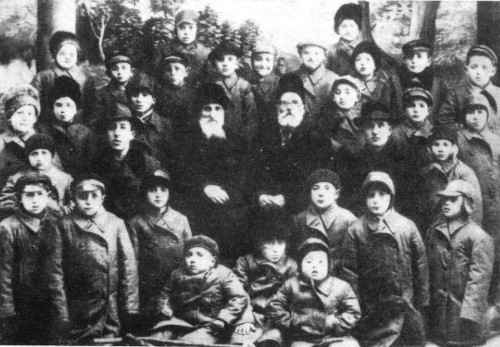
| At the Distribution of Winter Clothes to the children of the cheder In the middle: Yakov Shimon Vasserman |
|
|
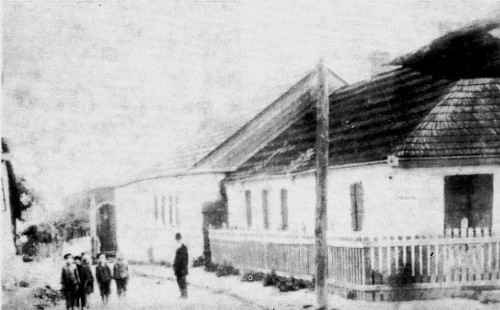
| Dovid Shmuel's House of Study |
Translator's footnotes:
|
|
JewishGen, Inc. makes no representations regarding the accuracy of
the translation. The reader may wish to refer to the original material
for verification.
JewishGen is not responsible for inaccuracies or omissions in the original work and cannot rewrite or edit the text to correct inaccuracies and/or omissions.
Our mission is to produce a translation of the original work and we cannot verify the accuracy of statements or alter facts cited.
 Khotyn, Ukraine
 Yizkor Book Project
 JewishGen Home Page
Copyright © 1999-2026 by JewishGen, Inc.
Updated 04 Oct 2026 by JH