 |
|
|
[Column 281]
by Baruch Melamed
Translated by Jerrold Landau
@Roberta Paula Books
Kamin Kashirskyi, like almost all the Jewish towns of Poland, was planed and built so that there was a square in the center of town – the market – which was surrounded on all four sides by shops, where all the businesses and trades of the towns were concentrated. It was also the location of the weekly fairs. Business and trades were the sole sources of Jewish economic existence, because all other sources of livelihood, including agriculture, heavy industry, military, and government jobs, were banned for Jews and Poles. The previous weekdays were gloomy with they greyness, and with their mood of struggle.
Jews were burdened with concerns of livelihood, and encumbered with exceptional difficulties due to the yoke of various innumerable
[Column 282]
taxes from the regime and the municipality. They hurried to fill the marketplace, nervously walking by their poor shops which, for the most part, were empty without customers, bitterly sighing and asking themselves the question: from where will we get money to pay a debt whose due date is quickly approaching; or pay the taxes in order to avoid penalties and punishments?
Aside from this, everyone had to provide a livelihood for their families. Some were also concerned about where to procure the dowry for a daughter who has come of age, to pay rent, or to obtain wood for the winter, etc. The Jews of Kamin Kashirskyi were not lacking in any worries.
If the wagon of a peasant traveled into the marketplace, several interested Jews would immediately approach, and take a whiff of what they had brought to sell,
[Column 283]
or to think about what they had to purchase. More than once, a small dispute would break out between the interested parties, but it was always solved by them themselves.
One could also determine, more or less, the time of day by what was transpiring in the marketplace. For example, when the city wagon drivers were seen in the marketplace waiting in their wagons for passengers to take to the railway station, which was two kilometers from town, one knew what time of day it was …
The weekdays were completely similar one to the other.
The Sabbath day was completely different. Jews from Kamin Kashirskyi observed the Sabbath. Not one Jewish business was active on the Sabbath. The town changed its appearance. All movement, even gentile, stopped. For them, the gentiles, there was no point in coming to town and finding everything closed. The Jewish population also looked completely different on that day. Jews did not hurry on that day. Jewish children, almost all of whom studied in the Hatekhiya Tarbut Hebrew School, did not hurry about ---
On Saturday morning, you would encounter many Jews, old and young, dressed in their Sabbath clothes and strolling slowly, most with tallises under their arms. They were on their way to the four synagogues of Kamin Kashirskyi: the Beis Midrash, Trisker, Stepiner, and Kobriner Shtibels.
In the latter years, a so-called Zionist Minyan existed. It was located in the Hatekhiya Tarbut School in the house of Meir Roizn.
Later, at noontime as well as in the rest hours of the early afternoon, the town was almost completely empty. One would seldom see a passer-by on the street. Everyone was resting.
On the other hand, on the late afternoon of Saturday, a strong movement of people out for a stroll began. Old and young took advantage of the Sabbath late afternoon to go for a pleasant stroll. It was still before the full week of toil, so they were able to forget all their weekday concerns. They had beautiful countenances of the additional soul[1], and they filled the streets.
That portrayed the Sabbath day, in all its timeframes.
[Column 284]
It could be easily seen, one could feel it in the air, and sense in all its details that the day was the Sabbath, the Jewish day of rest. Nobody disturbed the rest. The surrounding population from the entire region knew that it was useless to come to the town on the Sabbath, because nothing could be taken care of that day. They regarded this as an understandable thing.
Unfortunately, the Sabbath in Poland during those times was not just one time for Jews, but rather a full two days, for Sunday was also a compulsory day of rest. All business enterprises, which, as we said, were concentrated in the marketplace, were closed on Sunday as well. However, the town had a completely different appearance on Sunday: Jews were dressed in weekday garb on that day, and the entire yoke of the exile was etched on their faces…
Frequently, wagons of farmers who had come on their free day of rest stood in the marketplace. They had come to take care of various affairs, ignoring the fact that the businesses were officially closed. They dealt with those with whom they had need, and they purchased everything that they needed from the Jewish shops. However, they did so only from the back door, because the Jews had to be careful that their business transactions would not be noticed by the policeman responsible for this issue (for the most part, it was the crafty Lutzki), and thereby get a “report” …
On Sunday morning, the Jews gathered in groups around their shops, carrying on various conversations about general world politics, national politics, Jewish issues, and, indeed, also a bit of local gossip.
Zionists used the day of Sunday for various activities, as well as for committee meetings and events. Civic activists used the day to take care of communal affairs. The children also went to study in their Hatekhiya Hebrew School, as they did on a regular weekday.
That is how our Sunday went, or, as we called it, “The second Sabbath of the Diaspora”[2]. It was also a recognizable day. Casual observers would
[Column 285]
be able to recognize that it was a Sunday, even without looking at a calendar, but rather from the different appearance of the town.
There was another day of the week that stood out from the other weekdays. That was Tuesday, the weekly market day in Kamin Kashirskyi.
On that day, people from the entire region would come to us. The marketplace was full of wagons.
[Column 286]
Virtually all the stores were packed with customers. The mood of the merchants and tradespeople was high. On that day, people did not even eat on time, for they had to earn their livelihoods for almost the entire week on that day. On that day, Jewish businessmen from the surrounding towns would come to sell their merchandise and take part in the strong earning power of the market day.
Translator's footnotes:
by Y. Ben-Moshe
Translated by Jerrold Landau
@Roberta Paula Books
The town lived mainly from business and trades, with the customers being the peasants who would come to the fairs. Gentiles would stream into town from all sides precisely in the middle of the day. They would come from the surrounding villages with horses and wagons, often hitched to a head of cattle. The wagons were laden with all types of products from the villages. They would raise the wagon shaft aloft and have something to refresh themselves. Then the peasant would sell the head of cattle, as well as the beans, dried berries, eggs, mushrooms, and pig hair. Then they went to the shops to purchase all types of merchandise. During the winter, they would also purchase furs and boots. Then they would go to an inn to have something to drink.
The commotion and noise during the fair were great, both from the animals as well as, to differentiate, from the people. Fights between the Jews and gentiles would often break out regarding a theft that the peasants would attempt to perpetrate in the shops. The peasants from Buzak and Vidricha were especially known as thieves.
There were large fairs at the end of the summer, when the cool wind was already blowing, and the peasants were already bringing their grain into the barns. Then they began to prepare for winter with new boots and warm furs, and to provide the old grandmothers with warm clothes.
[Column 286]
They [the peasants] had enough people to be concerned about them. Jews would travel to Kovel and other cities, and bring back all sorts of textiles, furs, and boots from there. Even the poor Jewish women who stood in the market with buns, bagels, and a variety of apples, pears, and apple kvass took in their earnings and were happy.
The tradesmen also indirectly earned their livelihoods from the fairs and market days, just as the merchants did. People would order a suit from the tailor, a pair of shoes from the shoemaker, and a piece of furniture from the carpenter. Even the melamdim and teachers were paid their tuition after the fair.
There were also many landowners [poretzes], noblemen around our town, who owned large estates, lots, forests, and property. Their entire varied business endeavours were conducted by Jews from our town. Every landowner had his Jews with whom he did business. Even when he required money for interest, he would obtain it from them.
I recall when they often came to drive through the town with their fine carriages with four or six horses in tandem. They would travel to their host, Reb Hershel Verba or Reb Yehoshua Kremener (Gortenstein). Instead of going to cheder, we children ran after them and enjoyed looking at the fine horses.
[Column 287]
There were many colonies of Poles and Germans in our area whose needs were much greater. They purchased more than the Ukrainian peasants. The also had more
[Column 288]
to sell to our Jewish townsfolk, for our town was considered among to be among the ones with the strongest economies in our region. The possibilities for earning a livelihood were not bad.
by Chava Litwinski – Zafran
Translated by Jerrold Landau
@Roberta Paula Books
|
Who can forget the home with the people, with the entire family, in which love to everything and everyone pervaded? Who can forget our good home where righteousness and justice pervaded.
I recall our mother, Basya Zafran. She was always thinking about how to help others. She always looked for ways to help arrange a wedding for a poor orphan girl, to help someone who was lacking a livelihood or who was lacking something for the Sabbath. She had all the good traits that a modest woman would have. Her preparations for festivals and Sabbath were done with awe and honor!
I recall how she used to say to me, “My child, when Thursday comes, I dream that I am late in lighting the candles.” And that is indeed what happened. She was late in lighting the candles. Her candles were extinguished. The bandits broke her candelabra. However, her spiritual light was not extinguished, for we do not forget her. She lives in our hearts.
I remember how she implanted within us the ideas of giving and helping. We are the heirs of her good traits.
When Ratno burnt down, she did not request help from anyone. Rather, she took her own things and food from the house, and sent a full wagon to Ratno.
[Column 288]
I recall the Friday night meal, the holiness that pervaded in our house: the shalom aleikhem, the kiddush, the zemiros [table hymns]. It was a solid piece of holiness, and enabled us to forget the difficult Thursday.
|
|
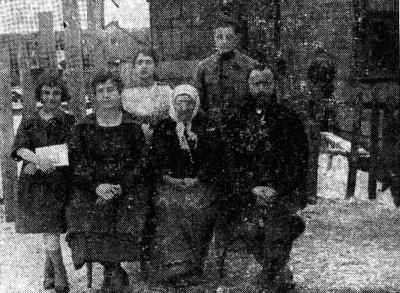
Standing: Mordechai Zafran and Feiga (Pruzhanski) Sitting: Shefe Zafran and her mother Chaya, his wife Basya and daughter Esther Chait |
I recall a Friday night when we were all sitting at the table and singing zemiros, Naftali Potok's son-in-law entered and said, “I got married today, and I received a note that I must present myself at the regiment.” Our
[Column 289]
father immediately answered him, “Go and rejoice with the bride.” My father went to the police and immediately straightened it out. When my father would go to request something from the Starosta [district leader] or at the Natshalskwa officials at the municipality, he would always tell them a parable with a story from the Torah. In that manner he could make anything happen with the authorities.
How can I forget my sisters and brothers, Feiga, Esther, Shimon, and Kopel? Feige would make peace between strangers and people close to her. She had a good, refined soul. I cannot forget Esther with her lovely laughter and her witticisms. Where are their bones? In sanctification of the Divine Name and the nation. How can I forget my town with its people? We must mention each one of them: The Eisenberg family, Gershon, Yitzchak and Akiva; the Pruzhansky family, Sheindel Pruzhansky. She would say: “If it was not in each week, one could live from a Thursday.” Everything was answered on the Thursday, and there was nothing more.
Today, on the festivals, or, as they are called, the Days of Awe, everyone would come and pour out their heart in their own manner.
[Column 290]
I remember my father Shabsai of blessed memory. He used to lead the Shacharit services frequently, and when he came home, he used to ask, “What do you say, Chava, how did I daven?” “Very good!” I used to answer, “But you went too fast.” One the second day of Rosh Hashana, he remembered my desire, and did so. How good it was then. Everything became silent…
How can I forget my friend Fruma Klorman with her true word? How she would always come and be such an enthusiastic friend. Saseh Eisenberg, and others. All my dear ones, who I will never forget!
Tzvi Gortenshtein of blessed memory was such a dear man and a dear citizen of the city. We lost him here, in Argentina.
Who can forget Tzipka Erlich of the Plott family, with her Socialist ideas and Zionist beliefs? Because of the murderous German hands, she could not reach our land that we fought for.
Many such sons and daughters of Kamin Kashirs will be inscribed in this book. They must not be forgotten by friends and relatives.
|
|
JewishGen, Inc. makes no representations regarding the accuracy of
the translation. The reader may wish to refer to the original material
for verification.
JewishGen is not responsible for inaccuracies or omissions in the original work and cannot rewrite or edit the text to correct inaccuracies and/or omissions.
Our mission is to produce a translation of the original work and we cannot verify the accuracy of statements or alter facts cited.
 Kamin'-Kashyrs'kyi, Ukraine
 Yizkor Book Project
 JewishGen Home Page
Copyright © 1999-2026 by JewishGen, Inc.
Updated 21 Oct 2026 by JH