 |
|
[Column 131]
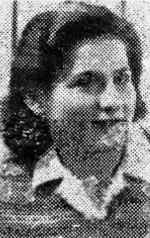
by Masha Wolfsthal (Dreitzen)[1]
Translated by Jerrold Landau
© Roberta Paula Books
|
|
Monday November 2, 1942 was the final day of our living in the ghetto. I was ten years old.
From our family, my father Zelig, my mother Freidel, and my brother Moshele still remained alive. My brother and I lived as illegals. From the time of the final large aktion (August 10, 1942), in which Grandmother and my little brother and sister were killed, as well as all of my paternal family – Grandfather, Grandmother, aunts, uncles, and all their families – we survived thanks to a hiding place. There were four people hiding in our house: three children and one adult. Two were in the double ceiling on the roof over the doorposts and two were in the double walls.
We would often sleep in one of the hiding places, both to get accustomed to “this situation” and on account of the disturbances at night. My father would return and explain how we children must act in a time of tribulation. Even though we were small, we understood the danger lurking around us, and we sensed the impending disaster.
That night, we all entered the hiding place. We were approximately twenty people, including Shevach Bergman and his entire family, Uncle Yitzchak Plot and Aunt Sheina Chaya, and, it seems to me, also Aunt Menucha and her family,
[Column 132]
as well as my father, my mother, my brother Moshele, and me.
We heard the Germans wandering about, shouting, and chasing everyone out. We also heard the weeping and groans of the many people who had been out walking, only few of whom had returned. I also remember how they took my grandmother Feiga-Rosy and my little brother and sister from their hiding place and chased them to the valley of murder from which one does not return. They were in a different hiding place, since some people claimed that it is better that not everyone hide along with young children. Indeed, all the reasoning and enticements and diversions that were prepared for the toddlers were to no avail. They burst out crying, which reached the ears of the Germans. My mother fainted at the moment they took them out.
If my memory does not fail me, we stayed in the hiding place for two days. During that time, we heard incessant shots. None of us closed an eye as we tensely watched what was taking place, barely breathing. After the two days, strong knocks began to reach our ears. We weren't able to figure out what the knocks were, until suddenly we heard weeping and speaking in low voices: “Jews, children of merciful ones, everything is over.” We were told the tidings of Job [i.e. the bad news], namely that nearly all of the city's residents had been murdered before the eyes of the few that remained. Since not many Jews were left,
[Column 133]
the Germans decided to shrink of the area the ghetto. We were situated outside the new boundaries of the ghetto and were not among those who had been granted permission to remain alive. Our situation continued to be dangerous – how could we go out? Even though the great immediate danger had passed, we were still not secure in our lives, and we did not know who had survived and who had had their lives cut off forever.
My mother strengthened a bit and comforted herself with hopes. My father, on the other hand, tried to be practical and to strengthen us. Somehow, we managed to sneak out at night and to cross to the other side of the ghetto. My brother and I barely went outside.
We lived for about three months under such conditions, in constant fear, until the final day of the existence of the ghetto. On the day before the final day, we sensed that a disaster was about to break out again. It was as if the air was electric, portending evil.
During that period, my brother became very sick, and my mother had not yet recovered fully from the loss of a part of our family. My father thought that we could continue to hide in our old hiding place, and that we would not be found. He concerned himself with providing food, water, and other necessities. However, it was clear to all of us that we would only be able to remain in this hiding place for a brief time, for at most several months. The question arose – what would come after that?
That day, we did not know why, permission was given to come and go through the gates of the ghetto without a special permit. My father wanted us all to leave town until the wrath had passed. However, my mother refused, saying that my brother was very sick. She was also weak. Therefore, she recommended that my father and I leave, and that she would stay along with my brother and the rest of our family who still remained. They would hide in our hiding place on the other side of the ghetto.
My father agreed. It seems to me that we did not say goodbye to each other. Perhaps we felt that we would meet again, perhaps because our hearts were heavy, or perhaps because of the great confusion of what was taking place – I cannot answer this…
From the moment that I left my mother and brother, at the age of only ten, in the year 1942, I never saw them again.
I left the ghetto along with my father, and we reached the railroad station without anyone asking us where we were going. It was a nice day, even though it was the beginning of the winter.
We met my cousin Lemme Klurman at the railway station. The three of us continued on our journey.
We went in this manner for six days. The area was forested, and “khotors” [cottages in the heart of the forest] were scattered about far from each other. Since my father was a native of that village, the farmers knew him, but they all refused to take us in. Only a few were prepared to give us a morsel of bread. We were unable to warm ourselves a bit and to rest, even though I was shivering.
[Column 134]
After six days, my father realized that all of his acquaintances were acting distantly and plotting against us. All hope was virtually lost. He made a very difficult decision on my account. The three of us were sitting in an attic of an unfinished house along the route, approximately five kilometers from the village. We suffered from cold and hunger. My energy was completely gone, but I still had a father who protected me with his body, caressed me, took off his jacket, and dressed me. Similarly, we also divided up our last morsel of bread.
Having no choice, my father presented his recommendation – that he and Lemme would go down and walk to the village of Dubetski. There, they hoped to obtain information about what was taking place at home in the ghetto, and general news. I would continue on my path in the evening toward a good acquaintance who had a great many of our belongings. In her time, she had agreed to take me in. I myself had barely absorbed the advice. I did not grasp the full meaning of the concept. One can imagine that I refused, but, as I had said, I did not understand what drove my father to entice me. His opinion was that I was still a young girl, and I had a chance to be saved and to survive – and I must take advantage of it. He then gave me all sorts of information about where certain belongings were located and the like, which I certainly did not understand. He stressed that he had a feeling that I would survive. This was perhaps the first time that I saw my father weep. He further explained to me how to get to that acquaintance: to descend from the roof and to go “straight along the telephone wires.” Suddenly, was alone. At that moment, I grasped the full severity of my situation. Suddenly, I sobered up, but too late. I was alone. I was forced to care for myself. I never saw my father and cousin again.
I do not recall whether I said goodbye to my father and my cousin Lemme. Apparently, they did not want to frighten me, since they promised to tell the acquaintance details about themselves and to ask about me. My lonely activities began that night.
First, I had to overcome the fear of jumping from a height of three meters. (My father had carried me up to the roof, but now I had to jump down myself.) I jumped, and I was not even hurt. I stood up, and with tears in my eyes, I began to march in the darkness along the “telephone wires.” Even with my full desire to overcome my fear, I did not stop trembling. However, with time, I also learned how to love the forest, but I did not yet know what a forest was.
Suddenly, it seemed to me that all the stories and legends that I had heard from Grandmother were popping up from behind every tree, whether in the image of a lion or a wolf, or just regular monsters. It was as if they had all came to capture me. I walked faster with my minimal energy. The route was not very long. I walked for an hour or two. Then I arrived at the place in peace. No animal, whether two-legged or four-legged, tore me up.
The acquaintance took me into her house and fed me. I was
[Column 135]
very tired and broken, and I only wanted to lie down to sleep. She displayed great respect for me, and comforted me, saying that, come what may, she will not send me away from her. I was too tired to be happy. I lay down on the floor, under the protection of a roof. However, the ideal situation did not last for long. Already the next morning, she woke me up and told me a very imaginative story. What I understood from her words was that she had told her neighbors and husband about me that night, and all of them decided that it was forbidden to keep me, and I could not remain in their midst. In addition, she added that my father had sent a messenger to her to send me back. I told her that my father would come himself, or at least write a note, but I cold not force her to keep me. I tried to urge her to allow me to rest with her, but it was for naught. She refused strongly. She gave me a flask of hot tea and some bread and sent me away.
Having no choice, I decided to return to where I had been. I knew the path somewhat from the night of walking. During the day, it was much more difficult than at night. The route was full of farmers traveling on wagons. They rejoiced at my misfortune, tormented me, beat me with whips, and tried to figure out how and when I would die. They expected I would be able to wander about this way for a few more days. They also told stories of the atrocities that they had seen and how much they enjoyed them. I reached the entrance of the town toward evening. As I entered, I saw Germans and Ukrainians overturning every plank in their search for Jews. I understood that I had no place to go. I returned, without knowing where my feet would take me. I walked about 20-30 kilometers. My feet would simply no longer carry me, and the cold also began to afflict me. With my meager clothing, I could not sleep outside, so I entered the first dwelling and asked to warm up, but they did not agree. I tried my luck at the second and third one, but in vain. All of them refused. I continued in the order of houses until I came to the house of the village drunk. As soon as he saw me, some sort of madness overtook him, and he began to pass judgment on me. He tried to figure out how he would kill me. He gave me “free choice” between four types of death: shooting, hanging, strangling, or burning. To prove the point, he quickly brought a flask of fuel.
My feet failed me, whether from the fear that overtook me or plain weariness. Therefore, he dragged me out on my knees, grabbed me with his hands, and tossed me against the wall several times like a ball. It is unbelievable, but I stayed fully conscious. He thought that I was a partisan because of my flask of tea and my strong stance. I responded that I was not a partisan, but I should not have told him anything. I tried to convince him that he should turn me over to the Germans. He was indeed convinced. My recommendation was in order to gain some time, and also because I thought it would be best to be killed by a shot rather than in such a cruel fashion.
[Column 136]
In the meantime, almost all the villagers gathered around. They were enjoying the unusual scene. Some of them tried to dissuade him from his deeds, but most encouraged him. In any case, he continued to drag me to one house. Guards were placed around us so that I would not escape, Heaven forbid. In any case, there was no need to worry about that, because I was unable to do so. I almost made peace with my fate, that my final night had come. It was the loneliness that was especially afflicting me. I thought about family warmth and unity during those moments. Their value is inestimable.
It was decided that I would sleep in that house, and they would bring me to the city the next day. They continued to torture me in the house in a completely different fashion. When they asked me if I ever ate pork, I responded with a definitive no. Suddenly, the entire family fell upon me and tried to force feed me. They finally had enough of this scene and let me be. I slept on a bench. They reminded me that this was “my last night.” It is strange, but I slept a bit. Weariness overtook me. This was a fitful sleep, full of reality and dreams.
I dreamt or saw that I was in my house, relating exactly what took place that night. Grandmother comforted me and said that no harm would befall me, for they are guarding me. I continued to weave my dreams in this manner, but suddenly they knocked on the window and woke me up. The reality was not encouraging… I girded myself with strength, that the good dream had a drop of hope. Perhaps with all this, I would be saved this time as well? Indeed, a change of plan had taken place. The drunk sobered up a bit. The rest of the people had been influenced by the only man who perpetrated the torture, and they simply sent me away. At that moment, I understood the meaning of their decision. I quickly turned around and began to walk as fast as I could in the direction from which I had come the previous day. The drunk tried to bring me back, claiming that this was not the right path. I did not pay attention to his calls. As a reaction to this, he sicced dogs on me. However, the dogs were miraculously more humane than the people… There was no reason to return to the town (on the previous night, the villagers told me terrifying stories about the atrocities perpetrated by the Germans against the Jews, and that the ghetto had been completely liquidated). I decided to return along the path that I had come, as I knew the route from the previous day, and try my luck with that “good woman.” The route during the day was difficult and cruel. I reached the entrance to the village of Verkhy in the evening. I went straight to my acquaintance, but the woman acted as though she did not know me at all. She screamed at me and threatened that if I did not immediately disappear, she would call the Germans. All my pleas for her to at least permit me to stay over with her were for naught. Having no choice, I set out again on my path into the night. The cold penetrated the bones. Tears disappeared, but some internal force impelled me to continue and to struggle.
November nights are cold. The cold afflicted me. I entered the village and began to knock on every door to ask that they take me in so that I could
[Column 137]
warm up a bit. The result was a definitive refusal by everyone. Despite my denial, they at once recognized that I was a Jewess. I finally admitted that I was a Jewess, and that my grandfather and his family knew them well, and were natives of the village. Trembling completely, I finally entered the pigsty so that I could at least be under a roof. However, I did not enjoy much comfort. I was afraid to lie down. I sat in a corner with my teeth chattering, unable to fall asleep despite the great weariness. I suddenly heard people talking around me. I surmised that they were partisans and that they had come to take pigs. However, my suspicious abated and I did not go out. Later, I regretted my inertia many times. To this day, I cannot explain to myself why I was quiet. It is possible that they also would have liquidated me, for I would have only been a burden to them. Or perhaps not? Who knows?
When I knocked on the door in the morning, they opened it. They gave me a glass of milk and allowed me to warm up a bit. From their conversation, I figured out that indeed there were partisans in the village, and they had caused some damage. That time as well, they did not agree to allow me to remain for a bit longer. Having no choice, I went outside again. I was always afraid and cold, and I began to get used to this. It is strange, but the thing I wanted most was a friend, an acquaintance, before whom I could cry and lament my loneliness. However, who wanted an added problem such as me during those days of madness? I was only a burden, just a little girl. Later, after I had already reached the forest and was among the people that I wanted, they were almost all strange to me. While we were in the forest, for a relatively brief time, many people tried to strengthen me. During the searches in the forest, they all chased me away coarsely, even though I always tried to grasp on to families literally with my nails. Once, a gentile saw this, and he took me in to his house (I do not even remember where this was), fed me, and let me stay several days.
However, all this was before I arrived in the forest. I continued to wander about for a half a year or more. My name began to go before me – the small Zhydina (Jewess). Even though at first I attempted to claim that I was not a Jewess, I finally admitted it, also because I was not fluent in the Polish and Ukrainian languages. I tried to change my story from time to time, but they knew of my existence within a radius of tens of kilometers. I wandered about in this way for several weeks, until one day I was told that Jews were wandering about the village of Karpylivka and several other villages in the area to gather a bit of food for their families, who were located somewhere in the forest. At first, I found it difficult to believe that this news was legitimate, but I was finally convinced that it was true.
One night, I met face to face with these Jews.
[Column 138]
They were surprised to see me and tried to prevent me from going with them. First of all, the distance was great, an entire night of walking. Second, most of them had families, and I would fall as a burden upon somebody.
A large portion of the residents of Karpylivka were Stundists[2] or Baptist farmers, whose main doctrine was to not harm one's fellow and to assist those in need. I wandered from house to house for about two weeks. Here I ate a plate of warm soup, and there I warmed up a bit, for winter had already begun to give its signs. The main difficulty was a place to sleep. Even there, I was forced at times to spend the night under the cover of the cold sky or in some barn or stable, for almost all of them were afraid to take me in. However, in the merit of the Baptists, it should be said that they were prepared to endanger themselves and strengthen me on condition that I become one of them, that is that I change my religion. I refused, however. Later, I at times regretted this. I could have accepted their religion externally to save myself and benefit from a roof, and later, like many others, return to the kiln that forged me. However, in my childlike innocence, I asserted passionately that it would be better for me to die as a Jewess rather than become an apostate.
Thus, one evening, I arrived with a heavy heart at the door of one of the houses. As usual, I knocked hesitantly. This time, a woman came out, looked at me, checked me over, and told me to wait outside for a bit. I waited in the darkness. After about a half an hour, she came out and took me into her house, fed me, and told me that she would allow me to remain in her house for a day or two to rest a bit from walking so much. My feet were covered with calluses, my shoes were disintegrating, and my clothes were worn out. Worst of all, I was infested with lice. I had not gotten undressed or bathed from the time that I left my home. The filth was terrible. I had long braids, and it was like my head was going to explode atop me. I was always scratching myself. When the good woman saw this, she shampooed my head, cut my braids, washed all my clothes, and dressed me in the clothing of her daughter, who was my age, but who had a better fortune than me.
The days were passed in laziness. I did not let myself to enjoy the relative good, out of fear that I would be forced to leave. At least, I had a place to lay my head and a warm house. I barely believed that this was reality. My sleep was fitful, and I always woke up with the thought – is this not a dream? My hands felt around to figure out where I was – outside or in a house?
Every day, my departure was deferred until the next day. The cold was harsh, and the gentile woman was afraid that I would freeze. She had mercy upon me. She compared me to her daughter and burst out crying. She was a widow, with a fourteen-year-old son and a nine-year-old daughter. A teacher also lived in her house, who did not know about my existence. Aside from her two children, nobody in the village knew about my existence (at
[Column 139]
times, the villagers talked about me and wondered about my disappearance even though of course this did not bother them). My daily schedule was more or less as follows: she would wake me up early in the morning (my sleeping place was on top of the stove, a warm place where nobody would see me), dress me in one of her old, large, warm coats, and place me in some ventilated fur, full of slits, and dark. I would sit there on a crate. I was not allowed to walk about, lest someone hear me. I sat for many days, about a half a year, without seeing the light of the sun, and without breathing fresh air. She would bring me my food when there was nobody around. I did not suffer from hunger with her, but since I would not eat unkosher food, I only ate dairy foods.
I was part of her family without asking to be (aside from my silent prayers), and without her receiving any payment or recompense from me. My life entered a “regular pattern,” aside from occasional German raids. I sat on the crate for most of the day. At times I lay down and shivered from cold. I turned my attention to any motion or any strange sound. I was a daydreamer. I dreamed good dreams, most of which have not been fulfilled to this day – how I would meet my family, etc. I also had nightmares. I imagined all kinds of things in order to keep myself busy and not go crazy. At times, I would count endlessly. At times, I would quietly sing songs that I had once learned. I was never so daring as to ask her for reading material, for there was none in her house. In general, I was embarrassed. I also did not know if it would be possible to read in such dim light – there was almost no light. That year, 1943, the situation was unbearable: The Germans made endless demands, the partisans appeared from time to time and demanded their share, and ordinary Jews would come to ask for a bit of bread. She responded to them all.
Although the relations of my benefactor toward me were good, the relations with her son were unbearable. He was opposed to me being with them and made me feel this in all ways, including severe beatings. I absorbed them in silence, gritted my teeth, and cried quietly. I often asked myself if the great day when I could leave this house and go out to the light of the day would ever come. Even though I was a girl, I was weak and full of pessimism. I almost did not believe that I would merit to reach the day of liberation.
Among the rest of the happenings that occurred to me with the gentile woman, there was – a terrifying encounter. One day, the village was swarming with partisans. The houses already bustled with them in the early morning hours. I entered the pantry and closed the lock, as usual. I continued to weave my dreams: perhaps I would suddenly recognize a very recognizable voice, of my father or of someone else close to me. I knew that my cousin Klurman already left the house when we were still in the ghetto, and it was possible that he was a partisan in these areas. I hoped that my father had also joined the partisans, and if
[Column 140]
they heard about me, they would certainly search for me. I imagined thousands of good thoughts in my daydreams. To increase my hope, I cocked my ears and listened. Perhaps luck would be in my favor and I would hear someone…
I listened to every voice, trying to associate it with a voice that was recognizable to me. At times, I also peered through the cracks in the door. However, to my sorrow, I did not find any recognizable voices. My heart was already full of feelings of despair, and I stopped believing that such a miracle would happen. Suddenly, I heard the gentile hurrying about and nervously trying to open the lock on the door that I had previously closed. Before I was able to ask her the meaning, she told me that someone had come to visit me. I was still immersed in my daydreams, and before I grasped whether I was still daydreaming, while I was still astounded in my place, emotional and afraid, she took me by my hand and brought me into the room where my cousin, Abba Klurman, was standing. I immediately regained my composure. I recognized him even with his weapons and strange dress. We both burst out crying. He told me that my parents, his parents, and all of our family had been killed. The delusion that perhaps I would still see someone from my family was ripped to pieces. He promised to ensure that I would be transferred to a certain civilian camp in the forest where he was located. Of course, I was very happy with his intention, but carrying out the action would take a great deal of time, and I would endure many bundles of tribulations until I left that village, which was quite far from “that certain forest.” My cousin came to visit me several times, and one time, he almost took me with him, but a rumor spread that the Germans were coming to the village, and all the partisan groups were forced to leave, of course without me…
How my cousin found out about my existence in that place is a story of its own. Once, the gentile woman visited her aunt in a different village, and, among other things, her aunt told her that she was hiding a Jew. When she heard this, “my gentile” confessed to her that she too was hiding a Jewish girl. Immediately, they decided among themselves that I should send him a letter, for perhaps he knew me. Of course, I did so. Somehow, that Jew moved about and reached the partisans along with my letter. He searched for someone from my town in order to give over the information of my existence and succeeded in reaching my cousin. Abba tried his luck and found me. “My gentile” was in seventh heaven – she was happy with my joy, that I have found a relative, and happy that I would be able to leave her alone…
However, in the meantime, I was with the gentile woman, and my situation was quite dangerous, for one morning the Germans came. A strong fear overtook the gentile women, and of course me. At first, she decided that she could no longer endanger herself because of me and asked me to leave. It was clear to her and also to me that at the moment I would leave and appear before everyone, they would immediately recognize me as the zhydina who had suddenly disappeared, and someone would certainly turn me over to the Germans. She began to cry that everything she had done to this day would have been in vain. Finally, her mercy overcame her, and she decided to not send me
[Column 141]
away that time. However, after the Germans left, I would have to leave. I agreed. She informed me that if the Germans came to her house, she would act as if she did not know me. I also agreed to that. However, when the Germans came, they went to the oven and found me lying down and groaning. She responded that I was her daughter, and I was sick.
Thus was I saved that time as well due to the gentile. Another time when the Germans came, they closed me into a small cellar atop the ground where they stored potatoes in the winter so they would not freeze. It was sealed completely, almost without light or air. For greater security, they also placed simmering coals there. In a quick manoeuvre, she succeeded in placing me there as well. This was a difficult task. I entered a tub. They turned the tub upside down and lay me down on the potatoes. Obviously, I felt quite bad. Worst of all was the lack air to breathe, and the impossibility of moving under the tub. I lay down in a constricted fashion. The gentile woman acted intelligently that time as well. She left the house and worked in the yard. At first, I girded myself with strength and tried to listen to what was taking place outside. I reminded myself of the many times in which I had found myself in similar situations and was saved. Perhaps I would be saved this time as well? However, my level of consciousness declined slowly and I completely stopped thinking. Apparently, this was due to the lack of air, the smoke of the coals, and the inability to move.
The gentile who was working in the yard sensed that I was liable to suffocate from lack of air. She therefore tried to see what the situation was. She quickly lifted up the tub, extracted me from there, and with an additional manoeuvre, rolled me into the house and attempted to feed me. I refused, however. When I came to, I only wanted air. She placed me into another pantry, this time ventilated, but very cold. She dressed me in her fur coat so I would not freeze from the cold. In the meantime, evening was approaching, and news spread through the village that the Germans had left. The gentile woman and I breathed a sigh of relief, each for different reasons… I was saved once again, and she… who knows? Perhaps she regretted all the responsibility and effort that she took upon herself, however, at the last minute, she always decided in my favor.
Her nine-year-old daughter served for her as a measuring stick regarding me. However, with regards to her son, I was a victim. He would beat me seriously, mock me, and always threaten me that my end would be bitter. I also knew that he was liable to turn me over to the Germans. On holidays, when his mother went to church, he remained at home. For him, the meaning of such a holiday
[Column 142]
was an opportunity to torment me. However, I became used to that as well. I was quiet and did not tell his mother. He took advantage of that to continue to beat me.
Now, I will add some memories of the ghetto.
I recall how the war broke out. I recall the fist bombardments during the early morning hours, followed by an announcement on the radio that the war has broken out. I also remember the proclamations of the Poles that they would fight until the last drop of blood. But to our great astonishment, Poland was defeated within a few days.
During those days, our town bustled with Jewish refugees who had escaped from western Poland. We also took in a large family from Radom. My father and other people organized a kitchen for those in need.
After that, the Russians entered. I continued to study in the Yiddish school, whereas previously I had studied in grade one and two of the Hatechiya Hebrew School.
There was no shortage of troubles also during that period. Mu father received an order to pay a very high amount of income tax. We had a store and were therefore considered as bourgeoisie. Bourgeoisie people were exiled to Siberia, or at the minimum, needed to pay a large amount of income tax.
When war broke out between Russia and Germany, my father was drafted into the infantry division. This was a heavy burden on my mother, for she remained home with four young children. I was the oldest. After some time, my father suddenly appeared at home.
The reason for his return was simple. The entire infantry unit had been bombed and defeated and scattered in every direction. Anyone who survived returned to their home. My mother's situation thereby became much easier. My father began to concern himself with food supplies. Indeed, I do not recall that we were ever starving for bread, even during the difficult days.
Before the decision to enclose all the Jews in a ghetto, a certain area was cordoned off, and it was only permitted to live in that area. We stayed within the boundaries, that is in the center of the Jewish quarter. The entire family that remained in these bounds had to crowd themselves and accept another family or two under their roof. We took in our Aunt Tzipa, and Moshele and Leahle Plot, whose house was outside the boundary. It seems that we also took in my paternal grandparents, who had lived in a village until that time and had been expelled from there.
Translator's Footnotes
by Ze'ev Ingberg
Translated by Selwyn Rose
I well remember those terrible days: the fear, the steadily worsening situation, the passivity with which we regarded others' suffering. We made no self-examination, and asked ourselves no questions as to why the Germans were killing us – and we paid a high price for it.
I remember clearly the first “Aktzia” when we were all standing together on the field, saying to Ben-Zion Malik and to Ya'akov Karsh, “Look, they are digging graves for us; if we don't do something we are lost!”
When I left the field and went back to the ghetto, I tried to get hold of a gun. With the help of my brother-in-law, Yeshayahu Kroin (z”l.), I managed to acquire a pistol and later two rifles.
I prepared a hiding place for the pistol in an empty water bucket for when I left and returned to the ghetto; outside the ghetto there was always a pistol in my pocket. My decision was firm and final: if I fell into the hands of the Germans, I would put an end to my life.
One day, I repaired a rifle in the cellar of the house and had to fire real bullets in order to test it. I placed Ya'akov Karsh on the steps of the house, gave him two large hammers and told him to start banging with them. Then I went down to the cellar again and started shooting.
One day we woke up to find the ghetto unguarded. I was quite sure that our liberation had not arrived but that it was some trick or other by the Germans.
During the day, I could not escape because the Gentiles pestered me with their demands that I return them the watches they had given for repair to my brother-in-law, Yeshayahu Kroin (he himself had already flown to his hiding place that he had prepared at a Gentile's house).
A few minutes before nightfall, I climbed up to the hiding place on the roof. The hiding place was able to hold about 15 people but there were about 30 people there. They just sat on one another's knees. I went to the hiding place where I had placed the rifles and found just one rifle there. Later on I discovered that the missing one had been taken by Ya'akov Karsh and Ben-Zion Malik who had escaped earlier. We sat there in the hiding place until late at night and couldn't get out because of the shooting going on all around. From time to time we heard someone coming up to the roof and going down again. We sat there petrified with fear and without uttering a sound.
Eventually, the sound of shooting lessened and I said that
[Column 144]
the time had come to get out to the forest. There were women from the Malik family and they said, “No, no – we'll stay here until tomorrow night. Almost certainly the whole situation will be even quieter by then.”
“No!” I protested. “Tomorrow they will destroy the ghetto. Come with me, please,” I begged.
The majority refused, so I opened the door to the hide-out and went out. My own wife and Yeshayahu Kroin, Ya'kov Yaffe and his wife and two orphans, whose names I don't know, came with me.
On the way, I saw some wagons coming towards us. We ran into the field, lay down hiding and waited. Afterwards, we went into the village and got some food to take with us. We ran into a Gentile who raised his voice and began shouting, “Dirty Jew! Dirty Jew!” I approached him with my rifle at my shoulder and the pistol in my hand and he shut up. His shouts of “Dirty Jew” quickly changed to “Sir” – or some such – and we got some food. I warned him that I would shoot him and burn his house to the ground if he sent the villagers after us and we continued on our way. On the second evening we entered the forest.
After some time some others joined us and we dug a large bunker in the ground where we could hide, but we didn't have any food.
Eventually we decided that I would go with two friends to Kamen-Kashirskiy, to Zaminkovski the miller and bring some food. A few hundred meters from the miller's house, I gave my two friends a rifle and we separated.
When I knocked on the door it was opened by his wife. When I told her what I wanted, she hurried to the flour-mill adjacent to the house to call her husband. I stood in the corner of the room to make sure I wouldn't be seen and attacked from the window. Zaminkovski was sincerely happy to see me alive and well. I gave him a few watches and some money and he gave me in return a sack of food and promised to send more. I parted from him warmly and went back to my waiting friends who had hidden under a pile of hay.
About three days later a wagon arrived loaded down with food. There was a sack of flour, a sack of oats, tobacco, kerosene, matches and salt. A short time later the food was stolen and we were again hungry.
[Column 145]
We decided to behave like all the other partisans. From time to time, we would take the wagon to one of the Gentile houses. My friends would wait outside while I, who didn't look all that Jewish, would go inside and order everyone to lay on the floor with their faces downwards. I confiscated about 40% of all the foodstuffs that they had, just like the partisans did. After we had visited two or three houses in one evening, our wagon was full of food.
The forest ranger, who was a good friend of ours, told us that they had lodged complaints with him about the partisans. But
[Column 146]
they never realized that the partisan who had entered their homes had been a Jew.
Once, it was decided that Yitzchak Toizner and I should make contact with a group of partisans. We succeeded in doing so. But they stole our weapons, killed Yitzchak Toizner and sought to kill me as well. But I managed to run, somehow, and hid among the trees and by a miracle the bullets failed to find their mark.
On the way back to my group, without a gun, I felt as if I had ceased to be master of my own fate and every rustle and every tree constituted a threat. But the distance wasn't great and I was soon holding the pistol I had left in safe-keeping with my wife.
|
JewishGen, Inc. makes no representations regarding the accuracy of
the translation. The reader may wish to refer to the original material
for verification.
JewishGen is not responsible for inaccuracies or omissions in the original work and cannot rewrite or edit the text to correct inaccuracies and/or omissions.
Our mission is to produce a translation of the original work and we cannot verify the accuracy of statements or alter facts cited.
 Kamen Kashirskiy, Ukraine
 Yizkor Book Project
 JewishGen Home Page
Copyright © 1999-2026 by JewishGen, Inc.
Updated 4 Nov 2026 by LA