 |
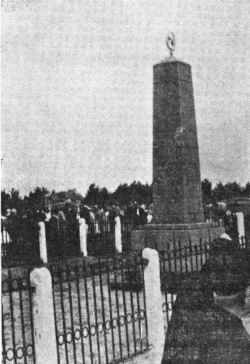
on the 21st of Adar 5722 [March 1942]
(The monument was erected in 1963)
|
|
[Page 805]
(Shchadryn, Belarus)
52°53', 29°33'
by Chayim Yeshinovsky
I was travelling through the countryside and came upon a place where I could rest for the night, a place where Jews lived, the town of Shchedrin, Bobruisk Gubernye. I was passing down a well-lined street between lovely houses and saw a beautiful synagogue. My soul yearned to know what kind of people lived here. I went to one of the houses and asked if they would take me in as a guest. A crowd of people surrounded me, all of them our brothers, Bnai Yisrael. They greeted me and accepted me warmly. One man took my hand and said, “The guest should come to my house. I have a large house. I can provide whatever he wishes since G-d gave me the good earth and my barns are full. I will give him hay for his horses without charge.” Another Jew spoke up, saying, “I would like the mitzvah of welcoming the guest. He can find whatever he would like at my place. He can eat and drink his fill.” He took hold of my horse and servants and guided them to his home. Within a minute the samovar was steaming and the smell of good food cooking came from the stove. I removed my heavy winter garments.
As I was relaxing from the long journey, I said, “How good and pleasant this place is.” Three men were standing in front of me. I said, “Jewish brothers, please tell me who you are and what you are doing here. Because I have never heard of the town of Shchedrin before.” The men said, “We are farmers. Since the order came from Czar Nicolai, G-d bless his soul, to give our brothers of Bnai Yisrael land to work and make a living from, our master, the wise Lubavitcher Rebbe gathered us together and gave us this land which he purchased with his money.” “Here is your land," he said. “Each of you take a piece of land to work it. If your hands are strong and you take pride in your work, G-d will bless your endeavors.” And we followed the words of the tzaddik. We came here and every man took a field for his home. We, our wives, and our children worked. And the great G-d blessed us with prosperity in whatever we did. We lack for nothing. Our Rebbe built us a synagogue where we pray morning and evening.
We didn't leave our Torah. Among us are people who know the Torah and share their knowledge of the Torah of Moses with us and our sons. The same for the mishna and gemara. Among our brothers are tradesmen, tailors, shoemakers, and all types of craftsmen. We are not like the other farmers. We are Jews and we always remember the wisdom of Solomon: there is a time to work, a time to pray, and a time to study the Torah. We don't need anyone to preach to us not to drink wine, because drinking alcohol would embarass us. We eat lots of bread but drink wine only sparingly, and we do not forget the blessing of our G-d.
[Page 806]
by Y. L. Katznelson
During Chol Hamoed Sukkot of this year (1864), I was travelling from Paritch to the nearby village of Shchedrin to be a guest at the house of one of my relatives. This large village was bought by a wealthy chasid for the tzaddik, Rabbi Mendel Schneerson of Lubavitch, to give him the rights of nobility. And Jews settled there to work the land and watch over it. Only a few of the villagers actually engaged in farming. Those with money were engaged in the timber trade. And the poor people who settled there only to escape army service made a living by tieing together logs and sending them down the Berezina and Dnieper Rivers. Only the women and girls worked in the vegetable gardens and fruit orchards. When I went out to have a look at what they were doing, they were embarrassed to be doing farm work, which is felt to not be appropriate work for Jewish women. That day, when I ate a dish of fresh-picked potatoes and cole slaw, and when I tasted the freshly-picked, sweet pears and apples, I first thought of the question, “why can't Jews also be farmers,” asked by the author of T'eudah B'yisrael. This question bothered me for many days. Only many years later, I devoted my story, Shirat Hazamir to this question. And when I was in the land of Judea a few years ago, in the beautiful blooming town of Rehovot, I saw men and women engaging in farming. On their faces wasn't shame, but ride and joy. And then, I felt as if a heavy stone was removed from my heart, and from the depths of my soul, came the words, Baruch meshane itim umachalif et ha zmanim. (Blessed be He who changes the times and the seasons).
[Page 807]
by G. Gankin, Dr. Z. Gordin
Translated by Odelia Alroy
Between two important cities in White Russia, Bobruisk and Homel, lies, torn away from the wide world, a small, poor, Soviet town, Shchedrin—17 verst [a little over eleven miles] from the railroad station Krasny-Bereg and 12 verst from the town Paritch. Now Shchedrin is a small Gentile village, with pigs and dogs, with graves crossed and uncrossed. Somewhat farther from the village lies a broken wooden fence of rotting boards—open to cattle and pigs: this was the old Jewish cemetery with her toppled monuments and destroyed community.
From the worn down letters one can still read many names. Here lies more than three generations of Shchedrin Jews.
Not far from the cemetery—two great mounds of earth. No path goes to them and no trees grow on that ground. These are the bloody graves of an entire Jewish settlement: all that is left of Shchedrin. In one hour they were all slaughtered by Hitler's beasts. In two big graves, which they forced them to dig themselves, they dumped them. They lie there in their bloody clothes. No one remained to mourn them.
*
In Czarist times was officially counted as a Jewish town. No Gentiles, no church, no graveyards, no young Gentiles, who in all Jewish towns would throw fear unto Jewish children.
Shchedrin was famous thanks to the illustrious, rich family Golodetz who lived there. They were noted as important, honest lumber merchants and philanthropists. Dealers, lumbers, brokers, salesmen, and assorted beggars would often come to their court. The foundation of the colony of the half-village, half-town was tied to the Golodetz family. And with its fate was also connected the decline of Shchedrin after the time of the Russian Revolution.
The ancestor of the Golodetzes was Reb Chaim Golod. When he became rich, he changed his family name to Golodetz (golod means hunger in Russian). His interesting biography can serve as a typical example through a historic viewpoint of how a Jewish center developed in Russia due to the outstanding energy of certain people.
[Page 808]
The poor family of Golod lived in the small town of Azarich [Ozarichi]with their son Chaim. When Chaim grew up, they apprenticed him to a tradesman. However, he soon showed his great merchant abilities.
In that time—at the end of the first quarter of the 1800s—the lumber trade started to develop in Russia and Chaim, almost without capital, began to deal in wood. He was one of the first who began to drive floats of lumber on the Berioza and on the Suzch into the Dnieper up to Yekaterinoslav and further—until Kherson. He would buy lumber from the landowners, chop it, saw it into boards, bind it into floats and transport it to “Niz” where there were no forests and lumber was precious. The dealings went well and Chaim was a very rich man—a gevir.
In 1841 Reb Chaim and a group of Jews who wanted to get involved in agriculture, bought a parcel of land from a landowner which was called Shchedrin. Reb Chaim received the forests and the court where the landowner had lived, and the group of Jews, all of the surrounding fields to sow crops and make a living from the soil. (Reb Chaim's portion was 120 desyatin [over 430 acres].)
Since not every Jew could buy permits to work the land, they used the law about Jewish merchants who need a license. But since just buying one in the name of the gevir is not good business, they came up with the idea to buy it in the name of the Lubavitcher rebbe, Reb Mendele (the Zemach tzaddik) who had the rights of a merchant.
In this manner Shchedrin became a kingdom of the Lubavitcher Rebbe. In 1865, when Reb Chaim himself got a permit, he listed his portion in his own name.
The entire purchase of Shchedrin, we heard, was a mistake. The orchards proved not to be fruitful, they were swampy. It didn't matter to the Golodetzes because by that time they were already rich. The colonists suffered terribly. Many turned to other occupations.
Later, Reb Chaim bought a big estate in Surzhe district, Tchernigov area, Lialychi, which had belonged to the family of the famous Firsht Zavadovsky, the favorite of Catherine II. This purchase was very fortunate. The big, thick forest, the orchards, and the brewery were an unusual source of wealth. Reb Chaim received the historic palace of Lialychi which the famous architect Rastelli built. The palace looked just like the Petersburg Tavrischer [Tauride] Palace where the dumas [a government assembly]. Catherine was often a guest in Zavadovsky's palace. It was said in Shchedrin that the palace had 356 rooms so the Czarina should be able to spend each night in a different room. In truth, there were only 120 rooms. The furniture in the palace was brought to Shchedrin to the Golodetzes and the mahogany was painted a “nice” color.
Reb Chaim had three sons and a daughter: Reb Leib, Reb Ber, Reb Zalman, and a daughter Hinde—Aunt Hinde she was called. She was married off to Eisel Demicovsky, a scholar. Aunt Hinde did not get an inheritance because a dowry was enough for a daughter. Reb Zalman's wife came from the Baal Shem's family—six or seven generations back. The Golodetzes made good matches. They looked for lineage because they had money of their own.
Reb Chaim was a big philanthropist.
[Page 809]
Relatives, even distant ones, he took under his wing, supported and gave them jobs. He showed a special love to students of Torah. His was Zlata, Bubbe Zlata, was extremely hospitable. She was buried on the leaves of the table upon which she doled out charity. There good habits the parents imparted to their children.
The number of inhabitants of Shchedrin was quite small. They were for the most part villagers who had a great desire to work the land, but as Jews they couldn't get accepted in the Gentile villages where they lived. These Jews now in Shchedrin called themselves by the names of the villages they had lived in before: Belzer, Perskoder, Tsheluser, Varatiner, etc. There were also tradesmen like Ber the smith, Israel the builder and his sons, Yekusiel the tailor and others like the rabbi, shochet Shmul and teachers. Aside from the aforementioned, there were Golodetz's representatives: the Micklins, Ber Pinsky, Shlomo Sheindlin.
The pioneers divided the fields into parcels and divided the profits the way it was done in every village in Russia. The ownership of the parcels was written in a book which the rabbi kept as was done in all Jewish communities. The right to participate in the council was the privilege of the pioneers, their sons and grandsons. They were called “community people.” Those settlers who arrived later had no voice in the community affairs. The main function of the council was to choose a village leader. The position in time became an honor and therefore the contest among the candidates was heated. Nevertheless, for many years the same chief was selected, Abraham Kavkin, because he had many relatives among the “community people.” The first leaders were Akiva Lazer and Dan Falai or Dan the leader.
The life of the court and the town were almost totally separate and lived in their own fashion. Only the religious functionaries, the rabbi, the shochet and the doctor were shared. There was one cemetery and the Golodetzes had their own row of graves.
The Jewish laborers took to their work energetically. The bought some livestock (horses, pigs and cattle). They plowed, sowed corn, planted potatoes, beans, cabbage and cucumbers and cut hay. Soon someone built a windmill (a blind horse would turn the wheel) to make oil. The laborers didn't come to anyone for help and there was no job which they couldn't do or which was too hard for them. Too much success from their work they didn't see. The reason was that the land wasn't fertile and the crops were small. There was another problem—they were always far from a town, from a railroad and from a river and it wasn't easy to sell the products. So in the dead of winter, the Jewish worker did not have anything to do and the lumber trade which
[Page 810]
the Gentiles had wasn't possible because there was no forest. Without a good livelihood it was bitter, especially because the Jew needed more than the Gentile. Indeed, agronomists from the government agency would come to Shchedrin from time to time but they never brought any help. And how is it possible to take advice from strangers? The old-timers could not understand this. Therefore it was no wonder that many stopped farming and the area started to lose its colonial character. They began to lease the fields to the nearby farmers and to receive half of the grain in return. But it went poorly for the Gentiles also because the ground wasn't good and anyway the profits of the Jews decreased. When the Jews stopped farming, they didn't give up the easier land-related work and there were even families who in no way wanted to turn to other occupations. They stubbornly clung to the soil. They were true peasants who saw in the land their food supply. Let us here mention Zalman Starostupiev, a learned Jew who never left the land and performed all the labor himself. He was absorbed in the land, a true idealist and also Berl Levicks, who thoroughly believed that “fortune lies in the plow.” Itche the pale one was very poor, was very absorbed in his plot of land and with great love he did all the work. There were many Jews who didn't like business and busied themselves with the land.
The court where the landowner had previously lived was situated somewhat higher than the town and it was dry there all year long. The Golodetzes' houses were large palaces. In front of each house was a garden and in every court a big orchard with wonderful linden trees left over from the former landowner.
In summer the village was a scenic spot. On one side there were green fields of corn, potatoes, beans and many gardens up to the forest; on the other side, below, were thick carpets of heavy grass and flowers.
The town began to lose its village character more and more. It began to grow and the number of inhabitants reached four thousand. This was due to the large number of messengers and ordinary Jews who were involved in the court life. Appraisers who appraise the lumber; people who row the logs down the river, appointed salespeople in assorted places on the Dnieper and in Riga and in the town of Memel. The number of people involved in the trade kept increasing as well as tradesmen, storekeepers, teachers and so forth. The socio-economic structure of the colony had to change. The land produced little food. There was no industry. There was no possibility of forming extensive trade with the surrounding villages because the Czarist government did not allow market days in a Jewish village. There were even coarse Jews who wanted a church near Shchedrin in order that on Sunday and holidays when the Gentiles would come there would be trade with them. They suggested to the Gentile people of the area to request permission to build a church almost in Shchedrin. But the Lubavitcher Rebbe did not allow it and the plan came to naught. The Jews of the town were poor. The tradesmen had little work and worked for very little. The storekeepers couldn't earn a living just from the stores which were mostly run by their wives as a side job. And because of the difficulty in earning a living, the Jews became policemen. In the winter, they would work at the river and when the river would thaw they would move the ice or move the logs.
The brokers belonged to the wealthier class of Shchedrin. They brought quite a bit of money into Shchedrin. As long as the Golodetzes and the brokers were “fat cats,” the town could exist. But in the beginning of the current [twentieth] century, business in the court turned down and it was felt in the town and there came a time of great need. Then America was “discovered” and people began to emigrate more and more.
[Page 811]
Not to find success, just a bit of bread.
It was “good” in Shchedrin only for a short time after the fire in Paritch when the wealthy from there came to Shchedrin. But they soon went back to Paritch and the good times ended. In better times, when Jews had work, America, where you had to work on Shabbos, was strange and distant, even a fright for the town Jews.
The first to leave were those who fled the draft. No one wanted to serve the Czar and eat unkosher food. The Golodetzes were exempt and didn't serve but the village Jews, when they couldn't be released, had to flee to America. Those who ran away were regarded as unfortunate because they were torn from their families, they believed, forever. Little by little the people got used to America and they stopped crying as one mourns for someone who has died, when someone went to the new land.
When the Golodetzes began to sell their houses and relocate, the town was left without a livelihood. The brokers lost their income. The storekeepers were left without sales, the tradesmen had no work, the drivers no passengers, the butchers could no live off their butchering. People felt the earth quaking under their feet and they didn't know where to turn. It was the first time that fathers allowed their daughters to go to America. More tickets were received from America. With sorrow, each would depart from Shchedrin and rivers of tears were spilled at leave-taking.
Reb Abraham Ber, the treasurer, plowed the court and he himself, the old dear official, began to work the land.
That was the end of an honorable history of a Jewish colony which for a long time was remarkable for her quiet assorted toilers, full-time and part-time land workers and her famous rich men, big business and great charity.
The crisis in the court did not come suddenly but occurred gradually and stemmed from two causes: (1) the great forests of White Russia had little by little been cut down and the sale of lumber became harder because of the union of the forest traders. The lumber business began to diminish and (2) because a railroad had been built and it connected the north and south of Russia and they began to use the larger northern forests.
|
|
on the 21st of Adar 5722 [March 1942] (The monument was erected in 1963) |
[Page 812]
At the time of the first World War, the emigration to America stopped and the few young people who remained in the town left for other parts of Russia. Only a few old people stayed and some land workers who didn't want and didn't have the opportunity to move. Many of them would get stipends from their relatives in North America, Canada and South Africa.
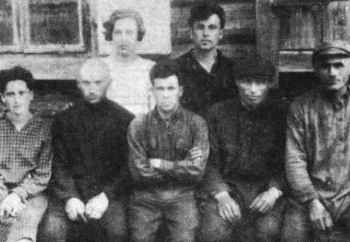
After the Bolshevik Revolution, the government paid much attention to the Shchedrin land workers and the support was noticeable. But when Shchedrin was formed into a collective farm, the number of Jewish land workers became a minority among the Gentiles, who had come from the surrounding villages. Heading the collective were Jewish Shchedrin young men whose authority came down especially hard on the heads of the Jews whose lands had been confiscated.
In the second World War, Hitler's murderers killed all the Jews. Among them: Abraham Yosef Akiva Lazers and his entire family, Nachum Pinsky, Berl Skorman, the slaughterer who was a woman and her daughters and others whom no one will know who they were.
For a hundred years there existed a Jewish settlement and such a dismal end!
by Yankev Gorelik
Translated by Odelia Alroy
Hasidism brought ardor and created many, many tunes and songs. According to reports, the old Rabbi Schneur Zalman the Tzaddik, composed ten tunes, one for each of the spheres (according to the Kabbalah). One particular tune was sung often by Lubavitch Hasidim all over the world. This tune is indeed called “The Old Rabbi's Tune.” In Shchedrin, the Chabad town, I heard this tune sung by yeshiva boys in the Lubavitch Yeshiva. The Lubavitcher yeshiva boys sang the tune with religious fervor, fire and enthusiasm—they started singing quietly, pianissimo and then sang stronger and stronger until it reached the highest heavens....
The Rabbi's tune was not only sung by yeshiva boys, but by the people. All week the laborers of the town were busy and worked hard. But when Shabbos finally came, they forgot all the worries of earning a living, inhaled the spirit of the Shabbos and hummed the Rabbi's tune. On Shabbos evening, between Mincha and Maariv the Lubavitcher Rabbi Raphael the Kohen discussed Torah at the long table in Elkin's shul.
And there they also sang the Rabbi's tune. They began quietly, with religious ecstasy and everyone joined in....
In Elkin's shul, where I would pray with my father, may he rest in peace, there were several Kohanim. I remember some of them well: the stately Lubavitcher Rabbi Raphael the Kohen, my father Aaron ben Reb Mordechai, a neighbor from our bathhouse street, Shlomo, Chaya Golda's husband, and Pinea, a short Jew with a high voice. Before making the blessing the Kohanim would take off their shoes, go over to the washstand and Levite would pour water over their hands. Then the Kohanim would go over to the eastern wall, stand
[Page 813]
facing the people praying and repeat word for word after Israel the Chazzan, the proper blessing. I followed intently what the Kohanim did, because I knew that soon, I would be Bar Mitzvah and would also perform this priestly blessing. I prepared myself and learned the laws and how to raise my hands and divide my fingers in the appropriate way.
The first time I was very nervous about participating and was a bit frightened. But I steeled myself and sang the blessing. Afterward we went over to the people praying and greeted them. My greatest joy was coming home when my beloved mother said that she heard my voice upstairs in the women's section, and recognized her only son Yakov.
The great, beloved, everlasting Sholom Aleichem has eternalized the Simchas Torah Jew in the story “They Celebrate”: “Those Jews, indeed quiet people and quite poor, but when it came to Simchas Torah they became lively.” That's how we celebrated in our town: a tall Jew, a family man, but of modest means, always worried about earning a living, subdued, quiet, and earnest all during the year. But on Simchas Torah he became a new man, a dancing, happy Jew. After the procession with the Torah scrolls around the synagogue in celebration of the completed year' reading cycle, he would go out into the street and sing and dance. Soon a crowd would gather around him, mainly the young people, and the Simchas Torah Jew, all warmed up, would call out: “Let us rejoice at Simchas Torah and break into dance.” He was an inspirational dancer. He would call “Dance!” and we boys would answer with a hora! Next year in Jerusalem! Another hora and our hearts were beating with joy. We wanted to have such joyous days several times a year and not only on Simchas Torah.
It happened in our town that one cheder would fight with another and as they would say “one cheder against another.” The fights would occur because of youthful rivalry, “cops and robbers.” The direct cause would often be local cheder patriotism. For example, it was enough for one boy to joke about or make fun of another cheder and soon there would be a fight between the cheders. The mobilization and preparation for the right would be quiet or secret; how would it look if respectable cheder boys would fight? My first rabbi was Reb Avreml Levick Olshansky, me he rest in peace, a beautiful Jew with a black beard. He ran the cheder according to the semi-modern methods and we the cheder boys respected and loved him. Once my cheder decided to have a battle with another (Levick Avremke's cheder). The older boys were the leaders and the entire cheder was feverishly preparing for the big moment. At an agreed-upon day, both cheders met and had a big fight. Many boys came out of the “battle” bloody and with torn clothes. Soon we were sorry about the whole thing. We came to the cheder the next day ashamed, with our heads bowed. The rabbi was pale and in a strong voice told us that he is disappointed over the incident—his cheder of whom he is so proud should fight like “sons of Esau.” Didn't we know about loving our neighbor like ourself and “why does the wicked man hate his neighbor?” The punishment deserved to be big said the rabbi, but since it had happened for the first time, we would get just a symbolic punishment—every boy should
[Page 814]
go over to the furnace and kiss it ten times.
One after another we went over to the furnace, kissed it, and in our hearts decided we would not trouble our beloved rabbi with youthful pranks.
In the monotonous life of my town, a wedding would be a great event and would bring joy and celebration not only for the bride and groom and their families but for practically the whole town. Especially the young people.
The weddings would mostly take place on Friday. Bride and groom, accompanied by the town band, would be led in a parade through the main street
|
|
to the shul where under the clear sky the chuppah was set.
The local rabbi, Reb Raphael the Cohen, of blessed memory, a Lubavitch scholar, was the one who officiated. I still remember his lyric voice and the tune of the seven blessings which were sung at the chuppah.
In earlier times, Sholom the hazzan (or as we called him, Sholom the singer)—a titled hazzan, singer and interpreter of Hasidic tunes—would sing the seven blessings in his unique manner.
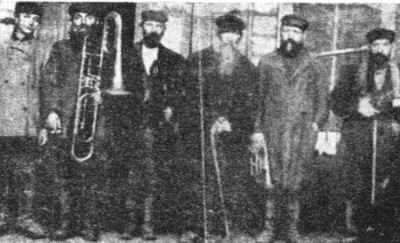
After Shabbos they would have the wedding supper and the young people would dance a quadrille, two-step, various dances and a kazatzke. Shmuel (Muninke) the badchan [wedding jester] (who in his youth had been an assistant to the famous badchan Eliokum Tzunzer) and his family members, a whole orchestra, played a violin, cornet, clarinet, trumpet, and drums.
The houses were for the most part small and therefore only the family and close friends would be invited. The house would be surrounded by the curious who would stand at the window and look in.
The Czar's representative in Shchedrin was the local police official, who was a little Czar, ruler of the town. Dressed in his uniform with epaulets, ribboned hat, and hanging sword, angry face, small gray beard and mustache (my school friend Aryeh who had a sharp eye would say that when he got angry, his mustache would rise like sharp needles), the official would patrol the main street of his kingdom. His helper would often accompany him. He had a “weakness” for lashing out whenever he had the chance. When he would notice a group of people in the street, surrounding a fight or drunkards from a nearby village, he would soon call out, “Disperse.” He would begin to hit whoever was close to him and afterwards ask what happened and why. One time he beat up several older farmers from a nearby village and they decided that the official should taste some of the blows. When the official passed through their village, they suddenly sprang upon his small carriage, put a sack on his head, and beat him.
[Page 815]
The Jewish town of Shchedrin was rocked by a gruesome murder in 1909. One summer night practically the entire family of Raphael Matte, the owner of a large manufacturing shop, was murdered. Two young farmers from the neighboring village, Skarige, wanted to rob the shop. Unable to get into the shop because the door and shutters were closed, they went into the residence which was behind the business, where the owner's wife, a son, two daughters, a maid and a guest were sleeping. The owner and another son were not at home. They had gone to buy merchandise. The children heard the robbers' steps and began to scream. But their screams were soon stifled. That is how they were murdered. They robbed the merchandise of the business and ran away.
In the morning an employee discovered the bloody drama and screamed. The high police officer soon came and they began to hunt for the murderers. The whole town accompanied the family to the cemetery where they were buried in one grave. On the grave was erected a monument upon which was inscribed a verse from Jeremiah.
The police searched diligently for the murderers and indeed found one in an inn where he was drunkenly bragging about the murder of the Jewish family. He was soon arrested together with his helpers. The government sentenced them to life imprisonment in Siberia.
The cemetery had many names in Yiddish—the house of the graves, house of the living, and the eternal place, and in the town the cemetery was an important and active site. At various times people would go to the cemetery to visit close relatives, to ask that they be good intermediaries for a cure or help with a problem. At the time of a wedding, an orphan would invite the mother or father to the wedding; when moving to another town or land they would go to the cemetery to take one's leave of those close ones buried there. The first several years of the founding of Shchedrin, there was no cemetery and the dead were buried in the cemeteries of the neighboring town of Paritch, near the Berezina River.
It happened that the Berezina overflowed and it wasn't possible to get to the Paritch cemetery for several days with some corpse from Shchedrin. That was when the cemetery was established in Shchedrin on a large tract of land a kilometer from the town where tall trees grew. A burial society was founded and a register was started. With the growth of the town, the cemetery grew. And quite often new monuments were erected. There was also a monument on a family grave or local martyrs who were murdered in a robbery. A young farmer from the nearby village Kuchin, who would graze his horses near the cemetery would desecrate the monument. The farmer would climb on the monument and do his work…until he was punished. Once when he had climbed on the monument, he suddenly began to scream that he saw a ghost coming toward him. He wanted to jump off the monument and run away but in jumping he fell on a stone, hit his head, and died near the monument.
In Paritch there was a large organization of Bund-Youth who decided to carry out
[Page 816]
a demonstration in the nearby town of Shchedrin where there was a Bund-Youth group.
On a summer day, Tisha b'Av, there suddenly appeared the Paritch Bund-Youth on the main street, a large number of young people who marched and sang the Bund's revolutionary songs. They marched to Elkin's shul and dispersed. In Shchedrin they gaped at the bravery of the Bund-Youth—to lead a demonstration against the Czar on a holy day—and they talked about “today's youth” who lost their fear.
The Enlightenment movement which began in Germany reached the Jewish towns and villages of Russia. In Germany the Enlightenment led toward assimilation; in Russia, it tended toward educating the Jewish masses. The battle between the religious Jews and the Enlightened was sometimes very sharp. But there were also Enlightened followers who tried to reach a synthesis of faith and Enlightenment and they kept the traditional ways—prayed, wore beards, etc.
In my town Shchedrin, there was a Jew who laughed at that kind of religious Enlightened ones. He was called Moshe Shaya Zanvils—an original and colorful personality. He was a teacher, a cantor, and he gave private lessons in Russian.
He stood out as a teacher, wrote a children's play in Hebrew, published a book, and was a good businessman. He lived in Canada in his final years and died at the advanced age of 90.
Most of the residents of my town Shchedrin had close and distant relatives in America and Canada. The parents, especially the mothers, would wait impatiently for the letter carriers. When an awaited letter was late or lost, the mothers cried their eyes out from worry.
In my family, three children left for America and my mother, may she rest in peace, would say that with each child who leaves, goes part of her heart and so they should write and not forget her. I remember three letter carriers in various times: Motl, Israel Meyer and Aaron Meyer Kiva Lazars. The letter carriers were friendly people. The mothers would pour out their heavy hearts when there were no letters from the children and the letter carriers would reasure them: “Don't worry, don't worry—tomorrow, God willing, you'll get a letter!”
One of the most popular people in Shchedrin was the letter carrier Aaron Meyer. He was appointed to the town position until the last years and the destruction of Shchedrin in 1942 (before Aaron Meyer there were other popular letter carriers—Motl and Israel Meyer.) The town mail was the living nerve which would bind the town and her children who were scattered far and wide in all parts of the world where they had gone to earn a living. After the revolution, many people from Shchedrin left for the larger cities of Russia to study and work.
They would gather with great curiosity every evening at the post office and wait for the mailman to come out and
[Page 817]
call those who had a letter, postcard, package, money delivery, or newspaper. The mailman Aaron Meyer was a great lover of letters. He would tenderly and lovingly touch each letter and give it to the addressee. The mailman himself had a large family but they were all in town and no one in his family had to write letters and so Aaron Meyer would be disappointed in distributing the letters. Once, after giving out the letters, he said, “I give everyone mail but there is none for me. All the shoemakers go barefoot.”
“Mirele Efros,” the drama, written by Yakov Gordin, was played over the entire world of Jewish theater troupes and drama groups and it also came to my town Shchedrin. There was no professional theater in town but there was a drama group under the direction of Samuel Elies, Pesach Dropkin (the localk pharmacist), and Mariasinen (a theater from the nearby town of Paritch) and others who enthusiastically performed a number of dramas and comedies: “Mirele Efros,” “Casia and the Orphan Girl,” “People,” “God of Revenge,” and others.
The main actress of the drama group was Hannah Rachel Hanelin; and in town she was held in high regard as an actress. In “Mirele Efros” Hannah Rachel played Mirele on the improvised stages in the hospital building and the fire department building where the talented members of the drama group performed and the audience sat on hard benches and participated.
In the scene when Mirele Efros needed to leave her home because of her wicked daughter-in-law, Shaindele, the audience cried bitter tears and cursed Shaindel, the evil and cursed daughter-in-law.
by G. Gankin, Dr. Z. Gordin
Translated by Odelia Alroy
In the court of the wealthy they ate well and they would drink tea and jam every day. In summer the Golodetzes would travel out of the country to the baths, chiefly to Karlsbad, to lose weight. In winter they would wrack their brains about lumber business affairs and in summer concern themselves with shipping the logs. And every day all year long they concerned themselves with making appropriate matches.
In town the semi-peasants worked hard. The tradesmen were very poor. But those who worked in the court were fairly privileged. The shopkeepers struggled when certain stores were said to be doing well, the couriers were jealous that they earned a good living.
Despite the poverty, life in the colony had a certain charm, warmth and freedom. No Gentile power oppressed and the entire government was Jewish: there was a Jewish district head and a Jewish local official who were in charge. There was also a Gentile official,
[Page 818]
but he could be bribed.
In summer and winter there was a village stillness. The Golodetzes would sometimes come into the office, but they didn't work. In the office were the trusted shopkeeper, Abraham Ber the treasurer of the Golodetzes and Efros, at the sons'-in-law.
In town the tradesmen weren't loaded down with work, except before a holiday. They would often pray. The shopkeepers would often nap in the afternoon. There was no market day and the turmoil of earning a living wasn't felt in the street. On a Friday and before a holiday a neighboring Gentile would stop by to sell a live fish or, in winter, to bring a load of wood. The storekeepers would sometimes cancel a debt for a herring or a bit of salt. Then Abraham Yosef, the innkeeper, would collect the most for whiskey.
There were no lawbreakers in the colony. Petty thievery: stealing a chicken, taking advantage of someone else's prosperity—yes. But it was known who the thieves were and how to get even for the thefts.
In town issues—there were no others. The rabbi was the judge. People would come to him for a ruling.
They would sometimes come to the head of the local administration as a witness. Without question, they would have to speak Russian, as much as one knew.
In the colony they sometimes stole a churn and the suspicion fell upon the local thieves. Mordechai the teacher or Mordechai Ishaiah's was a witness. This is the word for word testimony: On the 15th of Tammuz [the tenth month of the Jewish calendar, usually falling in June/July] I went out at night to urinate. The moon was out, the stars, too. All of a sudden, I saw someone running with a churn. I thought: What's my concern? Let him take it in good health!” Then the judge stops him and asks if the thief was a Jew or a Gentile? “How do I know?,” answers the witness. It could be a Jew or maybe a Gentile.”
Once, apostasy: was almost unheard of in Shchedrin. But someone did convert. It was in the court—one of sons'-in-law. They took their clothes on morning and nothing more was heard.
People dressed in long clothes. Young people in clothes that reached the knee and older people in long black coats. During the week—a simple one—and on Shabbos and holidays, the one that was saved since the wedding. In summer, robes with ritual fringes and underneath, drawers. It would sometimes happen that youngsters would sometimes on Shabbos put on a paper collar. The couriers, taking their style from Nice, would dress in a sophisticated fashion and wear white ironed overshirts with shiny studs. But they weren't dressed as well as their bosses, the Golodetzes.
Beards were not shaved until later years. Earlier in the court, later in town, when quietly someone would shave his beard.
There were ten prayer houses in town. The community was not a poor one and everyone would contribute. But there were those whose whole life was the house of worship.
Yosef Chaim, the woman's tailor, was not a rich man. But he built a shul. He didn't sell any places because he wanted to have the entire good deed in his own account. He was the court tailor and the Golodetzes would help him. The shul was named after him—Yosef Chaim's shul.
Elkineh the builder also had a shul—Elkineh's shul. The rabbi would say afternoon and evening prayers there.
Reb Aisel, “Aunt” Herde's husband, although he inherited nothing from the Golodetzes, also wanted his own shul. It was called Aisel's shul. Rabbi Yehudi Leib Estrin
[Page 819]
said prayers there with the second minyan. Reb Abraham Ber the shochet and the most prosperous men in town were steady worshippers there.
The craftsmen didn't feel comfortable among the business men and they built their own shul, the Poale-Zion shul.
There was also a Lubavitch shul in Shchedrin. And although everyone was Lubavitch, the Kaidanover Hasidim, the Paritch shul, Reb Zalman's shul, the Talmud Torah which was built with community money and a shul in the court for the Golodetzes and their families.
On Shabbos all the shuls were full. Even a child who could stand was not allowed to stay at home. “Amen” and “Blessed Art Thou” they could say. Old women would stand outside the windows of the shul. There were two minyans in the town: in the court one and if not for the visiting students who eat at different homes on different days, there would not have been a second minyan. Shabbos afternoon the shuls were overflowing with ordinary people reciting psalms, not only those with advanced Jewish education.
Preachers would often come to preach and collect funds for yeshivas. In the last years, Zionist preachers would come. Those were ordinary people who would urge religiosity.
At the entrance to the shul there would be a table and people would make contribution. On the next day the preacher would make the collection. How poor they were can be seen from the jest which was popular in those times:
A preacher asks the Rabbi: “What is it that says 'meh, meh'?” “A goat,” answers the Rabbi. “And what says 'moo'?” “A cow.” And again the preacher asks, “What goes on all four legs and doesn't make anything.” The Rabbi doesn't know the answer. Explains the preacher: that is the preacher “who goes with a partner and makes nothing.”
Each winter a representative of Lubavitch would come, stay for weeks and talk about Hasidism. The followers would come to listen to him.
A representative of the Kaidanover would also come. There weren't many Kaidanover but they respected their rabbi. That would cause much criticism on the side of the Lubavitch. Abraham Yosef the innkeeper, who had the whiskey, had the honor to host them for the third meal of the Shabbos. Pinea the teacher, who later became a driver, was the heart of these gatherings.
It would sometimes happen that those would battle in shul for honors. On the side of the gabbai [sexton] it required a lot to divide the honors, because it wasn't right to honor just anyone with the sixth or third aliyahs because they were so important. The ordinary person was content with a small honor, like the fourth aliyah.
Chaim Berl the woodcutter was once given a small honor and he made such a scandal that he left Aisel's shul where that happened.
When they forgot to call someone up for an honor, there would be a fuss. When they called them up too late, more fuss. Am I less than he, that I am so treated. The entire life of the colony revolved around the shul. If one wanted to get the attention of the
[Page 820]
community to a dispute that one had with another, the only way was to do that with a hearing.
Kalmanken Sarah's was excommunicated as a result of such a hearing, because Kalmanke the blind said that Kalmanken Sarah's knew who the thieves were, who killed almost the entire Goldberg family in Shchedrin. Kalmanken Sarah's had another hearing and he was found not guilty.
When someone had a complaint, he would not allow the reading to continue until he was heard. When a driver's horse would fall or someone would be drafted and he had to be outfitted, two people would make a collection. All important issues were resolved in shul.
Each year they would choose a gabbai by writing on papers and putting them in a hat. It was a hot issue and there would sometimes be harsh words.
But there were also celebrations in the synagogues. Such as Kislev— a meal for members of the burial society, Kislev—the end of a reading. Before Pesach they would divide honey cake, Hoshana Rabbah [the seventh day of Sukkot, the last of the Days of Judgment]—apples, and when there was a Yahrtzeit or a guest would come or a messenger then there would be whiskey.
All the boys of Shchedrin went to cheder. No one took them out of cheder until their Bar Mitzvah. And if a boy wanted to study and had “a good head,” he was sent to yeshiva. And whoever wasn't a good student, had the Torah beat into his head with a whip.
The Aleph Bais was learned with symbols.
Aleph—a yoke with two armsA cut off foot. Why? If the boy didn't want to go to cheder, they would cut off his foot....
Bais—a dot in the belly
Gimel—a fat foot
Daled—a small axe
Hey—a cut off foot
Aside from teachers of the alphabet, there were many teachers of Torah and the Commentaries of Rashi. Not everyone studied Gemara [the portion of the Talmud containing rabbinic commentary on the Mishna, the oral law]. In later years they studied math.
Girls—a long time ago didn't study. Later, they began to teach them with tutors. From the beginning, the women were the spreaders of education. Israel Friedman was a girls teacher. He would teach them to write an address. He wouldn't hit them because one doesn't hit girls: whatever they know is good.
Russian—the girls were the first to learn. Ziame Rabinovitch's wife came from a bigger town and was the pioneer. She started a class and they began to speak Russian. Some of the brokers sent their daughters to progymnasia [secondary school] in Novozikov.
The first Russian teacher was from Minsk. When the girls heard the words absolyutna that nearly went crazy from the beauty of the sound.
In the court, there were teachers also. At Abraham Simcha Kabash Reb Yehoshua was the teacher for more than twenty years. His family was in Paritch and he lived in Abraham Simcha's house and taught his children and grandchildren. No scholars came out of the Golodetzes. Occasionally, one of the sons would chant and that was good enough to make a good match. Benjamin Greenberg's son at one time went to a [Page 821]
yeshiva. Asher Kabash's son, Chaim, went to Lubavitch and became a rabbi.
There were good teachers in the court and almost every one of the young people learned Russian. Eskin, Henin, Zhigolin brought Russian culture to Shchedrin. There were governesses in many of the families.
Misha Golodetz gave his children a worldly education. De Bur, a Gentile, lived in their house and taught the children French, music and violin. Many didn't approve of this.
The court was not less observant than the town. When the old couple were alive, man and wife were not allowed to walk together because not everyone would know that they were a couple...and boys would tease about conversion if they did.
The revolution affected the court in that all servants were removed and at Abraham Yosef's the cholent [a stew traditionally simmered overnight] was overturned on Shabbos. That made a big impression.
by Yehuda Slutsky
Translated by Dr. Sheldon Benjamin
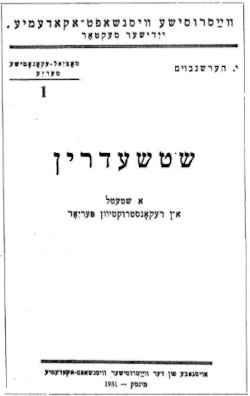
The year 1930. The Jews of Russia have for more than 10 years been as if on another planet. We know very little about what is happening, because all manner of free expression is prevented. A little book of 45 pages, entitled Shchedrin, published in 1931 by the Belarussian Academy of Science, has given us the opportunity to look through the eyes of the Yevsektsia at what was going on in this Jewish township. This publication includes a study that was done in late 1930 by two workers of the Jewish section of the Belarussian Academy. These were two members of the social economic committee by the names of Hillel Alexandrov, the son of Rabbi Shmuel Alexandrov of Bobruisk, and Y. Hirshenbaum.
The first thing stated was the decline in the population of Shchedrin. We cannot atribute this decline to the Soviet regime since the decline started at the turn of the century and continued into the Soviet era. In 1897 there were 4,234 people in Shchedrin. Of these, 4,022 were Jews, about 95% of the population. In 1926 there were 1,930 residents, of whom 1,759 were Jews, about 91%. In 1930
|
|
[Page 822]
there were 2,021 residents, consisting of 419 families. Of these, 379 families were Jewish, constituting about 90% of the total. In the previous 10 years, 44 Jewish families left the town. 13 of them moved to Bobruisk and the rest spread to different corners of the Soviet Union.
The years from 1927-1929, the period Yakov Leshinsky called the most tragic days of Soviet Jewry. We don't know many details of the collectivization and dismantling of capitalism in Shchedrin, but probably the same “good deeds” that happened in other towns in Belarus took place in Shchedrin. Even the Emes (apparently a Moscow Yiddish newspaper) warned about these events, and wrote that they took away the strong ones from the land. And later, they levied heavy taxes on those who couldn't pay. In the end they took away the right to vote. This was published in Emes on June 12, 1930 according to Leschinsky's book, The Jews in Soviet Russia, p. 106.
The process was similar in Shchedrin. Poor people were thrown out of their houses by excessive taxation. Eventually they lost their civil rights and they became “leshentzim". Within a year or two, the so-called Jewish capitalism of Shchedrin was broken and the days of socialist heaven arrived, Joseph Stalin style.
By the end of 1930, the 419 families of Shchedrin were divided as follows according to their socioeconomic status: farmers 215 (51.3%); tradesmen 95 (22.7%); laborers 17 (4.2%); clerks 18 (4.2%); those without permanent employment 31 (7.4%); dependent 39 (9.4%); unemployed elements 4 (0.9%).
Who are these non-working elements who were left in Shchedrin in the midst of the first 5-year plan? They were the holy assistants (kley kodesh: literally holy instruments) of the town Rabbi: the butcher and his 2 helpers.
Was all private trade eliminated in 1930? No. All private stores and pushcarts were eliminated and replaced by government stores. Private merchants adapted to the new conditions. They conducted their trade without license, store, signs, or advertising. Trade is now conducted by mailing packages. When we spend time in the post office, we can see packages arriving daily from Moscow, Leningrad, Dniepropetrovsk, and other industrial centers. Other packages in turn are being sent to those centers. We were interested to see what was being shipped to Shchedrin and what Shchedrin was exporting. Into Shchedrin was coming fish, saltfish, shoes, soap, etc. Shchedrin was shipping butter, pigfat (saleh),apples, etc. At this time they were shipping large quantities of apples to the Donbas, Kharkov, and Dniepropetrovsk. As far as we know the price of apples in free market centers was from 30-40 rubles a pud (Russian weight measurement), and in Shchedrin it was 10 rubles a pud. There is a sub-rosa exchange in the market as well (black market). The study also reveals the existence of illegal hostels that operate almost openly. They feed guests with fish, salted fish, and other products obtained from the packages. These products can not be found in the local government stores and haven't been for a long time. These surprising grocers are included in the official group of those without permanent employment or those dependent on relatives.
There were many families in Shchedrin dependent on other relatives, especially those who left in time to get to the United States. Every month, Shchedriners receive 400-450 dollars support from their US relatives. The most important change in Shchedrin at the time of the 1927-1929 crisis was the transformation to an agricultural economy. This transformation started at the beginning of the Soviet regime. By 1924 there were 104 farming families, representing about fourth of the families in Shchedrin, a figure double the number of those engagingin agriculture prior to the revolution. By 1930, the number of farm families increased to 215.
Collectivization was a bit late coming to Shchedrin. Of the list of 46 kolkhoz (collective farms) in the Bobruisk area by July 1, 1929, the kolkhoz, Sotzialistishe Veg (Socialist Way) established in Shchedrin in the fall of 1929 is not mentioned. Elsewhere it is mentioned that the movement to start a kolkhoz actually began in
[Page 823]
early 1928 but the Jewish farmers resisted. Naturally, they wanted to become the nucleus of the new kolkhoz. At the time of the study, the kolkhoz included 198 families, 20 of which were Belarussian (the rest Jewish). There were 841 people in the kolkhoz, 456 of which were of working age. The kolkoz was the center of economic activity of the town. Only 84 families had been farmers before joining the kolkhoz. The other 114 familes came from “non-working elements” and those who lacked permanent employment (61 families), craftsmen (26 families), laborers and poor (21 families),
|
|
clerks (6 families). For many the kolkhoz was a refuge for those with no other way out. The study tells of the widow, Basya Feyge Rifkin, who treated people with cupping (bankis), served as a midwife, worked in the bathhouse and the like. Of her, the local pundits would say, “the kolkhoz makes you sick and Basya Feyge applies the cups."
The commercial elements in the kolkhoz who had difficulty adjusting to the new conditions wished to leave and return to free trade. These elements look at the kolkhoz as helping them pass the time until they have the opportunity to reestablish their stores. The study described elements who practiced the “terrible” ritual of refusal to work on Rosh Hashana and Yom Kippur. In answer to a researcher's question as to why Jewish kolkhozniks refused to work on the Jewish holidays, one of the Jews said, “You want us to work on Rosh Hashana and Yom Kippur but you don't give us any boots.” He immediately showed the researcher his torn boots. The researchers also claim that the Jewish kolkhozniks resold on the free market some of the crops given them to feed their families and their cattle.
The authorities responded by attempting to recruit the faithful and the youth. On Yom Kippur they announced the formation of “shlag brigades” and social competitions. They also deported 3 troublemakers from the kolkoz.
On October 1, 1930 the kolkhoz had 1500 disyatnus (archaic land measurement) of land. Of those, 1200 were for farming and the rest were for cattle. 400 dunam(land measurement) were incompletely eradicated forest and 300 dunam were sand of poor quality (the text describes it as sand that needed a lot of work to render it useful). The kolkoz concentrated mainly on growing vegetables, and by the end of the first year produced 80,000 pud (weight measure) of vegetables for towns around Belarus. 2 canneries were built for cucumbers and coleslaw. A large barn was established for 333 cattle. There were 140 pigs and 30 honeycombs in a large building, and a mechanical mill, previously privately owned. The mill served not only the kolkhoz but the surrounding farms. The kolkhoz also received 2 tractors, a few seeding machines, and other farming machines.
The condition of the craftsmen of Shchedrin was not very bright. Especially hurt were the shoemakers who could not engage in their trade because of a dearth of raw materials that especially effected the leather trades. So the shoemakers changed over to fixing old shoes. There were 26 shoemakers, 25 tailors, 20 workers, 7 cart owners, 5 roofers. There were 4 cooperatives of craftsmen (artisan's guilds) established in 1927-1928 under pressure from the authorities. These were the tailors (18 men), shoemakers (22 men), the roofers (20), and the welders. The condition of the shoemakers and tailors was quite bad. The researchers saw no future for them other than moving to the kolkhoz or to big cities where they could find work in large factories. The iron smelting workers suffered from lack of iron, but had a future in fixing agricultural machines which proliferate in villages. The poor condition of the craftsmen was evident from their average pay: roofers - 82 rubles a month, tailors - 62 rubles, shoemakers - 45 rubles. Income was not steady and the economic condition of
[Page 824]
the non-union craftsmen was even more difficult. Most of them wanted to be accepted into the cooperatives, but they couldn't be accepted due to lack of raw materials. There was one iron worker who refused to join a cooperative because he wished to finish his life as “his own boss.”
Even among the craftsmen, the researcher complains about hostile elements causing the cooperative members not to work on Rosh Hashana and Yom Kippur.
From the civil and cultural point of view, the dominance of the town hibiskim (?-implied meaning is secular--perhaps it's a term that refers to members of the Yevsektsia--the Jewish arm of the Communist Party) was complete, at least on the surface. Although we do hear that there was still a rabbi and a butcher in town. The rafashnikes seized 4 synagogues in town for other public and cultural uses. It appears, however, that a few of the 8 synagogues in town were left for prayer. The attempt to force kolkhoz craftsmen to work on Jewish holidays was not completely successful, though the attempt was made by the hibiskim. However, the iron fist of the authorities does do a job had an effect nevertheless.
Since 1920 there has been a school in town with 4 Yiddish departments. The school has 190 students. On the kolkhoz is a Jewish school with 46 students. It also offers night classes for adults. Shabbat observance was eradicated and the official rest day in the kolkhoz, cooperatives, and government offices was either Tuesday, Wednesday or Thursday, depending on the specific circumstances in each establishment. There are still a few members of the artisans and kolkhoz who do not work on Shabbat, but these are mainly older members. During Sukkot workers make only a few sukkot. In contrast, everyone celebrates the revolution with pomp and ceremony.
The author states that apart from the 9 teachers, one can find in Shchedrin 3 agronomists, 1 physician, 1 veteranarian, a midwife, a medic, and a dentist. Overall there are 17 intelligentsia. Nevertheless the town looks somewhat rundown. The local library has not yet been purified of its Zionist inheritance. In 1930 there was a subscription drive in town for Soviet journals and newspapers. Within a year their subscribers grew from 45 to 271. 115 of these were in Russian and Belarussian. The most popular paper was October, a daily from Minsk, with 64 subscribers. The Communist youth weekly from Minsk, Yunger Leninetz, had 40 subscribers. The children's magazine from Kharkov, Zay Greyt, 40 subscribers. The Emes (Truth) from Moscow had 4 subscribers in Shchedrin. The Shtern, a monthly book review from Minsk had 5 subscribers.
From the government organization perspective, Shchedrin was called a Jewish Nationalist Body. But the right to vote for the body was given only to the working elements. In 1929 there were 264 disenfranchised individuals. By 1930 their number had decreased to 144. The head of the body was Chana Mira Elkin.
The Communist Party had a local chapter which was the most important political body under Soviet rule. It was the eyes and the ears of the authorities. There were only 7 members in this party chapter. Among them was the chairman of the kolkhoz, L. Olshansky, and the director. The Communist Youth group, Komsomol, had 25 members. They were the activists in Communist and anti-religious propaganda in town.
Overall, the book gives us an opportunity to have some insight into what was taking place in Shchedrin in this rather stormy transformation period. The book, however, obviously does not tell the feelings of the hundreds of people who saw everything they loved being trampled. The book does not describe the misery of those who were deported, those whose rights were usurped. Mainly, it cannot tell us what happened next. Were the Jews able to hold on to their status in the kolkhoz and the cooperatives. How the Jews accepted the Holocaust which suddenly came upon them in the summer of 1941. For these questions we must look to other sources.
|
|
JewishGen, Inc. makes no representations regarding the accuracy of
the translation. The reader may wish to refer to the original material
for verification.
JewishGen is not responsible for inaccuracies or omissions in the original work and cannot rewrite or edit the text to correct inaccuracies and/or omissions.
Our mission is to produce a translation of the original work and we cannot verify the accuracy of statements or alter facts cited.
 Bobruisk, Belarus
 Yizkor Book Project
 JewishGen Home Page
Copyright © 1999-2026 by JewishGen, Inc.
Updated 27 Nov 2026 by LA