 |
|
|
[Page 793]
(Parichi, Belarus)
52°48', 29°25'
by Simkhe Gorelik
Translated by Don Mopsick
All Poritchers were convinced that our little village was the most beautiful and best of all the nearby villages. It just mortified us that Poritch did not have a railroad. For the little village lay upon the banks of the beautiful Berezina. The river was the spinal chord, the nerve center of the village. Over its calm waters rafts were drifted with lumber from Belarus to Ukraine and to the Black Sea. The forest business and the lumber industry were the most important branches of the Poritch economy. Ships were coming and going from Poritch, brought and took away people and merchandise to Bobruisk, Berezin, and Borisov, - upstream; to Retshitse, Loyev, - downstream. The “downstream” connected us with Ukraine, to the very end Odessa. Our parakhodn (steamships) went as far as Loyev, thence one used to board the large Dnieper ship. The going and coming of the steamer was an event in the life of the village. In the middle of the night, one could hear for miles around the mighty breath of the steamer, one used to get up to meet it. How much beauty the river brought into our lives! Who of us did not bathe in the Berezina? The men, the gallant “cavaliers” - upon the nearby bank and the poor young wives - upon the distant higher bank. Who of us did not play upon its mirrored waters; who has not looked wistfully at the bow where the river loses itself among the oak forest and the green meadows.
The history of Poritch is divided into two epochs: before and after the fire. The village burned in 1891. The fire broke out Friday after the Sabbath light blessing, when one is in shul in Sabbath prayer. Some say that the fire began with a Sabbath candle which fell in a house and burned the roof; others, on the other hand, that it was the work of an arsonist. [Ed. note: my grandmother, who was four years old at the time, told us that the arsonist was the landlord of the Jewish quarter]. In the space of several hours the village was obliterated. There remained only several secluded little houses facing the field. Long had Poritch remembered the “Red Rooster,” but, as usual, the village returned to rebuiding itself, more beautiful and better than before, and therefore a new institution was enriched - the Volunteer Fireman's Society. Poritch youthful and middle-aged men from then on took part in new catgories - “climbers” and “pumpers” instead of Kohanim, Levites, and Israelites. The “climbers” in the brass hats became the city heroes. Youths which had “climbers” in the family were thereby glorified. The rehearsals and parades of the firemen, with music and ceremony, became civil holidays, recognized even by the Hebrew school teachers, who on those days used to close the Hebrew schools. In the fire station. we used to from time to time put on amateur shows in Russian and Yiddish. An extraordinary holiday used to be that day for the youth of the village. In the summer they used to on the occasion dress up the depot with trees and Japanese lanterns.
Poritch had 5 synagogues, 4 Hassidic and one Misnagdic. “True Hassidim” in Poritch were but the Misnagdim. In the great Hassidic shul, one feared for tsukvinten - for new streams. There, everything was “no” because “yes” cost money. And there prayed the great wealthy men of the villiage, among them Gershon Kohen.
A warm, plain-spoken atmosphere
[Page 794]
ruled in the Misnagdic shul. Magidim and cantors would take up love and yras-hkhpod. In the Hassid shul, they used to guard against such afflictions. The cantor in the Hassidic shul, Avromel Cohen, who was called Avromel the Shammes, was wise, sophisticated, and posessed a pleasant baritone voice. He was a virtuoso in his trade. The cator in the Misnagdic shul, Shaul the Scribe Boymel, brought out in his davenen artistic expression and zeal. His son, Yankev Boymel, was later famous as a cantor in New York. At home, we used to love Boymel to read his words truly musically, in B Minor. I remember that cantor Yankev Boymel gave a concert in Poritch, he then studied music out of the country and came to Poritch for a visit.
The Hassidic rabbi in Poritch, Khaim Shnieurson got his yikhus [standing] from the famous Shnieurson dynasty. His bearing was sometwhat pretensious in naturally diginity.
The Misnagdic rabbi, Rabbi Henokh Hendel, was a pious and naive man, a personality who distinguished himself with humility and wisdom. He died a tragic death. He suddenly fell ill on Sabbath Eve in the bath house and fell fainting. A young man, wanting to resuscitate him, in the great confusion and excitement doused him with a bushel of boiling hot water. Several days later, after difficult suffering, the scalded Hendel died. Before his death, he called for the bokher who had scalded him. He expressed faith in him and begged him forgiveness for his heartache, and the bad name which the bokher had only to bear, Rabbi Hendel blessed him that he should therefore be free of the draft. They say that Rabbi Hendel's wish was fulfilled.
As a village, Poritch also had its cheif heretics. This was Mendel Hillel the mazhgiekh [Jewish dietary supervisor]. From Minsk, where he learned more his military draft, Mendel brought into the village both the Haskole, and the unrest of national nightmare which later gave the beginning to the Zionist movement. His influence upon the Poritch youth and the spiritual life of Poritch by and large was enormously great. Mendel was sharply cynical, intelligent, and had a mighty sense of humor. His close frends and students were Nakhman and Moshe Gorelik. Nakhman later organized the Lovers of Zion organization in Poritch. He was a proud Jew, a gifted speaker full of temperment. Moyshe Gorelik had literary ambition. His first step in Hebrew literature was the story After the Fire which won the Hatsofe contest and opened a series of contest stories. The first prize of the contest was won by Y. D. Berkovitsh for his Moshkele Khzir Stories.
Both comrades Nakhman and Moyshe were died of [shvindzukht] very young, in their twenties.
Also Zhame Mayzels, the Poritcher sculptor and painter, died in Paris of neck [shvinzukht] in his twenties. His work was a group of figures under the name “Gogol-types,” won a prize at an art show in Minsk.
An honorable place in Poritch society was taken by Leybl Shklabski, Libeh the Shoemaker; his thirteen children were the mirror of the Poritch assimilationist intelligentsia. Hersh Ber, the eldest son, lived in Switzerland, was Lenin's close associate, and soon after the Bolshevik Revolution played an important role in Russia.
His brother, Leyvik, was a well-known Bolshevik leader in Kiev and the Yakaterinoslav region. Shloyme, the youngest, was killed by Bielakhovitshe's band
[Page 795]
between Poritch and Bobruisk. He died as a hero and martyr, he surrendered to the band, advising them that they were already passengers of the ship of which he was the captain.
The Poritch Bund was founded by Pineh Okun, Avromel Shestantsky, and the writer of these lines. Leyvik Shklovsky cooperated with the Bund when he used to visti Poritch, but he never became Bundist. The founding of the Bund took place in the house of Shmuel Itshe the leatherworler (Okun) . Among the fourteen founders, the Okuns were represented by three: Pinie, his sister Rozhe, and the Elder himself. The Elder, as he was called him in the movement, was the partriarch of the movement in the entire region. At a certain time he was employed in the professional movement. He impressed with his patriarchal stately appearance, even in the city of New York where I encountered him in January 1924.
I remember the fight among Lovers of Zion and Bundists on Dr. Herzl's first yortsayt. The Zionists wanted to force a mouring day upon the village and went around and demanded with good and bad that they should close the stores. The Bundists, on their side, held for their “holy debt” standing against the “enemy,” and fighting them, like gentiles. It should be said in truth that this writer was not then in the village. He wanted to be away, he wished the loathsome episode not to take place.
One of the remarkable Poritcher types was Aryeh the Blind. He was the true segeh nahor, the far-sighted one. Whether by day or by night, even in the great city of Bobruisk, one used to encounter him in the street and the people who he visited. He was the happiest hard-worker, the greatest optimist that Poritch had, with the exception perhaps of the village wit and humorist, Moyshe Nakhmen, the wagon-driver. No work to him was hard. He didn't want to get charity and fought for his right to work not only because of making a living, but also for the love of work and activity. He was able to say all the prayers, the entire Book of Psalms. Sabbath, from minkha to meyrev I didn't one time hear that he led the psalm-singing in the great Hassidic shul He walked ahead of the city funerals with the charity cashbox tatsil mames and conducted the city marriages in the shul courtyard, beating the drum of the city musicians. He was a sentry in the market and a sentry at weddings to remember, he knew who was going and who was coming. He was alway able to know according to their voice and laughter. People used cover for him.. He would travel on a steamer and he used to know in which house to come and in which window to knock.
[Page 797]
by Noakh Goldberg
Translated by Odelia Alroy
Baruchl was happy with his find. He knows that a “horseshoe is lucky” and in wartime, a piece of iron and especially from a horseshoe is equal to gold. The boy began to fantasize about how much gold he'd get for it. Just then he heard the steps of horses which seemed closer every minute. Baruchl did not delay and went deeper into the wood and hid behind a thick bush.
It didn't take long and a squadron of Haler's gang passed. Strong with long, angry faces and outrage in their eyes, they sat atop the tall, well-fed horses, they didn't speak and if not for the snorting of the horses and the tramping of their feet, one would have thought that the haunted were riding through the forest on an evil mission.....
In about an hour, a tired Baruchl ran into his house. Once he caught his breath, he took out the loaf of bread from his sack, gave it to his mother, drew out the horseshoe from his bosom and showed it to Katzl: “Father, look what I've found! I'll sell it to the smith or I'll bring it to the village and they'll surely give me two loaves of bread and a sack of potatoes!”
His father, who would often go to the market and so knew all sorts of horses, took the horseshoe in his hands and couldn't determine who such a large horseshoe belonged to, because the several horses who were still in town, were small, thin and narrow-legged. Their ribs showed from under their hides like staves of barrels and their legs were thin with small hooves. Anyway—he had the cursed thought that it belonged to the military!
He wasn't far off, for when he turned the horseshoe over he saw two initials: “A.P.” which probably stood for Polish Army and his hands and feet started to tremble: “Thief! What did you bring? The horseshoe belongs to the Polish Army! If they find it they'll shoot us all!...”
[Page 798]
Basha Leah just caught the last word “ shoot” and she became as pale as wax. She clasped her hands and started to cry.
“Woe is me! A tragedy has occurred!”At night she cooked a pot of potatoes which were charred in the oven and when she put them in a deep dish, they fell apart like flour. Nevertheless the potatoes let out thin blue steam, which reached the low ceiling. The steam disappeared like the previous courage. Just the word “shoot” sent such a shudder through our house that no one had the heart to eat.
Katzl was in bed. His pointed nose was like a teacher's pointer. His eyes didn't move. His long beard, it seems, got shorter. In the evening darkness, his face took the form of a bird—thin, sharp and pointy. Just the dark-haired point over his low brow let you know that his face was human, Jewish.
In his dark fantasy, pictures passed before his eyes—one worse and darker than the next. The Commandant is here. He is smoking a cigarette. Curling his
[Page 800]
moustache and smiling a sadistic smile: “Where is the horse that belongs to that horseshoe? And what did you do with the soldier that belongs to the horse? Did you kill him? You rat you!”
His eyes became bloodshot. He tightened his right hand around the blackjacks. Even the horse felt his master's anger and became uneasy, and began to stomp the ground with its feet and the Commandant shouted: “Where is he, the dog?!”
In that moment he forgot about the Jews. Now the only thing that bothered him was that he had been made a fool of before so many people who had assembled in the marketplace. But most of all he was embarrassed that his soldiers had witnessed his humiliation.
He galloped over to the sausage maker, who ran as fast as he could, and rapped him as hard as he could
[Page 801]
on the head, that he bled like a pig and was lying on the ground with the Commandant screaming:
“I, the Commandant, the Polish Army, you try to fool? You idiot! Take him, give him 25, no, 50 lashes on his bare bottom and he'll know how to ridicule the Polish government!”The gentiles were still in the marketplace. They wanted to see how the sausage maker was whipped and in contrast, the Rabbi and the Poritch Jews were exhausted, frightened, weary and had such trust in the Almighty, that they went to shul to pray and give thanks that they were spared from a certain death.
[Page 802]
by Ahron Gorelik
Translated by Odelia Alroy
In Poritch there was a Jew “Areh the Blind Man” who was born blind in both eyes. It is awful, may it not happen to you, to be blind. But God sends the remedy before the ailment. When one of the five senses is missing, the other senses become sharper and compensate for the missing sense. So it was with Areh the Blind Man from Poritch that all his other senses were sharpened. He earned his living for himself and his family by accepting orders from the town shopkeepers and tradesmen. After he got these orders, he would travel by ship, which would sail from Poritch to Bobruisk. There, in Bobruisk, he would buy merchandise and bring it back by ship. Areh knew all the ways around Poritch and Bobruisk. No one needed to lead him or tell him where to go. Should anyone want to help him, he would good-naturedly say: “Am I a blind person who needs help? I see!” He was noted for his extreme honesty.
The storekeepers would trust him with money for the orders. For his efforts, he took a minimum and would decline greater earnings.
Areh would recognize people by their voice and had an unusual memory. A man from Canada, who had been from Poritch, came to Poritch once for a visit after having been away for 37 years and when he went up to the blind man and said: “Sholom Aleichem, Reb Areh!,” Areh knew him immediately by his voice and called him by name.
[Page 803]
by Sh. Rivkin
Donated by James Gross
Translated by David Goldman
Once prior to the war dozens of prominent forest merchants such as Roginsky, Kogan, Rachmilvitz had their own steamships and dozens of shipping vessels and several hundred woodcutters, rope makers and ferry boatmen who would stand in water up to their knees from one night to the next loading and unloading entire ships, tying ferry boats, and thereby managed to barely eke out a living for themselves and their families.
The “community inventory” of Poritch used to include 5 synagogues/study halls, 3 churches and around 10 Chadarim [religious elementary schools for small children] and Talmud Torahs [religious elementary for pre-bar mitzvah older children].
Through Stalin's Five-Year Plans and the day-to-day leadership of the Party and the government, the city and district of Poritch changed beyond recognition. As early as 1926 the international collective farm [kolkhoz] Oktober was established on the confiscated land of the landowners. Byelorusians and Jews started working as friends on the kolkhoz and starting new lives.
Today in Partich more than 800 workers work in 6 artisan cooperatives, and there is an electric plant in town that supplies electricity not only to the town but also to nearby villages (Kozlovka, Skola, Wysoki-Polak).
There are two large high schools in Poritch attended by 1,300 students.
The town provided many talented people to the socialist homeland. More than 160 Poritch residents recently completed their high school studies. They now all work as engineers, doctors and teachers in various towns and villages in our homeland. The son of the former rope maker, Lazer Gorelick, today works as a scientist at the Education Institute of Minsk, and the son of the wagon driver, Beilin, is today a violinist at a conservatory in Moscow.
Culture became the lasting inheritance of masses of workers, and Poritch now has a movie theater, culture center, large library, radio station and other cultural institutions. In the place where the market used to stand with its famous local egg that used to spread various diseases, there now blossoms a young municipal kindergarten.
Translated by David Goldman
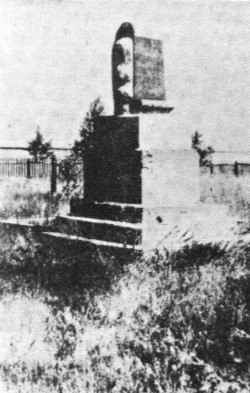
In 1941 the Germans conquered the city of Poritch, and upon their arrival in town they first and foremost imposed cruel decrees on the Jewish population. The Germans decorated all the Jews with yellow stars of David, and then gathered them in the quarter surrounded by barbed wire. After they abused the Jews the fascist German wild animals started to exterminate them. In October 1941 they took the Jews out in cars to the outskirts of town and shot them following cruel torture and derision. In all, more than 1,700 Jews were murdered . The executions were performed with systematic cruelty typical only of Germans. They placed the people in rows in pits that the Jews had dug, and then the Germans would kill them with salvos of bullets from submachine guns. Among the dead there were those who were severely and lightly wounded, and the German sadists buried them alive in the ground. They would raise the children on their spears and toss them into the pits. One woman resident of the town of Poritch, Steinbok, managed to get away after the Germans left because she was lying in the last row and was lightly wounded on her hand.
In order to hide the tracks of their disgusting crimes, in March 1944 the Germans took out the corpses, poured tar and gasoline on them and set them on fire. The fire could be seen in the entire area for a whole day.
(From the certification of the district committee of Poritch about the destruction of the town – [in Russian:] The Crimes of the German Fascist Occupiers in Byelorussia, Minsk 1963)
“It is impossible to describe the cruelty of the murderers in simple human language,” – so wrote the daughter of Shlomo Beltzer, the granddaughter of Zalman Motia, the Jewish butcher [shochet] of Poritch, to the secretary of former residents of Poritch in New York about the destruction of her hometown.
by Simkhe Gorelik
Translated by Don Mopsick
At the request of my Poritch countrymen, I bring these dreadful facts as to how the German murderers killed the Jewish community of our village. I am not a writer, still I wish that my simple words, soaked in torture and pain for our annihilated people - should go out to the world.
|
|
The Jewish population of Poritch - approximately some two thousand souls - made their livelihood from hard work - lumber work, construction, table-making, tailoring, shoemaking, etc. The Poritch Christians never once complained that they were wronged by the Jews. On the contrary, the Jews supported and helped out their needy Christian neighbors. But the Germans poisoned these good relations with their venomous propaganda and Jew-hatred, which they promoted among the sinister Christian masses.
This happened on the 18th of October, 1941. A bloody spectacle such as the world had not yet seen. The sun had only just come come up, and Germans were seen in the streets with weapons and whips in their hands, accompanied by local police and their collaborators. With weapons and clubs, attacking with their fingernails, under the goading of drunken swear-words and impudent laughter they drove the Jews to the prepared mass-grave. The wail of the defenseless victims split the heavens. The gangsters cold-bloodedly did their work. The rabbi gave a short speech - he said - he would not keep quiet about it - the accursed Hitler will be defeated as Haman. The murderers subsequently cut out his tongue. In the ghetto, the Jews were loaded up into trucks and driven to the ditches. From the first truck were led out Ephraim Ayzik the hearse-driver, Raful the butcher, Moyshe Elkind. Yoysef Meytin, Dovid Vendrof, and others, who dug the ditches on that side of the Visoki village people. Ayze the shoemaker stood in tallis and tefillin and prayed, when the murderers entered his house, he begged them to let him go alone to the killing site.
[Page 805]
Leyzer Shtoybtser did not leave his weeping wife - so the enemy would not see our tear-filled eyes - our children and younger brothers would take revenge for us - he consoled her.
Shaya Shtaynberg and his wife Elka Sakiritser remained in Poritch because of their sick children. Their daughter Roze had two days earlier taken her two younger little brothers away with them to the forest and remained alive. Shaya evaded death from a German bullet, he died of a heart attack when they came to take him away... his wife, with a sick child on her hands, was murderously beaten and thrown into the ditch. Elka lay wounded among the corpses until it got very dark. At night, she got out from among the corpses and dragged herself to a nearby hamlet. She went in with a peasant, washed herself up, and from there went away to Sakirits, the hamlet where she was born - 20 viorsts from Poritch. Thanks to her Aryan appearance she lived among the peasants, worked hard and bitter, and no one knew that she was Jewish. In the end she was denounced, and the German policemen beat her to death with clubs.
Yente Bernshtayn hid herself with her three little children in a little forest nearby, but they found her. On the way to the headquarters, she ripped herself out of the hands of the police, leaped into a well, and they found her there dead.
Moyshe Malikin, Moyshe Bleykher, Abba Makhtun, Yoysef Olshanski, and several girls went away to the partisans and took revenge on the Germans.
Roze Elkin was in a partisan “local” with her husband and their three little children. During a battle between the Germans and the partisans, when the Germans had surrounded the forest and they stood up to their necks in mud, a child started to cry and they had to strangle him in order not to give away the hiding place of the partisan group. Roze died a martyr for the freedom of Poritch.
|
|
JewishGen, Inc. makes no representations regarding the accuracy of
the translation. The reader may wish to refer to the original material
for verification.
JewishGen is not responsible for inaccuracies or omissions in the original work and cannot rewrite or edit the text to correct inaccuracies and/or omissions.
Our mission is to produce a translation of the original work and we cannot verify the accuracy of statements or alter facts cited.
 Bobruisk, Belarus
 Yizkor Book Project
 JewishGen Home Page
Copyright © 1999-2026 by JewishGen, Inc.
Updated 24 Nov 2026 by LA