 |
|
|
[Page 583]
Translated by Ala Gamulka
Edited by Gail Kraushar
The pressure-action of the Central Bureau
From all that has been said so far, it may be concluded that even its position on the material situation and the operational possibilities of the “Central Bureau” was not greatly affected by the events of those years. Thus, its activity in relation to the central institutions was not significantly reduced. The basic assumptions on which it worked were based primarily on contributions from branches (regional committees), institutions, and individuals (both in the Diaspora and in the Land of Israel) for financing the institutions and the Zionist movement. To this must be added the results of the various initiatives undertaken to organize Zionist activity and to advance its political and organizational goals – all according to the financial situation and the needs of the time.
Through the various activities of the movement's institutions in interwar Europe, a strengthening of the “practical” Zionist approach became evident. From time to time, “territorial” proposals appeared, which were intended primarily as a solution to the refugee problem in the Diaspora; these, however, did not undermine the fundamental goal of Zionism. Throughout the entire period, the guiding question was how to ensure that all funds raised would be directed toward immigration and settlement in the Land of Israel. At the same time, there was concern that excessive engagement in rescue activities might weaken the ideological and organizational effort.
A. Publication of textbooks
One of the questions that received particular attention in relation to activities in the camps and settlements was the publication of general studies textbooks for elementary schools. For this purpose, the Bureau published special textbooks under the title of “Ascola”. Over the years, four textbooks were published in a brief time: four arithmetic texts, one for geography, and another for Jewish history.[52] The authors emphasized that all this was done with the intention of adapting the material to local conditions.
[Page 584]
Also, the basics from Eretz Israel were included. This project was awarded over half a million lei (close to 1000 pounds sterling). For poor little Bessarabia it was a decent amount. The teachers and community leaders received the project with respect. They were trying to support it by selling bonds worth 100 pounds. However, the challenging times in the following years put a stop to this activity. The publication of more textbooks for general studies, sadly lacking, was postponed. This influenced the normal condition and growth of the high schools. The dearth of Hebrew textbooks created the need for the use of two languages in the classroom.
B. Supervision and guidance
The second issue, not less important, dealt with supervision and guidance. As previously mentioned, for the first three years of the existence of the Hebrew school – from 1922 to 1925 – there was a regular mechanism for supervision and guidance by the central branch of Tarbut. The first inspector, writer Shlomo Hillels, represented the Hebrew Ascola committee under the Ministry of Education. It was later abolished. After him, representing Tarbut, came David Rabelsky, Yakov Wasserman, and Tzadok Veinshteyn (who was a counsellor and organizer).
The absence of a permanent pedagogical and organizational counsellor became one of the first problems. It had nothing to do with the legal-political entity. This fault was the result of the dire financial situation from which the central committee suffered in all its years. Tarbut tried to obtain funds from various funds, as they would benefit from the spiritual training of the young and older generations. The central branches in Jerusalem refused to help. The Zionist movement and the Jewish Agency were involved in getting funds, but not for Tarbut.
It happened twice, for a brief period of three months each, that Bessarabia was fortunate to receive visits from famous pedagogues from Eretz Israel. In 1929, it was Moshe A. Bagel (Avigail), from the center for education and culture of the Union of Workers. In 1931– Dr. Eliyahu Rosenbaum (Meroz), from the central branch of JNF. The brief time at their disposal was well used. There were school visits, pedagogical meetings, and parent sessions.
[Page 584a]
|
|
[Page 584b]
|
|
|
|
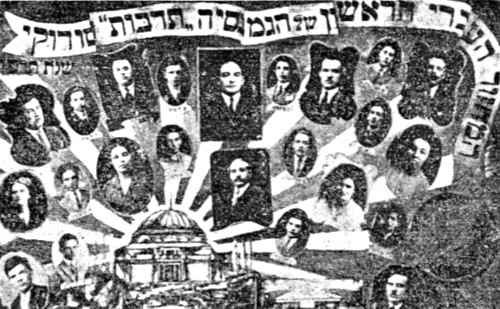
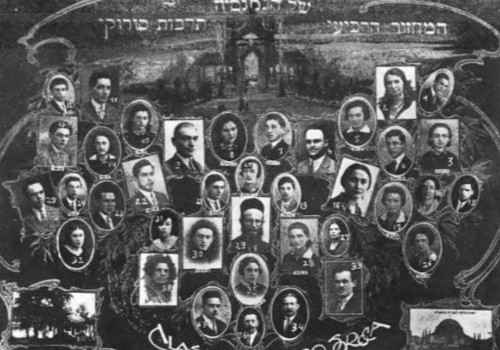
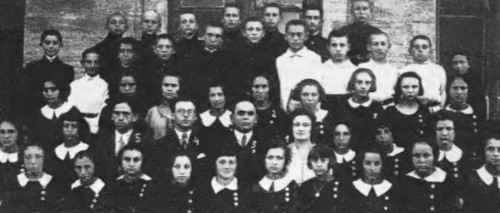
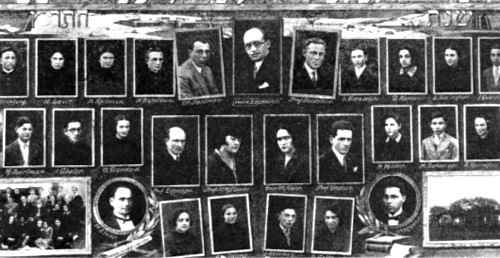
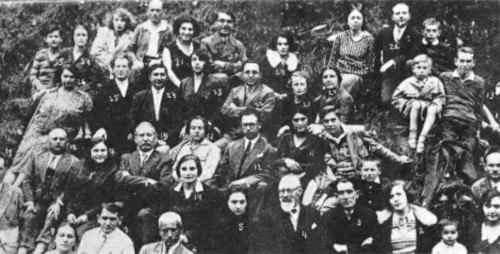
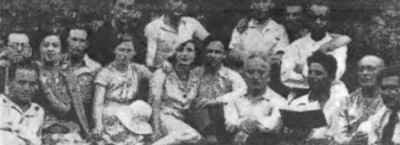
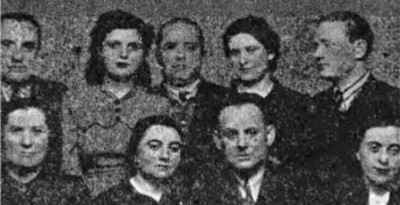
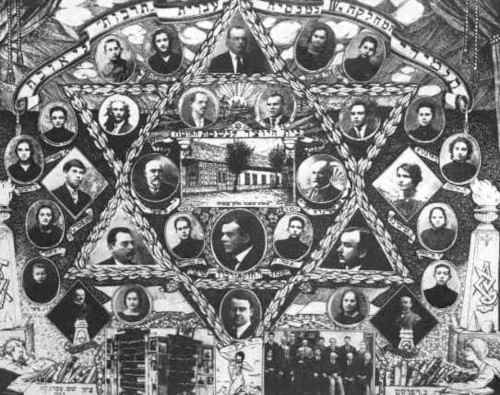
1) Secretary, 2) Carmel in, 3) Kh. Gelbord, 4) B. Khitron, 5) B. Lerner, 6) Principal Rafael Katz, 7) D. Khitron, 8) Buzia Shkolnik, 9) Dr. Zvi Helner (previous principal), 10) Musial Shor, 11) Aharon Golirgant (Bartini), 12) Yitzhak Gurman, 13) Ben Zion Kharakh, 14) Leah Kharakh, 15) Gandel, 16) unidentified, 17) Sheindl Gelman, 18) Rozhdova, 19) Idel Grinberg, 20) Mania Bronshteyn, 21) Aryeh Zukerman, 22) Aharon Chassid, 23) Latin teacher, 24) Yitzhak Brodsky, 25) History teacher, 26) Ita Vinitsky, 27) Makhler, 28) Esther Babis, 29) Rabbi Mordechai Shokhetman, 30) Pinkhas, 31) Batya Shor, 32) Sonia Frankel, 33) Shlomo Kilimanis, 34) Leib Gurman, 35-38) unidentified teachers |
[Page 584c]
|
|
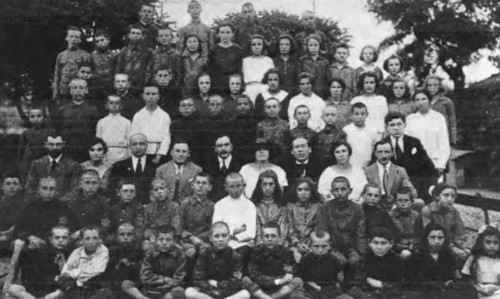
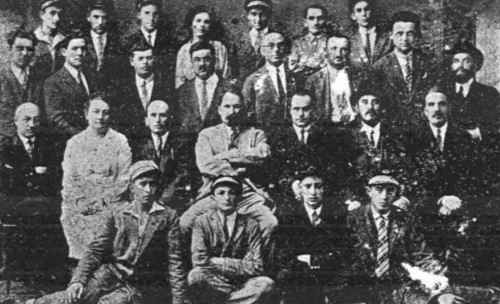
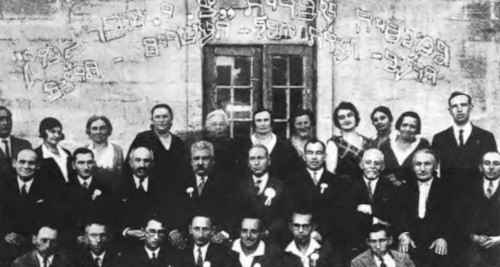
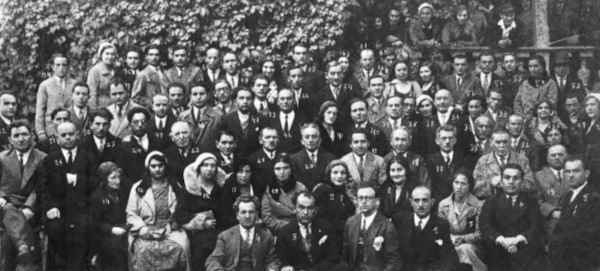
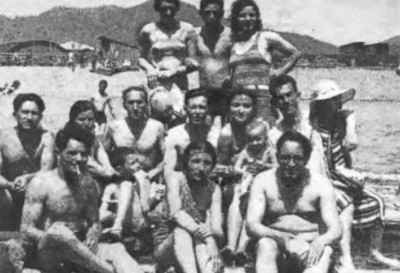
In the center, from right to left, teachers: Alexander Shapira, Dr. Shaul Tzalaring, Mania Sharira, Shtefanescu, Miriam Berman, Principal Yakov Berger, Levi Bercovitch (chairperson of Tarbut committee), Novak, Sonia Helman, Moshe Cohen |
|
|
Row 1, on top, 1-2) unidentified, 3) D. Tcherniavsky, 4) Principal Yakov Berger, 5) Sonia Helman, 6) Efraim Davidzon, 7) unidentified |
[Page 584d]
|
|
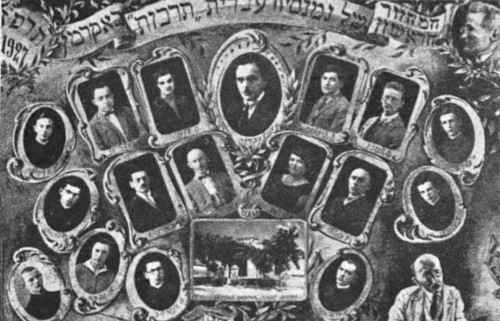
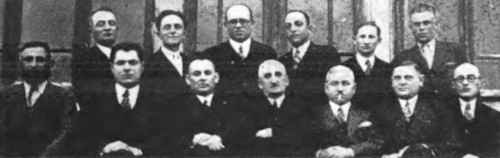
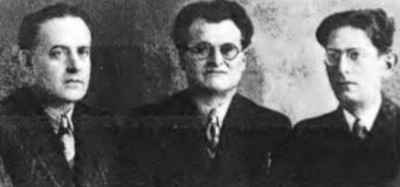
In center, right to left, teachers: 1) Bronshteyn, 2) unidentified, 3) Principal Gedalya Rosenthal, 4) Yeshayahu Vinitsky, 5) unidentified |
|
|
From bottom to top, right to left, row 1: I. Gurfink, A. Dubinsky, I. Levov (Levac), Z. Grinberg |
[Page 584e]
|
|
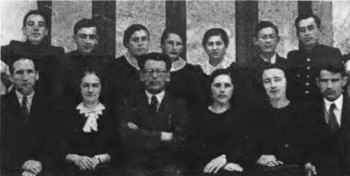
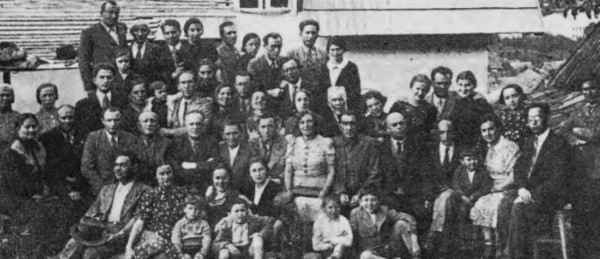
Right to left, teachers: 1. Aharon Liberzon, 2) unidentified, 3) Yosef Apelboim, 4) Averbuch, 5-6) unidentified, 7) Principal Nahum Lisbon, 8) Mrs. Mordekovitch, 9) unidentified, 10) Rabinovitch, 11) Kisliuk, 12) Israel Wertheim, 13) Yakov Kutcher, 14) unidentified |
[Page 584f]
|
|
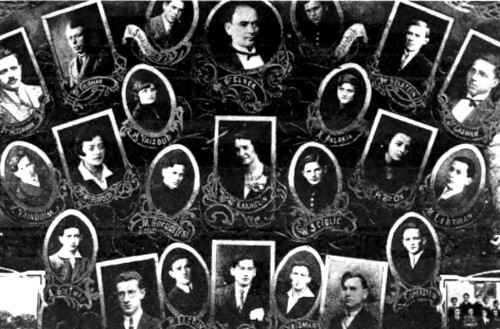
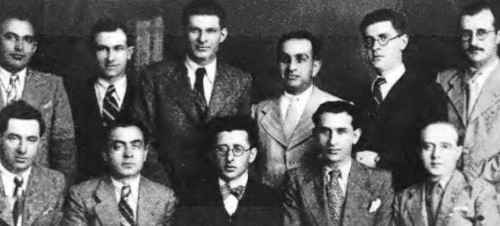
Right to left, row 1, top: Dr. B. Kayvan (former principal), I. Goldstein, M. Weisbuch, Principal Dr. Zvi Helner, Schvartzburd, Dr. Feldman, Asman |
|
|
Right to left, row 1, top: I. Goldstein, L. Lisinger, I. Gorodetsky, I. Goldstein, principal David Kumelfeld, Dr. Feldman, Haim Zigelboim (Toran), Kh. Roitman, Kh. Levitt, I. Grinberg |
[Page 584g]
|
|
Bottom to top, right to left |
|
|
Right to left, Row 1, seated: Moshe Guzman, Dr. G. Zisman, A. Tz. Aharon, M. Weisman, Zev Igrat, Moshe-Yechiel Zohar (Geller), Alter Overbuch |
|
|
From right to left, seated are teachers: Ir. Gander, D. Gander, D. Tur-Kaspa, Principal Z. Nakia, L. Kotik, Aharon Tur-Kaspa |
[Page 584h]
|
|
From bottom to top, right to left |
|
|
[Page 585]
Dr. Rosenbaum himself visited 4 institutions, in Kishinev and in 11 smaller towns.
As a substitute for a regular school, Tarbut had to set up a voluntary, collective, training institution. It consisted of some teachers and members of the central committee. They visited the various institutions, as needed. The visits took place in the summer, in preparation for the next school term. Among the teachers active in this capacity were: Zev Igrat, Abba Blank, Zvi Grinautsky, Yitzhak Dubinuvsky, Hillel Dubrov, Noach Leiderman, Yitzhak Fiter, Shlomo Kilimnik, and Yitzhak Schwartz.
At the beginning of January 1937, the center succeeded in overcoming its financial difficulties and invited the teacher Shlomo Kilimnik to come for three months. He conducted urgent visits to schools that required help. Also, the legal counsellor, Shmuel Rosenhaupt, was able to visit some high schools in the north. These visits raised the mood in these locations and produced positive results. However, these were temporary activities, for a limited time. The issue of permanent inspection was only resolved in the next school year – 1937/38.
The central committee was unable to eliminate its accumulating debts – many of them to those who worked for Tarbut. It decided to do a “snake jump” to carry out its purpose. The principal of the Tarbut high school in Soroca, poet K.A. Bertini, was appointed supervisor of the Hebrew schools and was transferred to Kishinev for that purpose. (In his place, Zvi Weinberg-Atsmon from Kishinev was appointed as principal of the high school. He is now the general secretary of the Rishon Letzion municipality.) The need for this change came, primarily, from a pedagogical perspective. In addition to the key role of Bertini, he was to try and organize advanced courses in Jewish subjects and in pedagogic preparation for young people interested in teaching. He was even able to receive a permit from the authorities. Preparations began for the opening of the courses. However, there was a problem. The financial situation of the teacher was low, and teaching did not draw young people, as it had in the past. In addition, there was no financial help to the participants while they were studying. The small number of students caused the courses not to open. The program was put away.
The establishment of the instructorat became a life and death situation. The educational program was surrounded by a difficult reality.
[Page 586]
The economic situation of the Jewish population, with parents burdened by tuition, was poor. Also, there were tremendous sacrifices demanded of the teachers.
From then on, until the end of the 1940 school year, supervision was done properly. This was despite the difficulties met occasionally in obtaining funds, even for transportation. Thanks to more staff in the central committee, it was possible to broaden other spheres of activity. Several workbooks for personal reading by the students of different ages were produced. Imported books were expensive, especially in view of the lower value of the state currency.
C. Student feeding project
The drought in summer 1928 and the famine that prevailed in the southern area as well as part of the central one of Bessarabia, were mentioned earlier. Tarbut organized, together with the central committee for aid to famine victims, a special program for feeding school students. The program continued for many years afterwards. The central committee received donations from foreign lands – from the Association of Former Residents of Bessarabia in Argentina[53]. It was quite generous. Feeding consisted of breakfast and lunch for all students, without any differentiation. Parents with means also contributed. This important social activity was organized in many towns, quite successfully, by many women's groups together with Wizo. The institutions benefitted educationally and socially.
D. Summer courses for teachers
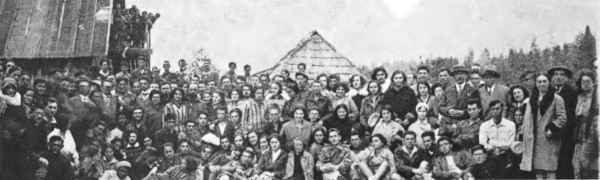
There was a known cultural value to the project of summer courses that Tarbut organized for its teachers. It began in the summer of 1930 in Dorna-Vatra, a resort town in the Carpathian Mountains of Bukovina. There were many opportunities and satisfactory results for a teacher: rest in extremely comfortable locations, as well as financial reasons. This was a rest from challenging work during the year in a healthy environment. There were outings in the area and a beautiful countryside. It was an opportunity to meet and form connections with other teachers as well as to have an exchange of opinion on assorted topics.
[Page 587]
It was also a chance to hear lectures and discussions on assorted topics from other teachers and from important speakers, specially invited.
Despite the many tourists in the mountains during that season, the registration in the courses was well known, especially among the Jews. It happened often that after a concert in one of the venues in the parks, after the orchestra had left – usually early – there would be Jewish music and singing. There would even be a conductor, and the improvised choir would begin singing. A multi-colored crowd was drawn to listen and to watch the excitement of a different existence.
Since 1930, the summer courses became a tradition every year. They were held, alternately, in Kimpulung and Yakoban in the Carpathian Mountains of Bukovina. In 1938, when the regime changed and it was not possible to organize the courses in Bukovina, they were moved to the vineyards near Kishinev (this time with help of the teachers' union). There was individual aid to teachers from smaller towns who needed it.
E. Literary output for students
The change in regime in the country brought about the closing of most of the public Jewish libraries. They stayed shuttered for a long time. In the meantime, the cost of an imported book increased due to the devaluation of the currency of the state. The readers could not control it. The demand for Hebrew books grew and the World Hebrew Covenant sent, in 1938, books as a gift to Tarbut and the youth movements, including Hechalutz. It did happen that books were lost after the official censorship law passed, but there were still enough left to enjoy.
Since there was not enough to satisfy the thirst for Hebrew books, Tarbut itself began, as of 1939, to publish annotated books for students of different ages. The library consisted of booklets in three series (Gargerim, on cartons, for young children; “gifts for the holidays” – for holidays; Grapes – for graduating students). Every series had several divisions that came out on a regular basis. There was much work, effort, and financial contribution put into it. The price of the booklets was low. The students loved the series, and the project was well received.
[Page 588]
Teachers and Tarbut leaders enjoyed it. The preparation of the booklets was supervised by the inspector, K.A. Bertini.
F. Literary output for adults
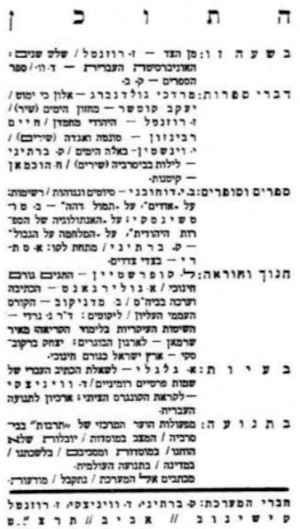
From literary output for students to one for adults:
|
|
[Page 589]
In addition, there was news about the Tarbut movement: activities of the central committee, of the central branch (as prepared by the secretary), events in various institutions (as per the inspector), what was happening in the world movement, and many more details. These were usually seen in memos and “Yediot” sent from time to time to teachers and community leaders.
Here was a good combination of literary material and factual ones, reflecting the problems of the day. It was available to everyone.
This was not the fate of the second booklet. Its birth ran into bad luck. Its printing happened on an important occasion that caused surprising changes of regime. It was the day the Soviet army entered Bessarabia, 28 June 1940. It replaced the Romanian army, in favor of Mother Russia. Naturally, the booklet never arrived – not to its readers, nor to its creators.
In parallel to the literary activities of Tarbut in Kishinev, a young writer from Bessarabia, B.I. Duchovny (Michaly), tried to publish a monthly literary and educational magazine in Hebrew. He was in Bucharest and had managed to earn a good standing among other authors. The first booklet, “Tarbut”, appeared in Iyar 1939 under his editorship and was published by the Tarbut center in Bucharest.
The editorial introductions defined the new purpose:
To give to the isolated Hebrew book in the Romanian diaspora a chance to publicize the fruit of its soul; for the Jewish youth – a fresh Hebrew pipeline to slake his thirst to know the problems of the times in our Jewish world; to the teacher – a forum from which to discuss the rightful demands in the field of Jewish education.
In the second booklet, “Nativ” (a change of name because of the authorities), published in Sivan 1939, the editorial board again repeats its intentions:
To get our few authors out of their frozen state and desolation. To bring them to another space. To encourage their creativity to show to the public. We will not be satisfied with the status quo. We will make sure there is continuity. We will nurture the young forces, encourage them, and direct their first steps. Without new recruits, the chain of Hebrew creativity in Romania will disband and become rusty. We want to build it up.
The booklets were well received by the Hebrew readers, and they wanted them to continue. However, for political reasons, internal as well as external (the Antisemitic youth movement “the iron guard” rose in importance and was battling with the king, plus there was intense pressure by Nazi Germany on the state), Romania was struggling before WWII broke out. The life of the Jews in general, and their cultural life in particular, was unbearable. The program thus disappeared, and the publication of booklets was stopped.
[Page 591]
Cultural enterprises of individuals
The ancients did not – as we see in the 32 dimensions of Eliezer, son of Yossi of the Galilee – hesitate to correct versions of the Bible. This despite the reverence they held for sacred texts. They would do so when they felt it necessary. This is also what the Amorites did to the Mishna and the geniuses to the Gemara.
Therefore-
Now that God has opened the path to discover, in the Bible, the ways and means to restore to him the glory and splendor of earlier times, he must not conquer the thoughts of his heart. “Your tears will be filled with joy.”
If, truly, the “new concept” did not earn proper attention, it is possible that after advancement in biblical research, it will serve as study material for the experts in this material.
In winter of 1938, when the antisemitic regime took over in Romania, the economic situation of the Jews worsened. Tarbut was obliged to ask the World Hebrew Covenant in Eretz Israel for help. “The Covenant” called, in March, for a special session of Former Residents of Bessarabia – writers, teachers, businesspeople and graduates of Tarbut. Its chief secretary, Dr. A. Rosenfeld, brought to the assembled details about the demanding situation in the country of their birth. He emphasized the need for urgent aid by the central branch of Tarbut. This was needed for it to fulfill its mandate in these crazy times. A special committee was chosen –Yakov Fishman, Shlomo Hillels, Israel Berman, Zadok Weinstein, Israel Skwirsky, Yitzhak Khitron, Hillel Dobrev, Efraim Davidzon, Zvi Ackerman (Ekroni), Dvora Schechter, and Dov Zitser.
The committee's task was to organize a modest fund raiser, to alleviate the distress of the central branch. The writer Ari Even-Zahav was visiting Romania in May of that year. He understood the demanding situation. When he returned to Eretz Israel, he worked tirelessly to enlarge the plan and to obtain aid. A special operation was organized, as mentioned earlier, sending books as a gift to the schools. It was a good deed.
During the visit of Even-Zahav, he was invited to Bucharest to a conference of those active in Tarbut in Romania. They came from all the provinces. The purpose was to form a local branch of World Hebrew Covenant. Participants were K. Bertini, D. Vinitsky, and L. Kupershteyn (Bessarabia),
[Page 594]
Burstein and Petrushka (Yassy), Dr. Erich (Czernowitz), Dr. Rosenberg (Timishora), M. Orkhovsky, B.I. Duchovny (MIkhaly), G. Zlibansky, Maganzin, Dr. M. Kotik, I. Risfeld (Bucharest), and others. This new branch did not manage to do anything useful.
Yitzhak Grinboim comes to the aid of Tarbut
In 1939/40, after WWII had begun, Poland fell and was divided between Germany and the Soviet Union. Tension and need grew among the Jews of Bessarabia. The first victims were the educational institutions. Among them was the central branch of Tarbut. It could not conduct its affairs. Yitzhak Grinboim, a member of the Zionist management, was visiting Romania then. He was particularly interested in the situation of Tarbut. He listened to its representatives, D. Vinitsky, and Sh. Rozenhaupt, and tried to find financial backing. This allowed the centre to keep the embers from dying prematurely and to continue the work until the end of the school year. This was the last year of the existence of the Jewish community in Bessarabia as a unified one.
Visit of Nahum Sokolov in Magen David high school in Kishinev
Nahum Sokolov, chairperson of the World Zionist movement visited Kishinev on 11-16 Kislev 1930. He was asked by Rabbi Tsirelson to visit the Hebrew high school, Magen David. It was his pet project. Sokolov was accompanied by Shlomo Berliand, chairperson of the Zionist organization in Bessarabia, and Dr. A. Mavshan, representative of the Zionist federation in Bucharest. Also in attendance was an honor guard of members of Maccabi. He was received, in the school, with happiness and respect. After principal Nahum Lisbon greeted the special guest, Rabbi Tsirelson explained the history of the institution and its many accomplishments, despite the legal obstacles that stood in its way. One of the students spoke about the great, blessed effort of Nahum Sokolov to revive the Hebrew language.
Sokolov was quite impressed by the school and even visited the kindergarten, under head teacher, Leah Khazin-Kutcher. He spoke to the children and watched them play. We can read about Sokolov's impressions of his visit in the message he wrote in the visitors book of the school[54].
[Page 595]
During my stay in Kishinev, I first visited an institution that carries the name of our national symbol, “Magen David”. We had this name from ancient times. It shows the religious and the secular and reminds us of a magnificent time in our history. However, the name Magen David stands for a shield and a symbol. I first heard it here in Kishinev. I was curious to hear more about it. Unfortunately, I was unable to spend much time there due to time constraints and other reasons. From the little I heard and saw during my visit in the school, I understood how fitting was the name. All used the language of David. It is the main spirit that embraces, like a cloud of honor, teachers, and students alike. This starts with the small plants in kindergarten and ends with the top, the cedars: the teachers, and the supervisors. The Heder, Talmud Torah and the Yeshiva brought here, on one side, “the light of the Torah”. On the other hand, the influence of the new pedagogy is obvious. Secular subjects have introduced universal sciences and meaningful education. These were absent for some time in the old educational institutions. I am convinced that this institution will produce a generation of complete, educated Jews – capable of supporting an honorable Jewish life.
As it pertains to the above description, it would be useful to add details about the history of this glorious institution. This is discussed in booklet #4, Kishinev, August 1928:
The Hebrew high school Magen David was founded in 1921 by Agudat Israel, under the initiative of Rabbi I. L. Tzirelson, as a national religious institution. The founders had as their aim, to unite ancient traditional Judaism with the requirements of life and new education. That is why they added hours for national and religious studies. This was on top of the time spent on general studies as ordered by the curriculum of the government. These were: Bible, Mishna, Aggadah, Talmud, laws, and customs, as well as the basics (Shulchan Aruch, “Yad Hazaka”, Hovat Halevavot, etc.)Most parents, even the most liberal ones, prefer Magen David high school and send their children there because of the national religious atmosphere.
The Hebrew language permeates the high school. Hebrew literature has a special section. Guests arriving from Eretz Israel who visit Magen David high school, find in it a complete atmosphere of Eretz Israel.
Next to the high school there is an elementary school with four grades, as well as an exemplary kindergarten. Their curriculum prepares the students for the high school.
This school year, there were 30 children in kindergarten, 140 in the elementary school, and 180 in the high school. All students of the 4th grade received, this year, government certificates.
[Page 596]
The gymnasium was founded through the initiative of Tarbut and without outside financial support. Its budget has now reached 2 million lei. The number of educators and teachers in it was 22.During its short existence, the high school has acquired a rich library in the following languages: Hebrew, German, Romanian, and French, plus many tools, pictures, and maps.
In the eighth grade, a special emphasis was placed on pedagogy and psychology, to train the graduating students as teachers.
In the next school year, the study of English will be included.
This year, the first graduating class included the following students: 1) Baltzan Haim (outstanding accomplishment in Hebrew language and literature); 2) Kerenkurs Zvi; 3) Dubinsky Aharon; 4) Lvov Yakov (distinction); 5) Rubenstein Yakov; 6) Posen Yehoshua; 7) Gorfink Yosef; 8) Grinberg Zev; 9) Spector Eliezer; 10) Tovis Yerachmiel.
The high school became an important center of Hebrew culture in Kishinev. There were annual balls (mostly Purim and Lag Baomer), organized by the students of Magen David in the best theatres in town. The first one was on Lag Baomer 1922, a year after the founding of the school. It was held in the national theatre. The first part, after a musical overture, was dedicated to the spirit of Rabbi Shimon Bar Yochai. Haim Boltzmann welcomed the audience and many students took part.
Hebrew songs were sung by the school choir, with the following student soloists: Avraham Shechterman, Kh. Radai (Berman), and Bukovitch. There were also the following Jewish singers from the royal opera in Bucharest: I.L. Gorski and G. Gurini. The latter later performed with the Israeli Opera. (He was born in Soroca, and his name was Hershel Bogomolny.) They were accompanied by the pianist Bein – later a conductor in the Bucharest opera. In 1923, at Purim, the well-known singer Friedman-Lvov was the performer.
Plays by Shlomo Hillels were staged. “Either Friendship or Death” was directed by Karson. There were also plays by Israel Berman: “Two Purim Meals” and “Meeting Spring”. Gorski was the director. The famous Maccabi orchestra of Kishinev played the music.
History of the Hebrew high school in Beltz
We find key details about the high school in Beltz, one of the big, important institutions in Bessarabia, in a list published in a jubilee edition of Unzer Tzeit in Kishinev. It was #4000, February 1936, written by I.L. Kain.
[Page 597]
On 14 April 1917, five weeks after the revolution in Russia, the first meeting of local businesspeople was held under the leadership of A. Gafter. It was decided to set up a Hebrew high school there. At first, the high school was located within the government high school, and its principal was a non-Jewish local educator, Voskrasanski. During the first year, a building was bought, Eventually, a second story was built. Boris Dubinsky was invited to be the principal. He came from a well-known Zionist family in Kishinev. He was followed later by Yeshayahu Tumarkin and Rafael Katz.
The chairs of the committee at the time, until 1935/36, were: A. Gafter, Moshe Krasiuk, Gedalya Lipson, B. Roizman and, finally, A. Roit. Other committee members, in the last year, were I. Krasiuk, and Dr. Fayerman, vice chairs; Forer, secretary; Rabbi Gulko, treasurer and house manager. As well, A. Kagan, I. Dekhtiar, M. Dubruskin, A. Fireshteyn, Sh. Lekhtman, G. Rosenthal, M. Tanenbaum, and M. Weinshteyn.
Some of the teachers appointed in 1935/36 were: Sh. Burd, Moshe Gafter, Gleikhman, Grumman, Weintraub, Mrs. Tumarkin, Mrs. Yakobson, Langerman, L. Kupershteyn, Sh. Kilminik and others. The number of students in the last year, 1935/36, were:
kindergarten – 40, elementary school – 104, boys high school – 139, and girls high school – 176. The total was 459.
The story about the high school in Soroca
Earlier (in the chapter on representation in the Soviet Union, pages 482-3), we discussed the malicious murder of 6 young people in Soroca in early January 1932. They were kidnapped by border patrol to smuggle them to the Soviet Union. Consequently, the ministry of education ordered the closing of Tarbut high school there. The claim was that one of the murder victims, Rivka Darkutzan, a lover of Communism, had been a member of the staff of the school. This was a malicious fabrication. It was untrue for Darkutzan, as well as for the other victims. They were never students in the school. Although these facts were proven to the authorities who visited, the wrong was never corrected and the school remained closed for several weeks. Tarbut sent a memorandum to the prime minister and to the minister of education, Prof. Nikolai Yurna. In it, Tarbut disproved the fabrication about the school. It added its grievance about the fact that an educational institution was dragged into the situation, through no fault of its own. It was merely an evil fabrication.
[Page 598]
The prime minister's reply shows the true intention of the regime, without any reason[55]:
The ministry of education repeats and confirms the closing of the Hebrew high school Tarbut in Soroca, as ordered by the interior ministry through the provincial authority. This is because many Jewish young people have tried to go to the Soviet Union. It proves that, among the Jewish population of Soroca, there is a centrifugal current.Despite the efforts of the teachers in the high school, there is no guarantee that the children of this population are liable to be isolated in their educational environment, which does lead them in the proper way.
So that the closing of the school does not harm the students whether in general studies or Hebrew subjects, an order was given by the ministry that all students of Tarbut sitting for exams by the government testing authority, would be able to register as external students in the public schools. Hebrew language will be taught for 3 hours a week in every class.
The Jewish community could not accept the ruling. After many efforts by Tarbut, the discussion about the future of the school was transferred to the permanent council under the ministry. The meeting was chaired Prof. Radulescu-Motru, a loyal, not corrupt man. For the defense appeared the legal counsel of Tarbut, Shmuel Rozenhaupt; representative of Tarbut in Soroca, Yitzhak Khitron; and Dr. Avraham Mavshan, a Zionist leader from Bucharest. They succeeded in refuting the accusations, fears and points of view brought by the clerks of the ministry of education. The committee ruled in favor of the school.
It was a lengthy and nerve-racking struggle with strong enemy forces. It continued in the belief that victory was coming. And so it was.
Youth in front of false temptation
We should not deny the truth that the interest in communism grew roots among some youths in Bessarabia – those who did not have the identification with national Judaism. This was more obvious than in other parts of Romania. The main reason was the deep oppression by the reactionary regime in antisemitic Romania, which was getting stronger – especially among the student population.
[Page 599]
Also, the border with the Soviet Union was quite close. Communist propaganda managed to instill the belief that a free state was established on the other side of the border. This was a state of justice, true camaraderie, and equality. The young people of Bessarabia could not arrange their future as they wanted and were blinded by the lights on the other side of the border.
The visual side was also important. Many of the border settlements – many important towns among them – were witness to mass processions in nearby areas across the river. These were celebrated at Christmas time, or at any other important occasion. The sounds of the orchestra and the bombastic speeches full of revolutionary symbols could be heard, amplified by huge speakers. It was as if the intention was to evoke jealousy and yearning in the hearts of the population on the other side – the side that was forcibly torn from the new “Mother Russia” and was now under an oppressive regime.
There were some young people who did not obey the instructions from above to stay in their place. They were interested in renewing and deepening the Communist consciousness among the people and to incite them against the authorities. They preferred, on their own, to promote and enter the gates of the Soviet “Garden of Eden”. It was helpful to smuggle across the border in winter, when the frozen Dniester became a natural bridge. Only a few minutes were needed to cross it, running or crawling, covered in a white sheet. In their imagination, the white cover was a symbol, for many of them, of their fate and future in the lower “Garden of Eden”. The security forces of the Soviet Union did not trust these excited followers. They were sent to hard-labor camps, for examination and filtering. This fact became known to their relatives in Bessarabia later.
First teachers conference
The conference was held in Kishinev during Hol Hamoed of Succot, 1932. There were close to 100 delegates – teachers and other guests. The author Natan Bistritsky, head of the public relations department of the central bureau of JNF in Jerusalem, was in attendance. Minutes of the conference are not available, only some impressions. Thus, it can be said that this conference was different from other professional conferences, with discussion of salary and protection of individual rights. In Bessarabia, there was no uniform salary scale in the institutions.
[Page 600]
Everything depended on the local situation, seniority, and experience of the candidate and even his standing in the community. There was no teacher's seminary and candidates were drawn from Hebrew speaking graduates of the public high schools. They were under the authority of the local board shared by Tarbut and the teachers union. The board had the power to decide on pay scale. It negotiated with the committees of inspectors in the institutions.
The board had no interest in changing the situation. At that time, the financial condition of the institutions was not bad yet. The idea of the board became an inner fortification for the school. As far as instilling an atmosphere of Eretz Israel, Bistritsky was the person to do it.
There were some lectures on actual pedagogical topics, in view of the legal situation of the school. There were also reports from several places. It was felt that due to the legal restrictions in private education, the development of the Hebrew school was in a crisis. Difficult days were coming. However, this fear was obliterated by the news of the country that was being built. Everyone came back refreshed.
Second teachers conference
During Passover vacation, in April 1935, a second conference was held in Kishinev[56]. On its agenda was the situation of the Hebrew school and its teachers.
The conference was opened by poet Yakov Kutcher, who arrived specially from Timishora. This was his new place of work after Magen David high school in Kishinev was downsized. He pointed out the demanding situation of the Hebrew teacher – that due to the material hardship in Bessarabia, the burden falls on the teacher[57].
[Page 600a]
|
|
Bottom to top, right to left, row 1: 1) unidentified, 2) Yeshayahu Vinitsky, 3) Israel Gleizer, 4) Zev Rozenfein |
[Page 600b]
|
|
[Page 600c]
|
|
Bottom to top |
|
|
Bottom to top |
|
|
Bottom to top, right to left: |
[Page 600d]
|
|
(three months before annexation by Soviet Union)
Bottom to top, right to left |
|
|
Right to left: poet Shania Pinsky, Eliyahu Meitus, writer Zalman Rosenthal |
|
|
Right to left, seated: David Vinitsky, Dr. Meir Kotik, author Ari Even-Zahav (E.I), Moshe Orkhovsky, Aharon Golirgat (Bertini) |
[Page 601]
It was the cause for many teachers leaving Bessarabia. They either made Aliyah to Eretz Israel or moved to other areas. The council sought a way to stop this emptying of pedagogical powers.
Kutcher brought greetings from Tarbut in Transylvania, headed by Dr. Yechezkel Brisker and Ernest Varmash. He spoke about his trust in the movement in this province.
Sh. Berliand brought greetings from the Kishinev educational council. He was sorry that the new, young committee was not yet able to subsidize the school.
D. Vinitsky, secretary of the central committee of Tarbut, encouraged the cooperation between Tarbut and the teachers union – two important, united parts. The torch that was lit 15 years ago needs to be supported. It is sad that Hebrew education is thriving in Eretz Israel, but we see a decline in our complete Hebrew instruction. The Zionist seems to have turned its back on us, and we stand alone in this struggle. Our people must be reminded, day and night, about this strange occurrence and they must find the way to remind the Zionists that education is vital.
Others who greeted the assembly were: Issac Rabinovitch, from JNF; Yehudit Geller, WIZO; Haim Weisadler and Yitzhak Dubinovsky (Beltz), Zeirei Zion; Ben Zion Baltzan, Young Zionists; Zvi Botnik, Gordonia; Aharon Cohen, Hashomer Hatzair; Yitzhak Retakh, Poalei Zion; Kupshteyn, Zeirei Mizrachi; Haim Baltzan, students union; Rachel Brun, Yavne kindergarten; Yosef Apelboim, Magen David; and Israel Weinstein, Unzer Tzeit.
The following were elected to the permanent council: Yakov Kutcher – honorary chairperson; Yakov Berger (Akkerman) chairperson; Zev Igrat (Securany) and Yitzhak Dubinovsky (Beltz), members of the board; M. Britman (Markulesht) and Sh. Malmud (Kishinev), secretaries; L. Trois (Akkerman), Leib Coopershteyn (Beltz), A. Tur-Kaspa (Zeguritza), Grugerman (Tarutino), Zvi Grianutsky (Lipcany), Gleizer (Markulesht),
[Page 602]
K.A. Bertini (Soroca), N. Raduliansky (Kiliya), I. Vinitsky (Kishinev), and Rachel Lechter (Romanovka).
The secretary of the teachers union, Yeshayahu Vinitsky, in his lecture about the situation of the Hebrew school, explained that even though the council was created to discuss the professional interests of the teachers, it could not deny the general situation of the school. One depends on the other. Teachers' salaries are equal in all schools. It is connected to the financial situation of the institution there. It is, therefore, essential to discuss the root of the problem – the actual situation of the schools.
He surveyed the history of the Hebrew school from its establishment to today and he pointed out the events and mistakes that had occurred recently: a. Lack of broad public relations among the parents about the value of a national school; b. Lack of a sound foundation for the school which would allow it to exist in a normal way and to develop nicely. These are the two reasons for the decline of the school lately. There are fewer students and some high schools have closed.
The elected community, for which we had fought recently, disappointed us completely. It was helpless when new efforts were required to assure the increasing need for education of the next generation. The Hebrew teacher is the only who carries the heavy load. All the deficits of the institutions hang on their heads. Is it surprising that our ranks have decreased and that young people are not interested in teaching? The only solution is to alert the Jewish public, the Zionist movement, and the Jewish community, to help in saving the Hebrew school.
Zvi Grianutsky, principal of the school in Lipcany, spoke about the methods to improve the condition of the Hebrew school in Bessarabia. He also gave a concrete proposal to solve the painful problem very much on the minds of the delegates. It would be useful to approach the main institutions in Eretz Israel, the national committee and the teachers union. They would be asked to send, for a year or two, their best teachers as pedagogical emissaries. Some of our best people go to Eretz Israel every year. This would be friendly reciprocity.
Yitzhak Yashan, principal of the new Talmud Torah in Kishinev, proposed, in his speech, that our representatives to the Hebrew congress in Tel Aviv should demand, from the Zionist leadership, to allot some funds for Jewish education in the diaspora. This would be in view of their refusal to allow a third fund.
Zev Igrat, principal of the school in Securany, spoke against the Zionist movement with all its branches.
[Page 603]
It does not do enough for the fate of Hebrew education. He demanded, from the press, to dedicate more space for explanations of the issues.
A. Tur-Kaspa, a teacher in the school in Zeguritza, proposed the formation of a special, unified council for Tarbut and the Zionist organization in small towns to find a solution.
After a long discussion of the painful topic of the financial situation of the school, it was decided to announce that May fifth will be a day for demonstrations. Students will be dismissed earlier and there will be public relations sessions to seek help.
Indeed, the recommendations of the council were well received by the population. At the end of May, the press published an announcement for all Jews in Romania[58] to conduct a campaign to collect funds for the Hebrew school in Bessarabia. It was signed by the central committees of Tarbut, the teachers union, and all Zionist groups, as well as by the youth movements. June was announced as “the month for the Hebrew school”. The purpose was to aid the educational institutions to finish the year without a deficit and to prepare a financial basis for the coming year. Dozens of volunteers went to smaller towns to help in this activity. Its success was thus assured.
Celebration of the tenth anniversary of the Hebrew University in Jerusalem
While the leaders of Tarbut and the teachers were occupied with the council – meeting during the Passover holidays – the Union of National Students in Kishinev undertook to organize a celebration of the tenth anniversary of the Hebrew University in Jerusalem. The celebration took place in the elegant hall of City Hall. It was emceed by the young lawyer, Haim Baltzan. He described, in detail, the demanding situation of the Jewish students in Europe. That is the reason for the value of our national university. In conclusion, he proposed to choose Shlomo Berliand -- chairperson of the Zionist organization and Tarbut -- as president of the celebration.
After words of introduction by the president, in Hebrew, the right to speak was given to Colonel Urbanovitch.
[Page 604]
He brought greetings from the military governor, General Kantchulescu. Others who brought greetings were Yitzhak Finkelstein on behalf of the community, Leib Coopershteyn from the teachers union, Zvi Cohen from Keren Hayesod, advocate Yehudit Geller from WIZO, and Gershon Shtarman from Hatza'r.
Yechezkel Landon, attorney Yitzhak Korn, and Michael Kotliar spoke about the importance of the university for the Jewish people in the entire world, and about its importance in the eyes of the world.
At the end of the celebration, a congratulatory cable was sent to the university in Jerusalem as well as to King Karol II. He was asked to protect the Jewish students in the universities.
The celebration impressed all who attended, especially the students.
Third Conference
Based on everything discussed above, it can be said that the condition of the Hebrew school was full of dramatic moments. This continued for many years. It began with the first phase of its establishment, continued during its struggle for rights with the evil regime and ended with the final one – the undermining of its existence. This happened with the attempt to get used to the new conditions thrown at it. It was different in the second decade of its existence. The dominant issues, in the 1930s, were the financial needs that worsened during the starvation years of 1933-35, on one hand. On the other hand, there was a change in attitude from the regime towards the Jews, following in Hitler's footsteps. The latter shook the financial ability of the Jewish community in Bessarabia. As a result, most of the institutions had to pare their budgets from time to time. This led to decreasing the salaries of the teachers.
In view of the situation, several issues arose. They required a discussion in a larger forum, with the participation of representatives of the teachers union and the principals. For that reason, a third conference was held in Kishinev in October 1936. It was a larger group, including all the above[59]. In addition to members of the central committee, the following also took part: I. Berger (Akkerman), K. Bertini (Soroca), Sh. Budkaer (Britcheva), Tz. Grianutsky (Lipcany), Tz. Weissman (Ungany), A. Tur-Kaspa, R. Mermelshteyn and Z. Hakim (Zeguritza), I. Koffman and L. Coopershteyn (Beltz), Zvi Schwartzman (Bender) and M. Shapiro (Rezina).
[Page 605]
Secretary D. Vinitsky gave a report on the activities of the central committee and the central branch in the previous three years, since the fourth conference[60].
Legal situation. All the attempts and hopes to change the legal situation of the private schools failed. Therefore, the legal council directed its activities to fortifying the gains made so far. These were some reliefs from the ministry of education – changes in taxes on tests, teacher training by experts, etc. – and a decent attitude towards Tarbut from the authorities, as well. The senior officials in the ministry of education usually replied in a positive manner to the various requests of Tarbut. It was even possible to obtain permanent licenses for 26 elementary schools, out of 34. Tarbut became a proper representative in the eyes of the authorities, as a body that could speak for the educational system of the Jews. This was important for the Yiddish and religious schools that were not truly part of Tarbut. All the good rulings that Tarbut received applied to all schools, without any differentiation.
Annual permits for teachers. There was an understanding in place with the ministry of education that Tarbut would present a list of teachers of all institutions. This, without attaching certificates and diplomas of any kind. The original documents were kept in the central office in case proof was needed. There was a special form which included all pertinent details about every teacher. Four copies were sent to the ministry. One of the senior officials checked the file and gave his opinion in a column next to each name. After the ministry approved, the form was returned to the proper inspection office[61]. Tarbut officially informed the teacher based on this procedure.
[Page 606]
This certification by the ministry was enough to satisfy the requirements of the local authorities.
The scope of the school system.
In 1935/36, the system had 59 institutions – 218 classes with 4897 students (3028 boys and 1869 girls) and 279 teachers, as follows:13 kindergartens with 422 children (there were 320 children in 1932); 34 elementary schools, full or partial, with 3332 students (compared to 37 schools and 3739 students in 1932); 12 high schools, full or partial, with 1143 students (compared to 1178 students in 1932). The total budget was close to 10 million lei (compared to close to 17 million lei in 1932).
Although there was an increase in the number of children in kindergarten, there were 3 fewer elementary schools, and the total number of students was 641 lower. Several institutions were closed; there were fewer students and the budget was decreased. This was a direct result of the dire economic situation of the Jewish community. The financial situation of teachers in most places worsened drastically. There was a danger of degeneration of the institutions. In view of this sad reality, the need for the appointing of a permanent supervisor was felt. He would visit all the institutions. However, where will the funds originate for this?
The only good result is that the subject of buildings was solved by itself. 51 out of 59 institutions were in their own buildings. This fact was helpful for obtaining permanent certificates for some of them. It must be said that most of the buildings were specially built recently by the school committees. Only 3 were not. The elementary and high school building in Akkerman was donated by the philanthropist Moshe Milshteyn, the school building in Bymaklya was donated by the brothers Katz, and the one in Ataki was donated by the Khalfin family[62].
Chairperson Sh. Berliand and member of the presidium V. Rosenthal added to the words of the secretary.
[Page 607]
This proved that the center did much to strengthen the previously gained rights and even broadened its activities.
In the discussions, with everyone's participation, a thank you to the center was announced for all its help. The budget was approved and practical proposals for the future were brought up.
In addition to this conference, there was also a teachers union with participants from smaller towns. Also, there was a special session of Tarbut with high school principals.
The first meeting dealt with the financial situation of the teacher. It had deteriorated recently. It was decided to assign a definite minimum wage for teachers. In addition, the local superintendents would be encouraged to find new funds to sustain the schools. Also, summer courses for teachers would be planned, at a reasonable cost.
A special report was dedicated to the curriculum of the elementary schools. It was decided, in view of new needs, to broaden the curriculum and to form a new committee to prepare it.
In the second meeting, with high school principals, the main topics were: the place of Hebrew studies in the schools after the forced Romanization, and the character of the government tests, after attempts by the authorities to exclude Hebrew examiners from the tests committees. The marks that resulted were atrocious. Tarbut worked hard to stop the testing by government examiners in the past. However, it is important to have a unified stand for the future.
All these decisions resulted in the following responses: a. A minimal, unified curriculum for Hebrew studies in the high schools that was brought to the ministry of education for approval. A pedagogical committee, located in Beltz, was appointed. Its members were: Z. Igrat (Securany), Sh. Burd (Beltz), M. Britman (Markulesht), K.A. Bertini (Soroca), A. Tur-Kaspa (Zeguritza), L. Coopershteyn and Sh. Kilmenik (Beltz); b. A compulsory Hebrew test for students graduating from government high schools; c. To fulfill the earlier decision for teachers who do not teach in Hebrew, to learn the language within a year; d. To encourage the committees of supervisors to enlarge the school libraries. This would help in the formation of clubs and reading rooms for the students and find special prizes for outstanding students in Hebrew studies;
[Page 608]
e. To ask the ministry of education to add marks in Hebrew and religion to the other results; f. To start the preparation, together with other minorities, to have exams at the end of a school year and not twice, as now; g. To allow the legal counsel, Sh. Rozenhaupt, to visit every school to find out their specific problems.
Three weeks after the conference, on 6-8 November, the committee for the preparation of Hebrew curriculum in high schools met in Beltz[63]. Detailed proposals were presented, even about teaching methods and concentration on significant moments per class. The members of the committee were: K.A. Bertini – Hebrew language, grammar, and literature; A. Tur-Kaspa – Tanach; L. Coopershteyn – Jewish history and geography. After discussion, explanations and clarifications, all members of the committee formally approved the curriculum, and it became compulsory.
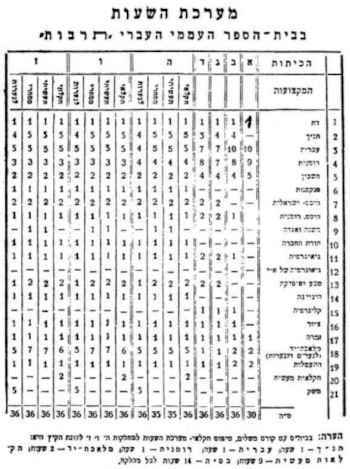
Before the school year of 1938, a special pedagogical committee met in Kishinev. Its members were: A. Golirgant (Bertini), Tz. Grianutsky, A. Maidanik, L. Coopershteyn, and Sh. Kilimnik. The committee prepared a broad curriculum for elementary schools, as decided in the past conference. (For comparison, please see the new schedule on the next page, against the earlier one on page 553).
Tarbut center published the curriculum. When Sh. Rosenhaupt visited some high schools in northern Bessarabia, he invited the teacher Sh. Kilimnik to conduct urgent visits, for a period of 3 months, to some elementary schools.
[Page 609]
In the Tarbut Hebrew elementary school
Subjects
Religion, Tanach, Hebrew, Romanian, Math, bookkeeping, Israeli history, Romanian history, Mishna and Aggadah, sociology, geography, geography of Eretz Israel, science, hygiene, calligraphy, art, choir, handwork (boys and girls), physical education, practical agriculture, household.
#53. Schedule for the new curriculum
Sources and clarifications
On pages 610-611, the changes in Hebrew education during its 22-year existence, is shown. The following conclusions are made:
A. The development of the Hebrew school and its changes in the first 3 years.
[Page 610]
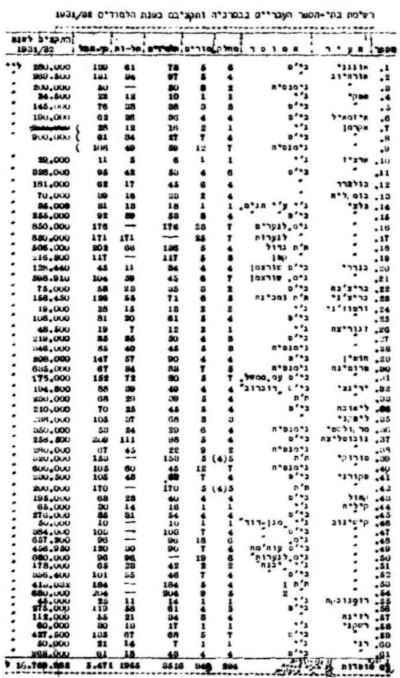
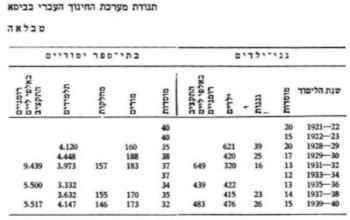
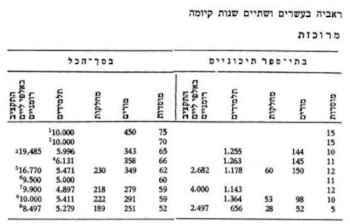
Table of the fluctuation of the Hebrew education system in Bessarabia during its 22-year existence
Sources and clarifications
Budget of Tarbut institutions in Bessarabia at the start of the 1928-29 school year.
19, 485, 475 lei- 100%
The budget was covered as follows:
A. Tuition 10,747,980 lei -55.16% B. Municipal allowance 363,000 lei -1.86% C. Allowances from Korobka income 2,188,741 lei- 11.23% D. Allowances from businesses 120,000 lei- 0.62% E. From Zionist women organization 296,750 lei- 1.52% F. Income from galas and other activities 1,175,721 lei- 6.03% G. Collections and donations 2,180,953 lei – 11.20% Deficit for the year 2,412,330 lei- 12.38% Total 19,485,475 lei- 100%
[Page 611]
The elementary school system had the following: 1 school with 2 grades, 4 schools with 3 grades, 23 schools with 4 grades, 5 schools with 5 grades, 2 schools with 6 grades, 1 school with 3 grades, 2 schools with 4 grades, 1 school with 5 grades, 2 schools with 6 grades and 4 schools with 7 grades.
[Page 612]
Summary
The Hebrew school in Bessarabia, as in other countries of the Diaspora, played a significant role in educating for the future. Tens of thousands of students were connected, from early childhood, in a spiritual way, to their traditions and their distant homeland. The schools enabled a renewal of the covenant with the Holy Language, until it was used on an everyday basis, a spoken language. It continued to the youth movements that undertook the fulfillment of the dream of Aliyah. Even the survivors of the Holocaust and the evacuees that came to Israel after WWII and until today, brought with them their childhood version, and renewed it here.
Original footnotes:
He would go on stage from time to time, as an actor or director, to bring in money for the institutional coffers.
The Hebrew teacher was the pioneer of the Zionist movement in the diaspora, who did not merit to earn a certificate for Aliyah. He could not have been replaced in his role. Return
On this occasion, it is interesting to introduce the reader to an episode dealing with the certification of poet Yakov Kutcher, teacher of Tanach and Hebrew literature. In the file, it was noted that he was a graduate of Beit Midrash and Yeshiva. Also, that he was a poet who translated to Hebrew the poetry of Aminescu, Alexandrei and others. The director of private education still hesitated to certify a teacher without an acceptable education. The legal counsel, Rozenhaupt, gave an explanation. Inspector Holman added his positive opinion, by stating: “Mr. Director, did our Savior not have the same certification?” The official laughed and agreed. He at once put his stamp on the file. Return
|
|
JewishGen, Inc. makes no representations regarding the accuracy of
the translation. The reader may wish to refer to the original material
for verification.
JewishGen is not responsible for inaccuracies or omissions in the original work and cannot rewrite or edit the text to correct inaccuracies and/or omissions.
Our mission is to produce a translation of the original work and we cannot verify the accuracy of statements or alter facts cited.
 The Jews in Bessarabia
 Yizkor Book Project
 JewishGen Home Page
Copyright © 1999-2026 by JewishGen, Inc.
Updated 28 Jun 2026 by LA