|
Previous Use of Premises and
Formation: |
The Poor Jews' Temporary Shelter
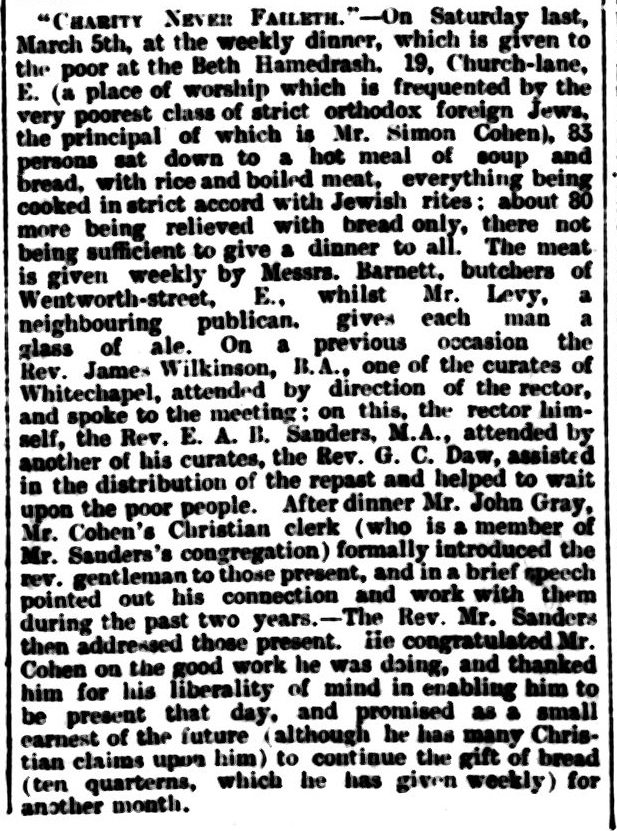
In 1879, Simon Cohen (affectionately known as Simcha Becker), a local baker based at 32 Church Lane,
decided to establish a makeshift refuge at 19 Church Lane for destitute, newly arrived Eastern European Jewish immigrants.
Although he was himself a relatively recent immigrant (having arrived from Poland in 1870)
and had not risen far above the poverty level, he financed the refuge entirely out of his own pocket.
While conditions were admittedly spartan, the new arrivals were provided with clothes, kosher food, and a place to sleep,
alongside basic facilities for prayer and study. Unsold bread from Cohen's bakery was regularly given to the inmates at the
end of the day.(iii)
However, members of the established Anglo-Jewish community frowned upon Cohen's ad-hoc activities,
fearing they would encourage a larger influx of helpless refugees to British shores. At their behest,
the local authorities intervened in 1884, closing the refuge on the grounds of severe overcrowding and unsanitary conditions.
This action inevitably backfired by provoking intense community criticism.
Frederic D. Mocatta, vice-president of the Jewish Board of Guardians, was even forced to appear before a public protest meeting
to defend the Board's restrictive policies.
Consequently, a number of prominent communal leaders, led by Sir Samuel Montagu, Hermann Landau, and Ellis Franklin,
stepped in to sponsor a formal, well-regulated institution: the Poor Jews' Temporary Shelter.
This officially sanctioned shelter opened in temporary premises in 1885 before relocating to
a permanent facility at 84 Leman Street the following year.(iii)
Following a falling out with the formal Shelter Committee, Simon Cohen maintained control of 19 Church Lane
as an independent institution. By at least March 1892,
he was operating the premises as a Beth Hamedrash (study circle and
synagogue), serving as its principal.(iv)
Acting as his own builder, he later carried out further structural conversion works on the house in 1895–6.(v) |
|
Location and Local Government Districts: |
White Church Lane, a short road, running south from Whitechapel Road to
Commercial Road, parallel with, and just to the west of, Adler Street,
Whitechapel, is in
the London Borough of Tower Hamlets,(ix)
created on 1 April 1965. Previously,
White Church Lane (until 1939, Church Lane) was in the former Metropolitan Borough of
Stepney (established 1900) in the former County of London
(established 1889).
The street was also within the former civil parish of Whitechapel (which was in the
former County of Middlesex until 1889) and which, from 1856 to 1900, was
a constituent of the Whitechapel District.
The civil parish of Whitechapel was abolished in 1927, being absorbed
into Stepney Borough parish, which itself was abolished in 1965. |