|
|
|
[Pages IX-XX]
Province of Bialystok, Poland
We consider it important and necessary to represent a review of our Memorial-Book to the children and friends of the Goniondz Society who do not read Yiddish or Hebrew. Let all of them get an idea about the Hometown of their parents and relatives and together with them hold dear the memory of the small Jewish community, that went to martyrdom during the black period of the bestial Nazi rule.
6,000,000 Jews perished during the 2nd World War in Eastern and Central Europe. Many bigger and smaller towns were immortalized in memorial books. They stand out like living symbols, spiritual monuments for the coming generations.
Our beloved Goniondz has surely earned such a monument. The Jewish Goniondz was very lively and interesting. The small Jewish population was very active, established many parties and clubs and gave to the world outstanding intellectuals in many fields, both Jewish and general.
Citizens of Goniondz are spread out all over the world. The majority of them live in the United States and in Israel, where they have established many societies and cooperatives in the socio-philanthropic field, giving financial and moral support to needy townspeople.
The Memorial-Book portrays to a great extent the manysided life of Goniondz before its destruction.
The Chronicle is divided in 4 parts, each with a different content. The first-historico-social part contains articles and notes about the history of Goniondz in general and the development - economic and cultural - of the Jewish community through the generations, who left behind them documents and witnesses.
The second part is devoted to the catastrophy. It brings to the reader the heartrending account of how the town, after having undergone indescribable sufferings, was completely obliterated together with all the Jewish communities in Eastern Europe.
The third part immortalizes outstanding personalities no longer with us, such as: Rabbis, public figures, talented young people, gone before their time.
According to old historical documents, Goniondz was in existence already in the 13th century.
Thanks to her geographic location as a connecting link by land and water between Poland, Lithuania and Prussia, Goniondz played an important role both strategically and economically.
For a long time the town was a battle-ground between the Crusaders and the Polish Gentry.
Under the feudal Polish Government, Goniondz enjoyed the dubious “privilege” of not tolerating the Jews. In 1425 the town was taken over by the Lithuanians. In the year 1597 the town was granted the so-called “Magdeburg Rights”, which permitted the Jews to settle there. In the beginning of the 16th century, Goniondz was occupied by the Swedes on their march into Russia. In the surroundings of the town can still be found traces of the Swedish occupation. In the second half of the 18th century Goniondz belonged to Prussia. After the division of Poland, Goniondz became part of Russia.
For a period of a 100 years, the town goes through good and bad times: economic and commercial growth and also fires and epidemics. The proximity of the railroad and the fortress of Osowiec that were built in the second half of the 19th century, brought about the growth of the Jewish population and a marked improvement in their conditions of life. The market-days and the fairs attracted the peasants of the surrounding village. Goniondz became a lively trading center for lumber and grains, horses and cattle. The number of Jews in Goniondz varied at different times. In 1847 in a total population of 2050, the Jews numbered 1337. In 1897 the number of Jews was 2056 out of a total population of 3436. In 1921, after the first World War, there lived in Goniondz 1135 Jews of a total of 2642.
The reason for the decline of the Jewish population was emigration and war. The 2 great fires in 1906 and 1912 intensified the emigration of the Jews to the USA.
In the first World War, that started in 1914, Goniondz suffered from the shelling of the fortress of Osowiec by the Germans. The Jews were forced to flee and the town was plundered by the Russian soldiers. During the German occupation many Jews returned, but the town was impoverished.
Under the rule of the new Poland, after the first World War, Goniondz went through hard times: mental anguish and torment, economic difficulties, all this due to the nascent antisemitism of the Poles. The emigration became intensified. The Jews who had the means emigrated to the United States, the Zion pioneers to Eretz-Israel.
Among all the neighboring towns, such as: Trestine, Yashinovke, Kniesin, was Goniondz the most interesting and the liveliest town in the socio-cultural field.
At the very inception of political Zionism, there became active in Goniondz a Zionist group, that sent a delegate to the Zionist Congress - the businessman and erudite Yakov Rudski. A short time thereafter, there came into being different Socialist groupings, such as: the “Bund” the “S.S.”, that were very active among the working class and the youth.
They participated in revolutionary activity and propaganda that even reached the soldiers in the fortress of Osowiec. As a result, many Jewish boys and girls were from time to time arrested by the secret police and a number of suspects were forced to flee to escape the danger of being exiled to Siberia. The Zionist and Socialist activities went on unabated even during the black period of severest Russian reaction in the years of 1906-1914. It became intensified and came out in the open during the time of the German occupation in the first World War.
When Poland achieved he independence, there arose different political parties and groups, such as: “Misrachi”, “General Zionists”, “Zeirei Zion”, “Poalei Zion”, “Hashomer Hatzair”, “Hechalutz”, “Bund”. After the Bolshevic Revolution - there came into being also the Communist Party, led by the returnees from Russia. All these parties and groups were very active. Goniondz excelled particularly in the field of Jewish education. The very first Zionists with the intellectual Efraim Halpern at the head established a modern “Cheder”, where besides prayers, there was instruction in “Tanach” (Bible) and “Gemara” (Talmud) as well as reading and writing in Russian and Hebrew in a modern way. The first teacher of this school was the Hebrew scholar Gedalie Koslowski.
During the time of the first German occupation there was established in Goniondz the first Hebrew public school in Poland under the direction of the beloved pedagogue Moishe Levin. The hebrew school, where all the subjects were taught by lectures and study-books, especially written for this purpose by Moishe Levin, became a model school for the entire province and even for Bialystok, where similar schools were opened after the creation of the Polish state. The school attracted a healthy Hebrew-speaking and chalutz-oriented youth, that for the most part saved themselves from the catastrophy by emigrating to Eretz Israel.
Goniondz possessed a rich library in different languages, but mainly in Yiddish and Hebrew. The radical groups have established a library of their own. They also prevailed upon to introduce in their school the study of Yiddish. The non-partisan “dramatic circle” produced a great number of Yiddish plays, both drama and comedy, with Jewish and general motif. The plays were shown in a hall specially fitted for this purpose in the brewery building of Yakov Rudski.
The clubs used to arrange entertainments, discussion-evenings and excursions. Goniondz had charitable institutions that dispensed medical and financial aid to the sick and needy. This relief work was made easier for these institutions to bear thanks to the steady flow of subsidies from the Goniondz societies in the United States.
The “Goniondz Relief Committee in America” stands out by itself as a lodestar, a shining example of fraternal help. The members have never forgotten their friends and kinsmen and have always cared for the sundry needs of their native town. Thousands of dollars and hundreds of food-and-clothing packages have reached the Goniondz brethren though different ways and means.
With the cooperation of the ladies auxiliary, the “Goniondz-Trestine Society” created the necessary funds for the erection of a school building atop the famous “School-Mountain”. With the help of the Societv was also established the “Goniondz-Loan-and Savings Fund.”
When the second World War broke out and Poland was crushed by the Nazis in a matter of days, the Jews of Goniondz lived through days of panic and terror. There took place attacks on Jews, plunder was widespread. However, the Soviet Army soon occupied the eastern part of Poland and marched into Goniondz. The town enjoyed relative quiet and the population gradually adjusted itself to the new regime. These conditions obtained until June 22, 1941, when the Nazi armies started on their march into Russia. Several Goniondz people, who survived the holocaust, have given us a vivid account, a heartrending description of the horrible catastrophy and destruction that befell our town. In the second part of this Memorial-Book Tovia Yevreiski portrays in grisly detail how our town perished. Other Goniondz inhabitants, like Z. Altschild, described the tragic events, but it is imperative to bring to light a resume in English so, that everyone should know what unbelieveable cruelties were visited by the Nazi beast upon our beloved people. How this wildbeast decimated, destroyed helpless, innocent human beings - young and old, woman and child - our own flesh and blood. You shudder when you read all this!
The Nazis entered Goniondz on the 26th of June, but from the first days of the Nazi invasion, the local Polish population took over power and began a systematic reign of terror and barbarism against the frightened, helpless Jews.
The Jewish homes were closed, the doors and shutters locked. On Friday, June 26, they issued an order that the entire Jewish population - men, women and children - the old and the sick be assembled at a certain hour on the market-place.
The Poles, under the direction of a Gestapo officer, made a “Selection”. Those whom they pointed out as “Communists” or those against whom they carried a grudge, were assembled separately. The order of the Gestapo officer read: “The unofficial Communists are to he sent to work, as to the 'official ones' you are free to do with them as you like”.
The Poles began to carry out this horrible order with great glee. Beating them mercilessly, they drove them, the “Communists” - into the synagogue and planned to set it afire. However, the neighboring Poles did not permit that, for fear that the conflagration may engulf their own homes. Then they marched them through the market place to the cellar of Mordechai Klap. An attempt was made to rescue them by offers of money and clothing - to no avail. In a few days they were all brought to the cemetery and murdered in the most gruesome way.
Among those who perished were: Shimon Yevreiski with two daughters, Boruch Trochimovski, Yakov Theodorowicz, Zalmon Niewodowski, Leibl Kravetz, the brothers Green, Aaron Bialy, Moishe-Faivel Bialosukenski, Efraim Kravetz and others.
The second group that was locked in a barn, was for weeks dragged to heavy labor. The Polish hooligans, however, did not cease their bestialities against the Jews. They murdered another number of them, among whom were: Wolf Reigrodski with wife and children, Mary Bialy with her son Yosef, Yosel Kobrinski, Sonia Lurie, Niesel Friedman with his son-in-law Yudel Linchewski with wife and children. Yoshua Halpern with wife and 3 children were murdered in the Jewish cemetery.
A few weeks later came the Gestapo and took away 15 persons, among them:
Asher Kobrinski, A. Brzezinski, Noiach Barski, Shimon Felsinowicz, Yerachmiel Halpern. They were led out of town and shot there.
Almost all these murders were perpetrated at the beginning by the Poles with the local priest and “intelligentzia” at the head. All Jews were forced to shave off their beards. Those who survived were subjected to merciless tortures both physical and moral.
When the power in Goniondz was taken over by the Nazis, quiet prevailed in town.
The Jews were going to work under the direction of the newly-created so-called “Juden-Rat” (Jewish Council).
The Polish city council would invent daily new methods to oppress and plunder the frightened Jewish population.
For a time the Jews would gain some surcease by giving their tormentors the few belongings still left to them, such as: clothing and jewelry until they became completely ruined and impoverished.
Thus, the painful tortured life of hunger, forced labor and degradation dragged on until the tragic end came.
On November 2, 1942 came an order from the Nazis to the effect that all the villages around Goniondz have to deliver 200 wagons for the town.
No one knew the meaning of this order, but there was foreboding. The local commander, however, assured everyone that the order has nothing to do with the Jewish population. A few days later came a heavy truck with armed soldiers. They stopped all Jews going to work and warned them that anyone trying to escape will be shot. The peasant wagons began coming in. The Nazis with the help of the Polish police began to chase the Jews out of their homes. Many hid in cellars and attics, but all were fished out of their hiding places. The Nazis started to shoot in order to stop those trying to flee.
In a few hours the wagons were packed with fainting and crying Jews - young and old. This wretched transport was sent to the village of Bogushe, a few miles from Greive. There were assembled thousands of Jews from the all the neighboring towns and from Trestine.
The local Polish bandits immediately swarmed all over the town like a locust plague, plundering the empty houses of the martyred Jews and taking away the few pitiful belongings left there. Then they started an orgy-dancing, singing and drinking full of joy of making the town of Goniondz “Juden-rein” (free of Jews).
In the camp of Bogushe many old and sick died. Those who survived were transported to the death camps, some to Tremblinka, some to Auschwitz.
Thus, after undergoing indescribable pain, degradation and barbarities perpetrated upon them by the savage beasts, perished our beloved, tortured town of Goniondz. Only a pitiful few survived as if by a miracle!
Let the blood of the martyrs come forth from the earth and to the end of time follow those 2-legged swine and their evil spirits be forever damned in Hades!
The Higher Power will avenge the deaths of the loved ones! The memory of the martyrs will forever and ever live in our hearts in love and reverence!
Recollections From My Childhood
by Maurice Gelbort
The countryside where I was born and grew to manhood among surrounding hills, green pastures, wild flowers in the summer, and icebergs in the winter, was known as Dolko.
On a summer night, a stout and odd shaped moon slowly rose on the horizon and crept up from behind the trees, lighting up the countryside with her magic light. It was so serene and quiet that I could hear the moon whispering, 'I am coming to bring you rest and quiet from your days' worries and toil.”
While the town and surrounding countryside lay down to rest, another world was awakening. Creatures of all kinds, from the tiniest insect to the croaking frog, and to the melodious trill of the nightingale, greeted the moon with prayer in their own mysterious language; for them a busy day starts.
Who has not experienced a frosty moonlit night with trillions of diamonds sparkling on a white blanket of snow? The moon rose above the roof-tops, as though watching over us so that we would not be disturbed from our slumber, assuring us, “all is well and no harm will come to you”.
It is dead quiet and holy in the still of the night only an occasional disturbance by a barking dog who is displeased with something or has some grievance, or insomnia.
The moon completed her mission, hastily disappearing in the light of the dawn, making way for the rising sun.
Robed in flames and amber light, majestically, the sun rose from the eastern gate, awakening man and beast from their deep slumber, bidding them a cheerful good morning.
Then a new day of hustling and bustling and back to the daily routine.
I wonder whether the sun and moon darkened when they looked down upon Goniondz after the Destruction!
|
A little town, so jar and far away, Is well remembered even today. A group of people who once did live there, Many years later still really care. So many others were left behind, And suffered much in body and mind. We in America heard the pleas, Of our ow'n “Landsleit” across the seas.. We joined together to give some aid, To those from Goniondz sick and afraid. We try to help them find a new life, Away from poverty, hate and strife. In a land of sun where brothers dwell, In our old, new land - in Israel.
IDELL ARENSON Daughter of a friend |
|
|
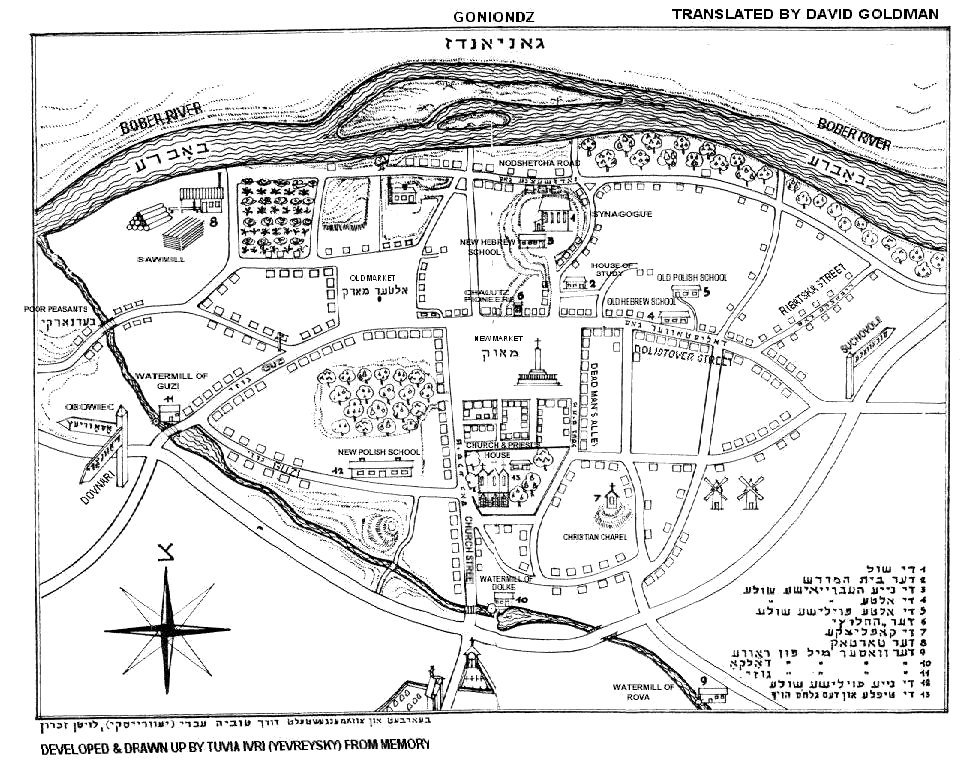
| Map of the surrounding area | |
|
|
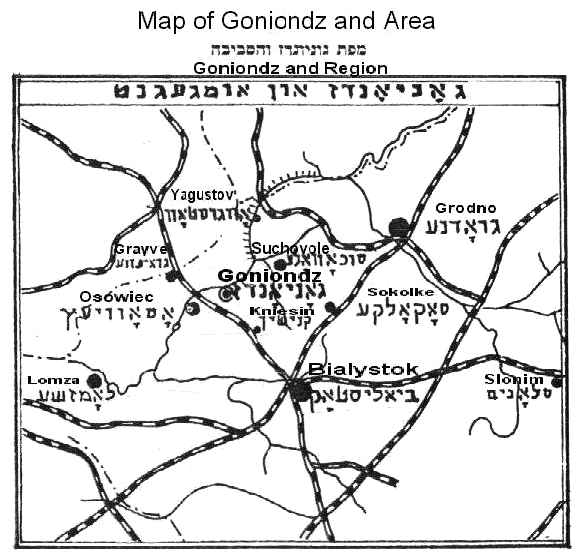
| Map of the surrounding area | |
Translated from Yiddish by Shayna Kravetz
| “If only my words were written down, |
| if only they were inscribed in a book!” |
| Job 19:23 |
The dreadful Jewish destruction in Europe during World War II - a destruction unparalleled in history for its extent and cruelty - has led to the growth of a large “literature of destruction”. Many monographs and memorial books about the greater and lesser Jewish communities destroyed in Europe have emerged and continue to emerge through special publications (such as “Cities and Ancestors of Israel”, “Encyclopedia of the Exiled”, etc.) and mainly through towndwellers' groups.
Our literature of destruction brings with it a terrible and anguished portrait of a giant cemetery filled with large and small tombstones, each with its own individual renowned name and personality, and with its local description of a rich Jewish life and its terrifying and tragic loss.
A memorial made of stone will be eroded and lost in the stream of time but a spiritual remembrance in the form of a book persists through the generations.
With our memorial book, we will perpetuate our beloved and dear town Goniondz, adding a chapter to the huge, bloody tale of the last Jewish destruction.
The four sections of the memorial book reflect the social and spiritual lives of our hometown in the last generations, although only in a limited way for, to our sorrow, we lack materials, documents, and comments from many interesting areas in old Goniondz life.
Like all Jewish cities and towns, Goniondz had its ups and downs, constructions and fires, good and beautiful achievements in unity and brotherhood as well as disputes and quarrels.
Goniondz contributed accomplished personalities in various areas with honoured names in the Jewish world, even including interesting folk-types. It was a lively town with virtues and flaws, greatness and smallness, storm and tranquillity, light and shadow like life itself.
From the dark region of its perishing there still beam out its beautiful, good, honest, and shining facets, pure and holy.
With bowed heads and deep sorrow, we establish through our memorial book a spiritual remembrance for our unforgettable destroyed hometown.
M.S. Ben-Meir (of blessed memory)
|
|
JewishGen, Inc. makes no representations regarding the accuracy of
the translation. The reader may wish to refer to the original material
for verification.
JewishGen is not responsible for inaccuracies or omissions in the original work and cannot rewrite or edit the text to correct inaccuracies and/or omissions.
Our mission is to produce a translation of the original work and we cannot verify the accuracy of statements or alter facts cited.
 Goniadz, Poland
 Yizkor Book Project
 JewishGen Home Page
Copyright © 1999-2024 by JewishGen, Inc.
Updated 14 Mar 2014 by LA