 |
|
|
[Page 431 - Hebrew] [Pages 437-442 - Yiddish]
by Pinchas Mann
Translated from Hebrew by Ala Gamulka
| If you wish to find information about a scholarly or philanthropic Jew from Yedinitz, there is no problem. If you want to be told about an excellent teacher or educator of the generation, it will be done happily. If the topic is a generous woman, a Yiddishe Momme, you will get details as if the events happened yesterday, or even if it happened much earlier. It sometimes seems to you as if the number of scholars, philanthropists, wise and generous people about whom there were many told stories was greater than the actual total number was. |
However, unexpected difficulties and insurmountable obstacles came in my way when I heard that in our town there were also thieves in the early days. These were not ordinary thieves that would have embarrassed us, but highly professional ones with an outstanding sense of organization. They were imaginative, and their character was nothing to be ashamed of, not even when compared to their colleagues in the big cities. For some reason, their tracks have been hidden. Even if they are spoken about, it is in whispers and with reservation. It is as if we had a bastard in the family, or a fear their dossiers would be reopened after 80-90 years. It is as if even though they have long been gone, they would, God forbid, suddenly reappear, and call on us to be their heirs.
Truthfully, I must admit, I do not understand why our town elders are embarrassed by this group. They remember them from their childhood and from their parents' stories. It seems to me that those who lived in the same generation should be grateful that they enlivened the monotonous and boring life of our forlorn village. They excited the imagination and spurned routine.
[Page 432]
In reality, their deeds were transgressions against the Ten Commandments. However, if our Bible describes what our forefathers and previous generations had done, not always perfectly, then who are we to hide them from future generations. Our village was very “human” and pure, like a blue Tallit.
After preparing ourselves and struggling with “ideology,” let us tell the story itself. There are different versions, of course. It was about quite a band of people, about 25-40 in all. My ears managed to catch a few names, but they will not be published here. It is possible that their grandchild or great-grandchild has reached today an honorable position in North or South America. It can even be said that one of those is now an important member of “The Association of Former Residents of Yedinitz” in any of those countries.
The head of this group was a scholarly Jew with a beautiful beard who spent his days learning Torah and his nights riding horses and robbing. The major occupation of this group was the theft of horses and cattle from wealthy estate owners and their Jewish lessees.
When they stole cows or horses from the barns, it was unnecessary to see it as a loss, as long as the authorities were not involved. As Jews, they detested all informers. If the authorities were to be contacted, the loss would be redeemed only in a dream. They had their own system of returning lost items. It was a system steeped in Jewish tradition and appropriate for the scholarly Jew who was at the head. The gang was connected to a few “spokesmen” who were not thieves themselves but knew how to guess. After a long procedure, when one who had a loss came to one of the “psychics” with an appropriate amount of money, the “clairvoyant” would be inspired. His face would show the spirit of this vision as he peered into the distance. Finally, he visualized the sought-after horses as they stood tied in the distant forest, tens of kilometers away.
[Page 433]
It was not an empty vision.
In the years to come, the members of this band developed an “import” cattle business from across the Prut River. Once they became importers, they stopped bothering the locals. The price of meat was lower, and that band's business was thriving. This situation would have continued for many years if not for the night of fear. A cavalry unit attacked our village. No one knew anything about them. People were truly petrified. It then became known that the authorities had a specific list with names of members of the band and that they intended to eliminate them once and for all. The catastrophe took place when they were trying to transport a herd of cattle across the Prut River. It was their misfortune to run into the Romanian border patrol guards. They could transport the herd across the river, but some border guards were injured. This caused a direct appeal from the Romanian government to the Russian authorities in Moscow. As a result, the authorities, who had known about the band for some time, agreed to eliminate it.
Some members of the band managed to escape overseas, but the others who remained were sent to Siberia. Since then, and for many years, there were no new professionals of that caliber.
Polishtchuk, the thief
In the late 1920s, Polishtchuk the thief appeared in our town and in the villages nearby. He soon became famous in faraway places with his daring, conniving, and ability to evade the authorities. He looked at them with contempt. Polishtchuk was not one of ours. He was born in one suburb of our town, where his family had lived there for many years. He spread terror in our town and nearby. His shadow fell on the town for some years and kept many residents from sleeping. Perl Goldberg, z”l, whose family was one of the wealthiest in town, confessed that one reason that forced her to leave our town and move to Kishinev was the fear of Polishtchuk.
There are many stories about the burglaries of Polishtchuk. Some are probably just fables and we will not overdo them in the telling. We will speak of the famous story about the robbery in the house of the pharmacist Avraham Bronstein. It happened early evening when about ten townspeople were sitting in Bronstein's house. Suddenly, a broad-shouldered man appeared at the back door. He had piercing eyes and a black beard and held a pistol in his hand. In a quiet and deep voice, he said, “I am Polishtchuk, and I am asking everyone here to not move from their place.” Those who were there, in Bronstein's house, emphasize that there was something “pleasant” in the behavior of Polishtchuk. He robbed his victims in a “gentlemanly” manner. This was in spite of the fact that they were all in shock when they discovered they had the “honor” to meet Polishtchuk face to face. They even added that during the time he was “working,” they were a bit scared. The event continued until it reached the point where Monia Shteinbortz expressed that the money on him was not really his. To everyone's surprise, Polishtchuk returned the money. When the robbery was finished, the thief ordered that no one should leave the house for the next half hour.
[Page 434]
When he saw there was a telephone in the next room, he suspected that someone had enough facts to tell the authorities about what happened. And indeed, he was not wrong. He did not lose his coolness and crossed to the other side of the street. He entered the house of a man who lived directly across the street from the pharmacy, presented himself to the man and his wife, and asked them to prepare a bed for him to spend the night. He assumed no one would search precisely for Polishtchuk in this man's house.
A few years later, when his reputation preceded him, Polishtchuk stopped working on the roads and visiting homes. He began to conduct his business with “correspondence.” He knew the income of every Jew better than the income tax department. When a Jew received a letter from him instructing to transfer a certain amount (tens of thousands of Lei?) to the account of Polishtchuk, it was not done simply due to arbitrariness. The instructions were based on detailed accounts of each person's business and his income.
As any honorable businessman in town did, Polishtchuk had agents. It was possible to enter into discussions with them to complete the matter.
When Alter Fuchs was over 90 years old (died in 1968 in Tel Aviv), he narrated with unusual excitement as if it were yesterday about a letter he had received from Polishtchuk. In it, he is asked to “donate” a hundred thousand Lei. Despite the fear and danger in refusing, Polishtchuk was unable to get the money easily from Alter Fuchs. He remembers the tiring give and take of the discussions with Aharon, the wagon driver, who was one of the “agents” of Polishtchuk in town.
Aharon was a cheerful man, an honest wagon driver. He probably made a connection with Polishtchuk as he traveled with his horse and wagon in the surrounding villages in order to earn a living. He did not abandon his horse and wagon, even when his income from this “hobby” brought in more than his regular job. He went daily on his usual route. He allowed himself to print business cards. Only lawyers were using them at that time. On the business card, he invited the public to travel in his vehicle. It signed: Aharon “intelligent driver.”
Indeed, the townsfolk preferred to travel the roads in nearby forests in Aharon's wagon, although they doubted his intelligence.
Alter Fuchs made a deal with Aharon to pay half of the amount demanded by Polishtchuk, 50.000 Lei. This is the equivalent of the salary of a bank manager in those days. When the amount was paid, Alter Fuchs was given a security certificate. It allowed him to leave his doors unlocked at night and no one would dare to bother him.
It was also said of Polishtchuk that he never killed anyone and that even helped the needy with funds he had obtained. This helped him to elude the authorities when he was in danger. However, his chief assistant, Boda, knew how to murder in cold blood.
The end of their lives for both was similar. Both were executed by shooting, without a trial, after they were caught asleep in the forest. An informant denounced them.
“Nir-Am” Settlement
[Pages 437-440]
by Natanel Shachar
Translated from the Yiddish by Pamela Russ
Just as the future, even the near future, appears unknown in our eyes, to the contrary, we remember events from the distant past just as if they have occurred yesterday. The events and images of our childhood embed themselves so deeply into our memories that all the twists of time remain as if they had occurred just passed. You think that even though half a yovel has passed since then; it seems as if you could still go out onto the street and meet those faces from long ago…
[Page 442]
Zalmale “Gives the Station”
I remember my town, its half-caved-in small houses, the straight streets, and the twisted back streets covered with runny and sticky mud for six to seven months a year. During the season of the mud, particularly in the long fall, the town would be practically cut off from the rest of the world, especially because the nearest train station was 20 kilometers away.
[Page 443]
And if you wanted to come to this station to use the train to get to one of the larger cities especially in the muddy season, then you would have to get up at dawn, with the stars, and put on heavy clothes which you prepared the day before, and that was no small task. In Yedinitz you did not go out of your house; you did not get into a car and go. In the muddy season if you wanted to arrive with non-frozen limbs there was no other choice than to wrap yourself in all kinds of heavy clothing, crawl into a huge fur coat that would completely envelop you and leave only your eyes exposed so that you can sense the outside, because anyway, during these hours, you did not see anything. At that time, there were no electric lights in the streets. Also, no lanterns were lighting up the roads.
The main part of these clothes was, without a doubt, the big boots that had to hold your feet that were already wrapped up. But if you wrapped your feet too heavily so that they should be warm, you faced a difficult battle until you finally could stuff your feet into these boots. And that is how your feet held up your wrapped up body until you reached the “paiton” that Zalmeleh, the wagon driver, rode with the three “eagles” harnessed to it.
Zalmaleh was of small build, and most of his fingers on both hands were missing. But he had a sharp tongue, and from time to time, he would throw out sharp jokes and speak badly about the entire town. His face would shine with joy when he would toss around sharp words or berate one of the town's prestigious people, but he knew his wagon driver's skills well and he held the reins of his “eagles” strongly in his strong hands.
The train station was in Rishnitz. The train would pass through there once per day in each direction, at around four p.m..
The first question that Zalmeleh was asked, understandably, was, “Will we get to the train on time?” He would scratch his bald head and reply:
“If you ask that, then you do not know Zalmaleh! I can assure you that I will deliver you to the station on time…”
The passengers of the “paiton” really enjoyed this wisdom, and truthfully, he would often “deliver you to the station” as the train was really just about flying by under your nose, leaving behind thick smoke.
[Page 444]
Sometimes you could even hear the long whistle of the locomotive, a sign that you were not too late at all…
Zalmaleh would even pour salt on your wounds with these actual words:
“I promised to get you to the station, and here you are in front of it in one piece!”
There was no choice but to wait for the next train, often for 24 hours…
Garfinkel's Hall
On the “Post Office” street of my city, there was a tall building, with long, empty walls, without windows. The building was gray and dull. On the side was a wide entrance with simple doors. You could have thought it was a “warehouse” or a garbage dump. The building had no name, so it was called by the name of its owner, “Garfinkel's Hall.” Irrelevant to say today, but during this time the ownership went to five or six other hands, but the “historical” name remained.
When the doors to the hall opened you could see the long rows of benches that stretched to the edge of the stage. The floor of the hall was made of boards that were never changed and it was worn out from age and full of holes. More than once, because of that, your foot was sprained.
At the back of the hall, the floor was raised to about 20 centimeters, and this made up for the “gallery.” There were no benches there, and the tickets for the gallery were “standing only,” sold according to capacity. So, they were never short of tickets. It's easy to imagine what happened in the gallery when we heard the third “bell,” the lights went out and the curtain was raised: pushing, screaming, panicked running, and even some physical fights. If you think that it was all, then you are wrong.
Elyosha the Electricity Technician
Do you remember Shpeier's electricity station in Yedinitz? It would provide electricity to the entire town and to Garfinkel's Hall. At midnight, the electricity would go off.
[Page 445]
And not simply that. At a quarter to twelve, there was a signal, and the entire town knew that in about a quarter of an hour the town would go dark. Woe to the person who just at that time fell into the mud with short boots …
It was not only the theater audience that knew the taste of the darkness but also the troupes who were “performing” in the Hall. They had to prepare “luxury lamps” in case they needed them.
But it often happened that just in the middle of a performance, at the height of the piece, suddenly it became dark in your eyes – it was a short circuit. And that is when things began to happen. People went to get Elyosha, the electricity technician, who had the monopoly on electricity issues in town. He was a middle-aged Christian man who loved the bitter drops and spent most of his time in the taverns. Woe to the person who tried to fix the electricity himself. He was active in town, knew everyone, and spoke Yiddish like a Jew. But a Christian remains a Christian, and no one dared to enter to his territory. You did not meet him often, but when you did, he was drunk. When he used to come to our place, he would take a glass or two of something before he would start to work on the short circuit. Because of that, we had to end the performance with the light of the lamps. It was not so good, but Yedinitz enjoyed the theater performances (others write about Elyosha's sad role in the years of death – ed.).
The Water Porters
Hamsin, the type of heats like those in Israel did not happen in Yedinitz, but the summers there were really warm. I remember one hot summer day, there was no more water in the barrels of the homes. The water porters used to fill these barrels because there was no water pipe system in town. Every water porter had a huge barrel on a wagon to which two huge burly horses were harnessed. Water used to be drawn from wells outside of the city. Each water porter had his regular customers, and for 50 lei a month, he would fill the barrels in each home.
[Page 446]
Every day, a “few” wooden water pails would be filled with fresh water to “revive the soul.” There was a hole in the barrel that was plugged up with a wooden plug or balls of lint. You pulled out the plug and the balls of lint from the pails, and they would fill up by the streaming of the water.
Woe to the homemaker who fought with her water porter. She and her family were set for thirst. The water porters were organized even though they did not have a professional union. Because of that, you could not switch from one water carrier to another.
In general, an argument would end with a fine drink of whiskey and some delicious food.
But on one hot day, the city was left without a drop of water – without a why or when. But the reason was soon explained, when suddenly, you heard a smack in the middle of the day, a bell ringing, and the sound of galloping horses … A long line of water porters with barrels and wagons was moving across the Post Office Street…
The horses were all decorated, the stoppers of the barrels were pulled out, and the water was pouring down the street. All the while, the water porters were singing cheerfully.
Only after an inquiry did we find out what was going on. An argument had broken out between a water porter family from Yedinitz and a family from the nearby city of Briceni. The water porters got into their wagons and went to Briceni to back up the family of Yedinitz, whose pride was severely weakened, and to teach the enemy a lesson.
These are the crumbs … crumbs of life in my town. Often, I have a strong yearning for that rich Jewish town with active, beautiful youth movements, Hebrew schools, people speaking Hebrew, and from where hundreds of pioneers made Aliyah to Israel.
During the great cataclysm, the majority of Jews were killed. May their memory never leave us, those who survived, and may we give over the memory of the town to our own children.
Netanya
Translator's footnotes:
[Page 447]
by Golda Gutman-Krimmer
Excerpted from the book, Yedinitz, My Home, Buenos Aires, 1946
Translated from the Yiddish by Asher Szmulewicz
Donated by Ed Berkowitz in memory of his Grandparents, Rivke and Itzek Berkowitz,
both were born in Yedinitz in 1872, married in Yedinitz, and died in New York
The cold weather had already gone away and in the street, there was hard, sticky, and gray mud. Fat Jewish women ran around from house to house with strings around their cotton winter jackets, selling fat geese skins (shmaltz) and the veins of the skinned geese. In the market, teacher assistants were selling red wooden noisemakers for Purim. The sun was bright and warm. The town was preparing for Passover. People were scraping the old paint off the walls in their houses and polishing the brass and copper. Our most beautiful and happiest holiday was Passover.
[Page 448]
Passover Eve
And it is already here, the day of Passover Eve. The sun outside already smells like the beginning of Passover. The tight curtains on the windows and the flowery carpet on the waxed floor also smell like Passover. The silk napkins spread out on the table and the sofa stuffed with the chairs tightly covered with white paint crumpled under slipcovers. The small side table is covered with glassware. From the kitchen comes the Passover smell, of flat potato rolls and hot semolina. The Passover tableware is already unpacked and stands in the wall cupboard. My little glass is over there, a small one, a blue one. I want to touch it. My three little plates with narrow golden rims are looking at me from the cupboard. They are longing for me. The whole year they are stored in the attic, forgotten.
[Page 449]
I climbed sometimes to the attic to smell them in the corner of the Passover tableware and now, it is standing and waits for me.
Above the roofs, the sun stands like a red-hot piece of copper. Jews are clean from top to bottom and run from the bathhouse to their homes. The dirty laundry full of leavened breadcrumbs under their arms is now clean, and they smell festive. The gates and the iron curtains of the stores are already closed. It is late and poor women carry home from the market some garlic and a pound of inexpensively priced fish for the Seder.
[Page 450]
The Seder
There is already a place to lean on the stuffed sofa (you need to lean on the left side to drink the four cups of wine on Passover). The lamp in the corner flashes on the white table with the tall silver candlesticks. There is a glow in my mother's eyes, a silent one, who frightens me like our calm shtetl river. Quietly, the mother sits us down on the small benches around the table. Quietly, she hands our father a sky white linen robe (kittel) with a yarmulke and a new Haggadah.
[Page 451]
With the white linen robe and the yarmulke on his head, my father is more handsome, more important, and quieter. My mother sits by his side with a new robe, which suits her calm, sad face.
The painted lamp which stands in a corner under the door releases a fear. It is so cold and black. It is a big mismatch with the festive whiteness!
“Pour out your wrath...” (extract of the Pesach Haggadah). My father starts reading the Haggadah, and in the room, there is a profound and severe silence. Everybody looks at the open door. I look at the glass of wine prepared for the prophet Eliyahu. I cannot see that we can refuse him something.
[Page 452]
How can a prophet drink so many glasses of wine from so many Seders in half an hour? How does he come so punctually to all Jewish Seders? And other similar questions come to my mind.
Shabbat eve
On Friday evenings, Jews with perfumed beards run from the bath, women run back home with bags full of fruits for Shabbat, including fried fruit pits. Hair washed and dressed up, young women are already strolling in the streets with conical paper bags full of fruit pits. A white half-moon looks down from the sky shining above the hill. The moon arose early, appearing, looking around how the Jews receive the Shabbat in Yedinitz. And now, a tall Jew screams at the top of his lungs: “Jews go to the synagogue!”
[Page 447]
by Golda Gutman-Krimmer
Translated from the Yiddish by Ala Gamulka
Donated by Allan Ira Bass in memory of his Aunt Anna (aka - Ecu/Genia) Roitman,
her husband Israel (Sol) Goldenberg and their two sons, Nuchem and Avram.
Already quite early, a crowd of poor people, wearing torn shoes, red and brown kerchiefs around their necks, stood around the porch. Filthy shirts stuck out from the encrusted skirts or hairy chests.
“Give something to the poor,” they stretched their hands to Yoske and Rayzl, the bride's parents. “Give us some clothing, we're naked and barefoot.”
Maids had lit large fires on bricks in the courtyard and were placing big, strange things on them. The soups and fish were cooking for the wedding supper.
Bayle, the seamstress, had laid the ironed clothes on the bed and, smiling, called Sorke, “Bride, time to get dressed. It's already three o'clock!”
[Page 448]
On the birch walls of the wooden hut hung black flowered rugs, with green and red roses around the crowded framework, clashing with the deep redness of the braided chains of roses hanging from the ceiling, decorating the walls around the room. In an elevated place, next to the dais, was a little table with a big, silver candlestick in which special wax candles burned, where the bride was seated among bundles of flowers.
Sholom, the joker, a tall, dried up little Jew, lively as quicksilver, with a long neck and a dancing Adam's apple in the very center, with a ragged, thin, little beard, gave counsel to the in-laws, waving his hands.
[Page 449]
“In honor of the father of the bride, Reb Yoske, may his days be long, let a fine 'Mazel Tov' be played!”
Old Jewish men and women, young women in the middle, girls and boys, hands on each other's shoulders, heads raised, danced a Bulgarish hora, weaving and stomping their feet on the trodden grass.
“Sholom, a Rusaka dance!” cried a broad-shouldered Bessarabian, already holding his hands in the air, stomping his feet on the ground, making the walls tremble.
Sholom, an expert at taking money, performed for each of the in-laws separately, old, and young, big and small. It spread about the walls, the courtyard, street trembled with the pounding of feet and the clapping of hands.
- Back from the wedding ceremony-
Yoske walked around among the tables and helped serve the food: roasted and cooked fish, roasted turkey, soup with mandlen, compote and fruit. Klezmer musicians played one freylekhs after another. People clapped and got up from their places.
Stingotsh, whom they had brought to play at the wedding supper, drew his long, bony, trembling fingers over the strings of his fiddle and various melodies were heard.
“Play, Stingotshele, a Jewish piece, a blessing on your gentile head!”
And Stingotsh closed his dark eyes and sounds of weeping, of hatred and bitterness, of pleading and humility, of pain and assurance, bewitched the hall with a deep silence.
[Page 450]
When he opened his closed, dewy eyes, they were greeted by teary Jewish faces. Stingotsh straightened himself up and began to play a soothing song, calm, as after a storm, and the melody became brighter, more comfortable, as though he were God's witness who led them over the quiet waters to still, green fields. The audience began to sigh, “God-given [his musical talent].”
Sholom the Joker stood on a bench in the middle of the room, his head back, swinging his thin neck even more with the excess bit of alcohol that he had drunk, and tried to amuse and awaken the guests.
“Men, women, in-laws on the bride's side—announce your gifts!”
“The bride's parents, may they live long, give five years of support and a half a house,” Sholom cried to everyone.
Sholom threw his head back on all sides, looking for the main in-laws.
“Announce the gifts! Reb Alter, the furrier, and his wife Khantshe, may their days be long, give a thousand Lei. Reb Moishe Oyfer and his wife and six little children, may they be healthy, five hundred Lei!”
In the blue dawn, that in its coolness, dewed under thin gusts of wind like a blue enamel, the sounds of music carried over the quiet streets, accompanying the tired parents, father and mother, and the young dreamy pair, home.
by Golda Gutman-Krimmer
Translated from the Yiddish by Pamela Russ
It is already the middle of winter. The streets are covered with a bluish whiteness, hard as steel. Hard, rocky hills of snow surround the houses reaching the edge of the windows. A sharp winter sun shines on the frosted windowpanes of the closed doors and windows.
In town, rumors are spreading about the blood libel of Mendel Beilis and the trial that is happening in Kiev.
The young bakers who worked with Hersh Czernopoi are not singing as they usually do. They are talking, arguing, and pounding with their fists on the bagel tables that are laying on the trough:
“Beilis must be set free! The truth will come out! The world is not undisciplined!”Zechariah reads to the workers from the Russian newspaper “Odeskye Novosti.”
The village Jews and leaders from the surrounding villages are moaning and whining more than the people in the larger city. With fatigue in their drawn faces, and with a heavy gait, an unsure one, they are being discreet, hiding themselves from the Christians.
Every day, they ask what is written up in the Odeskye Novosti about the trial and the chances of Beilis being freed. Everywhere you go you hear the song of Beilis:
| Twelve o'clock at night, A ruckus is heard in the street. They created a libel around Beilis, He himself knows not why. Twelve o'clock at night, Beilis hears a banging on the door: |
[Page 452]
|
- Beilis, open the door, Because you are under arrest! … As soon as he heard these words, He called out with great surprise: - I beg you to allow me To say goodbye to my wife and children! The complaint commission is silent, Ignoring Beilis' plea, They drag him out of his house, Beilis goes with them to the prison. When they put Beilis into prison, The guard says to him with a smile: - Beilis, take off your clothes, And out in your uniform for hanging!... They tortured and beat Beilis, Blood ran from the wounds. A Russian smiles into his face And says: “When Jews do this, it's good!... He suffered there for a long time, Never saw his wife and children, He never asked for mercy, Always remained silent, like a dead stone! |
The song continues to narrate about the trial and how Beilis went to the Holy Land and lived, may no Evil Eye be him, in wealth and honor…
A final report in the Odeska Novosti, in the archives alone will defend Beilis. “Certainly,” all will agree, “Beilis must be freed. The truth will be evident, as oil on water.”
Buenos Aires
by Moshe Furman
Translated from the Yiddish by Pamela Russ
In the years 1890-1910, there was a Jew in Yedinitz by the name of Chaikel Melamed, z”l, who was called “Chaikel with the stilt,” because he did not have a foot and walked with a stilt. Sadly, he was a very poor man.
It was the time of the Russian-Japanese War, and there were slaughters taking place around Port Arthur. Since he could not pronounce the words Port Arthur, Chaikel Melamed would ask: “What is going on in that place?” In that way, he was also able to ask you for some cigar or some snuff tobacco.
There was a Jew in town who came from Lithuania, he was called the Zhvilner melamed [teacher] from Zhvil, z”l. He was very tall, and he had a huge hernia, almost reaching the top floor [of the steam baths]. On Fridays, he could be seen in the bathhouse, in the sauna. His hernia was a thing unto itself. In financial conversations, you could often hear one person saying to another: “I can give you the Zhvilner's hernia.”
There was a man in town by the name of Chaim Goloshke, z”l. He would collect donations every week. In a year that Purim happened on a Friday, he would come to the Dayan Reb Shmulik'el, of blessed memory, and he asked the Dayan to delay Purim until Sunday, first because on Fridays he collected donations, and second, because Friday was too short a day to collect sufficient Purim contributions. A Friday Purim was a serious factor for him.
There was a Jew in Yedinitz by the name of Moshe Ozis-Schnitkovski M, z”l,. For a living, he produced honey, wax, and whiskey, that were called “Meid.” Before Passover, he would hang up signs on the buildings, with these words: “At Moshe Ozis' we are selling Meid that is Kosher for Passover.”
At that time, there was a fine young man who added the final “nun” to the word “Meid” changing it to “Mieden” [“young women”], so that the sign now read: “At Moshe Ozis' we are selling young women that are Kosher for Passover.” There was a great tumult over this, a disgrace of G-d's name, but they could not tear down the signs because by the time they noticed them it was already Yom Tov.
[Page 454]
There were a few wealthy, comfortable families in Yedinitz, where peace in the home was absent. People would say that these families were being blackened by wealth and honor.
There was a Jew, Dovid Hershkovitz, z”l. He had a grocery store. He once said that before you open a store among Jews, you first have to remove your gall.
He later became a Hebrew teacher and left for America, around 1910.
A well-known resident, Chaim Rabinovitch, z”l, used to say, that if one would know the taste of a second wife, then one would understand the importance of keeping the first.
His father used to say that a Jew needs three wives: one for doing the shopping, the second for housekeeping, and the third as an actual wife…
There were wine sellers who said that you can also make wine out of wine grapes … and that there were times when they used to pour water into the wine. These last times they used to pour wine into the water…
There was a Jew by the name of Yisroel Szapoznik. On Fridays, he would carry home a huge fish, weighing three “okes” [total of nine pounds]. People asked him: “What is this for?” He replied, “We are really two people, me and my wife.”
There was a Jew named Yisroel Leib Loibman (Zaikaner), z”l. His livelihood was that he lent money and charged interest. If the person would return the money a few days before the designated time, he never lend this person any more money because, as he said, “this type of person will soon go broke, so he is preparing his money in advance, and meanwhile he has to pay interest.”
There was a Jew who used to lend money with interest, Avraham Dovid the deaf man, z”l.
[Page 455]
Once, his wife came in from the street to see him and she said: “Avraham Dovid'el, so-and-so of your debtors has tricked you.” Avraham Dovid the deaf man replied: “Give me some food.”
There was a Jew, Yosef Leizer, the redhead, z”l,. He considered himself a real lawyer who used to write petitions, but if someone came and asked him to read something, he would say: “I know how to write but I do not know how to read.”
Mayer Szapoznik, z”l,, was someone who made things happy. He made everyone laugh, even in the most difficult times.
Once, a wagon and two horses ran him over. People ran over to drag him out from under the wheels. Although he was so hurt, he said to the crowd of people: “Why are you all rushing? Are you afraid that the same thing will happen to me again tomorrow?”
When women would be carrying the newly bought dishes for Passover, Mayer would wish them “mazel and blessings,” and to the dishes, he would say: “From one of you, let there be three, four…”
[Page 456]
On the eve of Tisha b'Av, the women had a tradition of throwing garlic onto the grave-sites. One woman asked her neighbor not to throw garlic on her mother's grave, G-d forbid, because she died hoarse and with a cold.
One would break the fast on Tisha b'Av by eating dairy foods. It happened that a man had journeyed for several months. His wife was upset that she could not prepare the dairy foods for her husband to enjoy after the fast ended. But she quickly comforted herself, saying: “I will make him a Tisha b'Av even on the day of Simchas Torah.”
My grandfather Reb Mordechai Nissen Rappaport, z”l, was well known as an exorcist. Once a woman came to see him, but he was not at home. She then asked my grandmother, Bubbe Raize Leah, may she rest in peace, that she should make sure that my grandfather would exorcise … and then she gave over the name for the sick person. But my grandmother forgot about this whole thing. The following day, the woman came to thank my grandmother: “May you live a long life! The exorcism took away the sickness as if with its own hand!”
|
|
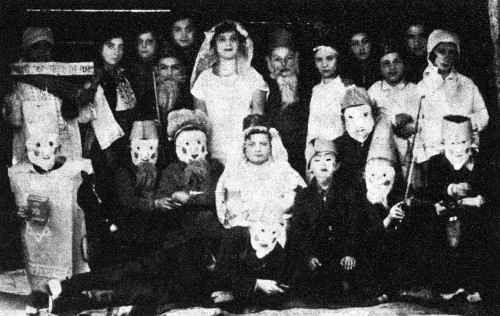
| Purim Party in the school of the teacher Dobrov, 1934-35 |
By Moshe Furman
Translated from the Yiddish by Pamela Russ
Every Jew had a family name. But aside from that, almost everyone also had a “nickname.” The nicknames must be divided into four groups:
1. According to the family roots:
They called Jews according to their father's name, their mother's name, or father-in-law's name. Women used their husbands' names. Understandably, we will not go through all the names in the list. We limit ourselves with examples only.
Hersh Kassils… the Yuchenke … Moshe the Dudlech'es… Moshke - Moshe Yontel's … Yankel Chaim-Aaron's …
[Page 456]
2. According to the prior place of residence:
The one from Odessa … the tailor from Briceni … the one from Terebin … Shmuel Druckzer … Chaim from Rissen … Yankel from the bridge … Zalman from the marketplace.
3. According to vocation:
Yoel Tzukernik [confectioner]… Itzik Chadacznik ( the merchant)… Zagotowszczyk [farmer] (Yakov, Michel, Moshe)… Berl Rimer [harnass maker]… Itzik Blecher [tinsmith]… Shuster [shoemaker]… Shneider [tailor]… Farber [dyer]… Mottel Klezmer [musician]… Moshe Bodner [cooper]… Shlosser or Shliesser [locksmith]… Stoler [carpenter]… Sklodnik [warehouse owner]… Beker [baker]… Alte the baker [female]… Avraham with the bagels… Shinder [makes skins]… Katzev [butcher]…Tzelniker [notions seller]… Hersh Zaifenmacher [soap maker]… Zitzer [male salesman], Zitzerin [female salesperson]… Hersh Shloime Kalekhnik [coal maker]… Hersh Sotzki [rural police]… Koimenkerer [chimneysweep]… the Limenik [lemonade maker]… Meyer Goldschmidt [goldsmith]… Yankel of the wood… Sherer [barber]… Tzirulnik [jeweler]… Chaike the wigmaker… Chantze the Serverin [waitress]… Yankel Primar … Beky the Akusherke [midwife]… Hodya the matchmaker… Ida the writer… from the study hall… Yankel from the bench (before that: military)…
[Page 457]
… the storage… Chaike the Tepperin [potter]… Ida the Tukerin [administering women's ablusiotn]… Shmuel the Bagreber [burier]… Shmuel the Beder [bather, male]… the Beder [bather, female]… Balagule [wagon driver]… Izvoszczik [coachman]… Dovidel from the mill… Shimon Gazetczik (or: of the “pages”)… Shindelmacher [shingler]… Vasser firer [water porter]… Chaike the Beloshvaike [seamstress]… Shmuel the mohel, Laike Borscht [made beet soup]… Pesye of the teas… the Kurelapniczke [short-footed woman]…
4. Witty, humorous, or ridiculing nicknames:
These nicknames were not always teasing, but they always had some humor and truth to them. We will provide the nicknames without giving the names of those who actually bore those names:
The Gepeigerte [the dead]… Hak [ax]… Bulvan [blockhead]… Boksman [taking care of boxes]… Gornisht [nothing]… Goy [Christian]… Manolies… Varnetchke [fritters]… Kishke [intestine, generally cooked]… Parech [steam]… Malai [mess]… Hun [chicken]… the Shvartze [the black one]… the Geileh [the yellow one]… the Roite [the red one]… the Roiter [male, the red one]… Khruszcz [bug]… Loksh [noodle]… Knish… Bord [beard]… Smitia [smitty]… Beznos [noseless]… with the Bek [cheeks] … Gralnik [heater]… the Heizeriker [the hoarse one], the Langer [tall one]… the Kortzer [short one]… Czarnepucha [nightmare]… the Krumer [crooked one], the Blinder [blind one]… the Shtimmer [mute]… the Rebczyk [the teacher]… Shvitzer [the one who sweats], Mamzer [bastard], Prake [pants]…, Karnos [snub-nose]… Terk [Turk]… Zavereche [storm]… the Meshugener [crazy person]… with the Gatyes [underwear]… Tyombe… Katorzhan [criminal]… the Freilecher [happy one]… with the Talis [prayer shawl]… the Gruber [fat one]… Pardon [pardon]… Barabutz [goring ram]… with the Meizel [small mouse]…
[Page 458]
(There was also the nickname “Nizke,” [a pain, annoying person] which we will not mention.)
Finally, a “wise saying” of Zalman the wagon driver, who was also called “Parech” [steam] and “Shmeisser” [beater]. Once he had three passengers in his wagon: Moshe Hun [chicken], Fishel Malai [mess, poison], and Avraham the Gebeigerte [dead]. So, he said: “Listen here, Jews, a chicken ate a mess, and he died.” …
Described by: Chaya Chiruti
(in Yedinitz: Chaike Hersh Kassils Rosenberg).
Moshav Cheirut
M. Furman
Fonyes [Russians]; Chazir [pig]; Borscht [beet soup]; Kostaki [cross-eyed]; Hikevate [hunchback]; Chvok [nail]; the Griner [green one]; Stroyan [disabled]; Galan [gallant]; Odesser [from Odessa]; the Roiter [red one]; the Tzigayner [gypsy]; Chatzi meis [half dead]; Eisov [Esau]; Blinder [blind one]; Ganef [thief]; Leikech [cake]; Langer [tall one]; Kapusta [cabbage]; Beider [bathers]; Beis Hakvuros Yid [cemetery Jew]; Hekdesh Yid [poorhouse Jew]; Eiruv Macher [sets up conditions “eiruv” for being allowed to carry on Shabbath]; Kiddush Macher [recites the kiddush on Shabbat]; Titin Shneider [tobacco cutter]; Borscht Ferkoifer [beet juice seller]; Mamzer [bastard]; Kafengis [coffee pourer]; Moshe Moss [size]; Cheirutz [diligent; Gezunter [healthy one]; Gibbor [strong one].
|
|
JewishGen, Inc. makes no representations regarding the accuracy of
the translation. The reader may wish to refer to the original material
for verification.
JewishGen is not responsible for inaccuracies or omissions in the original work and cannot rewrite or edit the text to correct inaccuracies and/or omissions.
Our mission is to produce a translation of the original work and we cannot verify the accuracy of statements or alter facts cited.
 Edineţ, Moldova
 Yizkor Book Project
 JewishGen Home Page
Copyright © 1999-2024 by JewishGen, Inc.
Updated 16 Sep 2022 by LA