|
[Page 122]
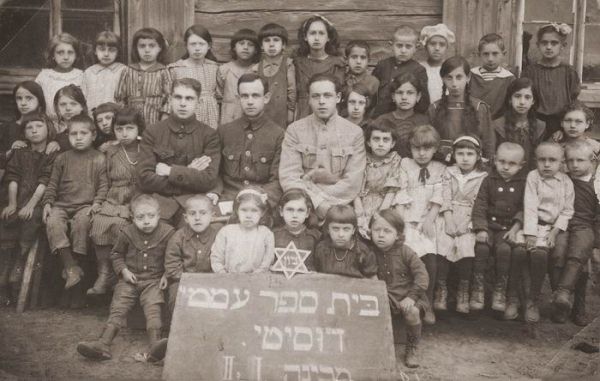
Before WWI there was a Russian elementary school in Dusiat (Narodnoya Utchilishtsa), attended by only a small minority of the Jewish children. After the war there were immeasurable cultural changes in the shtetl. The Balfour Declaration filled our hearts with new national hope.
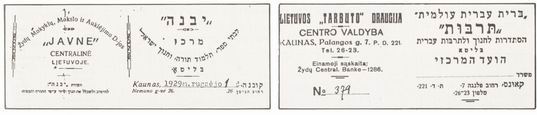
Yosef Yavnai: The young people organized a party to celebrate the Balfour Declaration. I remember suggesting to my friends that we change the words in the Jewish national anthem Hatikva, which state Our hope is not lost to Our hope has been realized, but my friend Yona Berman calmed me down and said to me in Yiddish: It's still too soon Daniel Ben-Nahum: The Jews were given autonomy in independent Lithuania, and at the beginning it also had a Ministry for Jewish Affairs. The policy of independent Lithuania was to encourage anything that would help eradicate Russian influence, and so it encouraged the opening of Hebrew schools in place of the Russian and German ones. Three different educational streams were established in Lithuania: Tarbut (secular education with Hebrew as the language of instruction), Kultur-Lige (secular education with Yiddish as the language of instruction), and Yavne (religious education with Hebrew as the language of instruction).
School Letterheads
[Page 122]
There were 5-6 cheders in Dusiat, as well as a cheder metukan[2]. Among the melamdim (teachers) were Alter Shein, who was a diligent scholar, Moshe Posler, a sofer stam[3] and scholar, Moshe Karpels, Moshe-Elya, Leib-Itze, Avraham-Moshe and Shaul who taught Gemara, and Chaim-Leib. The melamed of the cheder metukan, Yehiel Garber, was known as an outstanding Hebrew teacher.
Shayke Glick: During the summer vacation (knikel bein ha-zemanim), melamdim used to come to the shtetl and teach in the chederYosef Yavnai: That's how it was in my time. I recall a young melamed who came to the shtetl to teach a beginner's class in the evenings. I studied with Avraham-Hirshke Orlin, who was happy to get away from his strict rabbi, and there was another talented boy with us, Dovidke di katz [the cat]. It turned out that this melamed was also strict, and anyone who did not know the chapter thoroughly was punished, and had to remain at the cheder until he knew it. It wasn't pleasant to return home in the dark, and we would plot ruses. We decided that if one of us failed, we would all pretend to be corpses, and that is what we did. However, I remember that Dovidke betrayed us. When the melamed discovered two corpses lying in front of him, he took fright, and released us all to go home
Yitzchak Toker: Once, when the rabbi dozed off, we wanted to play a trick on him. We planned to put a sleep-inducing drug under his nose so that he would continue sleeping, but we did something wrong and he woke up
Shmuel Levitt: My melamed would hit us with a ruler, pull our ears, and stand us in the corner. He would say in Ashkenazi pronunciation Tamdi bapina, (Stand in the corner) and he would send us home with a kick in the pants. Our parents kept silent and did not complain. They knew that we probably deserved it. And what were our sins? For example: the melamed was always tired; he would actually fall asleep in the middle of the lesson, especially in the summer. Once we heated up some wax, and when he fell asleep with his head resting on the desk, we poured the wax onto his beard. The melamed stood up taking the table with him He had to have his beard trimmed We, of course, were expelled from that cheder, and another melamed was brought from Antaliept.
Batya Aviel: My brother Dov didn't want to study at the cheder and he would say: What, will they force me to sway?
Footnotes
[Pages 123-124]
The Jewish education network in independent Lithuania grew up and branched out, through the initiative of the parents and activists in every town and shtetl. The foreign languages, Russian and German, were replaced by Hebrew, under pressure from the public struggle, in which 'both sides of the fence', teachers, parents and children, took part, as there were opponents to the 'Hebrew revolution' in education. [1]
Batya Aviel: Even before the Tarbut School was opened in the shtetl we organized a study group for Hebrew, evening classes for adolescents. My first teacher was Yosef Slep (now Yavnai), who is still dear to me, and whose letters I have kept. In Dusiat, like everywhere in Lithuania, almost all the teenagers knew Hebrew, and also many adults. In my time, the shop signs were written in Hebrew (and Lithuanian). I remember that in 1928 the poet Shaul Tchernichovsky came to Kovno (Kaunas). All the members of the youth movement went to meet him at the train station. We stood in a row, he walked passed us and said: I feel as though I am in the second Eretz Yisrael. What fine Hebrew you speak!Rivka Levitt: Two teachers in the shtetl who taught Hebrew before the opening of the Tarbut School were my relative Yosef Levitt and his nephew Zvi Levitt. Yosef was a realist and a great pedagogue. And Zvi, I can't forget how he read the poem El Hatzippor [To the Bird by Haim Nachman Bialik]. He lived the poem, and would actually weep tears. He was full of emotion and of Torah, and was in love with the Hebrew language, and via it he passed on to us his love for Eretz Yisrael. Most of the people in the shtetl were Zionists. The first books my father gave me as a present were Ahavat Zion and Ashmat Shomron [The Love of Zion and The Guilt of Shomron, both by Avraham Mapu], and I remember that this amazed me.
Batya Aviel: Uncle Yosef insisted that his students differentiate between the two Hebrew letters shin and sin. When I came to Palestine I was tested: How do you say meat in Hebrew? I answered basar, pronouncing this correctly with a sin. And you're from Lithuania? they asked in wonder. The Litvak oddity was to confuse the two letters, and the cause for laughter. Mimitzke, like myself, was a member of Kibbutz Givat Brenner and worked at Kibbutz Gesher, which had a member called Schechter. One Saturday many visitors came to the dining room at Givat Brenner, Schechter among them. Suddenly we heard Mimitzke's loud voice saying: Sechter, sabbat salom ma nisma B'Geser? [Instead of the correct Hebrew Schechter, shabbat shalom... ma nishma B'Gesher Hello Schechter what's new in Gesher?] All the members rolled on the floor with laughter...
The Hebrew letters: shin ![]()
sin ![]()
What is a L i t v a k? - Litvak's are considered stubborn and meticulous, and prefer the dry law to the moisture of the soul and the devotion (or stickiness) of Hassidism - It is said: Season the peasant with sugar or with vinegar he remains a peasant. So the Litvak: turn him to the left or the right, he will remain a Litvak - And why is it said of the Litvak that he is a tzelem kop (cross head)? Because the Litvak adheres to his opinion and says to his opponents: You can stretch lengthwise or sidewise, while drawing a cross in the air, but I am right. Micha Barron: When Lithuania gained its independence, a Tarbut School was opened in our shtetl. The principal of the school was Hillel Schwartz, and the teachers were Yudel (Yehuda) Slep, Hirschel (Zvi) Hammer, and the melamed Avraham-Moshe Schmidt. We made up a humorous phrase from a combination of their names: der schwartze schmidt shlept dem hammer (the blacksmith drags the hammer). Yitzchak Poritz also taught there for a while, and Leib Gordon was also mentioned among the first teachers.
Rivka Shteinman: I can't forget my first day at school, when our homework was to fill a full page with the letter alef. We immediately learned to write script. I sat at home and wrote, and tried very hard to write nicely and correctly. When the page was full of the letter alef, I proudly showed my notebook to my sister Batya, and what did I hear? You wrote it backwards!... My world collapsed. What would I do now, since we were forbidden to rip pages out of our notebook? My father saw my distress and gave me ten cents; I bought a new notebook and sat down to fill another page with the letter alef again. Since then my handwriting is like calligraphy.
| The Hebrew letter alef in script | |
| Written backwards! |
Rivka Levitt: Where did Hillel and Yehuda receive their education? Hillel studied at a Russian high school in Dvinsk (Daugavpils), and Yehuda received his education from his grandfather Hanoch and his father Emanuel, who were both walking encyclopedias. They learned the Hebrew language from the community leaders in the shtetl, all of whom were scholars well versed in the Torah.Micha Barron: Sir principal is how we addressed Hillel, and Sir teacher is how we addressed the teachers. Hillel had a soft pointed stick, which he used not only on the map and the blackboard He would sometimes lash out with it, and we suspected that he had been an officer in the Czar's army.
Rachel Vitkin: When Hillel saw a student trying to write with his/her left hand, he would immediately go up to him/her and smack his/her hand with a ruler.
Rivka Shteinman: In dictation lessons, we would sit in full concentration and tense. Suddenly on one occasion, Hillel the principal, passed by and inserted a piece of chocolate into my mouth In those days, chocolate was inordinately expensive, but why did he have to give it to me just then and interfere with my concentration when I was so on edge?
In the shtetl I was called Goldke or Goldale. What kind of name is that, Goldale? Don't you have another name? asked Hillel. And from then on he called me by my middle name, and he was the only one in the shtetl who called me Rivka.
Slovka Sarver: We used Ashkenazi pronunciation, but we didn't know that that was what it was called, and that a different pronunciation was in use in Eretz Yisrael. However, when people came and explained to us that in Eretz Yisrael they spoke differently, the explanation was convincing, and we adopted the new pronunciation. The vowels that we pronounced o became a and oi became o, and the letter th, that we pronounced s, was now pronounced t.
The youngsters quickly learned the new pronunciation, but the adults continued to confuse the sounds, and that is also what happened to Hillel the principal
Shayke Glick: There were Yiddish-Hebrew phrasebooks guidebooks for writing letters, with formats for business letters, love letters, greetings for happy occasions, etc. From the many formats, I remember this one, in Yiddish: At the beginning of my letter I can inform you that we are in the best state of health
Footnotes
[Page 125]
I began working at the Tarbut School in my shtetl at a very young age. I remember an incident, in 1924, when I was nineteen years old (although on my official papers I was only fifteen, in order to postpone being drafted into the army). The (non-Jewish) inspector of schools came to examine from up close the fifteen year-old genius who was applying for a teachers' license. Since lessons were taught in Hebrew, he could only assess my teaching ability in the subject of arithmetic, and thus he monitored me for three lessons He probably understood that I was older than stated on my papers, but he ignored it and issued me a temporary teaching license.
The following year a new inspector came, who was rumored to be an absolute anti-Semite. He began to plot against me, and I decided to stop teaching in the shtetl. I moved to Rakishok (Rokiskis), where I worked at bookkeeping
[Pages 125-129]
Rachel Rabinowitz: The teacher Yudel had beautiful handwriting. Many hours in the classroom were devoted to perfecting our handwriting. He would write a line on the blackboard, actually drawing the letters like a beautiful picture, and we had to copy that line several times. We tried to write beautifully in order to get a high grade. And truly, thanks to the teacher Yudel, most of us have nice handwriting.Henia Sneh: We all admired the teacher Yudel. He was an excellent and genial educator who understood us and did much to reconcile school and youth movements activities.
The principal Hillel was a different kind of person. He was more forceful, with strict requirements and punishments. However, it is impossible to ignore the fact that thanks to him there was proper discipline at the school.
Shayke Glick: Yudel also punished us. I remember that he would grab a boy by the chin, but when he did it, he probably had a good reason, so we forgave him
Dovid-Leib Aires: I don't think that in my life I ever encountered a person as good as the teacher Yudel Slep!
Shmuel Levitt: I was mischievous, and more than once I was expelled from the class, but I learned the material. How? The teachers pushed the pupils to learn and helped them. They would come to the pupil's home, see how he/she was doing and help. I am certain that the teacher Yudel considered his work a mission. I have no doubt that that is the reason he didn't immigrate to Eretz Yisrael. He turned all of us into pioneers. He is the one who sowed the love for Eretz Yisrael in us.
Micha Barron: The teachers were Zionists, aware of what was happening in Palestine, and they preached love for our people and Eretz Yisrael to us. They also insisted that we speak only Hebrew, both at school and in the street, and they would choose overseers from among the students, who would fine anyone who spoke Yiddish. The fines were all donated to the Keren Kayemet L'Yisrael (Jewish National Fund). It is no wonder that Dusiat excelled in its donations to this fund
Zvi Hammer was the teacher who taught singing and gave violin lessons. Who among us does not remember the song he taught: El Hatzippor (To the Bird)? We also studied arithmetic, geography, drawing, nature, Lithuanian, Jewish history, Bible and literature. The melamed Avraham-Moshe conducted the religion lessons.
Shayke Glick: Both the teachers at school and the youth movement counselors instilled our national identity and the sense of belonging to our people in us.
Rachel Vitkin: In comparison to other shtetls, in which they mostly spoke Yiddish at school, in our school they made certain that we speak only Hebrew, and also the level of studies was high, which attracted children from other shtetls to come and study in our school. A pupil who graduated from the Tarbut School in Dusiat could be compared to a graduate of a pro-gymnasia.
Shimon Toker (from Antaliept): An important advantage of the school in Dusiat was that the teachers were locals; they were involved in the life of the shtetl; they knew everyone and they cared!
Tzila Gudelsky: There were several larger shtetls near Dusiat, but Dusiat was truly special. It had quite a large number of intelligent people in it, who contributed to the cultural atmosphere of the shtetl. There were prestigious families and simple people, but the knowledge of Hebrew elevated everyone, and Hashomer Hatzair in its part contributed to the equality of status.
Rasya Tal: When we finished our studies in Dusiat we went to study at the pro-gymnasia in Utian (Utena), and when it closed we continued our studies in Vilkomir (Ukmerge). I studied in Utian for four years (where we also learned Lithuanian and German). It took an entire night to get there by horse and wagon, so we only came home every three months. Rivka Levitt, Yisrael Visakolsky and Honke Glick studied there at the same time as I did.
Shayke Glick: A few of the people from the shtetl went on to study at the university and the polytechnic in Kovno (Kaunas), among them Yitzchak (Itzke) Shteinman, Yankele Charit and Yisrael Visakolsky.
I remember from my childhood that the Tzeirei Zion (Young Zionists) used to gather in the Hebrew school in Dusiat young men and women and we, the children, used to sneak in, peek, and listen to what they were saying. They all spoke in Hebrew! Dor l'dor yabia omer let further generations pass on the knowledge.
People generally obtained their education on their own. My oldest brother Velve studied Russian and German independently. I loved to read, and would do so by the light of the lantern until the wee hours of the morn. More than once my mother woke up and shouted: Shayke, it will soon be dawn!...
We studied history according to [the Jewish historian, Simon] Dubnow. I loved the poetry of Bialik and Tchernichovsky, and read Mapu's Ahavat Zion (The Love of Zion). I wasn't the only one. The young people thirsted for Hebrew literature.
The elders of the shtetl also knew Hebrew. My mother, who had no formal education, told us that when she was a child she was curious, and would sneak in and listen to the lessons the rabbi gave the boys: Bible, Mishna and Gemara [the latter two make up the Talmud]. The women had a prayer book called Ma'ane Lashon (The Book of Supplications) with a Yiddish translation. (In Ashkenazi pronunciation Mayne Loshn.) I can picture them still, waiting for the stars to come out on Saturday night, so as to begin the blessing for the new week.
Rivka Levitt: Chaya-Hene Levitt was a woman with understanding and knowledge. I remember her quoting Tolstoy and Gogol.
Shmuel Levitt: She and my mother, Chasya-Leah, would sit together and sing Russian songs, and they especially liked to sing arias from famous operas
Tzila Gudelsky: My aunt Rochel-Leah (Poritz), who was a strong and domineering woman, pushed all her children to acquire an education, and her sons Dov and Yosef went as far as Petrograd to study.
Batya Aviel: Getzel Levitt (the brother of Yosef and Sonia Levitt) left Dusiat and moved to a big city so that his children could go to university. His son Zvi graduated from university in Kovno.
I studied Russian and Hebrew privately, and I don't know Lithuanian. I was the only one in my family who knew Russian. Life in the shtetl was generally hard, but all the parents made an effort to send their children to school, and schooling cost a fortune!
My father was a salesman for Singer sewing machines. The company offered him a position in Germany, but he turned it down, and afterwards regretted it. He used to say that if he had accepted the offer and gone to Germany, his children would have learned music and would have gone to university When we wanted to tease our father, we would say repeatedly: if if
The Jewish education network, in all its streams, continued to exist and develop even after the elimination and cancellation of Jewish autonomy, and despite attempts to halt it and to force the use Lithuanian as the language of instruction.
([44] Garfunkel, Leib. The Struggle of Lithuanian Jewry for Rights
of Independence, p. 68, in Yahadut Lita, Vol. 2, Tel Aviv 1972.)
[Pages 130-131]
We are already going to the Lithuanian school.We are studying in Section V, on the second floor, in a very large room
(Excerpt from a letter written in Hebrew by Dov Schwartz to Rivka Melamed Nov. 16, 1935.)
The Lithuanian people had folklore abounding in folksongs, fables, riddles, and the like. The Lithuanians developed original handicrafts, mainly colorful weaving, and paper cutouts. This art had an absolute rural character, and did not attract the urban Jewish population.
Because of the meagerness of urban Lithuanian culture, its literature and art, which were just beginning to develop, there was no cultural -linguistic assimilation of the Jews into the majority in Lithuania, as had happened in more developed countries. [1]
The Jews and Lithuanians lived alongside each other for centuries, but there is no noticeable influence of the Lithuanian environment on Jewish folk songs.
The Jewish world was different than that of the Lithuanian peasant. Jewish thought hovered in the space of Jewish history The Lithuanian Jew had his roots in Zion and his thoughts were on Zion [2]
Shayke Glick: There was a Lithuanian elementary school in Dusiat that was converted to a pro-gymnasia, which some of the graduates of the Hebrew elementary school in the shtetl attended.Henia Sneh: It is important to mention the good relations that existed between our Tarbut School and the Lithuanian school in Dusiat. The liaison between them was the teacher Kuzmickas.
We had joint sports events; attended each other's end of year ceremonies, and the graduates of the Tarbut School were permitted to continue their studies at the Lithuanian school.
Yes, before the war there were also manifestations of friendship
I remember the Lithuanian national anthem from that period:
Kur bèga Sasupé Where the Sasupa river runs Kur Nemunas teka Where the Nieman flows Ten musu tèvyné There lies our homeland Grazi Lietuva Beautiful Lithuania And we sang it as a Zionist song:
Kur bèga Jordanas Where the Jordan River runs Kur Kisonas teka Where the Kishon flows Ten musu tèvyné There lies our homeland Grazi Palestina Beautiful Palestine Tzila Gudelsky: Kuzmickas was the principal and a teacher in the Lithuanian school in Dusiat. In 1914 he was exiled to Russia, where he married a Russian woman. When he was released he brought her to Dusiat, and he was the head of the Sauliu Sàjunga[3] in the shtetl.
I went to the Lithuanian school and the Lithuanian girl Marita Plonita and I were the only girls in a class of boys. I remember an incident it was in the sixth grade. The boys imitated the accent of the Jews and made fun of them in our presence, and I ran away from the class crying bitterly. When Kuzmickas entered the classroom, Marita told him that they had insulted me, and I remember the moral behavior he preached, in short: We the Lithuanians need to remember the time when we were under the rule of the Russians who mistreated us, and we must not now mistreat the Jews, who are a minority in our midst. Kuzmickas condemned the phenomenon of anti-Semitism, and forced the students to apologize. Of course, I remembered this to his credit. He was a handsome man and I really loved him. I was an excellent and diligent student, gained his esteem, and on his recommendation would borrow books from the library he directed at school.
I recognize him in the photograph of the joint outing of the two schools the Jewish and Lithuanian ones to the Nieman River.
In the Soviet period (1940-1941) he was again exiled to Russia. After the war he returned to Lithuania, having received a pardon. Among those who signed the petition, there were also Jews. However, I know that Kuzmickas was a controversial figure: there were those who considered him an absolute anti-Semite and refused to sign the petition.
When I returned to Lithuania, I met him in Vilna (Vilnius). At that time, he told me that in the labor camp in Russia he became weak, lost a lot of weight, and a Jewish doctor from Czechoslovakia saved his life. The names of the teachers Hillel and Yehuda came up in our conversation, and he remembered the close friendship between them and himself. He said that if he had been in the shtetl during the time of the extermination he would have attempted to rescue them. [For reasons unknown, his only son suddenly left Dusiat in 1946, and returned in 1996.]
Footnotes
[Page 132-133]
Gitale Yavneh: Batya Roznikowitz and I both came from Ezerenai (Zarasai) to study at the school in Dusiat.Batya Duchan: And I came there from Antaliept.
Gitale Yavneh: We became tied to the life of the shtetl, to the children of Dusiat, and we share their memories. I was the only daughter of my parents Shmuel and Bela (née Horowitz). I had completed three grades in Zarasai, but I didn't know Hebrew yet. Hillel Schwartz, the principal of the Tarbut School in Dusiat, was my cousin his mother Teibe was my mother's sister and he frequently visited our home. One time he came and proposed to my mother that I transfer to the school in Dusiat. At that time I was living alone with my mother, and it was an emotional experience for me to go to a new place.
In Dusiat I lived with the Schwartz family, but I didn't get any special treatment from Hillel. Just the opposite, Hillel was a strict teacher and he would be angry with me when he didn't find me busy doing homework. His pressure was a burden to me; it was hard for me to concentrate, but there is no doubt that if he hadn't dealt with me firmly, I wouldn't have studied at all
Batya Grebler: Gitale and I were very mischievous, and we were nicknamed Ezerene tziegen, which in Yiddish means the kids (young goats) from Ezerenai.
I came to Dusiat through the influence of Yitzchak Poritz, as his mother and mine both called Rochel-Leah were cousins. Our families were friends and visited each other. I remember that my mother would visit the cemetery in Dusiat, but I don't know who's grave
Batya Duchan: We were all related. My mother Liba was Gitale's father's sister.
Gitale Yavneh: During the vacation I would go to Antaliept, to the Levin family. There were many children there, and it was fun!
Batya Grebler: I lived in the home of Rochel-Leah Poritz. There was no electricity and I remember Rochel-Leah lifting her glasses off her nose, drawing the Sefer Hatehinot (The Book of Mercies) close to her eyes, and reading by the dim light of the lantern.
Gitale Yavneh: I just remembered Hillel's sister, Chaya-Dvora Shapira, who immigrated to America and once came on a visit to Dusiat. We were impressed by her special appearance, in matching hat and shoes, and she lifted up her dress and revealed podikes colored garters with a flower on one end
Batya Grebler: I remember my time at school in Dusiat with great fondness. There I learned the Hebrew language. There was a Jewish school in Zarasai too, but they didn't speak Hebrew there.
Gitale Yavneh: I was immediately put into the third grade. The school was then in the old synagogue.
Batya Duchan: My first Hebrew teacher was Rivka Levitt.
Batya Grebler: Dusiat was really an Eretz Yisraeli shtetl. The teachers were Zionists, and they were the ones who directed us towards Zionism. Everyone who graduated from school in Dusiat knew Hebrew, and in general, the school gave a great deal to the children, and to the entire shtetl. The teacher there was someone. He had a special status.
Gitale Yavneh: I remember members of the Education Ministry coming to visit the school, and showing great esteem for Hillel. He ran the school with a firm hand, and introduced strict discipline.
Interestingly, I just remembered that Hillel kept a pistol hidden under his pillow, and I didn't understand why
Before making aliya to Eretz Yisrael, I received monogrammed silverware from Hillel, which had been engraved by Dov (Berke) Levitt. I keep it as a precious treasure, still wrapped in tissue paper.
My aunt Etel my mother's sister and her husband Zalman Soloveitchik were already in Eretz Yisrael. They said that his father was one of the first to leave the walls of the Old City [Jerusalem]. My uncle Zalman worked for the National Council of Jews in Palestine, and he sent the invitation for my mother and me.
My mother and I arrived in Eretz Yisrael on March 20, 1934. We disembarked in Haifa port, loaded our packages onto a wagon, and via the coastal road reached the home of Avraham Slep in Kiryat Chaim whose sister Ella was married to Hillel and there we spent our first night in Eretz Yisrael
A letter of congratulation from the teacher Yehuda Slep to his students Gita Musilewitz and Batya Levin, on the occasion of their marriages.(The letter to Gita is in Hebrew, and the addition for her mother, in Yiddish.)
25.3.1937
To the girls of valor
I was happy to receive the pleasing news of Gita's wedding. Even before the impression had a chance to start fading, I met Reina, with similar news. She told me about her sister Batya's wedding. We were very happy and also laughed. We recalled Gita, a white kid sitting at her school desk. Gita was very mischievous, but a good and joyful girl.
And Batya standing beside the parapet of her house in Antaliept, with a happy and kind face, discussing the virtues of Avraham Avinu. And I have yet to see a hero refuse her invitation to lunch.
I remember all those days, summer days, when Batya stood and enjoyed the garden in its full bloom, and the beautiful flowers.
I send you many, many good wishes, because I have more than one blessing (unlike Isaac, the father of Jacob and Esau).
Many heartfelt best wishes to you, wishes for much happiness.
May I hear only good news, only good news from you!
YehudaA few words to your mother:
On this occasion, it is my great pleasure to wish Aunt Beila (as Hanoch calls her) a Mazeltov! I always said that Gita is an eshet hayil (woman of valor), and you see that she really is a girl of valor.
I wish you always to have naches(satisfaction and joy) from her, and that she will always be happy.
Yehuda
|
JewishGen, Inc. makes no representations regarding the accuracy of the translation. The reader may wish to refer to the original material for verification. JewishGen is not responsible for inaccuracies or omissions in the original work and cannot rewrite or edit the text to correct inaccuracies and/or omissions. Our mission is to produce a translation of the original work and we cannot verify the accuracy of statements or alter facts cited.
Dusetos, Lithuania
Yizkor Book Project
JewishGen Home Page
Copyright © 1999-2008 by JewishGen, Inc.
Updated 20 Sep 2008 by LA