Economic Life of the Jews of Sanok (cont.)
Commerce, Banking and Agencies
We find hints and signs of an awakening of commercial life in Sanok during the first decade of the 1900s. We can surmise that the causes for this awakening were, on the one hand, the development of industry in the city and the region even though it was only in its early phases; and on the other hand, the growth of both the Jewish and gentile population in the city, which of course meant the growth of marketplace demand.
We find clear signs and hints in support of commerce in Sanok in the newspapers of that era, both daily and periodical. This is particularly clear in the Sanok weekly Folksfreund, where we find commercial advertisements and announcements; for example of the Galicia firm, which was a large wholesaling enterprise, apparently of large scope and with a large staff, which began by selling bone meal, phosphates, etc – that is the manufacture of fertilizer products for agriculture. There were also advertisements about the sale of sewing machines, bicycles, records, and even typewriters![1]
[Page 228]
In every edition of this newspaper, we encounter advertisements regarding the search for agents to distribute merchandise and products from this firm.
Here, as we discuss commerce, we will make note of a bakery that during the end of the 1800s and the beginning of the 1900s, rather than being merely a workplace and business enterprise, was noted in that its owner Elimelech Rosenblatt was the provider of bread for hundreds of Austrian soldiers of Kaiser Franz Josef who were stationed in the military camp of Sanok. Elimelech Rosenblatt was a scholar and Zionist activist. His name is mentioned among the members of Yeshurun, the first religious Zionist organization of Sanok, which was founded during the time of the leadership of Dr. Herzl. In the minutes of the founding meeting of Yeshurun, brought down in the book “The History of Zionism in Galicia” by Dr. N. M. Gelber, it is noted that Elimelech Rosenblatt was given the responsibility for the library[2].
In this era, we see an awakening in the banking sector. In the February, 1, 1912 edition of Folksfreund, we read an announcement in the weekly “chronica” section about the founding of banking institutions. These are in the form of objective announcements rather than advertisements, and there is no doubt about their authenticity. One is called “Credit and Handelsperein”, directed by Nachum Rosenberg, Avraham Hochdorf, and Hirsch Weiner, with the members of the audit committee listed as Dr. Sala Landau as chairman and Leon Hasenlauf as his vice. The second financial institution about which we read in the chronicles section of this newspaper was founded by the partners Shimon Reich, Shimon Scheiner, Dr. Ornstein and others. These were Jews who are known to us from the commercial and communal arenas of our city at that time and later.
Here is a different type of commercial announcement, from a later period, in Hamitzpeh, the Hebrew weekly published in Krakow. An advertisement appears signed by Doberish Rosenfeld, who is known to all of us as the owner of the monopoly store for cigarettes and tobacco (trafik). The following is the text of the advertisement[3]
|
|
|
Let the modest ones eat and be satiated!
I hereby inform that I have opened up an inn and tavern in Sanok
In the center of the city (opposite the Romelrowka)
The furnishings, the rooms and the food are all arranged in the finest manner possible.
There are also daily newspapers and a special telephone for guests.
With great honor
Doberish Rosenfeld
|
|
[Page 229]
If we are to derive positive conclusions about the economic situation from the various advertisements that illustrate a firmly based cultural life – we note an advertisement in the Sanok Folksfreund by Shmerel Bergenbaum, known to all of us as a Poale Zion activist in Sanok, about his shop for the sale of pieces of art by various artists; or the advertisement for the “worldwide matchmaker” in Sanok, David Schechter, who serves the community in four languages: Yiddish, German, Polish and Russian…
*
The First World War brought all sectors of commercial life to a halt. However, immediately during the first years following the end of the war, there was already a broad-based economic revival. The movement to restore and renovate ruins from the war increased demand and purchasing power. A large independent Poland arose and new, broad scale industrial regions came to the fore. New business enterprises were founded. Businesses and warehouses full of merchandise and new products that were attractive to customers were reestablished with improvements and modernization. The textile and fine goods businesses were expanded and merged. New sources of imports were developed, and previously unknown export markets were revealed. The building business was expanded for the purpose of restoration and re-erecting the ruins of the war. Alongside this, the branches of business relating to the building industry, such as building materials, equipment, and carpentry, also increased. We see a significant rise in the textile and clothing industries. We note the development of the egg exporting business, which was represented by Ephraim Kramer and Mordechai Bross.
|
|
| Mrs. Rachel Kramer, Ephraim Kramer's wife, next to her house and business – exporting eggs to foreign countriesAt her side is her son Reb Shlomo Kramer, the owner of a factory for vinegar and spices. He was a Zionist activist, one of the heads of the Mizrachi in Sanok |
[Page 230]
This era marks the beginning of the era of mechanization of industry and labor and even agriculture. Alongside this, we see during this era a flourishing of the machine business for all sectors of industry – especially the businesses of Ascher Barber and Chaim Langer.
An electric grid was set up in Sanok in 1928. Connected to this, business opened up for electric needs, machines and parts (Herman Sobel and others).
Alongside the signs of development and flourishing and the potential of further positive development, the economic life of the Jewish population of Poland, especially in the commercial sector, faced difficult tests, which included threats of liquidation and decrees of destruction upon Jewish businesses and industry in Poland. One test was the harsh, cruel, openly anti-Semitic hand of the Grabski government, which imposed unbearably heavy taxes upon the Jews, to the point of choking and strangulation. The second matter was the anti-Semitic spirit that pervaded among the various strata of Christian Poland, especially among the intelligentsia, and which began to place obstacles not only before the development of Jewish commerce in Poland in the near future, but also in the day to day life of Jewish business in Poland. This was done by the establishment of stores and co-operatives, the confiscation of Jewish businesses, and the imposition of boycotts upon Jewish stores – to the point where student guards were placed at the entrance of every Jewish store to prevent customers from purchasing in them.
We will note here that this manifestation of anti-Semitism was not new. It had affected the Jews of Sanok, and not only the Jews of Sanok, from time to time – at times in a similar fashion and at times in a somewhat different fashion. We read the report in Hamitzpeh of A. Siedlisker, the Sanok reporter for several newspapers in Galicia, from January 20 1905, which is more than 20 years prior to the era that we are dealing with here. In the report, several examples of anti-Semitic events in Sanok are described, manifesting themselves in literal anti-Semitic persecution. Siedlisker writes:
“The Jews of our city enjoyed good times prior to being afflicted by the illness of anti-Semitism which took root in the hearts of the Catholic citizens. Now the illness has spread… and the Jews of our city are in a bad state. Eight years ago, a “Tabaat” (Ognywo) society was formed here. The following is written in clear form at the top of its charter: 'A Jew may not remain in the society headquarters for more than five minutes.' Hatred and great animosity against the Jews flowed forth from this society.”… A dormitory was founded for gymnasium students “without differentiation based on religion.” 80% of the money that was collected for this purpose was from Jewish donors, and a Jew was among its founders. When the house was erected, it was decided that “no Jew can dwell in this house.” The writer of this article asks: “Who has ever seen or heard of such things? A house built with Jewish money is closed to Jews, and nobody opens up their mouth in complaint!”
The writer complains further that the anti-Semitic spirit penetrated from “Tabaat” to the city council, where a Jew occupied the position of vice chairman. He was Dr. G. “A good and upright man, a lover of justice, a man of spirit, who has the abilities to work for the benefit of the city. Furthermore, he has dedicated all of his energy toward the benefit of the citizens for the past three years straight, and the entire city was satisfied.” And behold “Christian citizens found fault with the vice chairman of the citizens… and an anti-Semitic gentile was appointed in his stead… From that time, the city advisors were split into two camps, Jew and Christian, arraigned one against the other in a battlefield. If the Jews said yes, the Catholics said no, and the city council was in turmoil for all of its days.”
The writer further complains about the anti-Semites persecuting the Jews in the areas of commerce by opening up communal stores for this purpose. The writer writes, “The hand of the Jews is disparaged in the center, for when
[Page 231]
the anti-Semites were unable to find any place for their merchandise, a Jew “who owned a fine house” had mercy upon them and rented his house to them for six years.”
The writer continues: “What do the heads of the community do against all of these many tribulations? They have their own unique politics… They still ride on the donkey of assimilationism, and kiss the hand of any Pole who smacks their face saying 'good gentile!' They speak only Polish at all of their meetings. Fifteen of the sixteen communal advisors understand only Yiddish, and nevertheless, they use the Polish language amongst themselves.”
The spirit of the Jewish population did not fall. The Jews continued in their struggle for life and continued existence. They attempted to utilize acceptable means of fighting and various methods of battle, such as: unifying the economic forces, forging commercial and financial entities for ensuring their protection and ability to maintain their stance in the face of the torrent of boycotts and economic persecution by the representatives of the Polish government. During these times of tribulation, we see, for example, signs of development and flourishing of the wheat and flour trade by firms that were founded in the wake of the cartel cooperatives. We see other unified entities, such as the “Produkt” cartel for wheat and flour, and others (Tzvi Trachman and sons). To continue and ensure the effectiveness of this struggle, and to give organizational and administrative assistance to the Jewish merchant, a union of Jewish merchants was founded and operated through the efforts of several merchants of the city, including Tzvi-Herman Sobel, Avraham and Yitzchok Gurfeinn and others. Throughout the duration of its existence, its purpose changed to the direction of the centralization of the cultural and social lives of the Jewish merchants of the city.
*
There is no doubt that the struggle for economic existence of the Jewish population would have continued on, and might even had been finally crowned with success, were it not for… the waves of deep-seated hatred and enmity by the entire Polish population that grew – until they became caught up in the international conflagration of the Second World War, which burnt and destroyed themselves as well.
|
|
“Produkt” From right to left, seated: Mordechai Gold, Yehuda Najes, ? Yosef Pessel
Standing: Naftali Gershon, ?, ?, Meier Tzvi Zilberman, Yisrael Grossman |
|
|
| “Commercial” agreements (for the sale of chometz[4] , 66 years ago
Elimelech Rosenblatt sells his bakery and flour and wheat warehouses to Wojciech Baran. Shmuel Charas sells his store, along with all of its merchandise and baking equipment, to Baran
(See Addendum)
|
[Page 235]
The Federation of Yad Charutzim in Sanok
by Ozer Pipe
Translated by Jerrold Landau
In memory of my father Alter Hirsch of blessed memory
The years of the end of the 19th and beginning of the 20th century were an era of arousal toward new life for the Jews of Eastern Europe. The Bund Jewish workers movement arose from one side, and the Poalei Zion and followers of Ber Borochov [1] from the other side. Zealous Hassidism in Galicia and Bukovina fought with all its might against the spreading stream, and could not overcome it. New winds blew in every Jewish city and town of Galicia. Signs of awakening during this era could be seen in our town of Sanok as well. The Zionist movement arose in the city during the years prior to the First World War. At that time, a Yiddish weekly “Folksfreund” was founded, and appeared for several years. All types of political organizations arose. We should note here that the burden of these new organizations was carried by the middle class intelligentsia, the children of Torah scholars and merchants who were searching for something in addition to the Beis Midrash in accordance with the spirit of the times. In Sanok, approximately one third of the Jewish population earned their livelihood from the work of their hands as tailors, shoemakers, etc. Their consciousness regarding independent political life was still weak, but such tradesmen were still searching for means of self–expression. The class of workers can be divided into three groups in Sanok from that time.
- The group of porters and musicians in the city, consisting of about 15 families, centered around the Chevrat Poalei Emes Synagogue.
- The group of tradesmen centered around the small synagogue of Reb Leibele Messer of blessed memory.
- The rest of the tradesmen and free professionals who banded together in Yad Charutzim.
Members of the first group, including the porters, musicians, and the wagon drivers and indigents who went begging from door to door were of the lowest intellectual level among the Jews of Sanok. They were virtually illiterate in the vernacular language as well as in Jewish matters. The community gave them a small synagogue next to the Great Synagogue, which they used for public worship on the Sabbath. The prayer leader was always a volunteer from among the worshippers of the adjacent Beis Midrash. Reb Leibusch Dominik of blessed memory served as the Torah reader for an extended period. (He was an interesting personality of a diligent, G–d fearing lad who rose up with his own initiative from the house of his father, Reb Nota Dominik of blessed memory, a simple vegetable merchant. He became a great scholar, one of the choicest of the scholarly youths of the city. He died in the typhus epidemic that spread through the city in the years 5679–5680 / 1919–1920. Let these memorial lines serve as a monument to his pure soul!) After him, this role was filled until the outbreak of the First World War by Reb Eliahu Berger, may he live long.
No mutual help activities took place among the members of this group. The younger generation was already seeking different ways. Many of them immigrated to America.
The second group did not have an actual organizational structure or the name of a set organization. Its ranks included those whose intellectual knowledge was at a higher level than that of the group of porters and wagon drivers. These were the independent tradesmen, tailors, shoemakers, and the like. They worshipped in whichever synagogue they chose for themselves, but they also sought spiritual satisfaction beyond the realm of prayer. They found this satisfaction in the Chevrat Poalei Emes Synagogue on Sabbath afternoons through the study of the weekly Torah portion and Pirkei Avot [2]. Reb Leibele Messer of blessed memory was the teacher of this class throughout all the years. By trade, he was a monument engraver and sign artist. He was a scholar with an expertise in Torah commentary and the legends of the sages. He had popular influence, and his audience listened with great attention as they drank up his works with thirst.
[Page 226]
|
|
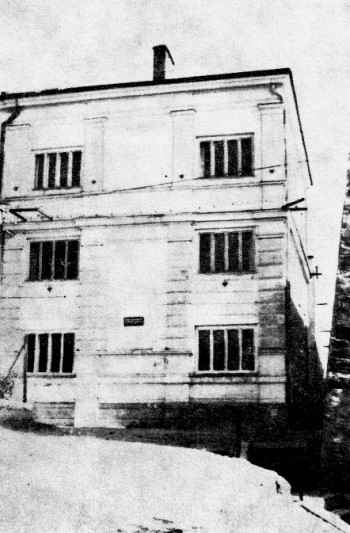
| The Yad Charutzim building at the side of Franciszkański Street |
The third group of tradesmen in the city was the group organized around Yad Charutzim. Although the organizational level of the first two groups was very weak and their status in the Jewish community was close to zero, it was the opposite with the members of Yad Charutzim. The Yad Charutzim movement arose in the cities of Galicia during the era of Austrian rule. Its purpose was to include the simple folk with the working folk into one organization, to assist them during time of tribulation, and primarily to find a means of self–expression within the Jewish community. This organization was founded in Sanok in the year 5661 – 1901, and succeeded literally with diligent hands [3] to raise and educate our splendid youth. The dedication of the synagogue and the entire building took place on Shabbat Beha'alotecha 5661 [4]. That Sabbath of the Torah portion of Beha'alotecha remains as the “birthday of the organization and the building, and was celebrated yearly in Sanok with great festivity.
The building itself was attractive to the eye. It was a three–story building in the center of the city. Its purpose was to provide for the religious and secular needs of the members of the organization. The main floor housed the synagogue – a large hall for 300 worshippers. The women's gallery was a large area on the second floor, very close to the ceiling of the hall. Lovely, artistic oil paintings of various Jewish historical topics (the twelve tribes; the twelve constellations; Adam, Eve, and the snake; the Tree of Knowledge and the apple, and other illustrations and symbols) decorated
[Page 237]
the ceiling and a portion of the walls in a pleasing fashion, catching the eye and attention of all who entered the building. It should be noted that members of the free professions such as physicians, lawyers, etc. joined the organization as members as well. As the years went on, the 200 members became a serious communal body in both city council and Jewish community of Sanok.
|
|
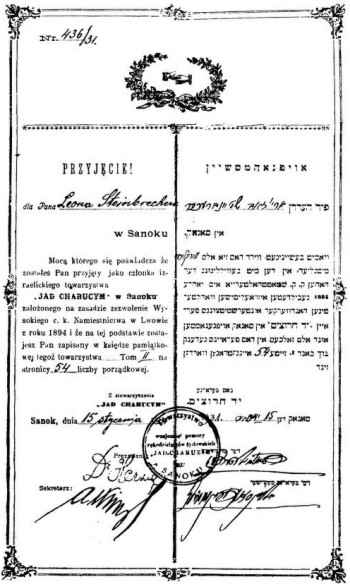
| Membership certificate of Aryeh Steinbrecher signed by Alexander Kimmel, secretary, and President Dr. Herczig |
As has been noted, the Yad Charutzim organization set its goal to provide for all the needs of the individual, both religious and secular. The synagogue undoubtedly provided for the religious needs. The various games that took place on the second floor of the building after the workday provided for the secular needs. The large hall also served as a source of income for the coffers of the organization through dance parties, celebrations, etc. The organization filled a third very vital role aside from these two roles. According to the charter of the organization, if a member got sick for a prolonged period,
[Page 238]
the organization would send two night guards to the bedside of the sick person, so that the family members would be able to rest from the travails of the day. If the illness was prolonged, the organization attempted to grant small loans to the family and to provide the necessary medicine, thereby lightening the load on the family during the tough time. The members toiled for the construction of the building, for they felt that it was indeed their home. (My father of blessed memory said that every member literally donated days of work in dragging bricks, etc. to hasten the building.) In the event of an illness, the family of a member was not abandoned, as they had someone to worry about them.
The first president of Yad Charutzim was Dr. Natan Nebenzahl. He lived in Sanok until the First World War (1914), and gave a great deal of his energy for the good of the organization. He remained the honorary president of the organization even after he left Sanok to move to his new residence in the Austrian capital of Vienna, where he died. His large portrait took an honorable place among the rest of the portraits of the members of Yad Charutzim on the second floor of the building. The members also paid monthly dues, collected by the shamash (beadle) of the synagogue, Yitzchak Krell of blessed memory.
In 1921 (5681), Rabbi Meir Shapira, the rabbi of Glina, was accepted as the rabbi in the city of Sanok. He later became famous throughout the world as the rabbi of Piotrków, and subsequently in Lublin, where he was the founder of Yeshivat Chachmei Lublin. This rabbi was very interested in forging relations with the members of Yad Charutzim. On the occasion of the reception arranged in his honor at the Yad Charutzim Synagogue, he delivered a sermon to the worshippers after the Shacharit service. He explained to them the value and meaning of the expression “Yad Charutzim” (Hand of Diligence) as is mentioned in the Book of Proverbs on two occasions: “The deceitful hand brings poverty, but the diligent hand becomes rich” (10:4); “The hand of the diligent will rule, but deception will lead to paying tribute” (12:24). He lauded the value in life of the labor of the hands, stressing that the combination of Torah and work forms a winning combination in life.
Even though elections for the local council of Yad Charutzim took place every year, there were several roles that various members held for many years consecutively. For example, after Dr. Nebenzahl, the role of president was filled by Dr. Shmuel Herzig and Moritz Gottdank. The role of secretary was filled by Mr. Yaakov Steinbrecher of blessed memory in a set fashion for more than thirty years. He was a painter by profession, and he excelled in his uprightness and representative consciousness. He was not a native of Sanok, but he was virtually the only one who knew how to manage the books (the book of minutes, etc.) in accordance with the charter of the organization, due to his mastery of the Polish language. The constant Shamash of the synagogue and the building was the aforementioned Yitzchak Krell of blessed memory. After his death, this role was filled by his son Mendel Krell, for payment. He died here in the Land after a lengthy illness.
There were no set roles for clergy and other religious duties in the Yad Charutzim Synagogue. Members of the congregation took turns in serving as prayer leaders. For a long period, the role of Torah reader was filled by Mr. Aharon Bachur of blessed memory, and after him, Mr. Eliahu Berger, may he live long.
Rabbi Meir Messer of blessed memory lead the Shacharit service on the High Holidays. He was a tailor by profession, the brother of Reb Leibele Messer of blessed memory. Reb Shmuel Bergenbum was always called upon to conduct the Musaf service. He too was a working man, but not a member of Yad Charutzim. He was a veteran worker in the factory for railway cars in the Posada district, and an enthusiastic Sadagora Hassid. He spent all the days of the year in that kloiz, but on the High Holidays he graced the worshippers in the Yad Charutzim Synagogue with his pleasant voice. The role of Shofar blowing was also filled by members of Yad Charutzim. Rabbi Eliezer Brumer of blessed memory served as Shofar blower, and the well–known Reb Yankel Shamash, the Shamash of the Great synagogue of the city, served as the caller.
When a typhus epidemic broke out in 1920, the entire building, including the synagogue hall and the upper hall, turned into a veritable hospital.
Members of Yad Charutzim knew how to organize their lives in an honorable fashion, as laborers who lived off the work of their hands in accordance with the verse in Proverbs, ““The hand of the diligent will rule, but deception will lead to paying tribute.”
Translator's Footnotes
- See https://en.wikipedia.org/wiki/ber_borochov return
- See https://en.wikipedia.org/wiki/pirkei_avot return
- Yad Charutzim literally means “the Hand of the Diligent Ones”. return
- Corresponds to June 8, 1901. return
[Page 239]
The Tomchei Aniyim Charitable Fund
by Chaya Reiser (Fennig)
Translated by Jerrold Landau
The porters congregated mainly around the Ocyca Theater. Prior to that, they sat in the display windows of the Weiner and Ozenloif stores on Jagielonski and Kosciuszko Streets that had already been broken from the time of the First World War.
Every porter had his own nickname. “Leizer Motshki”, “Efraim Potias”, “Avraham Avinu”, “Shmuel Hanavi”. Their shoes were always without laces. Their shirts were open to their belt. The odor of sweat and liquor coming from them could be smelled from afar. Thus did they sit for long hours, tired or without work. On their way home, they would make the rounds to the doors of the shops to collect donations, as was their usual custom... As if the merchants were required to make up for their losses every day.
Their wives would also beg. They were almost always pregnant, with babies in their arms and their older children around them. They would go from door to door and make the rounds to the offices endlessly. Therefore, the following sign was prominently displayed in many hallways and house entrances: “Entrance is forbidden to peddlers and beggars.” It was already hard enough to tolerate the “schleppers”[5], where each additional child would ask separately “and for me?”
For this reason, in a special meeting of the Merchants Union in 1928, we deliberated about the organization “Kupat Tomchei Aniyim” (The Fund for the Support of the Poor).
Three merchants with stores near to each other were chosen: Reb Feivel Mann as the secretary, Reb Zusia Fennig as the cashier, and Mr. Herman Wenig as the advisor. They compiled lists of residents who would donate generously as a form of monthly tax, and lists of needy people who would receive 3 zloty each week based on the decision of the committee.
The collection was given over to the hands of a sickly, weak widower who was the father of four children. This occupation supplemented his livelihood.
It was decided to grant from 3 to 5 zloty to beggars from outside of Sanok, according to their identity cards. The protocols of the “Kupat Tomchei Aniyim” were publicized widely. Many beggars accepted this willingly, for they would no longer have to waste time begging.
The most difficult task was that of Reb Feivel Mann, since for the most part the poor people from outside were equipped with forged identity cards. They would change their clothes and act deceptively in order to obtain money outside of the lineup and over and above what was due to them in accordance with the protocols.
Once an “elegant” vagabond, who presented himself as a merchant who had lost his livelihood, acted stubbornly and asked for a larger sum. When he did not succeed, he asked to speak to a member of the “black” committee (by coincidence, the three activists had red beards). The listeners burst out in laughter. The vagabond made scandals in the store and on the sidewalk. Threats of calling the police did not even help. In order to solve this complicated problem with this difficult “client”, the one-time urgent assistance of the black-bearded Mr. Yacov Gerber was solicited. He checked the vagabond's suitcase and removed several travel cards, which showed that this “downtrodden merchant” had been in several places in the region that day. As a punishment for his trickery, he was prohibited from appearing in the city for an entire year... (instead of three months)... This matter was publicized to everyone, and people learned a lesson from it. From that time, nobody disturbed the work anymore.
Much good was done in secrecy through messengers and protectors for the bashful poor and for those who had lost their means. The members of the committee suffered great suffering from this, for the visits of the beggars to their stores, and the negotiations with them took a long time. However, their dedication to the acts of charity and kindness overcame the suffering.
The following took place on a bright summer day in 1934. Several women dressed festively entered the Mr. Zusia Fennig's bookstore shouting “Woe”. These were the women from the “Jewish Street”
[Page 240]
who received regular weekly support. They shouted, “Reb Zusia! Reb Zusia! Fennig, Fennig! You must come with us. Otherwise, help with dollars.” I understood that my uncle Zusia Fennig knew about the matter. However, it was not pleasant for him, and he had no desire to go the Barak Joselewicz Street (This was the official name of the Street that was called “The Jewish Street” by everyone). Having no option, Mr. Fennig and Mr. Mann went with the women, and I was given the task of urgently summoning them back... I had no time to even think, and they had already returned, with high spirits and full of impressions and “experiences”. All of the families in need of financial help had gathered in the clean, orderly room of Itshele the Porter. The visitor from America, who was a relative of the owner of the room, decided to give the money over only to a “responsible organization” in accordance with the directions of the donors from America. Therefore, they called the men of “Tomchei Aniyim”. When the “leaders” arrived, they distributed the donations according to the list that they had made themselves; that is, only the communal workers signed with the “Tomchei Aniyim” of Sanok -- and that was all. The cleanliness that pervaded on the Jewish street was the main thing. It was hard to believe that suddenly all of the green puddles of sewage water, and the piles of feces and waste in front of the door of every house had suddenly disappeared. The “Kupat Tomchei Aniyim” organization had been the cause of the cleanup in the houses of the poor and on the Jewish Street. For when the women had stopped begging from door to door, they began to concern themselves with cooking and housekeeping. This also caused the porters, several of whom had died after difficult operations, to stop getting drunk. The children and youth gathered in the Moadon Peretz or in the Poale Zion movement, and the life of begging and alms collecting began to change for the better.
|
|
| Reb Zusia Fennig next to his shop, which served as the treasury and cash office of the “Tomchei Aniyim” and “Bikur Cholim” of Sanok |
Translator's Footnotes
- The exclamation mark is included in the original text. return
- There is a footnote in the text here: “See the addendum”. return
- There is a footnote in the text here: Hamitzpeh, January 9, 1914. return
- The sale of leavened products to gentiles prior to Passover. return
- Roughly -- bums or vagabonds. return
This material is made available by JewishGen, Inc.
and the Yizkor Book Project for the purpose of
fulfilling our
mission of disseminating information about the Holocaust and
destroyed Jewish communities.
This material may not be copied,
sold or bartered without JewishGen, Inc.'s permission. Rights may be
reserved by the copyright holder.
JewishGen, Inc. makes no representations regarding the accuracy of
the translation. The reader may wish to refer to the original material
for verification.
JewishGen is not responsible for inaccuracies or omissions in the original work and cannot rewrite or edit the text to correct inaccuracies and/or omissions.
Our mission is to produce a translation of the original work and we cannot verify the accuracy of statements or alter facts cited.
 Sanok, Poland
 Yizkor Book Project
 JewishGen Home Page
Yizkor Book Director, Lance Ackerfeld
This web page created by Lance Ackerfeld
Copyright © 1999-2024 by JewishGen, Inc.
Updated 27 Jul 2017 by JH
![san228.gif [4 KB] - Advertisement](images/san228.gif)
![san229.jpg [26 KB] - Mrs. Rachel Kramer, Ephraim Kramer's wife, next to her house and business - exporting eggs to foreign countries](images/san229.jpg)
![san231.jpg [26 KB] - 'Produkt'](images/san231.jpg)
![san232.gif [56 KB] - 'Commercial' agreements (for the sale of chometz, 66 years ago'](images/san232.gif)