![san176.jpg [43 KB] - Hashomer Hatzair, 1925](images/san176.jpg) |
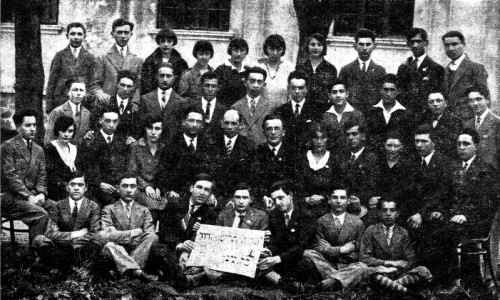
Hashomer Hatzair, 5655 (1925) – the Hatzofim group in Sanok
|
|
[Page 175]
The Hashomer Hatzair Chapter in Sanok
during the Years 1927-1937
by Gershon Givoni-Pipe
Translated by Jerrold Landau
We cannot point to the geniuses that came from our city but there was certainly something special there. Perhaps it was because of the wonderful mountain scenery, perhaps because this city was a sort of border city between eastern and western Galicia, or perhaps because of the fact that the population breakdown of the three nationalities was approximately 1/3 for each.
If we look at the Jewish youth of Sanok in retrospect, we can sum up that they were alert to the problems of the world. It was not like a “golden youth” who live only for the moment and is only interested in their individual human problems.
I will be dealing with the decade spanning 1927-1937 although this period certainly stretched back earlier, to the years following the First World War when Poland received its national independence and the city transferred from Austrian to Polish rule.
From the days of my childhood, I remember the Zionist and Hebrew atmosphere flourishing among the Jewish youth in Sanok. There was the Zionist Hechalutz “Upholders of the Hebrew Language” organization with its prominent personalities such as Yaakov Rosenfeld of blessed memory, Moshe Messer of blessed memory, and Freda Birendorf. I also recall the Ivria library and the literary and drama circle. All of these institutions left their mark on the Jewish youth.
Without doubt, the local chapter of Hashomer Hatzair played a large role in educating the youth with nationalist ideals.
The activities of Hashomer during the 1920s were directed towards the circle of acquaintances of the children of the intelligentsia and the middle class. As in the rest of the cities of Galicia, Hashomer had a unique outlook regarding its desire for the Land and for Hebrew. However the Polish language was commonly used by the youth during the course of their day-to-day activities. When the members of Hechalutz, who drew their support from the more populist classes, joined Hashomer, something of a change of environment began. That is, the petite bourgeois element blended with the populist element, and without doubt only good arose from this for the Jewish youth in our town.
I joined Hashomer Hatzair in 1927 when I was of Bar Mitzvah age and still at cheder in the upper grades of the Talmud Torah, as well as attending the public school. Hashomer Hatzair had a special attraction for the Jewish youth in the town. What was the attraction? Going out to the bosom of nature each Sabbath, either around the quarry, the White Mountain or to Olchawca across the San, the scouting games and following the personal examples of the counselors. Above all, there was the cohort of people of one's own age who worked together.
We were “Kfirim” for a year and a half – that is the youngest group. Then there was the “Aryeh” group under the leadership of Mondek Poretz, and the analogous “Tzvia” group for girls under the leadership of Yaffa Landsman.
For us, the counselors were sublime people who we held in great esteem. We were prepared to follow them with our eyes closed even into the fire.
During our activities we absorbed legends of the Land, read stories from the life of Hashomer, and also from sections of “Yizkor” (memorial). The chapters of bravery regarding the protection of Tel Chai were etched deeply into our tender hearts. We listened with eager eyes and open mouths to the stories of Yechezkel Nusinowicz and Yehoshua Chenkin from the days of the first settlement of the members of the Second Aliya.
[Page 176]
In the meantime, the educators of the two groups were diligent about forging ties of friendship and true camaraderie among the groups, and it can be said that they were successful in just about everything. The groups were consolidated among themselves and the counselors set for themselves the aim of educating them in the proper character to every detail. In summary, I can note that the educational endeavor was conducted with deep, vivacious independence which opened up the hearts of the children and prepared them to greet the future.
The chapter was divided into the following educational groups: alef) Kfirim for ages 12-14; beit) Hatzofim for ages 14-17; Bogrim for ages 17-18 and above. The division was planned well and had great influence.
In the second group, when a child became a youth, he was ready to begin scientific and investigatory thought, and his personality began to feel for justice and uprightness.
In 1929, two groups graduated to the Hatzofim group.
|
|
| The sign held up by the group of youths says:
Hashomer Hatzair, 5655 (1925) – the Hatzofim group in Sanok |
Two booklets lie before my eyes – “Hayinu” manuscripts, volumes A and B that were published by us in November and December 1929. (I was able to obtain them through the kind permission of the movement archives in Merchavya.) I read these publications and am astounded by the articles from the pure youth.
What do these articles deal with?
First, the youth demanded cultural activities and ideas. They were no longer content with the games that characterized the movement earlier. They requested presentations and deliberations in which they themselves could take part (“Shichvateinu” by Ben Zvi). In “Bapetach”, M. R. demands activity for the Hebrew nation, the Land, and human society. There are articles entitled “Toward Morning” and “At the Time of Evening”, which portray impressions and feelings about nature in Sanok in the Mickowiec Public Gardens where we would spend
[Page 177]
time during the early hours of the morning as well as the evening in study, private reading and discussion. This garden also served as an appropriate place for thinking and formulating ideas about the state of the group, the need to consolidate our world view, to think deeply after reading scientific books and to draw conclusions about the reality of the lives we were living.
There was a list of the older youths who left the group (marked with x) in which they had been members since their younger days. The writer does not hide the emotions that he and his friends felt when they left. However, his conclusion was otherwise. He asks that the youths gird themselves so that they would be able to stand up to any usual or unusual wind and that any incidents of abandonment of the group would be minimized. If they occurred, it would be clear that these were related to individuals who were weak of character, who could not live up to the sublime and serious objectives of the group and so the group would not lose out from this.
Questions of religion and tradition were an important topic in the deliberations of the group. The moral values of the Bible remained strong, as a wall that could not easily be demolished. With regard to the clergy, particularly of the Christian church, we placed a boundary between it and between the ethics of the Jewish religion. We took pride in the prophets and the Hassidic movement, and we claimed that the Jewish religion could not be compared to other religions.
There were extensive deliberations and discussions throughout a long period and we saw this as positive for we did not wish to accept the words of the counselors as Torah truth. We investigated their words and forged our own outlook with fiery debate - not just about external matters for the internal attitude was the main thing.
In the wake of these adjudications, we wrote articles on the topic of religion in general and the Jewish religion in particular. There were judgments. Most of our missiles and arrows were directed against Yidel Katz and Moshe Rosenblatt, who as older youths represented the international Socialist movement. A story was written on this topic, a novel by “Ben Ami” entitled “An Apostate in Halacha and in Practicality”. The author of the novel presents a 13 year old, the grandson of Rabbi Shlomo who studies Torah day and night and is not alert to the realities surrounding him. Motele denies the faith, but he cannot sit with his arms folded with a storm brewing outside – the anti-Semitic pogroms against Jewry in Ukraine. He bursts into the synagogue and summons the worshiping Jews to set up the means of self defense. The Jews who are wrapped in tallises and bent over their prayer books push aside the words of this apikoros (heretic) and do not wish to heed his calls. However, his soul knows no rest until his idea is realized – self defense in the plains of Ukraine – through going out to Hachsharah kibbutzim[1] through making aliya to the Land and through joining one of the kibbutzim that stand guard over the homeland. He performed labor with one hand and with the other he held a weapon.
The longing for the Land of Israel expresses itself in each and every article. The youths see themselves as citizens of the Land of Israel who are residing temporarily in a town on the banks of the San River.
Years passed. The youths completed their course of studies and were on the threshold of adulthood, but they did not abandon the ideas that were instilled in their hearts during the previous years. Activities in movements at a higher level, going out to Hachsharah activities and making aliya to the Land – these were the next stages in the education and activities of Hashomer Hatzair.
In the meantime, the youth movements of Gordonia, Hanoar Hatzioni, Akiva, Beitar and others arose and conducted a battle for the soul of the Jewish child in the cities of Poland, including Sanok.
How does one attract the heart of the youth, when the various youth movements arise, and Hashomer Hatzair is not the only one on the Jewish street?
Here I am leafing through Hachoresh, monthly issue number 1, from October 1934.
A new generation came to the fore in the activities of the movement. Hitler's ascension to power in Germany, and the rise of fascism throughout Europe left their mark upon us as well. Yaakov Simon writes in his article:
[Page 178]
“The War – Necessary Conditions for the Existence of Fascism”, that war is intended to destroy the finest and most refined sections of humanity. The Jewish youth were sensitive and they already felt that a disaster was about to afflict humanity and Jewry in particular.
Miriam Gefen tells of the activities of the second level of the Hashomer Hatzair movement and demands the realization of its goals in the local chapter in Sanok.
The memories of the national convention in Kruszelnica, in the eastern foothills of the Carpathians, arouse emotions.
A great many people traveled to that convention, which took place at the end of the director's meeting in the town. Prior to the convention, the participants of the summer camp went out on an excursion into the mountains. Their objective was Bobonsyce, a mountain peak 1,200 meters high.
A large crowd of Hashomer Hatzair members from all the cities and towns of Galicia gathered on the day of the convention. Members of the Sanok chapter also came out in significant numbers. They took part in the meetings of the members of the “Hamanof” Kibbutzim, alef-gimel (Hamafil), and beit (Yad Mordechai). They also organized meetings and fraternal gatherings of the participants of the leaders' camps that took place in Kruszelnica, Bubnów, Bludbikowka, Brzlnica[2] – all of these are towns in the heart of the forested Carpathians that adorn the valleys that were worked by the Chalutzim farmers.
The photographers were very busy. The photographs formed memories for the future and today we connect to them with pangs of longing for the lovely days of the past that will not return.
One of the chronicles informs us of the aliya of Ozer Fifah and Bilhah Rosenfeld to Kibbutz Hamanof in the Land.
Aliya to the Land was the highest plateau of the Hashomer education. The gates of the Land were almost locked in the face of the aliya of Jews, and the certificates that were issued by the Mandate government were a drop in the ocean as compared to the numbers of people knocking at the doors of the pioneering (Chalutz) movement everywhere. It was decided by the Chalutz headquarters to arrange for illegal aliya. Bilhah and Ozer were among the pioneers who set out on the first ship of illegal immigrants “Vilus”. This journey was clouded with extreme secrecy. The ship wandered in the heart of the sea for a long time and those aboard often worried that they would perish in the midst of the waves of the stormy sea.
Nevertheless, for the chapter, this means of aliya had a great educational influence, and it forged for the members a narrow and tortuous path to the Land, off the main highway.
|
|
| A Hachsharah group in Sanok |
[Page 179]
In that same issue, we find an article about the state of the chapter in the year 5694 (1934). The accounting was presented by the writer of these lines during the annual meeting.
First, the role of the chapter in the summer Moshava (Zuhotyn), the educational seminar and the national conventions was noted. A special role was played by the academy and exhibition that took place during the 1920s to support the worldwide movement (1913-1933). An evening of artistic performances was arranged in the Yad Charutzim hall which aroused feelings of esteem and gratitude in the local Hashomer Hatzair youth.
Even more was accomplished by the exhibition in which we invested the best of our energies. We displayed handicrafts, photographs and publicity about the chapter in Sanok and its various educational groups. Many visitors, young and old, came to see the spectacular exhibits (relative to the conditions in our town at that time). I especially remember the prominent tower made of newspapers. Eliezer Baron (Yisraeli), Chedva Leventhal, and the writer of these lines worked on gathering the exhibits, as far as I recall.
The issue of the Hebrew language in the chapter was especially important and occupied a prominent role in the annual discussions.
The chapter of Sanok was known throughout the breadth of the movement in Galicia for its use and mastery of the Hebrew language. Its local leadership meetings, its book of minutes, its correspondence with the central leadership, and even its leaflets were all in Hebrew.
A group for the promotion of the language was active in the chapter. It made sure that only Hebrew would be spoken at the meeting place of the chapter at least one or two nights per week.
A Tarbut school did not exist at that time, only evening classes in Safa Berurah. Without doubt, its central personality was the teacher Reb Tzvi Abt of blessed memory, who was known for his strictness. Despite this, Hebrew played an honorable role in the life of the Jewish youth and in the Hashomer chapter in particular.
|
|
| The exhibition of the Hashomer Hatzair chapter in Sanok |
[Page 180]
The educational and publicity activities in the educational group under the auspices of Hagedud (two parallel groups), and the activities of the chapter itself, earned a name not only in Hashomer Hatzair, but also affected all of the youth movements that arose after us in every place, and also in our place. Among the famous mottos was “Once a Shomer, always a Shomer”. Furthermore, the members remained faithful to the movement throughout the Kibbutz Haartzi[3]. Even thousands who had at some time or another left the movement recall the activities of the Hashomer Hatzair movement with esteem. The Sanok chapter was not one of the backward ones in this area and it made its mark in the Land as well as during the difficult trials that had to be endured during the wartime.
The anti-Zionist factions were not strong in Sanok. The principal form of Zionist activity came through the activities of the Keren Kayemet LeYisrael (Jewish National Fund), Ezra, W.I.Z.O. (Women's International Zionist Organization), the League for the Working Land of Israel, and Hechalutz.
In that same edition of Hechalutz, Hashomer Hatzair is mentioned in first place among the movements for its activities on behalf of the Keren Kayemet LeYisrael. In the year 5684 (1924), it collected 175 guilder, Akiva – 64.55 guilder, Hanoar Hatzioni – 48 guilder. In order to emphasize the size of this sum, I will point out that the chapter would send one guilder per moth as dues to the central authority.
Hashomer Hatzair also conducted large-scale activities in Sanok in the League and Hechalutz by joining forces with Gordonia, Hitachdut and the right-leaning Poale Tzion[4].
I visited the chapter in Sanok on behalf of the chief headquarters in October 1936. The composition of the members had changed. The percentage of the populist element had grown since the children of the higher classes who attended the civic gymnasium were barely found in Hashomer Hatzair. They were absent from the youth organizations in general and the Zionist ones in particular. On the other hand, the energies of the youths in these classes increased and it should be noted that they promised a great deal for the future.
The following were prominent among the youth: Malka Leventhal, Miriam Geffen, Shmuel Fennig, Tila Werner, Shoshana Poritz, Yehuda Wallach, Eliezer Freitsch, and others.
Yacov Mais entered the high leadership in Warsaw. Miriam Gorfein also prepared to leave the city.
Chedva Leventhal, Yosef Herzig and Yaffa Amster were in the chapter and participating in the work. However, they were headed toward the Kibbutzim and Hachsharah groups. Shoshana Antner of blessed memory had returned from the Hachsharah groups. However, they were not able to develop a wide variety of activities as there were barely any of their peers in the chapter anymore, and the younger people were not yet sufficiently experienced to bear the burden.
In his letter to the head leadership of May 27, 1937, Yosef Herzig of blessed memory writes that efforts were made to raise the energies of the youth to an appropriate level of activity. He singles out for praise Shmuel Fenig, who had great promise in his opinion, and raised the banner of the efforts. He renovated the meeting place of the chapter and he was pleasant to the members who spent their time there. Nevertheless, a fear for the future was felt, and there was a general atmosphere of crisis among the Jewish youth so the young people were not able to measure up to him sufficiently.
From the time that I made aliya to the Land in October 1937, I was no longer able to follow from up close what was going on in the Hashomer chapter in our city. However I knew that the outbreak of the war destroyed the chapter, as it did all the other Jewish communal organizations.
Many alumnae of Hashomer Hatzair from various eras live with us in Israel and I am sure that everyone remembers Hashomer Hatzair fondly from their youth as Hashomer Hatzair played such an important role in the education of a generation in our city of Sanok.
Translator's Footnotes
by Yacov Alster, Yitzchok Heller (Hal-Or), Binyomin Lazar, Eliahu Leschner
Translated by Jerrold Landau
Sanok was a district city, albeit not one of the largest. There were hundreds of cities like it throughout Poland. Its general population was more than 20,000. The Jewish population was approximately 4,000. This was a sweet, well-rooted, enthusiastic, traditional Jewry faithful to its sources. It generally excelled in its cultural life. It had Talmud Torahs, Yeshivas, Tarbut Schools, synagogues, and even courts of the Admorim of Dynow and Bokowsk, in which the community of Hassidim took refuge.
The vibrancy of Jewish life encompassed approximately 1,000 of the Jewish youth, who were students of the secondary school. Parochial Jewish education ended in the public schools. The high schools were general, run by the government or cities. It was specifically there that the Jewish youth began to feel the anti-Semitism, cultural so to speak, that inspired the first awakenings of nationalist thinking among the Jewish youths, and was one of the prime factors in the sprouting of the Zionist idea.
In the 1920s, during the first years after the First World War, the factional vibrancy penetrated this youth. There were many ideological streams among the high school students. Sanok, like the rest of the cities and towns in the large Polish Diaspora, was also blessed with them. One of them was the Youth Covenant of Yosef Trumpeldor - Beitar.
The Jabotinsky[1] Movement in Sanok consisted of two groups: The Covenant of the Revisionist Zionists (Tza”har) (known as the New Zionist Organization from 1935 until the Holocaust), and the Yosef Trumpeldor Organization - Beitar. However, both of these formed a single, inseparable body that could not be divided. The only difference between the two was the age of its members. For the most part, the same activists headed both movements.
This movement was blessed in that it did not suffer from a battle between fathers and sons. Just as the members of the Revisionist Zionists and New Zionists regarded themselves as parents of the Beitar members, and enveloped them with love and concern for their education and development; every Beitar member saw himself as a future member of the Revisionist Zionists and New Zionists, and not merely from an internal technical perspective. Every Beitar commander guided his young charges in a manner that they would automatically become members of the Revisionist Zionists or New Zionists when they reached the age of majority.
Even the fruit that grew and ripened on this tree, “Brit Hachayil” (freed soldiers, who were discharged from the various armies) and “Brit Yeshurun” (an Orthodox movement within the Revisionist Zionists and New Zionists), did not fall off and was not cut off from the tree upon which they were ripened. They became branches - branches from a single root where they drew their source of sustenance from a single source - Zeev Jabotinsky.
The beginning of the Jabotinsky Movement in Sanok was in 1927. A small group of young people imbued with the nationalist idea in accordance with the doctrine of Zeev Jabotinsky came to the realization that, from a general factional and ideological perspective, as well as from the human situation of a large segment of the youth in the city
[Page 182]
and the spirit of national Zionism, there was room for this ideology within the spectrum of the movements. This group felt duty bound to establish this framework.
Yacov Alster, Yitzchok Heller and Fischel Rauch, who live with us in Israel, were the chief founders of this movement; as well as Yitzchok Fink, a leader of the JOINT in France, and Menachem Toder may G-d avenge his blood, who perished in the Holocaust.
A Beitar chapter was set up alongside the establishment of the Revisionist Zionists, under the leadership of Yacov Alster and the members of the command Yitzchok Heller, Menachem Toder, Binyomin Lazar, Yitzchok Fink, and Shraga Feibusch.
The Arab disturbances amongst the Hebrew settlement in the Land in 1929 had their influence upon the youth movements in Sanok. Within a short time, the number of members of the Revisionist Zionists, and especially Beitar, grew. Its central idea of militaristic education drew the hearts of the high school students - the intelligentsia of the youth of the city -- who streamed to Beitar, as well as the populist classes who were attracted by the drills and the sporting events. In 1930-1931, there were already 150 Beitar members in all levels of the chapter, and Beitar was one of the largest movements in Sanok.
In the years 1931-1933, the movement consolidated from an organizational and cultural perspective. The mother movement, The Revisionist Zionists, excelled in all nationalistic Zionist activities - in publicizing the Zionist idea among the masses of Jews, the distribution of shekels [tokens of membership in the Zionist organization], collecting money for the Jewish National Fund [Keren Kayemet], Keren Hayesod and others, and general communal activities in the political and communal institutions of the city. The commissar of the Keren Kayemet LeYisrael in the city was Yacov Alster, the chairman of the Zionist Revisions of the city. In addition to these activities, the Revisionist Zionists conducted comprehensive publicity among the masses of Jews regarding the unique way of the Revisionist Zionists in the Zionist movement and the Jewish nation - political activism, cultural activity, imparting the Hebrew Language and knowledge of the homeland to its members.
|
|
| A farewell to Yacov Alster on the occasion of his aliya to the Land |
In those years, Beitar took one of the prime places in work for the national funds.
[Page 183]
However, most of its work and efforts were put into military and cultural education. The commander Binyomin Lazar, who completed a course on Army Service Units that was organized in the headquarters by Beitar in conjunction with the Polish Army in Rozyszcze near Luck, organized a similar course in the Beitar chapter in Sanok for the older youths of the chapter. In this course, an army sergeant from the Polish Army gave an introductory lecture on the foundations of military tactics, and conducted a special course in the use of weapons and sabotage. At the same time, courses in the Hebrew language took place under the auspices of the chapter.
|
|
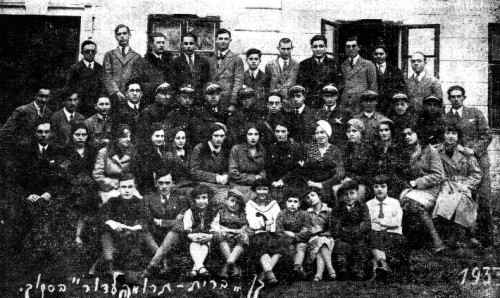
| The Beitar Chapter in Sanok, 1933 |
Hachshara formed a special chapter in the pioneering education. Those who completed hachshara were able to obtain a permit for aliya (certificate) from the Jewish Agency. There were six hachshara points in Western Galicia: Dilyatyn, Gnojnik, Boryslaw, Bolechów, Rzeszów, and Cieszanów[2]. At all of these points, Beitar members from Sanok prepared themselves for aliya to the Land.
Eliahu Leschner, Zev Rebhuhn and Zusha Schweitzer were in Dilyatyn. Moshe Gleicher and Dov Schachner were in Gnojnik. Yosef Silber was in Boryslaw. Tzvi Goldberg (today Shmuel, Sam Wang in the United States) was in Bolechów. Shoshana Birndorf, Chaim Heftil, Bilha Chaut, Chana Toder, Bluma Segal, Miryam Feitshevitch, Jochebed Frum, Devora Fried, and Isaak Kalb were in Rzeszów. Yacov Abt and Nina Scherer were in Cieszanów. The Beitar members from the Sanok chapter excelled greatly in their Hachshara locations. Four of them were appointed as leaders of their locations - Yacov Heller the leader of the Bolechów Hachshara, Moshe Gleicher the leader of the Kolbaszowa Hachshara, Binyomin Lazar and Tzvi Rauch the leaders of the Rzeszów Hachshara, and Zev Rebhuhn was chosen as the secretary of the Dilyatyn Hachshara.
It should be noted that Beitar members from the Sanok chapter went out to hachshara locations already in 1930. They brought with them the internal organization of the chapter and the methodology of cultural education. The Sanok chapter was divided into four groups - Tyomkina named for Zeev Tyomkin[3] (one of the leaders of the Revisionist Zionist Organization)
[Page 184]
Masada, Bar Kochba, and Sarah Chizik (named for Sarah Chizik, who fell along with Yosef Trumpeldor in the defense of Tel Hai).
The following people headed the groups: Shraga Feibusch, Yitzchok Gelender, Tzvi Schachner, and Chana Toder (who is with us in Israel).
In addition to the cultural activity of mastering the Hebrew Language, courses were given in knowledge about the homeland, Jewish and Zionist history, and various topics related to the Land of Israel and the Nation of Israel. The Oneg Shabbat and Melave Malka evenings[4], which excelled in their cultural content and communal singing, were especially loved by the members of the chapter.
We have already stated that the central ideas of Beitar, military education that was a sort of continuation of the Hebrew Brigades of the First World War, military discipline, exercise drills and sport attracted the hearts of the Jewish youth of Sanok. However, it was not only the Jewish youth who were influenced by the drills, parades, and marches in military formation in the outskirts of the city. Even the Polish population saw for the first time strong Jewish youth that they were not used to.
In particular, the participation of the Polish Army in this education made a strong impression. The Polish youth who were used to teasing the Jews, in particular within the walls of the high schools, understood that the time for this teasing had passed, and that the Jewish youth had learned how to and were prepared to return with a battle in kind.
The Jewish youth organizations of Sanok designated the day of Lag BaOmer as a day for inter-group intelligentsia. On that day, the studying youth in the schools organized excursions outside the city, and picnics with lectures on the issues of the day. Even on these excursions, the members of the Beitar chapter appeared in full uniform. The procession to the excursion was accompanied with a military march.
In 1931, a regional convention of Beitar chapters convened in Sanok. The 40 Beitar members who were delegates to the convention decided to conduct the convention in a non standard manner. They marched to the Czech border near Medzilaborce. The border guards on both the Polish and Czech sides permitted the marchers to cross the border. They sufficed themselves with a Beitar promise that all of them would return on Sunday afternoon. In both countries, the authorities recognized the Beitar youths and honored their promises.
Thus, the convention took place partly in Poland and partly in Czechoslovakia.
|
|
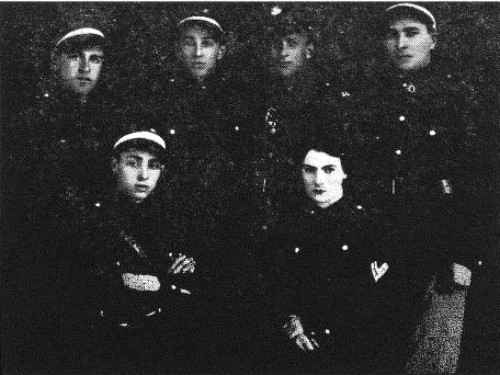
| Standing: Tzvi Rauch, Pesach Langsam, ?, Binyomin Lazar Sitting: Miryam Reich, Shraga Feibusch |
[Page 185]
|
|
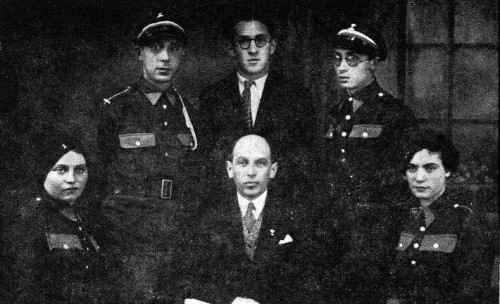
| Sitting from right to left: Reich, Alster, Racker
Standing: Shraga Feibusch, ?, Meier Gleicher |
In 1933, the first change of leadership took place within the Revisionist Zionists and Beitar. First, the family of Yacov Alster made aliya to the Land. In his place, Fischel Rauch was chosen as chairman of the Revisionist Zionists, and Shraga Feibusch as commander of the chapter. The activities of the chapter, which were conducted to that time in the classrooms of the Tarbut Hebrew School, moved to an independent hall in the home of the commander Pesach Langsam.
That year, Beitar was a major factor among the Jewish youth. Despite the battle that was conducted by various parties against the Jabotinsky movement in the background of the murder of Arlozoroff[5], everything associated with that murder, and the trial of those Jews accused of the murder; the Jabotinsky movement, and especially Beitar, grew. This era in particular was the bright era of the flourishing of the Jabotinsky movement. The chapter increased its ranks, and the headquarters of the movement in Krakow saw the need to include two members from Sanok, the commander of Beitar Binyomin Lazar and the chairman of the Zionist Revisionist chapter Fischel Rauch.
The year 1934 was blessed with the aliya of members of the movement to the homeland. Binyomin Lazar made aliya, and around that time, the Beitar members Shoshana Birndorf, Tzvi Rauch, the Jonas brothers, Yitzchok and Reuven Racker, and Yehudit Schwerd also made aliya. In 1935, the member of the Beitar command and Zionist Revisionist activist Yitzchok Heller (Hal-Or), as well as several older members of the movement made aliya to the homeland.
This aliya necessitated a change of personnel in the movement and the chapter. In addition, a new Zionist council was founded in Vienna that year, which necessitated a reorganization of the leadership of the movement. Dr. Shimon
[Page 186]
Kimmel was chosen as chairman of the New Zionists, but the Revisionist Zionists continued to officially exist under the presidency of Fischel Reich. Members of the two committees were Meier Gleicher, Chana Toder, and Eliahu Leschner (secretary).
During this period, two important branches, which played valuable roles in the growth and communal influence of the movement, were added to the movement.
We have not fulfilled our duty toward several of the members if we fail to dedicate a few lines to them as a memorial candle to their souls.
He was an open eyed dreamer. Everything that passed by his eyes bore the stamp of his thoughts. He always dreamed about the homeland. He enjoyed its beauty without having seen it. He never even merited to see it. He believed in the authority of the gun in the same manner as proverbs in a book[6]. He educated Beitar in this spirit, with the purity of the Hebrew Language. During the Oneg Shabbat celebrations, he would lecture on political and literary topics. He continued his activities in Beitar until the outbreak of the Second World War, in which he perished along with his young wife Tamar and their daughter Yael.
In addition to the members of the command who have been mentioned, the Beitar members Chaim Haptil, Lea Jarmark, and Jochebed Frum stood out in that era.
[Page 187]
The founding of the new Zionist Organization was the cause of two things that imparted their stamp upon the activities of the Revisionist Zionists, the New Zionists, and Beitar in Sanok. From one side, the Jabotinsky movement stopped its opposition to the Zionist institutions in the city, but rather forged an independent political path in every communal Zionist area. This obligated it to increase and broaden its publicity, organizational, and political activities. Many speakers and activists from the centers in Lwow, Krakow, and even Warsaw were sent to Sanok in order to help the chapter in its work, and in explaining the methodologies of the Zionist movement. This also necessitated the headquarters of other parties to increase and broaden their activates in Sanok. Thus, the city was fortunate to host well-known speakers from Poland, which raised the level of knowledge and information on the topics of Zionism and Judaism, and increased the cultural activities among the Zionist of the city in general and the Zionist youth in particular.
On the othe hand, Beitar and the New Zionist chapter did not receive the quota of aliya permits (certificates) that were due to them based on the number of their members in hachshara. Like Beitar chapters in other places, Beitar in Sanok and the Beitar leadership therefore began to search for other means for aliya, but did not find such. During this time, the Beitar illegal immigration (Haapala[7]) began to take its first steps. At first individuals, later hundreds, and finally many thousands of Maapilim made aliya to the homeland in this manner. Of course, the Beitar chapter in Sanok, as well as the chapter of the movement at large benefited from this aliya, even though one Beitar member, Tzvi Goldberg (today Shmuel Wang in the United States) was deported from the coast of the longed-for homeland to Belgium. His return did not influence, and did not instill fear on the Beitar members who prepared for aliya via the Haapalah.
In 1937, on the occasion of the aliya of several of its members to the homeland, there was again a necessity for changes in the makeup of the command of the chapter. Eliahu Leschner was appointed as commander of the chapter, and Yacov Abt was appointed as his deputy as well as the secretary of the chapter. Chana Toder, Sima Rein, Penina Reich, and Shimon Intrator of Lesko near Sanok were appointed as members of the command.
This command invested a great deal of energy and toil in organizing courses in Hebrew, the knowledge of our land, the use of weapons, and expert military knowledge.
In addition to the common Beitar activity, during this era, cells of the Irgun Tzvai Leumi[8] began to organize in Poland. Avraham Bard, may G-d avenge his blood, who was the district commander of these cells, organized a cell of the Etzel in named for Shlomo Ben-Yosef[9], the first to be executed on the gallows in our generation.
This era, the final era of communal activity of the Jewish population in general, seemed like the radiance of the sun before its setting. It excelled in large-scale activities. The command invested a great deal of energy in setting up a summer camp in Krajowice, in which the Beitar members went through training in weapons at a high military level.
This activity, great in scope and depth, ceased suddenly with the outbreak of the First World War, when the entire Beitar chapter volunteered to organize the building of shelters to protect against the enemy bombardment and to dig fortification lines to impede their advance. During the early days, their hope that the storm would pass and that it would soon be possible to renew the activities still pulsated within them. This was a deep disappointment on the threshold of the Holocaust.
The Germans conquered Sanok on October 4, 1939. The storm of the Holocaust grew in intensity and put an end not only to their hopes, but also to the lives of six million Jews of Europe, the Jews of Sanok among them.
Let us remember with deep love our pure brethren who were murdered!
Let us remember with fundamental hatred the impure Germans who murdered them!
Translator's Footnotes
|
|
JewishGen, Inc. makes no representations regarding the accuracy of
the translation. The reader may wish to refer to the original material
for verification.
JewishGen is not responsible for inaccuracies or omissions in the original work and cannot rewrite or edit the text to correct inaccuracies and/or omissions.
Our mission is to produce a translation of the original work and we cannot verify the accuracy of statements or alter facts cited.
 Sanok, Poland
 Yizkor Book Project
 JewishGen Home Page
Copyright © 1999-2024 by JewishGen, Inc.
Updated 27 Jul 2017 by JH
![san178.jpg [26 KB] - A Hachsharah group in Sanok](images/san178.jpg)
![san179.jpg [36 KB] - The exhibition of the Hashomer Hatzair](images/san179.jpg)