![rak074.jpg [38 KB]](images/rak074.jpg) |
|
These notes were written in 1925, as a result of my frequent visits to the “training collective” near Rakov. It complements the articles about the “HaHalutz” movement in Rakov, and sheds light on an area which left its mark on the town, in general, and on its youth, in particular, and was an important instrument in facilitating the 'ascent' to Eretz Israel.
I closed my books, put them in the case, and said to them: That's it! As of today, the ax and the pick will take your place. With my knapsack on my shoulders and my staff in my hand, I walked to the 'collective'.
The last rays of the setting sun accompanied me on my way; everything was placid with the calmness of dusk; the trees stoodquietly, dreamily, as if uttering a silent prayer. My feet were light, and my heart full of song -- finally I overcame, made my decision... I felt easier.
In the house of the 'collective' I found only the two “mamutchkes” -- as we used to call the two women, the mothers and sisters of the 'collective' -- being busy, the one with mending and the other by the stove. The men were just returning from their daily labor, and were entering the office to report. Moments later, and they and they entered with great noise and commotion. We were introduced, and I looked at their faces, covered with dust and soot, and their tarred hands. Yes, I said to myself, they did real work. And I? Will I adapt? Will I be able to take it?
Two weeks passed. I was struggling, we all were. We were still searching for the right road. The work, sawing wood, was hard. Our enthusiasm was not what it had been. Our bodies were demanding their rest, and when we returned from work we would fall on our beds and smoke a cigarette, which never left our mouth. Doubts began to creep into the hearts -- am I capable, and worthy, of being a halutz [pioneer]?
And the collective way-of-life was not smooth either. It was very hard to adjust to the sharing, to the group-living. Friction developed, caused by the different customs and mores of the environments in which we had lived. This was a sign that the road ahead of us was still very long. For example, a new comrade came from the town V., a bit of a 'greenhorn', and immediately he became the 'doormat' of those around him. For a time, he suffered his humiliations silently, on the inside; but then his patience snapped, and one day he grabbed a pale of water and emptied it on the heads of his two tormentors...
[Page 74]
|
|
| Training Camp in Mikhalova next to Rakow |
And here is a story that reached us from the 'collective' in G. D., a, about one of their best members, a conscientious halutz [pioneer], fluent in Hebrew, constantly talking of high ideals and moral behavior, and so on and so forth. They appointed him the treasurer. And lo, he was caught with his hand in the till, embezzling. He was tried by the members, and was thrown out of the 'collective'.
And here is an amusing episode: A young man, almost just a boy, came from the town D. to join us. One day we returned from work, sat at the table to eat, and the lad could not be found. We called him, searched for him, until he was found standing behind the wall, eating a “strudel”. We burst out laughing. And he stared at us -- so what?... that is, what's the matter? The “strudel” was his, his private property, and he was not going to share it with anybody else...
But -- I said to myself -- do not despair! This was only natural, and the 'collective' had to serve as a crucible for its members, so that they would emerge doubly purified, ready for the great mission -- the birth of a the new Jew, the new Man. For this purpose we had to undergo a cultural change, that is, a change of heart and mind.
These changes occurred after we were joined by G. He was an ideal halutz, expansive in his relations with others, of plain manners, and always happy and gay. Intellectually, he was only so-so, but with his open heart, common sense, and eyes full of wisdom, he exerted great influence on us. In a short time he became the 'living spirit' of the 'collective'. Indeed, this is the kind of people we needed. We turned more forcefully to our 'ideological training'. In the evenings, we read the 'ideological' literature: “The Collective Settlement”, “The Life of Trumpeldor”, “The Writings of A. D. Gordon”, the “HaPo'el HaTsayir” [The Young Worker], and, at last, we started receiving the daily “Davar” [the newspaper of the Jewish Workers Party], which had just begun its publication [in Eretz Israel].
One Saturday we conducted a discussion on the meaning of our way. I started by saying: “The Halutz Movement is not based only on the national element, the liberation of the afflicted [Jewish] People, but also on ideals for humanity as a whole. The Halutz Movement, by realizing the collective way of life in Eretz Israel. Is leaving the paved road, which was traveled by previous generations, in search of other lanes and other ways of life. It loathes the life based on wars and competition, and strives for the way of life which enables equality between men. The halutz has to purify himself, to cleanse himself, to distance himself from all that is ugly around him. We have to uproot every semblance of egoism, we have to be reborn!”
[Page76]
These words were heard, and absorbed, silently. But G. begged to differ, he stood up and said: “Comrade, you demand purification and reconditioning of the mind. Good! But I add to that, and demand, that the “Halutz” be, first of all, full of joy of life. We have to learn to sing with a Hasidic fervor, and that is what would lead us to the love of friends and comrades. We are Hasids! Modern Hasids!” He posed his demands, and he carried them out. He stood up and started singing, and others joined him, cleaved to him, and the circle of dancers moved as a single body, shouting: “El yivneh ha'galil” [God will rebuild the Galilee -- a Hebrew song, popular among the 'pioneers' of the time]... just like on a kibbutz in Eretz Israel.
The Gentile workers stood at the door and looked with amazement: “”What are they so happy about?” They could not understand how some Zhids [Jews], who were engaged in a hard and backbreaking work all day, were still so happy and gay. And they were not the only ones. The fathers could not understand why their sons left the shop, or the book, behind, and went to work for two gold coins a day. And the mothers were looking with amazement at their pampered sons, who got up one morning and went to work chopping wood, and then came back at noon with a shining face, as if they had won a victory over the whole world. And we? -- We were listening to the voice which came from the innermost parts of our souls: Be liberated! And it was our own strength that was liberating us.
|
|
| The “Maccabi” in Rakow 1925 |
The owner of the sawmill, Mr. M. R. was a 60 years old Jew. He, his wife, a son, and two daughters, lived in a large and spacious house, not far from the mill. His manners towards us were like those of a powerful lord. His family, too, kept their distance from us at first, and spoke to us in a patronizing voice. But things changed later. One day, the father and two daughters attended our meeting, which was devoted to the history of the “Aliyot” [waves of migration] to Eretz Israel. I, in my talk, mentioned the first migrants, and uttered the word “Bilu” [a pre-Herzl Zionist movement in Eastern Europe, which established the first agricultural settlements in Eretz Israel]. I saw that Mr. M. R. was suddenly shaking, and was paying more attention to our discussion; he was even listening attentively to my words. I understood this behavior later, when I learned that in his youth he was a member of the “Bilu” movement, intended to go to Eretz Israel but did not, married, started his successful business, and became very wealthy. His involvement in his business affairs made him forget Eretz Israel completely. Suddenly, after so many years, when he heard the word “Bilu”, a hidden string was pluck, and he heard the song of his youth coming out of the depth of his heart.
One day, later, we met and talked about our work; suddenly he asked: “Do you really and truly intend to emigrate to Eretz Israel?”
|
|
| “Hashomer Hatzair” Management Team in Rakow, 1934 |
One day, on the train to Vilna, I bumped into Mrs. M., our employer's wife. As we had known each other, we started talking. The conversation turned to personal matters, and she told me of their life in Moscow before the [First World] War, of their wealth and high position in those days, and then she sang the praises of her son, who was studying at the university in Vilna. But, she continued, she had only one fear, that he would be swept away by the torrent which was flooding the Jewish youth, and would decide to emigrate to Eretz Israel. She expected me to comfort her, but my heart was full with the shouts of victory: Yes! He would be swept away! All of you, and your children, would be swept away by this torrent, the torrent of the blood of the awakening People of Israel!
Edited by Ruth Wilnai
I spent three years in Rakov, in the “Tarbut” school as a teacher and as a principal. I worked with Malka Kazinitz z”l. Ties of love connected me to the town's scene.
I was a young teacher, and had just graduated from the teachers' training school “Tarbut” in Vilna, and somehow I found myself in the remote town, Rakov, on the border of Russia and Poland.
I remember my first trip from Olechnowicz to Rakov. We were somewhere on the top of a hill, when the carter, Eli Eliyahu, turned to me, pointed to the lights glittering far away in the horizon and said:
“This is Minsk!”Minsk then was a remote, very distant world.
The town, Rakov, was small. Here was the market square with its shops. From the square, streets spread out in the direction of the four corners of the world with their wooden houses, a few more lanes-and that was the entire town.
It seems to me that Rakov hadn't even one brick house. The Jews lived around the market square and in the nearby houses, and the Gentiles -- at the other end of the streets, facing the fields.
The town was clean, and it stirred my heart with its calm way, and the cultural atmosphere which prevailed in the Jewish homes. I became attached to the town, to the children, to the school, to the youth and to the entire Jewish community. If there was a time when I really got to know the small Jewish town, its character and its life, it was during the years I lived and worked in Rakov. I had known a small Jewish town earlier, as a boy, before I reached the age of fourteen and left for school, but that was not the same as the knowledge of a grown-up emotionally involved in the town.
What a treasure trove of Jews and their spiritual wealth:
Feitel Bernstein -- with his pure and honest soul, and his wife -- pure as a dove, with a good, delicate heart. He would welcome his guests with his whole heart and soul. Once, on the eve of the Second World War, he read a fictional work written by Yaushzon, (pen name of the author Moshe Yustman - a Jewish, Polish author 1889 - 1942) about the establishment of an independent Jewish state and, for days, he walked as if in a dream. How much human grace was there in their home; how much love for all Jewish, Zionist and Hebrew causes.
Tuvia Rubilnik -- clever with inner Jewish pride. On the outside he looked cold, but inside - he had a burning passion for the Hebrew school and Zionist education.
Bampi -- a Jew who could hardly make a living, shy and retiring; but one of the early Zionists in town, overflowing with knowledge of Judaism and Zionism. His spiritual roots were in Minsk -- a city radiating with national Jewish light. He was one of the founders of the local Hebrew school, and close to the Zionist youth movements. Greenholtz - the Zionist family par excellence in the town. The nerve center of all Zionist activities, from supporting the school to raising funds. The family was full of Jewish national pride.The extended Greenholtz family was very active and had a vital influence on the life of the town.
|
|
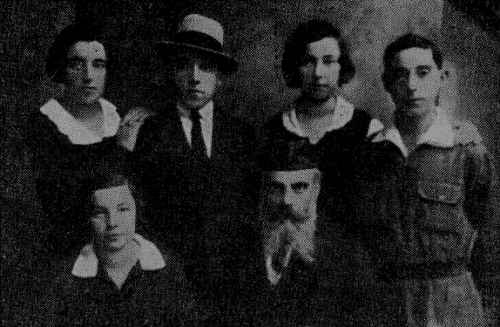
| Tzvi Shapira and his family |
Heikel Oberzhanski -- One of the notable men of the town. His home brought learning and wealth together under one roof. He was full of common sense and his clever remarks spread like wildfire among the local Jews.
The Kaganovitz family, the teacher Goldstein, and so many more were among the distinguished members of the Rakov community. Above all were those wonderful Jews who would drink thirstily, with open mouths, the sweet, pearls of wisdom from their teachers, preachers, and rabbis. I do not remember their names, but their dear images are still hovering in front of my eyes.
Before the Revolution, the town was under the patronage of Minsk. They went to Minsk to study, and there they acquired a sense of their Jewish and Russian culture. One could still sense, in many homes, the deep ties to Russian language and literature, when from time to time during a conversation, someone would quote Pushkin, Larmontov, or Tolstoy.
Daily life was not easy - the keeping of the shops, the flax trading; but the homes were full of lights, and warmth.
The younger generation knocked on the gates of the youth movements, weaved dreams about immigration to Israel, engaged in Zionist activities at school--fundraising, and so on. Can we mention the young generation without mentioning its nerve center -- Aba Botvinik (who wrote the article about the youth movements in this book)?
Remember the school. I doubt I would get the same enthusiasm, the same satisfaction from teaching, as I was privileged to have in my earlier years -- the years I spent at the Rakov school.
The new Hebrew school “Tarbut” was located in the New Synagogue, in its Ezrat Nashim (women's section) and its foyer, all of its seven classes.
The teacher, Malka Kazinitz, who was much beloved by the children and the teacher, Kavertatz, who taught the first grade, and I were responsible for all the classes in the school. We worked in two shifts, from 8 in the morning to 5 in the afternoon, sometimes combining two classes for the same lesson. We were young then, full of energy. In the evening we were involved in public, Zionist activity, and so on; every institution in the community included the participation of the teachers.
The Hebrew school in the town was a small sanctuary for Hebrew, Zionism, and the pioneering spirit, overflowing with love and cherished by everyone. It was the center of Zionist activity, the source of nourishment for the youth movements, prompting the youth to immigrate to Eretz Israel.
The school adopted the Hebrew language and endorsed it as the language par exellence. It encouraged the community to speak only in Hebrew throughout the whole day: in the street, in the stores, and at home. Thus the children spread the Hebrew language to every corner of the town.
I remember how Haya Minya Ovrazhenki, a clever woman, was forced to learn the Hebrew words for the school supplies, lest her store be boycotted by the children.
Last, but by no means the least, the community children. What sparkling lights they were. I loved them all, all of them, very, very deeply.
The children were full of affection and love for the school, the Hebrew, the learning, and the teachers. Who could ask for anything else?
I remember how we studied Nevi'im Rishonim (the prophets - the part of the Bible which tells the history of the Jewish People from the conquest of Canaan to the destruction of the first Temple). The children wanted to make more progress, and suggested that we start school an hour earlier than the regular time, at seven o'clock in the morning.
During the spring mornings, in the silence of the school building, we studied portions of Nevi'im Rishonim. The students, childhood dew still surrounding them, their eyes still reflecting fragments of their night's dreams, continued their dreams into the stories about Saul, David, and Jonathan. How excited they were when we read the chapter about the dramatic confrontation between the king Ahab and the prophet Elija, when Elija cried : “Have you murdered and also inherited?”
They sat enthralled. Many times I left the classroom, while the students continued to sit in place, still thinking and daydreaming. Even though I was hired to teach only the schoolchildren, as the time passed by, I was asked to teach the adults also. I accepted, and began to teach the adults a chapter from the Bible, every Saturday afternoon.
The children studied the idyllic poems of the poet Shimonovitz, and the legends of Tzfat (a town in the Galilee). They were especially impressed by the poem about the AR”Y (Rabbi Luria Ashkenazi, a sixteenth-century Kabbalist) welcoming the Sabbath in Tzfat; the children learned it by heart, and each wanted to recite it, with the right accent and with full expression. They enjoyed the content and its captivating rhythm. Oh! The passion and the enthusiasm with which Frumale Lifkovitz read the poem.
At one time, we studied an act from a play, by N. Bistritsky, about Rabban Yohannan ben Zakkai [a Talmudic sage, a disciple of Hillel, who saw the destruction of the Temple, and was the founder of the Yavneh Academy]. It was in the women's section of the synagogue, upstairs. The building was empty, and Elka Shapira read, with her excellent accent and with the right emphasis, the section describing how Yohanan ben Zakkai, fearing for the fate of the Jewish People in the future, suddenly felt as if the interior of the Temple was shaking. In her velvety voice, full of sadness, in complete identification with the play's character, she read:
“Temple, Temple, why are you shaking?!”And the sound of the words, from the mouth of the girl, still echoes in my ears today. Then we did not sense the approching earthquake.
|
|
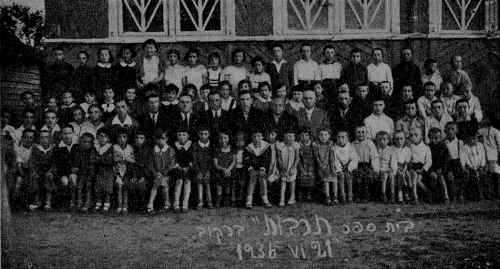
| Rakow – Tarbut School - 21 June, 1936 |
Tamar, Hela Lifkovitz, Moshale Rubinlik, Frumale, Alkale. All of them were pure young angels.
And the four that survived: Aharon, Nahum, Ziva, and Tsipora.
All of the children were assembled together, on that bitter, dark day, in the synagogue, their school. There they were burnt alive, and their bodies and souls went up in flames. They will remain imprinted in my heart, and live there, to my last day.
|
JewishGen, Inc. makes no representations regarding the accuracy of
the translation. The reader may wish to refer to the original material
for verification.
JewishGen is not responsible for inaccuracies or omissions in the original work and cannot rewrite or edit the text to correct inaccuracies and/or omissions.
Our mission is to produce a translation of the original work and we cannot verify the accuracy of statements or alter facts cited.
 Rakov, Belarus
 Yizkor Book Project
 JewishGen Home Page
Copyright © 1999-2026 by JewishGen, Inc.
Updated 26 Dec 2011 by JH
![rak076.jpg [38 KB]](images/rak076.jpg)
![rak077.jpg [38 KB]](images/rak077.jpg)