 |
|
It was in the 1880s of the previous century that a wave of pogroms was swept over Russian Jews. The skies had clouded over the Jews. The future of the Jewish people deeply touched his heart. Grandfather, my uncle Itzal'eh, and my father were regarded as the intellectual leaders of Rakov in those days. When they gathered in our home their conversation usually revolved around the state of Jews. Grandfather and uncle were the pessimists while father, the businessman, well versed in the current affairs of the world and the country, was among the optimists. Father used to travel far and wide in his extensive business dealings, to Kavkaz, Moscow, Warsaw, Tiplis, Vilna and more, and there he viewed the issues with a more optimistic view.
Upon his return from these trips he would talk about the commercial and
industrial developments in Russia and about its technical developments. His
words were like a light reflected from all he had seen and heard in his
travels.
“You are yet to see”, he used to say, “that the 20th
century will bring a tremendous development in technology and will march the
human race towards a happier life and a new world, and the Jews will advanced
along with the world population.” I do not know on what he based his
words, but that these were his words is a fact.
In my childhood I had the privilege to see one technical invention, an invention that was going to be part of the future civilization. We lived then in Bukhraka and we used to light up the house with “kinlakes” – branches from the pine tree, dry and thin, that were cut specifically for kindling. One day my father brought from Warsaw a great invention, an Oil Lamp. The oil lamp was a sensation in town.
The fact was that ready-made shoe stores or ready-made garment stores were not common then, also applied for furniture. It was a custom in the village to give a daughter that was about to marry a “commoda” (dresser) as part of her “oischteir” (dowry). My mother did not discriminate between a son and a daughter. When my eldest brother, Berel Zalmen, was going to marry my mother invited Moishe Yechiel the carpenter to prepare for him a “commoda”. The whole work was done, of course, by hand and took several weeks. And when the carpenter successfully completed his work he brought the furniture to our house. All the neighbors came to marvel and they all noted that the furniture was a real “antiquel”, never seen before.
Years later things had advanced so that for my sister Shosa's wedding my parents bought her a ready-made “commoda” from a Minsk furniture store. And when my mother came home and told her neighbors about purchasing a “commoda”, it was again a sensation. One of the women said, “Who knows, maybe there will be times when there will be no need to order a custom-made suit, but one could enter a clothing store, and buy himself a ready-made suit.”
On the edge of Rakov there was a narrow, winding alley-way. The narrow alley began at the huts of the ‘flax smashers’ (people who beat flax to make yarn), winding its way, like a colorful, charming snake, to the end of Vilna Street at the entrance to the town. Very few houses lined the alley, which was mostly filled with granaries overflowing with wheat, and with vegetable gardens -- a treasured corner. The precious place occupied our dreams during the days of our blossoming youth.
[Page 88]
Not even a single Jewish house could be seen in that alley-way, but nonetheless it was woven into our memories, the place that seeped into our dreams - the dreams of the Jewish boys in the town. Here was the “skolka”, a fine building in a well-maintained, fenced yard. Here the Gentile children supposedly studied. They “studied” there for one whole winter after another, and finally came out just as they had come in - ignorant, not even knowing the shape of an alphabet letter. We, the Jewish boys, were not jealous of them. Studying years at the “skolka” could not be compared with one Bible lesson with R. Shlomo Yidles the Melamed [teacher at the heder], who used to sit at the head of the table, with the yarmulka [skullcap] on his head and his eyes shining. He used to explain phrase after phrase with his special sweet intonation, sweet as honey. We often fought against the Gentile children. On winter days, the “skolka” boys attacked us with snow balls, but were forced to retreat after a hard-fought battle, as we had the upper hand. And it couldn't have been otherwise, for, after all, we were the descendants of David, who stood by himself in battle against Goliath the Philistine. And even more, in front of our eyes floated the images of the Biblical heroes who fought side-by-side with David -- Yoav and Avishai, the sons of Tsruyah. Their images stood before us in the battles against the “skolka” boys, the descendants of the Goliaths and the Amalekites…
|
|
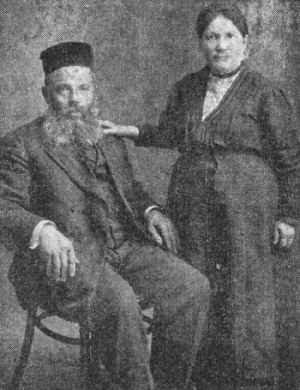
| Yakov and Rachel-Guta Botvinik |
Only a narrow path led from the Granary Lane to the synagogue's courtyard. It was this path that the Jews of the town took on Sabbath afternoons, on their walks to the open fields outside the town,
[Page 89]
next to the Gentiles' apple and pear groves. The smell of the fields was intoxicating, and transported them to another world, to infinite spaces in the world of God.
The small alley-way continued to wind its way like a snake until it reached Vilna Street in the west, and from there to the depths of the forest which surrounded the town. There we, the boys and our older sisters, would go in the summertime to pick those blackberries, and would bring them back home, to our mothers, to cook.
This alley-way connected east with west: Minsk to the east of town, and Vilna to its west. Minsk was some 35 kilometers away. It was the big city, and everyone's eyes were fastened upon it. There we went, after an internal struggle and a confrontation with our parents, to study and acquire the “heavenly education.” We came back home for the holidays, and immediately after the holidays we returned to the city. We traveled mostly by train, though sometimes we took a wagon. Going by wagon led us through many kilometers dotted with small and peaceful Jewish towns, just like ours, each shrouded in their dreams.
After the change of governments, Rakov became a border town, and the small granary alley led to Vilna, to the west. From then, Vilna became the preferred destination of the ambitious young men of the town, whether for studies or for commerce.
A small house, a thatched roof hut, standing alone, some one-and-a- half kilometers from Rakov, on the road to Minsk. A lonely peasant hut, next to the fragrant pine forest - the home of Rabbi Yohanan “the Commissioner” (a person who bought merchandise in the city for store owners in town, and received a commission). Seeing him, one could mistake him for Rabbi Yohanan the Cobbler (a Talmudic sage). A Jewish man with a respectful figure, handsome, high-minded, and a scholar. His highest ambitions were that his sons would also become scholars. And indeed, one of his sons became a rabbi somewhere in America.
Walking on the road to Slomianka, one might find himself at the door of a Jewish “settler” who is also a scholar. And when he, Rabbi Yohanan, opens and stand on the threshold of his door, his face is shining, his brow high and bright, his beard, just like those of the rabbis of the Talmud Period. He inspires his guests with joy and happiness.
A forest of pine trees, green and fragrant, a clear brook, the chirping of the birds on the tree tops, and the voice of Rabbi Yohanan studying the Gmara. That was Solmianka in those days.
Here, in Solmianka, was the cradle of the Bund in Rakov. Here we held our meetings, and here, in the Solmianka woods, the young men of Rakov first heard about the Revolution and about Socialism. Here, also, was the cradle of first loves. Here overloaded hearts came to weave their youthful dreams; in the woods of Slomianka.
|
JewishGen, Inc. makes no representations regarding the accuracy of
the translation. The reader may wish to refer to the original material
for verification.
JewishGen is not responsible for inaccuracies or omissions in the original work and cannot rewrite or edit the text to correct inaccuracies and/or omissions.
Our mission is to produce a translation of the original work and we cannot verify the accuracy of statements or alter facts cited.
 Rakov, Belarus
 Yizkor Book Project
 JewishGen Home Page
Copyright © 1999-2024 by JewishGen, Inc.
Updated 07 Jul 2013 by JH