|
|
|
[Pages 261-262]
by Moshe Bachrach
Translated by Gloria Berkenstat Freund
In his poem, If Your Soul Knows, Chaim Nachman Bialik called the beis hamedrash [synagogue or house of prayer] the creator of the nation's soul – the forge on which was formed the soul of the people. However a smithy is necessary to forge; nothing is forged by itself. So who in our shtetlekh [towns] were the “blacksmiths” who formed the soul of the people?
These were the individual Jews, men as well as women, who in the political, ethical and poetic sense had a daily effect on the life of the community and a direct influence on the path of life in the shtetl in general and on the sensitive individual in particular. Together, they all continually enriched, fertilized and made it easier. Those among us who were particularly perceptive and, especially those who had the luck to be under their influence, bless their memory.
The influence of these chosen few was quiet, but in sum total, very reciprocated in Goniadz.
[Pages 265-268]
By Ze'ev Wolf Kamenietzki Haifa, Israel
Translated from Yiddish to English by Dr. Isaac Fine
My father, may his memory be for a blessing, was born in Semyatich, a city in the environs of Brisk. His grandfather had been in a very successful business in association with his brother, who later became the rabbi of Bielsk. They transported salt in ships from the Carpathian Mountains through Galicia to the port of Danzig. When my father was three years of age, his grandfather traveled with a transport ship in the direction of Danzig. There was a great flood while traveling on the Vistula River, and all the ships with their salt cargoes went under. On that occasion they lost all of their wealth. My father's mother died from the severe stress which followed, and my father became a young orphan.
My father didn't study in yeshivas. His goal was to study with great and distinguished scholars. He traveled to Vilno, which was called the Jerusalem of Lithuania. Vilno had great rabbis and also renowned figures of the secular enlightenment. He spent a number of years there. When he returned home they began to refer to him as a “Berliner” and a “free one". Soon afterwards he married my mother and subsequently accepted a position as dayan in Sokolke. He stayed there several years, and then became rabbi in Vishnieve, a shtetl not far from Voloshin.
Vishnieve was encircled by forests. My mother was frightened, seeing the wild animals in the nearby woods from a distance. She became so anxious that she was unable to leave the house. She traveled to Vilno for medical consultations, and the physicians advised her to spend some time in Frantzenbad, as a curative experience. Returning back home she stayed with her parents in Suchovole, and from there wrote my father, informing him that the physicians ordered her not to live any longer in Vishnieve. Soon afterwards, Father left that town to join my mother in Suchovole. After arriving in Suchovole, he discovered that the Goniondz rabbi had recently left Goniondz after a great dispute with the Chassidim. Father traveled to Goniondz at that point, and then was accepted there as the new rabbi.
He spent the rest of his life in Goniondz. For five years, he suffered through another great dispute in town. After the dispute ended, however, everyone considered him a good friend. In character, he
was a rare, good man. My mother didn't let him handle money because he would give it away to the first guest who came to him. He would send every guest who came to him in the House of Study to the shtetl restaurant, and he would arrange to pay for that person's bill quietly with the restaurant owner so the person would have a good meal. He never argued with a person who disagreed with him. He would simply convey to him, quietly and peacefully, his intention. He would sit in the House of Study until one in the afternoon. When he saw a worker arriving in the House of Study, he would approach the man and inquire regarding his domestic affairs and also his work. Grandfather would walk with him around the House of Study, chatting with that person as one might with an important businessman. My grandfather was criticized for “lowering himself” too much by such behavior. His memory was quite extraordinary, and his mind was sharp and clear. I believe I do not exaggerate in stating that he knew the Babylonian Talmud by memory. He also was familiar with the old philosophical books. There were no cases in which protests were registered against his rabbinical judgments. He was loved by all the inhabitants of the shtetl, including the Christians. When he was occasionally traveling outside of town, Christian passersby would fall on their knees before him. When a Christian had a dispute with a Jew, he preferred to go to the rabbi for settlement of the case rather than to the secular court. When a wealthy Christian saw that my father was going to the river to bathe, he would accompany him, and wait for him at the river edge until he was finished.
I recall an anecdote concerning a Christian who came to the rabbi complaining that a baker had been required to pay him five rubles and sixty kopecks in exchange for grain. The baker had paid him the sixty kopecks, but didn't give him the five rubles. At the time of the transaction, the baker had told him that he had forgotten to bring the rubles. Later on, when he came to the baker to collect, the baker did not want to pay. My father immediately called in the baker and asked him, “What is the situation with the five rubles that this man says you didn't pay him?” The baker didn't answer. My father told him that he should pay the Christian the five rubles. The baker immediately took out five rubles and paid the Christian. After he had paid, the baker said, “God has sent me a reward, the rabbi has become my partner.” My father smiled broadly and remained silent.
My father was seventy-three years of age when he died, on the fourteenth day of the month of Sivan, 1907, on a Friday at sundown.
[Pages 269-270]
by Avraham Yaffa, Tel Aviv
Translated by Gloria Berkenstat Freund
My father, may his memory be blessed, came from many generations of rabbis, from which the first was the famous gaon [sage], Reb Mordekhai Yaffa, known by the name “the Levush”(a shortening of the title of the book Levush Malkhut [Robes of Royalty] which he authored). He [my father] was born in Kobrin, Grodner gubernia [province] to my grandfather, the Kobriner Rabbi, Reb Yakov Yaffa. At the age of 15 my father married my mother, the God-fearing esteemed Bluma, may she rest in peace. As was the custom at the time, my father was oyf kest [support from in-laws while studying] for several years, studying in the Beis-Medrash [house of study or prayer] for several years. My mother of blessed memory was a woman of valor and helped carry the burden of earning a living. She had thirteen children, of which only six survived. I remember how my mother, my she rest in peace, in addition to the Shabbos candles on the table, would light seven more small candles that she would place in potato “candlesticks” at the edge of the chimney. At the blessing of the candles, her tears would flow for the life and health of the living children and also for the souls of those whose lives were cut off before their time.
After kest, my father moved to Kovno for several years to study and receive ordination from the Kovner Rabbi, the Rabbi, the gaon [genius] Rebbe Yitzhak Elchanan, of blessed memory. An interesting episode is told about my father's life in Kovno: once, on a hot summer day, sitting with a gemara [Talmud] for many hours in the Beis-Medrash, Reb Elchanan suggested that the young zealots go outside and get a little fresh air. They sat under a tree
[Page 270]
resting and the tired yeshiva man fell asleep. When he opened his eyes he saw how Reb Yitzhak was driving away the flies with his handkerchief. One can imagine what he felt seeing the fatherly love of the giant of his generation.
Receiving his ordination as a rabbi, he was hired as a dayan [religious judge] in Goniadz. This was his first rabbinical position and his last. My father, may he rest in peace, was a refined scholar, quiet and modest and a great peacemaker. He always tried to calm things with good and clever words and when a couple came to him for a get [religious divorce]. His tall figure, his pale face with the beautiful beard and rabbinical frock coat, strolling across the room with an open book in his hand remains in my memory from my childhood.
He died very young at the age of 36 of pneumonia, on the 19th of Tishrei (Khol HaMoed Sukkous [intervening days of the Feast of Tabernacles]) 5651 [3 October 1890], when I was still a young child. I was later told that one of the cheerfully argumentative, embittered Hasidim in Goniadz, a scholar, who was a vindictive person, threatened to pour a dipper of cold water on him on erev [eve of] Yom Kippur at the steam bath. In order to avoid the grave disgrace and the quarrels, he [my father] went away to the river for the ritual immersion for purification – and the erev Yom Kippur immersion led him to the grave.
Thus a noble scholar was annihilated before his time by a sorrowful joke by a fanatic. May his soul be bound in the bond of life.
[Pages 271-276]
by Josef Hertzig, Tel Aviv
Translated by Gloria Berkenstat Freund
|
|
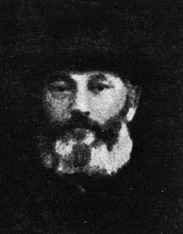
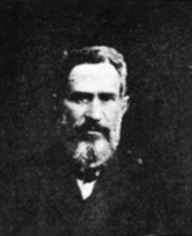
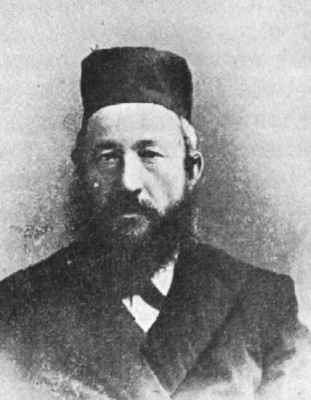
| Rabbi Tzvi Wolf |
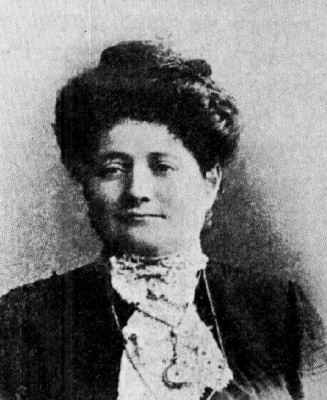
The Kovnicer Rabbi, Reb Tzvi Wolf, was chosen to occupy the rabbinical chair in Goniadz in 1907 after the death of the old rabbi, Reb Gedalia Hakhohan, may he rest in peace. The Rabbi Wolf was a lively, active personality. The middle class in Goniadz understood that it was not enough that the rabbi be a scholar; he had to know how to administer the kehile [religious community] and, in addition, to represent it vis-à-vis the state organs. These two traits were possessed by the Rabbi Wolf: he was a great scholar, an exceptional speaker and representative figure. His wife Blume was a true woman of valor and a helpmate to whom all related with respect.
Both the rabbi and the rebbitzen [rabbi's wife] threw themselves with life and soul into the activities of charity with good Jewish hearts. There was no lack of needy people in Goniadz who always struggled for their livelihood. The new
[Page 272]
rabbi's home became a communal Jewish center where one would come not only with a religious question or a Din-Torah [case brought to a religious court], but also for good advice in family and business matters. Before the loan office was created, the rabbi's house took care of many of the needs with interest-free loans. Not a rich man himself, the rabbi would borrow from others and give loans. The borrowers were usually not punctual in repaying the loans. The rabbi had to take a second and a third loan. All members of the family helped and, particularly, the rebbitzen. The rebbitzen also knew well who was in need of immediate help, a sick poor man needed a piece of meat, a baby a little soup or milk, or only a little jam for a delight. And if a needy woman lay in childbirth, linens or sheets were taken out of the cabinet and sent as a secret gift.
In general, the rabbi's home was open for everyone “who is hungry” – whoever entered
|
|
| The Rebbitzen Blume Wolf |
[Page 273]
hungry left satiated. Visitors, who always had enjoyment from the homey and friendly attitude, often sat at the table.
Rabbi Wolf sensed that which he had traced in his first sermon at his welcome in the synagogue that was as overflowing as at Kol Nidre [prayer opening the evening service] on Yom Kippur:
“A rabbi in a city must be a city clock; placed high and in the middle of the city. Placed high, in order that no one can steer him as he wishes… And in the middle of the city in order that all can see him and be guided by him at all times…”Rabbi Wolf did not treat the political powers in the city with partiality, but he was always on the side of the just and the weak and therefore he had opponents with whom he carried on a struggle.
He was well known as a good arbitrator and they turned to him from other cities with the most complicated disputes and religious court cases. He possessed a sharp mind and a phenomenal memory. He did not have to turn pages in a religious book to find the necessary law or answer to a religious question; but he knew exactly where and how to handle the matter. He did not need to take notes about the arguments of both sides at a religious trial because he remembered all of the details exactly. In addition, the “school of life” which he had gone through before assuming the rabbinical seat helped him; he was a merchant and a textile manufacturer in Bialystok for a time. His system was – to let the person who brought the case speak and argue as much as his heart wished without interruption, and then pose questions to the point.
Rabbi Wolf was an exceptional speaker. He directed the Khevre Mishnayus [Mishnah – compilation of early Torah commentary – Society], Khevrve Shulkhan Orech [Shulkhan Orech – code of Jewish law – Society] and for a time also the Khevre Shas [Talmud Society], in which
[Page 274]
Yakov Rudski had the privilege of leader. The Khevre Mishnayus was actually democratic and consisted of a large number of old and young Jews from various strata – businessmen, traders and artisans.
There was no yeshiva [religious secondary school stressing Torah studies] in Goniadz, but Rabbi Wolf was interested in the young men from the yeshiva, who would study “away from home.” The rabbi gave a lesson in Talmud several days a week for the capable young men who could not travel “away from home.” (His students were: Zelig Niewadowski, Yehuda'l the son of the shoykhet [ritual slaughterer], Meirim Welwl Zodczak's son, Idl the watchmaker, Khuna Machai, Sender's son Avraham'l and so on). He exhibited a warm interest in the unfamiliar young men who would come to Goniadz to study ritual slaughter (Goniadz contractors would slaughter many cows for the Russian military in the Osowiec Fortress and there was no fear of a cow becoming unkosher. Therefore, Gonaidz was a suitable place to practice ritual slaughtering.)
Before the outbreak of the First World War the rabbi would make an appearance to intervene with the Russian regime on behalf of Jewish soldiers or reservists who came to Osowiec for several weeks' exercises. Once, Erev [eve of] Rosh Hashanah, the rabbi delayed the praying until 11 o'clock at night, until the Warsaw reservists arrived from Osowiec. It was a group of several hundred Jews. They did not start praying until every reservist was taken care of in an inn and with meals for the two days of Rosh Hashanah.
At that time high ranking military men would come to the synagogue hill in connection with defense plans. The rabbi would come to greet them and receive the assurance that Russian soldiers would not disturb the calm in the city.
[Page 275]
When the war broke out, a group of staff officers with the War Minister [Vladimir] Suchomlinov at the head once came to the synagogue hill in the morning. Rabbi Wolf accompanied by Reb Benyamin the scribe came to the synagogue hill and opened the synagogue for them. When Suchomlinov observed, “It is dark and it is difficult to see the horizon” – Rabbi Wolf responded – “Therefore there will be light in all of Russia.” And the War Minister offered him his hand with a thank you for his good wish (several years later, after the collapse of the Czarist regime, Reb Meir the watchmaker said that the rabbi's blessing had come true…)
At the expulsion of the Jewish population from the front lines in 1914, the rabbi and his family traveled to Bialystok, which was flooded with refugees from the surrounding shtetlekh. He occupied himself with work on behalf of the homeless and particularly with the poor people from the town – the Goniadzer.
Rabbi Wolf received a high office
[Page 276]
in the Bialystok rabbinate and could have lived esteemed in the large city, but an opportunity arose to return to Goniadz and he returned with others. Then a misfortune happened and his devoted wife died. She was brought for burial in the Goniadz cemetery. From that day, the rabbi's health became severely worse. He suffered from diabetes for a long time and during a visit to his brother in Bialystok he became very sick and died. He died on the 18 Sivan [20 June] 5684 (1924) at the age of 58 and was buried in Bialystok.
Goniadz Jews mourned him deeply as their spiritual representative, the sage and worldly man. His handsome appearance, his neatness and purity, his energetic walk and worthy way of speaking remain unforgettable for everyone who knew him.
Blessed be his memory.
[Pages 277-280]
Translated by Gloria Berkenstat Freund
Our father, the Rabbi, Reb Yisroel Shlomowitz, of blessed memory, was born in 5641 [1881] in Yanow [Yanaveh], near Kovno. He was descended from the esteemed families of the shtetl [town]. While still in his young years, our father traveled to study in the world famous yeshiva, Knesset Yisroel, in Slobodka, where he was immediately recognized as one of the pillars of the yeshiva.
He excelled with varied expertise and intelligence so that he received the nickname, “the small Ketzot haChoshen.[1] He also had a good reputation because of his good traits.
My father studied in the yeshiva until his wedding. Widely known as a giant of Torah and musar [Jewish ethical movement], he received rabbinical ordination from the Rabbi, the Gaon Reb Eli Borukh Kamay, Mirer Rabbi and head of the yeshiva; from the Rabbi, the Gaon, Reb Iser Zalman Melcer, Slucker Rabbi; from the outstanding rabbi of his generation, the Telcer Rabbi and head of the yeshiva, Reb Eliezer Gordon (Reb Leizer Telcer).
My father was married in 5669 [1908 or 1909]. Our mother was a daughter of the Horodok shoykhet [ritual slaughterer], Reb Eli Rapoport, a distinguished scholar in Torah and a God-fearing person. After the wedding, my father spent time in Horodok and studied with an extraordinary zeal, as in the yeshiva, for approximately 16-18 hours a day. He traveled to Grodno from Horodok to study.
Later our father, may the memory of a righteous man be blessed, occupied the rabbinical seat in Amstibowe. After a short time, he arrived in Meyshegole [Maišiagala], near Vilna.
[Page 278]
|
|
| Rabbi Yisroel Shlomowitz |
He would study a page of Gemara at the Ramailes Yeshiva and at the same time published the book, Beit Yisroel [House of Israel], part one (published in 5686 [1926]). The book quickly was accepted by all Torah sages and yeshiva members.
In 1924, following the advice of the leader of his generation, the Gaon, Reb Chaim Ozer Grodzinski, he chose Goniadz from several towns that had invited him.
There were many good merchants, scholars and esteemed Jews in Goniadz at that time among whom my father became beloved.
In Goniadz, my father immediately began to create and revive various institutions, such as the gmiles khesed kase [interest free loan found], khevre kadishe [burial society] and so on. My father also renewed the linas hatzadek [society that cared for the sick] that really blossomed and helped very many poor and sick families.
In general, my father would spend a great deal of time helping all of the needy.
[Page 279]
There was no one who needed something who was left without help. He often did not leave the beis-hamedrash until he had made arrangements for all of the visitors and poor.
I find it necessary to remember that in all needs of the shtetl, the dear, generous Reb Benyamin Sofer [scribe], of blessed memory helped a great deal. He did good things for everyone throughout his life. My father would work together with him, as well as with the “Ladies Auxilary” of the Goniadz Landsleit [people from the same city] in New York.
My father did much in the realm of religious-cultural life. He created and studied with many societies: Talmud Society, Mishnius [Oral Law] Society, Mishneh Torah [Repetition of the Torah by Maimonides, also known as Rambam] Society and Chafetz-Chaim [Seeker of Life]. He created his khederim [religious primary schools] and hired teachers from other cities because the school in Goniadz, according to his understanding, was too liberal.
[Page 280]
But our father always strove to create a yeshiva in Goniadz, which, alas, he did not live to see.
In 1938-1939 my father printed the book Beis Yisroel, part two which, alas, remained in the printing establishment and was not published because of the war and his manuscript, a work of several treatises, was lost.
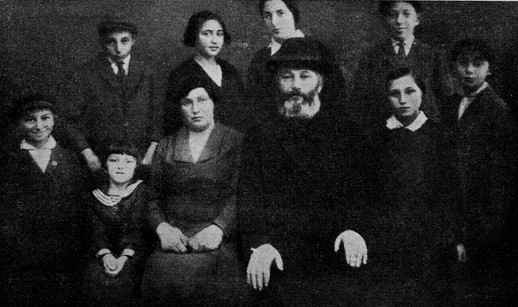
At the beginning of the war, 1939, before the Nazis entered and everyone ran from the city, my entire family also left for Horodok. My father returned when the Russians entered, even though we were opposed to this, because he believed that one must not leave the shtetl neglected. We escaped to Vilna, which had been given to Lithuania and we wanted everyone to travel together. But my father did not agree to this at first; then it was too late.
|
|
| The family of Rabbi Shlomowitz |
Translator's note:
While in the yeshiva he opened his own Gemiles Khesed Fund [interest free-loan fund] and every evening after Maariv [the evening prayers] he gave loans to the yeshiva members. He would himself make loans of money for this purpose. Return
[Pages 281-284]
by Moshe Bachrach
Translated by Gloria Berkenstat Freund
[Page 281]
It has happened more than once that I have heard from a non-Goniadzer that there was a greater abundance of idealism in Goniadz than in other shtetlekh [towns] – and I am inclined to agree with them on the basis of my own experience. I will only add that there was a spiritual and communal climate in Goniadz that made it possible to collaborate; mutual respect among scholars and simple Jews, Orthodox and free [secular] and between intellectuals and artisans. One met pious intellectuals in Goniadz who helped plan and carry out in practice the principle of modern education, both in content and in form – and equally for girls and boys. We also had “freethinkers” who strongly valued the pious and tolerant scholars and discussed Jewish matters with them with mutual respect.
For a provincial shtetl this was surely a rare phenomenon. I think that we have to remember here certain individuals who, with a kind of tolerant spiritual relationship to people and ideas, had an effect upon us.
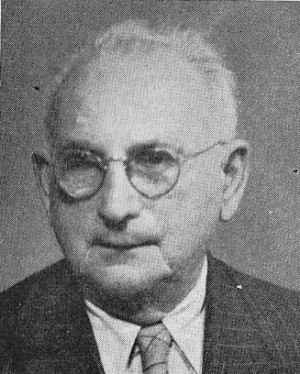
I will record in the book of memories of Goniadz one person who represented a rare combination: practical idealism. This is Moshe Levin, who we would familiarly call: Moshe Klewianker [Klewianka is village near Goniadz].
Moshe Levin has been identified with Hebrew education for more than a half century. First we know him as a private teacher, then as a founder and leader of Hebrew schools, as a teacher of teachers, as
[Page 282]
|
|
| Moshe Levin |
a writer of text books and – as a result of all of this – as an educator of two generations of cultural Jews in the Hebrew and Zionist spirit.
Like every self-educated man, Moshe Levin always studied and never “graduated” from anywhere – when the frame became too narrow for his widened horizon he would expand, and as an educator he adhered to the precept that “Because this people has rejected the gently flowing water of Shiloah…” [Isaiah 8:6].
He was quiet and industrious for all the years, first as a pioneer of modern, Hebrew education in Goniadz, later as the most recognized pedagogue in Bialystok, then in Canada and now, in 1957, in Israel, where he is the author of text books at the ripe age of more than 70.
But the crown of creation of Moshe Levin was without any doubt the Goniadz Hebrew School for Jewish and general education.
[Page 283]
This was during the time of the First World War in the autumn of 1915, right at the beginning of the German occupation. The military commandant still had not gotten his bearings in the life of the partially shot up shtetl and Moshe Levin, the practical idealist immediately planned and began to organize a Hebrew school – with the material that he found or decided to create on the spot.
Ephraim Halpern, of blessed memory, found favor with the commandant of the fortress in Osowiec and he probably persuaded the yekie [German Jew] that he [the yekie commandant] would be doing a “civilized” thing if he would permit the taking of the school chairs for the shtetl from the “skole” [public school] that the Russians earlier had for their children. Perhaps Ephraim had bought him off with what he said, that German would be taught in the school…
Right from the start Moshe Levin had one experienced teacher in Yoal Meir Khahan (son of Fayge Ruchl) and he trained two young intelligent young men in the work itself. This was Shimeon Halpern and Yohnatan Nejman, who were annihilated too young. Luck favored Levin and, among the Jews evacuated to the shtetl from the Brisk region, exiled behind the front by the German military regime, an experienced Hebrew teacher just happened to arrive in Goniadz –
[Page 284]
an instructor from the Grodno Hebrew pedagogical course who in addition could lead a choir. This was Shmuel Skliut.
As if through a spell, in a relatively reasonable short time, the shtetl became filled with the ring and melody of Hebrew, under Moshe Levin's leadership. Over a period of several years, Hebrew became a fluently spoken language among the school youth of Goniadz. The level of general education continually rose.
The Hebrew school was the “darling of the shtetl” and the influence of the new spirit that the school introduced had an effect on young and old. I cannot forget how once in the middle of praying in the house of prayer, I was called to the side by a Jew in a talis and tefilin [prayer shawl and phylacteries] and he roared a song for me that his children had “brought home” from the school…
The Goniadz school became a pattern for the entire area and years later earned recognition when it was declared to be the best Tarbot [network of secular Hebrew schools] school in all of Poland!
Rarely does a man live to see an ideal so fulfilled as Moshe Levin saw in the Goniadz Hebrew School, of which he was both the founder and the administrator.
[Pages 285-288]
by Moshe Bachrach
Translated by Lazer Mishulovin
Donated by Bradley and Kathy Fisher
Anyone who grew up in Goniadz in the days of Binyamin the scribe, cannot be objective when writing about Binyamin. Willingly or not, the writer will touch upon moments of his own life that are bonded to Binyamin with chords of love. This assertion explains how when the synagogue was the grandeur of Goniadz, Binyamin was the key to its splendor.
God blessed Binyamin with the skill to ignite candles of holiness. For decades he sparked festive and ecstatic joy in the hearts of an entire community of Jews. He was at that time the “minister” of religious-celebrative moments in the supernal Goniadz, of which the synagogue was her corridor. It is, therefore, not a wonder that already during his lifetime Binyamin was a national hero and a legend.
In his poem, The Shul,” Eidel Treshtchansky poetically expressed the sentiments of many Goniadz Jews towards the synagogue: “withy her thousand charms – where rests Godliness himself.” But the man, who with the skill and enthusiasm of an inspired artist, made the poem “one thousand charms” vibrate and flutter in the synagogue – was Binyamin. Under his influence, the entire “ensemble” – the prayer leaders, the cantor, along with the choir and the holy congregation of worshippers – very impressively played the religious-Jewish symphony in the Goniadz synagogue.
Certainly, there were synagogue wardens and “remarkable bourgeois” who voiced their opinion to Binyamin. Binyamin, however, invested so much of his personality in the minutest detail pertaining to the synagogue that the wardens and the bourgeois were totally eclipsed. Everyone in the synagogue was happy to be Binyamin's “subject.”
The slim livelihood Binyamin earned working for the synagogue, was compensated by the productive moments that he experienced. This is the case with every authentic artist, whose true profit is the mere creation.
I remember the pogrom at the Goniadz synagogue by the local Polish pranksters in the year 1912. The scene of a torn Torah scroll on the ground, where nearby elderly Jews stood weeping like children, will never leave my mind. But the most unfortunate one of all was Binyamin; his synagogue, his Torah scrolls and holy accessories to be so lowly desecrated!
Binyamin demonstrated another virtue for which he earned the love and reverence of many of the Goniadz's Jews. He, literally, felt a paternal love for everything and everyone that had a connection to Goniadz; and to Binyamin, all of the surrounding towns belonged to Goniadz's parish, including Bialostock…
Through the red-kerchief-method of gathering and sending help to the needy in Goniadz and its vicinity, Binyamin, from America, helped and cheered up many people between the two world-wars. In the Vale of Tears on the other side of the Atlantic Ocean, where there were so many people who did not have any contact with relatives in America – he became their “relative.”
Binyamin managed a precise, although primitive, bookkeeping of the collected money and the money that was distributes on the other side of the Atlantic – understandably, according to his instructions. He would, literally, experience the complaint-letters as well as the thank-you letters from his correspondence. With time, Binyamin became a legend to those who were suffering on the other side of the Atlantic, and for us Americans – a national hero.
Binyamin spent his last years in the Bialostock nursing home on East Broadway in New York, where he was honorably cared for. For many years, he was a great patriot of the institution, as well as a frequent visitor. On the nineteenth of Kislev, 5754 (November 26, 1953) Binyamin passed away. Binyamin's physical body was redeemed from the institution, but his memory lives on.
[Pages 289-291]
by Yeruham Levine z”l
Translated by Selwyn Rose
Even though the town had considerable economic difficulties, Goniadz had a group of residents who strenuously concerned themselves with the welfare of the public and Zionist activities without any consideration of personal gain or prestige.
The time: – the days of the German conquest during the First World War. For political and administrative considerations, the German authorities transferred Goniadz from the district of Grodno in the county of Bialystok (southern Lithuania in the German view) and attached it to the Warsaw zone (under von Beseler's General Government). The Warsaw zone was, from the beginning programmed for independence of the hoped–for future Polish government.
In Goniadz it was seen as an opportunity to exploit the pseudo–independence of the situation to found a Hebrew school, while in the Lithuanian zone such schools were forbidden. Shortly after the conquest the German authorities chose Rabbi Ephraim Halpern, a highly respected businessman in Goniadz and named him Burgomaster. A teacher and the son of a teacher, a close friend of Dr. Matman–Cohen, founder of the Hertzlia Gymnasium in Jaffa and Ramat–Gan, near Tel–Aviv, he sent his eldest son Joseph Halpern to study at the Gymnasium in 1912.
[Page 290]
|
|
| Rabbi Ephraim Halpern |
It was his intention to send his second son, Shimon as well but the 1914–1918 war broke out and delayed his plans. Rabbi Ephraim was dedicated heart and soul to the idea of a completely independent, fully Hebrew school in the Diaspora
[Page 291]
for the experimental educational methods of the teacher Gedaliahu Kozlowski who founded the school in Goniadz in 1903 through the instigation and efforts of Rabbi Ephraim.
After a concerted effort lasting some months trying to deal with the problems of “What shall we eat?” on the 1st January 1916, the Jewish Burgomaster dared to open the first Jewish Public School in Poland where all subjects are taught in Hebrew.
Yaakov Rudeski's brewery temporarily housed the school. At that time, the Germans demolished the Osowiec Castle and Rabbi Ephraim requested permission to use the rubble and furniture to construct and furnish the school from the Russian schools that had previously existed, and received in writing authority to do so, at no cost.
The first Hebrew school in Goniadz existed throughout the German occupation together with all its instructors. The manager, Mr. Moshe Levine, a veteran teacher of Hebrew, authored the school's first Hebrew text–book in geography. He was assisted by teachers who had been his pupils and one teacher who had been trapped in Goniadz by the blocking of the roads at the outbreak of war.
The manager of the first Hebrew school in Goniadz and Poland, Mr. Moshe Levine, and together with him, two other teachers, Joel Meir Cohen z”l and Shmuel Skalyt subsequently transferred to the Jewish Public school that had been founded in Bialystok in 5769 (1918–9) and there, too, were among the pioneers of Hebrew education.
One of the most accomplished and erudite of teachers, Shimon Halpern, the son of Rabbi Ephraim Halpern, was taken from us in the springtime of his life at the end of the First World War in the Typhus epidemic. Rabbi Ephraim Halpern immigrated to Palestine with his children in 5681 (1921) and resided in Tel–Aviv. He lived to enjoy happiness among the ranks of the population, dancing the Hora in the streets which were at the heart of his life's desire. All his life Rabbi Ephraim mourned over the sacrifice of the Jewish people and the Land of Israel, living to a ripe old age. He was killed on 29th Tevet 5708 (29th January 1948), one of the nights Tel–Aviv suffered an attack, when he fell victim to a volley of shots fired from the Hassan Bek mosque.
May He Be Remembered for a Blessing.
[Pages 291-292]
by Moishe Bachrach
Translated from Yiddish to English by Dr. Isaac Fine
Yaakov Rudski was a Talmud scholar. He was also a man of worldly achievement. He was clever in dealing with the world, but not with himself and his family. Yaakov was a handsome man. He had a keen intellect and a charismatic personality. Yaakov was from the stock which gives rise to leaders and diplomats. He brought prestige to Goniondz. He was competent to serve as spokesperson for the Jewish community with the Tzarist government.
Yaakov traveled from Goniondz to attend the Fourth Zionist Congress in Basel, Switzerland. He had a momentous experience there, a face-to-face encounter with Teador Herzl, during which he received a greeting from this distinguished person. Yaakov built and destroyed worlds in Goniondz. In doing so, he exhausted his strength and his ability. He built the Osowiec fortress. He also destroyed the hill and built a beer brewery on its site. He was however not successful in this enterprise. Yaakov spent a fortune on the brewery project, and the hill lost its face.
His enterprise was phenomenal in scope. In the illustrious phase of Goniondz history during the Tzarist occupation, he served as leader of the Talmudic study group. Later, when Goniondz was in decline under the Polish regime, he wished to be town rabbi. However, he was not considered an appropriate candidate for this position.
He was a brilliant entrepreneur, but he did not acquire wealth. It always seemed that, for Yaakov, the scope of the enterprise was more important than the profits which might result. The town considered him a rich man. However, his demeanor was not that of a wealthy person. He had neither the time nor the patience to behave in such a fashion.
In 1914, his world was completely overturned by financial reversal as a result of the events of the First World War. He was left penniless. Yaakov left Goniondz, and was not heard of again until the War ended. When he returned to town, he was like an eagle whose wings had been clipped. He again became involved in public affairs. But it was not as it had been before. He had become a poor man, and was dependent on the community for economic support. Yaakov Rudski ended his years in poverty and loneliness, even before the Jewish community of Goniondz was destroyed.
[Pages 297-300]
by Joseph ben Ephraim Halpern, Tel–Aviv
Translated by Selwyn Rose
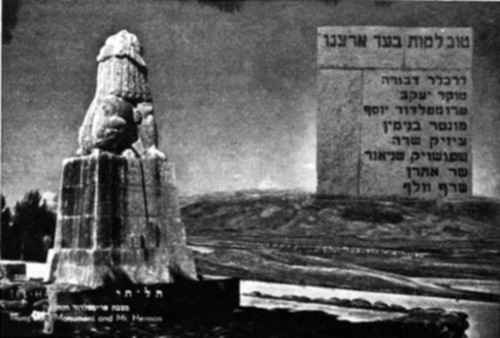
Yaakov Tucker, the son of Avraham Kalman and Haya–Gittel, and a son of Goniadz, fell heroically defending the main entrance gate to the Tel–Hai compound with his rifle in his hand.
Yaakov was a dear friend of mine; our memories go back to our earliest childhood recollections as members of the town's Cantor
|
|
| Tel–Hai memorial |
[Page 298]
Rabbi Nahum's z”l choir. Yaakov was blessed with a clear alto voice, light and pleasant to listen to. He was always the one upon whom rested the role of the solo in recitative passages, on the High Holy Days and the three pilgrimage festivals. His good–looks and delicate features captured everyone's heart and soul.
[Page 299]
Our ways parted while we were still young; he left Goniadz and went to live with his older brother in America, and I immigrated to Palestine. From then we never met or even wrote to each other.
After the First World war of 1914–1918 the 38th and 39th Battalions of the Royal Fusiliers – Yaakov Tucker served with them – were demobilized and Colonel Margolin z”l was in charge of their dispersal. I returned from Egypt to Jaffa from where I made my way to Jerusalem. In those days, we would travel as far as Lod by a narrow gauge railroad. At Lod we would have to walk about two kilometers to the station where the regular gauge railroad station was situated. The tracks were occupied by hundreds of wagons loaded with military equipment and heavy and light ammunition. Walking on my own, deep in thought, between the rows of wagons I suddenly became aware of a Jewish soldier, in British uniform striding towards me.
We both stood rooted to the spot – I in mine, he in his and after a brief glance one startled word sprang from my lips: “Yankov!” – as we used to call him when we were youngsters – and the soldier standing in front of me cried in disbelief: “Joseph!” It was our first meeting in Palestine.
We hugged and kissed each other and told each other everything that had befallen us in the years we had been apart. From that day onwards we never lost close touch with each other. He frequently visited us in our home in Neve Shalom and would spend days – months, even – in the company of my family. This was at the end of 1919 and Palestine was still closed with restricted entry and referred to officially as “Enemy Territory”; no one could come in and no one could leave. Representatives of the demobilized soldiers were seen throughout the country and Trumpledor[1] was active among the released Battalions. His voice was heard and listened to throughout their ranks; his fame preceded him. He was already on the lips of all our comrades in arms – the remnants of the “Zion Mule Corps” of 1915 – who fought under the command of Colonel Patterson.
The time: the days of Tel–Hai – Trumpledor, alarmed, was stuck in Tel–Hai – a weak spot. A call went out from there to all released soldiers dispersed throughout the country, to take up their arms and come to the defense of Tel–Hai, to defend it with their lives.
Leaving my home in Neve Shalom our dear Yaakov
[Page 300]
walked to the railroad station in town in order to travel to the Galilee in response to “Josef the Galilean's” (Trumpledor) call as he was nicknamed by everyone. Early Sunday morning Yaakov parted from us all with much warmth and affection, his haversack on his back and his rifle in his hand. We accompanied him as far as the railroad station. At four o'clock he returned to our house together with his equipment and ammunition.
We were stunned with surprise. Yaakov calmed us and explained that he together with others waiting to travel to the Galilee, were forced to return because the stormy rains that had fallen overnight had caused serious flooding and erosion along the tracks between Kfar Gigis and Rosh Ha–Ayin and the connection with Haifa broken. The situation continued through Monday and Tuesday and each day he went out and returned. Only on Thursday was the connection restored between Judea and the Galilee and Yaakov was on his last journey – to Tel–Hai.
There he fell, the hero's death. His name is engraved on Tel–Hai's memorial for eternity.
|
A letter from a Goniadz fellow-resident, Aharon Friedman, on the death of Yaakov Tucker z”l Mahanayim 19th Adar 5680 (1920). Mr. Joseph Halpern, I am writing this letter in deep sorrow. You certainly know from our town's newspapers that a son of our town, Yaakov Tucker was killed while defending Tel-Hai. Our responsibility now lies on us to arrange for the money due to him from the camp should be sent home. I have spoken about this with E. Golomb and he tells me that he sees no problem with doing so but since I am in Mahanayim I am unable to act – will you please take over this project? Please tell Golomb (if you agree to act), that I have asked you to act for me. I think Goniadz should be informed, taking care that his mother should not be informed. Maybe this news will awaken in the youth of Goniadz the impetus to immigrate to Palestine. I have not received any other letters from home.
Yours truly and in friendship, (–)
|
Translator's note:
|
|
JewishGen, Inc. makes no representations regarding the accuracy of
the translation. The reader may wish to refer to the original material
for verification.
JewishGen is not responsible for inaccuracies or omissions in the original work and cannot rewrite or edit the text to correct inaccuracies and/or omissions.
Our mission is to produce a translation of the original work and we cannot verify the accuracy of statements or alter facts cited.
 Goniadz, Poland
 Yizkor Book Project
 JewishGen Home Page
Copyright © 1999-2024 by JewishGen, Inc.
Updated 18 May 2014 by LA