 |
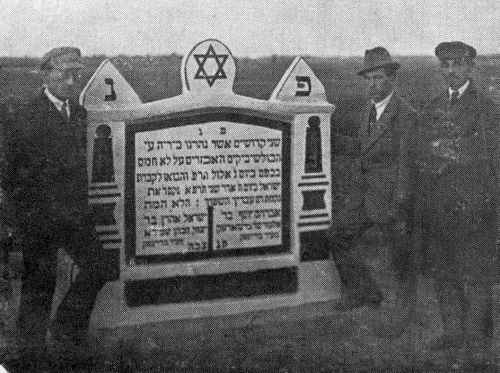
Standing by the gravestone is at the right: Haim Nosn Vengrov (Wegrow) z”l, thanks to whose initiative the corpses of those shot were brought out from the Christian cemetery to the Wyishkov (Wyszków) Jewish cemetery.
|
[Page 33]
Translated by Sheldon Clare
I do not remember the name of the last teacher-instructor in Vishkov – but also he – as all the pure and martyrs in town – all perished. I have attempted to recall from my memory certain figures of our annihilated holy community of Vishkov. I know that this is only a part: These are only bits (crumbs) of what our town had and possessed. I recalled the familiar, those who I knew. Those who I came together with them on various occasions, to cooperate or to see their activities. I know that I have omitted many names – they should not have a grudge against me. The (SHOROT) of mine should be a modest mourner's prayer to remember all the martyrs and purified ones (T'horim), who, along with the sayer of the mourner's prayer “perished for the martyrdom of being a Jew”.
by Mordekhe V. Bernshteyn, Buenos Aires
Translated by Edward Jaffe
Donated by Rona G. Finkelstein
In the description of the Nazi wrought destruction in Poland, the various recollections, witnesses testimony and other documents relate the behavior of the Polish population during the Nazi murders of the Jews. Not only did the Poles behave in a passive manner toward the Nazi atrocities, but they were often active participants in the awful acts perpetrated against the Jews. Not only did they often serve as denouncers in towns and villages, pointing out the Jews to the Germans, but frequently handed over Jews who were hidden and actually participated in robbing Jews during “actions” and “resettlements”, and ultimately becoming inheritors of the robbed goods and possessions.
Those who remember or know what the Poles did during the “honey times” at the creation of the independent Poland, after World War I, will not be surprised by the behavior of the Polish population, at least by its majority. When the Polish country took its first steps at the birth of the new “Zhetchpospolita”, the Jews experienced pain and paid in blood at the creation of the new country.
This is not the place to discuss the wave of pogroms that took place in the years 1918-1919. Specific details, materials and documents are recorded in several publications. The classic work by the known activist of Poali-Zion. Leon Khazanovich, describes the facts, the documents, the pogroms and the excesses in 105 towns and villages in Poland in November-December 1918. [L. Khazanovich: The Jewish pogroms in November and December 1918. Acts and Documents. Stockholm, 1918.]
Two particularly horrible massacres carried out by the Polish military, the extermination In Lemberg of that time, and the shootings in Pinsk in Nisan of 1919 are described in special publications. [Joseph Bendoov: “The Lemberg Jewish Pogrom” (November 1918 – January 1919), Vienna. About Pinsk: Abraham-Asher Feinstein - “Story of a Catastrophe”, Tel-Aviv, 1929.] Here we are discussing a second wave of anti-Jewish actions which came at the time of the communist invasion. At that time an anti-Jewish conspiracy developed in Poland. Circles of official military leaders, starting with orders from the general staff and down to the Polish underworld propagated a libel that Jews collaborated with Bolshevik “Revcoms”, and that Jews spied for the Red Army, and shot at Polish military units, etc.
At that time in Poland there was already some Jewish representation in the form of the Jewish National Board, whose members were elected representatives in the Polish Seim (parliament). The National Board began to collect facts about the horrible actions; send their representatives to a series of places where pogroms or other misdeeds against Jews took place; published a series of materials; and brought into the Seim various presentations, etc.
The materials about this bloody period was published by the Jewish parliament faction in a series of issues where authentic facts were presented about the executions of hundreds in little towns. [Two articles under the name “Invasion by the Bolsheviks and the Jews” issued by the National Club of Jewish representatives in Parliament for the Temporary Jewish National Advisory Board. Both appeared in Warsaw in 1921.]
[Page 34]
In the first collection there was material about an urgent presentation, entered on September 1920 in the Polish parliament by Jewish deputies: Greenbaum, Farbstein, Hartglas and others about the politics of Jewish persecution led by the Polish government. The presentation tells about pogroms in tens of little towns and hundreds of robberies and destruction incidents that were carried out by the Polish military in cooperation with local Polish groups (official and civil).
Among the documents that were presented, two were from Vishkov. We present these documents here translated into Yiddish. Such publications are a rarity, therefore it is important that this chapter not be missed in the “Book of Vishkov”. The first document describes the protocol delivered by Joseph Gravitzky who was sent by the Jewish deputies group in the Polish parliament to Vishkov, in order to establish exactly what happened. The second document is a declaration obtained from some of the arrested Jews.
Actually I bring here three declarations attached to the documents which I succeeded in obtaining from one of the three Jews that signed document number 2.
To the Deputies' Club of the Temporary National Council in the City (Warsaw).
In accord with your proposal of 27th of this month (August) I visited Viskov, and have the honor to submit the report about the incidents in that town. The information is based on statements I received from the injured and facts that I observed myself.
On the 11th of this month, in the afternoon, the Bolshevik military came into Vishkov. The military behaved reasonably peacefully. The Bolshevik commissar created a group of police to keep order in town. The police consisted of Christians and Jews. On the evening of the 18th of this month the police left town as a result of the Polish counteroffensive. Before leaving town the Bolshevik soldiers, particularly the rear guard (the group withdrawing last), robbed the stores and houses, particularly those belonging to Jews.
The same evening when the Polish military moved in, there were already occasional cases of robbery. The following morning words
[Page 35]
spread among
the military by the Polish population that shots were fired from Jewish
homes at Polish military personnel. Based on these declarations all
inhabitants of the Reichman house were taken out to be shot.
Chaim-David Goldwasser, 60 years old, his wife and three children.All above mentioned were lined up in the yard, and were told that they are to be shot. The entire house was searched and money, clothing, and other valuables were taken. Thanks to a declaration by Polish neighbors that the rumors about shots having been fired from windows of this house have not been confirmed, the people were released.
Leo Zrenchi, 32 years old.
Samual-Leo Holland, 26 years old, with his wife and children. Haikal Hiller, 40 years old, with his wife.
Abraham Reichman, 65 years old, with his wife.
Moishe Barak, 32 years old, with his wife.
Eisik-Meyer Krishtol, 50 years old, with his wife.
Ytzkhak-Hersh Bialistok (the blind), 60 years old, and his wife. And other inhabitants of the house.
Before the Bolsheviks left the town of Vishkov, several hundred Jews who feared possible war action, left town on the 17th of the month for Ostrov. Two days after their arrival in Ostrov, Polish soldiers entered the town. The Vishkov Jews turned to the military commander of Ostrov and the local mayor with a request for travel documents to Vishkov. They also asked for a police escort. They were afraid to go by themselves because the roads were full of military convoys. The mayor assigned to them 4 policemen, for which they paid 7300 marks.
Tuesday, the 24th in the morning they arrived in Vishkov. In the village Komisarka (7 miles from Vishkov) the Vishkov police already waited for them and together with the Ostrov policemen accompanied them into town. The Jews were brought into the firemen's hall. Immediately, a civilian Pole by the name of Liskevich showed up and declared that they will be shot because they are Bolsheviks. One half hour later they were transferred from the firemen's hall to the so called “senators garden”.
In the garden were already assembled several hundred Polish inhabitants of the town, actually the worst element, mostly young. About 200 Jews were lined up four in a row and terribly beaten in the process. The police requested that the youths find Bolsheviks among the Jews, and at the same time they called the town's Christian citizens to bring forth their grievances against the Jewish Bolsheviks, among whom there were also old people.
Those identified as Bolsheviks were taken out of formation and beaten with whips, sticks and wires to which they attached stones, as well as with rifle butts.
From the magistrate's office were brought tables. At one table sat down the secretary of the regional court, Voevudski and two senior military officers. From the point where the Jews were lined up to the tables were stationed two rows of civilian Poles and soldiers. Every Jew who passed through between the rows of men to the table was beaten harshly from both sides with sticks, wires, whips, rifle butts and even with bayonets. Anyone who approached a table was searched, undressed and left wearing a shirt only. During the searches everything was taken from the Jews and they were asked to get up on a table. While standing on a table they were asked to shout “long live Poland, and death to the rabbi”. They also had to ask the crowd: “does anyone have a request? Have I ever done anyone an evil deed?”.
Meanwhile they were beaten without interruption. Naturally, some people from the crowd would speak up and say that someone was a Bolshevik or that he harmed someone. Later the Jew was thrown off the table in such a way that the table landed on him, making it impossible to get up. When they ultimately got up, they had to return through the lineup and the beating was repeated once again. During the beatings some Jews lost their consciousness.
During my visit I personally saw Jews with bleeding wounds. I also saw wounded women who were beaten when they tried to approach their brothers or fathers.
The action lasted from 9 in the morning till 3-4 in the afternoon and caused great anxiety among the Jewish population and among some Poles, causing the soldiers and policemen to shoot several times in the air to scare and “pacify” the crowd. I was told that prior to the commencement of the action, soldiers and policemen visited houses and invited the Polish population to gather in the garden for a “game”. During the “game” I determined that the following were present: the town's mayor – Stanislaw Pavlovski, the town's physician – Ribka, the military physician – Sharkevich, two priests and many of the local intellectuals.
[Page 36]
After the action was over, the wounded and bloody Jews were brought to the town's jail and on the way were beaten again. The same happened inside the jail.
Now the Jews are in jail. While I was in Vishkov a temporary investigation was started and a few Jews were set free. In the coming days a larger number will be freed.
The arrested Jews are taken to work every day near the bridge over the river Bug. At work they are still beaten. They started to feed them one day before my arrival – Friday the 27th of this month. The citizen militia, composed of Christians only (among them are those who were policemen at the time of the Bolshevik invasion) are guarding the arrested. I determined that they let into the jail any passing soldiers who beat the inmates and are allowed to enjoy themselves.
The current town's commander has forbidden such behavior, and in the last couple of days such incidents were not repeated.
The Jewish population in town live under very difficult conditions. The beating of Jews and cutting of their beards by passing soldiers is a very frequent occurrence.
Warsaw, the 29th August 1920. I. Gravitzky
Declaration We the undersigned: Itzkhak Barab, 29 years old, Shloima Rosenberg, 28 years old, and ltzkhak Neuman, 23 years old, residing in Vishkov, declare as follows:
Tuesday the 17th of the month (August) we went to Ostrov. We were there 2 days, after that Polish soldiers came into Ostrov. Together with the other refugees from Vishkov, we went to the military commander of Ostrov, the mayor of this town and asked that he assign a policeman to take us to Vishkov. We were fearful to go without protection because the roads were teeming with soldiers. The mayor agreed to honor our request and assigned 4 policemen, for which we paid 7300 marks.
Monday
the 23rd of the month, the policemen took us to Vishkov.
Tuesday the 24th of the month in the morning we arrived in Vishkov.
In the village of Komisarka (7 miles from Vishkov) 5 policemen from Vishkov waited for us. Together with Ostrov's policemen they brought us into town. While walking through the town nobody was allowed to come
[Page 37]
close to us, not even to look through a window at us. Shots were fired to scare those who attempted to contact us. We were brought to the firehouse where the civilian Pole Liskevich declared that we are Bolsheviks and therefore we will be shot. A half hour later we were taken to the “senator park”. In the park we were aligned four in a row and were beaten without mercy. There were present many soldiers, policemen as well as civilian inhabitants of the town. The police asked the Polish youth to identify Bolsheviks among the detainees. The youths carried out the order. At the same time they called the town's Christians to voice their grievances against the Jews.
Among us were also old people. Those pointed out by the youths (as being Bolsheviks) were taken out of the rows and beaten with sticks, whips, wires to which stones were attached and so forth. These people were positioned separately. Then a table was brought and the secretary of the regional court, Voevudski, and two senior military man sat down. From the point where the rows of Jews (the so called Bolsheviks) were lined up and up to the table were stationed rows of civilians and soldiers. Every one of us who came through between the rows was cruelly beaten with sticks, whips and wires. When we approached the table we were searched and undressed and left standing wearing a shirt only. We were robbed of all our possessions. Then they asked us to get up on the table, from where we had to shout: “long live Poland and death to the rabbi”. Naturally, the crowd voiced demands from every one of us for the presumed misdeeds we inflicted upon them.
Later we were thrown off the table by turning it upside down and landing the table on us. We were not allowed to get up, and while laying on the ground we were again beaten with whips and sticks. When we ultimately got up and went back through the rows we were beaten once again.
After this action, we returned bloodied (many of us lost consciousness)
to our rows and were beaten again.
This action continued from 9 in the morning till 3 in the afternoon.
At 4 o'clock we were put under the town's arrest. In the jail yard
we were told to sit down like “Turks” – that is bend our legs under
our
bodies. Those who could not do it were beaten with rifle butts.
We set like that (like “Turks”) until 7 o'clock. Then we were taken
into the garden for the night.
During the action in the garden, there were shouts in town from mothers, sisters and others. To quiet the crowd rifle shots were fired to scare the people.
During the action the following were present: the town's mayor Stanislaw Povlovski, the town's physician Ribka, Dr. Sharkevich, a military physician, the priest,and the so called intellectuals. We were beaten by the town's police, headed by commissar Stazinski.
Now we are under arrest. We are 200 locked up Jews. Soldiers are constantly allowed to come in to beat and humiliate us.
Read: Itzik Barab, Shloima Rosenberg, Itzek Neuman.
As fate would have it one of the three Jews who signed the mentioned affidavit about the “games” in Vishkov, Itzkhak Barab (or as he was known in Vishkov, Itche-Motel the ritual slaughterer's son) survived the war. Exactly this Itzkhak Barab I met on the meandering roads in Samarkand and later in Buenos Aires. Seeing his name on the document, I could establish that it was the same person. From him I learned additional details which complete the picture of the bloody, torturous days of the Vishkov Jews.
Firstly, there is a question as to how did hundreds of Vishkov's Jews come to Ostrov. After the Bolsheviks were expelled, not only Vishkov's, but youths from many Polish towns and villages, found themselves outside their own towns. This happened not because Jews were Bolsheviks and retreated together with the Red Army (there were some, but a small minority) but because they were scared due to warning from the Poles that when “our people” (meaning Poles) will come, we will get even with the Jews for their service to the Bolsheviks. Actually, during the Bolshevik reign the “Revcoms” (Revolutionary Committees), the police (or militia) as well as other positions were to a large extent occupied by Poles from the general population. Generally, against such Poles no repressive measures were taken.
Many Jews (Itzkhak Barab among them), were hidden during the Polish reign because they did not want to serve in the Polish Army. At that time “patriotism” vis a vis
[Page 38]
the army was non-existent because of its extreme animosity toward Jews. Some were hidden outside their villages. When the Polish reign stabilized, some began coming back to their villages. Actually, for those who were hidden an amnesty was proclaimed absolving them from being deserters, provided they would report to the military commission.
Hundreds of Vishkov's Jews who were in Ostrov as refugees, were generally far from being politically active and particularly from being Bolshevik sympathizers. These were young and old from business backgrounds who suffered from “red” confiscation of their business goods (or where business goods were not confiscated, they were simply “bought” for worthless rubles). Many of them were known for their Zionist sympathies, among them were some real Zionist activists.
The group which appealed to the Ostrov mayor to provide an escort to Vishkov consisted of about 100 men. The local Zionist activist Shultz was helpful in obtaining the required permission. The 7300 marks that was paid to the mayor was collected from the refugees. The people who signed the affidavit from jail were also (besides Itzkhak Barab who was mentioned above) the following: Shloima Rosenberg, then a bachelor; his father Itzkhak-Ber Rosenberg was a clever Vorker Hasid who owned a yard goods store. Shloima himself was a Zionist who later married Malka, Shmuel Elbein's daughter and lived in Warsaw where he had a leather business. He was killed together with his family and all other Warsaw Jews.
Itzkhak Neuman, his father a Gerer Hasid, had a wholesale business of salt, herring and oil. He was then a bachelor. Later married the daughter of Mendel Shkariat; after the wedding had a flour wholesale business. During the Nazi offensive of 1939 escaped with many other Jews to Bialistok. Itzkhak Barab actually met him in Bialistok together with his wife and 2 children. Neuman evidently took a Soviet passport and stayed in the Soviet occupied parts of Poland, and was killed together with his family by the Germans.
And now a few words about the people mentioned in the report by Joseph Gravitzky.
Chaim-David Goldwasser, a Gerer Hasid, had the whiskey monopoly. Evidently died before the World War II.
Samuel-Leo Holland, was a horse trader. Killed with his family during the Nazi reign, apparently in Yadeve, whereto he escaped from Vishkov.
Haykal Hiller, representative of Warsaw Jewish newspapers. He and his wife were killed. Some of his children may be in Israel.
Abraham Reichman, a tailor by trade. He owned a house from where the people were taken. He was a short time in America, where he made “a few dollars” and then returned and bought the house.
Moishe Barak, it should be Barab, brother of Itzkhak Barab, son of Motel Shokhet. He was a watch repairman. Killed with his family in the Warsaw ghetto.
Eizik-Meyer Krishtol. Had a tobacco store. Perished.
Moishe-Mendel Greenberg had a hardware business. The last years lived in Ostrolenko.
Itzkhak-Hersh Bialistok, who was blind, was killed with his wife in Vishkov, before the start of the general murder campaign. It ought to be added that Vishkov's sacrifices included two additional Jewish youths who were shot under the pretense of being “deserters”. Abraham-Itzkhak the tailor, Frieda's son. The name of the second youth will perhaps be recalled by other Vishkov residents. This became known about a week or two after the above described “games” took place. The town's commandant called upon the chief rabbi Mendel Bressler to administer the death prayer for the two who were sentenced to death. They were shot beyond the confines of the town. Actually, many Poles had committed the sin of “desertion” but were never convicted for these offenses.
As a conclusion, a few additional details about Joseph Gravitzky who wrote the report about the story of Vishkov, according to the “Lexicon of the New Jewish Literature”, Volume 2, New York 1958.
Born in Warsaw on November 8, 1900, died in Israel in December 1955. Lately went by the name of Joseph Rogav. Received a Jewish and general upbringing.
Graduated from Krinski's gymnasium (high school) in Warsaw and studied government science in Vienna. Was a member of the Zionist movement from his early youth. Was the founder and general secretary of the Ze'iri-Zion in Poland. In the years 1921-1932 was a member of the central committee and general secretary of the Zionist organization in Poland. In those years was a delegate to all Zionist congresses. In the years 1928-1932 was a member of the community council in Warsaw. In 1932 emigrated to Israel. Was active in the Jewish Agency. From 1948 until his death was director of the press service of the Israeli government.
by Y. Mitlsbakh (Petakh Tikvah, Israel)
Translated in 2009 by Sylvia Schildt, z”l[1] (1934 -2010) (Baltimore MD)
Reviewed by Frida Grapa Markuschamer de Cielak (Mexico City)
Translation donated by the Historian Enrique Krauze (Mexico City, in 2013)
The house on the Pultusk Street in Wyishkov (Wyszków) known under the name “Epsteyn's (Epstein's) Hotel”, fulfilled a not-small role in the history of Jewish social and communal life in the shtetl. But this hotel became sadly famous in the year 1920, when the Bolsheviks, in the short interval of their rule in Wyszków, turned the building into their headquarters, where they also located the “Czeka”[2] and some other of their offices.
But above all, Epstein's Hotel was known for the library and reading room, where the youth would get together evenings. One would come to change a book, one to read a newspaper (not everyone in those days could afford to subscribe to a newspaper and not every parent would allow their children to read a newspaper).
From time to time in one or another locale, they would hold chess evenings and public readings in which their own friends participated: Israel Goldwasser (Goldvaser) the teacher of Nature Science on Shkolna Street, Yekhiel Bz'hoza (Bzhoza/Bzoza), Yurman, Itche Shkarlat, “Der geler”[3] Avraham Ferdman z”l and others. Long winter evenings we would sit at the tables - some read a book or nwspaper and others at the tiny tables would play chess.
Silence reigned in the room so you could hear a fly buzzing. Everyone was absorbed in either a book or a newspaper. The room was warmed by the big white stove, decorated by a pair of lions, painted in gold…
Under the very same roof where the library and reading-room were located, were a group of people who believed that out of the East would come freedom for the oppressed and among them - also for the Jews.
From time to time you could hear outbursts of laughter and singing. But as we said earlier, the entire building, along with its cultural institutions, changed into the headquarters of the Red Army and the “Tcheka.” There they condemned many innocent people whom they led out of town and with brutal means carried out death sentences. Among the condemned were two Jewish boys, that were brought (into Wyszkow) by the “Tcheka” from Bryansk/Bransk[4]: Abraham-Yosef ben Eliezer Misharik, leader of the Bransker Zionist Organization and Yisroel (Srulik) Shapiro, Secretary of the same organization. These two boys were led Friday afternoon out of town to the iron bridge and there they were murdered in terrible fashion. The leader's skull was split while he was still alive and they removed the skin off the secretary's fingers as if it was a glove. I got to know of this incident because I had been arrested when the Bolsheviks were driven out and our region was freed. In the town of Ostrow thousands of refugees were gathered who were trying to get to Russia. After the victory of the Polish Army, all Jewish youth had to present themselves to the Magistrate, in order to be sent home to their towns. I too was among the Wishkevers who obeyed the order and signed themselves in. A civilian guard led us to Wyszków, where the fate of each was decided.
Tens of young men were detained for trial. I together with Abraham Rubin (Alter Rubin's son, the heavy-set one), were close friends from childhood - and now each had to be tried in a field court in the gymnasium (high school) in the Senator's Garden. I learned of the sentence of the two Bryansker (Bransker) Jews, because he was in the Militia. (Abraham) Rubin had been sentenced to 10 years in prison. As I was still a minor, they took me to Warsaw. This same court also condemned three to be shot. This sentence was carried out behind the windows of the gymnasium. The three condemned were: Yaakov (the son of the tailor Yisroel who pleaded before the field court: ”I will not serve”… The other two were brought from the shtetl Jadów[5]. One of them I …
|
Standing by the gravestone is at the right: Haim Nosn Vengrov (Wegrow) z”l, thanks to whose initiative the corpses of those shot were brought out from the Christian cemetery to the Wyishkov (Wyszków) Jewish cemetery. |
[Page 40]
… knew personally; his name was Yankl Zhelenitz, the only one of the old revolutionary fighters from the year 1905. He wasn't surprised that he had received the death penalty. Those who found themselves in the same room with him he told that he would not let himself be led to the slaughter like a lamb. No sooner had they taken him from the room, he turned to the side as if he wanted to run away and thus with a cry - “I have left my only daughter” - they shot him on the spot.
Before the war broke out with the Bolsheviks, Wyszków had the honor of hearing a lecture by Peretz Markish about Yeshu(Jesus). Because of the recent accusation from the woman Koslowska, who represented the censor, they detained all the men who had attended the reading. A part of those present were active in various institutions and possessed illegal writings. Whoever had on his person lists of names chewed these lists and swallowed them. I then had a list of readers of the youth newspaper “Free Future” - and quickly chewed the list and swallowed it. Yekhiel Bzoza got the idea to dress Markish in a ladies' mantle and led him out the back door.
The previously mentioned Koslowska was also guilty of the heavy sentencing of Abraham Rubin. When we surveyed the proceedings that had taken place in the garden of the firefighters guild, she accused Rubin that he took part in shooting Poles who were buried in the Polish cemetery.
Footnotes
by Liber Vigoda, Tel Aviv
Translated by Pamela Russ
(In memory of my father Yisrael, my mother Chaya, my brother Yehuda, and beloved Mendel, the Morah Hora'ah [rabbi who can address issues of Jewish law])
The Bolshevik invasion of the year 1920 also reached Wyszkow. The first reconnaissance unit of the Red Army made its appearance on Kosciuszko Street, where we were living. Close by, there was the Polish police force that tried to flee actually moments before the arrival of the Bolsheviks. In order to cover their embarrassment of trying to run away, the Polaks beat every Jew that they found on the road. So, the Jews locked themselves in their houses. In times such as these, everyone followed “Ashrei Yoshvei Veisecho…” [prayer recited three times daily, translation: “Fortunate are those who dwell in Your (God's) house…”].
In those turbulent days, my brother Yehuda was born in our home. My weakened mother remained bedridden, and my father was very concerned: How should he make this child Jewish? My younger brother Reuven and I were thus free from our parents' watch. Through the crack of the slightly opened door, we saw how Russian soldiers, with long hair and dressed poorly, were approaching our home with lists in their hands. We quickly shut the door and soon heard knocking. My father opened the door and they asked him in Russian where was the place of the police force. When he answered that the site they were looking for was a little farther down, the ordered that one of the children should accompany them and show them the place. After they assured him [my father] that nothing would happen to me, my father allowed me to go with the soldiers.
The street was empty and quiet – as in a cemetery. I came home safely. And here they were preparing for the circumcision of the newborn. Truthfully, my father at that point did not know where he would find a minyan [quorum of ten men (as required for the circumcision ceremony)]. Because of the insecure situation in the town it was clear that not everyone would be so ready to leave his home, even to do such a great mitzvah [positive deed as ordained in the Torah]. My mother suggested that we go to Mendel the Rav, who lived not far from us. He readily agreed to come and asked that everything that was required be prepared – and in the merit of the Patriarch Abraham, God would help…
The following day, the invited neighbors and guests forgot about the tense and insecure situation in the town, and they came to our celebration. We drank l'chaim [a toast “to life”], wished each other mazal tov, and – better times. The rabbi (Reb Mendel Bresler) was the sandek [the person who holds the baby during the circumcision]. In the middle of the celebration, we heard loud banging on the door. On the other side of the door, they were shouting in Russian: “Open up!” Everyone remained frozen still. Only Reb Mendel remained seated calmly, and holding the baby he calmed everyone else down. My father did not lose his wits, but went to the door and opened it. Two officers from the Red Army came into the house and asked: “What's going on here, a holiday?” My father pointed to the mother who had just recently given birth and was still bedridden, and explained to them: “Today, on the eighth day after a boy is born, the Jews celebrate a circumcision ceremony…”
The officers calmly listened to the explanation, carefully looked over each person – and then permitted the celebration to continue. Even the behavior of the guest, probably, appeased the officers. Everyone present freely released their breath when the Red Army men left the house, and then praised their fine behavior and appropriate respectfulness.
by Israel Granat
Translated by Abraham Holland
|
I was ten years old when the Red Army retreated from Warsaw. About 400 Jewish young men who did not want to fall into the hands of the Poles ran off together with them. At Ostrov-Mazovietsk they were overtaken and brought back to Vishkov, where they were triumphantly paraded throughout the city, imprisoned in Senators Garden and there tortured.
I was curious to see what was being done with them. I went up to the Women's section of the small synagogue and from there observed everything that took place in the garden.
All the prisoners were seated on the ground. In the center there was a long table to which each was brought separately. The Jews were beaten from both sides with hoses and sticks, which the Poles had prepared. After three days in captivity almost all were released. The only ones kept were those that had deserted the Polish army. Almost all answered “yes.” Only one answered “no.” He was Avraham Yitzchak Shneider's son. The court sentenced him to death and he was shot there in Senators Garden and buried there. It was only eight days later that the Chevra Kadisha brought him to a Jewish cemetery.
Three more Jews were killed on the way back from Ostrov. The Bolsheviks had given them explosive materials that detonated on the way and killed the Vishkover Jews: Reichman, the son of Avraham Moshe Brock, the son of Nachum Stoller, and Sana Shuster, Chaya Neshe's husband.
In the first years of Poland's separation several political organizations were formed in the town. Worker youth were grouped in the leftist Poalei-Zion where the leader was Tsembal, in the Bund under the leadership of Simcha Yaakov Vengrov and the Communists under the leadership of Shvanek. There were also organized the parties of the general Zionists and rightist Poalei Zion. The worker youth ran mainly to the left Poalei Zion and the Communists. The aforementioned Shvanek afterwards played a noticeable role in the Warsaw Communist organization, where he had an important position. In the year1940 he was arrested, through the Soviets in Manischewitz, accused of Trotskyism and sentenced to death.
Vishkov provided another noticeable activist of Communist leanings, Chaim Trembelinski, in the year 1939. At the outbreak of the war he was freed. I met him in Bialostok. Eventually he was arrested in Lemberg and we know nothing more of him. I know that Trembelinski was one of Stalin's trusted men in Poland and he helped Stalin to liquidate a whole group of his opponents among the Polish Communists.
On Shkolna Street there was a society that gave evening courses for workers, where young upstanding men from worker families that had hardly any elementary background, were taught. The courses were given in three classes. I was taught in the third class. The courses were given by the teachers: Rosenblatt – Yiddish, Chanah Vistenetski – Polish, Israel Goldwasser – Nature knowledge.
|
This institution was supported by the left Poalei Zion and existed until the year 1928. In that same year a Yiddish
[Page 42]
school organization was founded, in which the left Poalei Zion, the Bund, and the Communists worked together. The staff consisted of the following friends:
Polstolski, Shaika
Rinek, Muttel
Rinek, Herschel
Facht, Nata
Tsembal,Aharon
Tsembal, Yisroel Moshe
and Ostroviak, Beinisch.
A dramatic crisis now existed in the Yiddish school organization, in which the following took part:
Shkarlat, Yisroel
Polstolski, Shaika
Shaiga, Yitzchak
Sapirstein, Muttel
Kraga, Chana
Marcushamer, Moshe and others.
From time to time they played at theater. The income was set aside for the school organization. The Jewish sports club of the school organization under the leadership of Baruch Chutnitsky, ran a lively sports activity. The school organization in Vishkov existed for three years. Because of the inner party conflicts, which more than once brought about the intervention of the area organizers, and with the approval of the Warsaw headquarters, the school was disbanded in the year 1930.
That years the Jewish sports club “Stern” was started, where I was a member. We only played on Shabbos because that was the only day we were free. Because of that, the local Sabbath observing leadership called for an ostracism. In the synagogue a notice was posted that all non-observers would, after death, be buried behind the park.
In the town, there was a baker, a certain Chana-Yidel. He was a member of Stern. Once on a Sabbath while bathing in a lake he drowned. Since he was a non-observer of the Sabbath, the Chevra Kadisha decided to bury him in a plot behind the park. All the townsfolk, from right to left, organized to prevent this disgrace from taking place. Police were brought in from Proviat and under a strong watch, the decision of the Chevra Kadisha was realized. He was buried in a back plot. But this was the first and last such episode in Vishkov.
During this period there arose a very strong social awareness among the Jewish youth in Poland and also in our town. To that time I worked as a needle-worker in Warsaw. I would often get away to Vishkov, where together with some friends, organized the first meeting of the needle workers, which took place in the woods.
Around 150 people attended. In the assemblage two separate groups were set up --- a society management and a youth management. In the first group the following were chosen: Yisroel Granat, Yoel Tchervanagura, Alter Popovsky, Sima Marcus, Sarah Zuzel, Simcha Gershonovitch, and Pinchus Sherok. In the youth group were Yechiel Shikur, Chaim Garnek, Yosef Zeltman, Faivel Gurshtein, Grushka Kartufel and Menusha Kahn.
The first task was setting the work day. Until then the work day was from morning to night, without counting the hours. Thanks to the actions of the organization the work day became established as eight hours. The second task was a battle against a law which mainly had been passed against young workers and practically made them slaves. Because of that a strike broke out which lasted four weeks and ended with a complete victory. As a result, the law was never enforced in our town.
The organization ran a broad cultural program for the worker youth. Every Shabbos there were readings and other programs. There were discussion groups, where a broad range of problems were dicussed. Many different opinions were offered by the group.
In Vishkov, there existed almost all the political parties. The left Poalei-Zion---at their head Valman and Popovsky --- the Bund, with Avraham Yedvab --- the Communists with Frider. Also active were the Shomer Hatzair and Poalei Hamizrachi. The Chalutz ran their Hacshara (preparation for immigration to Eretz Israel) programs.
I was then in Warsaw. On the 5th of September, 1939, I arrived in Vishkov. The city was under constant bombardment. There were already fatalities. The first victim was Chaim Silverberg, on his way from the railroad station. A great panic broke out. About 60 percent of the Jewish population ran away to Yadov and Vengrov. The rest of the inhabitants hid out in the cellars until the German army took over the city. Right after the Hitlerites marched into Vishkov, all the Jews were gathered up in the town center,
[Page 43]
where 10 of them were shot immediately. The women and children were sent home and the able-bodied men were sent to Pultusk. The old people were all shot.
Almost 300 Jews were driven to Poplivess, behind Pultusk. There they were forced to dig graves and were later murdered. Since I lived in Pultusk the last year before the war I went there after Rosh Hashanah. There I was told about the tragedy and the last moments of the Jews of Vishkov.
Those Jews of Vishkov that remained alive ran off in all directions. Some to Russia, where they were then sent to Siberia. Others ran off to surrounding cities, like Vengrov, Yadov, and others.
I escaped to Russia and ended up in Siberia, where some of those from Vishkov died.---Abe Altmark and his wife, David Yosef Tsimet, Shimon Altmark and his wife, Beinish Holland and his wife.
After being freed from Siberia, some of the Vishkov Jews died in Turkistan from various sicknesses. Faigel-Tsirel Holland, Shimon Kiris, Dobres, Sarah-Raiza Holland, Avraham Zuzel.
Many Jews of Vishkov took part in the Partisan operations --- Faivel Filler, Rachel Filler, Simcha-Moshe Naiman, and the Yanovich family.
by M.Rabin (New York)
Translated by Hershl Hartman (Los Angeles, Ca)
Reviewed by Frida Grapa Markuschamer de Cielak (Mexico City)
Translation donated by the Historian Enrique Krauze (Mexico City, in 2013)
This article “Wishkov in Laydn un in Freyd“ (Wyszkow in Pain and in Joy or During Bad and Good Times) does not pretend to consider all of Jewish life in Wishkov (Wyszków) in the interwar period. Wishkov's Jews, as part of Polish Jewry as a whole, shared in the developments and changes that affected all Jews in Congress Poland.
The German occupation of Poland during World War I, destroyed the economic life of Poland and deeply affected Wishkov (Wyszków). Trade ceased, the peasants did not come to the shtetl[1]. There was nothing for them to buy and they feared bringing their products to sell lest the Germans confiscate them.
There was a total ban on transporting of goods, which was considered illegal “smuggling.” Prices rose. Those who still had some money were able to pay the high prices and those who had neither reason - nor means - to engage in smuggling endured a bitter life. Malnourishment was a common occurence.
The Germans began to loot Poland. They transferred to Germany anything of any value. Even tree-sap was merchandise for them…, they fell upon the forest in Wyszków like locusts, making large wounds in a great number of trees to tap the tree-sap. The Wyszków forest stood wounded, dying, so that later the dead trees had to be cut down…but it was as though the forest had sworn its young generation, the young trees, to grow quickly, so that the forest would remain here. And wondrously, though forests generally grow slowly, the Wyszków forest was quickly restored…in a few years it was a young, dense forest.
The Senator's garden[2] could be seen by Wyszków's Jews through openings in the surrounding wall and they had various fantasies about it: about the types of trees and flowers it contained, which had certainly been brought from various countries to be planted there; about the varied birds whose names were unknown and who darted about as though in the heavenly Garden of Eden. The Germans opened the wall, established their command post, and the garden became for the Jews an unholy Gan-Eydn (Gehenna -Garden of Paradise}: it was there that Jewish men and women would come, sobbing and moaning, to seek relief from the orders that the German powers issued daily.
However, even as they were ruling over Poland and enslaving it economically, the Germans instituted political freedoms that were unheard of under Czarist rule[3]: political parties and societies began to be formed legally…
When the Germans halted their advance into Russia at the Pinsk bogs, they evacuated a significant number of Jews westward into Poland. Some of them were sent to Pultusk and Wishkov [Wyszków]. The Germans called them “refugees,” but the Jews immediately designated them, properly, as “homeless.”…
[Page 44]
… I remember the day when the homeless were unexpectedly brought to Wyszków. Within minutes the word spread that homeless Jews had been brought to town and that food needed to be brought for them to the Beis-Medresh (The Synagogue-Big House of Study). Food was carried from every direction. The poorest folk tore bits of their meager food stocks and there was enough food donated to feed twice as many homeless. Wyishkover Jews “grabbed” homeless families to sleep in their homes and later they were settled in dwellings.
Among the homeless were several educated young people. The homeless Jews, as was true of most from Lithuania and White Russia (Belarus), were dressed in the European style and Wyszków's Jews came to realize that a Litvak[4] is not a “crucifix-head,” that one could be dressed as a “German” and still be knowledgeable in a Talmudic tractate…
At that time almost all Wyszków boys wore long (Hasidic) coats. Directly and indirectly, the group of educated young people began to exert an influence on the youth of Wyishkov (Wyszków). A couple of the homeless opened a modern kheyder (elementary religious training), that was almost like a school. Some gave lectures in Wyszków homes and the youth began to become - in both an outer and inner sense - more secular, more mature. “Evenings Box (called kestl ovntn[5])“ were organized for questions and answers, a library was established, gatherings of young people were organized, and, as usual - (political) parties and associations began to form.
The first openly public group to appear was the “Maccabi” sport association. On a bright sunny day, in a garden somewhere, girls in blue-and-white dresses and boys in “Maccabi” caps began gymnastic exercises and the shtetl came running, as though to view some weird event, to see this uniformed Jewish troop that had appeared in public in their “Maccabi” clothes, risking their ability to return home at night because they knew what was awaiting them on the part of their parents… But slowly mothers and fathers became accustomed to this and, willy-nilly, the Hasidic Jews of Wyszków began to become more tolerant to the developments of the new times.
Publishers in Warsaw began to become active. (Czarist censorship had been abolished). Many books began to be published. A Yiddish press of many (political) leanings began to appear. Some Wyszków young men began to bring a large amount of newspapers to town every day. When one person bought a newspaper, it was read by ten others. In this way even the Hasidic cohort began to become newspaper readers and began to be bound with the (current) world and time and to creep out of their Wyszków Hasidic ancient ways…
The youth read a great deal of political literature and books and discussions over various issues became the main content of young people's lives. Groups were formed, affiliated with almost all the political parties in Poland. Although Wyszków did not have much of a proletariat, this did not prevent the formation of organizations with the programs and names of the various Polish workers' parties.
The formation of parties suddenly led to abolition of the caste-separation that had ruled Jewish life in general, and particularly in the shtetlekh. A bourgeoise child would not associate with the child of a craftsman. (A bourgeoise child was one whose father's hand held neither a hammer nor a needle. And since most Wyishkov Jews were of that category, bourgeoise children were in the majority). It was not fitting for such a child to learn a trade, so most young people hung about unemployed. But the break came on all at once - though the (social) psychology did not change as quickly. But conditions and time did change. Zionist emigration-propaganda and pressure to emigrate to other lands in general made hand-labor “kosher.” At first, one might hear a parent's excuse: my son or daughter needs to learn that handicraft for use in Palestine, Argentina, America…This would imply that, if not for those countries, their children would not need to learn handicrafts…Though the gates of all those lands were still locked, the youth began to learn hand-labor skills, or to think about learning a craft.
After the revolution in Germany (in 1918), when the Germans fled from Poland, on a certain day there appeared on the streets of Wyszków Poles with hunting rifles, seeking to disarm any remaining Germans. And, as usual, Jews felt that a …
[Page 45]
… change in power would not bode well for them… So, a spontaneous group of Jewish youths came together in a house to plan for Jewish self-defense in the event of danger. But official pronouncements quickly appeared on the streets, signed by the Polish militia in Wyszków, declaring that any act of violence would result in the death penalty. Wyszków's Jews calmed down.
Upon the formation of the independent Polish state - at first, semi-democratic - life in Wyszków, began to approach normality. But then there occured the pogrom in Lemberg, news of which the Polish government forbade to be published. Nevertheless, all the details became known to us and the mood in the shtetl was bleak.
Later, when the Polish government established relations with other countries, and America became interested in the Polish political situation, Henry Morgenthau[6] came to Poland, partly to report to the American government on anti-Jewish excesses. And because Wyszków, although a small shtetl, with a small Jewish population, was close to Warsaw and had good roads, Morgenthau came to Wyszków. He visited the Rabbi and the entire shtetl came running, filling up the rabbi's house, while those who could not enter stood outside to catch a glimpse of Morgenthau.
The Jews regarded him as an ‘American Moses Montefiore’. Characteristically, the youth stood aside, as though immediately perceiving that Morgenthau would not bring redemption to the Jews of Poland (as actually happened, according to the report he presented to the American government).
In 1920 war broke out between Poland and the Bolshevik government [of the Soviet Union]. And though Jews were proportionately represented in the Polish military, all Jews in general and Jewish soldiers specifically were regarded with suspicion by the Polish government. And before the Bolshevik army drew close to Warsaw, Jews were arrested all over the place, including young people in Wyszków - without any charges whatsoever.
The Russian army approached Warsaw and while Wyszków was not a fortified city, its position on the Bug River and its highways made it a target for both armies. Wyszków changed hands regularly and though the town did not appear to have suffered externally - because armies then fought each other, not involving the civilian population - Wyszków was internally shaken up by the war.
Soon after the war Wyishkover Jews took a prominent place in the long lines at the American Consulate in Warsaw. The early 20s saw the beginning of emigration to America. And when the quota[7] blocked the way to the United States, people began heading to South America. Today there is hardly a country in South America without Wishkover from that immigration period, which thinned the ranks of the youth. But soon a new generation arose that found almost all lands barred to them. All that remained were hopes for Eretz Yisroel (Palestine-Eretz Israel) which could be reached through Hakhshoreh [training], Hekhaluts [pioneering] and other Zionist branches - and young people filled the ranks of those organizations.
The youth organizations actually did bring much liveliness to Wyszków - not as much through their (political) programs as through their singing and dancing. And unlike the past, when one could hear the quiet singing of a folk song by a few girls behind closed windows and shutters, now the singing came out onto the streets. Almost every evening and until late into the night, one could hear the songs and dances of the (Zionist) pioneers.
Much of the liveliness was brought onto the youth scene by the newly-formed Maccabi orchestra. It played at various events. During its rehearsals, the quiet Wyszków night frequently echoed with the sound of an instrument, like the call of a shoyfer (shofar/ram's horn). For a certain time, the Maccabi orchestra was an institution in and of itself. And during the honeymoon period of Polish independence, when the First of May was recognized as an official holiday and the Polish proletariat in Wyszków paraded, the Jewish workers' organizations played a prominent role in the May Day demonstration and even the Maccabi orchestra was hired, although it had no relation whatsover with May Day.
The greatest part of the youth belonged to Zionist organizations. But there were also other political parties and each of them would bring in speakers. Almost all the prominent party leaders in Warsaw gave lectures in Wyszków. In addition to the party-speakers, the organizations would also bring literary lecturers, whose readings everyone attended, regardless of party affiliation.
Dramatic groups brought much joy to the young people. Every major organization tried to have such a group. At the beginning, the goal was to self-direct quite serious plays, but later they imported from Warsaw a professional actor to rehearse and direct.
When a performance was held in the firemen's hall, which served as a theater, the long-clothed Jews would not attend the “triyater,” but young people would fill the hall to its very last corner. There were …
[Page 46]
… exceptions, when Hasidic Jews did attend the theater.
Once, when (the very famous) Cantor Khazn Sirota gave a concert in the theater-hall, Hasidic Jews also came. I can still see before my eyes the famous cantor standing on the stage in Wyszków's theater-hall, mournfully regarding the low ceiling which caused him, for the first time, to refrain from hitting his highest notes…
Another event was the appearance of Hillel Zeitlin[8] in Wyszków. The personality of Hillel Zeitlin also brought long-clothed Jews to the theater-hall where his lecture took place. The utmost respect that Wishkover youth accorded a famous literary figure can be seen in the photograph that was taken at five o'clock in the morning of a group of Wyszków youth that had not slept all night so that they could accompany Hillel Zeitlin to the Warsaw-bound train - and to be photographed with him. It was in this way that our youth lived with poor food for its body but with a great deal of food for its spirit.
The Hasidic Jews lived in a similar way: they also had their own parties and groupings. He who knew the holy books found his spiritual food in them. Those who were not as close to the books listened to the recitation of a Talmudic chapter. In addition, they also had their own lecturers - the touring preachers and cantors, with which also involved some curious events. One such case concerned a Jew who appeared in the Beis-Medresh (Synagogue-House of Study) to preach. Suddenly, someone in the audience said that the Jew was not a preacher, but the (convert) missionary whom he had seen in Yadove (Jadów). A tumult arose in the shtetl and some of the porters prepared to take care of the “missionary.” He would not have emerged whole from their hands.
However, when it was noticed that a policeman (the police station was opposite the synagogue) was taking an interest in the tumult, things quieted down. The policeman's attention was deliberately drawn elsewhere and it was decided that the Jew be led off to the train station and that his immediate departure be assured. All his arguments that it was a mistake, that he was not, heaven help us, a missionary, were of no avail and the Jew was led to the station like a groom is led to the khupe (hupa, wedding canopy), with guards alongside.
A few weeks later the Jew returned to Wyszków, loaded with packs of letters from rabbis confirming that he was so-and-so, the preacher. His droshe (sermon) was outstanding. And he received more contributions than ten other preachers combined, as an atonement for the sin of wrongly suspecting him.
Another time the incident involved a cantor. A Jew arrived, dressed half-German (modern), half-Orthodox, with a handsome visage, and introduced himself as so-and-so, the Ober Kantor [chief cantor] of a Berlin synagogue, who had fled Germany because of Hitlerism. He was welcomed with great honor, and tickets were sold to an evening service in the synagogue. The synagogue was packed. Experts said that such cantorial singing had never before been heard in Wyszków. A second evening service was demanded. But suddenly the “Kantor” disappeared, after a Wyszków young man happened to recognize him as a tailor from a shtetl near Bialystok…
Thus the Jews in Wyszków lived their unique lives. A large part of the Wyishkover lived physically in Wyszków but in their thoughts - across all the seas! Almost everyone had a child, a father, a husband overseas, and the postman held a very important place in the life of Wishkover Jews. Every morning one could see, at the synagogue, facing the post office, groups of huddled Jewish men and women, waiting impatiently for the postman. When someone received a letter, he ran home in great joy. And those who did not receive letters would stand there sadly, lost in thought…
But it was not only individuals who lived in thought about overseas. The eyes of the Wyszków Establishment were focused on America, and by Hanukeh (Hanuka), they were calculating how much money the Wyishkover in America might send during the following year to help their needy hometown.
There was no lack of people to help in Wyszków. People needed help all year, sometimes this one, sometimes another. This was known to the “cure folk” who spied out a cold oven in winter, or where poverty was covered by a plush tablecloth while the pots stood empty in the kitchen. In Wyszków there were collectors for this kind of secret charity-giving. They were never asked for whom help was needed: they knew that one must contribute.
Wyszków also had many “professional” poor folk (beggars, both local and traveling-through), perhaps ten or fifteen a day. And no one ever left empty-handed, even at the poorest home. Charity was part of the budget of the poorest.
Elections to the shtot-rat (Town Council) were an important part of Wyszkówer Jewish life, because the Town Council was responsible for meeting local needs in the shtetl, i.e.(meaning), the Jewish interests, as well. While the election laws allowed Jews to hold a majority on the Town Council, they did not avail themselves of the right, in order to keep the peace… The Jewish Councillors were composed of representatives of all the larger parties. And despite all the immigration tendencies and discrimination on the part of the right-wing Polish parties, Jews still felt like natives of many generations and demanded, called for, and demonstrated their rights. Characteristically, when a motion was …
[Page 47]
… brought to the Council to assign a certain amount of money for Zionist causes, it was not adopted because… not all the Jewish Councillors supported it: some, due to party politics; some, because “what will the Gentiles say…”
Wishkov/Wyszków was Jewish. True, Jews did not constitute more than half the population, but its appearance was as if it were 90 percent Jewish. This was because Jews occupied the center of the shtetl. It was different on market days, when many more Christians than Jews were gathered in the shtetl. But even on market days the tumult of the peasants on the babske-barg (Grandma's Hill) could not still the Talmud-chanting of the yeshiva (academy of higher Talmudic learning) and the musical little voices of the children in the talmud-toyre (primary religious school).
Spring in Wyszków would come rapping on the shutters to announce its arrival. Sometimes - with the crash of melting ice on the Bug River and its echo in the forest; and sometimes - with the groan of the ice as it fought with the warm Spring and refused to surrender. And when the ice moved, the whole shtetl knew about the event - and the mood resembled that of the intermediate days of Jewish festivals. Storekeepers left their stores, craftsmen left their work-benches, and all headed to the wooden bridge where the ice flowed…
The Wyszków Jew was different: even though he appeared no different than Jews in another shtetl, he was still somehow different… Though they were an urban element, and like all urbanites, separated from nature, the magnificent Wyszków landscape brought them close to nature. True, no flowers were seen around Jewish houses, and rarely a flower pot in a Jewish window, as though to say: what need have we for flowers when we have the whole forest…
It was not only the youth who enjoyed the forest, but everyone. On Sabbath afternoons, during summer months, a stroll through the forest would begin. Starting along the whole length of the bridge, the Radzyminer and Lochówer highways, were lined for long distances with strolling Jews: young and old, men and women.
The Wyszków forest heard its fill of discussions about Zionism, Socialism and various world problems. The forest also heard its fill of the singing of various folk songs, love serenades and Hasidic nigunim (melodies), as well as divrey-toyre (Torah elucidations). During the last years another rabbi would come to the Wyszków forest on summer vacation and Hasidim would, with much singing, observe Sabbath suppers and the final Sabbath meals, the “leave-taking of the (Sabbath) queen”.
The “daughters of Yaakov” girls played a special role in Wyszków. From the various groupings of the Wyszków Jewish population, the younger ones would study in the Beys-Yakov school after attending the Polish public school. And the older girls had a separate class in the Beys-Yakov school. The curriculum of the Beys-Yakov school depended on the qualifications of the particular teacher. Very often the Beys-Yakov school had teachers of very high spiritual quality. The Beys-Yakov girls were distinguished from other girls by their modest clothing, quieter speech and shy gazes.
In the years preceding the Second World War, during the “stalls[9] epoch” when Jewish-owned stalls in Wyszków were removed from the best spots on the bridge and were moved down into the marketplace, the Endeks (ruling anti-semitic National Democratic Party) artificially created Christian traders with stalls in the marketplace. They brought in peasants, gave them money, and overnight declared them to be “traders.” The mood was sombre. Jews feared what might befall the next day - but even then they did not lose their sense of humor. Jewish and Christian market stalls stood side by side, and the newly-minted Christian “trader” wanted to learn something from the Jewish trader… Once, one of these new traders asked his neighbor, a Jewish stall-keeper, why he, the Pole, wasn't making any sales, while the Jew was doing a brisk business, though both were selling the same goods. The Jew replied: “That's precisely why you're not selling anything, because you have the same goods as I; if you were selling something that I don't have, they'd be grabbing it up.” Then the new trader asks: “What would you suggest that I stock for sale?” The Jew replies: “Bring in, for example, socks with fingers; I myself will buy them from you at a good profit…” So the new trader folded up his sales table and took the train to Warsaw to buy socks with fingers from the traders on Nalewki Street. The Warsaw Jewish traders didn't mock him, but each sent him to another, until the last one told him that such merchandise could be obtained only on Marshalkovska Street (in Warsaw) from the major Christian wholesalers…
Such are my recollections about the Wyszków of the past.
Footnotes
|
JewishGen, Inc. makes no representations regarding the accuracy of
the translation. The reader may wish to refer to the original material
for verification.
JewishGen is not responsible for inaccuracies or omissions in the original work and cannot rewrite or edit the text to correct inaccuracies and/or omissions.
Our mission is to produce a translation of the original work and we cannot verify the accuracy of statements or alter facts cited.
 Wyszków, Poland
 Yizkor Book Project
 JewishGen Home Page
Copyright © 1999-2026 by JewishGen, Inc.
Updated 19 Jan 2018 by LA