
Translation of
Published by the JewishGen Press
Original Yizkor Book Edited by: Shlomo Farber
Available from
for $43.00
Project Coordinator: Ernest Fine
Editor: Philip Shapiro
Cover Design: Nina Schwartz
Layout and formatting: Jonathan Wind
Indexing: Stefanie Holzman
Photo Extraction: Sondra Ettlinger
Book Description: Bruce Drake
8.5”x11” hardcover, 526 pages with original photographs
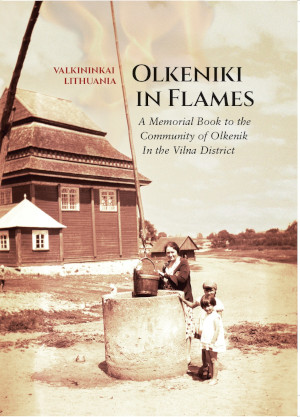 |
Details:
Olkeniki, present day Valkininkai, is a small town in what is now Lithuania, about 30 miles southwest of the capital Vilnius. Prior to World War II, it had been part of the Russian Empire and later Poland. The Russians and Poles called it Olkeniki. Following the joint German-Soviet invasion of Poland, the town was invaded by the Soviets in 1939, and then by Germany in 1941. After the war, Lithuania was annexed by the Soviet Union but emerged as an independent state in 1990, becoming the first Soviet Republic to break away from Moscow. The town sat along the so-called “kings` road”, which led from Vilnius to Krakow and consisted of about 10 streets and alleys, all of which were concentrated around a large market. The houses of the Jews were mostly one-story wooden houses, covered with wooden shingles. In 1897, the population included 1,126 Jews among 2,619 inhabitants. Many earned livings as traders or craftsmen or by providing accommodations to travelers along the Kings' Road. The surrounding forests also were a source of a thriving timber trade operated by the town's Jews. At the end of the 18th century, Jews constructed an extraordinary wooden synagogue in Baroque style with oak carvings and wooden decorations inside that amazed both locals and passers-by. Napoleon Bonaparte passed through the town during the 1812 invasion of Russia, was impressed by the local Jewish community and the synagogue. As a token of appreciation for their hospitality, Napoleon gifted his richly decorated saddle pad, which featured his initials, to the synagogue. The town's leaders converted the saddle pad into a parochet (a curtain used to cover the Aron Kodesh). The synagogue stood from 1800 to 1941 when it was destroyed by a bomb dropped by a Nazi airplane that ignited a fire that also consumed most of the town's buildings. The book has a long chapter detailing the synagogue's history. The Germans seized the town in June 1941 and, by Rosh Hashanah at the end of September, its Jews had been sent to the nearby town of Eišiškės, where they were murdered, along with the Jews of the area's other localities. The few who survived in the ghettos, in the forests, in Siberia, and in the Red Army, returned to the town in 1944 to find it destroyed. The square of the old synagogue and the Beit Midrash was desolated, and weeds had overgrown their foundations. The Holocaust section of the book contains detailed accounts of the travails the people suffered during this period. The book also contains two reference materials: a list of the names of townspeople who survived the Holocaust and important dates in the life of the town, spanning the years from the late 16th century to its end in 1941. Valkininkai, Lithuania is located at 54°21' N 24°50' E and 30 miles SW of Vilnius Alternate names of the Towns: Valkininkai [Lith], Olkieniki [Pol], Olkeniki [Rus], Olkenik [Yid], Alkeniki [Bel], Olkienniki, Olkinik, Olknik, Volknik, Valkiniras, Valkininkas, Valkininkay, Valkėninkā, Walkenykai Nearby Jewish Communities:
Degsnės 2 miles NW |
 JewishGen Press
 JewishGen Home Page
Copyright © 1999-2026 by JewishGen, Inc.
Updated 25 Jan 2026 by LA