 |
|
|
[Page 298]
by Dr. David Yakubovich
Translated by Mira Eckhaus
|
|
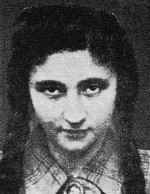
| Rut Lieblich |
She was the daughter of Edmund and Zina Lieblich, born in Andrychów on December 6, 1926. Already in her childhood, her blessed literary talent was noticed and a bright literary future was predicted for her. By 1939, she had only managed to finish six classes of elementary school, and with the outbreak of war, the doors of the state school were closed to her. But even the Nazis could not stifle her deep aspirations to learn. Even in the terrible conditions, Rut continued her education in the city and later in the ghetto, in Maya Vaksberg's advanced training course. She also learned a lot on her own and read a plenty of scientific and literary books. She made rapid progress in the learning of the Hebrew and English languages. She was autodidact in the full sense of the word.
She hardly noticed the oppression and humiliation that her parents and the entire Jewish population suffered at the hands of the Nazis; she believed wholeheartedly, despite everything, in the good future of humanity, and it was in this spirit that she wrote her works. At first, she wrote novellas and themes for children's plays, and later poems and a diary.
In her works, she describes first and foremost her own soul, her aspirations, her tendencies, and her strong desire to achieve a fruitful literary status. She also talks about her social relationships and successfully describes nature and the landscape.
We are publishing in the book of remembrance of our city, her city, excerpts from her diary that express her national feelings and connection to the Jewish people, her deep aspirations to immigrate to the Land of Israel and enter the path of ideal kibbutz life, as well as excerpts that express her belief in the eternal values of man and in the expected victory over the Nazis.
These chapters will also help the reader to get to know the town's life during the Holocaust era; the youth's enthusiasm for the Zionist idea and their desire to continue their studies, unfortunately, in private courses, and at the same time - to get to know the noble figure of the teacher Maya Vaksberg.
In the diary before us, the development of Rut's talent from year to year is particularly striking. At the end of the diary, she is already writing like an adult writer. We are filled with admiration for her gifted talent and shocked by her tragic end and the loss of such an important creative force for the people.
Rut Lieblich was sent to Auschwitz in the last women's transport, in August 1943, and there she apparently perished together with her parents. May God avenge them.
The diary was miraculously saved and after the war it was given by Poles to her cousin Rina Ringer in Bilitz, who passed it on to her aunt, Ms. Mania Neufeld, who lives in Holon.
It turns out, then, that Andrychów also had its own Anne Frank. The difference between Anne Frank's diary and Rut's diary is that for twenty years this diary was not known to the public
[Page 299]
At all. It is only thanks to the publication of the book before us that certain excerpts from her diary are brought to the attention of the Jewish public, excerpts that will tell once again about the tragedy of European Jewry during the Holocaust.
November 2, 1940
I am reading the book “Moses of Our Time”. It is a book about the great Jew Theodor Herzl. This great man built the foundations for the future Jewish state, the Land of Israel, our homeland. In his vision, he saw the Land of Israel flourishing as a paradise on earth.
I will at least travel to the Land of Israel, to rebuild there and raise the edifice of our future homeland. Because it will surely rise and shine on the map of the world as the national land of the great and mighty people of Israel. That will happen! Because like us, here, in Andrychów, all Jews must long for a homeland of their own, a place of quiet rest after the hardships of exile.
I am thinking of writing a lecture entitled “The Great Jew Theodor Herzl.” I will write this because I feel an inner need, I must, something pushes me to do it. We'll see how I can do it?!
Monday, December 9, 1940
December 6th was my birthday. It went pretty well. The class was held in my house. With God's help, next year I will celebrate it in my homeland, in Israel…
I am very emotional. My soul misses something. Outwardly I am a kind of Rutka, mischievous, a little evil and jealous. I would really like to be good so that everyone would love me, and yes, I would also like to be beautiful. I write stories. Maybe something will come out of me. I would like to be of help to my parents and bring them peace of mind and grow up as a decent person (and also Rishik and Manik). I hope everything comes true, because for now everything is the opposite.
Tuesday, December 17, 1940
It's already winter and it's very cold, but nature is still beautiful in its charms. But I'm not happy, I feel a little sad in my soul. I used to be happy when I could write stories. Some of the stories I wrote were very beautiful, like “Happiness”, “The Forester”, “The Wilted Flower”, etc. I was as if intoxicated by them, until the crisis came! On Sunday there was a class exam. I was absent-minded, I couldn't write, and there was a beautiful topic – “When I Look into the Distance”, but I couldn't write it well. Both Toshiya and the friends, who had previously admired all my stories, voiced harsh criticism. They didn't say it was bad, but the first one was the best of all. The most realistic one (I admit!).
But what can I do? I can't do otherwise; I write because I feel I have to write. But now I might stop, depending on what Maya tells me tomorrow. I don't want to take any further steps without her. We'll see tomorrow.
A few days later: Maya wrote a letter. It helped. I wrote a little play for Hanukkah. It came out very well (also thanks to the mood). Toshiya, Maya and the others were excited. They cried. And now I'm writing about realistic things. I hope I'll win and succeed…
[Page 300]
PS (19.12) I wrote and it was quite successful. There was a debate. After that I gave a lecture on the topic of “Different Jews in Different Parts of the World”. And on Sunday I lectured on “The Role of Women”. As a result of my lecture there was a passionate debate. It's a shame that I was annoyed by the class (there was a class exam) and because of my nervousness I wasn't able to prove and justify my assumptions as much.
Wednesday, February 5, 1941
…Now we are facing terrible times. They threaten us with deportation. Do they want to build a ghetto like in the Middle Ages…? It's impossible to organize classes, no one is in the mood for this, and there's no place to hold them. Everything's ruined. Inspiration has returned to me; I'm writing stories again (“Sacrifice and Self-Happiness”). It's snowing outside, the winter is beautiful, but what do we gain from it? We don't go out on sleds, skis, or snowmobiles. Even walking around the street is forbidden…
Wednesday, February 19, 1941
Today I decided to write in Hebrew. I have been studying Hebrew for a long time. And I speak and write well, especially in the last year, a year of war, since I have been studying with Maya. She has a method that I like. We (Shoshana and I) are studying modern Hebrew literature. We have already gone through the Enlightenment period and most of the Romantic period. I liked the Romantic period, because I am also a romantic person. I also write romantically because that's the kind of person I am.
I imagine how I will write everything in Hebrew in Israel. And I will immigrate to the Land of Israel because I love it very much. I am Jewish. That is my homeland, and there, in public work, is my destiny. And if I will be in my homeland, I want to be on a kibbutz. Sometimes the kibbutz is described to me as an ideal place and sometimes I don't believe it, because how can there be an ideal place in a world bathed in blood?
I write stories (“Nobilki”) and today I finished one with nine pages. It's a romantic one.
I am happy if I write. I am satisfied and my heart is full of joy.
Land:
A land is a homeland, a country, cities, villages, orchards, kibbutzim and colonies, all from the feeling of my soul.
A kibbutz is a liberation from the simple life; it is a liberation from the bondage of money.
A kibbutz is a fresh and free breath of air for tired lungs.
Hora:
Hora is a flame, a fire that reflects the Jewish temperament. Hora liberates, uplifts and brings to mind: the Land of Israel. Hora adds strength, hope, self-confidence and joy. It revives. Hora is the queen of Israeli dance.
Work is a blessing.
The beads of earth are the grain crops.
“The plow is more precious than the pen, plowed land is more precious than paper full of writing” (Korczak). (Translated from Polish)
[Page 301]
Monday, April 14, 1941, Chol Hamoed
The first two days of Passover have already passed. On those two days there was a Seder. On the first day it was a real holiday, I felt it was Passover. I read the Haggadah and understood everything. The holidays are not like before. We don't have dishes for Passover. We only eat matzah and what we can. The story of Passover is good for these days. We too are in exile among foreigners and we suffer very, very much, and liberation is not coming. Why? After all, there is God, blessed be He, just as before, who brought us out of Egypt with a strong hand and an outstretched arm, and in the Haggadah, it is also written that He made a difference between us and other peoples.
Why must we all our lives be far from the land of our ancestors - from the Land of Israel, this is what I, a child of exile, ask. But, Jews, why am I here and not there, where my heart longs for? Maybe this is a punishment because Jews are not good and do not believe in God? In the Lord? I do not know. They forget their country if the situation is good for them, and only if it is bad for them do they look to the East and want to travel there. - (the original was written in Hebrew).
Wednesday, April 16, 1941
Today I simply miss the Amen. I would like to pour out my heart. So many thoughts are running through my head. But I never have the opportunity to write them down. And I drown in the flood of thoughts that follow them. And then I forget. Today is a spring day. My beloved sun is scattering golden rays. It is indeed spring, but it is not very hot yet. However, despite the good weather I am not in the best mood. Pessimism has seized me. For some reason I cannot believe in anything today. I doubt everything. Is life really beautiful? Does love exist? Aren't these perhaps empty words? Who knows, sometimes I am like this and sometimes I am like that, or I believe passionately in everything or, on my gray days, I believe in nothing but in God.
This is the only refuge. I have already passed the age of childhood, when I could be told about miracles and wonders and old men with gray beards. But hasn't God performed miracles? He created the whole world, the wonderful nature, the earth, humans, the animals and plants and many other things. Aren't these miracles? Only a higher power could perform this. Someone had to be extraordinary. Every detail had to be arranged with precision, with perfection, so that it would work as it should. Who is this? The Lord, I believe in him. Because who else could do it like that…
There is a God, so why does such injustice prevail in His world? The Germans have already taken 75% of Europe. They are already extending to Africa. And it is so bad for us, I hope they do not reach the Land of Israel, because then our hope would be lost. The ideals would turn to dust, our future would be bitter and miserable, a degenerate slavery - then it would be better to die. But what is death, what is there after it? New life? It is a hidden riddle, a secret, a mystery.
May 17, 1941
Lag BaOmer is a holiday for children, a holiday of joy, Torah, and spring. Pleasant memories will remain from it. Instead of a trip, we put on a pleasant play in the community hall for the children. It went well. Now my friends are coming to take me on a trip. So, I'm stopping the writing.
[Page 302]
Tuesday, June 17, 1941
There are many wonders in the world. Much beauty. So many wonderful things created by human labor and intelligence. And I haven't seen anything yet. I'll soon be fifteen and I haven't traveled anywhere yet. I've been here and there in Bielsko, Krakow, Lublin, but I didn't get any benefit from it either because I was little, or because there was no one to explain it to me, or because I didn't have the understanding. Even now I don't have much. But still I think, I'm interested, I ask, I want to know everything, to delve into the depths of the wisdom of the world. The fine arts attract me most of all. Going to the theater, the opera, and exhibitions are my dreams. I don't even dare to dream of being included among the greats of this world one day!
Spread my wings, fly somewhere in the world, tour Europe, America, get to know world literature, master foreign languages fluently, acquire knowledge!…
Already now I do not wish to be forever bound to the Land of Israel. Indeed, I want to be there, to work and contribute to its good, but I also want to get to know the world and delve into its depths.
I am microscopic and miserable compared to the world. I am nothing. But I am young. The whole world is spread out before. So they say. But aren't these empty words? I am young, but my wings are tied. I want to soar to the Land of Israel and I must drop my wings, because the world is closed to me. War. Europe is the center of the science and arts. Beautiful Europe is in the fire of the consuming and deadly war. Noble treasures, the works of intellect and labor, are lost.
Culture has been used as a criminal instrument of war, to its shame and the disgrace of Europe, which has surrendered to the tyranny of one man. I want to go out into the world, and the world is lost. But let us hope. Even if hope is the “mother of fools”, it is better to hold on to it, because it encourages the spirit. The world will return to its former glory and will again tempt me with its inexhaustible wonders. When will I get to know it? Will its gates ever open before me, will the depths of its wonders be revealed to me?… I want beauty and goodness! I have seen enough wickedness and filth in the world. Beauty, goodness, happiness, truth, and above all, I desire to gain knowledge. It is my right to do so. To learn, to acquire knowledge, this is the key to the world. To learn!… But it seems to me that I will not have the opportunity. Perhaps a miracle will happen, because I must learn!
Tuesday, July 15, 1941
I am a Jew within myself, a national Jew. I strongly feel my belonging to the nation. I am a bit of a nationalist, but is it strange? I am a stranger, captivated in exile, far from my beloved homeland. I hear about it. I read and study. Such wonders! And how can I not love it? How can I not be a nationalist and how can I not feel proud of my belonging to the Jewish people, this eternal people.
Nations have fallen, lost, buried under the ruins of their lands. They have fallen forever and will never rise again, they have disappeared from the world's landscape, and only a distant echo of their past remains. And my nation, the Jewish nation? The ruins of its land and its temple, and especially the holy Jerusalem, have not buried it under them. For the spirit of the nation is strong and eternal, despite all kinds of disasters and hardships that have befallen it. The nation is stronger in soul and body than many other nations. And the foundation on which the strength of the nation is founded is the faith that serves as a stable, living, and enduring foundation. It is true that over time it has changed for a few
[Page 303]
with zeal, but nevertheless it has existed pure, courageous and unshakable to this very day. And again, it has resurrected. In whom? In the youth and the idealistic pioneers.
The hope and faith that are thousands of years old, bring back to life the homeland, which is the Land of Israel. In fact, even the perspective of a free homeland attracts like a magnet, like a light shining in the darkness, our hearts that eager to freedom and liberty. It is the pillar of fire for our thoughts. It is the dream of our future. I have loved it and dreamed of it since I was a child. That is how I was raised, and Maya awakened in me much of her warm emotion for the Land of Israel.
Ever since I began to think, I have been thinking about the Land of Israel. This thought has taken root in me so deeply that it seems to me that I grew up there, and my disengagement from it, the disengagement of the confidence that I would travel and work for my country, would be a spiritual destruction for me. Being there, the opportunity to learn and speak in my beloved native language, the melodious, poetic, soft yet powerful Hebrew language; to work on a kibbutz or a moshav, with the feeling that you are working for the homeland, that you are serving the nation, is pure happiness!
And to this should be added the possibility of writing books in Hebrew, falling in love, being loved, having a home, a husband and children. To achieve great happiness all at once is a peak. But for now, I haven't reached that yet. For now, there is war, captivity and hardship, but despite the difficulties I am learning and we are all learning Hebrew together.
On Shabbat, the 20th of Tammuz, a memorial service was held for Herzl and Bialik, two great men of the Jewish nation. Maya spoke with such wonderful emotion and power in Hebrew. For the first time in my life, I wrote a small play in Hebrew.
I admire Herzl and admire his work, his love for the people and his self-sacrifice; Herzl, who laid the foundations for the Land of Israel, the homeland of the Jews that is revived; Herzl, whose wonderful and noble life vision is coming to fruition; Herzl, who was so great, noble, generous and had a great soul, and his memory will live on forever.
And I admire Bialik for his wonderful poems, his sense of language, and his love of the nation and tradition. I love very, very much and deeply, my people, my homeland, and the great Jews, as well as everything that is Jewish.
Sunday, August 10, 1941
I haven't written for ten days; I wasn't in the mood. Several big and important things have happened these days. Now, in this time of calamity, something is happening hour by hour and minute by minute. A great disaster has also happened in Andrychów. Rutka Grosser's father, a young man, died, and was actually tortured, in a concentration camp. These animals, savages, abused him and then burned him. Human life is so fragile. But what? One dies and the other must live, even though life is sometimes cruel! And as Ruta says: “We are wounded by all kinds of sticks, yet everyone is drawn to them and clings to them”. What is life really? What magnet lies within them?
Sunday, August 17, 1941
“My parents' home” is a common, everyday word, and yet when it is uttered it instills in a person a feeling of security, of unity, and love of family. But when they want to cut you off
[Page 304]
from this house, which you loved out of habit, the house where you were born, spent all your childhood and early youth, where you rejoiced, grieved and had fun, thought and loved, then the meaning of “my parents' home” emerges, it's something that is so close and dear.
When they want to separate us from home, it seems to me as if they are tearing something from inside me, leaving behind emptiness, longing, and fear of tomorrow.
Now this disaster threatens us, the local Jews. They are going to move us to the outskirts of town, God knows where. I know that one day, one way or another, I will have to leave my parents' house. My destination is the Land of Israel, and I also want to visit the world, and first of all, I am a woman and I will have to establish a new home (my own focus), another home, with some man, and this home will naturally be our home. Indeed, we have already left our apartment, but we have stayed at home. There is still our garden, my favorite place, where I read and study, think and dream.
And all this I must abandon at the behest of evil men. Oh, why everything is so evil now, why are men and the world evil now?
I am burning with an inner flame, which bursts out in a dark blush on my cheeks. My heart leaps and sings. How good it is that I am a Jew. I see the strength, power and hope of this nation who is now enslaved. Because the Israeli nation has strong and great personalities with the fullness of power. There are so many emotions inside me: love, the feeling of Jewish power, so much Jewish spirit inside me, despite the many red flags with swastikas that fill the city and even our home, despite the expected transfer tomorrow. Despite everything!
Maya, beloved Maya. Perhaps unknowingly, her spirit revives the entire town, the youth and the children. Her strong and individual Jewish spirit unites everyone. She educates us. She “knows everything and is capable of everything”.
The community performance, which Maya put on to end the “War Colony”, caused (it seemed to me) excitement in everyone's hearts. Our hearts were filled with joy when we saw these children, Jews “building the country”. And the “Hatikvah”, which was sung with power and emotion, lifted my spirits. The Jews are brothers who share (despite their disadvantages) equal virtues and a common goal: freedom and the Land of Israel! This beloved land, the land of free dreams, our Jewish and sacred land, that is nourished by the blood of its children, is the homeland. Will it open its gates of paradise before us? Before me? Will we hear the sound of the waters of the Jordan and the waves of the Sea of Galilee? Will we speak the beloved, beautiful Hebrew language? Will we ever work under the sun in the field or in the orchard of Israel for the benefit of all? Will this charming dream come true? Oh, my God, my good, strong and wise God, do, perform a miracle and free us. Bring us to the Land of Israel, to the happiness, the Torah and the work. Please, please make our coveted dream come true.
I shall learn English history and Hebrew Literature and perhaps I shall not be so stupid. With God's help will be good. With his help no Jew will go from flat. The world and people will be good and nice. -
[Page 305]
Sunday, September 28, 1941, year 5701
Rosh Hashanah. Today was the third Rosh Hashanah in the war: the first one was on the wagon, in fear of bombs and fires, during the mad escape, when all of Poland was on wheels. The second was after the burning of our holy and beloved synagogue; facing the ruins of the synagogue we prayed our beautiful, incomparable Hebrew prayers, in the hall of the tavern. And now for the third time, in a factory (at least a Jewish one).
Among the piles of planks, chairs and tables, the Torah scroll stood in a small, hastily made ark, and from there the sounds of prayer rose. Full of supplication, plea and hope, flew the wonderful melodious Hebrew words, which were pronounced with emphasis by us, the youth; and the melancholy Yiddish words, full of pain and worry, calling for a better future and existence; even words in German were interwoven with the sounds of prayer, desecrating the sacred (in my opinion). The past was revived by the influence of the sound of the shofar, the melody of the prayers, their singing and content.
Oh, when will all the prayers finally merge into one whole, into the melodious and wonderful sound in the language of our homeland? When will we pray together in Hebrew in our country? When?
Rosh Hashanah, the beginning of a new life, a new year of struggle with life, joy, happiness, wealth or poverty, disasters and distress? Even that holiday was not allowed for all Jews to celebrate. The workers worked without being able to pray and sanctify the tradition. And you, God, do you see this and do nothing? Why you do not redeem us and you allow us to be oppressed? Us, who believe in you with such great fervor!
In fact, on Rosh Hashanah, all the Jews of Europe in the German-held territories received a yellow Star of David with the inscription “Jude”. We don't care. We are Jews and feel it deeply even without this marking.
And worst of all, this new year began with the sign of deportation to the riverbank (na brzegi) where we lived in caves and dens, although some of us were put in decent apartments. The commotion, the noise, the din, the injustice and the favoritism were simply terrible. People quarreled, envied and stuck out their tongues at each other. Among the Jews, as everywhere, there are good and bad, righteous and wicked. But everyone united in their distress, together they helped each other without sparing themselves any labor. Their endurance and self-sacrifice are admirable. But here too there are exceptions. Everyone worked hard.
The transfer awaits us, perhaps after Yom Kippur.
Sunday, October 10, 1941
People who are bent over, frozen, worried, stricken by disasters and troubles are rushing through the streets and wallowing in the mud, where to? To damp, cold, unhealthy apartments, sometimes relatively good apartments. What did they do to these people? They were taken out of their beautiful, comfortable, dry, and bright homes and put in burrows. Only with protection and money were they given better apartments. And winter is approaching with rapid steps. It has already rained and snowed today. The winter will be hard, cold.
And we, the poor Jews, here in the “new” ghetto on Shevska Street and a few nearby streets, will all perish. Imprisoned without access to the city for food and sustenance, miserable, oppressed and tortured. We, the Jews, the most oppressed and humiliated nation, but a nation with a free,
[Page 306]
passionate soul, without chains, a nation great in its faith and acknowledgment and this is its bravery. The nation of Israel, an eternal nation!
Without a country, without friends, without land, without anything, and only with its faith in one great God, the people of Israel survived and endured all the persecutions and humiliations for thousands of years. Unable to live in the cruel reality, it lived in the memories of its past. In music, hymns and prayers, in traditional singing and in sacred studies, it found a long way out, comfort and hope that the miracles of the past would return. It lived and continued to “live” in its past despite everything and looked calmly and hopefully to the future. The power of prayers, the treasure of supreme wisdom hidden in them, the history and tradition that instilled a special strength in the Jews, gave strength and weapons to a people weakened by the hardships of the past, to a people against whom the whole world was fighting, to a people imprisoned in ghettos and bound in chains, to overcome the malice of oppressors. Nothing would help even though the enemies strive for their goal without eschewing the means. Spiritual shackles, ghettos and even death would have no effect. Because the mighty spirit, the spirit of ancient people of Israel, will not collapse and will always be able to grow again. After every blow, the nation renews its strength and is revived, in order to continue the struggle of life. And the lofty goal: “Redemption, Freedom, the Land of Israel” shines with great light. And even though it is terribly difficult to live, even though the obstacles are many, with the help of God and our youth, we will go forward, fight and achieve our goal by force!
Monday, October 27, 1941
I just finished drawing a small map of the Land of Israel. On a small piece of paper, I magically brought up cities, settlements, rivers, mountains, in short: the entire country. Every city, every settlement, separately. I love, know and understand. Every point means something to me. Every settlement was created through the labor, efforts and will of thousands of brothers, Jewish pioneers. Each of them absorbed the blood and sweat of Jews. I love each of them. And my vision is to continue to create new positions every day, positions of creativity for Jewish work.
Move forward, onward, to conquer, build and work. With a weapon in hand to work there, in the beloved land, in the homeland to which I cling, of which I dream and for which I want to live and toil. I want to live for the sake of life itself, for the feeling of happiness in work; to live and fight for my personal happiness and for the homeland, the happiness of the Jewish people, and for goodness, truth and justice, which are the happiness of the world. So strong is my desire to write, to write stories, articles, books and plays, to fight with the pen. So strong is my desire to be talented in this direction. At least that, if nothing else. My hobby is the beauty. Beauty is a word hidden in everything. You just have to search for it with talent and then you find it. The great beauty is in life. This is the beauty that interests us, because life is everything to us.
And the beauty of nature is something that every soul feels, even if it is numb. In nature is found the perfect, true beauty, in nature is found the supreme wonder, and who knows if it is not the soul of beauty? Because the beauty of nature attracts, captivates the heart, brings amazement. This beauty is wonderful. It is the relaxation, the relief for the eyes and the soul.
Thursday, November 6, 1941
There are strangers around, and I can't write in my diary if they look me with eyes without
[Page 307]
understanding, evil eyes or full of irony. Only rarely, with good eyes with love for all.
I write in Hebrew, the dear and beloved language that no one knows. Hebrew is my language and I cannot speak it to everyone, even though they are Jews, because they do not understand, except for a few of the young people! Why am I not in our homeland? Why was I not born there, in the Land of Israel? Why do we not hear and speak the poetic language of our ancestors from childhood, why? Why is our situation so bad? All the misery in the world has descended on us! For what sins do we suffer so much?
The glow of happiness sparkles from afar. Longings come to fly away, because life is sad and filled with poverty and endless evil. We can no longer hold back, it's too much, too much for our hearts and souls. Because the pain is already limitless and in my little heart beat feelings of anger and sadness at the times and reality. I want to live, live with all my strength, fight and win!
And you, our God, give us strength to get through this bitter and evil life and give us hope so that we can hold on. Give us strength, happiness, beauty and the knowledge of a good world, which will uplift the spirit and soul. (the original was written in Hebrew).
Saturday night, December 6, 1941
…I celebrated my birthday today. My friends were so smart that they brought me gifts as much as they could. And isn't that why people have a birthday party? But I understood it. Perhaps this is pride and vain ambition. But still, it is so unpleasant to come without a gift. But the most heartwarming gift was given to me by Maya: The Hebrew book “Shavei Zion” and, besides it, another letter, which perhaps made me even happier; a wonderful Hebrew letter and the poem “To the Young Ones”. Maya truly likes me. She called me “her beloved daughter”, and to all our friends – “her dear family”. She felt and understood my ideals, which are truth, beauty, and goodness. My dear sends me in a letter advice for my life, a call to my youth, to my strength, and to the sense of justice within me…
I turned fifteen, lost years without return in the sea of years. I will soon be an adult, and I am still a child! How miserable were the years that already passed. Going to bed and getting up again. I loved my beautiful white bed so much, but in fact, on my birthday, the disgusting Zono took it from me. Anyway, I have to accept fate. I just hope it doesn't get worse.
Next year in Jerusalem!
To be on my next birthday in the Land of Israel. May by then, the war will be over. May our oppressed people be liberated, may they attain full splendor and glory. Our God, please fulfill our supplications and requests. You are the Almighty God, our Lord who sits in heaven.
Monday, December 21, 1941
In every person there is a spark of the God of life. But the chosen ones, apart from this, have in them something of the builder of the world and they hold on their shoulders its beauty and secrets, its talent.
There are also evil geniuses, impregnated with impure inspiration by angels of destruction and evil spirits, who, instead of leading humanity to the heights, cast it down into the dark abyss, into the abysses of evil. Indeed, humanity is now descending into a downward spiral. It looks back in despair
[Page 308]
and looks to the shining heights. Should we seek the light, the helping and redeeming spirit? But the slavish multitude allows itself to be pushed into the pits of hell, from which blows the chill of evil and hatred; the multitude is now submissive to the evil genius in the form of a man, who is infected with his whimsical and destructive ideas and with the evil venom, that spits bombs and bullets on weak and suffering humanity for the time being.
But wait, Satan, humanity will awaken from its slumber! Leaning on the power of truth, goodness and beauty, the humanity will climb and ascend to the edge of the abyss and once again see the rays of the sun shining with divine glow! Humanity! Do not give in to your destruction. Seek God in your heart and be freed and victorious!
The holiday of Hanukkah is over, Hanukkah is a song of redemption, freedom, Hanukkah symbolizing through the candles the greatness and eternity of the Jewish people.
Every year, for years and years, we lit candles in silver candelabras. Their flames were large, their reddish-pink light sparkled in different shades. All eight nights of Hanukkah the candles were lit. Dad would pray and we would sing favorite songs, the beautiful songs, Hanukkah songs. And this year there were no candles, and in Jewish homes no candles would be lit. Their flames would not illuminate the reflection of people's faces. Coldness will prevail in the rooms….
No, there were no candles on Hanukkah. The Jewish symbol, our beloved tradition, did not take place. There were no candles, but in our hearts grew a fire of love and hope, that this would never happen again in our history, that the Jewish people would no longer be so poor that they could not light candles in a foreign land, an evil land full of envy for us.
We lit candles only on the first and last days of Hanukkah, to indicate that today was Hanukkah. But apart from that, I felt a deep and warm emotion, that this was a symbol of our desire, that with love and an inner voice called out loudly: “The Holiday of Hanukkah”. This was the first time in my life I celebrated Hanukkah in such a manner. (the original was written in Hebrew).
Friday, December 26, 1941
Description of a typical Polish winter. The continuation is:
…But the mind detaches itself from this landscape and sets out to see the future. In my imagination, a land illuminated by green light appears, and it is so diverse; the river flows vigorously, its waves are bustling; the fields are cultivated, covered with golden stalks of grain. Moshavim, kibbutzim and modern cities on the seashore. Tel Aviv, the “Spring Hill”, which always smiles with its azure sky and its deep sea. The city throbs with great toil as a city of science and culture. Poetry and literature have found a Jewish concentration here, a national city beloved by the Jews for its beauty.
Haifa, the white city of sands and gardens, of workers' quarters and a port, a city with a great future. It is surrounded by the charming Carmel slopes and the Jezreel Valley, which pulsates with the life of work and happiness. Haifa is the city of labor and recreation.
The Land of Israel, a land of contrasts in climates and settlements: here is a modern city and here again an ancient one with an oriental appearance.
The beautiful, majestic, and magnificent Jerusalem, Daughter of Zion, Mother of Israel, the nest of religion, with its oriental appearance. But even there the new is advancing and a new city is being built next to the old one.
Elegant in its attire, the magnificent attire of nature, stands the proud mountainous Galilee and its Kinneret
[Page 300]
reflecting in its depths the blue of the southern sky. In the distance, the snowy peaks of Lebanon and Mount Hermon sparkle in their whiteness. Ancient, legendary mountains, a wonderful song of the Jewish heart! My country, the cherished land of my dreams, unknown and distant, yet so close to my heart. My beloved homeland. Will fate bring me there, to where my heart goes out? Will I be privileged to see the land of my beloved homeland? People tell me that I have talent. I am happy! It's wonderful! If God wills, I will bring it and raise it on the altar of the homeland, I will sing its beauty. Talent is something divine that beats in the soul and seeks to be poured out, hidden and waiting for the right moment to come out. Sometimes I am in the seventh heaven, burning with a fiery flame and I write, I'm forced to write.
June 12, 1942
Farewell, my friend, my diary. Farewell, perhaps forever… For two years you were a faithful guardian of my thoughts and feelings. I don't know whose hands you will fall into. I feel sorry for you, I feel sorry for my thoughts, for everything[1].
August, 1942, 141 Litzow Street
…And again, I have returned to you, my beloved diary, once again your pages will be filled with descriptions of my feelings and sensations. Only a month has passed since I said goodbye to you, in my despair I thought it would be forever. But with God's help, I have returned![2] Between the previous page and this one stretches an abyss!… I wish all evil and malice would sink into hell. We remain here on the edge of the abyss. May the bright sun of our longing shine on our future!
October 4, 1942, Simchat Torah
…And again, an hour of “happiness”, stolen from life and from the gloomy reality. How different it is from the previous one! Today our youth burst forth, our feet danced themselves in the "Hora" dance, and a loud and strong song burst forth from our hearts, accompanied by a wonderful national spirit.
In the small, narrow room, there is a murky darkness; the room is packed with Jewish youth, youth who bring with him life, joy, and light.
Beautiful girls are united in the circle of the “Hora”. They all dance our “Hora”, the national, beautiful, Hebrew, fiery and fierce. And the loud singing rings out with the strength of emotion and power. Because the heart is excited that we are Jews, a Jewish youth, we are the future of our nation. In the “Hatikvah” words we discovered ourselves, until our souls were overwhelmed by the overflow of emotions! And it was so good for us when our voices, arms and thoughts were connected. There was a desire to embrace everyone with a warm embrace and a heartfelt kiss and shout to the stars at night, to the higher power in the sky: How good we feel today!
I love my people, the Jewish youth, all the Jews…
Saturday night, November 6, 1942
This evening, there was another wonderful moment. Once again, the voices and sounds of the song “Hamavdil bein kodesh lechol” burst from the gramophone box. The warmhearted wishes touched the heart: “A gote vach”, said the excited chazan repeated, and his words were repeated by the young voices of
[Page 310]
the girls' choir. The saying “A gote vach” made such a deep impression, as if a feeling of belonging to the Jewish people was expressed here, as if the people's feeling and perception of the warmhearted bond that binds them together through their common language were expressed here.
“Hatikvah” - the echo of the future and the call of the new life:
“To return to the land, the land of our ancestors,
To the city where David parked” - -
This song, which was sung with faith so many times, shook even more with its familiar sound. The anthem of the glorious Jewish national people, whose vision will be realized in our free land!
Monday, November 30, 1942
The holiday of Hanukkah is approaching… A show for Hanukkah. In these crazy days, it seems absurd, a paradox. But it is not so. This show is not nonsense. These are performances for children. After all, children also need something enjoyable, some kind of entertainment. And after all, this is noble entertainment, which arouses national feelings, love for ancient tradition and for the Land of Israel.
…The Hanukkah candles, lit in a menorah on the white-covered table, create such a pleasant and festive atmosphere. The flickering lights evoke a kind of a happy dream.
I love the tradition of my people so much, I love it for its ancient, incomprehensible, and so sad charm! Our tradition is imbued with the spirit of the past, the golden past of the period of the kingdom of the House of David, which is intertwined with the sadness of the Babylonian exile and the pain of the destruction of the Temple, the period of bloody wars followed by the long period of the dead letter, so to speak: the study of the Holy Books, the religious debates, the exile. In every period, the spirit of our strong people stands guard. It is the spirit of beauty, truth, goodness and knowledge. This is the spirit that preserves our people from destruction, and it will preserve us too.
Original footnotes:
by Lola Rauchberger-Bader
Translated by Mira Eckhaus
In September 1939, the Germans invaded Poland. Three days later, Hitler's armies, damn him, captured the city of Andrychów. Several dozen families managed to leave the city before it was captured by the Germans. Among them were my husband, me, my three-month-old baby, and my sister Matilda. We got as far as Kielce, but my husband later returned to pick up the rest of his family. Unfortunately, I never saw them again. So, I was left alone and fled with my sister and my youngest son to Lviv. The Germans advanced further, bombing and capturing city after city. While I was in Lviv, the Russians came and captured it.
The year 1941 has arrived. War again, the Russo-German war. Bombs were falling on Lviv again. My son was already two years old. We lived in air raid shelters and suffered from a lack of food and water. Finally, the Germans occupied Lviv.
A difficult and sad period began for the Jews of Lviv. From the moment the Germans entered, many people fell dead. Indeed, the murderers already had two years of experience…
Within a few days after the Nazis entering, several streets were designated as ghettos. I decided not to
[Page 311]
go to the ghetto at all costs and return to my father's house in Andrychów. It was not easy. Jews were not allowed to leave the Lviv area. However, I was lucky. Thanks to an acquaintance who worked for the Germans and thanks to the gold watch that I gave the German in exchange for the service, I got on a truck with my son and sister, in a convoy of cars returning from the Kiev front.
I left Lviv on the night of December 24, 1941. We sat huddled for 24 hours, hiding behind barrels. Every few hours the car would stop for inspection and our hearts would stop beating until we moved again. The next night the car suddenly stopped, the driver lowered the tarpaulin and ordered us to quickly get out of the car. When I asked, where are we? The driver answered that we were in the vicinity of Krakow.
It was snowing and the wind was strong. We stood helpless and could see neither a house nor a road around us. I held “Shimosh” (little Shimon) in my arms, as he shivered with cold. Suddenly, a few steps away from us, a light flashed in one of the windows. We walked towards the house, I knocked on the door and asked in a whisper for them to open it. And they did open it immediately. I said that the car had broken down on the road and was left there. The place was the village of Sulkovitsa, near Kalwaria. We stayed there until morning.
That same day we were in Kalwaria. We arrived straight at the town square (the “Rink”) without knowing that all the town's Jews had already been isolated in the ghetto. Luckily for us, no one paid any attention to us. We went into my brother-in-law's house. They were astonished to hear what we had done.
To this day, it is a mystery to me how the Germans, actually the city commissioner, found out about our illegal arrival in Kalwaria. They wanted to execute us, and my brother-in-law went to the city commissioner and gave what he could find (golden articles, etc.) as a “ransom” and the matter was hushed up.
Unfortunately, I couldn't get to Andrychów. Rumors reached me that Jews were being taken from there to labor camps. I would receive mail from my parents. They would reassure me in their letters as best they could. “After the rain, the sun will shine again”, my poor mother wrote. But for them it no longer shone…
On July 2, 1942, the first deportation (wysiedlenie) from Andrychów took place. My sisters Sidzia and Rutosia were with our parents. When they separated them, my father blessed them, and then he stretched out his hands into the open air and called out my name, Matilda's name, and the name of little Shimon, and blessed us too. My sister wrote to me about this.
Why didn't this news kill me? It amazes me to this day! Back then, I thought I couldn't go on living. I banged my head against the wall when I received the news. “My God, my God”, I cried, “Where are you! Why do you allow this? Why? Why?”
My sister sent me an apron that my mother wore, so that I would have something as a souvenir (to this day I carry a piece of cloth from this apron, in a “pendant”, around my neck).
I continued to live, even though my heart was bleeding. We learned that they had been taken to Belzec and murdered there.
Two months later, they knocked on all the doors in the Kalwaria ghetto: “Pack your belongings. Deportation. You are allowed to take small packages or suitcases; and besides, before leaving, the apartment must be cleaned and tidied”. Oh, this abominable mockery! Clean the apartment, Jew, so that the murderers don't get their damned feet and hands dirty!
A line of carts parked in the square. Those condemned to deportation board them, holding in their hands
[Page 312]
All their belongings, that is suitcases and a little food. We drove to the “unknown”. Then we found out that our destination was Skawina, where Jews from Myślenice and the surrounding area were gathered. For a few days (about three or four) we stayed there in the haylofts, where there was little space. Little Shimon cried, was afraid and always clung to me.
One day, maybe the second day of our stay in the hayloft, a little Polish girl came and asked us to go to their house together with the child. Her mother invited me. I went; the house was across the street. When I entered, a woman named Eva was waiting for me and greeted me with the words: “My children haven't given me any rest since they saw your child crying in the hayloft. Stay here, we have a vacant bed”.
This was the moment that decided my fate for life or death. I stayed here with Eva for two days with Matilda and little Shimon. On the third day, at dawn, a neighbor came running, panting, and said: “They are already removing the Jews from the haylofts and from every corner. Leave the child Shimon, we will take him under our protection. After all, you are young… With the child it is a death sentenced! But if you are alone, they will take you to work”.
Little Marisha, Eva's daughter, took Shimon by the hand and led him through the back door to the field. At the other door, a Gestapo man accompanied by a “dark blue”[1] Polish policeman entered and ordered us, “Move! Out!”. My sister and I went out and joined the group, which was growing. Frightened faces, who hasn't seen them? We were being led to the slaughter, like a herd. From time to time, the German sentry would push someone whose strength was not up to the task. They led us to the square (“Rink”) in Skawina. Here we already knew what awaited us. Someone brought news that in recent days they had “deported” all the Jews to a mass grave, and they did the same in Bochnia.
The terrible hours of waiting! Moans, cries. Evening came. The people lay on the sidewalks, in the corridors, wherever possible, guarded by the German and Polish police with the Gestapo men. From time to time a shot was fired at someone who tried to escape. Night fell, the last night for the convicts. A terrible night. I lay with my sister, may her memory be blessed, on the floor in the corridor. We could no longer cry. Suddenly I heard someone asking: “Is there anyone named Bedrova?” I thought I was dreaming. I got up. “Yes”, I said, “who is asking?” “It's me, Jadwiga, I found you, thank God. You must not die”, she said, “I have a rescue for you. A Polish policeman is standing in front of the corridor, come and get out”. I went out. She introduced me. It was agreed that tomorrow afternoon he would take me through.
I didn't believe it would be possible, I said to Jadwiga: “Where is Shimon? If they shoot me, take him under your protection!”
Morning came and I went out in front of the house with my sister. Suddenly my sister said to me: “Look over there, there's Eva walking towards us” (she's the woman with whom you left Shimon). Eva discovered us and secretly hinted that I should approach her.
I could not move from my place. Matilda pushed me lightly: “Go, didn't you see that she was calling you!” These were the last words I heard from her, after that I saw her no more. My poor, holy sister. Forgive me, beloved Matilda, my dear. I left you, alone, and went towards my fate…
[Page 313]
I approached Eva, I wrapped a handkerchief around my arms, which covered the strip with the “Star of David”. What a miracle, no policemen were seen, no one demanded our documents, because even Poles were now forbidden to go out into the square. “Be quiet and listen”, said Eva, “Shimon cried all night and called your name. In the morning, before it was even light outside, someone knocked. A policeman came in, asked for some water and asked about the child who had been crying all night. “This is my nephew”, I answered him. However, without asking, he went into the room and looked at little Shimon, who was sleeping in bed after a sleepless night. The policeman came out, looked at me and I trembled with fear. Finally, he said to me: “It's good that you saved a Jewish child. But if a child lives, then the mother must live too. Go to the square, take your ID, and look for his mother until you find her. Don't come back without her, otherwise you'll get hurt”. He spoke to me sternly, and I knew it would be in vain for me to resist. I went. He stayed with the child. God sent you an angel, and he will surely help you further”.
I approached the house. A Polish policeman stood at the door. I fell at his feet and kissed them. “You are an angel from heaven!” I cried. He told me to dress up as a peasant woman, take a basket and a sickle in my hand and quickly leave the Skawina area. A neighbor of Eva's took me to Korbnik, a village near Skawina. There I had another difficult night. Eva sent Shimon away with her daughter, because she didn't want to keep him any longer. I found out about this late at night.
The owner of the house entered the room, where I was lying on the floor, and, while cursing and pushing me, he told me that Eva wanted to get rid of the child and sent him here, but he sent him back with this girl. When I heard this, I wanted to run after the child, to save him, but he grabbed me tightly and knocked me down again. I don't remember anything more. The people around me brought me back to consciousness and carried me to the hayloft.
Early in the morning the landlord came and told me to get out of here. I went to Budzów, to an acquaintance of Jadwiga's, as Jadwiga had advised me that night. I didn't walk, I ran, barefoot, across the open field. The blood was dripping from my feet, but only one thing guided me: I have to run faster, I must save the child! Although I had not eaten for two days, the thought that the child must be saved and that it might be too late gave me strength. A few hours later, towards evening, I knocked on the Stypolova family's door.
Six weeks passed before I got my child back. Six weeks of torture, of waiting with bated breath. Stypolova went to Skawina and did not find the child. Eva did not want to say where he was. With threats and requests, Stashka Stypolova finally revealed the secret: he was in Krakow with her husband's sister. She wanted to get rid of him at all costs. Heaven was watching over him. In Krakow he was very ill, the doctor gave no hope of his recovery. But he was apparently written in the Book of Life and was destined to live.
When I finally held him in my arms after six weeks, he couldn't speak at all. For hours he clung to me, cried quietly, and finally asked: “Will you never leave me again, Mom? I thought they shot you”. He was only three years and three months old. The children from the ghettos were like adults. These children knew how to keep quiet. He knew that it was forbidden to cry. When we would sometimes hide later, and even though he was hungry and sick, he would keep quiet and not complain.
[Page 314]
In Budzów I was a cowgirl, but after I got Shimon, they didn't want to keep me with the child. I had no money, my work alone wasn't enough, because the child also had to eat. Stashka found a corner for me in another house, I started sewing. The winter passed. I renewed my contact with my sisters Sidzia and Rutosia. They were transferred to the Wadowice ghetto.
Sidzia wrote to me that I should try to cross the “Green Border”[2] and come to the Wadowice Ghetto. When I told Stashka about it, she advised me not to do so, because it was unknown what might happen there tomorrow. After a few days, Stashka brought me a letter from my sister (the mail would reach her). My sister asked me to save her child, which she herself did not know how to do it, because there were rumors about the liquidation of the Wadowice Ghetto. She would be taken to work, while the child, as it was known, would be exterminated.
I asked Stashka for help. I told Sidzia, that at a certain hour, when they are going to work, to try taking Dulosh with her, as if she is taking him to the doctor. Stashka was waiting on the street they were passing on their way to work. At a certain moment Dulosh ran to her, she took his hand (he was eight years old) and they walked. The border of the Reich was the Skawa River, and the guards were there, Budzów belonged to the Polish “government” area. An acquaintance of Stashka's took it upon himself to take Dulosh across the river at night. When he was already in the middle of the river, the Germans sensed them and started shooting, but they managed to slip away and return. On the third night they tried their luck again and this time they succeeded!
At three in the morning Stashka knocked on my window, and through the window she handed me Dulosh. He was pale, his face as emaciated as the faces of the ghetto children. But the worst thing was his Jewish appearance. What could be done? When they would notice him, we all be exterminated. In despair, I almost prayed for salvation, for some idea of salvation. The bright idea was an adhesive bandage: I simply stuck it on his nose and pulled it upwards; I cut out the adhesive bandage and glued one part across. I had to choose between bread and an adhesive bandage. I had no money, but the importance of the adhesive bandage was paramount.
The time had come for the liquidation of the Wadowice Ghetto. No more letters came from my sisters, neither from Sidzia nor from Rutosia. Where does a person have this strength to endure all the blows? There, in Skawina, I left Matilda, and here again is just as “Auschwitz!” “You must not collapse”. I said to myself, “Save those you have, the two children!”
One day the landlady I was living with kicked me out because someone said I must be Jewish and I didn't have any papers (certificates). I had no choice; I had to go to the forest. I took little Shimon on my shoulder and Dulosh in his hand and we left, homeless, expelled. No one wanted to take us in; according to the rumor, a “Volksdeutsch” who lived next door had informed on us to the “Gestapo”.
I went to the forests of Makow. The days were the end of summer. It was hot during the day, but cold at night. I would warm the children with my body. I would leave them by the icon (Kaplica) that stood in the forest and go and sew in houses in exchange for a little bread. Stashka knew that I was in the vicinity of the icon. One Sunday, at noon, I heard my name being called. I answered. It was Marisha, Stashka's friend, who worked for her. Stash, Stashka's son, came with her.
[Page 315]
They brought me a fake ID (Kennkarte) and an exit registration from one of the settlements near Krakow. It was an unforgettable moment… I remember stretching my hands to the sky and tears streaming down my face: God, God, you are saving me again! - -
Confident in myself, based on the documents, I left the forest with the children. On the mountaintop there were several farmhouses, I walked from one to the other, but none of them wanted to take me in, not even for one night. “Let it be in the hayloft”, I asked, in vain. Desperate, I went to the poorest hut. Here, I noticed two male figures. “Your personal documents”, they said. I took my documents out of my pockets and they looked at them. “Okay”, they said. “And what could be wrong?” I asked innocently. They answered me that they were now searching the forest, because a Jewish woman with two children who had fled from Budzów without documents had found a hiding place here. They walked on. My heart was beating fast inside me and my legs were out of control. I was so close to the end again. They were looking for me. I stood in front of this poor hut, not knowing what to do with myself and the children.
A moment later, a woman came out of the house, looked at me and the children. I greeted her and asked if there was any work for me for a few days. “Yes!”, she answered. Her husband was taken by the Germans and sent to forced labor in Germany, and it's hard for her to manage on her own. I can help her pull the potatoes out of the ground in the field. I stayed with her for a few days. The work was over and we had to move on. I had to find work, because the children also needed to eat. I went to Makow. Little Shimon on my back, Dulosh next to me, and the papers in my pockets were all I had. I went into the city hall. They referred me to the Polish Aid Committee. I received a few cents and a bread ticket, but I couldn't get a registration on the spot. In order to receive it, I had to go to the “Gestapo” in Nowy Targ and ask for a permit.
The people at the municipality were very kind to me, they wrote the application for me in German. Thanks to the money I received from the Polish committee, I traveled to Nowy Targ. With a prayer on my lips, I stood before the Gestapo man and submitted my application. Through an interpreter, I answered his questions: Why do I want to live in this restricted area? I replied that the child needed the mountain air. He looked at my fake identity card (“Kennkarte”), did not notice anything strange and gave me permission to register on Makow. When I returned to the municipality in Makow, they congratulated me. They did not believe that I would succeed in this.
I rented a tiny room, right next to the forest (for any trouble that might come). We were legal people. I worked in the fields and wherever possible. I sewed. Until January 26, 1945, came - and Makow was liberated.
This is how I lived and survived and arrived with the children at this time. Since I lacked an adhesive band for Dulosh's nose, he was left without it. Seeing him, the landlady shouted in horror: “He's a Jew. Just like a Jew!”
After a few days, Stashka and her husband came to take us to their place. On the way, as we crossed Mount Makow, I heard from them what had been said about me in Budzów after my deportation. It turns out that the “Volksdeutsch”, who had informed the “Gestapo” about the Jewish woman hiding with her children in Budzów, was shot by the Germans as he passed through the forest with a sack of saccharin on his shoulder, a few days after I left. “A punishment from heaven for wanting her dead”, said the Gentiles. He left behind a wife and children, but no one wanted to help them.
And finally, freedom had arrived. I was happy about it, I was excited, but in my heart the fear for my relatives grew:
[Page 316]
Are they alive? Will they return? After a few days, Andrychów was released. I decided to go to Andrychów to see, maybe they returned.
I left the children with Stashka and set off on foot; the trains had not yet started. On the way I entered Wadowice. Here I met several people who had returned from the concentration camps. My hope that perhaps one of my relatives had also returned grew.
Finally, I found myself in Andrychów. Here is the train station, and the little house opposite, where I was born. I spent my happy childhood here. Together with my sister Sidzia, we ran around in the meadow near here. Tears well up in my eyes. I kept walking. Someone looked at me, but apparently, he didn't recognize me. Maybe I just look like this Lola? I reached the square. Nothing has changed. The proud chestnut trees were still standing around, the same houses, and the church: only the synagogue was missing.
I stood in front of our house. I looked and waited: Maybe a miracle would happen! Maybe Dad, or Mom, or one of my sisters, would come out and call me? No one came out. No one came back. I was the first Jew in Andrychów, which was empty of Jews. I remained pressed against the wall. I had no more strength. Many people were standing around me. The first to speak to me was the drinker, Vitosh, he had a bottle of vodka in his hand and said: “Drink some of this, doll, warm your head. There is no one of your people. The sons of bitches murdered them. They burned your synagogue”. “And the cemetery”, I asked through tears. “The cemetery is still there; they probably didn't have enough time for that”.
Hearing this, I tore myself away from the crowd, which had meanwhile grown around me, and ran with all my might towards the cemetery. On my way, I stopped near the place where the synagogue had stood. It had burned down, and the Jews had to clear the burnt remains with their own hands. The pain constricted my heart. I must escape from here quickly, and not see it! I hurried. I could already see the wall surrounding the cemetery. A few more steps and here I was among my people…
I walked between the rows of graves, caressing them, the orphaned tombstones in the Jewish cemetery. “Where are your children? Who will visit you?” I felt that they were happy, blessing me with life… I spoke to them… Finally, I reached the tombstones of my grandparents: Aharon Ringer and Sidzia Ringer, née Felix. I read their names from the tombstones and pressed them. I pleaded with them. “Where are your children?” I asked. I walked away without an answer. I said goodbye to them; I said goodbye to all those who rested here in a foreign land. I returned to Stashka, to the children, broken.
I went to Andrychów once again. To my regret, none of my relatives returned. Adash (Dulosh) remained an orphan. Of all the young people taken to the concentration camps, only five girls and ten boys survived. None of the adults survived. The Jewish community in Andrychów ceased to exist.
I found my husband alive after the liberation; certainly thanks to the prayers of Shimon, who always prayed to our Father in Heaven and asked for his return.
In these memoirs, twenty-three years after the “Aktsia” in Skawina, I received my first letter from Jadwiga, with whom I had lost contact, as she too was hiding and no one knew where. Only now did I learn from her that the Polish policeman who was supposed to take me out of the “Aktsia”, as well as the second one who sent Eva to the square in Skawina to fetch me, were Polish partisans named Stanisław Wierwala and Mieczysław Olejnik. Both were
[Page 317]
well-known and highly respected fighters. Unfortunately, they were brutally murdered by the Germans, after both of them participated in the unsuccessful assassination attempt on Governor Frank in Krakow. Honor to their memory!
In 1948 I left Poland, on my way to our homeland. My dream of living on my own land came true. Here, on our land, we rebuilt our home. In 1947 I gave birth to a daughter, and she was named Sarah Geula - Sarah, after my mother, of blessed memory; Geula, because she was born on the day the United Nations recognized our right to our own homeland, November 29, 1947.
Unfortunately, so few have been blessed to reach this happy and hopeful moment. The Land of Israel! The Jews have their own homeland again. May it be blessed with peace and may the terrible and tragic history of two thousand years of wandering amid humiliation, murder and persecution never repeat itself.
Original footnotes:
by Lola Bader
Translated by Mira Eckhaus
|
Spread your mercy upon us, God –
Hear the voices of the wretched Who, even if they were full of sins Against you – today they plea for your mercy; Grant us peace, God! |
|
A man has been crushed to the ground by another man,
He will not dare to give a sign of life, nor lift his head, Nor reveal his identity to others, Because otherwise, from death he has no refuge. |
|
“After days of gloom, the sun comes out” –
That's what my dear mother used to say. When, oh God, will my mother's words Come true? – Has the time come And the cloudy leaden sky Will emit its first free sparks? |
|
And it will warm our frozen hearts
and the hopes of freedom will illuminate the oppressed. |
|
When will you return to us, the longed–for?
When will evil and the law of robbery cease to dominate us, oh, when will you expel them from us?
Oh, come, wonderful freedom!
|
[Page 319]
|
He's going!
Do you hear the rattling of the cable coming loose? It announces that the time has come to set free. Do you hear the strong heartbeat And see a glimmer of hope flickers in the eyes? – This is the anticipation of freedom, which will be resurrected. Is it for us? For the entire universe?
The longing for life is so great,
The fountain of tears has dried up,
|
|
It's sunny today – and there is joy all around
Remove the cloud from your darkened forehead. I can't – Will you command me to smile Even if my heart is wounded? Will you command a bird to fly Even if its wing is wounded? The sun will shine again – You will find happiness if you are sad Its golden ball – if only it had a heart – I wish it would have seen the magnitude of human pain – Out of sadness, it has long been dark, frozen Sun, please continue to shine – look at the blue sky For pain is fleeting, like our youth. Because the light of your blessed rays Is needed like a spring to the thirsty – – |
|
| Budzó January 1943 | (Translated from Polish) |
|
|
JewishGen, Inc. makes no representations regarding the accuracy of
the translation. The reader may wish to refer to the original material
for verification.
JewishGen is not responsible for inaccuracies or omissions in the original work and cannot rewrite or edit the text to correct inaccuracies and/or omissions.
Our mission is to produce a translation of the original work and we cannot verify the accuracy of statements or alter facts cited.
 Andrychów, Poland
 Yizkor Book Project
 JewishGen Home Page
Copyright © 1999-2026 by JewishGen, Inc.
Updated 11 Apr 2026 by OR