 |
|
[Page 53]
|
Municipality and city council in Sosnowiec since 1902 – The Jews of the city
were deprived of the right to vote – A Russian, the first mayor – Until 1914 the
mayors were Polish – German mayors during the German occupation in the First
World War – In 1919, the first elections for the local self-government of the city
took place – Nine Jews in a council of 40 members – In 1925, the council was
dissolved and new elections were scheduled – The Jews appeared as a unified
bloc and received 3 representatives – In 1929, the Jewish bloc obtained 7
members in the council – In the municipality budget for the years 1929-1930,
sums were included for Jewish institutions – In the new elections to the
municipality in 1934 – Nine Jews out of 44 members.
|
With the approval of Sosnowiec as a city in the year 1902, a municipality began
operating in it whose duties were: caring for the general interests of the
residents, diligently working on the development of the city, and providing
essential services such as: water, lighting, sanitation, paving streets,
education, and welfare. In order for the municipality to be able to fulfill its
duties, the state authority granted it various powers; among these was the
authority to enact municipal laws, as well as to impose and collect taxes and
service fees. At the head of the municipality stood the council; the management
of affairs was in the hands of the executive board, which was composed of the
mayor and his deputies, who were elected by the council from among its members.
The official name of the municipality under the Russian rule was “Gorodskaya Uprava” (the city management), meaning the management of the city. The mayor was appointed by the governor of the Piotrków governorate and all the elected members were Christians; indeed, according to Russian law, the Jews were deprived of the right to vote, both active and passive. It goes without saying that in view of this situation, the Jews found themselves discriminated against compared to the rest of the residents.
The first mayors were appointed and operated with the assistance of a council composed of three members, who were also appointed. The first mayor was Aleksandr Sofronov (a Russian). After him came the Poles: Edmund Kozłowski, Lieutenant Colonel Mieczysław Łopuszyński, and Władysław Mroczyński, who served until the First World War. With the occupation of the city by the Germans, the administration of the city passed to the mayors: Stolze, Kinzer, and Schröter.
After the departure of the German occupiers and when Poland became independent, the first elections for the local self-government of the
|
|
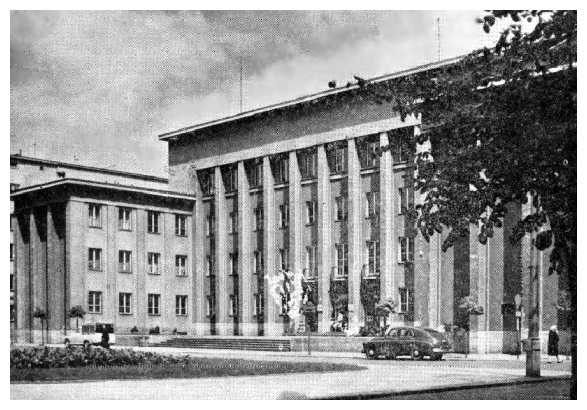
| The city council building of Sosnowiec |
[Page 54]
municipalities were held under the new regulations of the Moraczewski
government[1],
which granted the right to vote to everyone, without distinction.
The first city council of Sosnowiec in independent Poland began
its activity in the year 1920, with representatives of various
socio-political organizations gathered around it. From among the Jews, the
following were elected to this council: Mendel Lubelski, Gronem Sapir, Engineer
Józef Jungster, Dr. Abraham Perelman, Sz. Zyskind, E. Moszkowski, B.
Tencer, M. Judenherc, and Cudikowski. In this first council there were 40
members, and it functioned for five years (1920-1925).
In the various committees of the municipal economy, the Jewish members of the council were represented by M. Lubelski alone. At the head of the council stood the “Konwent Seniorów” (Council of Elders), in which all the different groups in the council were represented by their representatives; the Jews were represented by Dr. A. Perelman and M. Lubelski.
The Jewish population in Sosnowiec was a minority among the non-Jewish population; this was unlike in Będzin and other cities where the Jews constituted a majority. Indeed, for the antisemites from the school of Dmowski[2] and his associates, it made no difference whether the Jews constituted a majority or a minority; they did not want any Jew within local government. And if they did – it was only to win over public opinion with their supposedly tolerant boasting toward the Jews. Even the men of the P.P.S. (Polish Socialist Party) were not ashamed to oppose the rights of the Jews in Sosnowiec. Thus, Polish National Democracy kept deteriorating, narrowing, and shrinking; eventually, local self-government without the restriction of the rights of the Jews was considered by it to be a national disaster.
Within a short time, three appointed councils were formed, and afterwards a “First Council of Commissioners” was established, which included two Jews: Lajbisz Zandel and Herman Oliner. The influence of the Jews was almost non-existent; indeed, there was no willingness whatsoever to take them into account.
In the year 1925, the council was dissolved and new elections were scheduled.
At the initiative of the Merchants Association, a consultation of the representatives of the parties took place – Agudat Yisrael (Orthodox Jewish party), Mizrachi (Religious Zionist party), Zionists, merchants, and artisans – for the purpose of establishing a unified bloc toward the upcoming elections. It seemed that this time the Jews would overcome the schemes of the antisemites to deprive them of their elementary civic rights; however, the Jew-haters did not fold
|
|
| Sosnowiec – Building of the Chamber of Commerce and Industry |
[Page 55]
their hands and initiated a “let us outsmart them”[3]
scheme against the Jewish voters. The main election office sent notices to 40% of the local Jewish
residents stating that they did not have the right to vote because they lacked
Polish citizenship; furthermore, the right to appeal this decision was limited
to three days only. Among those whose right to vote was denied were natives of
the town, men who had served in the army, owners of businesses for decades,
taxpayers, and the like. There was no doubt at all that the hand of the
“Rozwój”[4]
was involved; these antisemites were certain that the short time would not
suffice for the Jews to handle the appeals, and in this manner, several hundred
potential Jewish voters would be removed from the game. The Jewish election committee
immediately challenged the notice; it ensured that as many objections as possible
were submitted within the allotted time, and the right to vote was restored to those affected.
The unified bloc established the following list: Dr. Perelman (Zionist), Moszkowski
(merchant), Warszawski (artisans), Zandel (religious), Dr. Melodysta (with the help
of Mizrachi), Rotstein (artisans), Wolfson (Orthodox), L. Szwajcer (Orthodox), and
others. In these elections, our situation changed for the better; the Jews received
three representatives from the civic bloc. This was already somewhat of an
achievement, even though they constituted a minority compared to the
30 members of the P.P.S. and the 10 Narodowcy (National Democrats). The achievement
lay in the fact that, at least, the opportunity was given to the Jews to voice their demands
and to warn against the discriminatory policy practiced toward them. The P.P.S., as a socialist
workers' party, sometimes cooperated with the representatives of the Jews; however,
it happened more than once that it held back from supporting their demands out of fear
that its reputation would be ruined in the eyes of the Polish population, which did not
excel in its sympathy for the Jews.
At a meeting of the Artisans Association that took place in January 1926, Dr. Abraham Perelman reviewed the activity of the Jewish representation in the city council; he pointed out the indifferent attitude and the lack of interest on the part of the Jews themselves toward the municipality. He demonstrated that out of a budget of 3,000,000 zł, Jewish institutions received only 25,000 zł. Among several hundred officials of the municipality there was not even a single Jew, with the exception of one who worked in the laboratory three hours a day. The clinic located on Targowa Street (in the center of the city) was visited but little by Jewish patients, who preferred to seek their help from the Jewish community; thus, they found themselves paying twice as much as the others. He emphasized the duties of the council and the rights of the residents, and demanded that they make an effort to receive what was due to them.
In the year 1929, the Jewish bloc obtained five members in the council, apart from Poale Zion (two members). Now, the voice of Yiddish was also heard from the platform of the municipality from the mouth of the senior representative on behalf of Left Poale Zion, who read his declaration at the beginning of the meeting in Polish and immediately translated it into Yiddish. On behalf of his faction, he announced that the working masses had placed their trust in him, and he would fight for the fulfillment of the just demands of the workers. Dr. Melodysta, who spoke on behalf of the Jewish bloc, urged the council
|
|
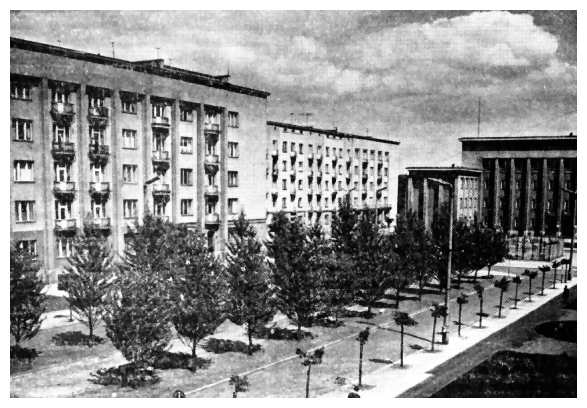
| Sosnowiec – Residential buildings for foreigners, near the city council building |
[Page 56]
to acknowledge the national, religious, economic, and cultural needs of the Jews,
and to ensure that all residents were fully supported regardless of their religion,
nationality, or social standing.
At that same meeting, various committees were elected; from the Jewish side, the following were appointed: to the finance committee – the dentist Rotstein; to the building committee – Hamburger and Tobiasz; the audit committee – Sz. Zyskind; economic affairs – Rotstein and Hamburger; health – Dr. Melodysta and Hamburger; social welfare – Dr. Melodysta and Liberman; education – Dr. Melodysta; popular university – Dr. Rotstein; city library – Dr. Liberman.
At one of the meetings of the council, Dr. Melodysta came forward with a demand that the municipality proceed to increase its share in satisfying the needs of the Jews; despite the fact that the Jews bear the burden of a large part of the tax revenues – he said – their needs are not satisfied except to a minimal extent, and this is by virtue of the rule that persists even after the removal of the Russian occupation of “Krome Yevreyev”.[5] In response to this came an Endecja cry: “You must choose: Land of Israel or Poland”. During the debate that developed, one of the members of the P.P.S. said: “You Jews demand special rights for yourselves, special schools, a special culture; our faction will not support the demands of the Jews”. At the conclusion of the debate, the representative of the bloc announced that, despite everything, the bloc would vote in favor of approving the budget.
In the budget of 1929-1930, we already find several sums for Jewish institutions; under the item “social welfare”, the following were approved: for “Dobroczynność”[6] – 18,000 zł; for the Jewish hospital – 20,000 zł; summer camps for Jewish children – 3,968 zł; day camps – 1,364 zł; “Malbish Arumim” (Clothing the Naked) – 500 zł; likewise, an allocation was made for the first time to the “TOZ” society – 2,000 zł; for “Maccabi” – 500 zł; for evening classes – 500 zł. This was a considerable increase compared to the allocation of the year before, and it was achieved through the influence of Dr. Fuks; the newspaper “Kurier Zachodni” (Western Courier) of the Endecja camp came out with an inciting article against this “success” of the Jews in the municipality, and pointed to the poverty prevailing among the Polish population in comparison to the situation of the Jews.
In the year 1934, a new city council was elected, which served until the Second World War; this council was composed of 44 members, among them nine Jews. The Jews created a “council faction” (Koło); it was composed of the following gentlemen: Mendel Lubelski and Szalom Lajzerowicz (Landlords Association), Herman Oliner and Dawid Kajzer (small merchants), Baruch Majerczyk (Revisionists), Józef Sapir (merchants and industrialists), Jakub Kromolowski (Zionists), Lajbisz Szwajcer (Orthodox), and Adam Zilberszlag (artisans).
|
|
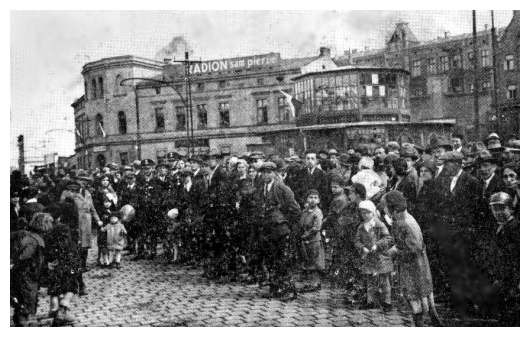
| Protest meeting against trade with Nazi Germany, at 3 Maja Square (1933) in Sosnowiec |
Coordinator's footnotes
|
Ch. N. Bialik as a Hebrew teacher in Sosnowiec – The revival of Zionism and
Judaism in the city and its surroundings – Ezra Goldin, “a righteous
advocate,” on Sosnowiec – “Sosnowiec, situated on the border of
Galicia” – Through the mediation of the poet Aron Luboźycki
from Łódź – S. Feliks from Sosnowiec is in need of
a Hebrew teacher – Bialik was accepted as a teacher in Sosnowiec in
May 1897 – His opinion of the city's Jews in his letter to Rawnicki –
Bialik's famous poems “HaMatmid” (The Persistent Student), “Achen
Chatzir Haam” (Indeed, the People are Grass) and “Lo Timach Dimati”
(Do Not Wipe Away My Tears) were written in Sosnowiec – In Sosnowiec, his
talent unfolded and his fame grew great – For three years he was engaged in
teaching in the city – The days of Sosnowiec were not forgotten from his heart.
|
Chaim Nachman Bialik (1873-1934) was the greatest of our poets in modern Hebrew
literature, a man of great deeds and one of the greatest builders of Jewish
culture. He stood at the center of the life of the generation that recognized
him as its poet and educator in life and in creation – his poor business
affairs caused him in the spring of 1897 to settle in Sosnowiec, where he
engaged in teaching as a teacher of Hebrew for three years.
Bialik's biographers divide his life and cultural activity into different periods: the period of childhood and youth, the Wołożyn period, the Odessa and Żytomierz period, and the period of his marriage and his business affairs in the timber trade. However, for us here, the important years are the three years 5657-5660 (1897-1900) during which he settled in Sosnowiec and engaged in teaching. At the same time, he breathed a spirit of life into Zionism and into Jewish life in the city and the surroundings.
At the beginning of 5657 (late 1896), the financial situation of the poet worsened. The maintenance at his father-in-law's table ceased, and in a short time, he lost his dowry money in the timber trade. He then began looking for a position, even as a bookkeeper in a commercial house. Through the intercession of the fiction writer Ezra Goldin, who published the miscellany “Ha-Zman” (The Time) in which Bialik also participated with his poems, Bialik obtained a position as a teacher in Sosnowiec. At the time, the city was close to the border of Russia and Germany.[1]
For three years Bialik lived there a peaceful life, even if it was not a pleasure. Regarding this matter, we find new details in Goldin's letters. When Bialik's forest business collapsed and his financial situation became very straitened, he turned to Goldin to seek advice. He wanted to know if it would be worthwhile for him to come to Goldin's place of residence, Łódź, and engage there in teaching Hebrew. Goldin, in a letter dated April 3, 1897, wrote to him that it was difficult for him to answer “yes” to his question, and even more difficult to answer “no”, because:
“Everything depends on luck. It is possible that you will come here and find what you are looking for, but it is also likely that you will regret coming. The main thing is that I am not an expert in the nature of teaching and the teachers here. In any case, let me know immediately: Do you know the Russian language well in writing and in speech? In general, outline your intellectual assets for me. Before I receive your reply, I will turn here and there to know how to answer you with clearer information. Rest assured that I love you forever.”
However, a few days passed and Goldin hastened to bring Bialik “good news”:
“And this is the good news in brief: In the Piotrków Governorate there is a small town called Sosnowiec, situated on the border of Galicia. In this town live wealthy Jews, brothers of Israel, who love our language dearly. One of them arrived here today. Through the young poet Aron Luboźycki, who lives here, I learned that this man wishes to bring a good teacher to his town. He, together with two or three local householders, will generously pay the tuition for their sons. I searched for this man all day but could not find him, as he was walking the streets on business. Only in the evening did I have the privilege of finding him at his brother's house. I spoke with him for two hours, and the outcome of our conversation is this: The man, named S. Feliks, who is very wealthy, wishes to bring you to his town. He guarantees that you will earn no less than forty rubles a month. According to him, you will likely earn more, but he guarantees only forty. Your work will be only a few hours a day with four boys, teaching them solely the Hebrew language. If you are highly proficient in Russian, you will earn more; and if you also know German, you will earn still more. But the main part of your work, as mentioned, is Hebrew alone. I concluded the matter with him conditionally, provided that you desire it. Therefore, if you are seeking a livelihood, do this: On the very day you receive this letter, hasten to write – in a concise and pleasant tone – to the man, S. Feliks, at the address below, stating that you wish to take upon yourself the position of Hebrew teacher, etc. With your letter, you will know how to win his heart. I told him that it would be a true blessing for his son to have you. In general, it will be good for you to come out of the dark hole in which you dwell, and I will be overjoyed to have you near me, for the city of Sosnowiec is close to Łódź. In your letter, you should tell him that, besides Hebrew, you know the Russian language well – if indeed you know it. I do not need to teach you how and what to write. Forgive me for repeating myself; it is only out of my love for you that I am anxious lest the matter be ruined because of a single mistake. Also write to me what you have done in this matter, and I will write to that man as well after I receive your reply. I hereby kiss you from afar. Your lifelong lover – Ezra Goldin.”
Bialik hastened, it seems, to follow Goldin's advice. On April 21, Goldin wrote to Bialik that he had received his open letter in which Bialik informed him that he had sent him a letter together with the reply from Sosnowiec. However, Goldin had not received that letter with the reply, and it seems the reply was not conclusive. As Goldin mentioned later in one of his letters, he continued to write to Mr. Feliks – but received no answer. He already feared that he had stumbled upon a dishonorable person; instead of helping Bialik and bringing him out distress, he might have given him false hopes and even a great loss. However, in the end, Bialik was accepted as a teacher in Sosnowiec and arrived there in May 1897. And Goldin furthermore asked to know how he was faring
[Page 58]
in Sosnowiec, as well as his success in the work of teaching. He also asked him
whether the students and parents alike appreciated a teacher like him, and whether
he found time to engage in literature as well.[a].
The financial situation of Bialik improved greatly; however, his emotional state worsened very much. Sosnowiec, as a border city, attracted smugglers; its “maskilim” [enlightened Jews] were assimilationists, and as a whole, it was without tradition and roots. In one of his letters to his friend J. Ch. Rawnicki, who resided in Odessa, he informed him:
“Now I can make you happy because I have a bit more room. I earn here a salary of approximately 50 rubles[2] per month; were it not for the cost of life being expensive here, my joy over the redemption and the change would be complete, even though this work, teaching, is alien to my spirit. When my salary increases a bit, I will also bring my wife here.”
However, in his emotional state, he did not find a “redemption and change” for the better. In one of his letters to Rawnicki, he complains:
“It has been months since I have written anything. The atmosphere of Sosnowiec and the livelihood of teaching or tutoring do not invite the Divine Presence(3) to dwell. It is true that if a decent line comes out of my pen sometimes, it escapes precisely from within the sadness and depression of the soul. But my current “sphere” is filthy and foolish, dominated by “M-Z-E-B-T” (a play on words for wolf-like environments) and “M-K-L-B-T” (a play on words for hound-like environments) – – – and my chariot, which lacks wheels, moves heavily day after day in this mud, with no change in sight(4). Even if a spark flies from beneath the hammer of the heart and a flash glimmers – I will hide it away for the future and conceal it for better days than these, like one who hoards the light.”
And in another letter:
“When I occasionally read in the Hebrew “Mishpat” (periodicals) about the revival and the awakening in the cities of Israel, even after deducting 90% of the exaggerated reports, my heart aches to see myself as a stranger, distant, and cast out from all of this. In this city where I am staying, there is no sign of any of this. There is no one listening, there is no one wishing to listen, and there is no one taking it to heart. A penny, a penny – hat’s all a person really is. There is no God and there is no Asmodeus.[5] [b]
And nevertheless, even in this “contaminated” environment, his Divine Presence (inspiration) did not depart. He did not hide away all the sparks that flashed in his soul for the time to come.
“I am writing a large song, a sort of poem. If I succeed in finishing it, I will be happy. However, I am very doubtful. At every step I feel the lack of my education and my knowledge, and I do not have enough opportunity to supplement them. I am also weak-willed, as you know.”
And Rawnicki adds in his book:
I do not know which poem he is referring to in his words. It is possible that
his intention was his great poem “Ha-Matmid”, which he began and finished
in Sosnowiec. About this poem, he wrote to me in the winter of 5658 (1897-1898):
“In “Ha-Shiloach” (a journal), volume 8, issue 3, my poem “Ha-Matmid” will be printed. When you see it, please tell me your opinion about it. There are many weak places in it, but there are also good ones.”
Rawnicki continues in his note that he had already heard about “Ha-Matmid” from the editor of “Ha-Shiloach”, Achad Ha'am, a man who was not easily impressed and who was never lavish with praise or commendation. Yet regarding “Ha-Matmid”, he expressed his admiration more than once, even before it was printed. And after reading the beginning of the poem in the issue of “Ha-Shiloach”, he hurried to congratulate the poet on the pleasure the poem's beautiful lines had given him. And Bialik replied to him as follows:
“Accept my sincere gratitude for the tokens of affection that you show by turning your heart toward me, to examine my work, and to find in it signs of talent. And may it be the Divine will that your words about me prove true.”
In Sosnowiec, Bialik also wrote various satirical poems that were not included in his collected poems. In his view on political Zionism, Bialik was entirely influenced by Achad Ha'am's battle against Dr. Herzl; nevertheless, there is no mention of it in any poem, story, or letter of his. Among the satires he wrote then, there is also one about political Zionism in the poem “Rabbi Zerach”. The poem tells of a man who goes to the king to influence him to return their land to the Jews. In the end, Rebbe Zerach is brought not to the king's house, but rather to the “hekdesh” (poorhouse/asylum). The satire is sharp, and Achad Ha'am, despite his opposition to Herzl and to political Zionism, did not find it possible to publish it in “Ha-Shiloach”. He believed that a great political movement can be opposed, but “it is impossible to mock it with levity.” Bialik then sent him the poem “Al Levavchem She-Shamam” (Upon Your Desolate Hearts), which was directed not against political Zionism, but rather against the revolutionaries in literature. This was the society of the “Tze'irim” (The Young Ones) founded by Berdyczewski and Tahon. At its end, he attached rhyming verses mocking the belief that it is possible to establish a state in a very short time:
“All is already set there in Vienna: just two brief moments and five small minutes – and, with good fortune, a new state will come into being.” Achad Ha'am refused to print this poem as well, with the anti-Herzlian addition, as well as a second poem against the literary revolutionaries named “Yaldut” (Childhood), in “Ha-Shiloach” for that same reason of “mocking with levity.”
Indeed, it is fitting to mention that Bialik composed at that time two poems filled with positive appreciation for the First Zionist Congress: “Mikraei Tzion” (The Convocations of Zion) and “Shomrim Laboker” (Watchmen for the Morning). And in the summer of that same year 5657 (1897), he completed and polished “Ha-Matmid”, which was printed in “Ha-Shiloach” in the summer of 5658 (1898).
In parallel with his poems of good tidings, Bialik wrote in Sosnowiec his first poems of rebuke (“Achen Chatzir Ha'am” and “Lo Timach Dim'ati”), which were the fruit of his disappointment with the people whom he loved. The poem “Achen Chatzir Ha'am” made his name widely known, more than all his poems up to that time. In addition to the poems “Al Levavchem She-Shamam” (Upon Your Desolate Hearts) and “Yaldut” (Childhood), “Mikraei Tzion” (in honor of the delegates of the First Zionist Congress), “Mishomrim Laboker”, “Im Yesh Et Nafshecha Lada'at”, and “Kochav Nidach” he also wrote and the folk poem “Tikvat Ani” (in which he analyzes the fate of the “melamed” [tutor] in those days). Furthermore, he composed the poems of awakening and hope “Pa'amei Aviv” and “Razei Lailah”. At that same time, he also tried his hand at prose for the first time, writing his story “Arieh Baal-Guf”. And thus, despite being depressed by his trade, and the suffocation of Sosnowiec, his talent continued to unfold and his fame was growing ever larger.
Bialik longed to leave Sosnowiec and settle in Odessa. Rawnicki pressed him insistently, urging him to come to Odessa. Achad Ha’am also wrote to him:
“Whenever you come, you will find here in Odessa people who cherish your talent and are ready to do everything within their power for you.”
[Page 59]
The memory of his poverty and suffering in Odessa – during the
six months he spent there in his youth – filled him with fear.
At the beginning of 5658 (late 1897), Rawnicki again urged him to move
to Odessa and settle there. Yet he did not offer a reliable source of livelihood
at that time, and Bialik therefore did not hasten to follow his advice. In a letter
that Rawnicki sent to him at the beginning of 5658, upon Bialik’s return during
the “bein ha-zmanim” (interterm vacation) from Sosnowiec to his
home in Korostyshiv, he wrote:
Once again you are in blessed K.[6] And what do you plan to do in the coming days? Will you spend the winter in K., or do you intend to return to the city you have grown weary of and spend the winter there, or travel to another city?
And again in another letter from that same year to Sosnowiec:
“And once again you are in Sosnowiec, engaged in teaching and tutoring. I will not tell you that this is not the path before you. Yet I hope that this occupation of yours will be only for a short while, and that you will not spend the prime of your years in vain. To be sure, I do not regard teaching as something empty or worthless. But it is a hard occupation for you to bear, for you were not made for this. It is incumbent upon you, my friend, to live in a large city – a place where a community of sages and writers can be found – and to devote yourself much more deeply to Torah and wisdom.“
And after a few months, at the end of the term:
“Do you truly intend to return in the summer to the work you are doing now? My friend, strengthen yourself and exert every effort to free yourself from this hardship. For if not now – when? The prime of your years will pass away, and what will your future be?”
And after he read “Ha-Matmid”, which was printed that winter in “Ha-Shiloach”:
“Yes, my friend, the author of “Ha-Matmid” is a poet by the grace of God, and I am certain that he will yet bring a great blessing to our literature. And it is a tragic waste of this talent, to be lost in places untrodden by human feet.”
And again in a letter in the summer of 5659 (1899):
“And your good intentions regarding your own future will not come to fruition – I am deeply, deeply sorry. And I had hoped that at the end of the summer you would come here. – Have you faltered now in taking action? – is your strength spent?”
And in a letter from Tuesday, the intermediate days of Sukkot 5660 (September 1899):
“My honored friend, no news has occurred, and no deliverances have yet been wrought. Nevertheless, I write to awaken and to arouse you, so that your heart does not fail. Gather the remainder of your courage and move your tent here. Do not let a sinful thought arise in your heart, for there is still a vision for the appointed time – the coming year in Odessa. I am certain that if you postpone the matter now, such a favorable hour will not soon return. And when will you finally act for the sake of your own soul? Your coming here is necessary – for the slumbering powers of your soul and spirit, for your growth, and for your spiritual and moral perfection. Is all this truly insignificant in your eyes? Will the loss of a few shekels outweigh the great spiritual reward set before you? No man can give you advance guarantees; yet once you settle here, you will surely find your path in the end, and you will bless all who strove to draw you out of the miry clay. Not by bread and shekel alone shall man live – especially one who possesses excellence of spirit. A good and precious gift the Creator has given you. If you squander the treasures of your spirit on wind and vanity, you will one day be called to account. I hope that this time your good inclination will prevail over the difficult evil inclination, and that soon I shall see you face to face in Odessa, drawing ever closer to the proper goal.”
For three years Bialik lived in Sosnowiec as a teacher. In those days, the “spiritual Zionists”, under the influence of Achad Ha'am, were aroused to care for the national Hebrew education of the children of Israel in general and of the Jewish children in Odessa in particular. Then a “Cheder Metukan” (reformed elementary school) was founded there, in which they taught Hebrew in Hebrew, and one of its principal teachers was the writer S. Ben-Zion. In the name of the directors of “the Cheder Metukan”, Rawnicki once again called upon Bialik to move to Odessa and to serve as a teacher in this “Cheder”. Bialik even came temporarily to Odessa during the Ten Days of Repentance 5660 (September 1899) to see whether he would find his livelihood there. The “the Cheder Metukan” was unable to provide him with a complete livelihood, and therefore he returned to Sosnowiec for the winter “term” 5660. However, during this winter, another “Cheder Metukan” was founded in an Odessa suburb (Peresyp). It was proposed to Bialik to be a teacher in both schools so that his livelihood would be secure, and Bialik accepted the proposal with joy.
Only after he had saved a considerable sum during his three years of teaching in Sosnowiec, and after his name had become well-known, did he consent to the invitation from Odessa to come and serve as a principal teacher and supervisor in the “Cheder Metukan” founded there. He then moved his residence to the beautiful capital of the South of Russia, where he lived for twenty-two years. His teaching work in Sosnowiec and later in Odessa turned Bialik's thoughts toward the needs of modern Hebrew education, to which he henceforth devoted much of his attention and his efforts. In Odessa, a period of great and fruitful cultural work began for him – a period that continued until the day of his immigration to the Land of Israel, where he remained active until the end of his life. Yet the days of Sosnowiec were never erased from his heart; he remembered them always with affection as the days of his youth.
Original footnotes
Coordinator's footnotes
|
JewishGen, Inc. makes no representations regarding the accuracy of
the translation. The reader may wish to refer to the original material
for verification.
JewishGen is not responsible for inaccuracies or omissions in the original work and cannot rewrite or edit the text to correct inaccuracies and/or omissions.
Our mission is to produce a translation of the original work and we cannot verify the accuracy of statements or alter facts cited.
 Sosnowiec, Poland
 Yizkor Book Project
 JewishGen Home Page
Copyright © 1999-2026 by JewishGen, Inc.
Updated 15 Oct 2026 by OR