 |
|
|
[Page 377]
by Dr. Avraham Chomet, Ramat-Gan
Translated by Libby Raichman
|
|
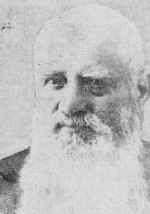
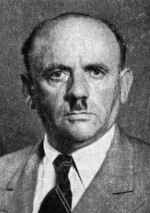
| Dr Abraham Chomet |
The first information about the town of Reisha (Zsezsow), that had become an important border post between Poland and Red-Belarus, is very hazy. The first Polish dukes of the Piast-line[a], had already recognized the great significance of the neighboring Red-Belarus regions. For Poland, these were windows to the east that, at the time, opened an important trade route for Poland, leading to the Black Sea. It was therefore no wonder, that the ownership of Reisha, a border point, created a long and bitter struggle between Poland and Red-Belarus. Finally in 1262, at a gathering in Tarnow, an agreement was reached between the leaders at the time, Daniel the Duke of Belarus, and Boleslav the 5th, the Duke of Poland. According to this agreement, Belarus was allotted to the Pshemishler [Polish - Przemysl] District, which was at that time, a Red-Belarus region[1]. For this reason, the earliest history of Reisha is tightly tied to the past of the Red-Belarus state.
The Polish king Kazimierz the Great (ruled 1333 – 1370), while searching for possibilities to expand Poland to the east, devoted great attention to the neighboring Red-Belarus province. After a string of bloody battles with the Red-Belarus dukes, King Kazimierz occupied the Red-Belarus areas around Halitsh-Lvov, as well as the entire area on both sides of the Wislok River; also the localities in the Pshemishl and Sanak districts. This is how the independence of the Red-Belarus dukes came to an end and Reisha and the entire vicinity fell to the Polish state.
The Polish king placed great importance on the new eastern regions and spared no effort in organizing a national administration to fortify the borders against the frequent attacks by the Tataric hordes. At the same time, he strove to advance their cultural and economic development by extending trade, and diversifying colonizing activity.
Reisha was also situated among the former Red-Belarus areas, in which the King Kazimierz the Great, displayed particular interest.
This poor village of Reisha was an important border post that had suffered at the hands of external enemies under Belarus rule and had stagnated under Polish rule since 1344. In order to enable the speedy establishment and construction of the village, Kazimierz the Great, in 1354, assigned the loyal activist and commendable diplomat Yan Fakoslov of Struzshik to the task of elevating this village to the level of a town. For this task, he provided all the privileges of the German Magdeburg Rights[b]. Jurisdiction over the residents of Reisha was now firstly granted to the village mayor, who was responsible only to the king or his
[Page 378]
representative, but in the case of negligence by the village mayor, the owner of the town[c] had the right to judge the residents of the town.
The reconstruction of Reisha however, developed in a completely different direction: south of the old Belarus Reisha, in an undeveloped area, a new town center was gradually built - the new Reisha. The old Reisha still existed for some time as a village that was first called “Old Reisha”, and later, simply, “The Old Town”.
As the Polish historian Adam Kaminski[2] explains, Reisha was a poor village during the first two hundred years, since the Rights of 1354. Due to the frequent fires, attacks and robberies, the efforts of the Zsheshovskis, the landowners of Reisha at that time, failed to ensure its existence and improve its economic situation. In 1427, a fire again destroyed the town, so the owners of the town realized that only with new rights and concessions would they be able to encourage the residents to rebuild the burnt-out town. These Rights of 1427 contained a whole range of economic issues that created favorable conditions for the residents to engage in intensive reconstruction.
Mikolai Zsheshovski was among the first owners of Reisha who distinguished himself particularly in his dedication for the benefit of the town. In 1571, he approved and extended the Rights of 1427. However, no sooner had the lively economic movement began to develop, than another terrible fire broke out in 1576 that destroyed the town entirely. In 1583, A few years after this catastrophe, the last descendant of the magnate family Zsheshovski died, without leaving any heirs.
As a result of inter-family ties - the widow of Adam Zsheshovski married the Polish magnate Mikolai Spitek Ligenza – the latter took over the ownership of the town of Reisha in 1589[3].
Under the Zsheshovski magnate-family rule, Reisha did not play a significant role in Polish regional life. It was, however, in this period that the town began to express its character clearly, as a trade center. This was due mainly to the fact that two main trade highways crossed there, joining the west with the east, as well as southern and northern Europe.
In the 15th century, Reisha became an important communication point on the great Roptshitzer Highway, that stretched from Krakow to Tarne, Roptshitz, Reisha, Lantzut, Jaroslaw, Pshemishl, as far as Lemberg. Then, when the export of cattle began to develop in the eastern borders of Poland, Reisha became an assembly point from which the cattle were driven further, to Krakow, and even further, to the west.
The trade in cattle was the oldest occupation of the residents of Reisha and its environs. The fairs in Reisha were an important source of income. Special rights for the town of Reisha contained issues that authorized the town's administration to see that no trader that transported cattle or other merchandise from western areas would avoid Reisha.
In the field of industry, brisk activity also developed In the Zsheshovski period in Reisha. Weaving mills played an important part. The Reisha weavers received permission to build shops for weaving and wool manufacturing. The Weaver's Guild of 1449, that regulated all matters that were tied to this industry, testifies in its statutes, to the development of weaving in Reisha.
Finally, at the end of the 15th century, Reisha residents began to involve themselves in beer distillery. At the same time, the first signs of the manufacture of fur coats were apparent.
Assumptions about the first Jews in Reisha
In sources currently available, regarding the oldest period in the history of Reisha, Jews are not mentioned at all. Based on this, Polish historians came to the decision that Jews appeared in Reisha only when the town became the property of the Polish magnate Mikolai Spitek Ligenza – that means, at the end of the 16th century. The Jewish historian Mgr.[d] Elazar Feldman came to a similar decision. In 1934, in the periodical “Pages for History” no 3, he published a list of towns in Galicia, and dates indicating when Jews settled there, without specifying the source of this information. According to this, Jews would have settled in Reisha in 1550. The writer notes, however, that there is no doubt
[Page 379]
that in Reisha (as in other towns), Jews were present prior to the existence of a Jewish community.
It will therefore not be an exaggeration, and one can confidently assert, that a Jewish community already existed in Reisha in the period when the town belonged to the Belarus state.
The Polish historian Waclaw Maciejowski, in his dissertation, “The Jews in Poland, in Belarus, and in Lithuania” states that already in 1015, the Belarus ruler Shviyentopelk, striving to develop trade, accepted the Karaites[e] for special protection. They had by then settled in a large number in Belarus[4]. One must consider that the entire eastern trade at the time, lay in Jewish hands, and that a local route through Reisha was already active, leading to Pshemishl, and then to Lemberg where the road was already open. It is then clear that Reisha, at that time, was situated on the very important eastern trade highway, and that a Jewish community of traders existed there.
However, at that time Reisha was an open unfortified area that suffered significantly from frequent fires and attacks by plundering tribes. In the first half of the 13th century, the cruel Dzshingchan, the leader of a strong Tatar army, arrived from the deep Asiatic steppes and destroyed Belarus towns and villages. In fire and smoke, the local Jewish communities that were situated on the formerly mentioned eastern trade route, left their settlements. From Belarus, the Tatar hordes entered Poland where they were met with strong resistance, and only after a bloody battle at Lignitza (1241), the Tatars were forced to retreat, inundating the Belarus province that had been destroyed.
The existing trade route became less important. The trade center moved from Kiev to the west, and in the eastern areas of Poland, new trading places emerged. At the same time, Jewish trade took a new direction. Without a doubt, such a trading place also existed in Reisha, given that according to royal decrees at the time, as well as the accepted knightly custom of the Middle Ages, the Polish aristocracy was forbidden to engage in industry and trade. As a result, trade lay mainly in Jewish hands. In this period, in Reisha, groups from the urban Christian population also engaged in trade, and for a certain time, Jewish and Christian traders lived in peace. Only when Jewish trade expanded significantly and Jewish traders set out on the great trade highways that had meanwhile emerged – urban Christian traders who were not capable of competing with Jewish traders, began to influence the ruling powers - the owners of the town, to limit or even stop Jewish trade in Reisha altogether.
Jews are not mentioned in the various acts (rights, tax exemptions etc.) neither in the privately owned or royal towns, so it is not known how long the Jewish and Christian traders lived in peace. Only when the Christian residents of a town, managed with the help of ruling agents, to limit the rights of Jews to live and trade there - that Jews were then mentioned in those acts.
For this reason we can understand why the Jews are not mentioned at all in the acts regarding Reisha during the first two centuries, although they were already living there. The Gift-Act of Kazimierz the Great in 1354 contains general decrees concerning the development of the town. The same appears in the content of the Rights of 1427, and later those of 1571. However, already in 1599, the town's Christian residents in Reisha – apparently troubled by the growth of the local Jewish population, persuaded the owner of Reisha at that time, Spitek Ligenza, to limit the number of houses, in which Jews had the right to live. In that documented license that the Reisha Christians received from Ligenza (exact details in the next chapter) – the Jews have been mentioned. The accepted assertion that the Jews first appeared in Reisha at the end of the 16th century, is consequently, entirely incorrect. More plausible is our premise that when King Kazimierz the Great, took over Reisha [1340-1] a Jewish community already existed there, one that in a tough struggle with external difficulties, fought for their future survival.
We must in addition, take into consideration that in the year 1333 – when Kazimierz took over the Polish government – chaos ruled there. Merchants on their way to trade fairs, carrying merchandise from the east to the west, were attacked by armed gangs that robbed them, and due to the lack of safety, the traders turned back. However, this Polish king soon began to be concerned about the economic development
[Page 380]
of the Polish state, and with this in mind, he began extensive construction in 70 towns, that were important for the economy and security of Poland[5].
Thanks to special royal privileges, these towns became an important attraction for residents of other Polish regions, for German settlers in farming communities, and for Jews who were driven out of other neighboring countries. The new Jewish residents in these towns became leaders in foreign trade that had begun to develop, based on exchange of Polish raw products for items that were needed in Poland. In this way the immigrant Jews, to whom Kazimierz the Great had given the right to live and trade, became intermediaries between internal and external trade in Polish towns. Reisha was among the 70 towns on which the king placed considerable importance, and with the Gift-Act of 1354, he elevated it to a position of a town according to the Magdeburg Rights.
In the work of Dr. Yitzchak Shipper we find other information about the presence of Jews in Reisha in the Zsheshovski period. In his publication “The History of Jewish Trade in Poland” (written in the Polish Language), he mentions that beginning from 1573, people encountered Jews from Reisha that travelled to Danzig for trading purposes.[6]
Ligenza – The New Landlord of Reisha
Mikolai Spitek Ligenza, a feudal magnate of the Krakow and Sandomir provinces, was deeply concerned about the town of Reisha and its residents. He placed great importance on strengthening trade and industry in the town, but his main concern was the defense of the town from external enemies.
Ligenza confirmed all former privileges that Reisha had received during the ownership of the Zsheshovskis. In the center of the “New Reisha” he built a fortified palace and when he divested himself of part of the area on the second side of the Wislok River for the benefit ofthe town, he began to build the new Reisha.
Recognizing the great importance of trade emanating from the town fairs, Ligenza was concerned about security on the trade routes and adopted measures to ensure that the fairs that were held in Reisha on the 25th of April would have the appropriate success. In the years 1600 -1605, Ligenza conducted an intense struggle with the owner of the neighboring town of Lantzut, the famous “devil” Stadnitzki who purposely took to protecting the fair that used to take place in Lantzut two days earlier, on the 23rd April. However, after the Polish King Alexander, issued in his decree of 11.12.1590, that included the annulment of the Lancut fair and declared that only the Reisha fair was valid, Stadnitzki, then made every effort to see that the fair in Lantzut would continue to be held as always on the 23rd April. To this end, he and his adherents would attack the merchants, block their way to Reisha, take large sums of money from them, or force them with strength to participate in the fair in Lantzut. Only in 1610, when Stadnitzki fell in battle with his bloody enemy Lukash Opalinski, the governor of the province of Lizshensk, was it possible to hold the fair in Reisha, as previously – on the 25th April.
Artisans also played an important part in the economic life of Reisha. They were organized in Guilds according to their line of business, and their main task was to control the local market in its battle with foreign competition. There was the Weaver's Guild, that has already been mentioned in an earlier chapter, and there were other Guilds that also existed in Reisha - of tailors, hatmakers, furriers, shoemakers, hairdressers, and those to which pharmacists and medical personnel also belonged. The Goldsmiths' Guild already existed in the 16th century.
A member of a Guild could only become an independent artisan, that means a master craftsman, if he was also a Reisha citizen. The members of the Guilds had to pay a tax to the town's owner – a kind of payment for the right to be active in one of the organized guild professions, as well as, for the use of the premises or the shop that belonged to the landowner. Judging by the significant number of Guilds that existed in Reisha in this period, it is easy to assume that the system of labor was then well developed.
A terrible fire destroyed the entire town of Reisha in 1621. However, no sooner had the town been rebuilt with great effort, it again suffered greatly from an attack by the Tatars in 1642. Ligenza now turned to the defense of the town. Firstly, in 1627, he ordered that the town be encircled with ramparts and fences, and at his own
[Page 381]
expense, he allowed gates and defense towers to be built.
He ordered all the town's residents, regardless of religious affiliation, to provide themselves with guns, with an appropriate number of bullets and with gunpowder. Only women and children under the age of 12, were free of this obligation. This entire defense activity was under the supervision of a member of the state council, a suburban representative, and a Jewish hetman (leader).[7]
To hasten the building of the protective wall, Ligenza divided the entire length of the fortification line into separate parts, and each group of the town's residents was required to build a specific section of the wall. In the general list of townsfolk that were obligated to take part in this work, no Jewish names appear, because at that time, Jews were living in a separate quarter in old Reisha and had to build their own protective wall around the area where they lived.
In the general defense plan of the town, Reisha Jews were subject to exactly the same obligations and decrees as the Christians; so the Jewish home-owners, as well as the renters had to keep ammunition in their homes – long rifles, with a “koppe” (60 bullets], charges [explosives], and three pounds of gunpowder for each rifle, separately.[8] Besides that, all Reisha Jews were compelled to have prepared in their homes, three stones, always dry and good gunpowder, a “koppe” bullets for the machine-guns, and half a “koppe” for the canons. In addition, at the call of the leader, they were compelled to stand under their own flag. Before 1627, the appointed Jewish hetman was Moshko Haftazsh.
The Reisha Jews were also provided with a separate tower that stood behind the synagogue, on which four machine guns were installed. They also had to maintain a permanent guard whose task it was to guard the four machine guns[9] and fire them in the event of an attack.
At the beginning of the 17th century, Reisha was already an important trade and industrial center. As a result, the number of wealthy townsfolk grew, and the town's entire administration lay in their hands. The regime of the town's upper classes often aroused hostility from the town's folk masses. This included, besides shop keepers, also residents who did not have citizenship, journeymen, residents of the Reisha suburbs, lodgers, ordinary working people, and all kinds of impoverished town residents. Independent artisans who did not belong to a Guild, were also part of the group that had no citizen rights in the town, as well as the so called “unskilled”, and finally, the Jews. The Polish historian Adam Przybos[10] explains, that at the end of the 16th century, a large group of Jews lived in Reisha, that played an important role in the town. At that time however, they did not yet have citizen rights and therefore did not participate in the town's administration. They always had a difficult struggle to be accepted into the Guilds, as well as to receive permission to have a shop. Removing the possibility for Reisha Jews to rent a stall or a shop, was the main weapon used by the Christian townsfolk in their efforts to break the competitive challenge presented by the Jews.
The town's Castle and Guild decrees in Reisha strongly prohibited the trading of merchandise in the streets or in private houses. However, while the wealthier Jewish merchants rented a few rooms to organize a store there, with a living room and a kitchen, the poor Jewish traders in Reisha had to be satisfied with an ordinary shop to store their merchandise, and were pleased when they managed to receive permission to have a store alongside a wall, or in the entrance to a private house.[11]
At the end of the 16th century, barely six Jews in Reisha had their own homes.[12] At that same time, most of the inns in the new town were already owned by Jews.[13]
All the Polish historians that researched the history of Reisha in feudal Poland, confirmed that the main reason for the rise of the economy in Reisha in the period between the 16th and 17th centuries, was due to the Jews. However, the extraordinary expansion of Jewish trade in Reisha, both in internal and external markets, had at the beginning of the 16th century already created discontent among the Christian townsfolk in Reisha. Suddenly they felt threatened in
[Page 382]
their privileged economic reign in the town, and on religious grounds, began a battle against their formidable Jewish rivalry.
A striking expression of the militant, hostile atmosphere among the Christian population in Reisha towards the local Jewish traders and artisans, was based on the Rights of 1599, in which Ligenza acceded to the wishes of the Christian trade and work circles, and prohibited the Jews from trading in merchandise that was produced in Christian workshops.[14] These Rights also contained a decree, according to which, only Jews who possessed their own plots of land in Reisha, had the right to build houses[15], with the restriction that in Reisha there could be no more than seven Jewish residences[16], for which the Jews had to pay the owner of the town a special tax impost.
These restrictions did not deter the Reisha Jews from pursuing their economic activity. As the Polish historian Adam Przybos emphasizes in his treatise about Reisha in the period between the 16th and 17th centuries – despite the difficulties and obstacles, the Jews in Reisha continued their activities as merchants, shopkeepers, brokers, tariff and tax lease-holders etc. Within a short time - adds Przybos – the Jews occupied an entire street in Reisha and even leased shops in the Reisha market-place itself, in order to sell merchandise there at the trade fairs.
During Ligenza's reign there was a small number of Jews in Reisha because at that time, they had the right to occupy only seven houses. In the old town in those days, the Jews were not allowed to own houses at all. They lived in a separate Jewish quarter in the vicinity of the cemetery, behind the old synagogue, in an area that in the 16th century belonged to the church.[17] The Jews found a way to overcome this, as the owners of the Jewish houses took in more families; so in fact, the number of Jews was always higher than the official number in the Jewish houses.
This is best confirmed by the fact, that at the beginning of the 17th century in the Jewish quarter in Reisha, there was already a synagogue, a stone building – built in the style of a defense fortress – that according to the opinion of the historians of Reisha, stems from the end of the 16th century. However, even this restricted number of Jews, struggled for their survival, searching for ways and means to affect the right to live and work in Reisha. The local authorities took every opportunity to make the daily lives of the Jewish population difficult, in the town. This is how, this same Ligenza, raised payments and imposed taxes on poor and rich Jews in Reisha in various ways, and regarded them as objects that can be exploited according to his ruling aristocratic fantasies. In 1627, he permitted the Reisha town administration to publish a decree whereby Jews were prohibited from employing a Christian girl as a servant, because he saw this as total corruption, due to the large salary paid to her, and a prohibited luxury.[18] At the same time, Jews were forbidden to open their shops during the non-Jewish holidays and were not even allowed to display their merchandise in their windows. During a procession, Jews houses had to be closed, and the residents had to withdraw deeper into the house.
Ligenza, the Polish feudal magnate, was always in financial need, and it was difficult for him to waive the income that he drew from his “non-believing” Jews. For this reason, he placed great importance on the development of export trade, in a wide variety of merchandise. This was organized by Jewish merchants in Reisha, in whose hands almost the entire trade lay.[19]
The Jewish retail traders and shopkeepers in Reisha also had to struggle with the interference of the Christian town administration who were on guard to see that Jewish traders would not be able to have a shop or a store in the center of the town. So they organized that many of the non-Jewish residents of Reisha that belonged to the nobility became owners of houses and rented their houses in the town to Jews, for high prices. They ignored the decrees of the magistrates, and in doing so, protected the Jews from the local authorities. These were the outward relationships in which the Reisha Jews found themselves living
[Page 383]
and struggling. On the one hand, there was blind hate from the Christian citizens who strove to get rid of the rivalry in the area of trade and industry, and on the other hand – a dishonest attitude to the Jewish problem by the feudal owner of the town, the magnate Ligenza, as well as by the Polish nobility, for whom Jews were merely a source of income.
Privately however, - in the narrow little Jewish streets, in a restricted area, a rich Jewish life stirred, a small kingdom, with its own authority that took care to maintain synagogues, and a study house, a bath house and a cemetery, traditional religious schools, a Jewish hospital, their own court of law, and many other social and religious needs.
The Community in Reisha during the Revival of Jewish Autonomy in Poland
The struggle of the Christian Merchant Association and the Guilds in Reisha to remove the Jews from their economic positions, encountered a strong resistance from the Reisha Jewish population, that already had its own community organizations.
Later, in the area of Galicia, two communal land-districts developed, namely: the land-district of Reisha Jews with the community in Lemberg as its center, and the Krakow-Sandomierz land-district with their central communities in Krakow and in Sandomierz.
Each of these land-districts had its own administration, and its own Rabbi, who took care of all common issues at the land-assembly, Sejmik Zyemski – as it was called in Polish.
Around the year 1700, the Pshemishl Community separated itself from the Reisha land-district with more community branches, creating their own Pshelmishl land-district, to which Reisha also belonged as an affiliated community of Pshemishl.
Soon however, in this district too, quarrels and disputes arose. In the first years of the 18th century, the Rabbi of the Pshelmishl district, Reb Yehoshua Yechezkel Frenkel, moved to Reisha without the approval of the Pshelmishl community, and took over the office of the Rabbinate. He was then deposed as Rabbi of the Pshelmishl district and in his place, the Slonim Rabbi, Reb Shmuel Mendelovitz[20] was appointed. In around 1715, this conflict had repercussions in the committee of the Pshelmishl district in Kantshuga and in Jaroslaw. Finally the Reisha community separated from the Pshekmishl district and created a new Reisha community group with the neighboring small towns.
As we have indicated earlier, at the beginning of the 17th century, a small group of Jews had concentrated in a separate quarter - in a ghetto – where, in the course of decades, Jews were given permission to live in only seven houses.
Evidence of the energetic and multifaceted economic activity of this small Jewish community, is testified by the fact that it then possessed a synagogue built of stone, that is already mentioned in the decrees of Ligenza in 1624. In later years, when Ligenza was still alive, a tower was added behind the synagogue, on which four canons with ammunition were permanently installed. Only in the first half of the 17th century, when the new neighborhood arose, the so called “New Town”, the Jews were then allowed to own 40 houses, and with that, the number of Jews in the Reisha community increased to more than 40 families. In the old town – except the ghetto quarter – Jews were still not permitted to reside[21].
These restrictions regarding the permitted living areas for Jews in Reisha, continued until later, when the ownership of the town changed. Ligenza left his entire estate to his two daughters, Zofia Krashinska Prudentziana, and her sister Konstantzia. The former married in 1633 to the Count of Torne, Vladislav Dominic Ostrogski, who later became the Provincial Governor of Krakow. The second sister married the Duke, Jerzy Sebastian Lubomirski, the great Field-Marshal, and Chief of State. Ligenza registered the town of Reisha and its environs, and 35 villages, to his older daughter Prudentziana, on condition that the town itself would not, under any circumstances, be divided, and with this, the town now found itself under the reign of Count Ostrogski. The new owner of the town played an important role in the battle that flared up between the Jesuits and the Arians – by supporting the Catholic church. At the Polish parliament coronation in 1633, he came out with a speech in which he proposed - imposing upon the lower classes, and the Jews[22], the entire burden of
[Page 384]
taxation for expenses for defending the state.
In 1648, Ostrogski renewed Ligenza's edict that prohibited Jews from owning houses in the old town, and simultaneously demanded that neither the village mayor, the members of the council, nor the townsfolk, were to sell plots of land, or dwellings in the old town, to Jews. The punishment for this would incur the annulment of the deed of sale.
A conflict regarding Reisha arose between Ostrogski and Lubomirski that often led to an open fight, that ended with a victory for Lubomirski – and the town of Reisha came under his ownership.
The first of the new owners of Reisha, Hieronim Augustyn Lubomirski, placed great importance on bringing order into the town. After he fortified the area of the new town, the economic center of Reisha was established there.
Besides Poles, Jewish traders and shopkeepers in particular, settled there and contributed to the development of the new town. The success of Jewish activity in this period, in the new town, must have been enormous, if the Polish historian A. Przybos, deplores in his already cited treatise about Reisha, that “soon after the new town was organized, Jews were quickly buying up the houses and plots of land that belonged to the Christians”. He adds that “in the last quarter of the 17th century, there must have already been a substantial number of Jews, if there was a necessity to build a new synagogue there, based on a permit of 6.1.1686, issued by Hieronim Augustyn Lubomirski”.
Another Polish historian, Franciszek Kotula[23], informs us that in an archive in Reisha's town museum, there is a Right, written on parchment, that was drawn up by Hieronim Augustyn Lubomirski on 6.1.1686, that contains a permit for Jews in Reisha, to build a synagogue at the town's “val” [wall], that fenced off the Jewish quarter (hence the name, the “Valyer synagogue”). In this document, it was also assured that the Jews would have the same benefits in the new synagogue as they had in the old synagogue.
Given that this document was first found in the archive of the Bernardine church, the Reisha Jews - according to Catholic opinion – built the new synagogue with help of a loan that they took from the Bernardines. The Document of Rights – says Kotula - was handed over by the Jews to the lenders as a pledge, and probably the money was never paid back, and the parchment document remained in the archive until 1946.
The consolidation of Jewish settlement in Reisha was due mainly to the fact that in 1696, Jerzy Augustyn Lubomirski repealed the decree that prohibited Jews from living in the old town. At the same time he permitted them to buy houses and plots of ground there, on condition that they would first receive permission from the town's owner who had to consider the advice of the town's residents.[24]
The fact that Jews were allowed to settle in the old town, had great significance not only for the Jewish population, but also for the development of the town itself. The old Reisha and the “New Town” existed alongside one another as two separate towns, until the end of the 17th century. Now, after Jews were also permitted to live in the old town, this separation was annulled. To enable the merchants who came from the western side to have a convenient path to the east, a new bridge was built over the Wislok River that joined both towns. At the same time, disputes arose between the Jewish and Christian populations, regarding the question of who was to bear the cost of the repairs to the bridge and the approach to it, as well as who would pay for conserving the town's eight gates. Lubomirski settled the conflict in this way: the Jews were responsible for repairing the road from one side, that stretched from Baldorf's house to the market-place of the new town, and from there, through the Volye to the town's brickfield; also from the second side, to the gate in the new town, and from there, through the Volye (later called Lvovska Street) to the bridge.[25] Regarding the conservation of the gates, Lubomirski ordered that the Jews had to take care of four gates, and the Christians of the other four gates.
In the history of Reisha as a private town, the owners in feudal Poland, played a significant role. Their attitude to the basic problems of the town's economy, towards trade, towards the merchants and the Guilds, determined the development of the town.
The previous owners of Reisha, the Zsheshovskis and Ligenza, in their concern for the town, dealt intensively with the anti-Jewish attitude of the town's Christian residents, who, with help in
[Page 385]
monopolizing trade and industry in the town, made a great effort to weaken Jewish competition.
The Lubomirskis, in contrast, who took over Reisha in a period of wars and fires – had only one aim in mind: to extract as much income as possible from both the Jewish and Christian populations. Their officials imposed taxes, for the benefit of the castle and the state treasury, both from the town and the surrounding villages. In this respect, the Lubomirskis did not differentiate between Christians and Jews. Besides taxes, the public had to make various payments, specifically for the town's plots of land, for gardens and for houses, and other payments for being engaged in trade or industry. In addition, there was also a variety of unpaid work for the benefit of the owner of the town.
From the Statutes of 1657 for the town of Reisha, we have a clear picture of the attitude of Hieronym Lubomirski to the Reisha Jews, as well their relationship with the local Christians.[26]
Mentioned there, are the grievances against the Jews – why they do not fulfill their obligations to the town; for example, that they still pay taxes according to the norm that was designated in the period when the town had only seven Jewish houses, and that they trade in items manufactured by Christian artisans etc. In order to prevent these Jewish “sins”, Hieronym Lubomirski, the so-called friend of the Jews, among his other decrees, stated that all previous decisions concerning the prohibition to be engaged in the trade of artisan manufacture, must continue to remain in force. All public obligations, all state and local responsibilities, must be fulfilled by the Jews in proportion to the number of residents.
In the first half of the 17th century, Reisha reached the peak of its development. Despite fires and wars, from which the town suffered so often, the residents displayed a great deal of initiative. In this respect, the influence of intense activity by Ligenza to create favorable conditions for trade and industry in the town, was still in effect. He understood the great significance of trade fairs for economic growth in the town, and already in 1578, he elicited a Right from the king, Stefan Batori. This Right emphasized the role of Reisha as a trade center for cattle and merchandise from Belarus, Podilye, and Volin, and the residents received the right to protect their privileges regarding foreign merchants. In particular, they were given permission to ensure that traders who were transporting merchandise or cattle did not avoid the town of Reisha. With this “smuggling”, the Reisha residents had the right to arrest a trader and confiscate his goods.
Since 1726, nine fairs were held annually in Reisha, apart from the weekly markets – that were held every Friday.
Trade in wine exceeded the level of trade in cattle in Reisha and had already developed there in the 16th century. One indication, among others, to the volume of this trade, are the cellars that were found under the market-place, particularly the cellar that had belonged to Tuchfeld the wine merchant, even before the First World War. This two-storied cellar that originated in the 16th century[27] stretched from west to east - a distance of 97 meters.
Aside from trade fairs, trade in shops, always retail shops, developed well. Hardly any shops were built of stone; the rest were shops and street stalls that were located on sidewalks,[28] alongside the walls of houses, or in the windows of residences. The street stalls were allocated to women who had become widows and were members of the Guilds. Since the 18th century, these stalls were almost entirely, managed by Jewish women.
According to the list of the town's taxpayers in Reisha in 1730, there were 91 stores, 31 larger stores, 9 street-stalls and 51 shops[29] that were all active. In addition, at the “Balyonyes”, located outside of the town, trade was brisk and more lucrative as the merchants dealt mainly in cattle. In trading abroad, grain was the most substantial commodity in Reisha. Trade alliances with foreign merchants extended to Danzig, Warotzlav, Moscow, and other distant destinations. The Reisha merchants also exported linen to the west. They supplied grain and fabric to Danzig, tanned skins to Warotzlav, and malt, eggs, and butter to Hungary. The so-called
[Page 386]
Reisha gold was exported to Moscow – this was a kind of copper that was known in the lands of the Urals and Caucasias.[30]
In the 18th century, Reisha Jews were almost exclusively involved with the export of this commodity to foreign countries. In the period 1681 – 1699, Jews travelled to the famous Leipzig fairs. There were three traders from Reisha[31], one of whom was Hersh Yisroel who had business connections with Danzig. In 1778 – 1780, the Danzig town council issued a document that would provide him with material assistance during his stay in Danzig.[32]
This trade abroad, that developed so well during Ligenza's rule in Reisha, began to decline increasingly, during Lubomirski's rule. There were other reasons for the decline of the economic situation in the town.
The most terrible calamities were the fires and the epidemics. The fires of 1698, 1709, and 1728,[33] destroyed the town. Almost all the wooden houses went up in the flames. The reconstruction of Reisha was fraught with great difficulties.
The town suffered greatly from epidemics. In the years 1707 to 1713, a terrible plague affected the whole country and did not escape Reisha. The bridges over the Wislok River were torn down, and the town's gates were locked. For some time, the town was isolated from the outside world.
A massive epidemic broke out in 1735. The local hospital, that had been built in the time of Hieronym Augustyn Lubomirski, was so neglected that instead of 20 rooms, there was only one room that could be used. Even the hospital that was built alongside the old one, with funds provided by Jerzy Ignacius Lubomirski, was in a poor state.
Unfortunately, again in 1745, there was an epidemic that affected the cattle and entire herds died, so aside from fires, hunger was now a danger for the residents of Reisha.
Wars and internal conflicts had a distressing impact in this period. Right at the beginning of the 18th century, Reisha was in chaos due to the war with Sweden. It began with a series of taxes, requisitions, and crimes by foreign troops – Swedish and Russian – and no less by their own Polish military detachments, some on the side of the Saxon King August the Second, and some on the side of his opponent, Stanislaw Leshtzinski.
In November 1702, the Swedes occupied Reisha. Their criminal administration in the town and in the vicinity lasted for nine months.
In March 1703, Lubomirski surrendered and approved the reign of the Swedish King Karl the Twelfth.
The Saxon King, August the Second, did not wait long to react, and in 1704, Reisha was occupied by the Saxon army; but they too, did not last long in the town. In August 1704, the Swedes again entered Reisha.
This is how the rulers changed in the town of Reisha, and its residents suffered greatly from the constant chaos. Even later, when the Swedes were driven out of the country by the patriots of the Tarnograd Confederation (1715), Reisha also suffered during the presence of the Polish fighters that stayed in the town.
Even after the death of August the Second, the Reisha residents had no respite. At this time, preparations began for the election of a new Polish king, and Reisha became the center of Saxon power against Leshtzinski.
In December 1735, a new confederation was organized by the governing board in Dzikov, in favor of Leshtzinski. On 10 January 1735, the Dzikov divisions marched through Reisha, and a week later, the Saxons arrived with the Russian soldiers, and the town was again ruled by the supporters of the Saxon royal candidate, King August the Third. Again, crimes, taxes, and requisitions began.
There was yet another reason for the economic decline during the rule of the Lubomirskis. There was an ongoing conflict between the owner of the town and the town council stemming from various decrees by the duke, who supported feudal regulations for the residents. This meant that they would be personally, administratively, legally, and financially dependent on him. He had only one aim – to protect his own interests, without considering the material situation of the local residents.
Therefore, in 1723, Jerzi Lubomirski taxed local trade with a string of harsh payments, that
[Page 387]
undermined the economic foundations of the town.
What is relevant to the attitude of the Lubomirskis to the Jews, is the fact that they had to consider that the entire foreign trade was concentrated in Jewish hands, particularly the export of grain and cattle, and that a great deal of the income from this trade belonged to the Lubomirskis as the town's owners. This is the reason for their so-called friendly relationship towards the Jewish population, who had with great effort, managed to carry out all the fiscal demands of the Lubomirskis.
In his monologue, Pentzkovski states that the figures regarding the manner and the extent of trade in Reisha in the 18th century, are characteristic.
In 1730, when Reisha had a population of more than 3000 residents[34], there were, together with the shops belonging to the Christians, 91 stores, including 31 larger stores, 8 grocery shops, 23 shops that were not classified, 9 street stalls and 51 shops, of which 13 sold only linen cloth.
Pentzkovski[35] recounts that in 1761, the number of shops and stores in Reisha fell to 41. It is interesting that the number of shops and stores was reduced from 51 to 31, but the number of larger stores did not diminish and reached 28.
It is also worth indicating – that in the Christian community, in the first half of the 18th century, there were 130 wealthier residents and artisans trading on a small scale, 22 clerical personnel, members of the Polish nobility, and a considerable percentage of townsfolk involved in minor agricultural work (a total of 220).
Towards the end of the 17th century, all the shops in Reisha belonged to Jewish residents.[36] Among the previously mentioned 91 shops in 1730, there were hardly 6 belonging to Christian residents, and in 1762, Reisha had only one Christian store, that belonged to the woman Frantzishka Noigebauer.
To be able to correctly assess the efforts of the Reisha Jews in their struggle to exist, it is necessary to be acquainted with the structure of the Guild organizations, its importance at the time, and its dominant influence in almost all areas of economic life in the town in the 17th and 18th centuries. The main aim of the Guilds was to rule and normalize the process of production and sales. Understandably, in feudal Poland, the establishment of a Guild was subject to the approval of the town's owners – the king as royalty – and the landowners of the private towns – in the form of a Right. These Rights for the various Guild organizations contained regulations that ensured that the members of the Guild would have a monopoly in their given branch of production. The Guilds guarded their interests, which was often the reason that these Rights detrimentally affected the development of the economy in the town.
Most of the Guilds in Reisha originated before the 18th century. The Guild-Rights of 1439, for the weavers, were the oldest, and were later confirmed a few times in the period of the Lubomirskis. In 1683, at the same time as the Rights of the weavers were confirmed, Hieronym taxed the Christian and the Jewish linen merchants with a payment of 12 groschen per quarter. The Jewish merchants possessed the Right of 1690 that released them from this payment – so since 1700, they had not paid this at all. The Duke Lubomirski, however, did not agree to free them of this payment, claiming that the document of Rights that the Reisha Jews possessed, was forged.[37]
The Barber's Guild, to which the pharmacists and those in the medical profession belonged, was of significant importance to the Reisha Jews. In their request to Hieronym Augustyn Lubomirski about permission to establish a Guild, the barbers asked to “curb the corruption plots of the various incompetent members of the healing profession, as well as opposing the unqualified medical personnel”. By this, they meant the Jews, because, as Pentzkovski states, regarding this demand by the Christian barbers – at that time in Reisha, the number of Jewish doctors increased considerably, none of whom had an academic degree or a certificate of completing practical training. From then on – every Jewish “surgeon” who wanted to settle in Reisha, had to take an examination. The examiners were appointed according to the recommendations
[Page 388]
of the Guild and the community. The Jewish doctors were permitted to live, only in the so-called Jewish Street, or in the new town, where they had to pay double taxes.
In addition to the main tasks of the Guild organizations in feudal Poland, they also sought to oppose any possibility of competition concerning economic issues, from those who were not members of their Guild.
The competitor was – the Jewish artisan … the Jewish merchant. The Guilds were typically religious Christian, so that Jews could not belong to such a Guild. Jewish artisans were branded as unskilled and had to work and sell their wares illegally. In Reisha the Jews belonged to the Guilds of the barbers, butchers, and bakers – but with certain restrictions. The statutes of the Butcher's and Baker's Guilds determined the number of shops and stores that Jews had the right to own (butchers - 6, bakers – 8), as well as the number of apprentices and journeymen that could be employed. The Butcher's Guild also contained a condition that only a Christian could be a master craftsman.
This control that was enforced in Reisha, was based on the Rights of 1686. A Guild of entirely Jewish furriers existed, who lived in the new town. They had their own Guild banner, rifles, bullets and gun-powder. All internal conflicts of all the Guilds were mediated by the representative of the castle, but due to the strong organization of the Christian Guilds, to which Jews did not have easy access, being involved in trade in Reisha, presented great difficulties for them. The inspections that were carried out in Reisha in 1757 indicated that in both the old and new parts of the town at that time, there were 26 Jewish goldsmiths, 19 tailors, 6 hatmakers, 4 butchers, 4 ertzte, 2 knife-sharpeners, 1 seal maker, 3 embroiderers, and 1 lathe operator.
This monopolizing character of the Guilds in business and trade, limited development and production, and furthered the destructive tendencies of the Guild organizations that seriously affected the economic decline in Reisha.
In 1730, Jewish residents in Reisha began to leave the town. A new problem of internal emigration emerged; houses stood empty. The merchants, particularly in the new town, left their homes and moved to the old town with their families, where they opened stores, rented houses, and began to engage in business and trade.
In order to restrain this exodus from the new town, Jerzy Lubomirski ordered, under threat of punishment, that all those who had lived there, must return to their old locality. In addition to this, in 1749, he published a decree, according to which all local and foreign residents who wanted to settle in the new town and build there, would be exempt from paying taxes to the castle or the town for seven years. They also received permission to trade during this time, without making any contributions.
These concessions and punishments, however, did not help. The houses in the new town continued to remain empty, and similar manifestations prevailed in the old town. First the poor people left the town, artisans who sought to earn a living in other places. There were a few cases where poor Jewish traders left the town, but most Reisha Jews, stubbornly struggled with the hardships and saved the new town from complete ruin. This confirms the view of the Polish historian Codello,[38] who emphasized that the Reisha residents who had displayed such initiative in the 17th century, “lost their will to trade in the 18th century, and the Jews enclosed themselves in crowded workshops”.[39]
In this situation, when the economic life in Reisha was almost at a standstill, when bare walls remained in the places where houses had become ruined, the Christian residents had only one concern: to revive the old complaints about the Jewish merchants. Instead of undertaking intensive reconstruction, with the help of the old Rights, the only salvation that they could see, was in their struggle with Jewish competition. A new series of accusations against Jews began, “that they are scrambling to get into prohibited areas, that they are trading in all kinds of merchandise, that they are taking away customers …” etc.
In this struggle, the Jews found help from the owners of the town, the Lubomirskis, and from the Polish nobility. As we have previously stressed, they both saw that their best source of revenue would be from the Jewish population.
It is enough to mention the accomplishments of Dr. Yitzchak Shipper in his book “The History of Jewish Trade in Poland”, where he states that at the end of the 17th century,
[Page 389]
Polish Jewry played a dominant role; the Jews became necessary for the country because trading lay entirely in their hands, and in that period, the Christian population's trading spirit came to a standstill.
Trade with foreign countries enriched many Reisha Jews, and as the Polish historian Pentzkovski[40] relates “in the 18th century, increasingly, a greater number of houses in the old market-place, passed into Jewish hands” and so, “in 1728, the Jews already owned 16 houses at the market-place in the old town”. Most of these were community buildings such as, the Rabbinical Court, the Talmud Torah [the traditional elementary school], and the houses of the Rabbi, and elected members of the Jewish community council, because the purchase of private houses was still very difficult”.
These difficulties were due, on the one hand, to the Christian ceremonial processions of “Bozshe-Tzyalo”, and on the other hand, to the mortgage charges imposed by the owners of the Catholic houses.
The procession of “Bozshe-Tzyalo” would always take place in the market-place, and the Christians, therefore, did not want to allow the Jews to become owners of houses there, that could be utilized for religious purposes. In every case, when it was necessary to sell a house, in this location, it was regarded as important, that at least, the stores and the sidewalks of these houses, would remain in Christian hands.
What is relevant to payments to the public and the church, pertaining to the ownership of houses with Catholic owners – these charges were reduced over time.
|
|
[Page 390]
“When the old houses were already about to collapse, and the families of the residents were on the verge of dying out, the Jews then moved closer to the Town Hall, so that in the second half of the 18th century, 62 houses had already passed into Jewish hands”. “Also, trade in the 18th century, passed almost exclusively into Jewish hands, and in 1730, the list of merchants already contained 85 Jewish and 6 Catholic names – but in 1762, only one Catholic house appeared in the market-place”.
Under Austrian Rule (1772 - 1918)
In 1772, when Poland was first divided, and Reisha came under Austrian rule, its Jewish population faced a new situation - the authorities in Reisha took over the Austrian administration and the reign of the Lubomirski magnates came to an end.
At the end of the 18th century – when the Austrian rulers seized the magnate's palace on account of their debt arising from old taxes, the Lubomirskis left Reisha and went to Chozshovitz near Rozvadov – taking with them, their family archive. The palace of the duke was converted to a court-house with a prison.
All matters relating to local self-rule, were now decided by the Austrian administration. The transitional regime also brought in changes regarding the social-political foundations, that had controlled Jewish life in the town for a period of a few hundred years.
The Reisha Jews – as well as their brethren in the occupied section of Galicia, were isolated from the social-communal collective of which they had been an integral part for generations – and were now deeply upset, essentially about their existence and their way of life. Suddenly, the Jews in the zones that fell to Austria, were beset by a set of edicts and decrees issued by Josef the Second, who was the Kaiser at the time. He was the arrogant creator of the harsh communication principles that strove to radically reconstruct the fundamental Jewish spiritual and economic way of life.
Firstly, in addition to his central motives, he further suppressed the already restricted activity of the community organizations and handed over the Jewish population in the occupied Galician areas to the Austrian administrative authorities. Right away, he appointed only, the so-called “delegates” (seniors) – numbering between three and seven in each Jewish community, and their control was limited only to matters concerning Jewish religion.
In this way, these “delegates” – hardly a pale shadow of the former Jewish autonomous community – were degraded to the role of supervisory authorities on matters regarding local synagogues and small study houses. However, despite all these regulations by the Austrian authorities, that were intended to break the thread of Jewish unity, the “delegates” maintained their character as unofficial representatives of the Jewish population. They received taxes and clearly fulfilled a great deal of the tasks that were carried out by the former communities.
The struggle of the Reisha Jews in the period of critical trials by government agents, was difficult. These factors upset the economic and spiritual circumstances that sustained Jews in feudal Poland for hundreds of years.
In the economic domain, the “humanitarian” decrees, that aimed to impoverish the Jews, (marriage taxes, laws against begging, restrictions on the right to live in a village and in a town) were weakened, thanks to the strong economic role of the Jewish population in the occupied part of Galicia.
In the whole of Galicia, in 1777, there were barely 315 active Christian merchants – of which, only one was eligible to bear the name, ‘merchant’.[41] Regarding employment in trade in Reisha, in Kaiser Josef's time, there were 4604 residents with a majority of Jews, according to a count in 1776.[42] At this time, trading from residential houses played an important role. As the Pastor Smuel Berdetzki expressed in his descriptions of his travels in 1811, the town of Reisha deserved to be called “Jerusalem of Galicia”.[43]
The manufacturers of seals excelled in the special quality of the seals that Jewish engravers in Reisha produced. The Reisha engraver, Ze'ev Yeshaya Finkelshteiner, worked for the Swedish king.[44] The travelling vendor, referred to engraver-manufacturing
[Page 391]
in Reisha, as proof of how strongly developed artistic talent was among Reisha Jews.[45] The main employment of Jews in Reisha in this period, was working as goldsmiths – their creations became famous in the world as “Reisha gold”. The production of this gold-metal blend exceeded the market prices in Hungary and Russia, and it appears that the Reisha jewellers travelled to Livorno, and even to Alexandria.[46]
The Reisha Jews did not weaken under the burden of the economic decrees of Josef the Second and his followers. The reason for this courageous attitude was largely due to the fact that Reisha Jewry then possessed dynamic communal leaders, such as the renowned leader Reb Zalman Parnas (died in 1789), and the Reisha Rabbi of 1811, Reb Yitzchak Chaim Blumenfeld.[47]
When the district chief in Reisha, where a large Chasidic center existed, requested instructions from the central Austrian government regarding the official position of the Chasidim, he received a directive from Vienna in 1788: “The Chasidim, the pious Jews, must not be persecuted”.[48]
This was the first positive decision by the Austrian government concerning the Chasidic movement in Galicia.
In later years – in some towns in eastern Galicia, particularly in the town Brodi, in the Zlatshov district, the enlightenment movement had developed considerably. Its leaders would often turn to the Austrian administration for support for their educational efforts for the Jewish people. Consequently, on 14th February 1814, a decree was published by the Viennese chief chancellor, to be implemented by the district official, that clearly referred to the instructions of 1788, according to which the “Chasidim, or pious Jews, may not be persecuted, because the law of tolerance of the Mosaic religion applies to them”. This decree by the Galician provincial president was sent as an official instruction to the district official of Zlatshov, on 1st April 1814.
At the beginning of the 19th century, the influence of the enlightenment in Reisha was sufficiently strong, that even the local community administration, in the same year as in Brod in 1820, turned to Austrian provincial government about establishing a German-Yiddish school asl in Tarnapol. This Reisha petition was rejected for fiscal reasons, because a new meat-tax could lower the consumption of meat, and with that, also the government revenue for regulating the taxes for kosher meat.
In March 1848, Europe experienced the “Spring of the Nations”. For those oppressed by the nations of power, the revolution brought the first rays of freedom. The Jews in Austria, particularly in Galicia, where they suffered under the powerful Metternich regime,[f] took a dramatic part in the March revolution. It lit up their hope of winning their struggle for equal civil rights.
The demands of the Jews also found support from the Polish leaders of the revolution in Galicia, who with approval, reacted to the patriotic manifestations from a large part of Galician Jewry. The Jewish youth, particularly in the circles of Jewish intellectuals in the larger towns, fought alongside the Polish National Guard. Special Jewish military divisions were also created with Jewish officers.
In Reisha, a certain, active, young, dynamic, female leader in the revolution, Matilda Ritter, – published a call to “the Jewish-Polish women in Zsheshov”[49] on 16th May 1848, written in Polish, that we have translated into Yiddish:
“Polish women of Mosaic faith!To you sisters, I turn myself today, in the belief that a word uttered from heart to heart will awaken you to collaboration and compassion. We are Polish women, Jewish children - the homeland for this nation to which we belong, places upon us double obligations; let is fulfill them with honor. The people of Israel, more than others, loved by God and chosen, has been dispersed throughout the world and his name has been extinguished among nations, and they, that once occupied such a splendid place – have wandered throughout the world, ousted from all humane and civil rights, that were lost with the fatherland. In memory of its former greatness, it yearned for the lost freedom and its fatherland – in Poland; although it accepted the wanderers into its heart, and although it was a devoted mother to them, it did not share all the civil rights with them, regarded them as guests, as foreign, that do not adopt the language and customs of the new fatherland. Now, however, something different is happening: the first ray of freedom has also been awakened in our hearts, the spark of hope … and this is not idle talk … finally
[Page 392]
after such a long and difficult period, the spirit of the nations has awoken, and on the ruins of fallen powers, we have overthrown the appalling burden of slavery; the nations that are united have reached the hands of fraternity and solidarity, so that their united spirits will be active for a free and happy future.The Polish people are the first, to call you to such a holy community, - the first to demand your rights, that have been refused us for so long, and the first to stretch out a brotherly hand to us. It is therefore, our duty to redeem ourselves with love, in a great debt of gratitude. With this aim, I turn to you – sisters! We, the wanderers of Zion, embrace the existing fatherland with eternal love, and may our feelings and deeds shine through. The first duty to the fatherland is to enlighten our young sisters and brothers, our co-religionists, immersed in ignorance, who do not even understand how important the current moment is. You should spread the feelings that nourish us amongst them; let us together with our brothers, work towards the spiritual education of our people, and seize the present, the prevailing national consciousness. Let us then sisters – establish a committee, where we will think about our shared means of reaching our goal. Let us work towards opening schools where children will acquire a national education, because this young generation will one day, be of support to our fatherland. Let us instill noble feelings in their hearts, civil qualities, and mainly, true religiosity, that will be a solid foundation for the splendor of this land in the future. Let us zealously take up with the fate of our poor brothers, let us bring them help and comfort because our most humble social class are most in need of our care. They are neglected by society, and become a burden, but if their plight is recognized, and they are included in society, they will become a respected social unity. I call on you to take action – my sisters! and I am sure that you will not refuse to help! But my desire to serve my fatherland and my people has motivated me - also being among you, the youngest, inspires me to speak to your hearts, and with collaborative work, bond with you. We are women that are engaged in our usual limited activity – it is only in our homes that we are active; but as Polish women we also need to be involved with the community at large, because the highest goal in our lives must be the happiness and well-being of our fatherland. And God – taking into consideration our good intentions – will bless our purpose, and He will want, to take us in, like a small drop into a huge spring of national aspirations and deeds. Respectfully and with greetings –
Matilda Ritter. Reisha 26. 5. 1848.
In 1867, the law granting equal rights for Jews in Galicia was published. All restrictions against Jews were abolished.
This formal publication of equal rights for Jews, also brought a breach in the cultural-social status of the Jewish population, that had, throughout the entire period 1848- 1867, experienced the whole process of the revolutionary struggle for a constitutional government regime. At the same time in Jewish society, the decades long internal battle regarding the essence of the spiritual lives of the Jewish folk masses, took place.
In the time of the dictatorial regime, this struggle between the enlightenment movement on the one hand, and the ruling spirit of the Rabbinate and Chasidism on the other – the government, that had initially supported the aspirations of enlightenment, interfered.
Naturally, in the epoch of revolutionary achievement in 1849, it also revived enlightenment among the Jewish people, and they began to act with new strength.
Moshe Dovid Geshvind belonged to the old generation of enlightened thinkers. In the second half of the 19th century, he was secretary of the Jewish community in Reisha for 30 years and made the effort to spread enlightenment among the young generation in the town. The first enlightened members of the community that began to spread Zionism among the youth in Reisha at the end of the 19th century and the beginning of the 20th century, were Leon (Levi) Chaim, and Naftali Gliksman, the latter, a Hebrew teacher, who published a weekly periodical “Di Yiddishe Folks-Tzeitung” [The Yiddish Folk-Newspaper]. Another journalist and cultured community worker in Reisha at that time, was Ephraim Hirshhorn. Apart from him, there were other outstanding active journalists such as Ben-Tzion Pett, and his brother Adolph Pett, Moshe Vizzenfeld and his brother Leib, who published his own newspaper in Reisha “Di Gerechtikeit” [The Justice].
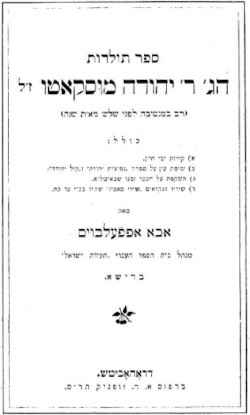
Tzvi Simchah Ledder, the author of the book of memories “Reisha Jews”, that we thank for the information cited above, relates that there were others who also belonged to the first group of intellectuals in Reisha: Mendl Karp, Nochum Shternheim, Abba Appelboim,[50] Meshulam Dovidzon, and the pioneer of the Zionist movement in Reisha – Chaim Vald.
One of the founders of the Chovevei-Tzion organization in Reisha in 1890, was Kalman Kurtzman, who was secretary of the Reisha community after Moshe Dovid Geshvind. The significant rise of national consciousness among
[Page 393]
 |
|
the Jewish community, is confirmed by the fact that already in 1894, the “Chovevei-Tzion” organization had 150 members.[51]
However, soon after 1851, when the government met with Austrian opposition that supported the Catholic clergy, the government supported the Jewish orthodox groups, as loyal and devoted monarchist groups.
In this period, that is, the second half of the 19th century, the Jewish community In Reisha had evolved strongly enough, and in 1869, numbered 5012 people. At the same time, the hateful attitude of the Reisha Christian town-administration towards the Jews, increased. When the Jewish community in Reisha tried to buy new plots of ground to increase the area of the cemetery (even as early as 1849), it always encountered opposition from the town-administration.
In 1899, the education department in Reisha demanded that when Jewish parents enrolled their children into schools, they had to commit to their children writing on the Sabbath. The Rabbi and the community administration in Reisha protested, but only after a telegram was sent to the school council in Lemberg. A reply was received stating that the director of the school had no right to force Jewish children to write on the Sabbath, because observing one's religion is affirmed by government law.[52]
The Polish Jew-baiters, supported by Jew-hating groups of the Christian clergy, did not refrain from rumors that again, accused Jews of blood-libel. In 1882, a blood-libel accusation against a couple named Ritter, shocked the social fabric of Jewish society. It stemmed from the fact that the body of a dead Christian girl was found adjacent to the Ritter's house. Based on the verdict of the judicial courts, the Ritters were both sentenced to death, and were only freed in1886, and declared innocent.
A wave of anti-semitic slogans was released in mid-Galicia when the Christian demagogue, the priest Stoyalovski, incited the peasant masses against Jews, exploiting the fact that in 1898, in the elections to the Austrian parliament, the fifth general kurye was introduced, in which the great mass of the population received the right to vote. The Jews in Galicia voted for left-wing Polish candidates, thus enabling socialist candidates to be elected in Krakow and Lemberg. Stoyalovski utilized this fact, and as a result of his incendiary public rhetoric in more than 30 localities in west Galicia, wild attacks took place that lasted a few days. Only when the peasants began to attack the palaces of the Polish noblemen, did the attacks and the looting came to an end, with the aid of the military.
What was more difficult, was the economic struggle of the Jews in Galicia in this period. Despite the offensive slogans of the formerly mentioned priest Stoyalovski and his Catholic Folk-party, the economic role and position of the Jews in Galicia at this time, was still sufficiently strong.
The Polish economist Shtshepanovski gives us a clear indication and estimate of the economic role of the Jews in Galicia. In dealing with
[Page 394]
necessities in Galicia, he writes: “if one would consider that so-called trivia, such as feathers, strong thread, and eggs, would bring our exports to 15 million zlotys – you will be convinced, of the value of Jewish concern for our country, they, who do not underestimate even the smallest item”.[53]
This level of Jewish traders and producers, that knew how to make the best of the restricted economic circumstances in Reisha – were few in number. Most Jews in Reisha – as in all Galicia, lived in poverty. The main reasons, for this situation, was due firstly, to the fact that Galicia in general, suffered from the Viennese economic policy that aspired to transform the country into a market for Austrian merchandise. Consequently, industry in Galicia was so poorly developed, and as a result of this, the opportunities for earning a living in Galicia were limited.
Another reason was the fact that most of the Jews earned a living from small business and simple work; at the same time, Polish antisemitic groups appeared that became increasingly aggressive, particularly after the 1893 Catholic convention in Krakow, where topics were concentrated around the organization and stimulation of anti-Jewish boycotts. For the time being, the leading wholesale merchants in Reisha did not suffer much from the anti-semitic boycott propaganda. The small business owners and small traders were the first to suffer from the anti-semitic boycotts. There was only one way out for the Jewish masses on the periphery: exodus from the town, or seeking a means of earning a living in other countries – particularly in Vienna and Hungary – in Austria, or – for those who had means – emigration to countries overseas.
We can outline a precise picture of the economic situation of the Jewish population in Reisha in the period before the outbreak of the First World War (1914) – based on some statistical data regarding the general and Jewish population in Reisha, in various time periods.
As we have noted above, in 1880, 5820 Jews lived in Reisha, that means 52.1% of the general number of residents (11,166) – but already in 1890, only 5492 Jews lived in Reisha, that is 45.9% of the general number of residents, that rose to 11,953 people. The period 1880 –1890, was the time when the emigration of Jews from Reisha and other towns in Galicia grew extensively, causing the loss of the natural growth of the Jewish population in this decade.
The Jewish community in Reisha did not stand by idly, indifferent to the fate of Jewish poverty. Jewish society as a whole, placed great importance on the social responsibilities of the community administrators, and Jewish humanitarian aid institutions were already active. But the activities of the community administration were not always at an appropriate level. Often, internal friction and personal ambitions of influential members of the community, misled the community leaders, and made incorrect decisions that were of no benefit to the Jewish community.
A wealthy community oligarch ruled in almost every community and exploited the Jewish folk-masses in different ways. However, among the rulers in the community, there were outstanding individuals, strong and refined personalities who understood the needs and suffering of their poor brothers.
From the beginning, Reisha was a town with great scholars, learned men, and eminent Talmudic scholars, and a strong Chasidic movement that developed later. Orthodox Jews were in the majority in Reisha.
However, the rays of Mendelssohnic enlightenment had hardly broken into Galicia, when Reisha became one of the first and most important enlightenment locations in west Galicia, with a local press and a substantial number of intellectuals, progressive journalists, and authors, as we have cited previously.
It is therefore no wonder that right from the beginning, the Jewish community in Reisha waged a relentless battle about who would rule in this institution that remained from the former autonomy in Poland.
This battle became intensified after the period of the “National Spring” in 1848, when those in the Jewish enlightenment circles pursued the idea of full assimilation with Polish culture, and tried to sway the community, whom they considered as a fortress of reactionism and separatism. Of course, in these endeavors, they received help from Polish patriotic groups.
After the constitution of 1876, that granted Jews equal rights, a conflict arose in the community in Reisha between three social powers in the Jewish population:
[Page 395]
between the orthodox, the progressive assimilated groups, and the nationally inclined intellectuals.
The Jewish assimilated, the progressive groups of that time, had the upper hand in the Reisha community for a long time. Correspondence from Reisha, that appeared in the periodical “Ivri Anochi” [I am a Hebrew] in 18. 2. 1887, was edited by the intellectual Ya'akov Baruch Verber of Brodi. From this correspondence we learn that in February 1887, community elections took place and that there was a difficult battle between the orthodox and the progressives, in which the latter had a great victory. In addition, the correspondence emphasizes that the regulations for the community elections were the same as they were 10 years earlier, and that the election of 15 members to the Jewish community council to represent the community, was decided by the Galician government organizations.
At the end of the 19th century, Jewish communal life was of a sufficiently high level. Several social and cultural institutes were active in Reisha at that time.
Based on an account of Jewish communities in Galicia, that was published annually in a printed table by “The Austrian-Israel Union in Vienna” providing information regarding all the communities in the whole of Austria – we were able to present a picture of Jewish society in Reisha in this period.
In the table recording the accounts of the budget-year 1897-1898, we read the names of those who were then on the community board of management - the “emperor's council” in Reisha. The head of the council was Yitzchak Haltzer, his deputy Dr. Shmuel Reich, and members of the governing board: Nachum L. Zilber, Ya'akov Kurtzman, and Marcus Ekshtein. The committee members, the so called “Kultus Rette” [Jewish Community Council] were Dr. Yosef Fechtdegen, Dr. Edvard Zegel, Yoel Kanarek, Shimon Tabyash Mintz, Moshe Geshvind, Volf Frelich, Yosef Shenblum, Shlomo Fershtendik jnr, Shlomo Blumberg.
What we also discover from this table, is that Dovid Geshvind was then secretary, Chaim Volf Ellenbogen was the Rabbi, and Osyas Hersh Vallershtein was the Rabbinic judge.
According to the table, the following institutions were then active in Reisha: the Chevra Kaddisha [Burial Society], an aid organization and support for the sick, a Bikkur Cholim organization [Visiting the Sick], an organization for the Aged and Orphans, an Artisans Association, a Zionist organization, and a “Progress” organization, a reading hall for Jewish youth, and a merchant casino association.
It appears that the progressive elements in Reisha, a large number of whom were under the influence of assimilated slogans, had the upper hand in the community elections.
|
|
[Page 396]
In the last decade of the 19th century, and in the first decade of the 20th century, there was significant development in Reisha. Firstly, the train line that connected Vienna and Bucharest had been completed, Reisha now became an important place, and with that, it raised the economic importance of the town. Reisha was now an attraction for the Karoremt village population, that looked for work and a source of income in their nearest town.
If one also considers that in 1900 Reisha merged with a whole string of neighboring villages, one can understand that during the decade 1890-1900, the general number of the population in Reisha rose to 11,953 in 1890, and 15,010 in 1900. In the decade 1900- 1910 the general number of residents grew extraordinarily stronger, because in 1910, there were 23,688 people living in Reisha.
In this framework of the general rise in the number of residents in Reisha, the Jewish population also increased modestly.
During 1890, 5,492 Jews lived in Reisha[54], and in 1900, the official number of Jews in Reisha rose to 6,324, but relative to the general number of residents, the percentage of Jews fell to 42.1%. The same process occurred in 1910, because, in that year the official number of Jews in Reisha rose to 8,785, but their relative percentage to the general population, fell to 37.1%.
We will of course, demonstrate some facts that caused the growth in the general population, and the decline of the relative number of Jews over a period of two decades. On the one hand, it was difficult to emigrate to America because of the high cost of travel and also, due to the new American immigration policy. On the other hand, the national policy of the ruling Polish parties in Galicia, aimed to reduce the number of Jews in Reisha, that in 1880, had reached more than 52%. The main goal of the Polish government organizations in Galicia was to ensure and strengthen the Polish majority in Reisha, aided by the administration, and by economic constraints that were introduced.
To reach this goal – the Polish administrative circles in Reisha, took the side of the Polish antisemitic groups in the town and applied drastic measures to oust Jewish fellow citizens from their economic positions in the town. The main axiom of this anti-Jewish action was their need to create their own Christian trading-position.
The circumstances of the Jewish traders and artisans, worsened from day to day because the “Polish Agricultural Alliances” (the so called Kulka Rolnitshe) that was established in the eighties of the 19th century, increased at a rapid pace and now openly voiced their sentiments regarding boycotts of Jewish trade. Jewish social circles recognized the danger that threatened Jewish trade, that came about only because of their own strength an ability. The main problem was the necessity to create credit facilities for the Jewish traders because Jews had no access to the state banking institutions such as “Bank Polski” and “Bank Krayovi”.
The Jewish economic alliances, did not sit back with their hands crossed, and understood that only well-organized self-reliance would prevent a catastrophe for Jewish trade. In June 1901, with assistance from the great aid organization “Ikka”, a Jewish “credit society” was established that developed quickly, and in 1908 this bank already had 978 members and had issued 607 loans, amounting to 144.270 Kroner[55].
Great changes took place in Reisha in the last two decades before the outbreak of the First World War in 1914. In the last decade of the 19th century, the social strength of Reisha Jewry already began to take effect and during the later years, two political camps emerged that stubbornly fought about the influence of the changes on Reisha Jewry.
Against the strong stream of the enlightenment movement in Reisha, that had quite early on, drawn close to Zionistic ideas – a united front emerged of Chasidic groups, and orthodox Jews opposed to Chasidism on the one hand, and Poles of the Mosaic faith on the other hand. A handful of polarized assimilated Jews who were quite remote from any signs of Judaism, stood at the head of the extreme orthodox in Reisha. They perceived that by shared means they could defend the threatened Jewish religion through Jewish national aspirations, and at the same time, show humility towards the Poles, who were mostly antisemitic Galician rulers. This was the view of these politicians, who,
[Page 397]
|
|
|||||||
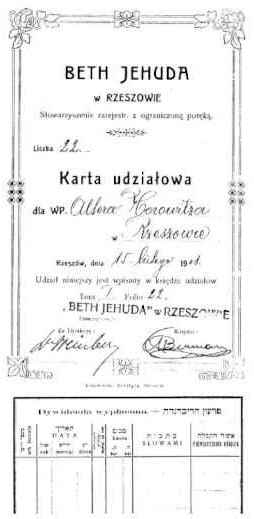 |
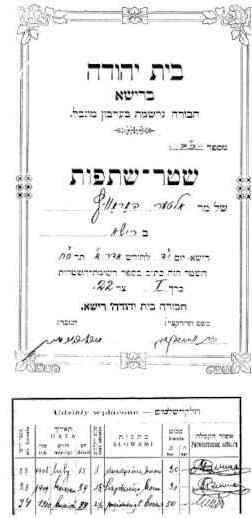 |
|||||||
with the validation of the Polish authorities, took upon themselves the right to represent the Jewish population in Reisha. As we discovered from the “union” table mentioned above, of the budget year 1909/10 (5670) in Vienna, one of the leaders of the assimilation group in Reisha was listed as head of the Jewish community. This was Dr. Wilhelm Hochfeld and his deputy, Dr. Heinreich Vachtel, also from the assimilation group. At that time, the following belonged to the close community administration, Motish Ekshtein, Isidore Vineberg, Asher Zilber – all from the united assimilated-orthodox bloc. The following belonged to the broader community administration, the” Keiser Council”, Moshe Geshvind, Wilhelm Tzangen, Noach Shapira, Dr. Shmuel Reich, Yosef Glazberg, Zcharish Yezshover, Yisrael Cohen, Shlomo Teitelboim, Michl Bierman and Avrom Valach. The chief Rabbi, according to this table, was
[Page 398]
Rabbi Natan Levin, and the community secretary was Kalman Kurtzman. There were also two teachers of religion who were active in the public schools: S. Kamerling, and M. Shlezinger.
In this period, Reisha had already developed significantly in all areas of societal-community life and belonged to the remarkable Jewish communities of western Galicia, that played a leading role in western Galician Jewry. According to information from the cited table - in that budget year, several humanitarian funds were established in Reisha, such as, a school fund managed by Zigmunt Blum, a larger fund for the hospital managed by Chaim Valfeld, Minke Geshvind, Elyash Reich, Neuman and Moshe Loib. Rozenfeld, and a fund for poor Jews was managed by Huga Cohen, Elyash Grinshtein, and Hertz Vineberg.
According to the table for the budget year 1909/10, the following humanitarian and social organizations and institutions then existed in Reisha: The Chevra Kaddisha [Burial Society], Nos'ei Ha'mitah [Coffin Bearers society], Bikkur Cholim [Visiting the Sick], Tom'chei Cholim [Support for the Sick], Yad Charutzim [The Hand of the Diligent], Dorshei Tov [Well- Wishers], a Care for the Aged and Orphans Society, and a Jewish Folk-Kitchen. At the time, a women's organization was also active, to take care of the sick, a Chovevei-Tzion [Lovers of Zion – a movement to build the Land of Israel, that preceded Zionism], the organization “Shulamit” (a Jewish national women's organization), the organization “Po'alei-Tzion” [A Labor-Zionist movement], an academic organization “Chermonia”, a cultural organization “Ha'shachar” [The Dawn] for orthodox youth, a literacy group, and “Bet Yehudah”.
A Talmud Torah [elementary school for poor children] also existed in Reisha at that time, as well as a Jewish hospital under the directorship of Dr. Y. Teller. The treasurer of the Jewish community in Reisha, was then Yechezkel Rost, and the income and expenditure [probably the net income] for the community in this budget year was 83,214 Kronen. As we observe, in the first decade of the 20th century, Jewish Reisha developed in all areas of societal-communal life. The head of the community, Dr. Hochfeld, a conservative member of the assimilated group, actively participated in the current endeavor to re-organize the Jewish community system. Hence, when the Galician national school council convened a conference of community representatives, that took place on 11.2.1907, regarding the necessity to regulate the study of Jewish religion in the public schools in Galicia, Dr. Hochfeld also participated as representative of the community in Reisha. In the discussions about this problem, he also spoke, expressing the opinion, that the main reason that the study of the Jewish religion in public schools was not appropriately managed, was because the teachers of this subject were appointed by the community and not by another official.
In Reisha, in the first decade of the 20th century – as in all of Galicia – the Jewish national movement grew. The elections to the Austrian parliament in 1907, based on a new democratic election ordinance, extracted the Jewish masses from political apathy and inertia. The young Zionist leaders carried out a bold promotional campaign among the Jews, and the national Jewish slogans evoked full enthusiasm among the Jewish voters.
During the electioneering in Reisha, no Jewish candidate was selected, because of an agreement with the social-democrats and the Ukrainians – that echoed the call to fight for Jewish national rights. The main attack by the Jewish national camp was directed against the extreme orthodox circles who allowed themselves to be led by a group of assimilated politicians.
In this period, the Zionist movement in Reisha already held a strong position in Jewish social life in the town, thanks to the activities of the Zionist organization “Ha'shachar” [The Dawn], under the determined leadership of Moshe Vizzenfeld. He Later became the director of the Keren Kayemet L'Yisrael [Jewish National Fund] in western Galicia, that included a large section of the Jewish youth from the prayer and study houses.
The rise of national consciousness among a large part of the Jewish population in Reisha, was clearly evident in the census of December 1910, when the ruling authorities in Galicia, officially warned that in the census lists, the everyday language recognized by government laws,[56] must be specified.
Additionally, listing Yiddish or Hebrew, incurred a fine (the two languages were not regarded as everyday languages) – so Reisha Jews in large numbers – just as in all other towns in Galicia – gave Yiddish as their everyday language, proclaiming in this way, their national character with its own folk-language.
The second decade of the 20th century began with new elections for the Vienna parliament (1911). The Polish administration, with the help of the Jewish assimilated groups, applied various means of
[Page 399]
of terror and corruption against the Jews, to repress the influence of the Zionist camp upon them. The words of the Zionists were taken up with great enthusiasm by the Jewish voting masses. The struggle was relentless and there was no shortage of human victims in one of the voting stations (Drohobitsh). The Polish administrative rulers in Galicia exerted such pressure on Jewish voters, using so many falsifications when administering the voting, that in Jewish voting electorates, only a few Jews from among the assimilated groups were elected. These Jewish candidates accepted the antisemitic program of the Polish National Democratic Party (Endentzye) and subjected themselves to the discipline of the Polish parliamentary faction (Kolo Polske). Representatives of the chauvinistic Polish nobility and other antisemitic organizations belonged to this faction.
With greater effort and with a difficult struggle, the Jewish national groups had to fight at the Galician parliamentary level, in Lemberg. There the Polish rulers maintained that this was due to an old reactionary voting system, and that only in 1912, the Ukrainians and the liberal Polish parliamentary representatives doubled their efforts to change the voting ordinances in parliament in a more liberal democratic direction.
Not one project however, concerning a new voting ordinance in parliament, mentioned the Jews, and as the Jewish assimilated parliamentary representatives were silent, the Zionist organization began a broadly branched promotional campaign. They put forward the requirements for organizing three national divisions, in the whole of Galicia: Polish, Ukrainian, and Jewish, with equal, direct, and secret voting rights for men and women.
The Jewish section that was supposed to include all Jews with voting rights in Galicia, should, according to the Zionist project, be allotted the number of parliamentary representatives relative to the number of Jews in Galicia. Of the general number of 194 parliamentary mandates, Jews would receive 20 Jewish mandates, and Reisha was one of the towns in which the Jews were supposed to receive their own parliamentary representative.[57]
The issue of a new electoral ordinance to parliament created powerful reverberations in Galician society. In June 1913, a large gathering regarding the elections to parliament, took place in Reisha, in which Polish noted individuals such as Glombinski, the current minister for Galicia, the Count Skarbek, and Professor Grabski, participated. What we read in correspondence from Reisha that was published in “Ha'Mitzpeh” [The Watch Tower] no. 23 of 6.6.1913 – that these well-known haters of Israel, pelted the Jews and Zionists with the most intense abuse, and “the Jew [Dr. Hochfeld], that sat at the presidial table together with the Jew-haters, did not even open his mouth to defend his fellow Jewish citizens whose votes he would expect in the elections to parliament”.
In the meantime, the economic pressure on the impoverished Jewish masses of traders and shopkeepers imposed by the Polish administration in Galicia, grew stronger every day. In this campaign against the Jews, to oust them from their economic positions that they had held until now, the Polish national organization and their agricultural sales division, (Kulka Rolnitshe) contributed greatly.
The Jewish economic circles in Galicia were seriously affected by the laws that designated Sunday as a day of rest, and the introduction of the salt monopoly.
However, the laws of trading in alcohol that lowered the number of concessions and granted the Land Administration the right to distribute the small number of permits in this line of business, was a shocking catastrophe for the Galician Jews. The main victims were the Jewish inn-keepers, because more than 90% of the general number of inn-keepers in Galicia, were Jews. Approximately 40,000 Jews were left without a source of income because of this tavern law.
According to Ledder, the previously mentioned author of the Reisha memoirs, almost all the former Jewish inn-keepers had their concessions returned to them as a result of a huge demonstration in Vienna, of more than 2000 Jewish inn-keepers. the Austrian government then increased the number of concessions for Jews.
On the eve of the First World War, when an acute economic crisis broke out in Galicia, the Jews were the first to suffer because of the official and unofficial policy of expelling Jews from their economic positions.
This struggle of the Reisha Jews against hostile forces in the economic arena, did not weaken the internal battle or the spiritual nature of the Jewish community in Reisha in the second decade of the 20th century. In this period, the Zionist movement had already strengthened, and among their followers, were fighters from all strata of the Jewish population.
[Page 400]
In 1911 and 1912, the strong “Tz'írei Tzion” [Youth of Zion] and “Po'alei Tzion” [Workers for Zion – Labor Zionist movement] organizations, were already having an impact on Jewish life in Reisha. The Zionist academic youth that had already developed separately in Reisha, were active, and had organized themselves in a separate organization - “Maccabia”. In 1911, a conference of the Zionist organization of western Galicia was held in Reisha, and the Reisha Zionist leader Dr. Hoffen, was elected as a member of the Zionist executive in west Galicia.[58] This testifies to the development and strength of the general Zionist organizations in Reisha.
This growing strength of the Zionist movement in Reisha struggled against the united front of the extreme orthodox with the assimilated politicians, who only maintained their position in Jewish society, thanks to the help from the Polish rulers in Galicia.
The clash between these two opposing Jewish powers, in the battle for control over the Jewish community in Reisha, was particularly intense. In addition, this anti-Zionist camp often took measures that lowered the dignity of Jewish society as a whole.
In the first half of the second decade of the 20th century, after a long period of time, elections were held in the Jewish community. It ended with a victory for the Jewish national bloc. As a result of a protest by the assimilated-orthodox camp, the victory was annulled and rule in the Reisha community was taken over by the leaders of this alliance. What we know from the previously mentioned “union” calendar in Vienna, for the budget year 1912/3 – is that Wilhelm Tzangen was nominated as the government commissioner in the Reisha community, and Dr. Herman Kraus, as his deputy. The following were elected to the council of the government commissioner; Motish Ekshtein, Yosef Faivel, Noach Shapira, Asher Zilber, Berish Shteinberg, Izidor Vineberg, Vekker Rekte Hass, Aharon Reitman, and Goldreich-Fink. The Reisha Rabbi was then Rabbi Natan Levin, and the community secretary was Kalman Kurtzman. After the elections to the Reisha local town council in 1912, the assimilated-orthodox leaders represented the Jewish population at a time when the Mayor in Reisha was Dr. Stanislav Yablonski. The leader of the assimilation camp was Dr. Wilhelm Hochfeld, who was then the deputy mayor, and the following belonged to the town council: the then community commissioner Wilhelm Tzangen, Dr. Henrik Vachtel, Markus Ekshtein, Zigmund Fertik, Dr. Henrik Kaffel, Dr. Herman Kraus, Dr. Izidor Reiner, Wilhelm Shferling, Noach Shapira, Izidor Vineberg, Yosef Faivel, Moshe Geshvind, Michael Bierman, Bertold Erlich, and Henrik Shtark. At the end of 1912, Dr. Yosef Shoifel replaced Moshe Geshvind. There were no changes in the community or in the town council in the budget year 1914/15.
|
|
Despite the difficult economic situation, in which Reisha Jewry found themselves on the eve of the First World War, it simultaneously manifested a strong drive towards free professions, and therefore, the number of Jewish students in Reisha public high schools, grew every year.
In 1910, 83 Jewish children studied in the public high school in Reisha.[59] At the end of the first decade and the beginning of the second decade of the 20th century, the number of Jewish advocates and doctors rose. In 1914, the following advocates and doctors were active in Reisha: Broinfeld, Yakov Frelich, Leib Hertzhaft, Wilhelm Hochfeld, Felix Haffen, Volf Kahana, Natan Kanner, Herman Lekker, Marek Peltzling, Shmuel Reich, Izidor Reiner, Yosef Shoifel, Adolph Shne'e, Yoachim Shaul Zilber, Mordechai Vachtel, Gotfried Vineberg, Boruch Tzangen; doctors: Izidor Dornfest, Yosef Hersh Elsner, Mannes Hertz, Ms. Friederika Yezshover, Herman Keppel, Herman Kraus, Herman Kronfeld, Friederik Shtrasser, Yosef Teller, Oscar Tzinneman, Izak Reiner[60].
[Page 401]
When the First World War broke out in August 1914, a new period of suffering and pain began for the Jewish population in Galicia. The fear of an invasion by the Tsarist army, particularly the Cossacks and Circassians, created terrible chaos in the Galician towns and villages. In fear and panic, the Jews left their homes and searched for protection in the western regions of the Austrian state.
The first Russian offensive occupied almost the whole of Galicia as far as Krakow. Sh. Ansky (Shlomo Rappaport), in his book “The destruction of Galicia”, describes a sad picture of the tragic situation of the Jewish population in the areas of Galicia occupied by the Russian army.
“A large Jewish area with a population of a million Jews” – writes Ansky – “who only yesterday, had all human and citizen rights – were surrounded by a fiery ring of blood and iron, cut off from the world and handed over to the full might of Cossacks and soldiers, who were enraged like wild animals”.
The town of Reisha was no exception. No sooner had the Cossacks entered Reisha, when a bloody pogrom took place, that included plundering and looting.[61]
Of the large section of the Reisha Jews who still managed to escape to Bemmen in time, many stayed in Prague, where the well-known Reisha leader Leib Vizzenfeld was staying. (Today he works in journalism as the editor of “The Jewish Voice Pictorial” in Cleveland). In Prague he also became very interested in the fate of his brothers, and by publishing, the “Prague Jewish Newspaper” at that time, he contributed significantly to ease the circumstances of the Galician refugees.
In Reisha itself, the circumstances of the remaining Jews, only improved after the defeat of the Russian army under Gorlitz. As a result of this defeat, the Russian retreat began and among other towns, Reisha was also liberated from Russian occupation. A large number of the refugees returned home to their destroyed and looted houses and stores, and embarked on reconstructing their workshops.
|
|
(The vacant square where the houses of Abba Appelbaum and Chaim Vald were once located) |
[Page 402]
In Independent Poland
In October 1918, the Austrian-Hungarian monarchy collapsed. The Poles began to form their own interim administration organizations, proclaiming that Galicia was an integral part of the new independent Polish state, that emerged on the ruins of occupying empires.
The Polish Liquidation Commission was established in Krakow, that on behalf of the interim Polish government appropriated the provisional governance around western Galicia.
The Polish Liquidation Commission appointed its delegates for the entire region of Reisha with all the rights of a government organization. The Krakow Liquidation Commission authorized the following representatives for Reisha; Antoni Bamba, Dr. Stanislav Yablonski, Dr. Roman Kragulski, and Dr. Teopilnietz. On the 2nd of November 1918, these four delegates published an appeal, in which they announced the take over of authority of the Reisha region that required the compliance of all the residents to the Polish military and civil government organizations. At the same time, they were summoned to observe public order and discipline, with regard to security authorities.
This appeal was published in communique no. 2, of 2.11.1918, by the authority for the “Organization for National Defense” that was established in Reisha. This organization was essentially a national democratic organization (anti-semitic-endekish). In this communique, details were also published of the discussions of the delegates of the Polish Liquidation Commission in Reisha. At the same time, we also discover that the Jewish population in Reisha had expressed its willingness to contribute with material help and active participation in the citizen militia. The delegates of the Polish Liquidation Commission however, answered that while not rejecting the possibility altogether of benefiting from such help, they must for the meantime, refuse.
Apart from the approval issues, the “Organization for National Defense” also saw to the problems of public safety, and for this purpose, the national militia was created.
As we read in communique no. 5, of 7.11.1918 – “only Polish Christians could belong to this national militia, and only the magistrate of the town of Reisha would be able – if he regarded it as necessary – to create an urban or citizen militia of all citizens of the town”.
In that same communique, an appeal by the Reisha community council to the Jewish population is also mentioned. It requires that the entrances to all taverns be closed, that there be no gatherings in public places, that spreading public panic be avoided, and that people refrain from buying items that are the proceeds of theft and looting.
Soon after the establishment of the Polish Liquidation Commission, the three political organizations in Krakow (the Zionist, Bundist, and Po'alei Tzion), established the Jewish National Council, that was active in the entire area of western Galicia, and at the outset, began to organize a Jewish militia to defend the Jews from looting gangs of deserting and discharged prisoners.
The Jewish National Council was in close contact with the Polish Liquidation Commission and clarified its goals and aspirations in a manifesto of 4.11.1918 regarding the Jewish population. Contained in this manifesto was the request that the recognition by the World Democratic Rights of Self-determination of the Polish people, should also apply to the Jewish people in the Polish state, and that Jews as a national minority should receive national autonomy. The manifesto ended with an appeal to the Polish nation that reciprocal relations should be regulated in the state by direct communication from folk to folk, in a way that eliminates every possibility of conflict and hate.
On the 7th November, the Jewish National Council in Reisha consisted of 50 members, who were representatives of all the Jewish parties in the town, that met with the Jewish national program. The following individuals belonged to the Board of the Jewish National Council: The Rabbi, Reb Natan Levin as president, and Abba Appelbaum and Dr Kalman Zaltzman as deputies, Dr Edvard Lekker and Kalman Kurtzman were elected as secretaries, and A. Ch. Lifshitz as treasurer. We learn these details from the communique that the Jewish national Council published on 15.11.1918, in which information was also given, that a provisional community council was elected from among the members of the Jewish National Council. This council, that consisted of 21 members, was expected to implement community elections in the shortest possible time, according to new regulations
[Page 403]
that would promote the broadest democratic principles. Board members of this community council were, Dr Adolf Shne'e, Dr Felix Haffen and Chaim Izenberg.
Immediately however, the government commissioner Dr Kragulski, the representative of the Liquidation Commission in Krakow, replaced the commissioner of this community council, and elected Dr Adolf Shne'e.
As the formerly mentioned communique of 15.11.1918, of the Jewish National Council in Reisha relates, the Jewish national council created four work-committees: 1) an economic trade committee; 2) a committee for religious and cultural issues; 3) a bureau for rights of protection; and 4) a finance and press committee.
The economic and trading committee immediately began its activity by reversing the prices of items in daily use. It was also decided to approach the commissioner of the P.K.L about creating a composite committee to establish these prices. Simultaneously, the Jewish National Council turned to the traders, particularly the Jewish tavern keepers, with the demand to strictly observe all decrees and restrictions that would be published by the government agencies, in order to maintain public order and calm, in the town. The cited communique also informs us about the intervention of the Jewish National Council with the deputy of the P.K.L. and with the Jewish Self-defense committee in Krakow, concerning the issue of not allowing Jews to serve in the citizen militia in Reisha. As a result of this intervention, the members of the Jewish National Council in Reisha, Dr Adolf Shne'e, Dr Shmuel Reich and Leib Vizzenfeld, began negotiations with the Reisha government commissioner Dr Kragulski, about this matter.
It was not easy to maintain order and calm in Reisha, at a time when the Austrian administration that had ruled until now, was in turmoil, and Poland was in the process of forming new agencies from among the normal state authorities, in order to create an independent Poland.
According to the decree of the P.K.L. in Krakow, Dr Kragulski was appointed as the government commissioner for the entire Reisha area, and with that, he assumed all the powers of the provincial governor on the regional council (Rada Povyatova). Despite Dr Kragulski's good intentions, he was unable to control the chaos and subdue the insecurity in the political-economic domain. The National Democratic elements went to great lengths to influence the authorities in the town, using their old Jew-hating slogans and spreading terrible hate propaganda against the Jewish population in Reisha and the vicinity.
This anti-Jewish propaganda soon bore fruit in Reisha and the surrounds – as well as, in the whole country – and brought a wave of unrest and brutality against the defenseless Jewish population. Raging mobs from the peripheries, and from the nearby villages, did not merely pillage – but simply threatened the physical existence of the Jewish masses. The vigilance and intervention of the Jewish National Council, together with the government commissioner Dr Kragulski, took effect, and for the time being, the attacks and anti-Jewish offensives were not of a mass nature. At the same time, Jewish soldiers that returned from the war front, contributed greatly to protecting Jewish life and possessions. These Jewish soldiers, who were not permitted to serve in the town's citizen militia, placed themselves at the service of the Jewish population in Reisha, and although they upset the Reisha Jewish National Council, they exchanged their Polish eagle symbols on their military hats, for a Magen David symbol.[62]
A clear expression of the anti-Jewish attitude of the endekish circles in Reisha, that were concentrated around the “Organization for National Defense in Reisha”, we find in communique no. 8 of 18.11.1918, the following quote regarding this organization: “The press commission is upset by the administration's denial in the communique, of the fabrications about pogroms against Jews in our circles, and demand that the Jewish members of the town council should protest against the lies and rumors that have been spread”.
It is interesting to note, that the administration of the “Organization for National Defense”, brings to the attention of the provincial governor, the abnormal situation that reigns in the Reisha community.
The attacks on Jews in the towns and villages of Galicia, were of a dangerous nature, and on 27.11.1918 the Polish Liquidation Commission in Krakow regarded it necessary to publish a decree, according to which, laws introduced for criminals for looting and arson, would incur the death penalty.
These laws did not help much. The irresponsible criminal propaganda against
[Page 404]
the Reisha population, was led by certain so called, Polish Patriotic parties, that incited the residents of the towns and villages that were only waiting for the opportunity to loot Jewish possessions.
The Zionist publication “Chvilla” in Lemberg, no.15 of 10.5.1919, gave a detailed report of the brutality and looting that took place in Reisha and other mid Galician areas, based on information that was published in the Krakow Polish daily newspaper, “Nova Reforma”, the agency of the Polish democratic circles in west Galicia.
We read in this report, that “five days earlier in the towns of Tarnobzsheg, Kalbushev, and Melitz, all in the Reisha area, that there was a wave of looting and destruction, by peasant gangs, firstly attacking Jewish stores, as well as private residences, and beating the Jews at the same time. These attacks – reports the newspaper – increased to such an extent in the areas of the pogroms, that larger military divisions had to be sent in. In addition, the Warsaw government took up the issue of these riots, and in order to suppress them, appointed General Shamota, specifically to lead the military operation in mid Galicia. Biederman, was appointed as a special commissioner, to manage the issues of the regime's civilian authorities”.
“Chronologically – we read further in the report mentioned – “the first attacks broke out in Melitz, then in Reisha, where they began with a local movement with provisional demands, and only took on a broader format when gangs of thousands of peasants arrived in these towns and began to loot Jewish stores.
In Reisha, some older Jews were seriously wounded, among them, one of the local advocates, and material damage was also very significant. The local police, although very determined, were unable to fulfill their duties, and only when larger military divisions arrived from Ny-santz and Krakow, and 60 policemen from Yeroslav, did they manage to restore calm and a little order. There were, in addition, victims among the assailants, as well as among the soldiers, because the looters were armed, many even, with weapons”.
The Polish government in Warsaw finally decided to investigate the reasons for these events, and how the attacks unfolded. The minister's council resolved to send a committee of representatives from the Ministry of Justice, Interior, and the Military, to mid Galicia, with the task of investigating on the spot, the reasons for, and the extent of, the sad events in the Kolbushev, Ropstshitz, and Reisha areas.[63]
We read in the Reisha “Folk-newspaper”, that was published in Reisha at that time, under the editorship of the previously mentioned social and Zionist leader, Leon Vizzenfeld, that this government commission came to Reisha on 20th May 1919. Dr. Kragulski and Leon Vizzenfeld were invited to this conference, and at their intervention, Dr. Shne'e, the head of the community at that time, and Dr. Vachtel, were also invited to the second session of this commission. Discussions centered on the events and the measures that “need and must be taken, in order not to allow the pogrom to be repeated”.
As the formerly mentioned “Folk-Newspaper” then reports, Leon Vizzenfeld presented a detailed account of the pillaged and destroyed merchandise, about the Jews that were robbed and beaten, about the damage to the synagogues, and also about the constant aggression at the train station in Pshevarsk. In addition, Vizzenfeld discussed another matter where he referred to the emergence and development of the pogrom, and about the measures that the government “needs to and must adopt to protect the Reisha Jews against further attacks. The committee promised to fulfill these requirements”.
The Polish parliament also sent an investigative committee to mid-Galicia, that held its first conference in Reisha on 10.5.1919. The mayor Dr Kragulski was invited to this event, also Dr Hochfeld, Dr Reich, the editor Leon Vizzenfeld, Dr Nyetz, Dobrovolski president of the courts, the director Ostrovski, and a few village mayors from the vicinity. As the previously mentioned “Folk-Newspaper” relates “the entire “investigation” – or “conference” took the form of an interrogation at which a few anti-semitic speeches were delivered”.
We read again, that in correspondence from Reisha that was published in the Lemberg “Chvilla” number 131 of 26.5.1919, that this same Parliamentary Investigative Committee held a conference in Reisha on 21.5.1919 with representatives from the city council, the Jewish community, the Press, and cultural-societal
[Page 405]
institutions, during which the editor Vizzenfeld demanded that Vitos, a member of the investigative committee and chairman of the “Piast party”, cease to incite the peasants against the Jews. He also presented a copy of the peasant newspaper “Piast” that had published trumped up information about finding pogrom political pamphlets in the possession a Jewish woman, and also, about a Bolshevik political pamphlet that was found in the possession of another Jewish person. The parliamentary representative Dr Yitzchak Shipper also belonged to this commission.
On the ruins of the destroyed workshops, the Jews of the western Galician towns and villages, undertook to rebuild their lives with new courage and energy. In Reisha too, the determination to rebuild was noticeable, and unified social activities of the Jewish community in the town, rescued the impoverished Jewish population.
In Reisha, the attempts to exterminate the Jewish population met with strong resistance. The Jewish economic sector was a cohesive one and reacted to the Polish attempts to expel them with their usual self-reliance in all aspects of their economic life.
The influx of Jews from the surrounding villages and small towns caused a growth in the number of Jewish residents in Reisha. The numbers from the community census of 1921, demonstrate that the number of Jews rose to 11,361 that was 45.5% of the general number of residents, that totalled 24,942 at that time.[64] In the decade 1910 - 1921, the number of Jews in Reisha had increased by 2,576 – when the general number of residents in Reisha, rose only by 1,254. So, also relatively, the number of Jews in Reisha rose from 37.1% in 1910, to 45.5% in 1921.
This growth in the number of Jews in Reisha in the decade mentioned above, proves that this town, was also now, favorable ground for Jewish economic activity – despite the intensified extermination policy towards the Jewish population. One must also take into consideration that the relative growth of the Jewish population in Reisha was also influenced by the difficulties regarding opportunities for Polish Jews to emigrate.
In the political arena too, the Jews of Reisha showed a high level of national consciousness and political stability during the elections to the second Polish parliament. Regarding the elections for this second parliament, the Jewish national camp in west Galicia followed a separate agenda, independent of Congress-Poland and east Galicia, that now participated in the elections. The main reason for this independence, was the fact that a minority bloc was established in Warsaw that the Jewish political factions in both parts of Galicia, did not regard as necessary for Jewish interests.
The political maturity of the Reisha youth, found its most striking expression during these elections to the second Polish parliament because the candidate of the Agudists [a member of Agudat Yisrael, an orthodox religious movement], Reb Faivel Stempl was appointed with great enthusiasm. In his book “Between Two World Wars”, (page 167) Dr Yitzchak Shvartzbart describes Stempl as a democratic leader for the common people.
During the elections to the second Polish parliament, the Reisha Jews displayed extraordinary solidarity and political maturity in their struggle for the success of the candidate on the Jewish national list, although the candidate belonged to a political movement that did not have great influence in Reisha.
The situation with Jewish representation in the Reisha town council, was completely different.
The last elections for the town council in Reisha took place in 1912. Later, the First World War began. After the emergence of independent Poland in 1918, the Polish government refrained from implementing elections to the town council, simply from fear, that the town would eventually lose its Polish character, with a stronger participation of Jews and Ukrainians in the elections. The town's administration was handed over to the government commissioner Dr Kragulski, and only in 1926, the first elections to the town council took place in Reisha in an independent Poland but still based on the old Kuryen system. In order to have a clear picture of the political events in Reisha, one must consider the fact that the ratio of the Jews and the Polish parties were such, that no party could attain a majority in the town council elections, if it did not join with another large party. A bloc was therefore created of the P.P.S. (Polish Socialist party), with the progressive democrats and the Zionists on the one side, and on the other side, a bloc of the “Chyena-Piast” party (this was a union of Christian National
[Page 406]
extreme antisemites, together with Vitos's peasant party) and Dr. Hochfeld's assimilated supporters. The democratic bloc had great success and Dr Hochfeld, and his aggressive candidates failed shamefully. As a result of this defeat of the reactionary antisemitic candidates, the newly elected town council was dissolved on 21.2.1927 and the town's administration was again assumed by Dr Kragulski, as government commissioner, along with a secondary council. Aside from the antisemitic national democrats, headed by Dr Talashevitz, Dr Hochfeld with another five of his supporters, belonged to this council. Not one of the democratic candidates was appointed to this council.
The problem of the town council evoked a storm of protests by the widest ranging masses of Reisha residents. At these mass gatherings of Jewish voters, the Zionist leaders and elected town council members Dr Vang and Dr Hoffen, pointed to the fact, that while the results of the last town council elections, 48 Jewish councilors received barely 18 representatives, and in the commissioner's secondary council, the Jews had barely 5 representatives. Although, of the 25 members in the commissioner's secondary council, they should have had at least 10 representatives.
The Krakow Zionist daily newspaper “Novi-Dziennik”[g], publishes this information in edition no. 44 of 24.2.1927, noting in addition, that it is indeed clear, that the people of the anti-Jewish “Rozvoy”, like Dr Talashevitz, Dr Nyetz, and Dr Liva, do not want to admit a greater number of Jewish representatives; but why? – asks the newspaper – “does Dr Hochfeld agree with this?”
The rule of the government commission in the town council did not last long, because in July 1927 new elections took place for the Reisha town council. These ended with a complete victory for the democratic bloc, to which the government party B.B.V.R. – (Bezparteinee Bloc Vspulpratzi z' zshondem) joined with the Zionist and Jewish economic groups. (Merchant Union).
In contrast, the anti-semitic National Democrats, realizing that the united front of the government party together with the national Jewish groups, meant that they would be powerless, therefore decided to join forces with the Jewish orthodox groups.
This bizarre partnership of extreme “Rozvoy” antisemites, together with a small group of irresponsible Jewish politicians, who wanted to secure a place on the town council at any cost, was met with astonishment and immense anger among the Jewish people, who had the clearest outcome at the end of the elections. In addition, it is worthwhile stressing that the assimilated group headed by Dr Hochfeld did not participate in this election campaign, in the second and fourth Kurye, and Dr Hochfeld received a mandate in the first Kurye.
What was interesting, were the promises that the Jews received, from their Christian partners, who were known antisemites in Reisha.
“As soon as we are elected to the new town council” – the orthodox-antisemitic partners assured the community- “our first accomplishment will then be to establish a large yeshivah [school of advanced Talmudic studies] that is fitting for such a pious community; we will grant subsidies for children attending the Talmud Torah [traditional elementary school], and will see that the teachers are well paid. We will put a new roof on the synagogue, we will build another Mikveh [ritual bath house] according to the law for women, during their monthly period of impurity. Finally we will provide for the religious needs of the Christian population”.
And finally, the religious Jews and the Christians avow, that voting for the undersigned on the placard, in the elections for the town council, “will be regarded as a very good deed”.
When one takes into consideration, that all this took place in a period when the striving to exterminate the Jewish population in the Polish towns and villages, was already in full swing, then the extent of the obscurity, social irresponsibility, and political naivety, becomes understandable.
An intended protest against the outcome of the elections that ended with a complete victory for the democratic bloc was turned down, and the results of the elections were confirmed.
The 18 elected Jewish council members established a club of Jewish council members headed by Dr Vachtel, with Dr Vang as first deputy and Dr Kraus as the second. Dr Kragulski was elected as Mayor, Dr Polyak Machovski as first deputy mayor, and Dr Hochfeld as second deputy Mayor. In the town council (town's administration), the following were elected: Machovski, as representative of the home-owners, Dr Vilush and the engineer Tsharnik, both from the B.B.V.R. – the government party (Bloc Vspulpratzi z zshondem), and the members of the Jewish council club, Dr Hochfeld, Dr Vachtel, and Dr Hoffen. The assimilated Dr Hochfeld and Fertik – reserved the right not to vote with most of the Jewish club to which they belonged, on issues of Jewish national policy.
[Page 407]
A solemn session of the newly elected town council was held on 8th September 1927, the first in 15 years. At this session Dr Vachtel read aloud, the declaration of the Jewish club concerning the specific needs of the Jewish people in the town.
As we have noted earlier – the internal rupture of Jewish social strength in Reisha, that became so clearly expressed during the last elections in the town council there, came at a time when the economic and financial decline in Jewish life, had already begun to undermine Jewish existence. With each passing year, the influence of antisemitic agitation in Polish society grew. At the same time, the Polish so called democratic circles, embittered the lives of the Jewish masses, taking up the call of General Slovai-Skladkovski: “economic battle against Jews – on the contrary”! This slogan was already a “progressive “ one, and a “”democratic” one, because it was against anti-Jewish pogroms, that the extreme right wing of Polish society propagated.
Already in 1923, when Poland introduced the sales tax, the situation of the Jewish merchant became catastrophic. This law hastened the process of expelling the busy Jewish traders from their positions. At the same time, the local community tax was raised, precisely in those areas of the Polish economy in which the Jews had an important role.
The Jewish community had an important task to fulfill in the struggle to maintain Jewish economic positions. It had to see whether it stood on a fitting social level, and particularly – whether it fulfilled the task of being the center of the national-religious life of the Jewish masses.
The Zionists fought for a community of this kind, in opposition to the system of the ”Agudat Yisrael” [an orthodox religious movement], let alone the more right winged group consisting of all kinds of Charedim, from Belz, through Bobova as far as Gora-Kalvaria, that strove exclusively to be a religious community. There was a third system – a Bundist one, that wanted the community to be a Jewish national secular center.
As is known, the Polish government authorities, supported the purely religious, minimalistic, line of thought, that was represented by the extreme right wing of the orthodox, who supported the small group of assimilated politicians – most of them, from among the Jewish intellectuals.
At the time, the Zionists in Reisha found themselves in a difficult struggle with the dominance of the assimilated-orthodox group in their community.
Even before the First World War – as we mentioned earlier, a government commissioner was at the head of the Reisha Jewish community. After the emergence of an independent Poland, the assimilated Dr Reich, became the government commissioner in the Reisha community, with an orthodox majority in the secondary council.
He had to organize elections for the Reisha community, according to the old kuryen system, which meant that it was prepared by the government commissioner's list of voters, who paid community taxes. Compiling this list of voters gave the community rulers the opportunity to use falsifications, so that the ordinary public at large would be unable to participate in the elections for the community administration. Dr Reich and his partners actually put together a list of voters, on which only the names of their supporters appeared. This election plot evoked strong disquiet among the Jewish people, so all the national Jewish groups joined together with economic organizations of merchants, artisans, and just ordinary home- owners, and created a united front against the influential members of the community, who with power, sought to maintain their authority in the Reisha community. Regarding this list of voters, 900 objections were lodged with the protest commission, of which 300 came from the united Jewish national bloc, and the remaining 600 were submitted at the last moment by an orthodox youth. The government commissioner however, cancelled almost all the objections by the Jewish national bloc, and confirmed the objections that were lodged by the orthodox.
Interventions, protests, and gatherings, at which these election methods were unmasked, did not help. Only – when Senator Vortzel, head of the delegation of the Reisha national bloc, intervened, and contacted the provincial government in Lemberg, was it decreed that the elections be postponed to 1st June 1924, and that a new improved election register be prepared. The so-called improved list was again rejected by the provincial government in Lemberg, and the elections postponed to 22.6.1924 – but also the third voter's list that was now presented, had changed very little from the previous one. This time again, Deputy Frostik, together with the Reisha delegates, Dr Hoffen and Naftali Tuchfeld, intervened and contacted the Lemberg provincial government. The Reisha Zionist leaders
[Page 408]
received a firm pledge that honest elections for the Reisha community would be carried out right away.
In order to demonstrate the general protest by the Jewish population in Reisha, against the election tactics of the assimilated-orthodox influential members of the community, an enormous folk gathering took place on 19th June 1924[65]. An account of this gathering was given by the parliamentary representative, Moshe Frostik.
The Reisha provincial governor now received a delegation from the united Jewish national bloc and assured them that he would see to it, that the community elections were fair and honest, and as a result, the deadline for the elections was postponed. He immediately instructed the government commissioner to prepare a precise and proper list of voters.
“While everything around us,” - writes Dr Yitzchak Shvartzbard, one of the most important leaders of pre-war Polish Jewry[66] – “our economic life, our battles, our general cultural needs, were in a state of growing decline, the community remained a support, a fortress, a small, and close one, confined - but a fortress”.
The job of the Zionist democratic camp was to wrest this stronghold of the extreme intolerant orthodox groups, under the leadership of a handful of assimilated individuals.
For this reason, they fought relentlessly about every detail that could influence the outcome of the elections in Reisha.
We will therefore continue to be involved in the events regarding the preparations for the community elections in Reisha in 1924.
In the commissioner's community secondary council in Reisha, there were 10 loyal supporters of Dr Reich, and 4 social activists, who utilized all possible resources, to oppose what they regarded, as detrimental to the Jewish population's economic life. To further their aims, and to get rid of secondary council members who had acted responsibly, but not in accordance with their views, like Michael Bierman, Naftali Tuchfeld, Moshe Shiffer, who honorably defended general Jewish interests, Dr Reich and his 10 assistants resigned from their positions as members of the commissioner's secondary council. However, the Reisha provincial governor re-nominated those who resigned from the secondary council with the former community commissioner, excluding the secondary council members mentioned above. They were critical of the unscrupulous management by a group of prominent people, whose entire strength came from the backing of the governor of the province.
After such a scandalous plot, this ambitious provincial governor was transferred to Tarnopol, and the provincial governor Spies, from Tarnabzsheg[67] took his place.
It would be wrong to think that Reisha Jewry was involved only in local politics. Actually, at a time of a harsh economic crisis in the whole of Poland, a time of serious inflation and economic decline around 1924/25 – those among the Reisha Jewry who were aware, particularly the Zionist organizations, were very active in areas of Jewish national, cultural, and social life in the town. Suffice to say, on 2nd May 1924, Reisha celebrated the 35th anniversary of the activity of its Zionist organization, that was headed for many years by the exemplary Dr Felix Haffen.
In the same year, the “Heçhalutz” association was established in Reisha. Its goal was to assist with the preparation of Reisha pioneers for their emigration to the Land of Israel[68].
In August 1924, the Jewish Gymnastic Sport Association in Reisha celebrated its 10th anniversary. Dr Marek Peltzling was the chairman of this association, and Dr Shapira was chairman in its anniversary year[69].
In the same cited correspondence from Reisha, there is also information that funds collected in the town for the Keren Kayemet L'Yisrael [Jewish National Fund] for the month of October 1924, totalled 835 zlotys. Regarding activity on behalf of the K.K.L. in western Galicia and Shlezye, Reisha took 4th place, after, Krakow, Byelitz and Torne.
The construction of a Jewish hospital in Reisha began a year earlier – in 1923, and thanks to the initiative of a few Jewish university students, a course was opened for illiterate persons, that had approximately 100 registered participants in the first days.
In general, the social and Zionist activists in Reisha, intensified their efforts to strengthen emigration to the Land of Israel (the fourth Grabski-emigration), and made enormous efforts
[Page 409]
to fulfill all the Zionist tasks. They applied themselves particularly seriously to the organizations that supported the Land of Israel – Keren Ha'yesod and Keren Kayemet. The Keren Ha'yesod committee was very active, encouraged by the tireless efforts of the Zionist leader Ya'akov Alter as chairman, and with his co-workers, Appelbaum, Dr Kanarek, Dr Aharon Vang, and Dr Shildkroit of the General Zionists, H.M. Izen and Hertz of “Mizrachi”, and Fish, Sroko, and Horner, of the academic Organization “Maccabi”.
Among the honorable, deeply religious leaders in Reisha, was the esteemed Rabbi, Reb Natan Levin, may his righteous memory be a blessing. He was Av-Bet-Din [presiding judge of the Jewish court of Justice] in Reisha for 20 years. He was born in 1857 in Brod, where he was educated together with the Rabbi of Pshelmishl, Rabbi Gedaliah Shmelkes, may his righteous memory be a blessing. He received instruction from the famous Rabbi in Lemberg, Rabbi Yitzchak Shmelkes, and later became his son-in-law.
In the beginning, Rabbi Natan Levin was a Rabbi in Rahatin, and from there he came to Reisha in 1905, and took over the Chair of the Rabbinate. In 1918, after the emergence of independent Poland, he was elected as a member of the Jewish National Council in Reisha. Politically, he was close to the Mizrachi movement, but due to his age, he did not actively participate in this movement. He even bought a property in the Land of Israel, was very involved with philosophical issues, spoke a few languages, and wrote several treatises. When he died on 15.8.1926, the entire Jewish community in Reisha attended his funeral. At the time of his death, two of his sons, Reb Aharon, may his righteous memory be a blessing, was a Rabbi in Sambor, and the second, Reb Yechezkel, may his righteous memory be a blessing, was a Rabbi in Lemberg.
|
|
A few days after the death of Reb Natan Levin, a dispute began concerning the Chair of the Rabbinate in Reisha. There were two candidates for the position of the town's Rabbi. One was Reb Aharon Levin, the son of the deceased Gaon [a brilliant, learned man], the Rabbi in Sambor, and the second was Rabbi Shteinberg, the vice-chairman of the commissioner's community administration in Reisha. A serious conflict developed regarding these two candidates, between Dr Hochfeld, the representative of the assimilation group on the one hand, and Asher Zilber, leader of the extreme orthodox camp, who had been until now, Dr Hochfeld's political friend. However, at the time of the appointment of Rabbi Aharon Levin, Dr Hochfeld took a stand in favor of this Rabbi, and in addition, at a mass gathering,[70] Fisher, the representative of the merchant's union, did so too. At the same gathering, in the name of the Zionist organization, Dr Vang declared that the Zionists were not against the election of Rabbi Levin as the town's Rabbi, despite the latter belonging to the Agudist movement.
At Rabbi Levin's request, his appointment to the position in the Reisha Rabbinate was dependent on a petition supported by the greater majority of Reisha Jews. More than 1200 established members of the community signed this request that Rabbi Aharon Levin should become the Rabbi in Reisha.
The complicated situation regarding the election of a town Rabbi in Reisha, had wider repercussions, because as we have mentioned earlier, the coalition between Asher Zilber and Dr Hochfeld had split, and Dr Hochfeld resigned from his position as government commissioner in the community. Noach Shapira took his place and after his death in 1927, Asher Zilber became the government commissioner in the Reisha community.
In 1927, after a year-long difficult struggle regarding the elections in the community, the Zionist leaders in Reisha intensified their battle against the commissioner's community administration, directing their main attack against
[Page 410]
the group of politicians who dominated the Reisha community, with the help of the national governing authorities. In a broader information campaign, among the Jewish population regarding the role and task of the community, the leaders of the Zionist organization in Reisha, were, among others, Dr Felix Hoffen, Dr Aharon Vang, Abba Appelboim, Eliyahu Vang, Ya'akov Alter, and Levi Chaim. They masked the election system of the hostile public elements that had intruded into the community administration and that were harmful to the Jewish population's economic life.
At one of these informative mass gatherings that was held in the large hall of the Jewish hospital in Reisha on 29.6.1927, we were informed about a correspondence that was published in the Krakow “Novi-Dziennik” number 18, of 12.7.1927. From this article, we discovered that Dr Hoffen reported the situation after the elections to the town council, and Levi Chaim spoke about the relationships in the community. Those who were gathered there, adopted a resolution that required the Lemberg provincial government to evaluate the detested community government commission, and to issue an injunction regarding the elections in the community in Reisha.
Dr Yitzchak Shvartbart also wrote about this information campaign by the Zionist leaders in Reisha. He was the chairman of the executive of the Zionist organization in western Galicia and in Shlezye, for many years. In his book mentioned previously, “Between the Two World Wars” (page 38) – he emphasizes “that the Reisha Zionist intellectuals fought a battle with the fanatical wing of religious Jews, and it is worthwhile” – writes Dr Shvartzbart – “to mention the names Ekshtein and Zilber, in this connection – and in this state of constant struggle (there was also no lack of a couple of assimilated Jews, and one of them[71] who was also very influential, embittered our lives more than once) –a substantial amount of Zionist energy was wasted.”
Rabbi Aharon Levin arrived in Reisha on 22nd February 1927 to assume the position of the town's Rabbi. After he was greeted ceremoniously at the train station, he gave a speech in both Yiddish and Polish, in the large synagogue. Representatives of state and local institutions were present in the synagogue, as well as a large gathering of Chasidim, and ordinary Reisha Jews. Representatives of the Polish parliamentary federation and the senate, and of the Sambor community, also attended. In the evening, a ceremonial banquet was held, in honor of the new Rabbi.
Rabbi Aharon Levin was one of the most important leaders in “Agudat Yisrael” in Galicia. His settling in Reisha, increased Agudist activity there. Dr Yitzchak Shvartzbart writes the following about Rabbi Aharon Levin – “he was the most militant person, and the strongest personality in Agudist circles in our area, as well as being an important person in the Agudist movement in general - this was the character of Rabbi Aharon Levin of Sambor – a wise man, not prone to compromise, a man of great influence in his domain”.
However, Rabbi Aharon Levin encountered resistance from a group of Rabbi Shteinberg's supporters. When Rabbi Shteinberg assumed the position as head of the Rabbinical court in the Reisha community soon after the death of Rabbi Natan Levin, it was in addition, now necessary to have the approval of the elected town's Rabbi, because only he, had the right to appoint the judges and the head of the Rabbinical court.
After extensive negotiations, the issue ended with a compromise. Rabbi Levin agreed to Rabbi Shteinberg becoming a member of the Rabbinical court, equally authorized with all the other judges. As a result, Rabbi Shteinbergs followers ceased their battle against the town's new Rabbi.[72]
The position taken by most of the leading Zionist circles regarding the election of Rabbi Aharon Levin as the town's Rabbi, evoked discontent among a great deal of the Zionist activists, and in the Zionist ranks, the opposition to his appointment that emerged, increased more and more.
Details of this agitation in the Zionist organization regarding Rabbi Aharon Levin's appointment, are reported in correspondence from Reisha that was published in the Krakow “Novi Dziennik”, number 26, of 22.2.1927. In this article, issued by the Zionists, we read, “for the sake of internal consolidation, and in pursuit of aligning with various conflicting opinions and ideas, both from ideological and practical aspects, and to unite all with the character of the organization's rising strength, the Zionist local committee decided to withdraw voluntarily”.
The above correspondence reports that after the 6th January 1927, a general gathering of the Zionist organization in Reisha took place, at which a committee was elected to prepare a list of names of members of a new local committee. On 23.1.1927, at this general gathering, according to the proposal of the committee, the following were elected,
[Page 411]
Ya'akov Alter as chairman of the new local committee, Dr Shmelkes as first vice-chairman and Keren Ha'Yesod representative, Tzvi Chaim as second representative, Adler as first secretary and Geiger as the second. Besides them, the following were chosen: Aimer, Pett, and Inzsh, Goldflus as Jewish National Fund representative, Dr Hoffen and Dr Kamarek as representatives for the Land of Israel and issues concerning “Ezra”[g], Dr Shapiro, Sraka, Mrs. Tenenbaum and Trink for financial resources, Dr Aharon Vang and Eliyahu Vang – as the organization's representatives, and Koretz, Mrs. Lipshitz, Mgr Moshe Reich and Dr Shildkroit, as members of the local committee.
|
|
Row 1, kneeling, from right: Natan Bodner, Yehoshua Kirsh Shvebl, Y. Frei, Monik Shvartzbard, Yosef Bott, Yungvirt; Sitting, from right: Nachum Shternheim, Duker, Moshe Reich, Shlomo Mintzberg, Yitzchak Weiss, Dr Artur Vang, Simchah Zeidn, Dr Sh. Yarre, Hanka Fink, Avraham Blasbalg; Row 1, standing, from right: Tzvibl, Moshe Sruka, ------, -----, Kalter, Salek Tzuker, -----, Ava Licht, Leib Gross, Berta Shiffer-Rozner, Frederik Hirshhorn, Shmuel Vaksfries, Gena Durnfest; Row 2, standing, from right: ----- , -----, Moshe Reiber, Fargeslich, Zeglboim. |
The new local committee introduced broader propaganda activities among the Jewish population. Great importance was attached to the aid activity for the pioneering youth, that were preparing for immigration to the Land of Israel. For this purpose, the society “Ezra”, developed intensive measures, that over a period of many years was administered by the commendable social activist, Dr Vachtel. In this atmosphere of extensive Zionist activity, when tens of pioneers needed help, a general gathering of “Ezra” supporters took place in March 1927, at which a broader Board of Administration was selected, comprised of, Dr Vachtel as chairman, Dr Binyamin Shlagger as vice-chairman, Dr Tzvi Kanarek as secretary, and Dr Shmelkes as treasurer. The following were elected to a sub-committee: the young ladies, Abramovitz and Tenenbaum, and the women, Rachel Alter, Hoizer, Lipshitz, Zaltzman, and Shneeweiss. The following were elected to the broader committee, the young ladies Izenberg, Lipshitz, and Rebhun, and the women: Shildkroit, Shmelkes, Hershtal, Veichslbaum, Vakspress and Vang. Those elected to the auditing committee were Bernard Fish, Hirshhorn, and Kurtzman.[73]
The extent to which the influence and importance of the Zionist organization in Reisha escalated, is evidenced by the fact that on the 20th March 1927 a convention was held in Reisha, of representatives of Zionist organizations in the Reisha region. This convention was attended by
[Page 412]
the Krakow executive Dr Feldshuhe, Dr Aberlender, Mgr Salpetter director of the Jewish National Fund headquarters, Moshe Vizzenfeld, as well as delegates of 12 surrounding localities, with Reisha in their midst. Among a whole range of resolutions that were adopted, a decision was taken to demand that the government authorities issue an injunction concerning the immediate enforcement of elections to the Reisha community based on five transparent election systems. Finally, a district committee was established, to be seated in Reisha, composed of the following: Eliyahu Vang as chairman, Simchah Zeiden as vice-chairman, and Kanan, Mgr Moshe Reich, and Mgr Vakspress as secretaries. Those selected as members of the district committee were: Ya'akov Alter from Reisha, Amster from Ranishav, Brav from Strizshov, Izen from Titshin, Pett from Dembitz, Dr Kanarek from Reisha, Inzsh, Avraham Shpatz from Lantzut, Shporn from Mielitz, Miss Tenenboim from Reisha, Trink from Reisha, Vineshteiner from Sokolov, and one proxy was reserved for the Zionist organization in Rozvodov and Tarnobzsheg.[74]
This short account of the Zionist district conference gives us a clear picture of the expansion of the Zionist movement in Reisha and its environs, but the most striking evidence of the growth of the Zionist ranks in Reisha, is the significant amount of 1400 shekels [Land of Israel currency] that were sold in Reisha in 1927.[75]
In March 1928, elections to the third Polish parliament took place. The Jewish national camp was placed in the position of dealing with extensive, difficult tasks that required a great deal of intense political enlightenment in Jewish society. The Zionist organization in western Galicia at that time, joined with the Zionist National Federation in east Galicia, and together they set up a joint list (no. 14) under the name: “The Jewish National Union in Little-Poland”, with the slogan, that specific Jewish concerns force the Jews in Poland to conduct an independent policy.
This union also introduced its list of candidates into the Reisha district elections. At the same time, all the Jewish economic and political organizations were added to this bloc, except for the “Agudah”, that was again added to the “General Jewish National Economic Bloc” that was established in Warsaw. The populists, and a few groups of the central merchant's association, also belonged to the latter group. The main emphasis of this bloc's election policy was, political independence on Jewish issues, and the full co-operation with the Polish government party B.B.V.R. in general state problems.
Besides the “Agudah”, an unorganized group of various orthodox sectors appeared, that aligned themselves with the ideas of the Rabbinic groups, for whom the political principle of support for the government, was holy – unconditional. They, therefore, took a stand, resisting any connection with the “Agudah”. It is also worth mentioning that separate lists were produced in Reisha by Po'alei Tzion, and also by the assimilated politician Dr Hochfeld, who later withdrew his list.
The Zionist camp in Reisha, with the greatest effort and determination, contributed to the election activities. In February 1928, a Zionist election committee was established with Dr Felix Hoffen at its head, and slogans of the Jewish national election program resounded at tens of mass gatherings. In addition, Dr Bulva, the second candidate of list no.14, presented speeches on many occasions. The Reisha Zionist election committee, also had to organize election activities in other areas that belonged to the Reisha electoral district.
The outcome of the elections justified the fear, that due to the split in the Jewish voting, the Jewish mandate would be lost in the Reisha district. The list no. 14, of the Jewish National Union, received 13,948 votes, while the list of the Agudah (General Jewish National Economic bloc no. 18) received 2,013 votes. Given that the electoral count amounted to 14,387 votes, the Zionist list was short of only 439 votes to receive a mandate. The 2,013 votes, that fell to the list of the “Agudah”, contributed to the loss of a Jewish mandate.[76]
However, after these Polish parliamentary elections, it was evident, that the Jews in the Reisha electoral district displayed a high level of political maturity, and by their large majority, they demonstrated clearly, their understanding of an independent Jewish policy, and their loyalty to Zionist ideals.
The success of the Zionist list in the Polish senate, that was elected in 1928, was even greater. In Reisha itself, this
[Page 413]
list received 2,218 votes, which was the highest number of votes in the town, because the government senate list to parliament in the town at that time, barely received 1,539 votes, and the list of the “Agudah” received a total of 5 votes.[77]
Thanks to the zeal and determination of the electoral activists, the Reisha Zionists achieved significant success, and with that, they contributed to the election of a Jewish senator in the electoral district of the Lemberg provincial governor, to which the Reisha district also belonged. The Zionist leaders in Reisha had a particularly difficult battle with their town council. Immediately after the last town council elections in 1927, a club was created consisting of Jewish council members, under the leadership of the impartial Dr Vachtel. However, this harmonious co-operation of Jewish representatives in the field of local autonomy, did not last long. Dr Hochfeld, with another 10 council members – his followers – left the Jewish club and created a separate one, and with that, caused a split in Jewish power in the town council. This action unsettled Jewish public opinion in Reisha. On 22.4.1928, a mass gathering took place under the chairmanship of Eliyahu Vang, at which the city-hall assessor Dr Felix Hoffen, the council members Dr Vang, and Ya'akov Alter appeared, and delivered fervent speeches.
The members of the Jewish club, that were previously united, remained; besides the Zionists, there were the council members: Michael Bierman, Kaplik, the Rabbi Aharon Levin, Advocate Dr Zilber, and the chairman of the club, Dr Vachtel. In the meantime, attempts to re-instate the unity of the Jewish representatives in the town council, remained unsuccessful. The business interests of the Jewish population in the town, suffered significantly from this situation.
Jewish society as a whole in Reisha, could still not get rid of the rule of the commissioner in the community. The system of introducing this rule in the community was largely made possible by the Kuryen system that allowed the restriction of the number of voters. Only after
|
|
From left: Ya'akov Druker, Michael Bierman, Asher Zilber, Ya'akov Rebhun – Kalman Hertz, Rabbi Aharon Levin, Hersh Vistreich, Hersh Moshe Izen. |
[Page 414]
an injunction of 14.10.1927 from the Polish state president, that applied to the whole of Poland (except the province of Shlezyen), the validity of the earlier decree of 7.2.1919, from the chief of the Polish state, was broadened. According to this decree, the Jewish community was only of a religious nature, but instead of elections according to the Kuryen system, 15-sided democratic voting rules were set, that excluded women. The new voting orders specified that the community needed 5 elected members to the Reisha community council, and 10 members to the community administration.
Dr Hochfeld, the community commissioner in Reisha, was required to implement the elections of the new community authorities in July 1928. His efforts to postpone the deadline for the elections were not successful, and the Reisha governor insisted that the elections had to take place by 15 July 1928.[78]
This time, the familiar tactics involved in the preparation of the voters' lists were of no help. On 1.7.1928, the Reisha Zionists initiated their election campaign with a huge folk gathering at which Dr Hoffen and the popular Zionist leader Dr Meir Geiyer from Lemberg, called upon the Reisha Jews to put an end to the commissioner's rule in the community.
The elections ended with a great victory for the Zionist groups, each one of which came out with its own list of candidates. In this way, the list of the ordinary Zionists received 379 votes, the “Mizrachi” list received 280 votes, and the list of Po'alei Tzion, 124 votes. These three groups combined received 7 mandates, the Jewish artisan's list 2 mandates, and the list of the followers of the government commissioner, that is the orthodox-assimilated group, received 498 votes and 5 mandates. In correspondence from Reisha that appeared in the “Novi Dziennik” number 195 of 21.7.1928, the above-mentioned figures were reported. We read that “this outcome of the elections must be considered as a solemn and decisive protest against the community administration that has existed until now, and also against the disparaging wishes and aspirations of the overriding majority of Jewish society that have been in place until now”.
With this, the long period of commissioner's rule in the Reisha community came to an end. The community administration now passed into the hands of a coalition of the Zionists groups, and the unaffiliated orthodox group.
In 1929, the first signs of a general economic crisis in Poland became noticeable. In 1930, the crisis assumed dangerous levels and undermined the foundations of the entire Polish economy.
The heavy tax burden unmercifully pressured all three categories of economic life in Poland: agriculture, industry, and trade, but those who were most affected and suffered from this tax burden and the consequences of the general economic crisis, were the middle categories of Jewish traders and the small traders. They now found themselves on the brink of economic fracture, without prospects of any other life, and without the possibility of earning a living. The level of trade for the general Polish population, was also affected, but the Polish merchant found help and support from state credit institutions, and a whole range of Polish organizations with anti-Jewish ostracism – as the main principle. The Jewish merchants on the other hand, had to shut their workshops, and could not find other occupations, because Jews were not permitted to work in state or municipal institutions. In addition, Jewish youth had no possibility of preparing themselves for any profession. In order to alleviate the consequences of the Polish policy of economic exclusion of the Jews, there was now only one way out; to organize strong independent institutions in Jewish society, with every resource available.
The Jewish social activists in Reisha also took this path, as the pressure on the Jewish population became more vehement with each passing day, and the anti-semitism was noticeable at every turn. With new strength, the credit co-operative that had been established in 1901 was reorganized, and in March 1929, a general assembly was held, and intense activity was undertaken for the benefit of this institution. Within a short time it had 1187 members.[79] In addition, in that year the co-operative showed a turnover of 6 million Zlotys.
The growth in poverty among the Jewish people in Reisha was immense and also brought a decline in the number of Jewish residents in the town. According to the census that took place in December1930, the number of Jews in Reisha fell from 11,361 in 1921, to 11,228 – that is, 133 people less. This decline in the meantime, is still not significant, but considering that, at the same time, according to this census,
[Page 415]
the relative number of Jews in Reisha had now fallen, and Jewish people who made up 45% of the general population in 1921, were now only 41.7%. The numbers in the general population rose from 24,942 in 1921 to 26,902 in 1931.[80]
|
|
Sitting from right; Ya'akov Friedman, Simchah Trink, Moshe Sraka, Avraham Blasbalg, Yitzchak Weiss, Moshe Reiber, Izak Licht, Chil Kanner. Standing from right, 1st row: Leon Gruss, Figgenbaum, Zeiftzer, Alian, B. Sandhoiz, -------- , Chaim Kross, M. Zoniv, ------- , K. Reichvald, M. Gruss. Standing 2nd row: Kalter, Salumon, Blasbalg, Buchholtz, -------, -------, Einhorn, Shtern. Standing 3rd row: Yehoshua Zoniv, Dovid Massing, Kanner, Weisman, Tzvibl, Naftali Zaggelbaum, Mendel Gross. |
The internal battles of the Reisha community, and the constant disputes between the various groups with conflicting views, paralyzed every positive activity of the community's administration, that was embroiled in a web of reciprocal intrigues and conspiracies. The last elections to the community ended – as we have previously reported – with significant success for the national-Jewish bloc, that in partnership with the unaffiliated orthodox, those that did not belong to the ”Agudah”, took over the management of the community. On the basis of such a compromise, the orthodox leader - Markus Eckshtein was elected chairman of the community council, and the Mizrachi leader Ya'akov Rebhun as his deputy. Asher Zilber, the leader of the non-Agudist orthodox group, was elected chairman of the community administration, and the Mizrachi leader Naftali Tuchfeld as his deputy. A short time later, when Markus Eckshtein resigned from his position as head of the community council, Ya'akov Rebhun was elected in his place, with Halbershtam as his deputy.[81]
In the context of this Mizrachi-orthodox majority in the Reisha community organization, it is worth mentioning, that the election of Rabbi Aharon Levin as the town's Rabbi, met with strong opposition from the orthodox leader Asher Zilber, and his followers. A relentless battle flared up between Rabbi Aharon Levin and the community administration. At that time the Rabbi had on his side, the “Agudat Yisrael” that had now begun to develop broadly branched propaganda slogans, striving mainly, to defeat the ruling power in the Reisha community.
This commotion in the Reisha community took place at a time when Reisha Jewry
[Page 416]
had already broken down under the heavy tax burdens, and the situation of the Jewish merchants and artisans was truly tragic. The sad predicament was clearly characterized by the parliamentary representative Dr Zommershtein who, in an article “Our Balance Sheet”, that was published in the Krakow “Novi Dziennik” of 4.22.1932, wrote: “Our economic front – is a unified front of terrifying need, of constantly expelling our society from economic positions, of narrowing the possibilities of earning a living, and of denying the right to work …”.
Despite this difficult period, when the number of Jewish people without an income, rose with each passing day, the Reisha Jewish social leaders of moderate political parties and economic organizations did not cross their arms and sit idly by, but with great effort, intensified their rescue work among the Jewish people.
In the first half of 1932, there was intense activity in all areas of Jewish social life in Reisha. There was a significant move towards Zionist activities, particularly on behalf of the Land of Israel Funds. In correspondence from Reisha, we learn from a report in “Novi Dziennik” of 7.2.1932 that on T'u Bishvat [15th of the Hebrew month of Shvat – Arbor Day], a solemn gathering was held in Reisha in aid of the K.K.L. [Keren Kayemet L'Yisrael]. At this event, the Zionist leader, Simchah Zeiden, delivered a speech, and an article from a current daily newspaper was read. The following Zionist activists participated: Freund, Friedman, Freulich, Cohen, Zeiden, Tuchman, and the folk singer, Nachum Shternheim. From this same correspondence we discover that a gathering took place at the Hebrew school for the same reason and included the participation of the parents of the students, teachers, school administrators, and the students.
The Zionist youth of every affiliation also held a gathering at the same time, with presentations by Mgr Moshe Reich, attendants from the Mizrachi youth, and Eichenshtein from Brit Trumpeldor. The income from these events was designated for the K.K.L.
The association of Friends of the Hebrew University in Jerusalem also held a gathering at the same time, at which a new board of management was elected, with Dr Shildkroit as chairman, Dr Vasserman as vice chairman, Mgr Vakspress as secretary, and Hafshtetter as treasurer. A Board of management was elected, comprising Mrs. Kanarek, Ya'akov Alter, and Mgr Reich. A group of young Zionists also excelled with their intensified activity and thanks to their devotion and enthusiasm, they had a distinct influence on the Zionist organization in Reisha. In order to create a solid organizational framework for this Zionist youth activity, a “Bnei Tzion” society was established in March 1932. At the first general assembly, a Board of Management was elected: M. Sraka as chairman, Moshe Reiber deputy chairman, A Buchholtz secretary, A. Rozenboim treasurer, and A. Blazbalg, Ch. Feigenboim, Friedman, Nachum Rozenvasser, and Ziegelboim, as committee members.[82]
At a gathering that took place in February 1932, of members of the association of the Hebrew Folk and High School, as well as the Jewish Trade School in Reisha, the chairman Dr Shmelkes gave his report. After that, the number of members on the school board was increased and new members were added: Dr Deiches, Amamar, Vineberg, Shneeweiss, and Zeiden, and the leadership of the association remained in the hands of Dr Shmelkes as chairman, Dr Tzvi Kanarek and Ya'akov Alter as deputies, M. Shneeweiss as secretary and A. Bierman as treasurer.
In Reisha, Jewish society as a whole, was also actively involved in humanitarian activities. It is suffice to mention a few more societal organizations and institutions, that engaged in developing broad, comprehensive aid-appeals in the Jewish Community in the town. Among others, there was a society called “Zelbst-Hilf” [Self-Help], whose aim it was, to help poor students. As we discover from the already cited correspondence in “Novi Dziennik” of 24.3.1932, Professor Guligger, the Engineer Manheim, and Advocate Dr Zilber, were at the helm of this society. In order to cover the budget for 1932, that totaled 3000 Zlotys, the board of management appealed to the Jewish population for help for this society.
A very large aid-activity in Reisha, to support youth who were studying, was developed by the academic society “Ognisko”, that was based in Krakow. In September 1932, a general assembly was held, at which a new board of management was elected, to which the national Jewish list belonged: Advocate Dr Yehoshua Aleksander Rozner, Hirshhorn, Rinde Peppa Tuchfeld, and from the left, those elected were, Shtirrer, Tzughaft, and Tuchman. Those elected to an associate committee were Kahana, Dr Gevirtz, and Shmuel Hofshtetter.
[Page 417]
Rinde, Mrs Dim, and Mrs.Shtierer, were elected to the control committee.[83]
In the very difficult circumstances of the Jews in the town, the treasury of Gemillut Chasadim, [Benevolent Society] developed an intense and necessary campaign that simply rescued hundreds of Jews. Great praise for the development of this institution was given to the chairman, Reich. His co-workers in the treasury organized a solemn gathering for the management of the organization, to express their recognition for his activities. At this event Ya'akov Alter, Dr Vang, Y. Druker, and Y. Tenenboim eloquently praised the actions of the chairman Sh. Reich for the development of the benevolent society's fund-raising efforts in Reisha.[84]
The work of the association for orphans led by Dr Zelcher, was carried out with great devotion. In April 1932, a general assembly of this society took place. In the reports presented by Mrs. Kahana and Mrs. Fisher, they pointed to the fact that both the town council, and the community administration, had not come to the aid of this society, so a new board of management was elected, led by Dr Hochfeld.
With significant zeal, the society for invalids, widows and orphans excelled in Reisha. At the general gathering that took place in May 1932, it was decided to inscribe the chairman of the society Ya'akov Tenenboim, in the Golden Book of the Jewish National Fund, in recognition of his praiseworthy activity on behalf of the society. A new board of management was also elected with Ya'akov Tenenboim as chairman, Y. Meir and Y. Tzuker as his deputies, B. Mett as secretary, and Sh. Einhorn as treasurer. Sheffer, Ch. Brukner, and Y. Lindman, were elected to the control-committee.
The Reisha community workers also cared for poor children. The society “Ochronke”, that had already emerged in 1918, was a place where children of hard-working parents found themselves under the special care of Mrs. Anana Kahana, Esther Vizzenfeld, and devoted educators. More than half the school children received help in all their studies, lectures, and in Hebrew language. The children were also provided with school stationery and clothing. Correspondence from Reisha that was published in “Novi Dziennik” on 21.5.1932, reports that in May 1932, a new unified management was elected with Bernard Fish as chairman, Mrs. Groyer as secretary, and Mrs. Vagner as treasurer. The ladies, Messrs. Feldmois, Yullin, Hirsh, Kahana, and Natanzon, were also elected to the board of management.
|
|
| Children of the “Ochronke” Children's Home |
This colorful activity of the tireless Reisha society leaders, gives a clear picture of the social, humanitarian activities in Jewish life
[Page 418]
in Reisha. Jewish leaders who fought energetically in the community during the elections to the town council and the parliament – found a common language in their social-communal activities. Therefore, the number of various philanthropic organizations and institutions blossomed and increased in Reisha.
Dr Yitzchak Shvartbart emphasizes this in his book “Between the Two World Wars”, where he lists the few towns that were active in the Zionist alliance committees in west Galicia. He writes, that among others, Reisha was not as animated as for example, Tarne, but more this-worldly, and there they built a line of splendid social institutions”.
Reisha Jewry suffered two losses in 1932. In April 1932 Dr Hochfeld died, a long-time assimilated politician, who, over a period of many years led the Jewish community in Reisha and also had an eminent role in its town council. He was a relentless, conservative, opponent of Zionism. For many years he had a strong influence on a group of Charedim [ultra-orthodox Jews], until they deserted him, after he supported the appointment of the candidate Rabbi Aharon Levin to the post of the Reisha Rabbi.
The Zionist organization in Reisha mourned deeply, after the death of the praiseworthy Zionist activist, Tzvi Hirsh Vistreich who died on 22.6.1932. For many years, he rendered great service to the community as a member of the town council, and of the community administration. He was much loved and esteemed in the broadest tiers of the Jewish population in the town.
Since Hitler, may his name be erased, acquired full power in Germany, the influence of his brutal anti-semitism, infiltrated more and more into the broader circles of Polish Society. The circumstances of Polish Jewry became more hopeless with each passing year, because the Polish government could also not conceal their extermination sentiments towards the Jewish population. Added to the arsenal of anti-semitic laws and decrees, was the law of slaughter, with various monopolies, and Jewish community tax experiments in various areas of economic life, all with the aim of removing the Jews from their means of earning a living. In addition there were the ghetto-benches[h] at the universities, the blockades of high schools and academic corridors, attacks on Jewish students, pogroms and brutality against Jews in tens of towns and villages; and finally, the anti-Jewish boycott that was openly displayed, in extremely violent ways, such as, among others, picketing Jewish shops.
These were the most striking signs, that Polish government factors had taken over the horrific means of solving the Jewish question from Hitler's Germany.
However, out of common need, the differences of opinion in Jewish society, were much less intense, the internal conflicts became weaker, and serious attempts were made to organize a broadly branched rescue mission.
The Jewish community in Reisha also found itself in the same sad predicament. In view of the need, and the oppressed Jewish livelihoods, social activists, political leaders, and ordinary people active in community affairs, took pains to create a unified front. It is worthwhile emphasizing the exemplary humanitarian co-operation of the members of the community leadership at that time, with Asher Zilber as chairman, and Naftali Tuchfeld as vice-chairman. Thanks to this teamwork, it actually became possible for the leadership of the Reisha community, to act with other communities in west Galicia, to endorse an appeal in favor of taking action to defend and build structures for the benefit of the Jewish people in the Land of Israel.
The Jewish representatives on the Reisha town council, also created a united club, that courageously and with honor, defended the interests of the Jewish population.
In 1936, when the president of the town was the retired colonel Yan Nyemirski, the following Jews belonged to the town council: Hirsh Tzvi Druker, Roman Izen, Eliyahu Eintracht, Shimon Grubner, Kalman Hertz, Dr Lazer Infeld, Eliyahu Reich, Ozyash Shneeweiss, Henrik Shpeizer, Naftali Tuchfeld, Dr Artur Vang, Ya'akov Alter, and Chaim Vintzelberg. Jewish community leaders, Asher Zilber and Felix Hoffen, belonged to the city council Board of Management, as aldermen. At the end of December1936, Ozyash Yarre was co-opted to the town council.
Regarding the social activity of the Reisha leaders in this period, it is sufficient to give a short overview of a few humanitarian organizations that developed intense activities in the last years before the destruction.
The work of the Gemillut Chesed treasury was of great importance. In 1937, it distributed 402 loans, amounting to 32,253 Zlotys. In that same year a new board of management was elected as follows: Dr Vang as chairman, Dr Vasserman and Rabbi Shteinberg as vice-chairmen, director Tannenboim as secretary, Kanarek as treasurer, and another 15
[Page 419]
active co-workers. The following belonged to the auditing committee: Dr Y. Elzner, M. Bierman, E. Karkes, and to the court of arbitration, Dr Kleinman, M. Mozes, and A. Shapira.[85]
|
|
| The Folk kitchen “Bet Lechem” [House of Bread/Bethlehem] |
The society “Bet Lechem” [House of Bread] played a very useful role in providing for the impoverished Jewish residents in Reisha. In 1938, it was headed by Baruch Kanner as chairman, Yitzchak Krantzler and Azyash Shapira as deputies, Lozer Lev as treasurer, and Yitzchak Mintz as secretary. The organization's members were Yitzchak Teitelboim, Ephrayim Shtiglitz, Michael Volf Shmukler, Herman Lubash, Shimon Vang, Markus Diller, Lozer Hertzberg, Naftali Shechter, Ya'akov Henig, Yosef Hirsh Rapaport, and Yitzchak Zonnenberg.
The following belonged to the auditing committee: Zelig Reisner, Yosef Summet, Volf Shlezinger, Shimon Tzitronenboim, and Ya'akov Zinger. The society maintained a folk-kitchen and distributed approximately 100 midday meals every day. The meals were also sent to the homes of poor people who were sick. Besides this, midday meals were also sent to the hospitals for sick patients. The community administration provided three rooms in the Talmud Torah building to house the kitchen. Thanks to the help of a generous committee of women who voluntarily went to work in the kitchen and helped with the delivery of the meals in particular. These midday meals were distributed for a minimal fee, and often without any pay. The following belonged to this group of women: R. Rebhun, Lifshitz, A. Fishman, Cohen, Infeld, N. Zilber, Inzsh, Shapiro, Druker, Trink, Noddel, Levin, Horovitz, Kanner, Mangel, Hagger, Krantzler, Shtiglitz, Frehlich, Horovitz, and Veksler.[86] These noble Jewish women who worked in the kitchen, displayed a great deal of sincerity and devotion, and did everything to help Jewish poverty in Reisha.
Regarding the extensive appeal to generate productivity among the Jewish masses in Poland, the headquarters of the Joint in Warsaw organized conferences for the Gemillut Chesed treasuries in a few parts of regional Poland, to broaden their activities. A regional conference like this, of non-interest bearing Gemillut Chesed treasuries, took place in Tarne on 6th February 1938, with the participation of delegates of the Joint headquarters in Warsaw – Director Gitterman, Inspector Kagan, Mrs. Inzsh, and Reichert. Dr Vasserman, who was a delegate of the Gemillut Chesed in Reisha, participated in this conference. He was also a member of the governing board of the conference.[87]
This conference contributed to strengthening the activities of the Gemillut Chesed in Reisha, where the number of people in need, increased daily, and for whom the immediate and prompt aid of this institution was simply, a matter of life or death.
In March 1938, a broader working committee of the Gemillut Chesed was established in Reisha to assist in constructive aid activities for the Jewish people.
[Page 420]
Dr Henrik Kanarek was elected chairman of the board, with the lady Dr Frederika Kohn and director Ya'akov Tenenboim as secretaries, and Henek Karkis as treasurer. Separate sections were created to deal with different issues - one for matters dealing with the employment of women, under the guidance of the wife of Rabbi Aharon Levin as chairlady, together with the ladies Dr Bronislava Infeld, and Anana Kahana as section members. The following belonged to the second section, that dealt with employment for men: Ya'akov Alter as chairman, and the members, Ozyash Yarre, Berish Landau, Professor Dr Hauzer, Dr Y. Reiter, Inzsh, Groyer, Shlomo Tzveig, Leopold Gutman, and Shlomo Kalpan. In addition, funds were designated for training tradesmen, under the guidance of Dr Knosov, Mgr Vakspress, the lady Dr Bronislav Infeld, Ozyash Yarre, Mrs. Anana Kahana, and Berish Landau.
Dr Ya'akov Tannenboim took over all matters concerning the artisans. The opening of a kitchen for the unemployed was a necessity, and of great importance. It benefitted approximately 1300 Jewish people daily.[88]
The activities of the “Toz” society, were now, also very significant. It did much to provide comprehensive aid to poor children.[89] The management lay in the hands of the social leader Dr Vasserman, and Mrs. Pella Shvepl. Suffice to say, that in the nick of time, the intermediate accommodation that was organized by this society, provided for 150 Jewish children. In June 1938, a general gathering was held where a new larger working committee was elected, made up of the following: Ashkenazi, Dr Deiches, Mrs. Ekshtein, Mrs. Hershtal, the young lady Dr Hirshhorn, Mrs. Kahana, Dr Knosov, Shlomo Mintzberg, Noddel, Mrs. Rebhun, Dr Rozengarten, Dr Reiter, Dr Shmelkes, and Dr Vasserman. Besides them, the co-workers elected to the committee were the women, Messrs Dr Bayer, Fuchs, Fus, Lifshitz, and the young women, Nordlicht, Rozenboim, and Tzuker.[90]
The committee for Jewish invalids and widows also extended their circle of active members to intensify their activities in the area of social aid and support for the rights of the invalids, according to legal norms. We learn from correspondence from Reisha that was published in “Novi Dziennik” on 13.3.1938 – that at a general gathering of this society that took place at that time, the commendable chairman Ya'akov Tannenboim was elected as an honorable member of the society. Simultaneously, general recognition was expressed for his tireless activities for the benefit of the victims of the war.
At this gathering, a new board of management was elected, comprising the following: Dr Tannenboim as chairman, the society members, Roize Schmidt and Frieda Shporn as managers of the widow's section, and on behalf of the invalids - Shmuel Einhorn, Meir Fusman, Aharon Kintzlich, Moshe Lieblich, Yosef Mar, Berel Mett, Betzalel Zak, Yechezkel Shildkroit, Ya'akov Ulri (from Sendzishov), and Yisrael Druker. The following were elected to the auditing committee: Mendel Leibel, Leon Dekel, and Chaskel Druker, and for court- arbitration, Mgr Moshe Reich, Shmuel Shneeweiss, and Yosef Vaks.
The social and philanthropic institutions in Reisha, were now, during this difficult period for Reisha Jewry, carrying out their tasks at a high level. This was only possible because of the consolidated efforts of all positive societal circles of the Jewish population, as well as the leading role played by the Zionist activists everywhere.
However, their noble Zionist efforts were not neglected in this fateful period for Reisha Jews. They continued to work for the Land of Israel Funds, to maintain the Hebrew school system in the town, to provide comprehensive assistance in agricultural training for pioneers to the Land of Israel, to intensify cultural activity in Jewish life, and to spread Zionist propaganda among the broadest social classes of the Jewish population.
Therefore, at the beginning of 1938, a complete re-organization of the local committee of the Zionist organization in Reisha, occurred. Mgr Sh. Vakspress, was elected in place of Hofshtetter, the former chairman of the local committee. A. Hofshtetter, A. Shenfeld, and L. Gross were elected as deputies, H. Fuchs as first secretary, and Mgr Yehoshua Aleksander Rozner as second secretary.
Dr Hoffen was now voted as political speaker, Ya'akov Alter as representative of the Keren Kayemet L'Yisrael [Jewish National Fund] – and Moshe Reiber as representative of the Keren Ha'Yesod [Jewish Foundation Fund]. Dr Kanarek took over the management of “Ezra La'Chalutzim” [Aid for the Pioneers], and the Palestine committee. Dr Bayer became the speaker for youth matters, Simchah Trink representative for organizational matters, Dr Reiter and Shlomo Mintzberg took charge of cultural matters, and A. Yarre and Y. Druker were elected as speakers on social/economic issues. Sh. Blazbalg became finance representative, and A. Licht
[Page 421]
the representative for party taxes. There was one representative from the youth organization “Akiva” or “Ha'No'ar Ha'Tzioni” [The Zionist Youth]. Besides them, the following were on the new local committee: Mrs. Anana Kahanna, the young lady L. Amkroit, R. Koss, Mgr Moshe Reich, Mgr. A. Rinde, Moshe Shiffer, Menek Shiffer, M. Sraka, R. Zegelboim, Yehoshua Shtrasberg, Dr A. Vang, and Sh.Tzuker.
The most important work of the new local committee was the establishment of a joint committee of both Zionist and economic organizations, with the aim of attending to the most urgent issues, according to the circumstances and the needs of the Jewish population in Reisha.
In addition to the participation of the Zionist organization in this committee, there were representatives of Jewish community organizations in Reisha, from “Mizrachi”, Po'alei-Tzion, Wizo, the Merchants Union, the Artisans' Organization “Yad Charutzim” [the hand of the diligent], the professional alliance of trade employees, and private officials. The leadership of the committee was entrusted to A. Hoffshtetter. Soon after, a convention took place in Reisha with delegates from the surrounding localities that belonged to the Reisha region, as well as Dr Shapira from Krakow.[91]
The Keren Ha'yesod committee was also expanded, and besides the chairman Ya'akov Alter, there were the Zionist leaders: Blasbalg, Friedhof, Hershtal, Yahannem, Nachum Rozenvasser, Mgr. Rinde, Dr Shmelkes and Trom from “Mizrachi”.
Despite community concerns about earning a living, and the difficult struggles with the anti-semitic pursuits of their fellow citizens throughout Poland, Jewish cultural activities blossomed in Reisha. It found expression in the “Tarbut” [culture] organization as well as in the “Folk University” supported by Dr Ton. The following also belonged to the committee of this cultural institution - Dr Reiter, Shlomo Mintzberg, Simchah Trink, Professor Landau, and Hirsh Friedhof. Very interesting lectures took place regularly in the Folk University, on Jewish and general subjects.
A large influx of students to the Hebrew courses was reported at the general gathering of the Tarbut society, in February 1938. The following were elected to the leadership of this society: Mgr. Hershtal as chairman, and Ya'akov Alter, Kurtzman, Shlomo Mintzberg, Dr Reiter, Noibauer, and Blasbalg as committee members.[92]
The Jewish people in Reisha showed great sincerity and made selfless sacrifices to assist the Polish Jews who were driven out of Germany at the end of 1938 and were concentrated in the German-Polish border locality, Zbonshin. The committee to aid their unfortunate brothers that arrived in Reisha, the eminent leaders in the community, and society activists of all political leanings, were actively engaged in assisting them. Under the leadership of A. Shenfeld, the determined chairman of this committee in Reisha, these actions were undertaken with great strain and sacrifice and will always remain as a splendid page in the history of Reisha Jewry.
It was already difficult to breathe under the immense pressure of anti-semitic attacks, boycotts, edicts, persecutions, and all kinds of harassment from the official Polish government authorities. Even in the first quarter of 1939, the illusions about the possibility of regulating the mutual Polish-German government agreements, could indeed be seen as illusions. Although this understanding was based on amicable communications, the oppressive Jewish attacks still raged with quiet agreement from official government sources that consequently adhered to the principal of the economic “Ovshem” policy[i] towards the Jewish population.
When the Polish Sanatzia[j] government finally recognized the true intentions of the Nazi aggressive policy, the Polish ministers, who over a long period of time were blinded by the Nazi anti-Jewish extermination aspirations, finally realized that the threat of Hitler's Germany was already a real danger to Poland's independence. In response, a campaign was launched to arm the military, and the entire population, without differentiating between faith and ethnic groups, who were now called up to greater dedication towards this goal. In addition, an anti-Hitler stance was already openly proclaimed through official channels.
The Jews in Reisha – exactly as in the whole of Poland – responded warmly to this appeal and were forthcoming in gathering funds for this purpose.
In the new political situation in which Polish Jewry now found itself, the last land conference of the Zionist organization in West Galicia and Shlezye took place on 25.3.1939 in Krakow, before the Holocaust. The following residents of Reisha participated in this conference: Mgr. Vakspress as representative of the governing body, and Simchah Trink as one of the secretaries. The importance of this conference is evidenced by the participation of Martin Buber and Dr Shmorak, a member of the executive of the World Zionist Organization at that time.
[Page 422]
After the detailed presentation by Dr Yitzchak Shvartzbart, the Chairman of the executive of the Zionist Organization of West Galicia and Shlezye, regarding “the struggle of Polish Jewry for equal rights” – the resolution that was unanimously accepted, called on Jews to declare their full participation and contribution to government loans that was required to arm the air-force.
The Reisha Jews fulfilled their duty to the government. They demonstrated their patriotism with action and contributed large sums of money to purchase the necessary war materials for the Polish army.
At the end of August 1939, when general mobilization was proclaimed in Reisha, Reisha Jews without exception, joined the ranks of fighters for Poland's independence against the Nazi murderers.
With the entry of the German soldiers into Reisha - came the terrifying deluge that flooded everything … the horrific period of extermination and the death of Reisha Jewry.
After all the deportations and annihilation campaigns, the 160 Jews who remained in Reisha were entirely liquidated in January 1944. The men in this group were sent away to a camp in the Stalova-Vola, and the women were sent to Plashov.
In order to perpetuate that moment when Reisha became “Yuden-rein” [free of jews], the vile Nazis, the local regional leaders, and chief of the local S.S. Heintz Ehaus, ordered that a board be erected on the wall of the Reisha town council building, displaying a German eagle and with the following German inscription that is quoted verbatim by Dr Y Kermish in his formerly mentioned book “The Operations and Deportations”, part 1, page 116:
This eagle, the German symbol of the uprising was placed here on the occasion of the liberation of the town of the Reichshof district, of all Jews in July 1942. It was placed here during the Nazi era, during the tenure of the first district governor and the district standard-bearer of the N.S.D.AP. [Nazi party – The National Socialist German Workers Party] of the Reichshof district administration SS-Storm Battalion leader Dr Heinz Ehaus.
Jewish life in Reisha was erased and wiped out.
|
|
| A board that was nailed on to the Reisha town council building reads: “Yuden Rein.” |
Original footnotes:
During the period 1573 – 1648, Jews in Reisha were already travelling to Danzig for trade purposes. Dr Yitzchak Shipper: The History of Jewish Trade in Poland, page 78. Return
The History of Israel page 19. Return
Translator's footnotes:
|
|
JewishGen, Inc. makes no representations regarding the accuracy of
the translation. The reader may wish to refer to the original material
for verification.
JewishGen is not responsible for inaccuracies or omissions in the original work and cannot rewrite or edit the text to correct inaccuracies and/or omissions.
Our mission is to produce a translation of the original work and we cannot verify the accuracy of statements or alter facts cited.
 Rzeszów, Poland
 Yizkor Book Project
 JewishGen Home Page
Copyright © 1999-2026 by JewishGen, Inc.
Updated 1 Jul 2026 by LA