 |
[Page 81]
[Page 82]
[Page 83]
[Pages 84-85]
[Pages 85-103]
by Efrayim Ben-Dor, Tel-Aviv
Translated by Tina Lunson
Introduction
The memories are left to us. We live and they live in us. We will remember them to our last day. Like rays of light – sometimes bright and sometimes dull – they penetrate through the distance of the past that becomes all the more foggy over the passage of time, with the days, years, decades. And in order to eternalize our glorious Jewish past, our Jewish Rozhan, we attempt
[Page 104]
to gather all the pearls of our Jewish life in the little town. We want to recognize the source from which our elders drew the energy and courage to maintain the life and continue on the Jewish folk's long path of martyrdom. And that continuation found its expression in the establishment of Medinat Yisroel, the State of Israel, especially after the great destruction and murder of our people.
The writing of this book by a few dozen from our town is a huge yet minimal obligation that is due to all the members of our families and friends of our town who did not survive and did not merit seeing the rise of our People Israel in their historic land. With the installation of the memorial we join with the other Jewish communities that were annihilated and their everlasting fulfillment of the vow: Not to Forget! We add a small chapter to Jewish history and give a complete reply to all enemies of Israel who not only murdered us but also disowned us and only want to erase our memory in the history of their countries, countries that we built along with them, with the sweat and blood of Jews over hundreds of years.
There our ancestors led their many-hued Jewish lives in the hateful Christian environment, and at the same time integrated themselves economically and politically through a constant struggle for their rights. They were laboring Jews, craftsmen and workers, shopkeepers and merchants, town-dwellers and village Jews, hasidim and Enlighteners and plain traditional Jews. Among them were people of all parties, nationalists and socialists and also youth in every movement that matched their vision of happiness for the Jewish people and the whole world – each one in his way striving for the best and finest.
On an economic and social basis of a typical Yiddish small-town in Poland between the two world wars, from the beginning of Polish independence until its liquidation with the outbreak of WW II, they led an ordinary Jewish life with a particular local Jewish color. From that life grew and developed all the social and political movements whose high goals brought salvation and redemption to the people and to humanity, but did little to ease the Jewish want, which grew with the times because of the antisemitic persecution and the loose of hatred and oppression became tighter and tighter.
The development of the political movements and parties was like a mirror of the teneral Jewish reality, beginning with the “Agudas Yisroel” which the government protected and which had deep roots in the large religious population, through the socialist parties like the “Bund” and the right and left “Poaley Tsion”, to the Zionist of all leanings. The specific gravity of all the movements was different in each era, parallel to what was happening in the whole Jewish population and in the states in which they had settled. It is important to note that in Rozhan, in the 1920s and 1930s
[Page 105]
the community activities in the Left “Poaley Tsion” and “Ha'shomer ha'tsair” excelled. And besides the “Agudas Yisroel” which held a firm position in the broader religious and conservative strata. Its position became weaker before the outbreak of the war, when the movement of the “Mizrakhi” widened its influence in those strata and attracted them to Zionism.
All that was murderously cut down and is no more. But as embers remain from the fire, we remain in order to relate herein and in order to record them in a book – another chapter of tragic Jewish history, a gravestone for us and for the coming generations.
Landscape and Life
Rozhan was a particular shtetl, and she possessed a particular charm. First of all, because of her geographic position: On the flats of Mazowia our town arose on a certain hill, on the west side of the Narew River. And who of her residents did not love that river? When you came into the town over the river, by way of the bridge – a wooden bridge with a “history” – it seemed as if you rose up to a land of hills. And the same from the northern side, from Ostrolenke. The town lay among hills that drew you toward the south, very close to the river, and made a strong impression. But on the western side it drew to the flatter land and joined itself to the flats of Mazowia up to Makow and Pultusk. The folks of Rozhan had the feeling that they were sitting above the hills and looking down on a wonderfully beautiful landscape that drew one far, far over the river and around and around the fields and meadows like many-colored carpets that change their colors according to the seasons of the year. The deep greenness of the forests closed on the horizon somewhere far along the line of the sky.
Each season and its particular beauty. Spring came and the ice began to drip. Slowly it melted and the rive flowed up over its bands and flooded wide areas. The image of the mighty waters used to evoke a feeling of strength in the heart, but also of fear. The water would reach the foot of the hill and threaten to flood the poor houses of the goyim and the Jews together. But it became warmer and warmer and the water receded, and we now waited for the soon-arriving summer, to bathe in the river, swim from shore to shore, sail in boats, play in the fields and forests and other summer pass-times. The river shrank into its usual banks and the great wide meadow showed itself, where we pastured the cows and also the famous Rozhan goats, which became a symbol of Jewish Rozhan and a nickname for her Jews. And how could I not mention the goats and the kids that were reared in our garden every year when I was a child. Oy how I regretted that we had to slaughter the male goats! Their soft
[Page 106]
pelts remained a memory and adorned the floor until my last day in the town.
Spring brought with it special new smells. The wafts from the blooming fruit trees in the gardens and the aroma of the lilacs carried on the breeze and mixed in with the smell of the freshly cut hay. The warmth increased and it was soon warm enough to go bathe in the river and have the pleasure of a good swim. The bathing spot in the river when I was a child were separate for men and for women, and bathing suits were not seen in our neighborhood. When the style of wearing bathing suits came to Rozhan, the swimming place drew closer together and swimming in the river became a summertime community gathering of Rozhan youth, and the bank of the Narew became a beach like those in the rest of the world. The visitors to the “beach” were mostly Jews. The town bums spent the summer days “tanning” but most of the bathers came in the afternoon after work and Friday before Shabes. You could see young people and also old Jews with beards who used the river instead of a ritual bath. It was no wonder that Rozhan produced many Jewish swimmers.
But the summer swimming in the river was not just a pleasure but very much also a symbol of misfortune. There was almost no summer when someone was not drowned,
|
|
[Page 107]
because the river was wide and oftentimes murderous and would swallow its victims.
One of the pass-times in the town was walking. Rozhaners loved to go for a stroll. A stroll could begin on the paved sidewalks around the four-sided market square and go on to the highway leading to Pultuske, the cut-out road that joined the main highway to the bridge. A longer walk that people often took on Shabes and holidays was over the bridge to the barracks in the little forest, and further. And who did not walk in Rozhan? Everyone walked, of every age! And most of all the youth, who were saturated with romance and especially with the beaty of the surrounding nature. They derived great pleasure being out in Nature, with joy and laughter, in singing and playing. At least that went on until the Jew-hatred began to be rampant. With the raging antisemitism, their walks shrank to the sidewalks of the market square and no further.
Among the summer amusements one must mention the country house of Rozhan, which was a privilege for the “rich ones” as a change in their lives or for the ill and weak – in a nearby village, Koshevits. We, the youth, had no need for the datshe. We were satisfied with a portion of ice cream (made of pure sweet cream and produced in a primitive method in a copper barrel that spun around in ice that was protected in a natural “ice box”, in a pit in the ground, prepared last winter and covered with insulating material like wood chips) or with a glass of lemonade from a big copper balloon that was stored in ice. Who of the young folks could want more, as long as Jewish life went on in the usual way, even with the antisemitic menace.
The warm days of Tamuz and Av are gone; the days of Elul come and then the Jewish holidays. The autumn spreads out its grey and gloomy wings. The joy in the field and forest come to an end, do not disappear completely, just reorganize in the houses and the local venues.
In autumn, when the peasants gather the grain from the fields, people begin to prepare for winter. Preparing potatoes, cabbage, firewood – those were the concerns of every family. The sky is already gloomy, and angry autumn rains beat the earth, people put up the double windows and stuff the gaps with green moss. The river which in summer had much shrunken, widens itself again and overflows its banks with the heavy waters that stream from the hills. The streets are full of mud and galoshes, especially in the streets that are not bricked over and have no sidewalks. The first frost draws his frost-flowers on the windowpanes and announces that the winter has arrived. The world is glum and as if locked up.
And then the first snow comes down. The entire atmosphere has changed.
[Page 108]
Everything everywhere is covered in white, with a white blanket and the green specks of the forests far on the horizon, in contrast to the dazzling whiteness, seem even stronger than in summer in their closeness to the sky. The cold is harder and chunks of ice appear in the river, whose color has turned very dark. The winter gradually freezes the water in the river, and one morning one gets up and sees that the river is paralyzed, frozen. The ice gets thicker and thicker until it becomes like a firm roof on the flowing waters under it. And the snow that falls without stop and covers the ice, unites the two shores into one domain, as if there were no river at all in the world. From above one can see people who are going over the river without fear, and after them go sleds and sleighs drawn by horses. Only the bridge reminds everyone that a river flows right underneath. The days are short and the nights are long. The joy of life pushes everyone outside again. Again walking, again sledding and playing pranks – in appropriate warm clothing – and long may winter live!
Who does not remember the joy and pleasure of winter? Of taking the sleds out of storage and setting oneself flying downhill at a frightful speed. The little sleds are over-loaded with boys and girls, and joy and laughter and a good noise all around. Most of those who make use of this pass-time are our Jewish youth again, members of political movements and parties, children of schools and khedarim. There is plenty of snow and of hills to sled down and those who have skis and are agile enough make a living on the great ice-mirror over the river.
Even the winter has an end and so finishes the wheel of the seasons with their loveliness and many hues, each season with its joys and games. Thus we lived our lives in the climate and landscape of Poland over many generations. And suddenly everything changed, was severed, and Jews were torn up from the land in a persecutorial manner, for which there is no example in the history of mankind.
The landscape remains, the soil remains, the sun shines as ever, but no Jews are there anymore. Remaining are only the memories.
The Persona of the Shtetl
There arose in the particular natural landscape of our town a particular Jewish life. I do not know where our particular dialect of Yiddish came from. It is a fact that our Yiddish was different from the Yiddish in neighboring Makow, only 19 kilometers separated us, and distinguished us with a sharp “rish” [“r”] from the Yiddish in Ostrolenke 27 km from us; and like the Litvish [Lithuanian] Yiddish ; or of Pultuske Yiddish 31 km from us and also settled along the Narew River.
[Page 109]
The geographic and topological position of Rozhan on the main road between Warsaw and Russia made her a strategic point (one of many) along the Narew River. To that goal – even in tsarist times – they built underground fortresses, which was also the reason that Rozhan was destroyed in every war of the many wars that were fought in the country in many eras. Witnesses have testified to this in all the historical documents.
The district was considered one of the agricultural areas, although part of it was covered with forests. The Polish population of the area lived exclusively from agriculture, cattle raising, fishing and forestry. Administratively Rozhan belonged to the Makow-Mazowiecka district. The agriculture in the region was extensive, consisting of and divided into many peasants with small farms. I do not recall any large estates in our vicinity.
Travel around our town was conducted on poor roadways, and to the villages, on unpaved roads. The closest train station – on the Warsaw to Ostrolenke line – was in Pasheki, 14 km from Rozhan. The poverty of the area, the lack of industry and the poor transportation, added to the stagnation and low standard of living.
Rozhan was stuck deep in that backwards agricultural region. There was no indoor plumbing in the houses. Water was hauled in a primitive method from the full wells. There was only one pump in the shtetl, in the middle of the market square, and it provided work for all the water-carriers who hauled water to the houses in pails hung from wooden yokes around their shoulders. Rozhan was supplied with electricity only in the mid-1920s when the electric station was built there. And then Rozhan became a town center that supplied consumer goods to the entire region. The majority of Poles who lived in the town were employed in town trades and a few in agriculture.
Thanks to the need of a center of trade and craftsmen the shtetl developed a special Jewish economy that became known in Jewish legal history in Poland, with a social standing and specialized trades of the Jewish residents. The Jews in Rozhan comprised (although we do not have figures for it) about 60% of the town's population, around 3,000 souls, before the outbreak of the Second World War. At election time – in order to avoid a Jewish majority in the town – the government intentionally included all the surrounding villages and thereby increased the number of Polish voters.
The various artisans held a special place in their number: tailors, shoemakers, leather-cutters, locksmiths, [black] smiths, wheelmakers, capmakers, bakers, butchers and other laborers such as wagon drivers, porters, chauffeurs and others. Wealthy merchants were few in our shtetl. Most of the trade was in the hands of small middle-sized shopkeepers in small,
[Page 110]
crammed-full shops: food, men's clothing, manufactured goods and building materials, utensils and dishes. There were also small restaurants, kiosks for light drinks and so on.
There were two mills in our town: a mechanical one that belonged to Margolis-Pazshitski, and a windmill. Entrepreneurial bakers not far from town belonged to the village Dishobaba. It was an industrial “imperative” for them.
The artisans were the organizing part of the shtetl. They were organized in “handwork unions”. Each artisan was in fact an independent worker or had at most two or three workers as journeymen. The term for journeymen was like that of a kheyder, the so-called “semester”: a semester from Peysakh to Sukes and a semester from Sukes to Peysakh. In many cases the journeyman was provided with food by the employer, and then he was obligated to work from early morning into the night with no set hours. But in more recent times, after many long struggles, the wage-laborer attained an eight-hour workday.
The dream of every journeyman was to open his own workshop or to emigrate across the ocean. Economically the situation of the artisan was a hard one. In order to draw any profit, he had to work endless hours. The competition among them was fierce and in time the government made their lives even harder. The handworkers had to belong to a guild organized by the government and acquire an official permit as a master (Karta Rzemieslnicza). In order to become independent, every journeyman had to go through an exam and receive a certificate from a master. This was a clear antisemitic tendency to make life more difficult for the artisans, who continued to multiply.
The artisans had to sell their own products, and among them were a good number of well-respected proprietors. Most of them were religious Jews who carried out their civic duties in the shuln. There were two shuln in the town, the large shul and the small shul, one near the other. The large shul was built on the site of the old shul, that was destroyed in the First World War. It was built over many years, little by little. Because of its large size and great height, they could not pray in it in the wintertime. So then, they prayed in the small shul, which was easier to heat. The shul served not only for praying but also for meetings, as a community house during elections, for public events and for presentations by Zionist and other speakers.
The small shul was in fact the center for the artisans and their union and that is where they held their gatherings. Besides that, for many decades there was a minyen in our house, which came down as a tradition from my grandfather Khayim. The shliakh tsibur [Prayer leader] of that minyen was Avrom Shaul
[Page 111]
Zamek. There was a special pinkes [record book] from the artisans in the minyen. Before the destruction of the town in the First Worl War, all the public events of the working Jews were recorded in that book.
One of the important undertakings for the for the artisans was the gemiles-khesed treasury that provided interest-free loans to its members. The fund was managed by Fishl Gogol, who had a workshop for repairing bicycles and sewing machines. The “handworkers union” held a very honored place in the shtetl. It was especially involved with social problems and trade questions. From a political standpoint the union was not monolithic and people of every party and current worked together and were successful.
Most of the shops stood close together around the four-cornered market square (raynek) in the center of the town. There were a few shops in the side streets as well. I remember the yatke gas [butcher-shop street] in particular. All of the shops were tiny and the selections were meager. There were no wholesale dealers in town, so the shopkeepers and the merchants had to bring the merchandise directly from Warsaw or order them through their own shipping agent.
The exchanges with Warsaw took place by buses that for a long time were run by Jews, or by train through the Fasheke station. There were also trucks that brought merchandise for the shopkeepers and the merchants. In time, in the late 1930s when the antisemitism and the economic struggle against the Jews gained strength, the Poles nationalized the bus lines and created a government monopoly. The Jews, whose livelihood was in these exchanges, using the “omnibus” pulled by horses, ran in competition with the Polish nationalized buses. That was a closed wagon with twenty seats. Instead of three hours on a bus, people traveled 17 or 18 hours – but time did not play any role then for the Jews. They had enough time, especially as the boycott and the economic decrees warned of sticking the Jews and one had to endure all that. The trips to Warsaw with the inefficient travel medium operated two times a week, with a stop along the way to feed the horses. The trip was difficult, in crowded and uncomfortable seats, and after such a trip over the poor roads the passengers arrived in Waraw or back in Rozhan crooked and broken. But that exhausting trip had a large side-draw: It was cheap and it offered a feeling of victory – you see, we can get along without the government buses!
The center of the economic activity was the weekly market day and the monthly fair. Twice a week, Tuesday and Friday, were market days. And if the market day fell on a Jewish holiday, it was canceled because without Jews there was no market and no fair – so
[Page 112]
strong was the Jewish participation in trade and in the primitive economic situation in those circumstances.
The fairs took place every fourth week on a Tuesday. On the regular market days, the peasants of the surrounding villages would bring their agricultural products into town, and from that they bought everything they could not produce. At the market there were reciprocal relationships between the two parts of the population: the Jewish family was concerned with buying agricultural products for use in their home, and the peasant bought from the Jew the essential consumer goods like salt and sugar and fuel oil, up to products from the artisans and various merchandise. The market days and the fairs operated, as said above, in the market square. They were very intensive trade days and the main artery of trade in the entire region.
The day of the fair was literally an event in the life of the town. At the fair Jews brought a lot of merchandise in huge quantities. For a long time before the fair the artisans and shopkeepers were preparing significant reserves. Preparations had already begun in the afternoon of the day before the fair. Caravans of merchants and craftsmen began pouring into the town from all the neighboring shtetlekh, in open wagons and in coaches, and grabbing a place in the market and immediately busied themselves setting up their booths. The booths were set up overnight and, in the morning, they were all ready for the fair. There was no planner or director, but a fact was that the booths were set up according to the professions and the sort of merchandise: tailors near tailors, shoemakers near shoemakers and so on. A years'-long tradition held that they carried out such an arrangement – each trade to itself.
Noise and clamor filled the shtetl. The market square had suddenly become too small to take in the hundreds and thousands of buyers and sellers as well as the plain curious. The crowding among the booths was intense. Already in the morning the noise had begun at with the alarming pace: sellers who shout out and praise their merchandise, and buyers who bargain loudly. The shtetl is over-full. And within that tumult and business there were also meetings of acquaintances and friends taking place. In a word, a brilliant, many-hued and effervescent uproar.
Another business was taking place at the end of town in another place, at the horse market. This was the dealing in horses, cows, (not in the same breath) pigs. People also brought cattle there to be slaughtered. And the noise and the voices rose up to the heavens, but other voices: the neighing of horses and mooing of the cows mixed in with the shouting of the customers and sellers.
In the evening the great noise gradually diminished. And with it the town, although not entirely. Voices from drunken goyim who dragged themselves around, tottering among the almost empty and dirty sites, were “proclaiming” the end of their businesses on the way from a tavern to their wagons. Every Jew quickly
[Page 113]
cleared out after the great tumult and into his house, in order to avoid bumping into a drunk goy.
Every fair was a big event in the life of the Jews, because the ransom from such a day was an important support in the life and trade of the coming weeks. And so on from fair to fair, from market to market, the wheel of Jewish economic life in our town turned on them, and through that determined its specific Jewish community.
The days of their holidays and Sundays were official days of rest and according to the law the shops had to remain shut, but the merchandise just went through the back doors. The goyim from the local villages who came into town to pray in the big churches of Rozhan always found a way to make it part of their acquisitions. And afterwards when they had stuffed themselves and drunk aplenty, they became a drunken and tormenting threat to the Jews. Pestering the Jews was a fashion, almost a duty. Besides that, on Sundays and Christian holidays the soldiers from the barracks across the river used to come into town. And they also filled the town on those days, in order to pass the time, to drink a lot and amuse themselves by picking on Jews.
The Polish holidays left memories on the Jews of the shtetl. In the last years before the Holocaust, they became literally a nightmare and most of the time we were afraid to go out on the street. That was also so on the national holidays, on independence day and the “Third of May”. The soldiers also came from their barracks then and made a military parade in town accompanied by the military band and the local firefighters' band. Then we had to decorate the buildings with national flags and various decorations. There was no exception made for the Jews of the town. We knew well that after the military parade of the Polish State's power that the angst in our hearts would return and the question “What will tomorrow bring?” would drill into us. We looked on the parades with concealed envy, as they were expressions of nations and political independence, and we dreamed about our Erets-Yisroel, about Jewish independence, about a Jewish land and a Jewish military. Yes, on the banks of the Narew River, in antisemitic Poland, we dreamed about the Tribes of Zion, about a national experience. On those holiday days of the goyim our shtetl lost its Jewish color. Those were days of terror and quiet sadness for us. An atmosphere of holiday was felt in the shtetl only on the Jewish holy days.
Jewish Life
Friday afternoon the shtetl was emptied of the peasants who had come to the market. A Shabes-dike atmosphere filled the market square, that only a few hours before had been filled with noisy people. Quiet and stillness
[Page 114]
pervade all around. Here goes Shmuel Yankl the Shames [sexton] calling down the streets that now, now, it is Shabes, people must close their shops and get to the shul. Who would not remember his thundering voice: “In shul arayn! Shabes!”
The shops close one after another. Jews go back from the mikve and bath clean and beaming. And whoever doesn't go to the bath washed himself well at home. The sun sets and Shabes light beams from every window. Jews hurry themselves to shul and to the prayer houses to welcome the sabbath and pray in community. And in shul whoever comes to pray with intention and whoever comes just to meet with friends, the atmosphere is celebratory, and even if you are not observant and do not observe all the mitsves, you feel a certain elevation. After another week of running and hoo-hah comes the awaited day of calm and rest. The sabbath arrives.
The solemn gathering of friends and acquaintances begins in shul. The news of the week goes around from mouth to ear, social and political news that includes the whole world and all its problems. There is no problem that was not discussed in shul. After greeting the Shabes, people return home to the celebratory meal, to kidish over wine and home-baked khale, to the fish and the meat. For the youth the Sabbath evening begins after the feast, at the weekly gatherings at the venues of the political parties and movements, at lectures and strolling.
Such were the Shabosim and the holy days. Complete rest and traditional Yiddish. Every holiday had its specific customs and particularities. The shtetl was practically closed and locked, without orders and laws. The shops shut and no Jews would dare to open a shop on Shabes. There were almost no goyim in the town. Jewish life and lifeways ruled the shtetl. And here I feel an urge to depict a little of the Jewish holidays as I saw them then and as they remain in my memory.
Peysakh draws near and the time of matse arrives. A few weeks before that, the ovens in several locations are heated. Neighbors work together in groups as temporary help in baking matse. The joy of the imminent holiday is notable even among the children, who are fluid partners in all the preparations, from baking matse, up to burning the khomets. A central place for burning the khomets was across from the mikve, on the empty lot in the valley on the street that leads down to the river. There, people made campfires from straw that they had taken from their mattresses, which they refreshed in honor of the holiday.
In every yard and every house there was great activity: they kashered the pots in boiling water with scalding stones; they cleaned the houses, they whitewashed the walls and the like. Everything was renewed.
Even Nature renewed herself. The scent of Spring was carried on the breezes. The sun warms more strongly. Greenness sprouts from the trees and from the earth and lends solemnity to the holiday of Spring and freedom.
And then Shavues approaches. It also brings a particular appearance to the shtetl. Besides
[Page 115]
the custom of dairy foods I remember with happiness the custom of adorning the house with greens that we had dragged from afar or had bought from the gentiles, who knew about the Jewish holidays and were accustomed to them.
I remember the Days of Awe in our shtetl with special feelings. The first days of autumn arrived with their gloomy spirits. The days of slikhes [repentance] came. Peacefulness and pleading filled the talk and interchanges. On the two days of Rosh-ha'shone the big shul was jammed. Anyone who had a set seat in the shul protected it fiercely, for himself and for his family because the shul was too small to accommodate all the Jewish residents of the shtetl. People actually brought chairs from home during the high holidays so everyone could sit and would not miss the prayers and the cantors of the shtetl, and especially the cantor and ritual slaughterer Fridman the Radzinover.
And who could forget Yon-kiper in our town, which began a few days earlier with the buying of the “kapores” [sacrifices], and their slaughter all at once on erev yon-kiper. Already by the middle of the day a holiness had descended on the shtetl. After the last feast people began walking to the shul and to the prayer rooms – young and old, kith and kin.
In time they introduced the custom of collecting funds for Keren-kayemet too, along with the other traditional funds in shul on erev Yon-kiper. The members of “Ha'shomer ha'tsair” also stood close by the collection bowl for Keren-kayemet in Rozhan.
With an earnest shiver I mention the kol nidrey evening in shul, which was flaming with light, small electric and large candle lights, and gave a special feeling of Yon-kiper that permeated deep into the soul. The prayers of acquittal and the weeping in the women's gallery, along with the deep and trembling voice of the Rov in the kol-nidrey prayer and the responses from the whole community together – all of it had a strong, specific effect on each person.
And the day of Yon-kiper was something special in our shtetl. It was worth mentioning the three ritual slaughterers were also prayer leaders that day, each in his own style, and who made it lighter and more loving for the congregation to spend the long hours in the crowded shul. They divided the three roles among them: Itshe Mayer Albik began with P'suki d'zimre; Khayim Shleyme Khotskovitsh prayed the Shakhris; and the official cantor Fridman the Radzinover, with his strong and sweet voice prayed Musaf, outdoing the others. Even members of “Ha'shomer ha'tsair”, lovers of song, joined in with a capella improvisation and helped with the singing, in particular the prayer “Ha'avoda”. In my eyes that was the “Ha'shomer ha'tsair” hour in shul. A strange unity, but that's how it was – not so much from religious feeling as from the love of song. The solemnity of the holiday in the illuminated shul, from the Kol-nidrey until the Neila, I will never forget.
And then it was not far from Sukes. From every yard you could hear hammers banging – people preparing their Sukes. They brought in shkhakh. The esrogim and then the lulavim arrived,
[Page 116]
which the Shames carried from house to house. And those who did not have the means to purchase the blessing over an esrog in their own home were able to perform the mitsve with the community esrog and lulav in shul. And on Hoshana raba, those concerned with the hoshanas took green twigs from willow trees and tied them into little bundles to beat for the special ceremony until all the leaves fell off.
The Jews of our shtetl tried with great attention to protect all the Jewish traditions and customs, although modern life was already permeating the town. And so it went on, from holiday to holiday, Jewish life as in the olden times. But many already lived free, struggled with the many beliefs and customs, and others made peace and went on – old and new spun a Jewish life out together.
With the rise of Zionism in our shtetl – necessarily among the young, through the huge movement “Ha'shomer ha'tsair” – there came a new layer to our Jewish life. It was a time of strong national awakening, because the enemies of Yisroel and the economic struggles against the Jews made our life narrow in Poland to suffocation. The politics of the Owszem became the official politics of the Sanatis Party, which ruled the land until the outbreak of the war and in fact permitted some of the laws of economic boycotts against Jews. In that area they competed with the Endekes, who demanded a physical war against the Jews until they were torn out from Poland by any means.
Our life became sadder, the holidays were lonelier, the worries greater – because of the politics of the government which became poisonously antisemitic under the influence of the rising Hitlerism in neighboring Germany, which pressed to drown the whole world in a bloodbath. And the first victims would be us, the Jews.
Jewish Education and Schools in the Shtetl
Jewish education was religious-determined, as the entire life in the shtetl was, but over time it underwent a process of secularization. I felt all these changes for myself. Even as a child I went through the struggle between religious and secular education. I began in a traditional “kheyder” and went through one semester, then another semester in various other khedarim, starting with “Kheyder Metukn” of Shran, through the khedarim of the teachers Avigdor Grinberg, Mendl Aba's, Rafael Hirsh and others. Learning in the kheyder was smothering and boring. Most of the teachers were old men, without any pedagogical education and without a broad educational horizon. The children were punished and received blows for any small mistake in this regime of the kheyder. It was a backward educational system that should have disappeared long ago. The only
[Page 117]
amusement and relaxation were the traditional children's games like the mate (a stick with a little ball), the palant (a stick with a piece of wood) and the like. Of course, the children were not happy in a boring kheyder, especially when another education was calling them, one freer and more progressive.
Meanwhile, education became an obligation by law in Poland and knowledge of the Polish language and culture became a requirement for life and a condition for development. That also moved my religious parents, and they wanted to send me to the Jewish secular Polish school where one studied with an uncovered head, and the language of instruction was Polish. And yet it was a Jewish school. The students and the teachers and the director were Jews, and the atmosphere was Jewish as well. Even the buildings in which the shule was founded belonged to Jews, having belonged to the famous Segal family, which the Poles had confiscated for a school after the Segals left Rozhan during the Bolshevik period. That was the first breakthrough for Jewish children and youths of the exclusively traditional education to a secular education and boys together with girls. I well recall the envious glances that were thrown, seeing a boy sitting near a girl on one bench and both looking embarrassed.
After the lessons in the shule, in the afternoon, I went on to “kheyder” and studied there until evening. The tension was intense. The “kheyder” had stopped interesting me completely, and the heavy pressure from
|
|
[Page 118]
my parents that I observe the traditional education did not help. To keep peace in the home I tried to do my parents' will, but I knew very well that the shule was closer to my heart and answered my desires and needs much better.
The shule in Rozhan had a particular development. Because of the Jewish reality in the shtetl, they had to operate a general folks-shule only for Jewish children with Jewish teachers and managers. Besides that, there was also a shule for the Poles. In the Polish shule there were students not just from the town but from all the surrounding villages. Neither shule bothered the other. But when the antisemitism got stronger they began to torment the Jews of the area. They forced the introduction of lessons in the Polish language even in the kheydarim, so that the religious children who did not attend the general folks-shule would be acquainted with Polish culture. That was, in particular, a legal measure to enforce education.
In time further developments ensured. The antisemites did not rest. They could not see a Jewish independent shule. A law came out that the two highest classes – sixth and seventh – should be transferred over to the Polish shule and the Jewish children mixed in with the Polish ones. Then there arose the problem of studying on Shabes, which no Jewish child could even contemplate. We decided on a strike by the students and did not go to school. An open struggle began among the leaders of the town. A delegation of parents traveled to the provincial administrators with the goal of allowing all the children into the Jewish folks-shule. The delegation came back humiliated and with their heads hanging. I recall my father, who was one of the delegates, as he returned from Makow and tears choked his throat. We had to give in and swallow that decree as well.
We attended school just five days a week, and that was very hard on us. The antisemitism among the children and the teachers worsened from day to day. Our teacher Penzinski was literally a coarse young man and would torment us and provoke us with antisemitic questions. My friends in the same class remind me to this day about the bitter dispute between me and him about the situation of the Polish Jews because of the economic antisemitic politics of Grabowski. To end the dispute, when Penzinski eventually could not be against my reasons about the poor relationship with the Polish Jews, he shouted out to me in anger and with murder in his voice, “Do not talk any more! You sound like a communist!'
Of course I was silent. But they called me in to explain it to the director Ziblevski, under the supervision of the priest. They also called in my father and told him what a rebellious son I was. It was a storm in the life of the class and also in my life, and I was all a boy of
[Page 119]
thirteen years. The feeling about what awaited us penetrated deep in my soul and awoke me to consider my further path in life.
In the class, in the first year of going over to the Polish shule, we were a united Jewish class. But a year later, in the seventh class, we were already a mixed class and life became more difficult. They intentionally gave the serious lessons on Shabes in order that we would be tempted to attend. The disputes and clashes between us and the Polish children were a daily occurrence. We complained but also fought it; and so approached the end of the school year. Only the lessons in religion (that is, Jewish history) by Arye (Leybl) Bukhner were a bright ray in our hours in the shule.
Due to that situation the shule in Segal's houses were limited to five classes. Later, when the Jewish director Ring was accused of communist activity, the shule was placed under the oversight of the Polish director and it lost its last independence.
With the development of the “Ha'shomer ha'tsair” movement that permeated the shule, the youth envisioned the path to a better future. The dream about the Zionist solution to the Jewish situation – that got worse and worse – gave a fresh flavor in our life and made the difficulties easier.
”Ha'shomer ha'tsair” in Rozhan
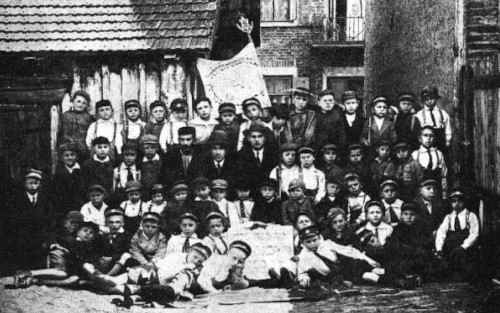
The “Ha'shomer ha'tsair” movement arose , as stated earlier, in the shule. There, groups of boys and girls had a special charm in their joking together. The grey shomer blouses appeared among us, and the scout's tie; the emblems of the shomer social class impressed us; the shomer blessing “Be strong and of good courage!” rang out among other such impressive manifestations. That made me curious. I very much wanted to be with them, one of them, but I was afraid for my parents. I was also not certain if I could maintain the many-sided activities: in the shule, in the “kheyder” and also in the movement. I was envious of my friends, who were free already at their age to do as they wanted. The taboo against the movement in my house was strong and absolute. But I was so drawn to the free life in the youth movement, that I nevertheless decided to join a group that be just being formed.
In those days the Shomer “cell” was completely organized, with all its levels, groups, troops and leadership institutions. I remember my first group leader was Dovid Ablodziner (left for America) and he pulled our group together. The “meetings” were in the free Nature in the summer, and in his house in bad weather and winter. The group was called “Binyumin”. Members of the group were Alter Rozenfeld (today in Tavria), Tsvi Sheluntshik
[Page 120]
(in Paris), Zev Kvartovitsh (in Uruguay), Yitskhak Grude and Yankev (Yakl) Nayman (murdered by the Nazis), Zev Sapirshteyn (in Argentina) and a few others who were with us for a short while and were killed with all the Polish Jews.
It is worth mentioning the situation and the ground for the development of the movement in our shtetl. There were no cultural institutions or entertainments in Rozhan then, not even a cinema. Electricity was wired in to us only in the middle of the 1920s. There was a small island of electric lighting in Beker's [bakers' ? Trans.] undertakings and the houses around it. The cultural activity took place in the local venues of the parties, but that was no more than presentations by fans, various impressions and reading of lectures by some who had come from the nearby towns. That did not give the youth joy.
The formal democracy and the Jewish want in Poland created good grounds for social and political development among the Jews, and especially among the youth. The many-hued Jewish parties and movements indicated Rozhan too. Our political and intellectual “food” we gleaned from the Yiddish daily newspapers and periodical journals and also from the local library. The Jewish reality, on the ground of the ruins of the Polish economy, stood under the shadows of the poisonous antisemitism. The youth felt that the earth was burning beneath their feet. The youth sought a better and more certain future. Zionism was a real way to solve the Jewish question. The Zionist movement spread and strengthened itself through that in which it fought for the Jewish right in democratic Poland.
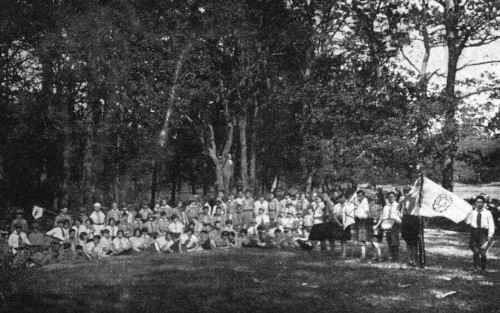
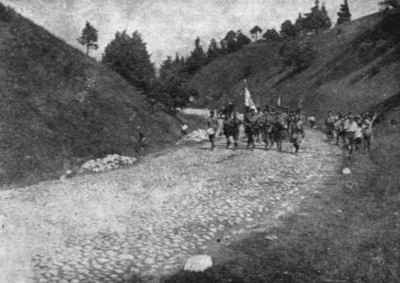
The movement “Ha'shomer ha'tsair” , with its Zionistic and Pioneering program, attracted the youth. Its educational activity for national renewal and the Pioneering accomplishments in Erets Yisroel deeply permeated the life of the youth in the shtetl. In that reality the cell of “Ha'shomer ha'tsair” was organized in Rozhan, that led an effervescent activity for many years, until the decimation. The youngest level was called “Tsufim tseyrim” and “Tsufim bogrim”; and the older one were called “Keshishim”. Each level lived its life within the framework of the troop, group and subgroup. The education was many-sided. The scouts gave the young ones a feeling of unloading and complete freedom through the sports exercises and marching in a shared rhythm, thanks to the scouts' playing in the open Nature, cultural evenings, hiking, summer camps of Mlove Galil and spending time with the cells of the “Ha'shomer ha'tsair” in the neighboring towns. The cultural activity for the most part consisted of Zionist and Erets-Yisroel themes, speaking and reading about the “Ha'shomer” organization and the strength of the members. Reading good and current literature was accompanied by hot debates and literary “processing”. There was no higher education in our town, so the cell was a base for self-development, provided a desire to read and brought culture in among the youth.
[Page 121]
|
|
Bringing the organization into the generous space at the Bukhners' gave the cell a lot of gusto. It was the largest and finest space in the shtetl. Its windows looked out onto the market square, onto the center of the town. We decorated the walls with pictures and slogans of general and shomer-ish content. The space was full of life and youthful joy. The sounds of members singing and the rhythm of a thunderous hora, Shabes and holidays too, used to carry out from the windows of the second floor and resound afar. It called on the youth to join our lifestyle, which was itself a revolt against the Jewish reality in the shtetl. Most of all it disturbed the neighbors or angered the goyim, who were irked at the “Jewish impudence”, but they had to accept it as a fact and could do nothing about it.
The cell became a cultural and social center and drew in many young people. We had our library there, a very big one that was open for everyone. It contained only good books, and many youths visited that corner of knowledge and education.
The “Ha'shomer ha'tsair” movement in our shtetl consisted mostly of students, but also of youth who were working or had no trade. The movement pulled in youth from every circle and enriched their
[Page 122]
lives with intelligence and ideals. It became a center of cultural and social activities.
Over time the problems of the older members became sharper. The efforts were clear: productivity and agricultural training to emigrate to Erets-Yisroel. The ole to Erets-Yisroel was the dream and ideal of us all. The leaving for agricultural training and the preparing of ourselves for emigration united all the older members in their activity for the movement and also in the social life of the shtetl. All the actions of the “Ha'shomer ha'tsair” “nest” in Rozhan concentrated around the khalutsim [Pioneers] – a laboring Erets-Yisroel, the national funds, the Zionist shekel, the elections to the Zionist Congress and other items. Except for the president of the Keren-kayemet in Rozhan, Meyshe Aron Prizant, who was a General Zionist, but he was one of the few in the shtetl. The basis and chief factor of the Zionist activity in Rozhan was the cell of the “Ha'shomer ha'tsair”.
As stated earlier, the stimulus in the bagrim level was the emigration to Erets- Yisroel, and it was usually in opposite proportions between the neediness and the possibility. Parallel to the situation in the emigration, the cell would rise or sink. If the leaders of the cell would emigrate, the management would change. (We named the eras in the cell after them: the era of Arye Bukhner, the era of Khayim Perl, and so on.) The situation in the emigration determined the situation of the entire movement. If there was a large emigration the cell changed, and vice versa.
The beautiful era of the “Ha'shomer ha'tsair” in Rozhan was the era of Arye Bukhner of blessed memory, the gifted teacher and educator who founded the cell and for many years was its leader, until his aliye to Erets Yisroel. We have him to thank for all the finest and best in our life. After his aliye Khayim Perl of blessed memory took his place, also a teacher and educator and also graduate of a teachers' seminar. In his era I was not in the shtetl, because I was studying in Warsaw, but I kept in contact with the cell when I would visit the shtetl on the breaks and holidays.
And then came a new era – a mass exit for Pioneer agricultural training, and it also drew me into it. Responding to a call from the movement I interrupted my studies. After Khayim Perl's aliye Yitskhak Senderovitsh took his place. In that era the aliye became much weakened. Pioneers were in training for a long time and many lost patience and sought a personal solution in various directions. Our cell lost many members. Some left the movement, because they could not see any prospect of making aliye. Because of that difficult situation I was called back from training in order to lead the cell along with Yitskhak Senderovitsh. We worked together for a long period. It was not easy to carry that yoke as the disapointment had permeated the movement.
[Page 123]
With the beginning of the illegal aliye, Aliye Bet, when it appeared there could be a prospect for aliye, the situation in the cell improved. It began to broaden again. We lacked mentors and we laid a lot of attention on the activity of the bogrim. We even tried to organize our own summer camps for the younger levels, because the summer camps for the Galilee had been canceled due to the growing antisemitism. I remind myself of our last camp (Moshevet kits), which we organized in a village near Rozhan and which came very close to ending in misfortune. We heard in the night that the peasants were preparing an attack on us, and we left early in the morning when the peasants would be going out to their work. We left on time and avoided a certain misfortune.
When Yitskhak Senderovitsh made aliye I remained to lead to cell alone. I pulled in Shabsay Kats and took to preparing him for duty. That was a hard and interesting era. We had lost the large venue in the center of town long ago and we rented another (from Reytshik, on Halera Street). Dozens of fresh young folks arrived and the cell was enlarged; and even reminded us of the good days of the past. It is worth mentioning the performances and events, some of which Shayke Vayner from the first administration participated in. Mounted at the center was the Erets Yisroel poem “Ha'rakevet” (The Train) by Avrom Shlonski which we presented with much grace in the background of our improvised paper decorations.
I remember our last command around Peysakh, 1939. We stood in ranks, one hundred and fifty cadets according to their troops, and with their banners. But I stood there overwhelmed. I felt that the end was approaching. I could not find any new instructors who were able to continue the activity of the cell. And in the autumn of that same year the war broke out, and everything was torn apart.
Saying Farewell to the Shtetl
May 1939.
An ordinary Friday, a market day, erev Shabes in the shtetl. I was coming out of the town hall after completing the necessary formalities for my aliye to Erets Yisroel. Nearby a radio resounded with a loud voice that awoke notice among the people even in the market-day tumult. Jews and gentiles gathered around together. The voice of the Polish Foreign Minister Yosef Bek came from the radio. He spoke about the German demands concerning the Danzig corridor. The international tension was coming to its high point. The minister declared that Poland would fight life and death if there was a Nazi invasion. The gentiles around were inspired, but I had a heavy mood. The ground burned under my feet. I left that place.
[Page 124]
The walls were plastered with posters from the Polish Endekes with the slogan “Do Not Buy From Jews!”, accompanied by antisemitic caricatures. These were tacked up near the town hall, right under the eyes of the police. With my whole being I could feel the oncoming storm.
And what would become of the Jews?
I walked like a lunatic. When I came home, I waited impatiently for the mail carrier, for a letter with the last instructions about going to Warsaw to the transport of the illegal aliye (Aliya Bet).
The war could already be felt in the breezes, it was already near, a question of weeks or days. In the Polish camp one felt a sort of awakening. People were preparing. Extra security was proclaimed. And the Jews were called upon to fulfill their “patriarchal duty” – yes, the Jews, whom they used and boycotted. The Jews found themselves between the hammer and the sickle, and their sources of livelihood were closed off. The organized economic boycott was not enough – Jews were beaten and it did not bother anyone. The Jewish youth withdrew and locked themselves behind their own four walls. The evening strolls along the Pultusk Road were shorter, no more than to the “cross” (at the corner where the cut road meets the bridge). The danger lurked on every side. The Jewish youth walked only around the market square. The only activity was carried out only in the youth movements, especially the “Ha'shomer ha'tsair” in their shrunken venue.
Every Sunday was like a nightmare in the shtetl. Jews locked themselves in their houses. Drunken soldiers who wandered around in the streets were a danger for every Jew. Mostly one heard the screaming of a molested or a persecuted Jew in the darkness of the night. Every time I returned home, the family was awaiting me with great unrest. A stone was lifted from their hearts when they saw me whole and healthy.
That was the reality in our shtetl and in all of Polish Jewry: antisemitism, economic boycott, the danger of Nazi Germany, the closed gates of Erets-Yisroel – no exit, without a hope!
We, the youth, just searched for the morning, a way out of the suffocating situation. Indeed, the news about the Second Aliye was a ray of light in our dark lives. Those who merited emigration were lucky. I was one of those.
Finally the notice with the details about the aliye arrived. My friends also received notices of where to go in Warsaw. I did not receive such instructions, and my situation was not clear. I decided to leave along with them and travel to Warsaw. When I came to the pioneer headquarters in Warsaw, I discovered that they had scheduled me for the next transport. I simply announced
[Page 125]
I was staying and I would not go back to Rozhan for anything. They proposed that I wait until morning, as perhaps someone designated for this aliye may not arrive. In the morning they assured me that two people had canceled their travel and that there was a place for me.
My happiness was huge, but not complete, because I had to arrange for my release from the military at a station in Pultusk. I had to remain another 48 hours until my departure from Polish soil. It was very urgent and so I decided to travel to Pultusk and take care of the matter on the spot. After a difficult journey I arrived in Pultusk and went straight to the military authorities. I was seen by a Polish officer, an invalid (missing one arm) and an interesting conversation developed between us about the reasons for my leaving Poland. He began to pour out his bitter heart for me, but I turned from the true reason and answered that I was traveling for an excursion. He tried to convince me that I should not leave Poland because her situation was so difficult and she needs to have the Jews. In the end he asked that I at least promise that I would come back after the “excursion”. Did I have any choice then? “Of course I will come back!” I assured him. He then abbreviated the bureaucratic procedure and in one hour I was already outdoors with the necessary documents in hand. Before I left, he had given me a friendly goodbye and wished me a happy trip.
I still had time before tomorrow morning. It was lunch-time and I was 31 kilometers from Rozhan, so I decided to visit one last time. That day was a fair day in Rozhan. A tumult and a commotion in the streets. And again I see the antisemitic placards in the Jewish shop and on the electric poles of our shtetl. The Jews I met wondered at me and asked what had happened, that I was here again. My family was very surprised. I related what had happened with me over the last two days. We sat and talked about the old times. I looked at my family members and tears stood in my eyes. I had the feeling that I would not see them again, that we were parting forever.
I decided to leave Rozhan that same day, on the mid-afternoon bus, and not to wait until early tomorrow. When I arrived at the bus station a warm surprise awaited me. I had thought that only a few people had seen me arrive in the shtetl, and here were many who had come to accompany me: members of the movement, friends and regular Jews. Some came to say goodbye, some to send greetings to Erets Yisroel and some to see a towns-fellow leave the country. Until this day I cannot understand how the news about my visit spread in such a busy day as the fair. That was an experience that I will never forget.
When I stepped up onto the bus, I looked at the many Jews who
[Page 126]
had come to see a townsman off on his way to Erets Yisroel. A tear fell off my face, a tear of sadness and joy together.
You are precious, Rozhan, without measure…
JewishGen, Inc. makes no representations regarding the accuracy of
the translation. The reader may wish to refer to the original material
for verification.
JewishGen is not responsible for inaccuracies or omissions in the original work and cannot rewrite or edit the text to correct inaccuracies and/or omissions.
Our mission is to produce a translation of the original work and we cannot verify the accuracy of statements or alter facts cited.
 Różan, Poland
 Yizkor Book Project
 JewishGen Home Page
Copyright © 1999-2026 by JewishGen, Inc.
Updated 10 Sep 2026 by JH