 |
|
[Pages 85-86]
by Maurice (Moshe Tsvi) Berman
Translated by Edward Meltzer and Isac Tabib
It was in the 1880s of the previous century that a wave of pogroms was swept over Russian Jews. The skies had clouded over the Jews. The future of the Jewish people deeply touched his heart. Grandfather, my uncle Itzal'eh, and my father were regarded as the intellectual leaders of Rakov in those days. When they gathered in our home their conversation usually revolved around the state of Jews. Grandfather and uncle were the pessimists while father, the businessman, well versed in the current affairs of the world and the country, was among the optimists. Father used to travel far and wide in his extensive business dealings, to Kavkaz, Moscow, Warsaw, Tiplis, Vilna and more, and there he viewed the issues with a more optimistic view.
Upon his return from these trips he would talk about the commercial and
industrial developments in Russia and about its technical developments. His
words were like a light reflected from all he had seen and heard in his
travels.
“You are yet to see”, he used to say, “that the 20th
century will bring a tremendous development in technology and will march the
human race towards a happier life and a new world, and the Jews will advanced
along with the world population.” I do not know on what he based his
words, but that these were his words is a fact.
In my childhood I had the privilege to see one technical invention, an invention that was going to be part of the future civilization. We lived then in Bukhraka and we used to light up the house with “kinlakes” – branches from the pine tree, dry and thin, that were cut specifically for kindling. One day my father brought from Warsaw a great invention, an Oil Lamp. The oil lamp was a sensation in town.
Modern Advancements
We were five boys at home. It was customary in our family that on the eve of Passover, mother goes to the Paltiel Store or Batya-Riva's Store, and she buys several pieces of “taldana” to sew suits for the five sons for the upcoming summer days. And the same rule was applied for shoes. Mother bought the essential materials for shoes from Nechemia Shlomo. She invited Hershel, the shoemaker, to our house, where he would sit with his apprentice, and together they sewed shoes for all the boys.
The fact was that ready-made shoe stores or ready-made garment stores were not common then, also applied for furniture. It was a custom in the village to give a daughter that was about to marry a “commoda” (dresser) as part of her “oischteir” (dowry). My mother did not discriminate between a son and a daughter. When my eldest brother, Berel Zalmen, was going to marry my mother invited Moishe Yechiel the carpenter to prepare for him a “commoda”. The whole work was done, of course, by hand and took several weeks. And when the carpenter successfully completed his work he brought the furniture to our house. All the neighbors came to marvel and they all noted that the furniture was a real “antiquel”, never seen before.
Years later things had advanced so that for my sister Shosa's wedding my parents bought her a ready-made “commoda” from a Minsk furniture store. And when my mother came home and told her neighbors about purchasing a “commoda”, it was again a sensation. One of the women said, “Who knows, maybe there will be times when there will be no need to order a custom-made suit, but one could enter a clothing store, and buy himself a ready-made suit.”
by B. Botvinik z”l
Translated by Shmuel Winograd
On the edge of Rakov there was a narrow, winding alley-way. The narrow alley began at the huts of the ‘flax smashers’ (people who beat flax to make yarn), winding its way, like a colorful, charming snake, to the end of Vilna Street at the entrance to the town. Very few houses lined the alley, which was mostly filled with granaries overflowing with wheat, and with vegetable gardens -- a treasured corner. The precious place occupied our dreams during the days of our blossoming youth.
[Page 88]
Not even a single Jewish house could be seen in that alley-way, but nonetheless it was woven into our memories, the place that seeped into our dreams - the dreams of the Jewish boys in the town. Here was the “skolka”, a fine building in a well-maintained, fenced yard. Here the Gentile children supposedly studied. They “studied” there for one whole winter after another, and finally came out just as they had come in - ignorant, not even knowing the shape of an alphabet letter. We, the Jewish boys, were not jealous of them. Studying years at the “skolka” could not be compared with one Bible lesson with R. Shlomo Yidles the Melamed [teacher at the heder], who used to sit at the head of the table, with the yarmulka [skullcap] on his head and his eyes shining. He used to explain phrase after phrase with his special sweet intonation, sweet as honey. We often fought against the Gentile children. On winter days, the “skolka” boys attacked us with snow balls, but were forced to retreat after a hard-fought battle, as we had the upper hand. And it couldn't have been otherwise, for, after all, we were the descendants of David, who stood by himself in battle against Goliath the Philistine. And even more, in front of our eyes floated the images of the Biblical heroes who fought side-by-side with David -- Yoav and Avishai, the sons of Tsruyah. Their images stood before us in the battles against the “skolka” boys, the descendants of the Goliaths and the Amalekites…
|
|
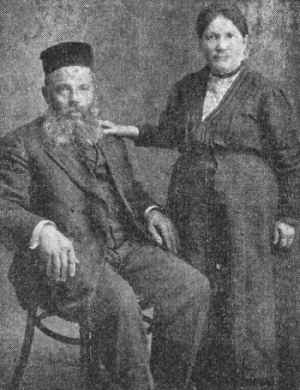
| Yakov and Rachel-Guta Botvinik |
Only a narrow path led from the Granary Lane to the synagogue's courtyard. It was this path that the Jews of the town took on Sabbath afternoons, on their walks to the open fields outside the town,
[Page 89]
next to the Gentiles' apple and pear groves. The smell of the fields was intoxicating, and transported them to another world, to infinite spaces in the world of God.
The small alley-way continued to wind its way like a snake until it reached Vilna Street in the west, and from there to the depths of the forest which surrounded the town. There we, the boys and our older sisters, would go in the summertime to pick those blackberries, and would bring them back home, to our mothers, to cook.
This alley-way connected east with west: Minsk to the east of town, and Vilna to its west. Minsk was some 35 kilometers away. It was the big city, and everyone's eyes were fastened upon it. There we went, after an internal struggle and a confrontation with our parents, to study and acquire the “heavenly education.” We came back home for the holidays, and immediately after the holidays we returned to the city. We traveled mostly by train, though sometimes we took a wagon. Going by wagon led us through many kilometers dotted with small and peaceful Jewish towns, just like ours, each shrouded in their dreams.
After the change of governments, Rakov became a border town, and the small granary alley led to Vilna, to the west. From then, Vilna became the preferred destination of the ambitious young men of the town, whether for studies or for commerce.
by B. Botvinik z”l
Translated by Shmuel Winograd
A small house, a thatched roof hut, standing alone, some one-and-a- half kilometers from Rakov, on the road to Minsk. A lonely peasant hut, next to the fragrant pine forest - the home of Rabbi Yohanan “the Commissioner” (a person who bought merchandise in the city for store owners in town, and received a commission). Seeing him, one could mistake him for Rabbi Yohanan the Cobbler (a Talmudic sage). A Jewish man with a respectful figure, handsome, high-minded, and a scholar. His highest ambitions were that his sons would also become scholars. And indeed, one of his sons became a rabbi somewhere in America.
Walking on the road to Slomianka, one might find himself at the door of a Jewish “settler” who is also a scholar. And when he, Rabbi Yohanan, opens and stand on the threshold of his door, his face is shining, his brow high and bright, his beard, just like those of the rabbis of the Talmud Period. He inspires his guests with joy and happiness.
A forest of pine trees, green and fragrant, a clear brook, the chirping of the birds on the tree tops, and the voice of Rabbi Yohanan studying the Gmara. That was Solmianka in those days.
Here, in Solmianka, was the cradle of the Bund in Rakov. Here we held our meetings, and here, in the Solmianka woods, the young men of Rakov first heard about the Revolution and about Socialism. Here, also, was the cradle of first loves. Here overloaded hearts came to weave their youthful dreams; in the woods of Slomianka.
by William Rosenthal z”l
In my mind's eyes, I can still see Rakov, our hometown. A small out-of-the-way town, far from the railroad and from water; far from paved roads, without natural resources, except for some clay for the pottery industry and some lime stones. Yet, Jews lived there, and somehow found their sustenance there -- a little bit of this and a little bit of that, little bargaining, some trade, “Kley Kodesh” [religious objects], etc.
I recall my years at the heder. I remember the studying, on the long winter nights, by the light of the oil lamp, as the number of daylight hours was not sufficient for a yeshiva student in Minsk. I had my “eating days” [being assigned, on different days, to different households for meals], and slept on the floor at night. Then the years of the yeshiva were over, and I concentrated on the “tachlit” [material goals in life]. I was learning my craft, and spent four years apprenticing, without pay. Then the Zionist Organization was established, and I was full of enthusiasm. The idea of the rebirth of the oppressed Jewish People captured my heart. And I remembered the words of the prophet [Isaiah 27; 13]: “And they shall come that were lost in the land of Assyria, and they that were dispersed in the land of Egypt”.
At the same time I was also a conscientious member of the working class, and as such joined the Bund, the Jewish socialist party, and was active there. True, there was some danger involved, but that only raised the level of enthusiasm for those activities. Socialism! Socialism! It would be the savior of humanity and the Jewish People alike.
Mother was endowed with much beauty and intelligence. Embittered women, whose husbands had migrated to America and forgot to write and remind their families that they are still living, would pour out their troubles and sorrows,
[Page 92]
and Mother would write letters to the husbands, describing the sorrow of the wives who were waiting to hear from them. And my father, R. Shlomo Rosenthal the Melamed [teacher]. He would make the Bible so sweet and its study so interesting, and was, therefore, much beloved by his students. I remember the Winter evening, when he was teaching us the famous verse of Isaiah [chapter 27, verse 13]: “And it shall come to pass on that day that a great horn shall be blown, and they shall come that were lost in the land of Assyria, and they that were dispersed in the land of Egypt”. How much yearning, and how much soul lifting, did Father put into the explanation of this verse. He would repeat the verse again and again, closing his eyes, wanting us to sense how great, how exalted, were these words. And we, the students, were swept away by him and could see all the ‘lost’ and ‘dispersed’ returning to their land…
Some in the town considered themselves “progressive” and a little above their surrounding, and viewed themselves as “intellectuals”; such was Hayim Aba, who subscribed to a Russian newspaper, and others who subscribed to “HaTzfirah” [a Hebrew newspaper] or an Yiddish paper. By the way, I know that there was an attempt to publish a paper in Rakov, but it was not successful and the plan was not carried out.
I remember the days when the library was established by an enthusiastic and idealistic group of young people. That was also the time when the Zionist movement and the “Hovevey Sfat Ever” [lovers of the Hebrew language] movement started their activities in Rakov. Father z”l was one of the Rakov founders of the latter movement. Those same years also saw the beginning of the Socialist movement in Rakov. And the landscape of Rakov included the rabbi R. Avraham Moshe, who had sat on the throne of the rabbinate for fifty-three years.He was like a planted tree covering a wide shady landscape . It was a tree that could not be uprooted.
The scenery of Rakov in those days included the ‘simple folks’ as well: Avremale the Cobbler and his “Hevra Kadisha” [burial society], the old cantor eternally humming his “bim bam”. And please forgive me if I add to the list our the following figures: the crazy woman Gita, the mad man Yankl, and also our Christian neighbors, headed by the Catholic and Pravoslav [Russian Orthodox] priests. All these images are very vivid in my eyes to this day. I long for them, as everyone longs for his childhood landscape.
Thirty-two years later, in 1937, I visited my hometown and found it to be quite different from what I had left: A border town, under the Polish authorities, separated from Minsk and the large estates which had surrounded it. I found it in utter poverty, expecting charity from relatives in America. I stayed there for some time and observed the poverty of the people, how some of them were, literally, down to their last piece of bread. My heart was broken. But it must be said, that in spite of this dark picture, the social-cultural life was as effervescent as ever: the bank, the community institutions, the Hebrew school, and the Youth Movements -- they were all full of bustle, energy, and many activities. All of these made one hopeful, and were the basis for the belief that somehow the town would overcome the material crisis. Alas, who could have foretold that only four - five years later all of that would come to its bitter end. How great is the calamity, how deep is the pain…
William Rosenthal Mr. Rosenthal was born in Rakov, and in 1905 he immigrated to the United States. Just like all the Jewish immigrants at that time, he took a regular laborer job in a small factory. But a short time later he left his job and opened a small clothing factory. After the First World War he, together with his partner, opened a factory for manufacturing brassieres. The business was very successful, and today his company, “Maidenform Brassieres Co.”, is considered the largest American company in this area. He employs some four thousand workers and produces more than thirty million dollars' worth of goods annually. They sell their products in over fifty countries. The company publishes two newspapers, one for its employees and one which deals with manufacturing. The “Maidenform Brassieres Co.” Is a good example of friendly relations between the employer and the employees, and mutual respect. Mr. Rosenthal was a friend of David Dubinsky [the head of the International Ladies Garments Workers Union]. He cared about public matters and served on many committees. Every year he would donate a large amount of money to the United Jewish Appeal and to other charitable organizations. He established and financed a summer camp, in memory of his late son, which provided camping experience to some fifteen hundred young city boys. Mr. Rosenthal had a warm Jewish heart. He took great interest in what was going on in the Jewish world, both in Israel and in the Diaspora. We must hasten to add that he, the busy man, took interest not only in material things; he had an artistic soul, and culture and art were an integral part of his personality. His hobby, sculpture, was an expression of this facet of his personality. He started it at the age of fifty, at first for self-amusement, but later, having received good reviews of his work, he sent his sculptures to various exhibitions, where they were acclaimed by the critics. After his sculpture “A Black Maiden” received first prize, he took sculpting even more seriously and studied with the sculptor Max Kaddish. His sculptures were purchased by art collectors; One of the walls of the Jewish Theological Seminary in New York is decorated with a bronze relief of his, called “Faith and Prophesy”, which is based on the verse “And they shall beat their swords into plowshares, and their spears into pruning-hooks.” Not long ago he finished a bust of Colonel Marcus, who fell [during the battle for Jerusalem] in the War of Independence. Two bronze copies of this bust are currently being done, one for the Israel Defense Force and the other for the Israeli Consulate in New York.
Taken from an article by M. A. Ger in the “Tag Margene Journal”,
Sunday, the eleventh of Shevat, 5717 [February 1957]
by William Rosenthal
The question of what the driving force behind this creation was, and what motivated me, could have been answered by the tens of students of Father z”l whom he taught the Bible. As one of them, my mind was imprinted with the words of the Prophet Isaiah, chapter 2, verse 4: “And they shall beat their swords into plowshares, and their spears into pruning-hooks; nation shall not lift up sword against nation, neither shall they learn war anymore.” The prophet, who lived in a stormy period of wars among nations, and who foresaw the fateful struggle of the People of Israel for its existence, enunciated, precisely at that time, his lofty vision of 'the days to come', and expressed his deep belief in the happy future of humanity. This lofty vision was engraved in my young mind and excited my heart for many years. Later, while studying the history of our people, delving deeply into it, this prophecy evolved in my imagination into a magnificent picture, standing in its full glory in front of my eyes. Since then, it was the dream of my life to shape this picture, just as I saw it, in bronze, and this way to express that which was in my inner soul. This dream was realized when I learned to sculpture, and my hands could express my thoughts in stone and bronze. I have been working on this image for a long time, until I completed it.
And this is what you see in the relief: On the left stands the great prophet, Isaiah the son of Amots, holding an open scroll in his hand; a scroll in which his prophecy of 'the days to come' is inscribed in English and in Hebrew. Next to him, towards the center, you can see the symbol of his prophecy in the shape of an ironsmith fanning the flames of the fire which transforms swords into plowshares and spears into pruning-hooks. At his feet, the lamb and the lion lie peacefully. On the right you can see all the nations who, throughout the generations, were going to destroy us, but for the Holy One, blessed be He, who saved us: Egypt, Assyria, Rome, the Crusaders, the Inquisition, to the latest of our enemies; and next to them is the Jew who kept on existing, kept on wandering with the Bible and various books of knowledge under his arms. In one hand he is carrying a bag with his tallit [fringed prayer shawl], tefillin [phylacteries], and other personal articles, while with his other hand he is shading his eyes, the eyes which keep searching the depths of time, looking for the fulfillment of the prophecy and the coming of the Savior. With bent figure, but with sure steps, he marches down his wandering way, full of obstacles and no end of troubles, but his aim is steady: the salvation of the Jewish People and the salvation of the world -- two intertwined goals. And lo! Just when he found the road leading towards that eternal peace, and but a few steps separated him from his goal, the Nazis came and destroyed his whole world, the world of great hopes.
[Page 96]
|
JewishGen, Inc. makes no representations regarding the accuracy of
the translation. The reader may wish to refer to the original material
for verification.
JewishGen is not responsible for inaccuracies or omissions in the original work and cannot rewrite or edit the text to correct inaccuracies and/or omissions.
Our mission is to produce a translation of the original work and we cannot verify the accuracy of statements or alter facts cited.
 Rakov, Belarus
 Yizkor Book Project
 JewishGen Home Page
Copyright © 1999-2026 by JewishGen, Inc.
Updated 16 Oct 2026 by LA