|
|
[Page 401]
by Paltiel Geshri–Brikman, Toronto
Translated by Tina Lunson
Adolf Eichman may his name be blotted out maintained that he had done nothing, had only transported Jews to the death–camps. I will tell you how he carried out that transportation, and by all means, you may judge whether for that alone he deserves a violent death.
The torture of the local Jews began as soon as the German beasts arrived, but the liquidation of all Ostrovtse was designated for the Sunday after Sukes in 1942.
On that day they chased all the Jews with their wives and children together in one place and held them there for a few days, without food, without water. The German, Lithuanian, Latvian and Ukrainian murderers sat with rifles over their heads and shot them for any small infraction.
No pen can describe what took place there. The screams reached the high heavens. Children lost their parents and wailed. A community of Jews, among whom there were so many dear souls, herded like a herd of animals being taken to the slaughter.
But one does not bully and deride animals. They do not torture for no reason, and here the murderers spilled blood with particular pleasure, gruesomely beating and laughing about it, making jokes.
My younger brother and I were standing
[Page 402]
on a hillock at the factory “Zaklaki Ostrovietske” where we had worked and wept bitterly, seeing the hellish scenes at the collection point.
From Sunday on they were driving Jews to this point. Lithuanians, Letts and Ukrainians helped the S.S. soldiers and civilian Germans to beat Jews with rifle butts, pull off the boots from some Jews and shoot them, dropping them dead on the spot.
In the Jewish hospital they shot nurses and doctors where they stood, and they hanged the young Doctor Abramovitsh.
About 20,000 Jewish men, women and children, including refugees from Lodz, were assembled at Koniev hill and from there marched to the train cars. This went on for three days. They marched the hungry and exhausted. The entire path was strewn with dead bodies, as the murderers shot left and right.
They stuffed the nearly–dead into the wagons much worse than animals and the Ukrainians, Lithuanians and Germans continually chased and beat them. They wanted only broken and unconscious Jews in the wagons.
Jammed on top of one another lay holy men, rabbis, scholars, doctors, attorneys, and they sealed the wagons. Many who had been shot lay on along the sides. The moans, screams and cries for help were indescribable.
The Jewish [ghetto] policemen had known earlier about the Sunday action but they did not say anything. Only two of the Jewish [ghetto] policemen wakened their pity and seeing the hellish scenes threw aside their police hats with the stripes and willingly leapt into the wagons along with the other Jews. They were a son of Avrom Funt and a young man from Lodz, manager of the sanitations command for the “Judenrat”.
Two years later they also stuffed me and my two brothers into those wagons. Until then I had worked in the “A. G. Farben” factory near Auschwitz, and in January 1944, on the coldest and snowiest day, they took us through the Yelanker brick factory to Glivitz.
They threw 150 people into an open train car and the same number into a closed wagon and sent all the cars around for twelve days and twelve nights, without even a drink of water. Perhaps two times in that whole period they threw in a couple of hard, frozen loaves of bread. We went through Austria, Czechoslovakia and Germany. And when we came to Orenburg, an airplane factory near Berlin, 80 percent were dead.
My two brothers and I remained alive – because we were traveling in an open car we had air and mostly, we could lick the snow.
Everyone was pressed together like herring [in a tin] and people had to defecate behind themselves. People became wild and bit one another. If you wanted to bend over you had to kill someone. Or throw them over the side of the moving train. People jumped from one wagon to another and the guards quickly shot them, or they fell between the wheels and were shredded.
We were successful. My two brothers and I were the first into the wagon and grabbed a place in a corner. Two of us would stand while the third sat between their feet, and we exchanged places.
Finally I want to remember the Czechs for good. When we passed through their country, they began to throw us food. I succeeded in grabbing an apple, which I promptly shared with my brothers. But many Czechs paid for this with their lives, because the guards opened fire on them with rifles.
There was also a case when we were going through a large train station and there was a passenger train standing near our train, and the passengers began throwing their food to us. My youngest brother succeeded in grabbing a treasure: a sandwich, two thin pieces of bread with shmalts, which we also shared.
The trip lasted, as I have stated, for twelve days, and it is impossible to describe how it looked in the wagons and what happened in there. Frozen from traveling in an open wagon during such a crackling frost, filthy from defecating behind oneself and hungry and thirsty, with the fear of death every moment, because the guards were continually murdering us.
by Miriam Gutholz–Feldman
Translated by Yaacov David Shulman
It was January, 1943, the year of the death and the might of the final remnant of Polish Jewry.
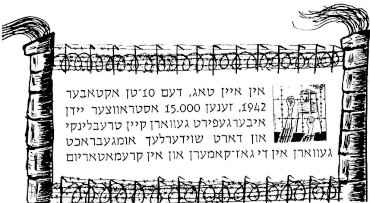
All of Congress Poland, including my home town of Ostrovtse, had already experienced the mass deportations of October 10, 1942.
About 2,000 people remained in town, many of them illegal–meaning that they did not have jobs. Rumors were going about that the German beast was preparing a new “action.” They were planning to murder the last remaining, tormented Jews, those who had concealed themselves under the worst conditions in various hiding places at the time of the first evacuation.
At first, people had believed they were being sent to work. The executioner himself thought up that lie. But they immediately realized the brutal truth: that those deported were cruel sacrifices to be gassed in the crematoria of Majdanek and Treblinka.
It was already after the mass deportations and slaughters of the larger Jewish communities in Poland, such as Lublin, Warsaw and many other towns. In the air one could feel that the great, cruel storm was hanging over our heads. The tragic day came. It was Sunday, January 10, 1943. On that terrible Sunday the remaining tormented Jews of the Kielce group were taken and murdered. During the deportation at that time, I went to Treblinka.
At five in the morning, the devil's dance began. The ghetto was awoken by the SS, by Lithuanian and Polish police and other dark forces. To our great disgrace, the executioners did not even lack the help of the Jewish police.
Worn out and frightened, some dragged by force from various hiding places, everyone was taken to the transport, forced to the train station and the waiting freight wagons. It was very cold, the road was slippery, and those driving us forward did so without mercy. If someone fell, whether because he slipped or from exposure, he was immediately shot. The road was littered with the dead. Blood spotted the white snow, Jewish blood of the unfortunates who could not keep up with the driven crowds.
Along the entire way to our death train, the murderers rained down blows, which often knocked their victims unconscious. But the true orgy took place at the train station. As we entered the train, every smallest item of value, not to mention money and jewelry, was taken from us. We were ordered to remove our shoes and coats. And thus, half–dressed, we were pushed in, 120 people to a wagon. The dirty wagons had certainly only carried animals until now. We stood inside, pressed against each other, the small windows covered with barbed wire.
Outside, a blizzard raged and the frost stung. As soon as the wagon doors were locked from the outside, the train moved, and no one could determine in which direction we were being taken. A dead stillness reigned. The wagon was very stuffy, and everyone began to suffer from thirst. Some people fainted. People scratched the frost from the walls and with that rescued those who had fainted. All human needs were taken care of on the spot. We traveled that way for two and a half days in the crowded wagon, in the worst conditions.
On the third day, as the sealed wagon moved forward, the people, tormented to the point of death, noticed a sign, “Treblinka,” to which the train was coming ever closer. We knew very well what Treblinka meant for us. The
[Page 404]
train turned onto a side line, which was close to the death camp. There was nothing more to hope for. Death was all but certain. My only desire was to at least die an honorable death. Many people in the wagon still did not want to believe that our end was coming. The terror that the murderers had cast on their victims was so great that people trembled at the slightest thought of staging a resistance.
I told everyone that this was the time to jump from the wagon. Whoever can must jump, I told everyone. But my words fell on deaf ears. No one listened to me.
With difficulty, and thanks to the help of a family friend, R. Leibish Rosenberg, a Jew from Lodz who was no longer young, I succeeded in fighting my way to the little barred window. Before I jumped out, the martyr Rosenberg gave me courage with the words, “You are young. Jump and tell the world about our destruction.”
I jump from the train
His blessing was realized. The train was traveling quickly and I leapt as far from the tracks as I could. The guards accompanying the transport shot at me. I ran a considerable distance on the white, snowy field, and then I looked around to see where I was. I wasn't wounded, but I was alone in the endless whiteness. It was a beautiful winter day, and on the horizon appeared a white, snowy forest. Everything shone, but I was in darkness. I felt like the last person on earth. I did not know what to do, and I regretted having leapt from the train. In such an oppressive mood, I was barely able with my last strength to drag myself to a peasant hut, where I asked to be allowed to warm myself a little. The peasants immediately saw that I was Jewish and they drove me from the house. As I ran away from them, I fell into a snow–filled hole and I was soaked through and through.
I had not eaten for three days, but I did not feel hunger. Darkness began to fall, and the night came quickly. Desperate and filled with fear, I barely managed to drag myself to the forest. I sat down to rest, and fell asleep. When I woke up in the morning, I felt entirely frozen. I didn't realize that my feet had been frost–bitten overnight in the forest. I left the forest and approached another peasant hut, which wasn't far from the forest. I knocked, and a peasant woman opened the door for me. She let me warm myself, and she gave me hot coffee and bread. I warmed myself and began to feel a biting sensation in my feet. I took off my shoes, but I could not put them back on. My feet were swollen, and my toes were completely stiff.
The Christian woman gave me a large pair of shoes with wooden soles, and I gave her my own shoes. I bought from her an old coat with a peasant shawl, and since she had saved me I went on the road to Kasav–Latzki, where there was still a Jewish ghetto and where I could hide, because it would have been very dangerous for her should I be found on her property. In such a case, the SS would burn down the entire place and kill the owner.
In the Kasav–Latzki Ghetto
It was about eight kilometers to Kasav–Latzki. This was the time of a Christian holiday, and from everywhere in the neighborhood, peasants were going into town. I blended among the Christians and in that way I entered the town. It wasn't hard to recognize the Jewish ghetto. I snuck in through an open slat in the fence, and in that way I became a ghetto resident.
In the ghetto, sanitary conditions were very terrible. In addition, there was a typhus epidemic, and people were terrified of the SS men, who would come from neighboring Treblinka and kill Jews with axes in a bestial manner. I contracted
[Page 405]
typhus, and the only Jewish doctor there (a woman whose name I unfortunately don't remember) saved me, even though no medicine was available. In the ghetto, I met a few other people from our transport who had jumped from the wagons as I had. I also met the Lublin rebbe's son, Eiger, with a Jew from Lodz. They told me that they were preparing to return to Ostrovtse, where the rebbe's entire family had been since the Germans had entered Lodz. The youth from Lodz had an Aryan appearance. But I was still sick, and I could not go on the road in such a state.
Back to Ostrovtse
The youth from Lodz with the Aryan appearance made his way to Ostrovtse, and told my parents about my condition. They immediately found a Christian, Maian Khamera, who came to Kasav–Latzki and looked for me in the ghetto. He brought me a train ticket. I disguised myself as a peasant woman, and, although I was suffering from fever and from extreme pain in my feet, I went on my way.
We didn't travel together in the same wagon, so that if I were discovered to be a Jewish woman, no suspicion would fall on him. But he helped me a great deal and showed where I must change trains. To this day, I cannot understand how I succeeded in making my way without any documents and, in addition, so sick with fever, which could also have given me away. Moreover, at every station the SS checked people's documents, and they arrested more than one person.
An interesting episode occurred at the Warsaw depot, where I was waiting for the next train. There was no place to hide. An old Polish woman came to me and after making an apology, she said, “You know, you look very Jewish.” “Yes,” I answered her, “a few people have told me that. It could be because in my village we all have dark skin.”
My heart was pounding, and I was all but certain that she was about to denounce me to an SS man or a Polish policeman, and that I would be taken away. The time until the train came appeared to be an eternity, but the train to Skarzshisk finally arrived. I pushed myself in together with everyone else, and that same evening I arrived in the Ostrovtse ghetto, where my family was waiting for me.
The state of my health was terrible. My feet had to be operated on as soon as possible. To my great good fortune, the well–known professor of Poyzner University, Professor Drevus, who was famous as a surgeon, was in the Ostrovtse ghetto, and he, together with Dr. Meir operated on me in his home. My return to health was greatly aided by the caring treatment of our informal doctor, Nachman Alman, who helped all of the sick people in the ghetto with great dedication. May his memory be blessed.
From the work camp to Auschwitz
At the end of March, 1943, the ghetto was liquidated, and the remaining tormented Jews were led to the kasharn [type of building] next to the factory. That was a camp guarded by Ukrainians, where we worked 16 hours a day in a state of hunger. At the same time, the overseers and Jewish police lived in conditions of the very greatest luxury. We remained in that work camp until the summer of 1944. When the front came closer, the Germans liquidated all of the camps in the area and sent everyone to Auschwitz. The number tattooed on my left arm is 16922–a.
From Auschwitz, we were sent in a transport to various camps in Germany and Sudetenland, until we were liberated on May 9, 1945.
I don't have the strength to write about the humiliation, hunger, dirt and pain that we suffered in all of these camps. May our compatriots and readers forgive this gap in my writing.
by Mordechai and Yehuda Rosenberg
(concentration camp number from Auschwitz: B4479)
Translated by Theodore Steinberg
We are awakened from sleep by a frantic ringing of the camp bell. We are all terrified. What now? Who could tell what kind of troubles today would bring! I had not slept enough, and I was dead tired and weary. Oh, if they would let me sleep only five minutes on the hard boards under that thin blanket! My tired, thin, and weakened body rolled up at night seeking a bit of warmth, though it was hard to find.
We hear the wild yells and cries from the “controllers,” sticks striking heads and wherever else, and the loud orders: “Herraus! Herraus!. Get to work!” There is no time to think, as we had to rush out of the barracks.
Outside it is still pitch black. It is raining, and the cold goes through our bones. We can not hesitate! My first frightened glance falls on the chimneys of the crematoria, which belch fire that lights up the whole surrounding area. Oy, the horrible image of the fire in the crematoria, where human souls were brought, where my sister and brothers were exterminated! How long, Great God? How long, Master of the Universe?
So we march, thousands of people, bent, shrunken, and crowded together, with faces crumpled and wrinkled from woe. We look at each other, but no one utters a word. From time to time we hear a groan from someone or other, such a deep groan…From a distance comes the terrible odor of burnt bodies. Still more, still more!
Under my light garments I feel the cold dampness of the rain, which goes to the marrow of my bones. It's terribly cold. The wind blows in my face and torments me. And with painful feelings of sorrow, terror, and hunger, standing four in a row, we march to the gate, where all the inmates are gathered, prepared to go out to work.
The March of the Slaves is Accompanied by Music
An orchestra plays cheerful marches and nice foxtrots with pizazz, and the fire from the crematoria chimneys performs a horrible dance and is reflected in the shiny musical instruments of the band, which plays the last march for the departing young lives which have stood there since yesterday and, together with us, await their fate…
We approach the gate with great fear and anxiety. I feel the rapid beating of my heart. In my head–there is a murmur and my brain churns. I strive with all my might to master myself and to march strictly in time to the music, not shaking, God forbid, my hands or my head. All buttons must be buttoned properly. The collar cannot be turned up. The head must be shaved. One must look cheerful and not drowsy. We hear the command: “Left! Left!”
By the gate, many SS murderers await us with clubs in their hands. They are all freshly shaved, neat, and elegantly dressed. On their uniforms are various medals and awards–for different “heroic acts” and mass murders. They all look happy, cheerful, and free from worry.
The kapo of the command calls in a loud voice to the gate commander: “Work commando Strassen-Bahn with 216 prisoners. Permission to exit for work.” “Herraus!” responds Commandant Puderman–“To the side! Hats off! March lively! Left! Left!”
The murderers do not stand there with arms crossed. Like hungry wolves, they watch their victims. Whoever comes up short, they hold out
[Page 407]
their clubs with their half-rounded handles, seize their victim by the neck, and drag him out of the line. From all sides their clubs fall on shoulders and on heads. In many cases, a vicious trained dog leaps out and tears living flesh from the victim. And when the unlucky victim hears the order, “Up! Get going!” he's whole and good…beaten up. Torn apart, they run after their commando and back in rhythm: Left! Left! And no one feels the blood flowing under his clothing. No one sees it and no one asks. Everyone knows: there, where the fire comes from the chimneys–there it is even worse. And so commando after commando, day in and day out: Left! Left!
We find ourselves on the other side of the gate. The tension has let up a bit. I feel tired, weak, worn out from fright, as if after a long fast. Beaten and embittered, with clothing soaked from the unceasing rain. Finally we come to our workplace. Our labor consists of moving rocks from one spot to another.
We are surrounded by SS men–the same ones who watched us on the way to work. With rifles, clubs, and dogs, wearing fine raincoats, they stand there and make sure that we do good work. We carry the rocks unceasingly, with our last strength, without catching our breath, and we try as much as possible to keep our crumpled bodies from falling to the earth, because that would mean–the end.
The rain falls without cessation, but nothing keeps us from our hard labor. From time to time a wild yell is heard: “Will you work or not?” And more than one of us feels the pitiless clubs that fall barbarically on the thin bones of hardly living men.
Time stands still. The morning is endless. It seems endless. Our troubles last so long, as if there is no end to our suffering to our pain…
Three Brothers Cling Together
Finally we saw that people were bringing the pot with our watery soup. But together with the soup, they brought bitter, Job-like news of a selection in the camp…A cold sweat covered my skin. I suddenly felt a terrible fright in my heart. My hands fell helplessly and my eyes clouded over. In the quiet, I could only repeat, “Selektion, selektion, selection.”
After all the other selektions until now–who will live and who will die–Yidl, Shmuel, and I, three brothers out of a family of eight, succeeded in remaining together in one place. The youngest brother, Shmuel, stayed in the camp today together with many other inmates and did not go out to work. Because the Russians were approaching, many of the worksites were superfluous, and the work that we did was not useful. They were only there to torment us.
For three brothers to remain together in a camp–this was a rare situation. All of our manipulations to remain together cost us dearly. More than once we felt the blows from clubs on our heads. But it was all fine. We three remained together, helped each other in times of trouble, consoled each other in days of despair and hopelessness, and together hoped for better times, for brighter days that must come…
Terrible hunger drove me to the line for the food bucket. My stomach had its own needs, and even the terrible news about the selection in the camp could not keep me from eating. After eating, which lasted only a short time, the kapo ordered the empty pot to be returned to the camp, and I was one of the fortunate ones, along with three others, assigned to this task.
The Death March of the Women
We went quickly, because we were going to learn what had happened to our near and dear ones there in the camp after the selection. As we approached the camp entrance, we were
[Page 408]
moved to the depths of our souls by a horrible image. Here is what we saw: hundreds of women going in closed ranks, accompanied by armed SS men with whips in their hands and with dogs by their sides. Women old and young, with bowed heads and eyes wide with terror. The weakest among them were supported by others. I heard no weeping. But tears, so many tears, flowed from their blank eyes. Some of them were half naked, because having been forced out of the block by cries of “Heraus!” they had not grabbed their clothing. One of us took the risk of asking, “Where are you going, women?” and as if from a deep cellar we heard frightened, sad voice say, “To death, dear Jews, to death.”
It is hard for me to describe today what I felt then looking at this sad funeral procession of 500 Jewish women, old and young, mothers of children, who were now going, after so many difficult experiences, on their last journey…This horrifying image is engraved deep in my memory, and I will never forget it in my whole life.
We came to the kitchen and turned in the empty pot. We saw no one in the camp, as if everything had died. Try as we might, we could not learn what had happened in our absence. Oppressed and with broken hearts, we returned to our worksite.
As we returned, the rain grew harder; and when we got there, we found all the inmates in a single cell. The SS men had driven them in there not, God forbid, out of pity lest the slaves be soaked and worn out by the rain but only so that the inmates could be concentrated in a single spot in order to ensure that in the rain and fog none of the “bandits” should, God forbid, escape.
Everyone besieged us with questions and wanted to know what happened in the camp after the selection. We told all that we had seen: the hundreds of women being led to their deaths. The dark mood grew in everyone, and everyone was dumbfounded.
The congestion in the cell was terrible, but we crowded together to get a little warmer. And so we stood pressed together. Bitter sighs were torn from the depths of our hearts, and in simple words we prayed to God, said Psalms, and wrung our hands.
From the Crematorium Comes a Fire…
A kapo came into the cell and told us the “happy” news that a frightful fire was coming from the crematorium chimneys. All 100 of us were shaken to the depths of our souls. Those burning were the victims of today's selection. From all sides we heard deep sighs and terrible weeping. Suddenly we heard the words of “El Maleh Rachamim” growing louder and louder. A chazzan among us, with a weeping voice began singing the words, “Give fitting rest in the heights of the holy and pure who shine like the radiance of heaven…” At that moment we forget the greater danger around us. We wept like little children and with broken voices sang along with the chazzan this heartfelt prayer in memory of our tortured brothers and sisters. I never in my life forgot those many tears in that cell in Auschwitz.
But no. That, too, was a luxury. Crying in the camp was strictly forbidden. The door of the cell was suddenly pushed open and an SS man rushed in, shouting angrily, “What is this? Stop!” He could not calm things, and he cried, “Who is the leader here?” When he noticed that we were all standing around the chazzan, he came up to him and, with lips curled in anger, shouted, “What are you doing, swine!” He immediately wrote in his notebook his concentration camp number and said to him, “Tonight you'll really sing”…This was a threat of the crematorium.
Standing in even rows, surrounded on all sides by our armed guards with their
[Page 409]
dogs, we marched back into the camp. We heard the commando: Left! Left! Yes, we were going home. This was our “home”–this horrible Gehenna that the Nazi barbarians created for us in the twentieth century in the heart of Europe.
As we neared the camp gate, we heard from a distance the orchestra that was playing various marches. The kapo made himself heard and Puderman paid no attention to his command: “To the right! Left! Left!” We straightened ourselves out in full order to the rhythm of the march. We marched into the camp, where our supervisors were. They counted and checked us with German efficiency to see that everything was in order.
As happened every day after work, we went to our block, where we were counted and checked again by the block leaders. Only then were we allowed to enter. But today they had us stand outside. The rain fell without stopping, and darkness was falling. The fire from the crematorium chimney became even stronger and clearer in the dark. It was terrible to see. The damp and the cold pierced the marrow of our bones. And thus we stood and waited. For what? Who knows what awaited us!…
I stood and thought: why this further torment? I felt resigned, and I no longer had my strong will to survive. No! The heck with this suffering. Who would help us and who would be interested in our pain, our woes, our suffering?!
“Today is the second day of Sukkos.” My neighbor, standing not far from me, pierced my sad thoughts with these words. They had a powerful effect on me, and I felt in these few words a strong protest and a bitter reproof. My God, do you not see our pitiful situation on this Yom Tov? The festive Yom Tov of Sukkos, when we used to praise Your name with song, with joy, with prayers. Ah, great God! How wonderful it was! At home–clean, bright, warm, and joyful in every corner. The family sat with beaming faces in the beautifully decorated succah and ate, drank, and sang all the songs, while our beloved, faithful mother passed the best and nicest foods through the window…And we were all there together, older people and children, brothers and sisters, aunts and uncles, grandmothers and grandfathers–all together. Was this only a dream or was it a reality? What Sukkos was like in our dear home! Oy, how quickly it all disappeared!…
My Brother Saves Himself from the Selektion
Wait! Suddenly a wild cry is heard. My brother and I run quickly through the block and there we find our third brother. Our joy is indescribable. We throw ourselves into each other's arms, and tears flow from our eyes. He tells us about the great fear that he survived that day. There was a major selection among the women, only some of whom I saw. And there was also a selection among the men who had not gone out to work that day. He hid himself for the whole day and then after the selection awaited our arrival to leave his hiding place. The fear of death throughout that day changed my brother so that he could hardly be recognized. Because of his weakness and agitation, we could hardly understand what he was saying. The main thing was, thank God, that we were again all three brothers together.
We too off our wet clothing and hung them as well as we could. The three of us got under the two blankets that we had and warmed each other. We were given our provisions, which consisted of three small pieces of bread, and we decided to eat one piece today and have two pieces tomorrow. But soon after eating that one piece, we decided to have another and leave one for tomorrow, so that one piece would have to suffice until lunch.
And so the three of us lay on the hard boards. Each of us wanted to say something, but no one wanted to go first. Then one of us shyly asked, “Perhaps
[Page 410]
we should eat it?” We soon agreed, because we were deathly hungry. It did not last long and–no more bread. No memory of it even remained…
A Terrible Selektion
Tired and worn out from that frightful day that we had lived through, we slept like the dead, having no idea of what yet awaited us. Cries and screams, blows from clubs suddenly awakened us from deep sleep. “Quickly! Down quickly!” the bunker leaders screamed. In the block there was a great disturbance, and no one knew what it portended. Deathly fear fell upon us when we saw that we were being herded to one side of the block that was divided off by a long, low wall. Our thoughts were confused; our hands and feet trembled. We quickly realized that a selection was coming. In other words, that terrible day had not yet ended. The vessel of sorrows had not yet overflowed. Vay, vay, what is the limit? How much can a man bear?
We stood there in a long column, all as naked as Adam. The tension increased from minute to minute, and it reached a climax with the arrival of the Nazi Angel of Suffering. The silence was so great that I could hear the chattering of teeth of those near me in the line. “Achtung!” came the cry from the block elder, which set us all to trembling. Happy and laughing, the sadistic doctors and their helpers, who had to determine the fates of thousands of men, life or death, approached. The column suddenly moved and the dreadful Day of Judgment began: who would live and who would die.
My mind stopped working. I felt that everything for me was pointless and cut short. It sounded like there was a mill in my head and I felt anesthetized. I went automatically to the committee. The doctors looked me over and with a wave of the hand motioned me to the left, to the other side of the block. This meant to life. The others, those meant for death, were soon led out to a special block and that same night were burned in the crematorias.
I did not celebrate remaining alive, just as I would not have wept had I been sentenced to death. I did not realize that this was a decisive moment of “to be or not to be.” I was so stunned that I did not even think about my brothers. I actually did not remember that I had brothers. I do not know how long it was until I returned to consciousness and realized that I was again lying on the hard boards together with my brothers, unable to speak a word. I noticed their fitful sleep, accompanied by sighs and sharp cries from bad dreams, full of fear–dreams that could today or tomorrow, God forbid, be transformed into gray reality…
The above-written lines describe precisely what I experienced in Auschwitz. The horrible events of the second day of Sukkos in 1944 I have described as well as I can–not because this was the hardest day of my tragic experiences in the terrible years of my confinement in this camp.
The events of the second day of Sukkos of that year were only a small link in the long chain of my difficult experiences over many years that I am in no condition to describe, because they were so horrible; and due to my concerns about my health, I dare not recall those horrifying images that are like a nightmare that I try to escape and cannot. I am in no condition to describe all the terrible events that are engraved in my memory and afflict me like a heavy weight all the days and nights of my life.
I have described the events of the second day of Sukkos, first because it sticks in mind because of the date, which a person standing near me pointed out with a deep sigh: “Today is the second day of Sukkos.” And second, because of the terrible image of the 500
[Page 411]
unfortunate women that I encountered that day on their last journey to the crematoria–I see them always before my eyes after so many years, as if it were happening today. So I take it as a sacred duty to recall the day of their barbaric murder by the sadistic German murderers, may their names be blotted out.
May my experiences serve as a “yizkor” for the masses of men and women whose lives were so gruesomely cut short on the second day of Sukkos in 1944 (5704). May their memories be sanctified forever.
This should also be a reminder never to forget, and never to allow to be forgotten, the horrible crimes of the barbaric, impure Nazis that were committed against our people behind the barbed wire of the terrible Hitlerian concentration camp–Auschwitz.
by Meir Blankman, Tel Aviv
Translated by Pamela Russ
You heavens, high above, looked on when, day and night,The train, that is taking us from Warsaw to Katowice, is running at a mad speed. It is already late into the second half of the night. But I simply cannot fall asleep. Difficult to chase away the thoughts that do not let you rest.
When children of my people were sent
On trains, and on foot, in daytime, in light,
And in darkness, at night, to their death.
Millions of children waved their hands to you as they were dying-
No one touched you.
Millions of fine mothers and fathers – could not shake off
Your blue skin's crust.(Yitzchok Katznelson – “The Song of the Murdered Jewish Nation”;
trans: https://www.yivo.org/cimages/song_of_the_murdered_jewish_people.pdf )
This trip is the most painful one of my life. I am going to see the death camp Auschwitz. The entire night, this thought does not stop upsetting and torturing me: that in those horrific Hitler years, so many transports of people went in this same manner, and so few of these people ever came back home. Also, in this same manner, the heads of the “master race” in these unsustainable conditions, led a large part of my people to their slaughter.
Around seven in the morning, our train stops in a small station, and the conductor calls out loudly: “Oswiecim!” [Auschwitz]. You feel as if a piece of your heart has been torn off.
We still have a little way to go on foot. It is not far from here. A strange feeling takes over all of us and we become silenced and frozen. With the deepest fear and awe, we approach the death camp of Auschwitz.
“Arbeit macht frei!” [“Work makes one free!”]
We are standing in front of a large, iron gate. At the top, written in German, there is the phrase: “Arbeit macht frei!” It is difficult to describe what you feel when your feet step on the ground there. It is as if a heavy rock laid itself on your heart and it is difficult for you to speak even one word…
We look all around us. Paved roads and huge housing blocks, fenced in with long rows of wired walls, with German inscription: “Caution, high voltage, dangerous.” These wires were filled with electricity so that no katzetnik [concentration camp inmate] could escape. But many of them would knowingly throw themselves onto these electric wires to be freed from bearing the impossible workload, which would “free them.”
We are in the place from which the tragic katzetnikes would march every morning in fixed lineups to their labor. And the Germans really took care of this, making sure they would have all the comforts. On the side, there was always an orchestra, comprised of Jewish musicians. They escorted the marching workers with lively Nazi marches. And coming back from the work that “makes free,” many already did not return, because
[Page 426]
they either fell by the wayside exhausted and totally depleted, or – in a brutal manner, they were murdered by their Nazi guards.
“Canada”
We are now in the blocks called “Canada.” We go from one room to the next. You see: mountains of eye glasses, baskets, stockings, blouses, jackets. Valises, scissors, spoons, forks, graters, chopping knives, small machines, matzo wheels, combs, baby powder, lighting machines, buckets, prostheses, and a lot of buttons.
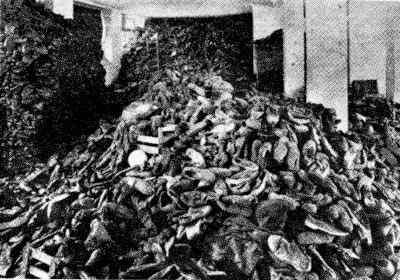
Your attention is drawn to a mountain of prayer shawls and ataras [decoration on the prayer shawl, around the neck], the one memory of our God-fearing grandfathers and fathers, who were in these unmanageable conditions, in the eye of death - just as the Anusim [those Jews forced to convert in 1390s-1490s] in Spain and Portugal, they went to their death as they sanctified the Name of God, and did not forego the faith of their forefathers. Then you are pushed against a sea of shoes. Shoes and shoes. In a nearby room - about two tons of women's hair, which the German specialists would sort, clean, and then make bed mattresses from them. Then you stop and you tremble, unsettled to the depths of your soul; an ocean of children's shoes, blouses, pants, dresses, toys, and orphaned dolls.
“Al da'atefet, atfuch”
In the Jewish museum. A black aron [ark containing the Torah] with a menorah. At the top, in large writing: “Yizkor!” On the side, a list of perished Jewish writers, artists, editors, thinkers, and intellectuals. Farther in, a mountain of ashes and gathered up bones – remaining traces of our perished brothers and sisters. We think about these various exhibits, pictures of agony and pain. The soles of shoes catch your eyes, put together from the Torah parchments. And if you go farther ahead, you stop at a picture, and you actually shudder. The picture shows how a Jewish mother is protecting her little, depleted, terrified child. The face of this tragic woman expresses so much agony and pain, that you are actually moved to the depths of your soul. You feel as if the tears are choking you and it is so difficult to control yourself … A Jewish mother! Your devotion and sacrifice for your children is renowned in the entire world!
And then we crowd around a small prayer book – an old prayer book with half-burnt pages, and if I strain myself, and try to read – these words from the Ethics of Our Fathers scream out to me: “Af hu ra'ah gulgolet achat shetzafah al penei hammayim. Amar lah: Al da'atefet, atfuch. Vesof metayefayich yetufun.” [“He also saw a skull floating upon the water. Said he to it: Because you drowned others, you were drowned; and those who drowned you, will themselves be drowned. Pirkei Avot, Chap 2: 6].
“Will themselves be drowned!” These words resonate here in Auschwitz as a symbol of a stern warning.“Will themselves be drowned!” Sooner or later, you murderers and hangmen of our people, will be touched by the hands of justice and you will receive your deserved punishment for the innocent, spilled blood of our brothers and sisters – and we are certain of this – that not one of you will avoid the judgement of history.
The Katzetnikes [“concentration camp inmates”] and Their Hangmen
We are thinking about the paintings and pictures which the katzetnikes themselves created. It is really interesting that during these horrific Hitler years, even with the intolerable conditions, many of those tortured in Auschwitz painted pictures in which they mocked and spited their tormentors and expressed their sharpest protest – the pain and rage against their murderers and hangmen. Here you find caricatures of all the bigger leaders and smaller leaders. These were the very men who decided between life and death of millions of people, especially those who were exceptional in their cruelty and savagery toward their innocent victims. And these pictures laugh at the cook with the bulging stomach, the cruel Kapo, the “staff,” and of all those who in some manner helped embitter the intolerable life of the numbered residents in Auschwitz.
[Page 427]
Cots and Water Closets [toilets]
We are approaching the Block where there are cots that were used for sleeping. Frau Zukerman-Laskowska, a former officer of the Central Committee of the Jews in Poland, who spent two black years in Auschwitz, and carried the number 48462… shows us with her hand: Here was my cot. And they tell us about worms, mice, flies, bed bugs, and lice; about incessant bites, dysentery, and other sicknesses. We think about the tightness, the terrible filth, and do not stop wondering: Master of the Universe! How did these locked up people survive even one day in such terrible, unbearable conditions? Impossible, actually impossible to understand this with an ordinary mind…
Not far from here are the water closets. And don't think that whoever needed to go was able to just go here and stay there as long as they needed. The Germans, as is known, love “order and discipline.” To satisfy a person's natural needs, there were set times for the katznikes [concentration camp inmates]. And if he hardly used a little more time than the regulations allowed – then he was strongly punished. A Kapo always stood there with a spiked club in hand, and continually harassed the people. “Faster! Faster! And woe to the katzetnik who delayed in this “issue” by even one minute…
“Science Unit”
Block #10. Here is the “Science Unit.” Here, Nazi professors and “educated ones” would sit for full days and nights, crease their foreheads, and conduct all kinds of “scientific” experiments on young women, the majority of whom were Jewish girls from Greece. Here, in this Block, they dealt with gynecology, sterilization, and artificial impregnation. Here, they did terrible injections, and rarely did a women come out alive from this “science” laboratory. And if a woman managed to stay alive, she remained disabled until her death ….
The Place of Death
Block #11. In this place, the Nazi judges would gather, and pass judgement on the guilty ones and the criminals – and rarely did anyone come out alive from this “court.”
We view the details of the “steibunker” [“standing bunker”]. For the smallest “sin,” the katzetnikes would be thrown in, then locked up for a long time.
It was a narrow and dark room, without air. The “sinners” had to stand on their feet the entire time, and because of that, they would suffocate one another in order to free up some space. But the situation in the so-called “water closet” was much worse, where the “sinners” would, without air and in intolerable crowding, have to stand in water above knee level… And not far from here is the “place of death” at the black “wall of death,” where they were cruelly killed. This place – which was discussed by eye- witnesses – was always soaked in human blood.
Yes, if only this black “wall of death” would be able to speak – about so many human tragedies that took place here, it would have a lot to tell us! …
The Camp Model
We view the camp model, which was created by the well-known sculptor from Cracow, Mieczislow Staviarski. This is a beautiful work of art, made from plaster.
This model shows the entire process, all seven levels of hell, that the Auschwitz victim experienced as soon as he dismounted in the train station, until he was slid out dead from the gas chamber and into the crematoria. All the plaster figures speak in a bold language. You see here the long road of torture, the
[Page 428]
total pain and agony of these tragic people – and this is etched strongly in your minds forever.
The Small Crematoria
First, the Germans set up the small crematoria – an oven with ventilation and with the necessary equipment according to the latest criteria of German technology. On one side – they show us – they pushed in the gassed bodies, and from the other side, from the back, they would shovel out the ashes…
And you stand and think about all this – and you do not want to believe that all this could really have happened in reality in the 20th century, the century of culture, progress, and civilization.
But these small crematoria did not completely satisfy the appetites of the Nazi cannibals, because at that time, they were not equipped to manage all the toxins, sometimes a lot, that were emitted from the gas chambers. So, with time, they built four new, large crematoria in nearby Birkenau.
At the Hanging of Rudolf Hess
We find ourselves at the place where, in the year 1947, they hanged the commandant of the Auschwitz camp, the bloody hangman Rudolf Hess, who, in his time, was sentenced to death by the Warsaw court.
Rudolf Hess – as far as we know – lived in Auschwitz as if in the Garden of Eden, as a married man. He owned a beautiful villa with a lovely garden, had his own orchestra, had all the ease and comforts. Here, in Auschwitz, he even had a child.
Hess used to sit calmly in his beautiful cabin, and like a cold thief, he would sign the death sentences. In his hands lay the fate of millions of people – life or death – and now we are standing at the gravesite in Auschwitz where this horrific satrap [henchman] received his well-deserved punishment.
Birkenau-Brzezhinski
We are now in Birkenau. For the Germans, Auschwitz was called the “model camp,” because over there were the large labor factories. The actual death camp, where millions of people died, was Birkenau.
Birkenau had up to 500 barracks. The four crematoria and gas chambers were set up according to the latest information of German technology. This was the pride of the German “science of annihilation.” For 24 hours, in various times, they continued to gas and burn, and the smoke and fumes were felt in the distant surrounding areas. And since all four crematoria were not able to burn all the gassed corpses, they had to burn the rest of the bodies in a primitive manner under the open sky…
Step by step, we move about here on traces of human bodies, even though the Nazi barbarians tried, with all possibilities, to erase any traces of their horrifying crimes
Yizkor! [“Remember”]
Now we are standing by the monument which the Central Committee of the Jews in Poland put up. We read a large inscription in Yiddish, Polish, and Hebrew:
“YizkorAnd looking at this monument, I think: Who knows how many of my family members, and my dear and close ones from the tragically destroyed Jewish Ostrowiec – are found among the deathly punished Jews in Auschwitz!
In memory of the millions of Jews, martyrs, and fighters, who were annihilated in Auschwitz by the hands of the Hitler murderers in Birkenau-Brzezhinski.”
We bow our heads in front of the monument, in deepest awe and respect, in memory of our brothers and sisters who perished in the Nazi death camp of Auschwitz.
[Page 429]
The Final Road
We come to a large area. Here and there – bones and ashes. We see traces of destroyed buildings. Here were the gas chambers and crematoria. The Nazi murderers tried to destroy all of these [buildings] before leaving Auschwitz, so that, Heaven forbid, there should be no memory of their horrific acts.
On this road, they led the miserable katzetnikes to bathe, basically to wash and disinfect themselves. And from there – straight to the gas chambers. This was the most tortuous road, filled with pain, agony, and anguish – the final road.
The Violated Twentieth Century
In Auschwitz-Brzezhinski, 3,000,000 people, from various nationalities, among whom were 2,000,000 Jews, were cruelly murdered in a means unequaled anywhere in the history of humanity.
In Auschwitz, in an ugly manner, the twentieth century was desecrated.
We Leave Auschwitz
It is a beautiful summer morning when we leave Auschwitz. We throw our final glances onto this death camp, onto the pride of the German annihilation science. From a distance, from the iron gate, the hypocritically seductive phrase, calls out: “Arbeit Macht Frei!” [“Work Makes You Free”]. It is very heavy on everyone's heart because of everything that you have heard, seen, and experienced during your lengthy visit.
We throw our final glances onto Auschwitz, and a curse tears itself out of our lips – mournful curses onto the heads of all the Nazi murderers and hangmen, who mercilessly murdered and tore apart all our close and dear ones. All those who brutally defiled the word “human” and cruelly annihilated more than one third of our nation.
|
|
| Storehouses filled with shoes of the Jewish children murdered in Auschwitz |
|
|
JewishGen, Inc. makes no representations regarding the accuracy of
the translation. The reader may wish to refer to the original material
for verification.
JewishGen is not responsible for inaccuracies or omissions in the original work and cannot rewrite or edit the text to correct inaccuracies and/or omissions.
Our mission is to produce a translation of the original work and we cannot verify the accuracy of statements or alter facts cited.
 Ostrowiec Świętokrzyski, Poland
 Yizkor Book Project
 JewishGen Home Page
Copyright © 1999-2026 by JewishGen, Inc.
Updated 23 Jan 2026 by JH