 |
|
|
by A.R.
Translated by Yechezkel Anis
Donated by the Rappaport family
When the Second World War broke out, Rabbi Yechezkel happened to have been in Warsaw, the capital. There he underwent terrible days of heavy bombing, of hunger and of want. In the summer of 1940, his followers were finally able to transport him to Ostrovtze in a vehicle marked “First Aid.” The Rebbe was afraid to live in his own house, so he went to live with his first-born, the young Rabbi Yekele.
In spite of the great risk taken by devout Jews by appearing publicly with their beards and ear locks, many Chassidim would gather in the Rebbe's apartment and on the Sabbath he would set a table for them and share words of Torah. Still, one could see how anguished he was at not being able to serve Hashem freely and in a loud voice, as he was accustomed to in the past, out of fear that he'd be heard outside.
The Rebbe refused to maintain any contact whatsoever with the Judenrat [local Jewish council appointed by the Germans]. Virtually all the members of the Judenrat in Ostrovtze were common, untutored Jews, but in spite of this they honored the Rebbe and provided him with a salary, just as before. The salary nevertheless was insufficient insofar as his needs increased. This was because his sons and their families had fled from their hometowns due to the Nazi oppressor and joined their father in Ostrovtze. The Rebbe's close followers tried to help him as best they could, but it was still insufficient. Our master, who was used to providing generously, began to live a life of frugality and hardship.
The horrible tidings that reached him from every direction oppressed his spirit.
[Page 111]
He began fasting and spending more time in prayer. One could see how suddenly he had aged. Hardly ever leaving his home, he spent his days and nights in study and prayer and in weeping over the calamity of his people.
As the year 5702 [1942] approached, the situation for the Jews got worse from day to day. His close confidants refrained from telling him the bitterest truths so as not to add to his suffering. A few months before the “resettlement” of Ostrovtze's Jews, some of them tried to obtain work certificates so as to avoid the expulsion, which they knew meant extermination.
I had a place working at the Hermann Goering factory. On the seventh day of Chol HaMoed Succos 5703 [should be the third day, 1942], before leaving for work, I went to see the Rebbe, as I lived in his neighborhood. When he saw me in my weekday garb, he sighed heavily and said, “What, are you going to work? How could that be? Today is the ushpizin [heavenly “visit” to the Succah] of your namesake, Aharon! It is also the yahrtzeit of your ancestor, the Holy Jew [R. Yaakov Yitzchak Rabinowitz 1766-1813]. It's better that you should stay here with me.” Even though I feared losing my job, I listened to the Rebbe and stayed with him that day in his house.
The terrible days of the expulsion were approaching. The Rebbe and his family members, lacking work certificates, hid in the cellar. Two days after the expulsion, on the first day of the month of Mar-Cheshvan 5703 [1942], the Jewish police removed the Rebbe and his family to Judenrat platz, where, supposedly, work certificates were to be distributed to the so-called illegal Jews. That is how the wicked Nazis managed to trick many Jews into leaving their hiding places so that they could subsequently expel them.
Through a fortunate circumstance, the Jewish police were able to rescue the Rebbe and his two sons, Reb Elimelech of Nasielsk and Reb Avraham Yitzchak of Mondziow, and to hide them from the Germans' sight until the crisis passed. The Rebbe's first-born, Reb Yekele, already had a work place in Bodzechow, nearby to Ostrovtze. His remaining two sons also found themselves work places there and that's how they were all saved at the time from the expulsion.
My work place was outside the ghetto, but I still managed to enter it by paying a large sum of money to the Jewish thugs who governed it. The first visit I paid was to the Rebbe's house. I was shocked to see our master, Reb Yechezkel, shorn of his beard and ear locks and wrapped in a simple cloak over his rabbinic satin frock. A Polish cap sat upon his head, covering his yarmulke. His first words were “Aharon! Can you see what I look like?”
Since I had not donned tefillin in many days, the Rebbe handed me his tallis and tefillin. I stood up to pray a short prayer. The Ukrainian police waited for me outside so as to return me to the factory. As I stood there praying the Shmoneh Esreh, I heard the Rebbe moaning behind me, “Woe is me! In spite of all of this, they continue to pray.” I quickly concluded my prayer and began to take leave of the Rebbe. He asked me why I didn't don the tefillin of Rabbeinu Tam [an additional set of tefillin donned by the particularly devout]. I told him that it was too burdensome to don two sets of tefillin at my work place. He dejectedly answered me, “How is Rabbeinu Tam to blame, nebich [a pity]?”
Some time later, I managed once again to enter the ghetto. Only a small number of Jews were left, including a number of “illegals,” that is, those without work certificates. The Jewish police provided the Rebbe with a work certificate, but he just hid in the attic and continued to study and pray. I sought him out and found him. He had with him his tallis and tefillin and a small Shas [Talmud] published by Chorev. He launched into a Torah discussion surrounding the topic of yiush shelo m'daas [despair without knowledge]. I asked the age-old question: “Is this the reward for adhering to the Torah?” The Rebbe answered me as follows, “Any man could comprehend the mind of another, but no mortal could comprehend the ways of G-d.” I was full of bitterness and refrained from asking anything else.
I couldn't bear seeing the Rebbe in his state of suffering and solitude, as he dwelled alone in that forsaken and smoky attic. I went to the Jewish police to ask that they arrange for him a small apartment, but due to the religious laxness that had taken hold in the ghetto, many were afraid to admit the Rebbe into their quarters lest he be critical of their violating the Sabbath and other laws. When I informed the Rebbe of this concern, he told me that he would promise not to bother anyone. All he desired was a small corner with a bed of any kind on which he could lay and look into his small Shas…that was all. However, being as I knew that the Rebbe's spirit would be broken if he had to witness religious laxity around him, I exerted great effort and arranged for him a small room of his own. Indeed, he was happy to have found this solution and from time to time I would prepare some food for him.
While in the Rebbe's company, I discovered that he wanted to believe that the Jews who had been expelled were still living and had not gone up in the smoke of the crematoria. He couldn't reconcile himself to the idea of such a great tragedy befalling his brethren. I am reminded of one particular detail during that time: The grandson of the Gerer Rebbe (son of his son-in-law, R. Yitzchak Meir Alter) was in the ghetto and came in to see Reb Yechezkel. The Rebbe ordered me to feed him and said, “Perhaps if I have mercy on the Gerer Rebbe's grandson, others will have mercy on my grandsons wherever they are.”
Here's another detail as proof of this [belief in family having survived]. On the eve of Chanukah 5707 [should be 5703= 1942], the Rebbe made an effort to resume his spiritual duties, asking me to present him with a pitka [a supplicatory “note” with one's name, requesting the Rebbe's blessing]. I handed him a note upon which my name alone was written, since I already knew at the time that I had lost all of my family. That is why I entreated him on my behalf alone. The Rebbe asked me, “Why didn't you write down the names of all your family? Add each and every one of them along with the words 'who is in captivity.'” Indeed, the thoughts of the wise cannot be understood at a time of ruin!
During Chanukah of 5707 [should be 5703=1942], many fled to Sandomierz. The Rebbe implored me to accompany him there, where we would learn Torah and forget some of our misfortunes. I escorted the Rebbe and his surviving sons
[Page 112]
as they left the Ostrovtze ghetto. It was my intention to join them afterward, but then, two days later, I heard that the murderers there had hatched a new extermination plot and so I did not go there.
On Wednesday, the 8th of Teves 5707 [should be 5703=1943], the holy Tzaddik, Reb Yechezkel ob”m, the first heir to the Ostrovtzer dynasty, was gathered [to his people]. Two days later I received a message from his two sons concerning the great loss, which they signed, “We are left to moan.”
Approximately one month later, the entire [Jewish] community of Sandomierz was liquidated [on the 7th of Shevat]. The local Jews were sent to Treblinka, among them our master's three sons: Reb Yekele, the young rabbi of Ostrovtze; Reb Elimelech of Nasielsk; and Reb Avraham Yitzchak of Mondziow. May G-d avenge their blood!
It is incumbent upon us, the surviving people of Ostrovtze, to commemorate the following:
Our Rabbi, the holy gaon, Reb Yechezkel, AB”D and Admor of Ostrovtze.
His first-born son, the young Reb Yekele of Ostrovtze
His son, Reb Elimelech of Nasielsk
His son, Reb Avraham Yitzchak, rabbi of Mondziow
His son, Reb Chaim
His son, Reb Naftali
His son, the youth Elazar
His son, the youth Menachem Mendel
Their daughter, Devorah
And their mother, the Rebbetzin Baila MirelMay G-d avenge their blood!
Translated by Sara Mages
One eyewitness, R' Yeshaya Zoiberman of Sandomierz, gave these details about the last hours of the rabbi, R' Yechezkel'e of Ostrowiec. After the great massacre in 1942 about fifteen hundred Jews, who worked at the factory in Bodzanów 6 km from Ostrowiec, remained in the city. Among the survivors was the rabbi, Rabbi Yechezkel'e. One day, the Gestapo began searching the workplace claiming that the Rabbi of Ostrowiec was hiding there. It was mediately decided to transfer the rabbi to Sandomierz, where the second ghetto was located.
In those days, there was no trace left of the first ghetto. The German authorities issued an “iron letter” to all the Jews hiding in the fields and forests, in cellars and attics, promising them that if they returned of their own free will to Tsoyzmer [Sandomierz], no harm would befall them. They will find work, bread and an apartment there. The evil authorities also spread a rumor that all those who will come to Tsoyzmer would be allowed to live in serenity until the end of the war. Thousands of Jews began to flock there. Did these Jews really believe the murderers' promise? Definitely not. But they had no choice, because they were persecuted and could not withstand the suffering of hunger and cold. The winter was very hard, and they had no strength left to hold out in their hiding places. In those days the Nazi murderer, Lesher, ruled Tsoyzmer Ghetto. Twice a day, all the inhabitance of the ghetto appeared before him, and he ordered everyone to be counted so that no one was missing.
Under these conditions, Rabbi Yechezkel was brought to Tsoyzmer. His head was wrapped in a bandage. They managed to get him into the ghetto and put him in a closed house, the entrance to which was blocked by a brick wall. Through a hole in the floor they brought him food and took care of his needs. This was in the second half of Kislev 5703 (1942).
Two weeks later, the head of the Gestapo, Braun, arrived in Tsoyzmer and took control of the ghetto. He entered the community building and demanded to bring him the Rabbi of Ostrowiec within an hour. When he was told that the rabbi was not in the Tsoyzmer Ghetto, he announced that if the rabbi is not found within the hour, he would burn alive two hundred of the city's inhabitants, men, women, and children, in the city's synagogue.
The community leaders immediately contacted the rabbi who ordered them to take him without delay to the head of the Gestapo. The rabbi did not answer a single word to the murderer's question. The latter photographed the rabbi several times, and then said that the community members would receive the rabbi “under their protection and care” until the next day at nine in the morning.
Once, Rabbi Yechezkel of Ostrowiec arrived in Otwock for rest in the summer days, and lived in the same hostel with Rabbi Chaim Pozner, of the Warsaw rabbis. Rabbi Yechezkel shouted loudly in his prayer. Rabbi Chaim couldn't bear it, he approached him and said: - I too pray with devotion and I do not shout, My master, why are you shouting?
- My master prays for himself. That is why he does not raise his voice. From my mouth erupt the cries of hundreds of Hasidim. That is why I raise my voice - Rabbi Yehezkel replied to him. |
[Page 113]
Then he, Braun, will come to take him. If the rabbi escapes in the meantime, Braun will carry out his threat and burn two hundred Jews.
The Rabbi Prepares for Kiddush Hashem
The rabbi felt that his time had come, he immersed himself in the mikveh after breaking through the ice and began to pray for his soul and the souls of his persecuted people. In the community building, where the rabbi was located, a number of Jews began to gather and recited Tehillim. The Jews of Tsoyzmer did not sleep all that night. Everyone prayed and asked for mercy.
At dawn (on 10 Tevet 5703), the rabbi wore a white kittel [robe] and prayed, recited Selichot and also Al Het [“for the sin”], and all the ghetto's inhabitants wept bitterly with him.
At nine in the morning, the Nazi murderer, the head of the Gestapo Braun, appeared with his entourage.
Then, twenty of the ghetto's Jews turned to the murderer with a request: They are willing to give their lives for the rabbi. Braun burst into devilish laughter: “Very good! Your request would be granted! You will die by shooting along with the rabbi!”…
He ordered the Nazi gendarmes to arrest the twenty Jews. Then he ordered to place the rabbi in the Synagogue Square facing the wall. When he aimed his pistol at Rabbi Yechezkel, the rabbi called loudly and forcefully: Sh'ma Yisrael, Adonai Eloheinu, Adonai Echad [“Hear, O Israel, the Lord our God, the Lord is One”].
The Nazi murderer fired six bullets at that martyr, whose body was loaded on a farmer's cart and transported to the cemetery. An hour later, the twenty Jews, who were arrested, were forced to dig a large mass grave for themselves. Immediately afterwards they were all shot by the Nazi murderers.
All that happened on 10 Tevet 5703 (13 December 1942). “O earth, do not cover their blood.”
This is how an eyewitness recounts the last hours of the holy Jew's life. The last Rabbi of Ostrowiec.
Written by Moshe Friedensohn
Published in Eleh Ezkera, History of Leading Rabbis who Perished in the Holocaust,
5700-5705 Edited by Yitzhak Levin. Volume 4, New York 5721
by S. Almoni [Anonymous]
Translated by Sara Mages
After a lecture on the Hasidut in San Francisco, I sat in the restaurant of “David Hotel” and talked with the hotel owner, a young Jew in his thirties. His face was gentle and his eyes sad. From this Jew, David Appleboim, I heard details about the martyrdom of the Rabbi of Ostroweic, R' Yechezkel Halstock hy”d, who was murdered together with his seven children in Tsoyzmer [Sandomierz] Galicia, on the month of Shevat 5703 (1942).
How did the rabbi live in the days before his death? This was not clarified to us. We only know that R' Chaim Yitzchok Wolgelernter, the faithful student R' Yechezkel'e, composed a special lament about his rabbi while he was hiding in a bunker, in the cowshed's attic belonging to a farmer. In this attic Chaim sat shivah for his father, mother and sisters who were murdered by the Germans. Suddenly the sad news reached him that his rabbi, Rabbi Yechezkel'e, died on the sanctification of God's name with his entire family. Upon hearing the news, R' Chaim composed a lament for his rabbi which was kept by R' Chaim's brother:
By his student Chaim Yitzchok Wolgelernter z”l
Translation of the Kina [Lament]courtesy of the Wolgelernter family
| Immersed in mourning over the loss of my father, mother, and sister. Who were plucked during the harvest of blood. Enshrouded alone in a twofold bereavement, my heart torn to pieces. I sit hidden in the loft of a cowshed, my soul weeping, When suddenly, I am startled by the news Of the appalling murder of my rebbe and his seven sons. And so I dedicate these lines to his sainted memory. |
[Page 114]
| With the book of Zohar before him, the rebbe sits, submerged in thought, Wearing bis tefillin, wrapped in his tallis, Mortifying bis body, fasting three days in succession, Searching in Kabbalah for a resolution to the questions that torment him Regarding the Torah commandment: Do not slaughter an animal and its offspring on the same day.
Thoughts and reflections wrestle within the mind of this tzaddik,
His father taught him Gemara, Halachah, and the secrets of Kabbalah,
After his father married him off to the daughter of the Melitzer Rebbe,
The pure Ostrovtze ideology that suffused the rebbe
When his father, Rav Meir Yechiel, returned his soul to his Maker
When standing in prayer and supplication, |
[Page 115]
| Our rebbe transmitted to us his father's method of pilpul: To penetrate the core with a crystal-clear view. With sharp-witted analysis, he clarified the intricacies of the subject matter, Settling innumerable questions of Halaebab And developing novel insights in Torah. Indeed, as his students testified, There was nary a question presented to the rebbe, Which he could not resolve at once.
Sacrifice, humility, self-effacement,
In his final days, the persecutions, deportations, killings, and atrocities, In memory of my holy teacher and rabbi, Rabbi Yechezkel Halevi, son of the Holy Admor, Rabbi Yechiel Meir Halstock of Ostrowiec, may the memory of the righteous and holy be a blessing for the life of the world to come, may HaShem avenge his blood. |
R' Chaim did not perish during the hellish years of the Germans rule in Poland. However, when Poland was liberated from the Nazi beasts by the Red Army, and R' Chaim came out of his hiding place in the cowshed's attic, the Poles attacked him and murdered him…
R' Chaim, the faithful student of the rabbi, R' Yehezkel'e, was a great genius and his rabbi gave him the manuscripts, the Torah innovations and the interpretations that were written by R' Yehezkel'e's father, our teacher, HaGaon HaKadosh, Rabbi Meir Yechiel. His brother went up to the cowshed's attic to search for the manuscripts and found the lament inside a pile of various papers.
David Appleboim told that the teacher, R' Yakov, the rabbi's eldest son, worked with him in Bodzechów, about 5km from Ostrowiec. The two paved an electric railway.
David Appleboim, escaped from the Nazis labor camps, became a partisan and blew up German trains. He also purchased weapons from the Poles for the partisans who operated in the forest stretching between Ostrowiec and Sandomierz. He frequently visited Sandomierz, disguised as a Pole, and on these occasions, he entered Sandomierz Ghetto, where the rabbi hid in a bunker.
Once, the rabbi asked David to bring him water. David risked his life and fulfilled the rabbi's request. When R' Yehezkel'e thanked him, he blessed him and wished him to be among Sh'erit ha-Pletah [the surviving remnant]…
David told me that when the rabbi said Sh'erit ha-Pletah to him, it was the first time he had heard this expression, which became very common in the years after the war. David is certain that he remained alive thanks to the rabbi's blessing…
[Page 116]
by Aron Tsaytlin
Translated by Tina Lunson
The tenth of Tevet is the yortsayt for a Rebi who on that day was killed in kodesh ha'shem in Hitler's Poland.
It is the Rebi Rov Yekhezkel may God avenge his blood, the son and heir of the old Ostrovtser Rebi.
The yortsayt of the Rebi falls on the tenth of Tevet and also of another twenty of his khasidim, who were murdered on the same day.
I know this from a document, from a letter, that I have in my possession and which I publish here. The letter was sent to me some time ago by a Jew from Tsoyzmir (Sandomiezsh) who saved himself and has lived the last years in Canada – Mr. Yeshaye Zoberman.
Here is his shocking letter, which depicts the martyrdom of the Rebi and of a Jewish witness:
“After the slaughter in Ostrovtse there were only about fifteen hundred Jews left, who worked in a factory six kilometers from town, in Bodzshekhov. The Ostrovtser Rebi, Rov Yekhezkel, was hidden among those remaining. The Gestapo suddenly raided the whole work site, searched for the Rebi but did not find him. It was decided to take the Rebi to Tsoyzmir. At that time there was a second ghetto in Tsoyzmir – the first had already been eradicated. The German authorities published a so-called ironclad decree to all the Jews hiding in forests and fields, in attics and cellars, that if they returned voluntarily to Tsoyzmir nothing would happen to them and they would get work, bread and an apartment. The Germans spread the rumor that those who returned would survive the war. Thousands of Jews who had been in hiding were drawn to Tsoyzmir from all directions. Had they believed the Nazi persecutors? No. But there was no alternative. They were weary to death, terribly tortured by hunger. The winter had been a frightfully cold one – there was no more strength for suffering.But the Tsoyzmir ghetto was then ruled by the Nazi murderer Lesher. He made the ghetto assemble twice a day for him to “give attention” and he recounted to see whether all the ghetto-folk were there. When someone was sick, pregnant and so on, they went to their home and shot them on the spot. A hope nonetheless glimmered in Jewish hearts that they might somehow outlive the murderers.
It was under such circumstances that they brought the Rebi to Tsoyzmir. His entire head was bandaged up so that his beard was not visible. The Rebi was smuggled into the ghetto for a hefty fee, set up in a closed house where the entrance was walled up, and they served him and brought in food through a hole in the floor.
This was in the second half of Kislev.
Two weeks later the Gestapo chief Braun came to the ghetto. Tsoyzmir ghetto was under his command. He went into the Jewish community office and demanded that they present the Ostrovtser Rebi within one hour. When they told him that the Rebi was not in the ghetto he let it be known that if they did not present the Rebi to him within the hour, he would order that two hundred Jews with their wives and children be burned alive in the shul.
The leaders communicated with the Rebi. The Rebi told them to take him to the Gestapo chief. The Rebi did not answer the murderer's questions. The Gestapo chief photographed him several times in various positions. After that he ordered that the community leaders take the Rebi under their responsibility until tomorrow at nine in the morning when he, Braun, would come for him. Should it happen that the Rebi fled he would carry out his “coercion”: he would burn two hundred Jews.
In the community office where the Rebi was sitting, they began gathering Jews and reciting psalms. The Rebi immersed himself in the mikve that was in the ghetto. He chopped through the ice and immersed himself.
No Jew in the Tsoyzmir ghetto slept the entire night. All were reciting psalms.
Since it was almost day (it was the tenth of Tevet) the Rebi dressed in a white kitel, prayed, recited slikhes and al kheyt – the whole ghetto wept together.
At exactly nine o'clock the Gestapo murderer showed up, accompanied by Nazi gendarmes. Twenty Jews appealed to the persecutor with a request: they would volunteer to give their lives for the Rebi's. Braun laughed; very well, he would carry out their request. He would shoot all of them, but along with the Rebi. And he ordered the gendarmes to arrest the twenty Jews. Then they told them to position the Rebi in the shul courtyard against the wall. When he pointed his revolver at the Rebi the Rebi called out loud and fast, “Shema Yisroel, d'alkeynu, d'akhod”. Six bullets the Nazi bandit shot into the holy man. A peasant wagon had already been prepared. They laid the martyr in the wagon and ordered it be driven to the cemetery. The twenty arrested Jews had to dig a large common grave for themselves in barely an hour. They were shot soon after. This happened on the tenth of Tevet sav-shin-giml (13 December 1942).”
|
|
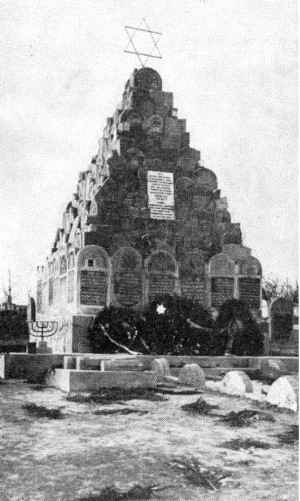
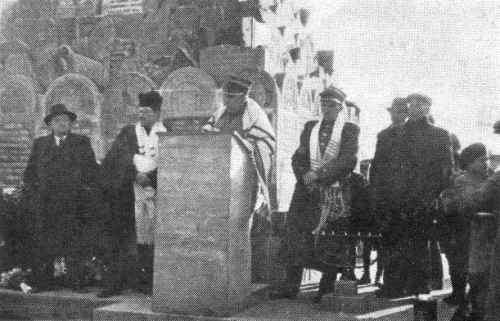
| The dedication of the memorial at the grave of Rov Yekhezkel may God avenge his blood |
[Page 118]
Translated by Sara Mages
January 1943, the days of the Judenstaat [The Jew's State] in Sandomierz. Jews gathered in a small area in the Jewish quarter. Human shadows, the survivors of the liquidated communities in the Kielce district, haunted by hunger and cold. They emerged from their hiding places in the towns, from their temporary shelter in the homes of their “Aryan” neighbors, who managed to extort the last of their property from them and then drove them out of their sight.
They crammed together in Sandomierz Ghetto, about six thousand people crowded in twenty small houses. The harvest of death did not stop for a single day. Every day, dozens of young and old were taken to the graves.
And here came the rumor: The Rabbi of Ostrowiec arrived and saw a miracle: sad eyes seemed to light up, the facial muscles that seemed fossilized showed signs of life. Immediately, great excitement and a spiritual awakening occurred that found their outlet in tears… Previously, it seemed that the source of tears had already dried up, and the shadows that walked slowly down the narrow street seemed emotionless, with no possibility of any response or expression to their suffering and sorrow. And now, a spirit of awakening passed through the shadows, their hearts opened to prayer, to supplication, to tears…
The rabbi sat in a cart drawn by a pitiful mare. His image radiated a precious light not of this world. He was pale, without a drop of blood on his face and only his eyes were burning… To his ruined community, which is rotting in suffering and poverty, he came… to say goodbye to it for the last time…
Thousands of hands reach out to receive a greeting from the rabbi. The hands tremble and reach upward in prayer, in protest…
The women and children are crying, their voices rising against the determined sky… and the rabbi - his facial expression is full of embarrassment and helplessness. They ask him for help and an answer to this suffering that has the power to darken the face of the world… And he -his foundations have collapsed and he stands astonished in the heart of the destruction… and he is silent. He always spoke pleasantly, every word that came out of his mouth and was absorbed by his listeners, ignited flames, instilled faith in the hearts of thousands, and now - the spring has been blocked, what comfort will he bring to these unfortunates?
And behold, the messenger of Satan appeared, the ghetto's guard, the man of the S. S. – the master of life and death in the ghetto. He is standing amazed. He has never seen the Jews in such a state of awakening. He was used to seeing them silent, utterly humiliated, lacking the will and the possibility of any reaction. And here, they are running around, singing enthusiastically with the remainder of their strength, Hasidic melodies, the Modzitz tunes… Indeed, there is still spirit in these Jews, he thought and quickly left the place.
The next day, in the morning, when the rabbi stood in prayer, wrapped in a tallit and tefillin, pouring his heart before the leader of the world – three S. S. men broke into the synagogue and ordered him to follow them. The rabbi did not utter a word, not even a slight sigh, he stood still and did not move from his place. He seemed to be in awe of what was around him. He removed the "crown" of the tallit from his head and remained standing stubbornly in front of the murderers' pointed pistols. He refused to take off the tallit and tefillin on him…
Shots were fired and the rabbi knelt down, fell wallowing in his blood, wearing a tallit and tefillin by the synagogue's eastern wall…
|
|
| A monument on the grave of Rabbi Yechezkel'e hy”d |
|
|
JewishGen, Inc. makes no representations regarding the accuracy of
the translation. The reader may wish to refer to the original material
for verification.
JewishGen is not responsible for inaccuracies or omissions in the original work and cannot rewrite or edit the text to correct inaccuracies and/or omissions.
Our mission is to produce a translation of the original work and we cannot verify the accuracy of statements or alter facts cited.
 Ostrowiec Świętokrzyski, Poland
 Yizkor Book Project
 JewishGen Home Page
Copyright © 1999-2026 by JewishGen, Inc.
Updated 23 Jan 2026 by JH