 |
|
|
[Page 271]
by Guta Firer, Tel Aviv
Translated by Gloria Berkenstat Freund
Across the sea of remembrance of my childhood emerges the gymnazie [secular secondary school] in various eras of its existence.
I still see myself at age nine and 10 in the first class at the gymnazie. A small girl walking every day from the beginning of Jorwica [Street] to the Jewish gymnazie – near the Russian cathedral. The road was not boring because it had various phases in its long distance… Here I left home, which was located in the area of the barracks, enveloped in beautiful, thick boulevards and in my childish fantasy they were prisons inhabited by medieval knights. The first passage led to a series of Jewish shops where, in front of one of them, on a high prizbe [earthen ledge on the wall of a house], Chaya-Fayge, the old woman, was sitting and waiting for me to answer her hearty “Good morning.” Her wide, agreeable smile warmed me and the gray autumn morning and I took courage for the further walk. Yes, I needed courage because at the alley near Zeman's Brewery young gentile boys with stones lay in wait for me.
It is interesting that this danger remained my secret. I told it to no one because I was ashamed of my fear. With feelings of fear and heroism, I luckily avoided the flying stones and entered the “zone” thickly inhabited by Jewish houses. This was the doline [valley].
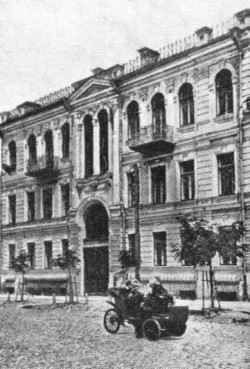
This small street was full of attractions for me: the residents – all spoke to me in a special language and [with] diverse content. I went past the synagogue and near Kraunsztajn's bare (taken from “ambar” – granary – a wheat granary), I began to enter the “city.” I passed the imposing three-story Russian gymnazie building, the beautiful city garden, the cathedral and finally I arrived at the gymnazie before eight o'clock.
Day in and day out, the path remained the same for eight years, but so varied with regard to the content of life at the gymnazie.
Understand, the teachers who created the atmosphere and the content had the dominant role in gymnazie life.
The happiest school year was the first. The first class was led by the dear, devoted, unforgettable teacher, Solomon Dovidowicz Fajnblut. A man with a large, Jewish heart and wide-ranging pedagogical erudition. He was our class educator and taught Latin and arithmetic.
We, his students, were Jewish children from bourgeois homes, with small ideas. He knew that we possessed fantasies and a great drive for knowledge, but he, as a pedagogue, was careful – he wanted his teaching not to be too abstract for us and, therefore, he found a way to us through beautiful stories of the historical mythology, the Roman history through pictures, episodes, examples taken from folksy Jewish life. However, every story was accompanied by a moral because he did not only want to teach us, but also educate us.
He won our hearts and with great joy we ran to school to our dear teacher. And what did he not do to make us happy? He gathered the class in the afternoon hours at the “meadow” near the
|
|
| Building of the Russian Gymnazie |
[Page 272]
|
|
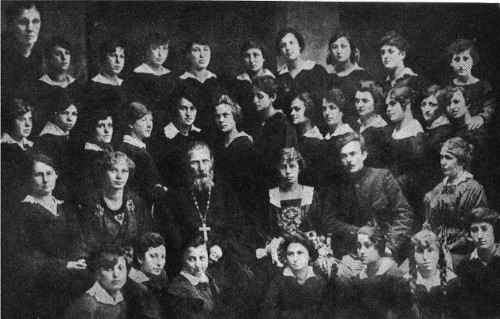
| A group of female students from the Russian Women's Gymnazie |
Styr River, played games with us; a friend played a fiddle; we told stories, anecdotes and riddles. He also gave individual help to each of us. He found a way to the most hidden corners of our souls and reassured [us]; with great respect, with great refinement and love, he began to heal those who already possessed symptoms of departures from normal childhood development. Through frequent class gatherings, a communal life was created and the viewpoint of each child was accepted in the society, which lasted the entire eight years of our coexistence at the gymnazie.
Alas, our luck only lasted for the school year, because Mr. Fajnblit left us for Russia while we were on vacation.
In the same year, we had other distinguished teachers who left a deep impression.
We must mention here that in the year that the gymnazie arose – 1918, at the end of the First World War and of the Russian Revolution – the teachers at the gymnazie were recruited from former military men or from high officials who were intelligent people with higher education. Many of them were accidently stuck in Lutsk after the World War and received positions as teachers at the gymnazie.
Such were: Mr. Frajman and his wife Wiera Wiktorowna, the teachers of Russian literature – Mr. Rusakow, the German teacher – Mr. Korpus and so on.
Among them all, Mr. Frajman, a former Russian officer, stood out. He was a magnificent teacher with a nice outward appearance and a clear, piercing voice. He taught natural science and would take us into the depths of nature.
Through his beautiful, resounding voice, through the magnificent Russian language, nature would awaken with him in the restricted class. With radiant eyes and open mouth, the teacher, Frajman, had great pedagogic capability and brilliant educational methods; he was kind, refined and a great friend to children.
Then the group of teachers, schooled in Russian culture, planted the first seeds of knowledge and morality in
[Page 273]
our childish souls that yearned for education.
In the later few years, in the time of Ukrainian unrest and until the rise of the Polish government, teachers were employed in the gymnazie who did not have the appropriate qualifications. Mainly, these were former Russian officials, as for example, a former judge and his daughter, or a former military man as teachers of the Russian language and so on.
However, also at that time, the small Russian director named Chwiedkowicz distinguished himself. A humanitarian figure of Russian culture and a true friend of children. He taught us mathematics.
However, he left us and, under pressure from the Polish government, the main language of the gymnazie was changed from Russian to Polish. The entire program changed according to the program of a Polish gymnazie. Hebrew as a language, Tanakh [Torah, Prophets and Writings] and Jewish history – in Hebrew were taught as before.
All of the teaching personnel were changed. At the head of the gymnazie stood the director, Mr. Lederfajnd, and teachers came mainly of Jewish origin, from Galicia, qualified with higher university education.
A new era began. The spirit of the gymnazie changed completely. The gymnazie began to strive for government rights with exams for a certificate of graduation [which provided entry to a university] and the stress was placed on actual [educational] theory.
The change was very difficult for we students. We were still bound to the previous democratic-liberal regime, to the friendly relationship of the teachers and to somewhat easier requirements in relation to the learning itself. At the beginning of the sixth class, we were enjoined to really study – we had to study and to grasp the grammatic laws of the new language, to acquire the history and literature of the up-to-then persecuted Polish people and to become Polish patriots overnight.
It is interesting that at first glance the imposed programs began to give fruit no earlier than after three years. The new teachers achieved their purpose and made us devoted Polish citizens. How did this happen? In fact, the factors were the spirited Polish literature and the martyred history of the Polish people. We were forced to read Polish literature. And this is what happened: with our Jewish emotionalism, we threw ourselves into the works of [Adam] Mickiewicz, [Julius] Słowacki, [Stefan] Żeromski, [Bolesław] Prus [pen name of Aleksander Głowacki], [Henryk] Sienkiewicz, [Stanisław] Wyspiański, [Eliza] Orzeszkowa and others. The similar situations among our people in Poland as oppressed, the striving to resolve
|
|
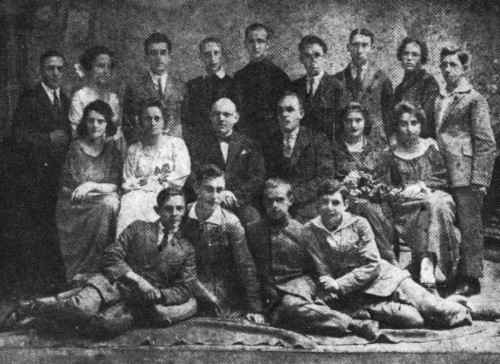
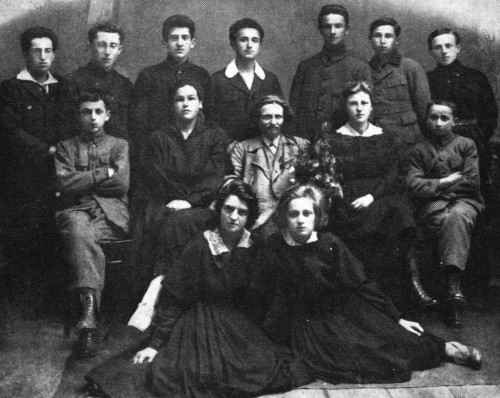
| A group in the Jewish Gymnazie (1922) |
[Page 274]
|
|
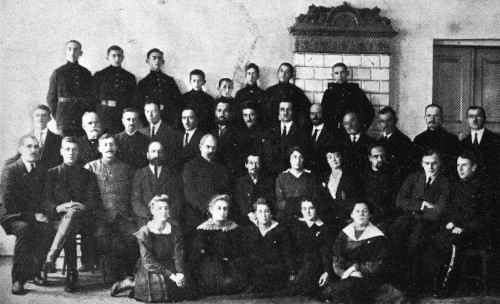
| The Jewish Gymnazie headed by Director Chwiedkowicz |
the problems of social and political justice and, in addition, the beautiful Polish language, the high standard of the Polish poets – this all had an effect, so we took eagerly to the object of the courses and began to read, to think and act in a Polish manner…
And thus, Polish culture penetrated in us unnoticeably and we dedicated the best years of our lives to it. I say the best years of our lives because these years had a dominant influence on our world view. The class was transformed into a forum for debates during the lectures on language and history and sharp Jewish heads discussed various problems and sought the truth. However, a pedagogical hand was lacking that would lead us on the road of finding the truth for our people. The role of the teacher was not a controlling one; that is, the teachers would explain the lectures; they would control our information, but they did not take any part in forming either our character or our world view. And perhaps they wanted to give us a pure Polish orientation because they themselves were Polish patriots?
These teachers attained their goal. The walls of the gymnazie remained deaf to the awakening sounds of the wide Jewish masses who at the time of the Balfour Declaration awoke and organized for a new life on the basis of equal social laws – all of this did not reach us. For us the sources of the Hebrew
|
|
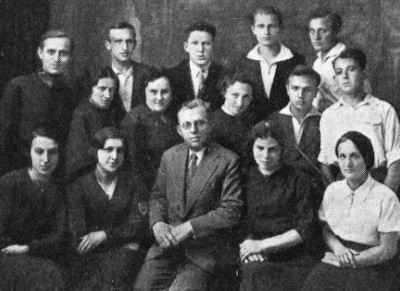
| The seventh class at the Gymnazie (1933) |
[Page 275]
language and culture remained strange, because we were provided with the bare minimum and its role was downgraded to a secondary one compared to Polish subjects. At this opportunity, I remember our three dear Hebrew teachers – Mr. Halaf, Kagan (Chohan) and Pietszenik, who were deeply pained by the situation and yet succeeded in giving us the elementary bases of modern Hebrew. Now I understand everyone who suffered, the people who could not save us from the danger of Polish assimilation. It came to that. Our origins from traditional homes rescued us, but that too was gradually threatened.
And, therefore, the end was sad. The lack of a pedagogical hand in a national direction tore away our best young people in Lutsk.
The greater number of graduates remained in Poland and took part in the terrible fate of all of the Jews there.
A large part of the young – left to cultivate foreign fields… The survivors occupy high positions.
A smaller number are located in the western European nations where they study and only those who had not graduated from the gymnazie came in contact with wide-ranging Jewish centers such as Vilna, Warsaw – they have become affiliated with the Jewish national ideology. Several came to Israel after the war.
|
|
From the right, first row: Khava Fisz, Manya Glezer (Zagagi – glazier in Hebrew) Second row: Y. Nul, T. Kercman, Director Chwiedkowicz, S. Milchker, Sh. Juniczman Third row: Z. Elbirt, unknown, Markus Mirski, Dovid Spard, C. Peker |
[Page 276]
However, despite the negative results, the Jewish gymnazie in Lutsk earned great merit for itself.
At this opportunity, I feel it is my duty to remember a group of parents who founded the gymnazie, this is: Shimkhah Milchiker, Ahron Fisz, (Yoel Barzach?), Moshe Szajner (and others, who perhaps I do not know). They really had good intentions, but, in the course of time, the gymnazie began to live its independent life according to the views of the teachers.
One praiseworthy action of the gymnazie was that, first of all, it created an environment of only Jewish children, in which we felt free and did not have to endure the antisemitic attitude on the part of Polish teachers and students.
The second praiseworthy action consisted of the education that we received from good, intelligent and highly qualified teachers. At this point, I want to remember the magnificent teacher of history, Dr. Mikhal Hendler, who was our teacher in the eighth class. To our good fortune, he has been in Israel for many years where he has used his great knowledge in the doctrine of history both as an inspector in a middle school and as a lecturer and writer of articles about history.
Also, as mentioned, the gymnazie gave us an education that awaked the impulse to go out into the greater world to seek knowledge and to become independent and free.
The gymnazie brought light to Jewish hearts in Lutsk in the course of its 30-year existence between the two world wars.[1]
|
|
Translator's footnote:
|
|
JewishGen, Inc. makes no representations regarding the accuracy of
the translation. The reader may wish to refer to the original material
for verification.
JewishGen is not responsible for inaccuracies or omissions in the original work and cannot rewrite or edit the text to correct inaccuracies and/or omissions.
Our mission is to produce a translation of the original work and we cannot verify the accuracy of statements or alter facts cited.
 Lutsk, Ukraine
 Yizkor Book Project
 JewishGen Home Page
Copyright © 1999-2026 by JewishGen, Inc.
Updated 28 Oct 2026 by JH