 |
|
|
[Page 250]
by Zelda Zigman (Litman), Haifa
Translated by Gloria Berkenstat Freund
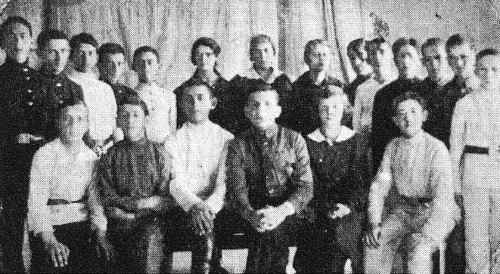
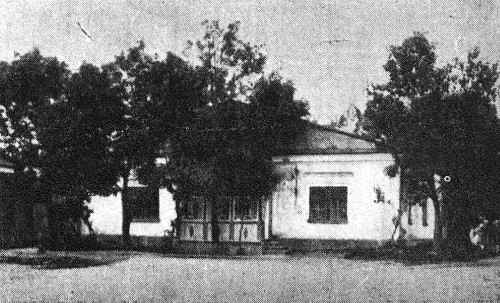
At Szienkiewicza 39, were the Jewish kehila [organized Jewish Community in Lutsk], several classes of the Tarbut School [secular Hebrew-language school] and also the Orphans' Home which the Messrs. Czeczotka and Dr. Pemow, of blessed memory, had led. Approximately 60 children were in the Orphans' Home. Jewish women interested themselves and provided support for them.
|
|
| Managing committee of the Orphans' Home |
The municipal city hall gave limited support for a time. However, the Jewish kehila [organized Jewish community] provided much greater help and support.
I found myself among those brought up at the Orphans' Home. We had various times there. Sometimes worse and sometimes better. We would travel to Juliane to a summer house or part-time colony where we had a very good time and drew in fresh strength for the new school-year.
We particularly have to remember Vova Czeszatka (perished in the ghetto) who was devoted to us with body and life. The Seder night with the participation of the directors is especially engraved in my memory. We celebrated the Seder in a real Jewish manner, with matzos, wine and other Passover foods. We asked the Four Questions and sang the Haggadah [the text read at the Passover meal]. Czeszatka only went home to her family late at night when the Seder had ended and celebrated the Seder [with her family]. It was this way year-in and year-out.
In 1939, a radical change occurred in our life. We were taken to a general Soviet orphans' home, where sometimes, during Polish rule, an inscription hung at the gate: "Jews and dogs – entrance forbidden!" Czeszatka watched with bitter tears how her children were being led to another home.
Little by little, we became accustomed to our new fate.
The worst was in 1941 after the outbreak of the German-Soviet War. At that time, our educator, Vova Czeszatka, Dr. Pemow and many other devoted activists from the Orphan's Home perished. May their memory give us light for eternity.
1959
Translated by Gloria Berkenstat Freund
In a difficult hour, we turn to you for help; we know how difficult it is for the Jews in the present day to help somehow even if you would willingly do so. However, we have no other choice!
The fate of the orphans, for whom the society provides, lays on our and, also, on your responsibility.
We, on our side, exert all [our] strength in order not to let our most important institution, the Orphans Home fall. Because of this, however, that city hall has temporarily ended its subsidy almost completely, our work has recently become very difficult.
Therefore, we turn to you with the call: Give us food products! We can [make do] without everything, but not food. The Jewish orphan must not starve! We do not permit this. But our power is weak. You must help us with your support. Not money, but food products and clothing! “Whether one does much or does little, it is the sincerity and intention that is important.”
Respond to the call of your friends who will challenge you through a Product-Ring[1] that we have begun on behalf of our orphans.
| The Orphans Committee
(Volyner Prese, number 2 [211] of 13 January 1933) |
List number 1
Dr. Pemow donated one suit and one overcoat and called out: Dr. Junger, Dr. Abramski, Dr. Segal, Dr. Raafalowski, Mec, Y. Pakszt, Minya Kraunsztajn and Aniuta Gliklich.Pani [Mister] Razowska donated cloth for 10 dresses and called out: Nakhum Warkowcki, Soni Mairsun, Fishl Lakrec, Chaim Bliak, Ahron Blecher and A. Pinczuk.
M. Zilberg donated two kilograms of soap and two shirts and called out: Serl Druker, Klara Grafman, Yeta Bak and the sisters Roza and Broni Kurperman.
Yakov Waksin donated 10 kilograms beans and called out: the Rozgold Mill, Spulke Necht-Tabacznik, Fefer-Udlis, Zwi Goldsztajn, Sholem Bereze and Gordon.
Dr. Chazanowa donated one suit, two shirts and called out: Dr. Arnold, A. Dragiczin, Pesakh Szac, Pinkhas Fridman, K. Friszberg and Moshe Bliak.
Dora Sawicka donated one piece of linen and called out Y. Blumenkranc and Noakh Cukerman.
Dr. Kamieniecka donated 10 kilograms of buckwheat and called out: Dr. Cukerman, Dr. Sh. Goldberg, Liba Liwen, Bela Fridman and Misha Epel.
Y.D. donated five kilograms of pearl barley and called out: Director Lederfajnd, A. Goldbrg, Wajsbard, Lando, Nodel, Brajt, Blajberg, Rotensztrajch, Chalif, A. Kolodni, Dr. Paltarak, A. Hofman, A. Waksman.
Kh. Elbirt donated a half meter of wood and called out: the M. Brothers and F. Fiszbajn, Yehezkiel Szirczik, Sh.Kh. Wernik and Moshe Fridlender.
Y. Lewenton donated five kilograms of barley and called out: Dr. Friling, Rabbi Ingerlajb, A. Lewentol, Blowsztajn, A. Sztrachman and M. Wajsman.
B. Erlichgerecht donated two kilograms sugar and called out: Dovid Chait Jungsztajn, Yisroel Szapiro and Yisroel Kimelman.
P. Szulc donated a half kilogram of tea and called out: Regina Goldsztan, Tspira Hausman, Hersh Gurwic, Chaim Pinkhas Cybuch (Tarczin), Czarna Bursztajn, Shlomo Aks, Borukh Liberman, Ziglbaum, Gorensztajn, (all from Rovna), Y.M. Altsziler (Warsaw).
| (Volyner Prese, number 2 [211]) |
Translator's footnote
by Y. Dimsik
Translated by Gloria Berkenstat Freund
The Jewish butchers, who until the year 1929 were organized in a general artisans' union, little by little began to feel a certain difference between their situation and the situation of the general artisans. For example, they were thought of as merchants by the tax office, because of the sale of meat in their butcher shops. In addition, a series of specific problems surfaced, such as hygienic-sanitary rules, etc. Because of this, there arose among the influential members of the union's meat branch the idea of organizing by creting their own independent organization. After carrying out the first formalities, a legal regime recognized as the Butchers Guild was founded on the 17 th of August 1929 at the head of which stood the Messrs. Avraham Zigelbaum, Moshe Kazial, Efroim Abramowicz, Dovid Manker, Yehezkiel Sznajder (Pinya's son], Yosef Sznajder, Nisl Sznajder and Ahron Tesler. A journeymen's division also was created with the now- deceased butcher, Fridl Ditina, at the head.
However, alas, the financial situation of the guild was difficult. At the start, not all members showed an understanding of their own organization. Besides this, the minimal monthly dues were not sufficient to support an independent administrative office. The guild, consequently, found itself an autonomous section of the central artisans' union. When, instead of the monthly dues, a voluntary payment for each piece of slaughtered [meat] was initiated, it became possible to hire their own secretary – Yehiel Kornblit.
There was more than enough work. The tax penalty was associated with terrible difficulty and one had to help with whatever was possible. Besides this, the artisans' cells were born then and they brought new repercussions, such as certification, artisan cards, journeymen, agreements and so on.
Because of the rapid growth of the guild, Mr. Yisroel Dossik, the well-known athlete, was hired as the manager of the guild. The need arose to reduce the high support payment that had to be given to city hall. The leader of the guild began to beat a path to the thresholds of the various offices, intervening and asking them to permit a reduction to allow the existence of the butchers. When none of this helped, they turned to their last resort: Strikes. For a long time, there was no slaughtering in the city and there was no meat. Finally, city hall gave in and the reduction was granted.
The last challenge of that intense work by the guild was the organizing of the export of non-kosher meat to the larger centers of the country, such as Katowice, Warsaw, Lemberg and others.
Clear proof of how the guild grew is the proportionally higher budget, which was happily adopted: 4,000 zlotes a year.
[Page 255]
In 1935, Avraham Zigelbaum again was elected as the supervisor at the general meeting. Together with the other activists he carried on an energetic struggle for the betterment of the interests of the butchers. Energetic steps were undertaken to combat the unofficial slaughtering, which brought colossal losses to the organized meat branch. They received greater credit than the butchers in the artisans' bank; they erected their own storeroom where they collected the blood from the slaughtered cows and the various offal, which provided significant income.
The guild also willingly took upon itself the civic duty and taxed itself five groshn for each slaughtered piece. This decision [to tax themselves] was told to the village elder at the time, Mr. Sacherski.
In 1936 came the terrible blow of [Sejm (Polish parliament) deputy Janina] Prystorowa's ban on kosher slaughtering. The local butcher's guild then began a struggle against the kehile [organized Jewish community] to make the payment for ritual slaughtering cheaper. The guild also began to organize a central purchasing location that would buy the non-kosher parts of the meat from all of the butchers and they would not be forced to sell the [non-kosher] zadeks (hindquarters) for pennies.
However, the blow that was designed to annihilate all Jewish butchers interrupted everything. Everyone's attention was turned to the new misfortune that carried destruction and ruin.
The Butchers Guild, through its leader Zigelbaum and director Dossik, first made contact with the General Jewish Butchers Union of Poland, which undertook defensive action. Here, on the spot, the right of the existing butchers cooperative was granted and a permit for 19 butcher shops with a central office was received from the regime.
Thus, of the 70 butchers, 57 butchers were allowed for; nine received individual permits and the remaining had to be taken to the mechanical slaughtering. How much the tactic of the butchers managing committee was foreseen can be seen by the fact that some time before the slaughtering misfortune, a course for menakrim [people who remove prohibited fat and veins from cows to make the meat kosher] who would remove veins and fat from the hindquarters of meat had been opened in Lutsk to increase the portions of meat.
Alas, the cooperative did not exist for long. Its privileges were voided and the butchers remained standing in danger of the collapse [of their shops]. The leaders of the guild again had to apply means to secure the existence of the local butchers. Their intervention was successful. Forty-eight butchers were again organized with the 19 permits and the unorganized were taken care of, too.
In 1938, Mr. Zigelbaum was again elected as supervisor. Then, the actual question was about a larger amount of meat and about its fair distribution. When the repeated interventions did not provide the appropriate result, the guild turned to the Agrarian Ministry and the matter was resolved positively.
The Guild decided to tax itself with voluntary payments for the purpose of giving the local 24th Polk [regiment] a heavy machine gun with all accessories in the sum of 6,000 zlotes. The village elder, Mr. Koszczolek, was informed about the decision by Supervisor Zigelbaum and Director Dossik.
In 1939, the butcher's guild celebrated its 10th anniversary. The number of members had reached 70 people.
The managing committee consisted of the following people: A. Zigelbaum (supervisor for the 9th time), Efroim Abramowicz (under-supervisor for the 8th time), Yekhezkiel Koziol (under-supervisor), Sheps Lekhter (treasurer for the 9th time), Yosef Sznajder (secretary for the 5th time), Dovid Manker, Chaim Kardisz, Avraham Baczar (member).
by Sh. Chazan
Translated by Gloria Berkenstat Freund
The first spring after the Russian Revolution also called to life the Jewish nationally-inclined [Zionist] young people in Lutsk, who were then grouped in the Histadrut [organization].
Among the varied goals and tasks of this youth organization, physical culture was also noted – a culture that could only develop among Jews under the rays of freedom's sun.
There was a Christian, an expert in the field of physical culture, and he would carry out gymnastic exercises with the members. Not long after, the Lutsk resident, Benyamin Farsztaj, a great theorist and practitioner in this area, and a person with an outspoken national ideology, came from [exile] in Austria and placed himself at the head of the small group. He created a gymnastic course for instructors whose task, after completing the course, would be to carry out propaganda among the people for the idea of a physical renaissance and to carry out practical training work.
B. Farsztaj also abolished the Russian terminology at the exercises and brought in Hebrew as the obligatory commanding language.
It was difficult for the Russian assimilated candidate instructors to learn the strange-to-them sounding Hebrew language but the awakening and rising national feeling in them helped overcome this difficulty.
|
|
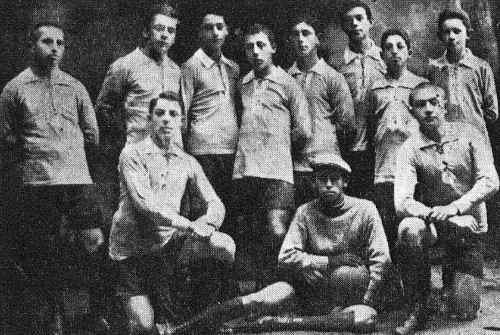
| Jewish Sports Club in 1918 |
The first course of instruction lasted six weeks and the following members went through it: Motl Glezer (today Zagag [in] Israel), Mulik Zbar (later a medical doctor in Paris), Muni Garbacz (Israel), Uri Gliklich (perished in Warsaw), Yankl Aszchanazi (today in Israel), Lender (Israel), Anna Spektor (the wife of the world-famous violin virtuoso, Professor Zardi), Muni Sznajger, Blumenkranc and Ester Cardawa (Israel),
A premises was rented in the Narodnyye Chayaniya [Russian – People's Aspirations]. Dozens of Jewish sons and daughters would come together every day and under the leadership of the graduated instructors perform various gymnastic exercises.
This lasted until the Polish military entered the city. The new regime requisitioned the premises. Demat ([acronym of Departament Likwidacji Materiałów Po-Rosyjskich – State Department for the Liquidation of Material Remaining after the Russian Army] a state institution that had the task of gathering various material remaining from the Russians) took the sports equipment.
Being left without a premises and equipment, the activity ended and the organization ceased to exist.
|
|
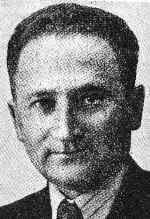
| Benyamin Farsztaj |
However, the impulse of the better part of the young to live communally, to have a place of refuge where they could come together and, mainly, to engage in sports and gymnastics was great and could not be stifled. Dozens of young people would come together from time to time in the large kehila [organized Jewish community] hall and carry out gymnastic exercises under the leadership of the instructors and, very often, under the personal leadership of Mr. Benyamin Farsztaj.
However, the kehila leaders at the time did not have any understanding of the strivings of the young and they prevented them from entering the kehila hall. The young, however, did not yield and would very often, thanks to the “greased one's” [those bribed] help (now we can reveal this) from the guard, Reb Yudl, drop into the hall during the evening and engage in gymnastics.
[Page 257]
However, such an abnormal condition could not last long because of not knowing for sure when they would be able to enter there; few people would come. The gymnastics had to end. The leaders then decided to make another attempt to found an independent club. However, it proved to be difficult; the young lacked one trifle for their drive after sports and physical development: material opportunities. They tried to come to an agreement with the older society. But here it was the opposite: means were present, but understanding of the work of the young – not for any money.
Again, this attempt did not succeed and the idea of a sports club remained hanging in a void.
Passover 1921.
As a result of assemblies and meetings of the sports activists, came the decision to make use of the days of Passover for another attempt to create a sports organization. At a large general meeting at the kehila, a managing committee was elected of the following people: Muli Zbar – chairman, Ilke Rechszaft – vice chairman, Moshe Goldberg – secretary, Sh. Chazan – cashier and Yasha Ptic – member. It was determined to organize an evening in the Strazh [firehouse] to create a little money to rent a premises. The best of the young were drawn to organizing it and it was successful. Then they rented a room in a house from Zbar at Jagelonska [Street].
As there was no hall for gymnastics there, the work was concentrated on the football [soccer] section, which Ayzia Garmal (later emigrated to America), newly arrived from Russia, led.
The football section made the sports organization very popular. Not because of its higher class, but because of the composition of the players who consisted of in the great majority, the so-called “golden” youth.
Almost every day in the evenings, dozens of young members and the unorganized gathered on the fields of the barracks; all would come to play, to exercise in the football art. Matches were organized on the Shabbosim [Sabbaths] and holidays. The managing committee had “forged the iron,” drawing in many members, arranged dance evenings in the city and even outside the city – in Kiwercer Forest.
When it was learned in the area that a sports club already existed in Lutsk, as in Rovno, Dubno and others, the managing committee began to receive invitations to come for friendly matches.
A tragic-comical episode: the captain of the football team, Ayzyk Garmel, was a weak organizer. Once, he announced that they were going to Dubno on Shabbos for a match with the sports club there, Hakoah, one of the strongest clubs in Volyn. After various ruses, such as inviting “benefactors” as judges, who gave contributions for expenses and various other “group contributions,” the necessary sum for travel expenses for the 14-15-person team was gathered with great effort and Friday night we left by train for Dubno. Chaim Leibl, Shura Bronberg, Shimek Bakawiecki, Mulik Zbar, Yasha Ptic, Kibrik. Shachniuk, Moshe Grosberg, Garmel and others were among the team. From the managing committee – Rechtszaft and the writer of these lines. The “benefactors” were Ben-Tzion Rapoport and Nisan Kamer (a horse-trader – voluntarily).
The team, arriving in Dubno at the train station in the middle of the night, deadly hungry, left on foot for four to five kilometers to the city. However, no one from the Dubno Hakoah came to welcome us. When we arrived in the city, we saw a large poster about a football match between Dubno Hakoah with… Lemberger Hasmonea!
The circumstances under which such long-distance matches would be arranged was thus: the invited team traveled at its own expense and own cost. After the match, the businessmen took the return [trip] expenses for the guest team off of the cost of the match. However, as Dubno was playing that day with Lemberg, from where would we receive expenses for returning [home]?
However, we left the concern until the morning and, meanwhile, left to find a place to spend the night somewhere on the floor in a third-rate inn.
We somehow overcame the night and left for the city early on Shabbos and the misunderstanding became crystal clear.
Meanwhile, the match took place and brought in a large amount of money. We were on the field as guests, they ate lunch, but not us, and not me… from where could we get it?…
We remained to play a match in the morning, Sunday. With luck, we won, scoring four goals. Hakoah made a “group contribution” for expenses. For a place to sleep, we were provided with the…houses and – onward home, hungry and exhausted. A miracle that Ben-Tzion Rapoport somewhere at a train station told all of us to eat at his expense… God knows first how he managed [to provide us with the meal], then him…
After a night of riding on a freight train, we arrived home and straightened out our bones, making sure they were protected from the emotions caused by sports….”
Despite the idealism of the small group of sports activists, the club could not last. There was no legalization and no one to undertake
[Page 258]
this – and in short: one day the managing committee gathered in A. Rechtszaft's house, held the last meeting and took leave of the books and stamps, which were cleared out…
Summer, 19th of May 1924.
The general situation had stabilized. Sports began to penetrate the Jewish alleys, too. Football, particularly, was elevated by the young to a deity. Not so – in Lutsk. The few sports followers decided to again make an attempt to create the sports organization. The attorney Rotfeld was attracted to secure permission from Makabi [Zionist youth sports organization]. However, as it turned out, the Rovno Makabi, already a strong team then, arrived in Lutsk for a match with the local military club and it won. It made a banquet in one of the local restaurants, Polonia, where they rejoiced over the victory and among other songs, they sang in Russian, to which they were accustomed [to doing].
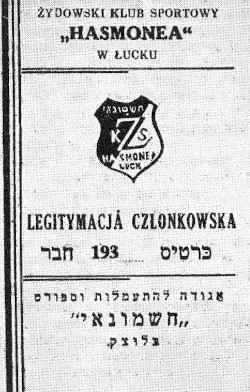
This caused Makabi to be banned in Volyn. The local activists headed by B. Farsztaj decided to adopt the name Hasmonea [the Hasmonean dynasty is descended from the Maccabees]. After a long period of intervention, the charter [for the group] was successfully legalized.
The patience of the activists and the young was unlimited. The committee under the leadership of Mr. Rotfeld as chairman, Kheikl Wajc as vice chairman and Dr. Cezar Chait as treasurer – began to work energetically. A solemn gathering in honor of the opening of the club was arranged in the municipal theater. However, after the celebratory mood came the grey reality. They again were persuaded that they could not support a club with pure idealism; one must also have even more
|
|
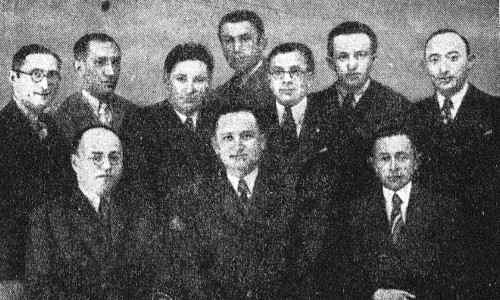
| The leadership of Hasmonea | |
|
From the right, first row: L. Bursztajn, B. Farsztaj, Dr. Oksman;
Second row: A. Wajnsztajn, Y. Broszewski, Y. Dossik, Y. Krauz, Sh. Chazan, Y. Berger, B. Farsztaj |
|
money and there was none. Interesting wide Jewish interest as a community, as occurred in other cities, was not successful. And the club again began to vegetate. The administrative office moved from one apartment to another. Until the club was evicted and the small amount of inventory was moved to Chairman B. Farsztaj's office.
We would see a trace of Hasmonea only on days of government or Jewish national celebrations. The members of Hasmonea would then take part under the leadership of the newly arrived football expert, the lieutenant from the Polish military, Zigmunt Dim, who had settled in Lutsk.
Thus also passed 1926. True, two significant assets for sports arrived, Yona Osifow and Yisroel Dossik, the popular sports activist, who stood at the center of general and Jewish sports work, but one swallow cannot make a summer.
1929.
The decline of Hasomea and of Jewish sports in Lutsk, in general, dates from this year.
The Municipal Committee for Physical Education, which was brought to life by the regime also had an effect. The committee gave Hasmonea its military instructors, who carried out gymnastics with the young. Then, a bicycle section was created that had its group of strong masters who beat records. Thus the members, Gertner and L. Owerbuch, won the championship of Volyn in a dash contest for a distance of 10 kilometers [6.2 miles]. The members Kigel and Kacubaj excelled at a shorter distance.
In 1930, at a meeting that took place in the assembly hall, a new managing committee was elected with Y. Barzach, B. Farsztaj, Y. Dossik, N. Osipow at the head. A premises was rented where ping-pong was brought in for the first time,
[Page 259]
which attracted the young en masse. The football section, under the direction of Y. Dossik, became active.
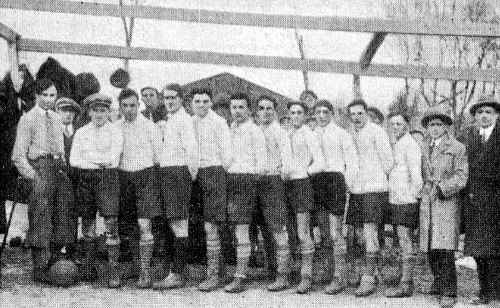
The Jewish police commissar at that time, Mr. Pawel Heller, gave a strong push to the activation of sports in general and football in particular. He was an avid athlete and a warm Jew, too. Thanks to his efforts, there was success in obtaining a place for football in the center of the city on the meadows behind the covered markets. Thanks to this, the young always had a place to train and exercise in football. And this also provided [income from people] because the crowd came here en masse.
|
|
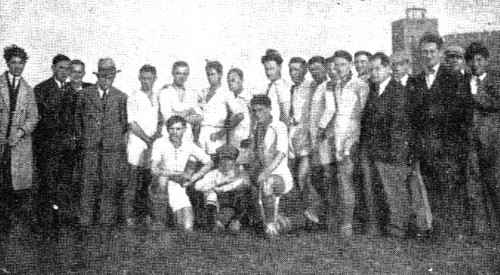
| Football group from Hasmonea |
Hasmonea could attract members from the matches. How remarkable the situation was then can be seen from the fact that the club had attracted attention by bringing the currently world-famous Viennese Hakoah [the strength – Jewish sports club], which was paid as much as 300 dollars for its “tour,” which was then almost 3,000 zlotys.
Hasmonea became popular. [New] members joined. The club premises in Yosef Blinder's house moved to a splendid location at Kronsztajn's. There was a large room for gymnastics. The football section especially blossomed; it possessed several talented players, such as Salomon Pinus, who later was known across the entire country because of his participation in several international matches. In the 1930s Pinus played with Lemberg's Hasmonea, occupying an esteemed place there. Then the managing committee decided to hire a trainer, Zinger, the Jewish-Hungarian specialist, for the football squad.
1933.
Thanks to the tireless work of the coaches and, particularly, because of the idealistic attitude of the members of the football section, who showed ambition and discipline, success was celebrated in a series of magnificent victories on the football field and a move into class “A.” In addition to the football section, the gymnastics section, boxing section and bicycle section were also active. The latter showed great activity so that several leading members, namely: Adolf Cazanow, Ayzyk Rapoport, Yakov Gasko, Dovid Diatlowicki and Moshe Sznajder went on a trip across Poland, from which they returned with two albums of photographs and signatures from all points included in their route.
A larger segment of society also began to demonstrate its sympathy by paying member dues and taxing themselves during various campaigns.
The same year, the 15th anniversary of Hasmonea was celebrated with an impressive solemn evening in the municipal theater, which was fully occupied with guests. Editor Sh. Chazan gave a detailed report about Hasmonea and there was a magnificent concert in which the famous piano-master and composer, Maks Ferszka, and the famous actor, Leib Lerner, took part. The latter used great whimsy, singing the special song, Hasmonea, which humorously described how Lutsk Jewish sports would look in the days to come…
HasmoneaTo be sung to the melody of the song Abdul Bey
There is a Hasmonean present here in our city
With Farsztaj, a tiny, little chairman.
He marches in front for everything
And leads them [like a] great Greek.
It is no joke, oh, I swear, listen to me.
From behind, Kiperman the long “office mik”
He wears short pants; although it is though an antique
From the left, Senator Dal,
From the right goes Zebulun Perkol
And all according to the drills in the ranks…
Refrain:Oh, oh Hasmonea
You throw a ball, woe to the other one,
Oh, oh, oh, P.K.S. [Polksi Klub Sportowy – Polish Sport Club]
Oh, you tremble at our little comrade Pinus.
Oh, your small muscles
Are not [made of] dumplings,
Are yet chivalrous.
Oh, oh Hasmonea,
You are a real gem – I hear wherever I go.
[Page 260]
|
In the year 1936, Hasmonea celebrated its 18th year of its life with the unveiling of its flag.
This solemn act was carried out very impressively: a divine service and consecration of the flag with the participation of the staff rabbi [chaplain], Reb Zalman Soroczkin, and in the Great City Synagogue; a numerous procession of all members through the streets that led from the club to the synagogue; a solemn assembly in the reception hall of the kehila [organized Jewish community], where the hammering in of the tokens in the flag pole and the registering in the “Copper Book” [a book with a copper cover], and, to close, a rich banquet.
An honorary guard of members of Hasmonea stood the entire time at the unveiled flag, which was magnificent in its execution and original in its national symbolism that had been deeply thought out and dealt with important moments in glorious Jewish history.
The flag, the only one, not only in Volyn, but possibly in all of Poland, was planned by Chairman Benyamin Farsztaj and painted by the artist, M. Boruszek.
The “Cooper Book” also was original, both in the conception and in the execution. On the first page, the great spirits Max Nardau, Nakhum Sokolow and others, who had had the understanding of the physical renaissance of the people and of the practical work in this area, were memorialized.
After the flag celebration, the managing committee began to think about realizing the great idea of a swimming and rowing hall.
In 1933, the members of Hasmonea and the members of the city committee for physical education, City Councilman Elkin and Secretary Y. Dossik managed to acquire a spot from the committee for a swimming hall that was located under the dyke at the Styr River, not far from the Polish Towarzystwo Wioślarskie [Rowing Club]. Hasmonea leased this spot for 10 years and they began to think about building a swimming hall there, which began to feel like a necessity. A special committee was chosen headed by Dr. Meir Grifel. The committee carried out a collection campaign and gathered a few hundred gildn. A fence was made on the spot and a gate and stairs to go down, but – it ended with this.
This happened perhaps because the people stood at the head of the committee, although practical, were without ideological wings, or perhaps the time was not yet worthy for the accomplishment of this idea. The fact is that the committee dispersed. The fence was torn down over the winter and the remaining boards were brought, as always, to Chairman Farsztaj's courtyard.
In the course of the summer of 1937, it seemed that a miracle occurred and the swim stadium would be erected, but difficulties emerged on the part of the Polish regime. We had to relinquish the spot and take another at the side of the Styr [River], near Bene. All formalities were overcome and we started to build in the summer of 1938.
Until the end of 1938, 7,000 gildn were invested in the building. Just as much was needed to finish it.
Lutsk, 1938
|
|
|
JewishGen, Inc. makes no representations regarding the accuracy of
the translation. The reader may wish to refer to the original material
for verification.
JewishGen is not responsible for inaccuracies or omissions in the original work and cannot rewrite or edit the text to correct inaccuracies and/or omissions.
Our mission is to produce a translation of the original work and we cannot verify the accuracy of statements or alter facts cited.
 Lutsk, Ukraine
 Yizkor Book Project
 JewishGen Home Page
Copyright © 1999-2026 by JewishGen, Inc.
Updated 24 Sep 2026 by OR