 |
|
|
[Page 207]
by Moshe Ferdman, Mexico
Translated by Gloria Berkenstat Freund
|
|
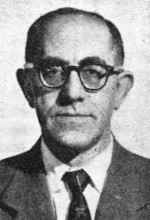
| Moshe Ferdman |
The work that we present here is not a documentary study about the Bund in Lutsk; we are not able to write an exhaustive characterization of its activity because we do not possess the Bund archive! It disappeared along with the Bundists, almost all died in Lutsk or in other places during the Holocaust.
The Bund in Lutsk was active before 1905. I remember well an event from my childhood years that engraved itself in my memory. In the violent fifth year [1905], a large peoples-gathering took place, organized by the Bund in the Great Synagogue, where a well-known Bundist orator – Comrade David [Petrovsky] – appeared. The gathering was dispersed by Cossacks. Shooting was heard. A bit of a pogrom also took place then with the participation of the Black Hundreds [reactionary, ultra-nationalist Russian groups]. I remember that a Jewish locksmith shot into the Lutsk district police office.
Among the Bundists of that time were, as much as I know, Shmulik Ayzen, Kalman Friszberg, Shmulik Garber and Efroim Maranc – the latter also was active in Bundist work in the years 1923-1939.
The new Bundist organization in Lutsk was founded in 1923 by an emissary from the central committee of the Bund in Poland, comrade Artur Zigelbaum. He later became well known when he organized the Jewish professional movement in Poland. In 1942, he tragically and heroically took his life in London as a protest against the silence of the world while the Jewish people were being annihilated by the Germans.
Until the rise of the official organization, the Bundists and their sympathizers were grouped around the Jewish library, the kindergarten and other cultural positions as well in the professional unions that were created at that time, mostly thanks to their initiative.
Thus organized then were: the nourishment union (the workers with milk and bakeries); the wood unions (the carpenters, cabinetmakers, construction workers and so on); the leather union (shoemakers, leather cutters, tanners and so on). The three mentioned unions were international – Jews, Poles, Ukrainians, Russians belonged to them. Later, two more professional unions arose – purely Jewish: the needle [trades] union and the union of sales workers.
The professional unions were occupied with economic actions that had the purpose of bettering wages and working conditions. Among the unions, the nourishment union, with its organization and readiness for struggle, with its internationalist spirit, as well as comradely solidarity and self-help, particularly excelled. Thus, for example, the institution of fayrant[1] was rigorously carried out and protected there. That is, that an unemployed baker would receive several days of work he was lacking from his comrade who [would work less] – this was applicable to both local members of the union and to those who came from outside [the city].
The professional unions – mainly the Jewish ones – would also carry out cultural-political work among the members, as much as was possible under the strict Kresy regime.[2] In general, the Polish regime used
|
|
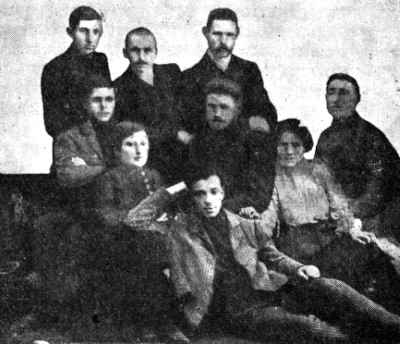
| The committee of the Bund in Lutsk in 1905 |
[Page 208]
|
|
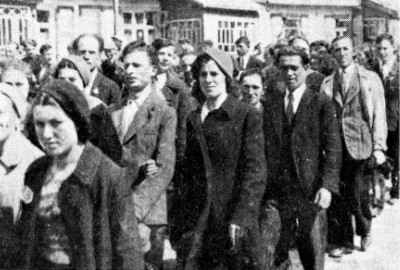
| A Bundist May 1st Demonstration in Lutsk |
all sorts of harassments and repressions against the professional unions and their activists.
All professional unions in Lutsk participated in the appropriate national central offices in Warsaw that stood under the influence of the P.P.S. (Polska Partia Socjalistyczna [Polish Socialist Party]) and the Bund.
At first, the Bund organization did not have a large number of officially declared members. The work of the organization mainly proceeded in the direction of ideological education and propaganda, as well as in general institutions in the city. Regular party meetings and circles would take place at which they conversed about various actual political problems of Jewish and general life. They would distribute the party press (Di Folks-Zeitung [The People's Newspaper] and so on). They took the first step of creating a youth organization (Tsukunft [Future]). The Bundists also were the initiators and the first activists of the reopened Jewish secular school (1925).
From time to time they would bring party activists from Warsaw who, in the majority, also appeared with public lectures on political and general cultural themes.
The first larger action of the Bundist organization was the election campaign to the first democratically elected city council in 1927.
At first, the Bund wanted to create a joint list with other radical activists. They negotiated about this with Shlomo Goldberg, Zalman Zarecki and so on, but nothing came of the plan because of a series of fundamental disagreements. And the Bund brought its own list to the election on which also appeared Dr. Josef Mininzon, who was not an official Bundist, but an old social-democratic activist. At that time Mininzon was the chairman of the Lutsk division of the Central Jewish School Organization (TSYSHO – Tsentrale Yidishe Shul Organizatsye) and of the school managing committee.
The election campaign carried out by the Bund was very lively and drew the attention of the Jewish masses. The election actions were used by the Bund for a wider informational campaign and actually led to significant growth for the organization. The election results were very good for the Bund, taking into consideration that Lutsk did not have a proportionally large working population. Three Bundist council members were elected: Dr. Josef Mininzon, Moshe Ferdman and Borukh Cwerner (a tailor, chairman of the Lutsk Needle Workers Union). Later, Shlomo Rimarczuk, a tailor, now in Argentina, replaced B. Cwerner in the city council. When Shlomo Rimarczuk later emigrated to Argentina, Tunya Bruman took his place.
Despite their proportionally smaller faction, the activity of the Bundist councilmen acquired a great importance in the city, particularly because of their matter-of-fact, but constantly principled attitude toward the most important questions of the municipal economy and its relation to the Jewish population. Even the Polish councilmen and the leaders of the city managing committee (city hall) took into account the Bundist councilmen, and they were represented in the most important committees (budget and so on). Their appearances in the budget debates would always evoke great interest, and many people would then come to the meetings.
The first city council did carry out relatively liberal communal politics, particularly in the matter of taxes; it also succeeded in providing
|
|
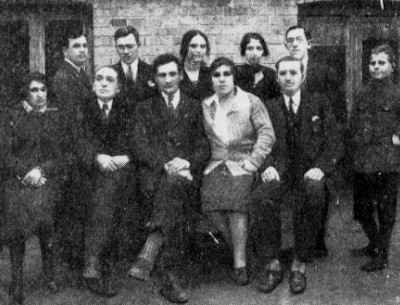
| A group of Bundists in Lutsk |
[Page 209]
subsidies for many Jewish institutions (schools, hospitals and so on).
There were cases when the Bundist councilmen often had to speak and even sharply against the attitude and actions of the remaining Jewish councilmen. For example, thus it was when a number of Jewish councilmen voted against the Bundist proposal to name a street after Yitzhak-Leibush Peretz and because of this the proposal failed (the Jewish councilmen then had a majority in the city council, since the Jewish population was the majority in the city). The Bundist organization then issued a sharp appeal again the conduct of the bourgeois Jewish councilmen. The appeal was, understand, confiscated by the starostwe [district office] and the writer of these lines (as the official responsible for the appeal) was tried as a result.
The Bund only had two city councilmen in the second city council. This was the result of the general changes in politics in the country. The government did everything in order to decrease the number of Jewish city councilmen and enacted a special limited election ordinance so that the Jewish population would not have any appropriate representation. All of the Jewish parties had smaller factions in the second city council. The Bundist councilmen were Moshe Ferdman and Tunya Bruman.
The election to the third city council, which took place right before the Second World War in the general atmosphere of fascism and national discrimination, particularly against the Jewish population, weakened Jewish representation in the city managing committee even more. By the way, the third city council actually did not begin its activities because of the outbreak of the war.
In the years 1936-1937, when the Polish government began carrying out openly antisemitic politics, when the country began anti-Jewish excesses (for example, the story of Przytyk[3] and so on), the Bund in Poland carried out a wide political campaign against antisemitism, for the rights of workers, and on so on. The Lutsk Bundists also took an active part in the struggle; this came most clearly to expression in the general protest strike on the 17th of March 1936.
In the Bundist publication, Der Yidisher Arbeter-klas [The Jewish Worker-class], in 1936, the following correspondence was published about the course of the protest strike in Lutsk:
“Our city had not experienced such a demonstration as a result of the well-known Kresy conditions that had not given any professional union the least opportunity to lead any activity, yet the protest strike showed the strength of the conscious labor force.
“We spread the call from our party and from the country council (of the professional unions) from mouth to mouth – the appeal that had been released by the local committee of the Bund had been confiscated.
“From seven in the morning, worker groups in various places in the city began to gather. (Later) large masses began to flow to the center of the city. The courageous conduct of the workers, and particularly of the young, carried with it the bourgeois population. One after the other, they lowered the shades of their businesses with a clatter. The strike was real.
“Despite the extraordinary [number of] guards (police on foot and on horses, on motorcycles), several meetings were successfully organized in the street that ended with calls and slogans. Many comrades were arrested over the course of the day.
“The Polish organized labor expressed its solidarity with the protest action. A protest meeting was organized in the premises of the local construction union by the P.P.S. comrades that was dispersed by the police in the middle of it.
“The entire city was impressed by our dignified fighting appearance against antisemitism.”
In time a large number of Jewish young workers, boys and girls gathered at the Bundist organization (tailors, business employees, construction workers, school youth and so on) and they helped the older comrades a great deal in the political organizational work. From 1927, an official Bund youth organization, Tsukunft, existed and it developed widespread and extensive activities among the working Jewish youth. Organized educational circles that included both general scientific and political instruction in their subject matter would take place. At Tsukunft a four-voice choir (under the direction of Shulik Ferdman) was later created, which appeared publicly several times and with great success. The members of Tsukunft would arrange frequent excursions outside the city and to the small shtetlekh [towns] around Lutsk (Torchyn, Rozhyshche, Oziutychi and so on) bringing both political instruction and entertainment for the young. Speaking about the entertainment, it is worthwhile to remember the beautiful tradition of the so-called red-blue balls (the members of Tsukunft would wear blue blouses with red ties). These were special and private evenings, intimate and cultural both in the program and in the atmosphere.
In order to give an idea of the work of the Bundist youth organization, we will cite several extracts from correspondents in Lutsk, published in
[Page 210]
the central office publication of the Youth Bund – Tsukunft – Yugnt Verker [The Awakener of Youth] – for the year 1929.
A correspondent in Lutsk, in the Yugnt Verker, no 2, January 1929:
“Our organization progressed; we carry on extended educational work among the young. We have recently sent eight older male and female comrades to the party. We arrange frequent readings in the unions. We carry on actions to gather money for a premises.”
| Motya
(Motya Gajer, today in Sao Paulo, Brazil) |
Yugnt Verker no. 11, 1929:
“We arranged a gathering in the municipal theater. After this, a procession formed under the flags of the Bund, Tsukunft, and professional unions. The procession marched through several streets in exemplary order with various labor songs and proclamations. Mass arrests took place on the eve of the First of May; one of our comrades was arrested who is still in prison.”
| Motya G.
(as above) |
Yugnt Verker no. 14, 1929:
“Shabbos [Sabbath], the 22nd of June, the gathering of the Volyn members of Tsukunft took place in the Czech Colony five kilometers from Lutsk. A few hundred comrades came from 10 locations: Lutsk, Rovno, Kovel, Dubnorca, Oziutychi, Kysylyn, Torchyn, Berestechko and so on. A solemn gathering took place with the participation of Mr. Lucian from the Central Committee (Central Committee of Tsukunft. Mr. Lucian – Lucian Bilt, now in London. – reported by M. Ferdman). In the evening, in the Ukrainian hall, Prosvita, a banquet took place; in the morning an excursion with boats on the River Styr. On Sunday, the comrades visited the castle, the Karaimer Synagogue, the old synagogue, the Jewish Folks-shul [public school] and so on. The congress, was a really great demonstration for the Tsukunft.
| A member of Tsukunft |
From a correspondent in Yugnt-Verker (June 1929?):
Third Lutsk regional conference
“The third regional conference of the Volyner Tsukunft organization took place on these days in which Mr. Lucian from the central committee also took part. Twenty-five delegates from 10 cities came to the conference; three cities did not send emissaries. From the report we see that our organizations in the region have approximately 300 organized members, in addition to a large number of sympathizers. Yugnt-Verker (the publication of the Tsukunft – reported by M.F.) distribute the organization's 280 [no indication of 280 of what]. We possess eight libraries with more than 9,000 books, 600 readers. Four organizations have Morgnsterns (the sport's organization of Tsukunft, reported by M.F.) with 250 members. Four organizations have well-functioning dramatic groups.
“The conference established that we were in a state of constant revival… The conference elected a new regional committee and drafted a complete series of work for the forthcoming time.” – Regional Committee
From Yugnt-Verker no. 19, August 1929:
The anti-war action in Lutsk
We proclaimed an anti-war action from the 3rd to the 10th of August. Over the course of the week, we carried out a series of special meetings. A solemn assembly with a very rich dramatic part carried out by the young people themselves took place on Shabbos, the 10th. The assembly took place in the premises of Prosvita. The assembly ended with the singing of The International and of Di Shvue [The Oath – the Bundist anthem].
| A Young Person |
From Yugnt-Verker no. 6, January 1930:
A Mikhalowicz Club in Lutsk
Despite the frightening unemployment among us in the city, we surmounted all of the difficulties and created a club named for Comrade Mikhalowicz. A large youth meeting took place on Shabbos, the 25th of January, dedicated to the opening. A banquet with the party organization took place in the evening. A comrade from the party committee spoke as well as a comrade from the youth committee, and so on. We sang various worker songs. We dispersed for our further work with enthusiastic courage. We now started the work. Every evening, the comrades come together at the club.
| Motya G. (as above) |
From Yugnt-Verker no. 11. May 1930:
A joint celebration with the Polish workers took place here in Lutsk. Immediately in the morning, the workers assembled in their (union's) premises. Then we marched out to the municipal theater where a (May) assembly took place. Giving speeches were: Mr. Zurowski on the part of the Poles [and] Comrade Buchman in the name of the Bund (This is a pseudonym. It could have been either Bruman, a Bundist councilmen, or Ferdman). A representative of the Tsukunft was supposed to speak, but the police did not permit it. The streets (through which) we marched were guarded by heavy divisions of riders and police on foot. Despite all of this, an impressive demonstration marched, in which 800 workers took part. The orchestra was at the head of the procession. We demonstrated with revolutionary songs and echoing calls through a number of streets. On the Peretz Square, not far from the Nidewer Bridge, near the Styr [River], a joint meeting took pace. There, too, the police did not permit [anyone] to speak in the name of Tsukufnt.
| Moshe (M. Ferdman) |
From Yugnt-Verker no. 20, 1930:
Police drive off the demonstration of Volyner members of Tsukunft
The second Volyner regional conference of the youth Bund, Tsukufnt, took place in Lutsk on Shabbos [Sabbath], the 30th and Sunday the 31st of August. They came on Friday from several shtetlekh; it felt like a holiday.
Shabbos, 2 o'clock in the afternoon, we left for the theater in closed ranks, where a solemn assembly took place. Mr. Ferdman, as chairman, opened the solemn assembly. Mr. Plapler delivered the report before the presidium that
[Page 211]
40 comrades from Rovno, Kovel - 35, Trisk - 3, Oziutychi - 11, Kysylyn - 6, Olyka - 2, Dubno - 1, Lutsk - 46; in total 144 comrades attended the meeting. After this, there were greetings from representatives of various institutions from Lutsk and other cities. Then the Dobno Morgnshtern [Morning Star – Jewish sports organization with ties to the Bund] carried out several gymnastic numbers. The Youth Bund's Tsukunft dramatic group in Lutsk performed a one-act play. In the afternoon, a meeting took place in the street. A procession formed that walked through the main streets of Lutsk. They carried torches and flags from Tsukunft and Morgnshtern.
When the procession was to end, the police arrived. They beat and chased – they did not permit the remaining part of the meeting to be concluded.
| F-R |
From the mentioned correspondences one can see that the Lutsk Tsukunft organization was also the center of the Bundist youth movement in Volyn.
A considerable number of young people grew up spiritually and politically in Tsukunft; then they were led to the Bundist party organization and took an esteemed position in it, for example, Motya and Stisya Gajer, Yoske and Guta Epel, Shmulik Braunsztajn, Ayzyk Gertner, Hersh Plapler, Malka Bidnik. Of the later generation of members of Tsukunft, these active young people must be mentioned: Sura Kloc, Roza Gergis, Etya Feldman, Moshe Zafran, Ruchl Ajzen, Sioma Fridman, Ayzyk Rajc and many, many others, whose names I cannot, alas, remember.
The Bund experienced the same fate as all of the non-communist parties and communal organizations with the outbreak of the Second World War in 1939, and particularly with the occupation of Lutsk by the Soviets – that is, complete liquidation.
Several Bundist activists from Lutsk tasted the flavor of investigation and constant supervision by the N.K.V.D. [Narodnyy Komissariat Vnutrennikh Del – People's Commissariat for Internal Affairs], but with good fortune, it did not lead to any arrests in Lutsk and exile as happened to Bundist activists in other places. We must assume that this happened thanks to the fact that the Lutsk communist activists did not sully themselves with any false accusations and denunciations against the Lutsk Bundists.
When the Germans took Lutsk, among the first victims were a number of Bundists, among them the long-time activist and Bundist city councilman Dovid Stoler, who was tortured to death in a horrible manner.
1960
Translator's footnotes:
|
|
JewishGen, Inc. makes no representations regarding the accuracy of
the translation. The reader may wish to refer to the original material
for verification.
JewishGen is not responsible for inaccuracies or omissions in the original work and cannot rewrite or edit the text to correct inaccuracies and/or omissions.
Our mission is to produce a translation of the original work and we cannot verify the accuracy of statements or alter facts cited.
 Lutsk, Ukraine
 Yizkor Book Project
 JewishGen Home Page
Copyright © 1999-2026 by JewishGen, Inc.
Updated 18 Feb 2026 by JH