 |
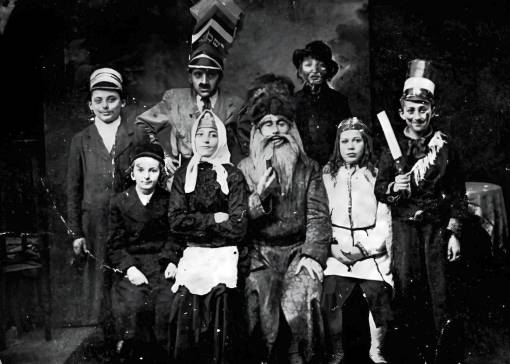
“The Binding of Isaac”
Performed after Chanina's era, however his spirit was recognizable in this performance
|
[Page 193]
by Meltza Shindelheim (Flick)
Our family was Zionist. Father conducted himself as a traditional Jew; however, he could not identify with those who held that true Judaism must be anti-Zionist.
To our dismay, we were forced to hide our ideas on this matter, for these ideas were improper in the eyes of the community of Lizhensk. They were improper, that is, until Chanina Glicksman came on the scene.
Chanina was the son of a poor family. His father was a poor tailor, whose whole family, including a married daughter with her family, live in one room. Chanina grew up in this room, under such circumstances.
Chanina received his education in the “Cheder” (traditional elementary school), and did not continue further. However, his creative spirit and his many talents drew him to the world of creativity and expression, even though he was not able to spend his time on completing his formal education.
He was very young when he began his communal activities in the city. At first, he tried his hand at writing lyric songs, however later, he felt that it was not a time of song for Israel, and he changed his course. He began to capture the masses around him with the idea of changing the anomaly in the national life.
Most of Chanina's efforts were directed toward the youth. He attracted the youth, worked together with him, and spread out his blessed activities to all branches of activity for them.
|
|
|
“The Binding of Isaac” Performed after Chanina's era, however his spirit was recognizable in this performance |
[Page 194]
He set up the first theatrical troupe in the city, organized flower days for the various Zionist organizations, and founded the “Tarbut” library which turned into an important public educational institution. On top of all this, he set the foundation for financial success of the Zionist movement.
The interesting thing is that with all of these activities, he did not lean toward the left, which was beginning to become an important force in the city and the area. Through his clear thought and his intellectual power, he deduced that Zionism was first and foremost the solution to the problems of the Jewish nation. He was not swayed by personal interests, and he did not deviate from his ideas. He did not attempt to sway the masses through personal means, which testifies that his weltanschauung was created by deep thoughts and ideas, and not as a result of personal reactions to the conditions of life, circumstances, education, etc.
The dynamism and unquenchable activism of Chanina were felt in the city immediately as he appeared on the scene, and caused much upheaval in the conservative groups. He was officially excommunicated by the leaders of the community, and the youth in the homes were forbidden from coming into contact with him. However, this was to no avail. He had a special charm, and it was difficult to stand up against him. The multitudes followed after him, and his influence was deep. His deep and strong will broke down any obstacle in his path. He never stopped even once along the way as he attempted to realize his objective.
The youth were captivated by him. Thus, Zionism arose in the city, and began to accelerate in its activities.
Evening parties were arranged on occasion, and the youth felt that this was the salvation for their youthful energy, which was stifled by indifferent parents, or parents who followed the pressure of the community.
The parties, which took place in the Ukrainian hall, also attracted Ukrainians. People from the area surrounding Lizhensk, from Lancut, Niska, and Rzeszow came to town for these parties, as if something was missing in their towns. Thus, his activities affected the areas surrounding somnolent Lizhensk, and his influence was felt very clearly in a radius of kilometers around our town.
The proceeds from these parties supported important Zionist activities. Simultaneously, other movements did not succeed financially, and their influence weakened day by day.
As I remember Chanina's fiery speeches, full of imagery and content, I think about where they took place. He never appeared in the synagogues, he was always forced into small rooms, where the youth gathered in a crowded manner. However, he never tired, and after a short period, he found other means in the city, and we all gathered together to hear Chanina. Each appearance of his was filled with novel ideas, and broadened our vistas. The small rooms in which Chanina appeared became too small to hold the crowds of youth who came to hear his speeches.
Chanina set up the library in a room that he rented on the other side of the wall of the house of Reb Shmuel Tzitzer. We gathered there, occupied ourselves in literary discussions, sang, danced, debated. This room was full of life.
[Page 195]
I remember when Shmuel Tzitzer would become angry and shout at us “shkotzim, shkotzot, stop the licentiousness.”[1] We were afraid that he would bring the situation to such a point where the hall of our activities would be destroyed or confiscated. However, we brought him to the library so that he could see with his own eyes the type of activities we occupied ourselves with, and he calmed down. Due to his foresight, he agreed to our activities with one condition, that “we should not go out to cool off in couples”, for “dancing is dancing, and there is no danger, Heaven forbid, however the danger is in going out to cool off”[2].
Chanina earned his livelihood as a foreman in the local sawmill, and he was also the agent of several organizations. His economic situation was strong. We wondered as to how he had further strength for this effervescent communal activity.
He got married and moved to Przemysl, and when he left, he took with him much of the taste of Zionist life in the city.
As I was told, Chanina Glicksman perished in Przemysl, along with all the residents of that city.
Translator's footnotes:
by Leah Braude
|
|
|||
|
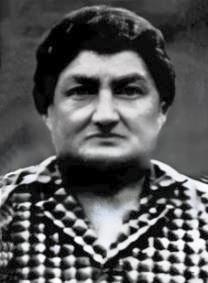
The wife of Reb Asher Shochet of blessed memory |
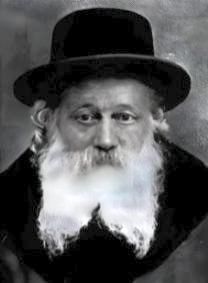
Reb Asher Shochet of blessed memory |
My grandfather made his nights like days and studied Torah. His tune[1] in the nights is woven in the depths of my dreams, and adds to their sweetness. I loved him for he was always goodhearted, and he smiled at me with a smile that imparted pleasantness whenever I desired a smile. When I grew up a bit (I only knew him until age twelve) I began to revere him as a man who was like no other person, as a unique man who possessed an additional soul. I began to revere him from the time of the incident with Motia Hertz Moshes. Grandfather Reb Asher would invite home on occasion various ragged guests whom nobody else would like to have at their table. He would bring the person home, seat him down next to himself, and share his meal equally with him. Often, the family members would complain, however this was to no avail. They once became very angry when he brought Motia home, and insisted that Motia should eat with us twice a week. Motia was the town fool of Lizhensk, an abandoned and forsaken youth whose stench could be smelled from a distance. We all refused to sit with him at the table. Rumor had it that his stench was due to a skin disease akin to leprosy, which was known to be contagious. We could not dissuade grandfather from this, for he said “who is fitting for the redemption if not one who understands the suffering of his fellow”, “in the merit of love of one's fellow Jew, we will be redeemed”. These were his retorts, and Motia sat by grandfather's seat at the table for quite some time.
When I grew up it became known to me that his tune in the nights was not only the tune of Gemara. Grandfather carried this tune to the depths of mysticism and Kabbalah, and was known as one of the Kabbalists of the area.
[Page 197]
He regarded his work as a means of livelihood that was forced upon him, through which he could support his family. He was comforted by the fact that his work increased the number of people who would eat kosher food, and this was more important than anything. However, this was not the most important thing, for a person should not spend too much time earning his livelihood. Whatever G-d prepares is prepared, and the rest of one's time one should devote to the fulfillment of the commandments. We are not to choose between commandments, for any commandment that comes one's way one should fulfill. It is not sufficient to fulfill the commandments, but through the commandments, one must treat the commandments as if they were people. Just as each person has the right to life and sustenance, so does each commandment have the right to sustenance and fulfillment. One must seek commandments which are forsaken, Heaven forbid, and fulfill them.
Every so often, he would disappear and go the cemetery, which was to the right of the synagogue. He would spend hour after hour there cleaning the gravestones, and making the inscriptions clearer. Since the gravestones are markers for the soul and placeholders for the time of the resurrection of the dead, it is important for the gravestone to be clear and the inscriptions conspicuous.
When the Messiah comes, each minute will be precious and holy, and it would be a shame if time would be wasted on clarifying the blurred inscriptions.
Once, he took me to the cemetery, and allowed me the merit of establishing the monuments. He explained to me thus: “Death is nothing but the natural continuation of life, and if we love a life of cleanliness and being cared for, we must give this also to the dead. We must look after the gravestones, just as we look after our own homes…”
At his request, I weeded the grass surrounding the graves. There was no end to his contentment. From that time I realized that grandfather was not afraid of death. He awaited it, and prepared for his death just as one prepares for other milestones.
Once he described me an event that took place to him when he was saved from the Cossacks who tried to kill him during the days of the First World War. The entire family escaped to Czechoslovakia due to the fury of the murderers. He alone remained behind, and continued to serve as the shochet (ritual slaughterer) of the town. The Cossacks invaded, and the fear of death fell upon everyone. Grandfather believed that he also would die in the war, so he went to the mikva (ritual bath) to purify himself before he was to come before the Throne of Glory. Along his way, the Cossacks saw him from afar and followed after him. When he arrived at the mikva and jumped inside, the Cossacks arrived. They looked and looked, but could not find him. He had plunged into the depths and was not to be found anywhere. The enemies retreated, and he was saved. As can be seen, he was only saved through the merit of the commandment “wash yourselves, and become meritorious”[2], and he was certain that it was through that commandment that he was saved from death.
When the Germans entered Lizhensk, they burnt the synagogue, and were about to burn our home, which was close by. They found that there were about two dozen Jews who had gathered in grandfather's house to finish their prayers. After they investigated and found the worshipers, and it was told to them that grandfather had made his house open for the needs of prayer, they chased away the other people and left grandfather locked up inside. They kept the key. A few minutes later, they surrounded the house with bundles of straw and rags soaked with kerosene, so that they could burn down the house with grandfather inside. My sister, who was then a girl of sixteen, began to weep and to beg the Germans to free grandfather. If the house was condemned to be burnt, at least grandfather should be spared. The Germans did not pay attention to her, and were about to fulfill their intent, when at the same time, the neighboring gentile woman joined my sister. She was afraid that her home would catch fire as well.
[Page 198]
The Germans returned the key to my sister and removed the flammable material from around the house, and grandfather was again saved from a certain death.
On the day that the Jews of Lizhensk were commanded to cross the San and leave their town, the atmosphere was laden with a sense of looming disaster and tribulation. The Jews gathered in the market square with heavy hearts and despair. Everyone held on to their family members as a last hope, as the bonds of the community were breaking up. Everyone searched for their family members, so that they would not be separated, Heaven forbid, from each other. Groans and sighs could be heard from everywhere. Suddenly we realized that grandfather was not with us. The order was given that anyone who would not join in the crowd who was leaving was to be shot. We were afraid of our lot, and we were unable to search for him without being shot ourselves. At the last moment, as we organized into rows for the gloomy march, he appeared next to us, calm and filled with family warmth. He was wearing his clean Sabbath clothing, and had his tallis and tefillin bag with him. We criticized him as to how he could have frightened us such, and roamed around when there was such a mortal danger. He smiled and mocked us:
“What is all the confusion, for it is impossible to believe these murderers, however, perhaps they do indeed intend to kill us. Therefore I went to the mikva to purify myself, and now I am ready and prepared if this is the will of our Creator, the Creator of the world who determines the fate of man.”
When we crossed the San, we continued to wander in the direction of Przemysl. Grandfather was a native of Przemysl, and he decided to remain there until the storm would pass. After we took leave of him, we never met again. He succumbed to the murderous Nazis.
Translator's footnotes:
by surviving members of his family
|
|
|
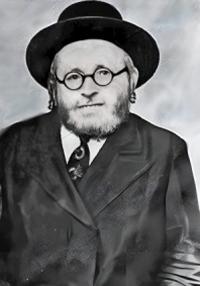
Reb Yoel Moshe Landau of blessed memory |
He was born in Strolisk in 1898 to his father Rabbi Yechezkel Landau and the Rebbetzin Chantche.
In his youth, he moved with his father to Lizhensk, and regarded Lizhensk as his native city, which molded his personality. In his youth, he was already noted for his special character traits, which singled him out from all of his friends. He was noted for his great intelligence and good heart.
As he became older, his father included him in the halachic deliberations that were brought before him as the rabbi of the city. His father would listen to his opinion, and often accept his advice.
In actuality, Reb Yoel Moshe conducted the rabbinic affairs of the city, and was a focal point for communal activity even when he was still young and supported at his father's table.
He busied himself with the establishment of the Talmud Torah in the city, and in the establishment of other religious schools. He would seek out solutions to the personal problems of the many people who would turn to the community for assistance.
As he was engaged in traditional studies during his youth, he did not have a chance to formally study the language of the nation. Nevertheless, he had full command of the language, both in terms of reading and writing, and his letters were known for their style. They inspired honor and they “opened locked gates”, which had to be opened.
His proficiency in the Polish language helped him to become an expert communal worker, who maintained the link between the community and the government. He was the expert intercessor of the city. He spent most of his days writing letters for various people, not for remuneration. This was because people believed that his letters had the power to influence, and would bring the required assistance that was requested by those in need.
His expertise in intercession helped him in his relations with the governing authorities, both with regard to the community and private individuals.
[Page 200]
His achievements in these areas were great. However, his most significant achievement was his success in attaining a discount for railway tickets for the multitudes who came to visit the grave of the Tzadik of Lizhensk.
Due to his intercession, he succeeded in obtaining a discount of 50% off the price of the railway tickets. This brought a blessing both to the city and to the government. As a result, the number of travelers increased from 2,000 to 15,000. Everyone was thankful to him for this.
Reb Yoel Moshe Landau was in Lizhensk for only two years after his father's passing. In 1939, he was forced to leave his beloved city and to wander to far off places, which were strange to him as well as to the other people. He waited for the future that was not to be.
Prior to leaving Lizhensk, he had opportunity to feel the force of the Nazis, who tortured him and disgraced his signs of Jewishness[1].
Reb Yoel Moshe and his family tarried for four months in Strovitz, near Brody. From there he was taken with many others to Siberia, where his personality, rich in feeling and great of soul, was in full evidence. His lofty spiritual stature stood out there.
He suffered many difficulties in Siberia, due to his efforts to maintain his and his family's Jewish practice, to avoid of working on the Sabbath and to avoid eating non-Kosher food. Despite all this, his spirit was not broken, and all of his efforts were given over to saving Jews, and establishing means for the preservation of Judaism.
Immediately upon arriving at his place of exile, where many Jews were gathered without any central place to look after their communal affairs and without any way of protecting their Judaism, Reb Yoel Moshe began to establish the religious life of the exiles, and to conduct public prayers with great self sacrifice and sanctification of the Name of Heaven. The prayers were conducted in his hut, and his children stood guard so that the N.K.V.D. and other non-Jewish informers would not pay attention to the worshippers.
Close to Passover, his family began to receive matzo from various places who concerned themselves that Reb Yoel Moshe would not have to eat chometz (leavened products) on Passover. However, Reb Yoel Moshe immediately took the fifteen packages that arrived at his place, and sent them in the hands of his children and associates to distribute to various families. He gave out a few matzot to each family, so that the Jews would not forget the commandment of eating matzo. He told his own family that it was not important if they themselves would not have matzo for the seder, firstly “because we are aware of these matters, and we will not forget”, and secondly “because for most of these people who were receiving the matzot, this would be their only morsel of food to break their hunger, and the hunger of their young children”.
Similarly, at risk to his life, he also fulfilled the commandment of erecting a Sukka on the festival of Sukkot. This was with the clear calculation that the fulfillment of these commandments was essential to the continuation of Judaism.
Unlike his fathers before him, he was liberal in his outlook. He kept his distance from exaggerated zealotry, and he opposed undue strictness in halachic matters, which tends to bring along with it hatred of Torah and Judaism. However, despite all of his liberal leanings, he was very careful with his own Jewish practice, and did not let his liberal attitude affect his personal fulfillment of the commandments as they should be.
Towards the end of the war, the exiled Jews were liberated, and Reb Yoel Moshe moved to Uzbekistan. Fate brought him to the town of Yangiol, where a unit of the Polish army was stationed. Obviously, many Jews came to that place in an attempt to be accepted to the Polish army, and thus to release themselves from their difficult exile in Russia.
[Page 201]
When a Jew came to this town, he knew that the address to go for a respite when he was in this town was the home of Reb Yoel Moshe Landau. Anyone who was in Uzbekistan knew how much danger was involved in hosting strangers overnight in their homes. However, Reb Yoel Moshe knew how to fulfill the commandment of receiving guests appropriately, which was fulfilled with clear sanctification of G-d name.
During his wanderings in Russia, Reb Yoel Moshe wrote himself the texts of various Jewish documents, such as marriage documents (ketubot), and other such things, so that G-d forbid Jews should not stumble upon versions of these documents that lacked the authority of tradition, especially in the area of marriage. There was a great danger of this happening in Siberia. Reb Yoel Moshe reached the epitome of his preservation of traditional Judaism by writing and arranging by himself a daily calendar for the establishment of the festival dates. He did this work with great expertise, as a continuation to the previous calendar which he had. This “calendar of testimony” is preserved to this day in the hands of his family, and serves a true testimonial to Reb Yoel Moshe, to whom Judaism and its appointed seasons were an integral and inseparable part of his being.
He was freed and merited to go the Land of Israel in 1943. Immediately after his arrival, he began to organize help for the Jews who remained in Russia. He already began these activities when he was in Tehran, on his way to the Land of Israel.
His impending aliya was known to his family members, who had much influence in Haifa. They contacted him immediately, and found him an honorable position in Haifa, as well as ample living quarters. However, he did not accept this, and he chose to live with his family, consisting of four people, in a dwelling with one room and a courtyard in the Mea Shearim quarter of holy Jerusalem. He explained his refusal to his family members as follows:
“I myself am not worried about the influence of Haifa, however I am afraid for my family, and I will not endanger them in that manner. I do not need a position of authority, and to make use of the crown of Torah, in holy Israel. Our place is in Jerusalem, and it is a great privilege to be able to live in such a holy atmosphere.”
In the land of Israel, he devoted himself fully to matters of saving Jews and establishing connections between lost family members. He spent a great deal of his own money in sending telegrams to Russia and other parts of the world.
Reb Yoel Moshe of holy blessed memory passed away on the 2nd of Nissan, 1952. He was the last descendent of the rabbis of forlorn Lizhensk. He died after a difficult and lengthy illness at the untimely age of 53.
Translator's footnote:
by Elimelech Ronen (Honig)
Dedicated to the memory of Rabbi Moshe Landau of blessed memory
This took place in the year 1942 or 1943. We were at that time in exile in
Russia, in far off Siberia, and the Second World War was at its height.
On one of these icy days, we received a notice from the post office that a package came for us. How great was our joy when it was revealed to us that this package was from the Land of Israel, and who the sender was! It was one of our brothers from the town of Lizhensk, Rabbi Yoel Moshe Landau, who stood at the head of the committee for the assistance of the Jews from the town of Rabbi Elimelech.
At that time, it was wondrous in our eyes how Rabbi Yoel Moshe succeeded in finding the locations of survivors of Lizhensk. We suddenly felt that if Jews such as this know about us, hope is not lost, all of the suffering which came upon us was not for naught, and that we would still, with G-d's help, merit to see the forthcoming redemption.
The event of opening this wonderful package, which arrived to us from Jerusalem, which was so far away, yet so close to our hearts, is still in my memory today. This package had all sorts of delicacies and objects inside, all products of the Land of Israel. Especially etched in my memory is a tube of toothpaste manufactured by “shemen”, which was enclosed in a round, beautiful box, upon which was engraved the symbol of the “Shemen” factory – an old symbol with Hebrew letters floating around it. Even if somebody could imagine that we use this toothpaste for the purpose that it was manufactured, who could permit this luxury to himself? We guarded this precious box with toothpaste inside for many years as we would guard a precious treasure. There was not one Jew in our neighborhood who did not feast his eyes on this object – through it, we could see the far off Land of Israel which is waiting for us, into which would be gathered the scattered remnants of our nation at the conclusion of this terrible war, with us among them.
Indeed, when 1945 came, and there was a full victory against Nazi Germany, tens of thousands of survivors arrived to the gates of our homeland, and fulfilled the verse “and the children shall return to their borders”[1].
I waited a long time for the chance to come, to arrive to the Land, to ascend to Jerusalem and to thank Reb Yoel Moshe Landau, the precious man, who sustained our souls in the depths of famine filled Russia, and inspired us with a hope in life, through whose strength we were able to overcome all kinds of desperate situations.
In 1948, I left my parents in the displaced person's came in Austria, and I was one of the first to volunteer for the army of Israel. I was fortunate that I was able to fulfill with my own body the commandment that is holier than all others – the participation in the War of Independence. However, many long days passed, and I was not able to visit him.
On the first opportunity that arose, when I succeeded in obtaining a short furlough from my duties in the Israel Defense Forces, I made haste and went to Jerusalem. I immediately searched for the address of our rabbi from Lizhensk, Rabbi Yoel Moshe Landau. His encouraging package that was sent to Siberia was still etched in my mind, even during the stormy days of our war of national independence. With quick steps, trembling and full of emotion, I ascended the steps and entered
{Page 203]
his home. I only met at the house the Rebbetzin and his son Velvel, for the rabbi himself was in the hospital.
I sat in this house for quite some time, and described all of the events that took place to us during the war. Since I could no longer remain in town, I requested that a hearty “Yasher Koach”[2] from my family, and from the other Lizhensk natives, for his holy work during the time of the war. I said that this will not be forgotten from our hearts even with the passage of many years, and at the first opportunity that arises I would come back to express my feelings of thanks to him. After several years, when I was able to come to visit him, the news came to me that Rabbi Yoel Moshe passed away after a lengthy illness, and once again, I was denied the opportunity to visit him.
May his noble deeds serve as a sign and example of true brotherhood between Jews, may we educate our children about the paths which accompanied us for generations, and may they derive the strength to stand up to the various challenges that may come.
May his memory be forever.
Translator's footnotes
by Dov Ausabel
|
|
|
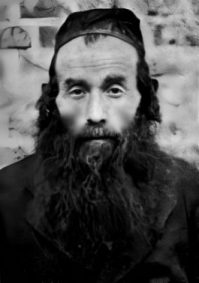
Reb Yosef Ausabel of blessed memory |
Reb Yosef was an accomplished scholar, however the situation came to be such that he exhibited a trait that is very rare among scholars. He served scholars.
He was a part of the social landscape of Lizhensk. There was no event in the town that Reb Yosef did not participate in. There was no societal event in the city that Reb Yosef was not welcome and present at. He was welcome by everybody, and he was present due to the sense of duty and the desire to be together with everybody.
During the First World War, he served in the Austrian army and was always careful to keep the dietary laws. He did not eat any forbidden foods. He donned his phylacteries (tefillin) and enwrapped himself in his prayer shawl (tallis) with great Jewish pride, during any circumstances and in any place, whether in the camp or at the front. After the war, he came out alive and well, however he returned to his town with no means of livelihood, and was forced to struggle for his livelihood, with great difficulties, and with overlooking his personal dignity as well as his great erudition. Nevertheless, he made great efforts to give his children a full education according to his outlook. He fulfilled his duty as a Jewish father, and never once became angry or short tempered.
He watched his character traits, as a Jew should, just which were recognizable symbols of his weltanschauung.
In Siberia, he was brought to trial for praying with a quorum (minyan), however he stood up for his rights, and did not relinquish his right to prayer. In the port of Omsk[1], I was an eyewitness to a scene which will not soon be forgotten by me: A Jewish worker, who was educated in the bosom of the Russian revolution, who abandoned religion and hated those that observed it, came to him during his prayers, and with tears in his eyes said to him, that his Jewish image
[Page 205]
which is recognizable externally and his self-sacrifice for his Judaism made a deep impression upon him which reached to the depths of his soul.
His pining for Israel was always very deep, and it became a very concrete hope, which his soul could not turn away from.
I saw in Jerusalem a letter that he had written to his son Simcha, in which he mentioned that he is like Jacob our father, who sent his son Joseph to prepare form him a place and to clear the path for him to make aliya to the Land.
He did not fulfill his objective, for he died in Tashkent. The terrible hunger took its toll upon him. He died far away from his desired Land, in cruel circumstances, on the 15th of Adar, 5702 (1942).
He was a straightforward Jew, who was great by virtue of his straightforwardness.
May his memory be a blessing.
Translator's footnote:
by Dovid Steinbok
Lizhensk was not known as a Hassidic town, as were the nearby towns of Lancut and Przeworsk. Nevertheless, the Hassidic courts were represented there, particular the Galician Hassidic courts, such as Rozwadow, Sienawa, Czortkow, and Belz.
The latter group was prominent in the city, and was the most organized. This group did not have any political inclinations, however their extreme orthodoxy, which caused them to turn a deaf ear to any new winds that would blow, turned them into the leadership of the political opposition in the city. This was particularly due to the fact that, among them were honorable, truly G-d fearing and learned men.
These Hassidim would gather on the yahrzeit days of their Admors from the Belz dynasty, on the 22nd of Cheshvan, and the 23rd of Shvat. They would hold a sacred meal, on occasion at the home of Reb Yechezkel Landau, and on occasion at the home of Reb Shalom Atner, our ritual slaughterer (shochet).
They had opportunities to get together on two other occasions during the year, when the collector would come to collect dues for the court of the Admor. The collector was Reb Shlomo Zucker of Sokol, who was a scholar. He would make sure to come toward the end of the week so that he could spend the Sabbath in Lizhensk. His coming would be considered a great honor, and he would stay with the rabbi of the city, Reb Yechezkel, who would seat him at the head of the table. All of the Hassidim would come to hear words of Torah from him, as an emissary of the Admor.
From among the Belzers, the personality of Reb Dovidel Rothman stood out. He was the son-in-law of the elder rabbi, Rabbi Yoel Moshe Segal Landau, the head of the rabbinic court of Lizhensk, as well as the uncle of the rabbi of the aforementioned rabbi of the city.
Reb Dovidel Rothman came from an established and respected family. He excelled in three matters. He would hasten to do any good deed, he satisfied himself with little, and he was of pleasant manner. His entire life was given over to learning and good deeds. Every morning, he could be found bending over a book, whether in the summer or the winter. In the morning, he would hasten to collect money for charity, money for Passover for poor people, money for poor brides, and other such needs. For his entire life in the city, he served as the trustee and treasurer of the charity of Rabbi Meir Baal Hanes – Kolel Galicia. This position was considered one of the most honorable and respected among the orthodox people of Poland.
Aside from the rabbi and Reb Dovidel, the Belzers included the son-in-law of Rabbi Menashe Frankel, Reb Mendel Rothman, Reb Chaim Nussbaum, Reb Shalom Shoub, Reb Meir Steinbok, Reb Shmelke Horshovski, Reb Zvi Ringel, and Reb Anshel Ringel. These men took played their rightful role in the community of Lizhensk, and brought honor to the community.
[Page 207]
Kahal Adat Yeshurun of Lizhensk, its Rabbis, Judges, and Parnassim (administrators), as we Remember them
Throughout many generations, starting from the Babylonian exile, throughout all of the eras of the Jewish Diaspora, autonomous Jewish institutions existed, through which Jews looked after their national identity, their culture, and way of life. It is understood that during the thousands of years of exile, there were ups and downs with respect to the independence of the communities, periods of widespread authority, as well as periods of constricted authority. There were high periods with exilarchs[1] and princes to lead the nation, and there were also periods of oppression, discrimination and being downtrodden. After the expulsion from Spain, the Jews were very careful to move their institutions to their new places of residence, and to guard them as the apple of their eye.
During the last 200 years, the communities of eastern and western Europe flourished and grew. They were a splendorous continuation of the Council of the Four Lands in terms of organizing charitable, assistance, and educational organizations. They were able to stand firm before any oppressor.
After the First World War, with the breakup of the Austro-Hungarian Empire and the Bolshevik revolution in Russia, in whose boundaries were contained most of the population and institutions of European Jewry, the lives of the communities changed for the worse. The definitive cutting off of Russian Jewry and the establishment of new nations on the former territory of the Austrian Empire, negatively affected the organizational structure and abilities of the communities, and limited their activities.
The Polish government under the leadership of Pilsodoski did not significantly restrict the cultural autonomy of the Jews, however the following government, that of the Colonials who cast glances toward Hitlerist Germany, began to oppress the communities. The situation reached the height of difficulty with the ban of Jewish slaughter on the advice of the merciful woman Prisorba. The haters had many other similar plans up their sleeve, and only the events of the war prevented them from realizing these plans. What the Poles did not succeed in doing, the Nazis, may their names be blotted out, finished off. With the liquidation of the Jewish community of Poland during the time of the holocaust, the end came to all of the wonderful institutions of Polish Jewry.
These are the names of the people who served in elected positions in the community during the course of the final fifty years:
Rabbi Yechezkel Segal Landau of blessed memory, the head of the rabbinical court.
Rabbi Shmuel Birenbaum, of blessed memory, rabbi and head of the rabbinical court, and an Admor.
Rabbi Menashe Frankel of blessed memory, the final head of the rabbinical court.
Rabbi Yoel Moshe Landau, the son of Rabbi Yechezkel, who inherited the rabbinical seat from his father after his untimely passing in 1938.
The Tzadik Reb Menashele the son of the Tzadik Reb Tzvi of Rozwadow, of holy blessed memory, who was the Admor of the Hassidim of Rozwadow.
The Tzadik Reb Baruchel Horowitz the son of the Tzadik of Mielic. He was the heir and son-in-law of Reb Chana, who was known as “Reb Melechs”, one of the grandchildren of Rebbe Elimelech of holy blessed memory. He led the synagogue of his Hassidim and supporters.
[Page 208]
The ritual slaughterers (shochtim) of the city were: Reb Asher Aroik of blessed
memory and Reb Shalom Atner.
The Parnassim of the community, in order of their service, were as follows:
Reb Naftali Weinman of blessed memory
Reb Yitzchak Shpatz of blessed memory
Reb Kalman Shpatz of blessed memory
Reb Zalman Nartzizenfeld of blessed memory
Reb Kalman Shpatz of blessed memory
Reb Meir Moshe Engelberg of blessed memory
Reb Meir Steinbok of blessed memory.
In the spring of 1939, when there was a dispute over the rabbinate, the regional government in Lancut deposed the elected communal council and replaced it with a government commissioner (Regierungskommissar), headed by Mr. Isidore Izrael.
Translator's footnote:
|
JewishGen, Inc. makes no representations regarding the accuracy of
the translation. The reader may wish to refer to the original material
for verification.
JewishGen is not responsible for inaccuracies or omissions in the original work and cannot rewrite or edit the text to correct inaccuracies and/or omissions.
Our mission is to produce a translation of the original work and we cannot verify the accuracy of statements or alter facts cited.
 Leżajsk, Poland
 Yizkor Book Project
 JewishGen Home Page
Copyright © 1999-2026 by JewishGen, Inc.
Updated 04 Apr 2026 by OR