|
|
[Page 303]
[Page 304]
[Page 305]
by E. Lebnshul
With the extinguishing of the radiance of our hometown of Kobryn, and with the bestial destruction of our dear and beloved families, special significance attaches to the Kobryner descendants, scattered across the world, among whom the sacred memory of lost Kobryn lives on.
Sparks of contact with the old home leap from one community to another, and the Kobryner descendants share a Kobryn spirit through their international contacts.
Many years before the First World War, emigration from Kobryn had already begun. The unstable circumstances facing many young people of Kobryn drove them to emigrate. Most of them settled in the then distant America, seeking their fortune in that land.
During the first years between the First and Second World Wars, emigration increased even further as a result of special economic discrimination and persecution. The hopeless material conditions strongly impelled people to leave. Hundreds of young Kobryners emigrated to America, Erets Yisroel, Argentina, Cuba, Canada, and other countries.
Most of those who emigrated to the various countries of the Americas became more or less successfully established. A considerable number climbed the industrial and commercial ladder and attained positions of prosperity and success. Not a few achieved professional distinction in technical, medical, and educational fields.
The largest center of Kobryner descendants is in the United States. Second place in the ranking probably belongs to Israel; Argentina comes third, followed by Canada, Cuba, Brazil, Uruguay, and other countries.
According to unofficial statistics, or rather according to current estimates, there are about 3,500 souls, consisting of Kobryner descendants and persons connected with the Kobryners, that is, wives married to Kobryners, as well as children and grandchildren.
The Kobryner community in Israel numbers approximately one thousand souls, naturally including spouses as well as children and grandchildren.
The Kobryner family in Argentina may be estimated at some 750 souls. Adding to the above figures some 500 Kobryners scattered throughout the remaining communities of the world, one gains the impression of a family numbering some 6,000 souls, descendants of and persons connected with the Kobryner root.
On the North American continent, we encounter with great satisfaction a number of Kobryner descendants who enjoy considerable prestige. One such figure is Professor Zaritski[1] (a son of Khane Zaritski of the dry goods store), who was among the first mathematicians to devote himself to the scientific study of the great discoveries of Professor Einstein, gaon ha-dor [preeminent sage of the generation], in the fields of mathematics and physics. During the 1930s, he was invited to the United States to assume a professorial chair at a university in Baltimore.
There is another Zaritski (a son of Zaritski the miller of Garber Street), who became a rabbi in a temple in North America. Also well known is our Kobryner landsman Pintshe Goldshmid, a university lecturer in the United States.
A particularly distinguished Kobryner figure was Professor Zalkind (a son of Zalkindtshekhe the shopkeeper), who was a professor and author of scientific and linguistic literature in England.
The same Professor Zalkind displayed remarkable mastery in translating the Talmud into Yiddish. He is discussed extensively in encyclopedias and has received considerable attention from historians.
Dr. Mukdoni portrayed Zalkind's life and character in a detailed and comprehensive sketch.
On the Israeli front, we should note
[Page 306]
a number of proud and courageous fighters and leaders. Well known to all of us is the dynamic figure of Sam Segal, a leader of General Zionism, who served as secretary of the World Federation of General Zionists. Sam Segal's visits to Argentina in connection with campaigns on behalf of Israel filled us with pride and stirred deep emotion. His activities in Argentina met with great success.
We wish to mention, with special significance, the following Kobryner personalities in Israel: Tsalke Shvarts, a profound scholar, left many notable pages in Kobryn in the ideological and educational sphere of Hashomer Hatzair, and today is actively engaged and widely respected in those fields in Israel.
The poet Biletski has won recognition and established a respected place for himself, and has been entrusted with missions to North America, a source of pride for our scattered Kobryner world.
I shall not dwell here on the worthy comrades of Argentina (other friends are already doing so). I wish only to add that the list of distinguished Kobryner personalities is far from exhausted. Together with all the Kobryner descendants, they form one large and widely branched family, which continues to exchange greetings through Kobryn sparks and draws sustenance from that past.
Translator's Note:
by Noach Priluk and Berl Adler
The emigration of Kobryners to Argentina began in 1921. Since immigration to North America involved a long wait for visas, Kobryners began emigrating to Argentina instead. The first emigrants were Vayner, Gvirtsman, and Lev. They traveled to Argentina with the intention of continuing on to North America. In fact, the first Kobryner emigrants eventually went on to North America.
Those Kobryners who remained, together with others who emigrated there in 1922 and 1923, formed the nucleus of the Kobryner family in Argentina.
The Formation of the Kobryners in Argentina
The years 1922, 1923, and 1924 may be described as the first years of Kobryner emigration to Argentina. The emigrants consisted almost entirely of young unmarried men. The only two families that arrived were the Lerner and Kleynerman families.
In 1924, Mrs. Malke Tenenboym also arrived as an entire family, coming to join her son Zeydl, together with her three daughters. The Tenenboym household became a gathering place for all the Kobryners who came to Argentina, especially on Sundays. Lonely in a foreign land, they sought a familiar corner where they could recall memories of their old home, and they found it with the Tenenboym family, where Mother Malke was like a mother to everyone.
Those years come to mind, when all the old hometown songs would be sung, and when the elderly Malke would prepare the table with homemade cake and tea.
Thus, immigration continued until the years 1926-1927, when married Kobryners, as well as families joining their children, began to arrive. Among the larger Kobryner families were those of Reb Yedidi Barenboym and Reb Mikhl Kemper of blessed memory, together with their families.
The years 1930-1939 may be regarded as the second and stronger wave of Kobryner immigration to Argentina. The economic crisis affecting the Jews of Poland, together with the boycott against Jews in all areas of activity, drove them to emigrate. During those years, a second mass emigration of Kobryners to Argentina began. Unlike the first
[Page 307]
immigration, which may be regarded as pioneering, the second wave found an already established Kobryner family there, one that extended a brotherly hand to the newcomers. They therefore did not feel as lonely as the first immigrants had.
In the history of the Kobryners in Argentina, the address Pukhol [Pujol] 1412 cannot go unmentioned. Six or seven Kobryners lived in that house. Among the Kobryners of Pujol whom we remember are the comrades Leon Avrukh, Yoske Bervikunkin, Noach Priluk, and Shmuel Gulnik, as well as the departed comrades Shmuel Lev and Rafael Kulerman.
From early Sunday morning onward, Kobryners (who lived in different neighborhoods of Buenos Aires) would gather there. They came together to learn who had arrived that week and who was expected to arrive. It served as an information center. Without exaggeration, it may be said that during that period there was not a single Kobryner who was not familiar with the house at Pujol 1412.
During that period, instances began to occur in which Kobryners came to one another's aid. One recalls the case of two Kobryners who were deceived by their agents and put ashore in Montevideo instead of Buenos Aires. Lonely and desperate in a strange place, they turned to the Kobryners in Buenos Aires and asked to be brought there. A fund-raising campaign was organized through Pujol 1412, making it possible for the two Kobryners to come to Buenos Aires.
In 1924, the Kobryner community was deeply affected by the death of the first young Kobryner immigrant, Noach Goldfarb, an unmarried youth of eighteen or nineteen.
Pujol 1412 intervened with the burial society, and Noach was buried entirely free of charge in Liniers. At the same time, the rabbi of Kobryn was informed of the case so that he could notify Noach's parents. His remaining belongings were sold, and the proceeds were used to erect a tombstone for him.
A separate chapter in the story of mutual aid is the case of Rafael Kulerman. After living in the country for two years, he became ill and had to have a leg amputated. Once again, Pujol 1412 took an interest in his situation. An artificial leg was purchased for him, and he was set up with a kiosk at the intersection of Kazhao and Koryentes [probably Callao and Corrientes]. After some time, he established himself near the Jewish Hospital with a kiosk selling cigarettes and fruit. He became known to all who visited the Jewish Hospital.
To the credit of the Kobryners, it must be said that they were always active and united in every case of need, always coming to the assistance of those who required help.
As time went on, the young Kobryner men began to marry, some bringing brides from the old home, others marrying local young women. A particularly strong impression was made by Berl the carpenter (Avrukh) when he brought a bride for his son Dovid directly from Kobryn. That bride was his present wife, Henye Kiselyov[1]. Out of respect for Berl the carpenter, nearly all the Kobryners attended the wedding.
Ignoring the advice to remain, and after spending five months with his sons Leyb and Dovid, he returned to Kobryn, where he was murdered by the Nazis together with the entire Jewish population of the city.
Economic Conditions of the Kobryners
Considering that Kobryn was not an industrial city, the emigrants naturally consisted almost entirely of people without trades.
Upon arriving in Argentina and realizing that they had to work, since here they no longer had fathers to support them, each of them began looking for an occupation. Some learned a trade, while others entered the installment-sales trade.
It is characteristic that a large proportion of the Kobryners took up the trade of house painting, and some of them have remained in that profession to this very day. The opposite also occurred: skilled craftsmen from Kobryn became merchants here.
As time went on, many Kobryner workers began going into business for themselves.
Starting out with a small workshop, working alone or with a single helper, they gradually expanded their workshops until they grew into factories. Today, we find large factories owned by Kobryners in various branches of industry. Thus, for example, it may be noted that the first Kobryner furniture factory was established by Leon Avrukh. In addition to the aforementioned landsman, among the major Jewish furniture manufacturers were the firms of
[Page 308]
Dovid Avrukh, Meylekh Yurozditski, Shraybman and Vaynerman, and others.
With the growth of the textile industry in the country, our Kobryner landsleit came to occupy a respected place. Among the leading textile industrialists were landsleit who owned their own factories, including Melech[2] Glotzer, Shmuel Epelboym, Natalio Shtilerman, Avraham Kornblum, and others.
In wholesale trade, the Kemper brothers occupied a prominent position. Operating under the firm name Gal-Prus, they manufactured their own plastic products, and their business extended beyond the borders of the country. Also occupying a respected place in commerce was our Kobryner Yakov Begun, with his furniture business, as well as the firm Prus, manufacturers of women's undergarments, owned by the husband of our Kobryner landsmanke [fellow native of Kobryn], Bayle Bereznyak de Prus.
In the provincial towns, there were also a number of Kobryners with well-established businesses and trading concerns. Among them were Yonah Permut of Tucumán, Shloyme Lev of La Plata, Shmuel Priluk of Médanos, and Pinkhas Lev of Posadas.
Generally speaking, the Kobryners enjoyed good material circumstances. A certain number could be counted among the wealthy. La Plata may be regarded as the second-largest center of Kobryners by number.
Participation in Social and Communal Life
Faced with the great and growing antisemitism in Poland and the increasingly restrictive immigration quotas of North America, which made immigration virtually impossible, the Kobryner immigrants in Argentina resolved to build permanent homes in Argentina.
They had to begin thinking about the future of the rising generation. Thus we find that some of the children of Kobryners, after completing elementary school, continued their studies until children of Kobryners also began to appear among Argentina's Jewish professionals. Among them we may note Dr. Shtilerman, an attorney, and Timyanker and Rozensheyn as doctors of medicine, while many others were still pursuing higher studies.
In the sphere of social and communal life, we find many Kobryners represented in political organizations, communal institutions, banking, education, and other fields.
Despite the fact that local customs were not suited to the traditional religious European way of life, we nevertheless find Kobryner families who preserved a traditionally observant religious life.
The Impulse Toward Organizing the Kobryners
During the years when everyone was occupied with establishing his own livelihood, and because of the vastness of Argentina, the Kobryners found themselves dispersed and scattered. Naturally, there was little opportunity for them to come together, nor was there an organizing force capable of creating an association that would bring the Kobryners together for a common gathering, a celebration, or any other purpose. The relief efforts carried out by the Kobryners, which we mentioned in the first part, were organized on an individual basis.
With the outbreak of the Second World War, when our region was occupied by the Nazis and the anguished cries over the murder and destruction of entire Jewish communities began to be heard, and knowing that the same fate had not spared our own city, the Kobryners in Argentina began drawing closer to one another and sought news of their families.
At that time, several Kobryners reached us after many wanderings. They had escaped from the Nazi clutches thanks to their daring flight in 1941 to Lithuania and the Soviet Union, making hazardous journeys through the Orient and Japan. These were Itsl Kobryniets and Nekhome Zalyuski.
After the first defeats suffered by the Hitlerite armies in Russia, and although Kobryn was still under Nazi occupation at the time, the idea arose among several Kobryners in Argentina to organize the Kobryners and establish a relief fund, so that, when the appropriate moment arrived,
[Page 309]
assistance could be given to our surviving landsleit.
At the initiative of Noach Priluk, letters were sent to landsleit calling upon them to come together and consider how aid might be organized for the survivors. At the first consultation, held in the home of Mr. Leon Avrukh, it was decided to convene a larger number of Kobryners and form a committee.
Because of the historical significance of this relief work, we reproduce below the text of the first protocol verbatim:
Protocol No. ISunday [sic], May 16, Buenos Aires
Considering the situation that had arisen, namely that upon the end of the war the surviving Jews of Kobryn would require assistance from us in order to alleviate their economic conditions and to help them rebuild their destroyed homes, a meeting was called, at the initiative of a group of Kobryner landsleit, to consider how to conduct a fund-raising campaign and, at the same time, establish a Kobryner Landsleit Association.
This meeting took place in the presence of the following Kobryners: Leon Avrukh, Berl Adler, Yisroel Bil, Yitskhok Lerner, and Noach Priluk. All expressed their views regarding the manner in which the relief campaign should be organized. After an extended exchange of opinions, it was resolved to convene a larger gathering of all Kobryners and their families in the form of a banquet on Sunday, June 10, 1945, and that at the banquet the relief campaign should be proclaimed and, if possible, the Landsleit Association as well.
On June 10, the banquet was held, and in the presence of nearly all the Kobryners, the relief campaign was proclaimed. It raised the sum of almost 10,000 pesos (at that time, this was a colossal sum).
To direct the relief work and to organize the Kobryner Landsleit Association, a provisional committee was appointed, composed of: Chairman, Leon Avrukh; Vice Chairman, Noach Priluk; Secretary, Itsl Kobryniets; Assistant Secretary, Aharon Khludnyevitsh; Recording Secretary, Berl Adler; Treasurer, Yakov Begun; Assistant Treasurer, Yisroel Blyezhovski; Board Members, Eli Belski and Yisroel Bil; Auditing Committee, Dovid Avrukh and Tevl Goldshal.
Under the direction of this provisional committee, all the work of the relief campaign was carried out until the first general assembly, which took place on Sunday, November 25, 1945, at the hall located at Nicasio Oroño [Street] 1669.
At that assembly, a committee was elected consisting of the above-mentioned individuals, together with Dovid Shraybman, Gedalyahu Bil, Yisroel Lerner, Yosl Garfinkel, Leybl Savitski, of blessed memory, Yakov Permut, Dovid Yurazditski, Yosl Vaynerman, and Syndic: Melech Glotzer.
Toward the end of 1945, letters began arriving from rescued Kobryners who were seeking to reestablish contact with their families or friends. At the same time, a letter arrived from our landsman Gedalyahu Bil, a living witness to the tragic destruction of Kobryn, who at that time was in Warsaw living under Aryan papers. The committee established contact with him and sent him a sum of money so that he could travel to Lower Silesia, where, at that time, many refugees were gathered, including a number of Kobryners. He was entrusted with distributing financial assistance to any Kobryner whom he might encounter.
With the transfer of our refugees to the camps in Italy and Germany, our association, then under the leadership of its dynamic president Yakov Begun, established contact with each landsman individually and responded to every request for assistance, both with money and with clothing. Thus, aid amounting to many thousands of pesos was sent to our suffering brothers.
In the course of our relief work, opportunities arose to bring refugees out of the camps. The association took advantage of these opportunities and brought nine Kobryner refugees to Argentina.
During the course of our existence, the State of Israel was proclaimed an independent state. The committee recognized the necessity of assisting the heroic Haganah army and
[Page 310]
the state authorities, and contributed the sum of ten thousand pesos to the State of Israel.With the growth of Aliyah to Erets Yisroel, many of our Kobryners also immigrated to Israel.
We then sent food parcels to our landsleit in Israel.
Our association also took part in assisting local institutions, as well as providing individual support to needy Kobryners.
Thus, for example, we are supporting members of the Jewish Hospital, the YIVO (Yidisher Visnshaftlekher Institut [Yiddish Scientific Institute]), and the Jewish Immigrants' Aid Association.
The association has now been in existence for six years and continues its work harmoniously. The secretariat of the Kobryner Landsleit Association is located in the home of Itsl Kobryniets.
|
|
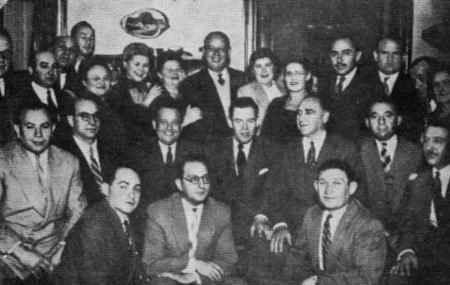
| The Executive and Invited Members of the Kobryner Landsleit Association during the visit of the distinguished landsman Sam Segal (Secretary of the World Zionist Federation) to Buenos Aires on a mission for Keren Kayemet LeYisroel [Jewish National Fund]. The guest is in the center and marked with an asterisk (*). |
Translator's Notes:
|
|
JewishGen, Inc. makes no representations regarding the accuracy of
the translation. The reader may wish to refer to the original material
for verification.
JewishGen is not responsible for inaccuracies or omissions in the original work and cannot rewrite or edit the text to correct inaccuracies and/or omissions.
Our mission is to produce a translation of the original work and we cannot verify the accuracy of statements or alter facts cited.
 Kobryn, Belarus
 Yizkor Book Project
 JewishGen Home Page
Copyright © 1999-2026 by JewishGen, Inc.
Updated 3 Nov 2026 by LA