 |
|
|
[Page 199]
Translated by Esther Libby Raichman
You will Indeed Remember !
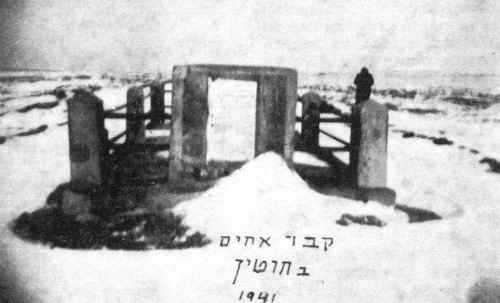
In Jewish Khotyn that was destroyed, there is a mass grave, a vestige of the wild animals of the Romanian army, who were Hitler's admirers and accomplices.
In Jerusalem, on Mount Zion there is a symbolic communal grave, in memory of the six million that bears the name “The Cellar of the Holocaust”. There are tombstones for the destroyed Jewish communities in the diaspora. The Khotyn community also has a tombstone in the “The Cellar of the Holocaust”.
Six million Jews were killed, slaughtered, burnt, annihilated in the most gruesome manner, as if they had never been human beings.
In this sea of tears and ashes, there is also a drop called Khotyn.
All Jews who were annihilated must be mentioned in a memorial book about one of the ravaged communities.
Europe became a sad cemetery, in which the graves of the martyrs were spread; the mass grave in Khotyn is only a link in the chain.
We need to remember that Asmodeus[1] wanted to erase every trace of the Jewish people from the earth.
The accursed army of Asmodeus reached the gates of the Land of Israel. The Arabs, Hitler's allies, openly declared: we will slaughter the old, the children, and the men, we will confiscate all their possessions, and we will turn the women into servants.
The Asmodeans were defeated before they invaded the Land of Israel, and in this way, we were saved from a third destruction. The State of Israel arose on the soil of the Land of Israel. The Jewish army is the symbol of Israel's security. A red thread links the generations from Yehoshua Bin Nun, King David, the Maccabees, Bar Kochba, the Diaspora, the exiles, the return to Zion, the period of the extermination of the Jews [by the Nazis], the uprising in Zion – until the establishment of the state.
Here in the State of Israel we can mention those who perished that were dear to us. This is not possible everywhere in the world, but here we have the opportunity, thanks to those who dreamed of the rebirth of Israel. There was a time when most of our people in the Diaspora led their daily lives, when the clouds of destruction were not yet apparent, or if they were, most did not recognize them. The few who saw what would befall us, were angry even at the thought of “a calm and productive Diaspora”. They dreamed of national pride, and of freedom on Zion's soil.
There were also those who showed open hatred towards Zionism. We mean the yevsekkes, Jewish members of the Communist party in the U.S.S.R. who took every opportunity to betray Zionists and hand them over to the Soviet authorities. Let us not forget the Prisoners of Zion ! They sacrificed themselves for the glory of Israel. In the prisons of the Soviet Union, and in the Arab lands, they carried on high, the flame of Israel's rebirth.
On this national flag and on the flag of national catastrophe, we must remember Jewish Khotyn.
In this book we mention Khotyn, those who were dear to us
[Page 200]
who perished; those closest, and those more distant. The older ones among us, still remember the government of the Tsar, and the younger ones, the Romanian government. Both remember well, the Soviet “paradise”.
There in Khotyn, Russian was spoken, Romanian, and also Yiddish, of course. There were also those who studied Hebrew, that later became the language of those who dreamed of Israel's rebirth in their fatherland.
At school the students learned what it was to be Jewish – “Zshidan Parshiv” – filthy Jew, they called us. When Goga-Cuza[2] came to power, and the swastika became the official symbol of the state, and hung in all the streets, the “Green Shirts” demonstrated and shouted anti-semitic slogans. When it became dark, the Fascists who gathered in the town's park preparing to attack, were beaten up and chased off by the Jewish youth, particularly the working Jewish youth who understood what would happen and were prepared.
This event however, ended quickly and the Jews were saved from pogroms. King Karl, who brought the Goga-Cuza government to power, that was supposed to take the place of the “Iron Guard”[3] with its anarchy, capitulated to the voice from the other side of the Dniester River, and put an end to the Fascist government. Kodre'anu the leader of the “Iron Guard”, was killed. Yet Hitler's admirers in Romania, still hoped that their day would come.
After the ultimatum that Moscow sent to Bucharest, the Soviets entered Bessarabia, and pogroms against the Jews began in Romania. The Jews were accused of selling Bessarabia to the Russians.
Those who were unable to realize their dream of emigrating to the Land of Israel, for various reasons, and remained in Bessarabia, began to suffer persecution; some were sent to Siberia, some were thrown into prison, and the rest suffered their cruel daily lives. When the Germans attacked the Soviet Union, the Romanians turned back to Bessarabia and began another cycle of persecutions and expulsions. The synagogues were burned, Jewish houses were plundered, blood and fire were the Jewish fate, day and night.
When we remember the Jewish community of Khotyn, we must not forget what was done to us and our brothers, no matter where it took place.
|
|
| [Communal grave in Khotyn 1941] |
[Page 201]
The Russians Enter Khotyn ….
That Friday, at 6am, the Communist youth came out with flags in their hands, singing and dancing, making their way to the bridge over the Dniester River to welcome the Soviets, the liberators. The Romanians fled.
After the Soviets entered, the town fell silent, people disappeared, possessions were nationalized, and the economy went downhill. With each passing day, the queues for purchasing food grew longer. Romanian documents were exchanged for Soviet documents, that had signs regarding classes to which people belonged, that only the authorities could interpret.
On 13th June, two Soviet soldiers came to me and took my documents. This meant that in reality, I ceased to exist. We were taken to the command headquarters, and when we arrived there, we met other Jews: Tzvi Furman, Berish Gittelman, Yosef Mednik, Shlomo Dezshman, Shmuel Barak and his son Matityahu, Shleimke Feldman, Gershon Levinzon, and Shabtai Kleinman, and their families.
We were taken across to Novoselitz, and there we were put into train carriages. Most of the families were separated - men and women separately. I remained with my family. Some men were taken from the carriages, and to this day, there fate is unknown.
After travelling for two weeks, we came to a place where we experienced the Shiv'ah M'dorei Gehinom [The Seven Halls of Hell].[4] Some of our group actually died there.
In retrospect, I can however say, that the Siberian cold, saved me from the German ovens.
The Destruction of Jewish Culture in Khotyn
The Soviet regime that “made us happy” in 1940, immediately set about reforming our spiritual life. The new people in power, did truly not like our prophets, but they observed the biblical verse from the book of the prophet Jeremiah [chapter 1:10] in full “to root out, to demolish, to ruin, and to destroy”. They maintained that first, the ‘old' had to be destroyed and then built anew, so they actually began their destruction, aided by the local activists.
First, they removed the small blue and white plaque from the library. They ordered the “Tarbut” school to be closed. They demanded from those responsible for the school that the community hand over all the money that they had received as aid during that time, although the community had actually also been liquidated, and existed only to collect the debts.
This was not all. They said that they would still require an account from those responsible for the school, for the misleading education that the children were given. They did not live to see this.
These Jewish activists thought that all their bridges to Judaism were made of paper, and it was enough to burn the bridges, to detach themselves from everything that was Jewish. They were not satisfied with “uprooting”, they were of the opinion, that it was also their duty, to “ruin”. They destroyed without mercy. They threw all the Yiddish and Hebrew books from the Zionist library into the courtyard, in the mud, where the pigs rummaged. When we asked the former representatives of the “Culture-League” - “take the books home, rather let them lie there” – “No” they answered - “we do not need any Zionist culture !”
No one dared to take a book into their home, in case they would be suspected, God forbid, of being a Zionist. This was how the entire library was destroyed. The committee managed to destroy, but it did not manage to rebuild, as our sages said: no man can be both accuser and judge.
The Soviets are destroying the Jewish Community
When the Russians entered Khotyn in 1940, the spiritual life of the Jewish community was torn apart, one that had been preserved for generations.
A commission was immediately established to liquidate the community. At the head of the commission was Shaul Osher (Shulikl the dancer), a cousin of the cantor Moshe Osher. He said: it is a shame that we are not living in the period of 1918. Then we would have hanged all the Zionists and all the providers of the community, in the middle of the street.
The liquidating commission decided, amongst other issues, that the Zionists must hand back the income that they received from the community in recent years. The leaders of the community had to repay 126,000 Lei – money that was received from inscriptions in the Golden Book of the Keren Kayemet L'Yisrael [JNF], expenses that were incurred in making changes in the community, and money that was given to the youth for expenses, on their way to the Land of Israel.
Six people were required to collect this sum of money: Yosef Appelboim, Moshe Viseman, Chaim Viseman, Advocate Feldman, Avrom Rubinshtein, and Moshe Roizman. Feldman
[Page 202]
had already been arrested, so his wife was forced to pay 21,000 Lei.
Finally, the community was entirely destroyed.
Under Soviet Regime
The anti-semitic regime of Goga-Cuza actually did not last long – altogether six weeks – but the decrees against the Jews remained: the Romanian language had to be the only language in the country; all the institutions, and the press, had to adopt Romanian. That meant that Jews from everywhere else, were expelled. Besides this, all the Bessarabian Jews were required to produce documents confirming that they were Romanian citizens. In trade, there was actually evidence of a revival, but for Jews in this domain, the ground was taken from under their feet.
In Europe, at the end of the thirties, unsettling events took place - the Germans occupied Poland and stood at the gates of Romania, the Russian-Finnish battle[5], and the like.
According to the agreement between the Soviet Union and Germany, Bessarabia was annexed to the Soviet Union, and the Bessarabian Jews were under the illusion that true freedom had arrived for them. Soon, it was evident that sources of income were closed to them. The youth were mobilized and sent to the mines in Dombas; they travelled there in a disorderly manner, amidst commotion, and returned meek and silent.
Denunciations had become a kind of new profession and was a tragedy for the Jews of Khotyn.
The well-known Khotyn wagon-drivers no longer had a source of income. The farmers no longer brought their produce into the town. Trade was weak, and the entire economy was stagnant. The spiritual, religious, and national leaders were exiled to Siberia. The synagogues were empty, and the only dominant faith, was the faith in Stalin.
The manufacturer Feldman, in his time, did not evict the admo”r[6] Rabbi Tversky from his apartment for not paying any rent, but the Soviet authorities fixed the injustice with the help of the police.
The authorities used this as an excuse to stage a trial against Advocate Feldman. Mati Barlam, Nakman the teacher, and other Chasidim of the new regime, presented Feldman as an enemy of the people, and he was exiled to Dniepropetrovsk. He died later in Tshernovitz.
This was the kind of justice that descended upon the Jews of Khotyn.
Sad Memories of the Month of July 1941
The Russians fled, and the Romanians and the Germans approached. The town became a battlefield. Those who fell were lying in the streets, among them the Appelboim couple, Yosef-Shimon and his wife, and Lerner's son Matityahu ….
People tried to find a way of saving themselves; some fled with the Russians – but the bullets reached them on their way. My sister Roza and her husband – Moshe Vartikovsky – and their whole family died in this stream of wild disorder.
On the 12th July, we – approximately 30 people – hid from the bombs in a room in my father's home. The building was built of stone, and we thought that it was preferable than being in a cellar where we could be covered in earth. My mother felt sick about staying there, and she trembled from shock all the time. Suddenly, a thick beam fell from the ceiling, and my mother died on the spot. Chaim Treggerman, aged 18, a relative of mine, was also killed.
People started running from the room, but we stayed with the two deceased. Only later, when the shooting increased, we left the dead, and with pain in our hearts, we went to look for a place to hide. It was not possible to run very far, so we went into Yankel Tzukerman's cellar (near the Turkish bridge). The cellar was already packed with people, and we stood squeezed together like herrings in a barrel.
The shootings continued for a second day. Ignoring the danger we faced, we decided to go out and bury our dead. With great effort, my father found a man with a small handcart and together with the father of the boy who was killed, my father went to the Jewish cemetery. They dug the graves themselves and buried their family members.
For three successive days, the murderers raged and bathed in Jewish blood. Christians informed the murderers where Jews were hiding, and they were dragged out and shot. Reuven Rozentzveig's daughter wanted to save her father and sacrifice herself for him, but the murderers shot them both – the father and the daughter.
On the 30th July, a new event began: Get out ! Khotyn Jews were driven out, only to perish on their way, far from home.
[Page 203]
When the Soviet Powers Left Khotyn
In the first days of the war, the Soviet authorities mobilized everyone into the army, without discrimination – Jews and non-Jews. After a few days however, there was an order that Jews should not be sent to the front lines. When the Red army retreated from the town, almost all the Jewish houses were set alight, from the boulevard to the bridge, where the wagon-drivers lived. All the Jewish streets were burning, and it was forbidden to extinguish the fires. Generally, at that time, people only thought about how to save their lives.
Hundreds of Jewish families, with wives and children, lay in Hirsh Tsherkes's orchard. Others hid at Asher Tshobetetta's, around the small church, close to the old bath-house, and some with Christian acquaintances. The Red army raged everywhere, setting fire, shooting, and plundering. The opinion regarding this destruction was, that the Soviets knew that the Germans would drive out all the Jews, so they did not want any Jewish houses to remain intact for the Germans. Christian homes were not set alight.
The Soviet authorities did not leave, God forbid, empty handed. They took everything that they could with them - food, clothing, and furniture. They loaded full cars and drove away. The Christians were not concerned at all; they went to the villages and waited until the confusion was over. Jews however, remained without a roof over their heads, without a cushion, without a piece of bread – even before the Germans and the Romanians came. This is what Soviet justice looked like.
Bloody Days
We piled in with the whole family into one of the houses that remained whole after the Soviet army retreated and left behind “scorched earth”. My aunt Binna, my mother's younger sister and her sister-in-law complained that it was too crowded, and they went out into the street. Suddenly, a vehicle arrived unexpectedly, and four Germans jumped down from it. One of them asked my mother if she was a Jewess. When she answered yes, he told her to take him into the house. The Germans turned the house upside down and told us all to go out into the street. As we lined up to leave, one of the Germans who had a revolver in his hand, told some of us to leave the line. Those who were taken out were told to go to the wall of a burnt-out house, and one by one he put a bullet in their heads. Only one remained alive because he fainted before the German shot him, and he fell.
My uncle and aunt pleaded with Smedu, the commissioner who had taken bribes from Jews for years and stuffed himself with their food, to allow them to bury the dead in the Jewish cemetery. Smedu spoke Yiddish like a Jew, but he shouted at them and said, that he was no longer Smedu, but Hitler.
With great effort they managed to acquire a wagon and took the dead to the cemetery. With my hands, I dug a grave for my father and also buried my two cousins.
We Are Being Chased from Place to Place
We were driven off from places where we had lived for generations and sent to our deaths, wandering unfamiliar paths.
In Sekurian, we were confined in the ghetto, and we gave away the last items of value in our possession, for a piece of bread or a potato. Many farmers exploited the situation in which we found ourselves and took our things without reward.
After two months, they sent us further, on the way to Mogilov. The Romanians said that those who did not have the strength to walk, should climb onto a wagon that they pointed out. Many did not understand the evil thoughts of the enemies. My aunt took her husband off the wagon by force, otherwise he would also have been shot with the other weak people.
By the time we reached Mogilov, many people died, but as soon as we arrived, we were told to return to Sekurian. Here, my younger brother and I, were fortunate to find a loft with many cans of paint that we gave to the farmers in exchange for potatoes, that kept us alive.
It did not take long, before we were driven off again, back to Mogilov. This was all done to exhaust us, and to drain us of our last strength. This time they took us across the Dniester River and drove us further, in rain and mud, until we reached Kopaigorod.
After a time, we were driven away further, from there too, to a forest, near the train station. I remember that my grandfather, Shmuel Fuksler, who was called by his nickname Shmuel Abelles, repaired a pair of boots for the station-master, and in return, he was allowed to live in a small house near the station, for a while.
[Page 204]
Many people from Khotyn died of hunger and cold in that forest. I would slip out of the forest and go around begging in the surrounding villages for a piece of bread. In this way, I fed my family. More than once, I was attacked by non-Jewish youths who beat me.
Khotyn Jews During the Holocaust
In reality, the Germans could have entered the town without firing a shot. The Soviets had retreated and there was no one to oppose them. Nevertheless, they came in with lightning and thunder. The first German bomb fell on the Gentile hospital. There were many children among the dead. Generally however, the number of victims of the bombs, was not high, because people hid in cellars. Among the Jews who were killed, were Shmaye Eppelboim and his wife, and Zalman Lerner.
When the Romanian military appeared, it became easier. The Jews thought that they were at least, used to the Romanians, and people crawled out of the cellars, but approximately 50 Jews remained in the cellar of Mrs. Chini at the “Mayidan”. They probably did not trust the Romanians, and they paid dearly for that. A few soldiers broke into the cellar and killed everyone. On that first day, about 300 Jews died, among whom were Nuni Kirzshner, Shlomo Foigl's two daughters, Shmuel Abelles's three children, three sons-in-law, two daughters-in-law, and two grandchildren.
On the 7th July 1941, corresponding to the 13th Tammuz 5701, the Khotyn Jews were assembled in the high school – first the intellectuals in the town. When the Jews were driven out of their homes, the persecutors pillaged and stole to their heart's content. These intellectuals were registered, and then taken out to the meadow, near the Polish river and they were all shot.
The Germans selected some people as hostages and confined them in the small synagogue where the butchers prayed. They sat there under strict guard for more than two weeks. Other Jews were taken to work - they swept the streets, cleaned ruined houses, repaired the road between Ataki, Zvanitz, and Khotyn, and dragged logs to the Dniester River to build a provisional bridge.
On the 21st July 1941, corresponding to the 9th Av 5701, wagons were brought to take all the Jews of Khotyn out of the town. Soldiers were chasing people out of their homes, loading four to a wagon and … out.
On the way, it appeared that the soldiers, the wagon drivers, and the Gentiles from the villages, had engaged in a planned concerted action to steal the last of the Jewish possessions. After approximately 20 kilometers, the persecutors suddenly felt compassion for living things and told the Jews to leave the wagons so that the horses could rest. When the Jews went off the wagons, the wagon drivers urged the horses forward and went off with the Jewish possessions. The Jews continued on foot, in pouring rain.
At night, in the dark, the soldiers completed their plundering work, beating and killing, so that the poor people thought that their lives were about to end.
At night they pleaded that the day would come, but when it was light, and they again began to walk in the mud – it was no better. Whoever fell, was shot; whoever stopped to drink a little water – was shot; so they again pleaded for the night to come so that they could catch their breath. They felt what was written in the Torah: In the morning you will say, may God bring on the evening, and in the evening, you will say, may God bring on the morning. (Deuteronomy 28:67).
Our Rabbi Reb Burke was paralyzed and could not walk so his son carried him. The murderers could not bear this and, out of great “pity”, they shot them both.
Vallach the leather merchant, stopped at a well to drink – so they shot him on the spot.
Suddenly a Romanian officer arrived with the good news that everyone was being sent back home: there was great joy from the crowd. On the way back, we met the Jews from Lipkan, and they told us that a week earlier they were driven out as far as Zshmerinke and back. Most of them were already barefoot and had swollen feet. We gave them what we had because we thought that we were going home. Again we arrived in Sekurian. On the way, we saw many Jews that had been killed and had not been buried; others, approximately 100 people, were driven into the Dniester River where they drowned. Finally, we discovered that the officer tricked us, and that there was no intention of allowing us to go home.
We stayed in Sekurian for two months in shocking conditions. People died of hunger,
[Page 205]
of cold, of Typhus, and from bullets. The farmers did not want to sell their wares for money, they only wanted goods: a shirt, a dress, a suit – in exchange for a bottle of milk, or an egg. On many occasions it happened that the farmer was in cahoots with the soldier who guarded the confined Jews: as soon as the Jew handed over the item of clothing to the farmer through the wire fences, the soldier would turn up unexpectedly and chase the farmer away … in this way, one was left without the garment and without the bottle of milk, that one craved so much.
On a beautiful day, it was Hoshanah Rabbah[7], everyone was told to make their way to Transnistria. That was what was planned for us, that year.
We travelled out in three groups: of the first group, 600 fell on the way. In the second group – about 1000. The third group had a very sad fate. A murderer in a blue coat stood on a hill, and like a bandleader with a baton in his hand, indicated who would go to the left, and who to the right. Those who went to the left, were immediately shot. When people left Sekurian, the elderly from the aged home were allowed to travel on wagons. A few of the younger people climbed onto these wagons.
After about 10 kilometers, they were all sent to the “left”, and not one of them survived the murderous hand.
On the way, there were some shocking scenes. People became savage, and all they thought about was how to save themselves. Parents abandoned sick children on the way, and children abandoned sick and weak parents. In such circumstances, we arrived in Ataki …
There were also those who could not bear their situation and took their own lives. Among them was also Dr Helman, and Meir Lutzker's son.
Having crossed the Dniester, in Mogilov, we were again driven away. Dead bodies were scattered all along the way. People fell like flies. Yisroel Charif (Gitzis), Tzvi Shveiger, Chaim Podkamin, Yankel Deutsh, Shmuel and Itte Genyes, and many others, died in this way. In the small town of Lutshinetz, while crossing a bridge, a few people jumped down and took their lives. Among them was Anita Kolpakshy.
In the camp at Kopaigorod, the persecuted Jews had a kind of fool's autonomy. There was a Jewish militia and also a Jewish colonial boss named Kupferberg. This man was a partner and loyal slave to the Romanians, who treated his own tortured brothers, cruelly. He stole and plundered from the Jews to enrich himself. He confiscated the parcels and money that some people received from their relatives in Romania.
Suddenly, a German officer arrived unexpectedly in Kopaigorod who planned to annihilate all the Jews in the camp. For this purpose, he drove everyone from Kopaigorod into the forest, to an area that was enclosed with barbed wire, where hunger and Typhus were rife, and ended the lives of hundreds of people every day.[8]
Surviving in that forest, was thanks to the new colonial boss P. Orenshtein (from Vizshnitz) – an honest and loyal person who was devoted to helping everyone. More than once, he risked his life to save people from death, by intervening with the Romanian authorities at headquarters in Mogilov, and whatever other sources of influence he could access. Orenshtein survived that tragic period and went to Israel.
Finally, salvation came, with liberation by the Red Army. First all the men up to the age of 45, were mobilized, but a large part was immediately freed because they were very sick and were bloated from hunger. Those who returned to Khotyn were mobilized and sent to the coal mines in Dombas. There too, they had a hard time, and they started thinking about the practicalities of liberation.
In Khotyn itself, people felt strange and uprooted. It soon became apparent that the Gentiles remained as they were, and that the war did not affect them. On market days, they traded freely with Jewish possessions that they had pillaged: silver candlesticks, glassware, samovars, and bed linen. No one asked them where they had stolen these articles, no one bothered them. However, if a Jew had no work, he was immediately taken for interrogation: How do you earn a living?
In the evenings, people were afraid to go out into the street. They were attacked and left without a shirt. There was no one to whom to complain. No one stood up for a Jew.
We were in Khotyn for two years, until we heard the news that we could travel to Romania, and that in Tshernovitz, people were queueing to register. At first, two elderly people were sent,
[Page 206]
Tzirrel Zeltzer and Sholem Kushnir – who had children in Israel, to see if it was true. When they returned and verified that people were in fact registering, others set out for Tshernovitz. It was perceived that true salvation could be found in the Land of Israel, and to get there, one had first to leave the Soviet Union.
About 50 families remained in Khotyn, who were not keen to move again. Of the approximately 12,000 Jews who had lived in Khotyn, only 700 or 800 survived, mostly in Israel, where, for the first time, they lived to see true salvation.
Memories of Khotyn and Transnistriya
The sun began to set for the Khotyn Jews on the 28th June 1940, when the Soviets entered the town. Then a long and dark night began for us.
Immediately on the first night, two officers of the NKVD[9] came to my brother Shleime and arrested him. They knocked on his door and said that they were “tshestneye lyudi”(honest people) – if only this was true. It appeared later that they were actually looking for another Shleime, but this was already a bad sign for all of us. When they released my brother from prison, he let out his anger on my father – why did he give him the name Shleime … But the calamity did not end there. They arrested him again and sent him, and his wife, and their two children to Siberia, because he was a Zionist. For such a sin, the “honest people” could not be forgiven. My sister Chanah Fichman and her husband had the same fate.
Then my husband was mobilized into the army, and he did not come home. I was left alone with two small children, one aged 10 and the other aged 2. I then went to the camps with them. My father was sent to prison by the Russians because he charged 10 Kopecks more for a spool of thread than the government co-operative shops, and they also confiscated all the merchandise in his haberdashery store.
When the Russians retreated, they burned down my house, so that I remained without resources, or support: my father in prison, Shleime and his family - in Siberia, Chanah and her family - in Siberia, and my husband - somewhere in the military.
In these circumstances I left Khotyn, during the expulsion of all the Jews in the town, first to Sekurian, and then further. I left my baggage on the way, in Ataki, and carried my child who was already 2 years old. This is how I went to Mogilov, and from there, I continued to Kopaigorod. When the police drove us further away from Kopaigorod, I took refuge with my two children in a forest and waited for the guarded columns to pass. There I had the good fortune of meeting my brother Hershke Feldman, and his family.
We suffered from hunger and from the cold in Kopaigorod, and when the last items of our possessions ran out, Hershke decided that we should make our way to Krielovitz, to the Germans actually, because we heard that they were employing people to work and paying them with bread. We went, together with a few Khotyn families: the Gellers, Chaim Rechter, Sholem Millman, and others.
In Krielovitz, I worked for the local Jews, greasing their ovens and grinding wheat. For this I received food. The local Jews were afraid to go out into the streets because of the Germans. I had no fear because I knew Russian – so wherever I went, I posed as a Gentile. My brother Hershke did work for the Germans and also received bread.
However, our sense of calm did not last long. The Germans rounded up the Jews from Snitkov in and Verbevitz in Krielovitz and massacred them right away. Whoever managed to hide, remained alive for the meantime.
The Germans said that those who remained alive, no longer need to be afraid, because they would not continue to shoot, but we felt that they were deceiving us, and that they were preparing for a new massacre, to annihilate everyone. We decided to escape, back to the Romanians, to Mogilov, where our brother Sunya, lived with his family.
My brother Hershke engaged a Gentile to take us over the border towards Yaroshetz. The Gentile, however, did not want to take everyone at one time – six adults and two small children. So, it was decided that I would go first with my two children, and if I arrived safely, I would send a pencil back to my brother with the Gentile, a sign that Hershke should follow me.
I left at night, barefoot, crawling on my hands and knees in the darkness. When it was daylight, a Romanian guard caught us and arrested us. In the meantime the Gentile ran away, and I did not manage to give him the pencil, the sign for my brother. I was suffering from shock. The Romanians took the fur coat that my brother had given me and allowed us to continue.
[Page 207]
Hershke did not receive any sign, and apparently, thought that we had been killed. Later I learned that he was in any case preparing to escape from Krielovitz, but he was caught in the new massacre. He had been in hiding for 20 days, until a Ukrainian denounced him to the Germans. They came, and set the hiding place alight, and all the Jews were burned.
Tultshin – a Place of Pain and Death
Many Bessarabian Jews, among them, many from Khotyn, were tortured in the years 1942-1943 in the camp in Tultshin, where the Romanians forced us to dig peat.
The police guards only knew one thing: faster, faster! The working conditions were brutal. The people were hungry, naked and barefoot. In the summer, it was half the battle, but when the rains started, and the snow – it was truly horrible.
The Romanian police guards demanded that the tormented workers should produce the normal standard of work, but as they did not have the strength to work, they could not meet the standard expected and were savagely beaten. The police did not grant us a pair of shoes, a jacket, a warm place to sleep – but they did not stint on beatings with rubber whips.
Hygienic conditions were non-existent and people died from epidemics. No one cared about providing medications for Jews. The Romanians after all, knew that other Jewish slaves would arrive to take the place of those who collapsed ….
We were thinking of finding a way out. Escape ? All means of escape were closed to us. No one dared to hide a Jew. Besides that, there was also the danger that the Jewish policeman would catch us and hand us over to the police guards. Some said that we should take our lives, but most were against that. On the contrary – they argued – we must find a way to stay alive.
Despite all the dangers, we left. There were many people from Khotyn among those who left, for example: Yisroel Kilimnik, Leib Gershon the shoemaker's son, Yakov Kirzshner, Pinye Kantorzshy, Moshe Beznos, Abba Kalotters, and others.
On the Roads of Expulsion
In order to right a wrong that had been become rooted in the Bessarabian Jews, that is, when the war broke out, everyone – Germans Romanians, and local neighbors – suddenly began plundering. The truth is, that our neighbors, the Gentiles who had always been our good friends, were the first to start killing and stealing, even before the actions of the Hitler automatic extermination machine.
Firstly, the Russians must be mentioned. When they came to us, in 1940, they took to liquidating the community and rooting out Judaism.
In 1941, when the danger of a Romanian-German invasion became a reality, in Khotyn we saw that the Russians were preparing to retreat. All the officials and their families took all their possessions and left together with the Russian military garrison. The Jews went to the military ruler and asked him not to abandon them. He promised to deal with their situation, but he did not keep his word.
Some Jews tried to cross the Dniester River on their own account, but the soldiers drove them back. A small number crossed the river by using side roads, but they all paid with their lives - they were killed by German bombs on the way from Kamenetz to Proskurov.
Only a small number of soldiers remained to the end, who had to carry out the “scorched earth” command. They had to set everything alight so that the enemy would not find anything in the settled areas. Incidentally, this did not harm the Germans much nor did it help the Soviets much. Finally only the Jews suffered from this action. The last Soviet riders on horseback through the streets, throwing rockets on the roofs of Jewish houses. The town began to burn from all four sides. The Gentile quarters remained far from the blaze.
When the fire flared up, many people ran to the Dniester River and hid in the excavated trenches . The Romanians shot at Khotyn with their cannons, the entire night.
The next day, the Romanians came into the town. The Jews squeezed in with a few families whose houses were still intact. We knocked on the doors of our Gentile neighbors, and
[Page 208]
asked them to let us in and give us a piece of bread, but our good neighbors bolted their doors and set their dogs on us. Suddenly we felt that we were in a jungle with wild animals.
The Romanian police chased all the Jews from the houses, with sticks, and confined them in the high school and the police station. They were immediately told to hand in jewelry, gold, and silver, and whoever did not obey, would be shot. In those two days, when we were kept isolated and in fear, confined to the high school and the police station, the Gentiles went into our homes and stole our entire possessions, gathered from years of toil. Perhaps they kept us confined, so as not to disturb the robbers at work.
The aim of this daily eviction from our houses was to exhaust us and take away our will to live. Men, women, and children were dragged to various work-places, its only purpose, to make our lives despicable. We carried stones, swept paved roads, cleaned toilets for the new landlords in the town. In those days, many Jews were killed in the streets, and their dead bodies did not even have the honor of being buried in a Jewish cemetery. They were simply dragged out of the town.
At the beginning of August 1941, we felt that the situation was nearing a catastrophe, and we did not know where to start. We tried the old way: pleading with superior authority. We approached the Romanian ruler, and the town's deputy, Smedu; but they chased us out shouting “Today we are all Hitler!”. We realized that we were in the paws of wild animals, and our hope was extinguished.
One day, in August 1941, approximately 500 wagons with Gentile drivers came into the town. We were all chased from our houses and the police warned that anyone who was found later – would be shot on the spot.
The most shocking and most painful issue was the lack of concern of our former neighbors who were pleased with our misfortune and mocked us. The pitiful sight of men, women, and children, and old people who had been chased out of aged homes, and the sick from hospitals – did not move them at all. We were loaded on to the wagons and were each given 30 grams of bread. It soon appeared that they had brought too few wagons, and many people had to walk.
In the wagons, we sat with our lives in our hands. First the old people, in their 70's and 80's, from the aged home, who barely twitched, were thrown off, and together with them, they threw off their belongings.
Finally we all had to walk to Yanovetz. When we reached Aknitza, the non-Jewish boys from the village came out, spread themselves into two rows on each side of the road, and beat us with sticks and whips while their parents stood on the side and took pleasure.
On the second day of the expulsion, the number of dead on the road increased. After four days we reached Sekurian. The Jewish houses were empty. The people had been driven away and killed. All that had been organized for us, was a ghetto in three streets that was enclosed with barbed wire. The area was so crowded, it was terrible. For two hours of the day, the Gentiles were permitted to approach so that we would be able to exchange shoes, clothes, watches, and other items of worth for a piece of bread. Those who were left without possessions truly hungered. The plague of Typhus began to spread. Every day the angel of death claimed more and more victims. After five weeks we were again driven out to Ataki and Kolonevize. The first group left in the morning, straight after Yom Kippur. Of every group, at least 100 people fell by the way until we reached Ataki. The police killed people, stole their poor bundles, sold them to the farmers, or even gave them away.
We stayed in Ataki for only two days. We had to leave the sick people behind, those who were no longer able to move. We never saw them again and one can imagine what their fate must have been.
Finally we arrived in Mogilov. We were chased into a large building, surrounded by a wall. The windows had no panes, and the filth came up to our knees. We were choking on the strong smell. We made a futile effort to clean the rooms ! It was impossible.
There too, however, they gave us no rest. It began to rain and we had to walk again in the deep mud. On the way, the police attacked us and beat us murderously. On a few occasions we collected money and gave it to the policemen, but it did not help at all. They complained that we Jews are to blame for everything that happens in the world, also because they, the police, were far from their families and their work.
We were not allowed to go on the main roads, rather
[Page 209]
on muddy side roads. The police guards were on horseback and we walked. Those who were unable to continue were shot by the police guards. This was the way the father-in-law of Dr Sheinberg and many others were killed. With my own eyes, I saw a lady who was carrying a bundle on her shoulder, fall into the mud. The policeman hit her with a stick on her head and she remained there. The group continued on its way. In the evening, we reached Azaranitz in pouring rain. Soaked, broken, starving, we were pushed into empty houses, and the dying remained outside. It was so crowded that one could not stand. A few of the young people climbed onto the roof and spent the night there. In the morning we were again driven out and continued on our way. We came to a village in the evening, and again spent the night in empty houses, and the next day again, we began to wander from village to village. We were not allowed to stay in the villages or on collective farms. At times we would find an empty stable and organize a place to sleep, but in the morning, the elder of the village or the collective farm appeared and told us to leave immediately. Whoever stayed would be shot.
The police guards who escorted us to this point suddenly disappeared and we remained like sheep without a shepherd. We became a kind of phantom flock, filled with terror. This was a dead end. Many people remained behind on the way because they were exhausted. Some began to beg, and some found work in the villages.
Once, when we were crossing a bridge over a river, Mrs. Anyuta Kolpakshy threw herself into the river. She still managed to scream: “Now things are better for me than for you!” We continued not knowing why and when.
We came into a village called Moskovitz, near Zshmerinke, drenched and starving – we went into a stable to rest. Soon the Gentiles from the vicinity showed up unexpectedly and brought food: bread, polenta, potatoes – truly a paradise. Whoever still had something of value bought their produce. Those who had nothing went to beg in the surrounding villages, and I was among them. There were Gentiles who gave us something and there were also those who set their dogs on us. In the evening, the village elder came together with Ukrainian militiamen who had been raised in the “spirit of communism” and told us to leave immediately. We begged and pleaded with them to let us stay overnight.
The next day they came again, and after much haggling we agreed to pay 500 Rubel for 100 people to remain and work on the collective farms. Our representatives were Volach, who had a cinema in Khotyn, and Yerachmiel Vasserman. They undertook to prepare a list only of Khotyn Jews. The question was, who should be the fortunate ones to stay on the farms. My family and I were not on the list because we were together with our relatives from Britshen, and we did not want to be separated from them. We continued to Zshmerinke and after a long period of wandering we arrived in Kopaigorod.
Those who remained in Moskovitz were not lucky. On the third night after they settled there, they were attacked by workers on the collective farms who beat them brutally, stole everything that they still possessed, and terrified them. The people fled with their last strength. They reached the vicinity of Kirilovki, unaware that that the Germans were already there. Just then, there was a massacre of the local Jews – about 1000 people – and the escapees from Moskovitz also fell victim to that terrible massacre.
We were about two thousand people from Bessarabia and Bukovina in Kopaigorod. We were driven out of there three times in the most extreme cold, and many died on the way. In Kopaigorod itself, many people died every day, from cold, hunger, and from Typhus. On one frosty day, there were more than 80 dead in a field, for the dogs to devour them. It is worth mentioning that of those who contracted Typhus, many remained alive despite the cold and the hunger.
During our wanderings, we met many Jews, half naked, with frozen, battered feet, wrapped in sack, but the great suffering did not bring us closer. On the contrary, close relatives often fought and struck one another other. The despair enveloped everyone.
We were in Kopaigorod for three years. True, the Romanians did not kill on a large scale, but they killed and tortured by other means. They did not use the techniques of mass murder, rather primitive means. They forced us to do hard-labor and hardly gave us any food. They beat us. They would attack us at night, drag young
[Page 210]
people out, half-naked, in the most severe frost, and take them into the forest towards Trichati, to chop wood. Only a few returned from there.
In our second year in Kopaigorod, on a hot summer's day, all the Jews were driven out of the town – the refugees from Bessarabia and Bukovina, and the local Jews - were taken to a forest nearby. Thousands of people were allotted to a small area, surrounded by barbed wire. About half the people died there of hunger and thirst.
All that I have said was only a drop in the great ocean of hardship that we suffered. It is truly a miracle that we remained alive.
The Period of Extermination (Fragments from material that was communicated to “Yad Vashem”)
With the Soviet invasion of Khotyn on the 28th June 1940, all the Jewish communal institutions were declared illegal. Jewish life in the town was curtailed, together with the highest forum – the community council, with all its institutions. Jewish schools were closed immediately and although the prayer houses were not initially touched, they stood vacant because people were afraid to go there. A month before the war with Germany broke out, approximately in May 1941, the Soviets exiled almost 150 families to Siberia. They also managed to split the Jewish community and sow hatred among the people. This is how lowly denunciation began, sometimes simply for a few Groshen. Those who were exiled were communal workers, Zionists, and leaders in the community. Among the Zionists were Yosef Appelboim, Advocate Moshe Feldman who was one of the leaders of the Zionist movement in the town, Dr Yakov Lerner, and Shlomo Feldman.
When the Red army retreated, on the 22nd June 1941, almost half of the Jewish population – approximately 4000 people – fled with the Russian military, fearing the Germans and the Romanians. Although the Soviets allowed them to leave the town, truly at the last moment, those who fled did not find a safe haven. Almost all of them were killed on their way by German bombs, or they fell into German hands and perished.
We heard about the German massacre of Jews from Hungary, Bukovina, and Bessarabia in Kamenetz-Podolsk, from an eye-witness, a non-Jewish lady who was arrested as a Jewess. In the beginning the Germans treated them more or less, fairly. The Jews worked at various tasks and were paid for their work. They were, however, deluded by this situation and did not even think about escaping while there was still time. One day they were taken to dig ditches outside of the town. Alongside the ditches were crates into which the Jews had to leave their clothes and items of value. A tall German officer issued a decree that the Jews must be annihilated, and the order was carried out; they were all shot. The lady who testified, remained alive because she was a Christian. I have forgotten her name. In September 1941, she returned to Khotyn and related what she had seen.
The Romanians entered Khotyn, with a regiment called “valdyegger”[forest hunters}, among whom were six officers from the gestapo. They came in the evening. There were still approximately 4000 Jews in Khotyn. The next day, they were all confined in the girls' high school, where they were required to stand, in crowded and suffocating conditions. Some were later taken to the courtyard outside.
The gestapo officers assembled the representatives of the people - the intellectuals, the Rabbis, the communal workers, and also those that the Romanians suspected of being communists – in total, about 80 people, among whom there were also two women. Various rumors circulated: it was said that they were hostages, or that they wanted to send them away for work. Some claimed that these would be the first victims of the massacre that was being prepared. There were also those who actually tried to join the group, in the hope that they would be saved from death. The Romanians did everything to create this illusion.
I also found myself in this group, but at the last moment they removed ten doctors, two pharmacists, and a nurse. I heard what happened subsequently from a police-officer, Smedu, whom I knew well (his entire family were my patients). At the session attended by German officers, and the commander of the Romanian military, Colonel Bredetzeanu (he was killed the next day during the bombardment),
[Page 211]
the fate of the Jews was discussed: a Romanian veterinary doctor, demanded that all the Jewish medical practitioners be freed, in case there was an outbreak of a plague. In truth, the next day, after the bombardment, many bodies lay in the streets – people and animals.
Two officers came into the courtyard of the high school, murderers, one could see from their faces. They had already spilled a lot of blood in the town. On a preceding morning, these two officers went around the town that was still burning from the bombardment, and entered the cellars where Jews were hiding. One of them chased parents and children, about seven at a time, and killed the children in front of their parents. They regarded the killing of Jews, and children too, as a holy act, and therefore observed the number seven, as a kind of special symbol. In one of the groups, there were only five children, so one of the officers went to look for two more victims to complete the number. These five children were saved, thanks to the second officer who suddenly screamed at them: what are you waiting for, why are you not running away?
Medical professionals and their families were freed. They were all told not to move from their homes. The next day we were called to the Romanian commander, and we received instructions concerning health conditions in the town. We were told to divide the town into five neighborhoods and assign two doctors to each neighborhood. Two Romanian nurses were allocated to each section. We went from house to house and took care of the sick.
The group from which we had been freed was taken out of the town, where there were ditches and everyone was shot. Only two people managed to save themselves: a young man, named Geller, ran out of the line when an automobile passed by; he went into a farmer's courtyard where they hid him until the deportation. The farmer also notified his parents of his location. The second was a Bucharest lady named Cohen, who was a German teacher in the high school. On the way, she realized what was happening, and said to one of the officers: “Is it possible that in the twentieth century people should be led to the slaughter like sheep ? and that only because they were born Jewish ?” The officer said nothing, but a soldier who heard these words was apparently affected and decided to save the lady. He had in mind to follow her and fired a shot above her head. She fell but no bullet hit her. The officer who justified the massacre, told the soldiers, according to German precision, to stab all the fallen with bayonets, to make sure that they were dead. The soldier mentioned above, again, wanted to make sure that the lady he had saved would remain alive. After the other soldiers left, the lady extricated herself from the grave, and with great effort made her way to the town.
She was driven out with all the other Jews to Transnistria and after the war she went back to Bucharest. She died in 1947. Everything that I have told, I learned from her. The lady testified against the Romanian officer. The writer of these lines gave the details against the “murderer in uniform” and he was arrested.
Gittelman, a former communist, and a member of the Socialist-Democratic party, a disappointment to all the regimes, lost himself altogether. The next day, after the murder of the 80 Jews, he came to me to find out what happened, because he was in hiding when the Jews were assembled in the high school. He was in a depressed state when he left me and took his own life.
The Deportation of the Khotyn Jews
Three weeks after the massacre, the Jews were driven out to Transnistria, and only 22 families, approximately 80 people remained, who were needed to preserve hygienic conditions in the town. Those who remained were a doctor (who subscribed to these lines), two dentists, a pharmacist, a watchmaker, a tailor, a metal-worker, a photographer, a mechanic, a radio-technician, a driver, a furrier, a glazier, a painter, five printers, and the family of Dr Ravitsh who had been mobilized in Romania. A few Jews from mixed families who committed themselves to wearing the yellow patch, also remained.
A branch of the “Jewish Headquarters” headed by Advocate Leibu from Bakoy, was established.
He was protected by the merits of his father who fought in the war of 1877. Two more doctors and their families remained in the vicinity of Khotyn.
The mayor, Yan Marku, the former director of the electrical station prior to 1940, who returned with the Romanians, was against my mother and my sister, the pharmacist Manya Zeidman, from remaining in Khotyn with the 22 other families.
[Page 212]
Under no circumstances would he agree to allowing five members of the Zeidman family to remain. I want to stress that Yan Marku, a member of the Fascist Kuzist party, was first in Germany, and after that, when he returned to Khotyn, he remained in regular contact with Hitler's ambassador in Bucharest – Manfred Von Kilinger. The local officials were afraid of him because of his connections to the Germans.
The military commander, Colonel Dragulesku, tried to arrange for my mother and sister to stay in Khotyn, but he did not dare oppose the mayor, Yan Marku. Dragulesku promised me that he would bring them back from the lines, and he kept his word. He sent a soldier with a wagon, to bring them back but due to an error in recording their names, the soldier brought back two other women with the surname Zeldman, instead of Zeidman. In this way two women were saved – it was all for the best! Amid this situation, my sister found out what had happened and managed to convince the commander of the deportation-unit to call Colonel Dragulesku, and he actually received an order to send my mother and sister back to Khotyn.
It is worth recording that Colonel Dragulesku had a good relationship with Jews. Some said that he had a Jewish wife and despite the insinuations from above, he did not want to divorce her.
Yet after the war, he was arrested as a war criminal, because he verbally communicated the order that he received, to the commander of the deportation unit, suggesting that this commander consider the fact that fewer Jews would remain alive on the way, if he released the two women. Because of this order, they immediately shot every Jew that stopped on the way, for one reason or another. Those who were killed were buried in a mass grave, every two kilometers. There were no official documents against Dragulesku, and the case did not reach a trial because he died in prison before the trial began.
Two months after the mass deportation, an order was received that the 22 families must also be sent away. The ruling authority for the area was not in town, and his replacement would not have dared to disobey the order. The 22 families also went to Transnistria. The commander on guard Feldvebl Enesku, received an order from Colonel Dragulesku, that he was to make sure that nothing happened to us. He told him: “Do not dare come back without a letter from Dr Zeidman, saying that they all reached the Dniester River safely”.
When the commander of the area, Colonel Popovitsh, returned to the town and found out about the deportation, he immediately told them to bring us back. In the meantime, we arrived in Lipnik. The local commander did not even want to hear, claiming that Jews only go forward and never turn back. By the way, this was a lie, because in Tepper's story, that also appears in this book, he describes how the people were chased back and forth, on their way to their deaths. This Feldvebl Enesku pretended that he understood the order, and brought us back to Sekurian, using roundabout routes.
There we were divided and sent to various areas of the region. My mother and sister were sent to Kelmentzi where my sister worked in nursing services.
My wife and I, and my son, returned to Khotyn. On the 25th December 1943, my wife died after an operation. On the 20th March 1944, I managed to reach Tshernovitz with my son. After eight days, the Soviets arrived. We stayed in Tshernovitz until 13th May 1945, and from there we went to Romania.
Only a quarter of all the Jews who were driven out of Khotyn to Transnistria, remained alive. Some of the survivors went to Israel; a small number remained in Khotyn.
Pages of a Diary from Transnistria
by L. Kunshtat
Immediately after Sukkot, 5702 (1941), the first survivors from Yedinetz appeared in Zshurin. They came on foot, 150 shadows of living creatures, neglected and covered in lice, barefoot, and wrapped in sacks and rags. In Zshurin they were named “the Khotyns”, because most of them were originally from Khotyn, a town of more than 10,000 Jews, of whom, some 200 remained after the July massacres.
Initially, Reb Hershel led them to the old synagogue. There were a dozen old people from the town, with their Rabbi – In their eyes, he was still the Rabbi. First, they dragged in wash tubs and filled them with hot water and told the people to undress, as their mother would have said, first men and then
[Page 213]
women, to cleanse themselves of all baseness. The rags with lice, in which they were wrapped, were burnt in the synagogue courtyard. Soon heaps of laundry appeared, old clothes, galoshes, headscarves, that had been collected from the residents, who were themselves poor, paupers, without a source of income, and without nourishment. After they had washed and changed their clothes, the Khotyn Rabbi asked that they be allowed to remain together. This time Reb Hershel uttered one of his “heretic” sayings.
‘Well, so be it, if God banished his Khotyn Jews to Zshurin, he must give up his holy place for them and be so kind as to drop in to Khotyn, where all the synagogues are now empty….
And so it was. The people from Khotyn remained living in the synagogue, except for a few families that were taken into the pitiful homes of Zshurin residents. Reb Hershel himself, gave up his large cheder to a widow and her little girl - her husband and two other children were killed by Antonesku's[10] murderers, and Reb Hershel then moved into a small alcove.
So, the Khotyn Jews now had a place to sleep, but they also had stomachs, truly shrunken, accustomed to hunger, but still stomachs, with silent complaints that grumbled. So the clever Reb Hershel soon found a solution to settling their growling stomachs. In the kitchen of his home, he set up a substantial pot on a tripod, called together all the established members of the community, and reminded them at the same time, that first of all, they need to know the precept “if you do not invest, there is no return”, and secondly, referring to the pot, that he would place a receptacle like this on the tripod, twice in 24 hours. They understood the hint, and soon brought potatoes etc. loaves of bread, dried pears, millet and similar items – one arrived in an apron, another in a zshmenye, whatever their hearts and pockets allowed. The Rabbi's tenants, the widow and the little girl, rolled up their sleeves, prepared to cook the meal. With his own hands, Reb Hershel helped to carry the pot with the cooked food into the synagogue, about half a kilometer away. Even though people tried to stop him – “it would have been hard for me, if the pot was light” – Reb Hershel said, “but if the pot is full and heavy, it seems to me, to be as light as a feather …”
The people, however, became tired of bringing food to put into the pot, day in and day out. Reb Hershel found a remedy for this too. Is there no market in the vicinity, where farmers from the surrounding villages bring their produce every morning, with all kinds of good things to sell ?
Where does one find the money ? You call that a question! First of all, from a metal trunk Reb Hershel removed his savings, that he had collected, one small coin after another – a total of 500 Rubel for his needs after 120 years of age, for his final journey and his tombstone.
“- Not bad” – Reb Hershel uttered – “when the time comes, the community will not pickle me in beet soup and will have to find a solution for me. Oh, a tombstone ? One may place the pot on my grave and write on it with chalk. This is the Zshurin Ritual Slaughterer's Tombstone.”
Truly, one could buy unusual bargains from the farmers at the market for half the price, and the 500 rubels were a remarkable fortune, but the 150 mouths of the Khotyn Jews had emptied this source too, and the pot did not want to know, and constantly asked to be filled.
So, Reb Hershel came up with another ingenious idea. “Where is it written”, he asked himself, “that a ritual slaughterer in a remote, God forsaken place, needs a cupboard, beds, linen, and other nonsense ? So, is sleeping on a wooden bench with your hand at your head, by any means a danger ? – certainly not “– he replied to his own question. And on that same day, the farmers removed the little poverty from the Rabbi's house, and in exchange some brought in a bag of potatoes, some brought flour, some a bunch of onions, a shawl of grain - in short Reb Hershel became a merchant on an equal footing with others….
I like it more when my house is empty, as before – when it is not the time for the Khotyn pot, Reb Hershel replied with shining eyes, when asked by those close to him: how is that possible, isn't that enough ? This was Reb Hershel, the Zshurin ritual slaughterer.
Ah, what happened then, when Reb Hershel no longer had anything to sell ? It really was a pity for the people of Khotyn, and they were deeply disappointed. Hunger and Typhus became rampant in the synagogue, and within half a year, there were no longer Khotyn residents in the synagogue, and God could move in again ….
The arrival of the Khotyn people in Zshurin, was only an omen. A month later, waves of transports of 200 and 300 people per day began to pour into Zshurin. Jews from the Bukovina and Dorohoi regions in Moldova, came to the little town of Zshurin, that had only some 300 cottages, and had to absorb more than 3000 people. Reb Hershel and those close to him actually welcomed the first transport, as we have already mentioned, and saw to it, that they should
[Page 214]
have a place to put their weary heads. However, as a series of transports began arriving night after night – the fragile merchandise could not be taken on the main roads during the day, in case of harm …. – now the clever Reb Hershel could not find a solution. A flood of this nature overtook his will and his strength. There were many Jews from South Bukovina among the transports, an area that had never been captured by the “Triffehn” regime - and these Jews were therefore seen as sort of reputable in the eyes of the Romanian authorities, compared to the Jews of Bessarabia and North Bukovina who lived under the Red Star and absorbed the dangerous Torah. So, specifically for this reason, the Jews of South Bukovina and Dorohoi, were able to take some of their possessions with them, and to bring at least part of it, to Zshurin.
Among them, there was even a large number of people who had been wealthy in the past, who had succeeded in smuggling a little money in Romanian Lei, although one could be sentenced to death for that. On arrival in Zshurin, these people settled in the Ukrainian part of the town, paying the Ukrainians proper rent, with cash, or with items from their baggage. Most of the arrivals, however, were ordinary people, without baggage, and without money, ragged, shabby creatures, who had barely managed to save their lives, and had nothing to see them through the day. They had no accommodation and had to be satisfied with ruined stables, attics, empty dilapidated houses, without light, and without air, with 20 or 30 people to a section. A Jewish council that was immediately established, opened a folk-kitchen, but this was akin to putting out a fire with a little saliva.
First Epilogue in 1950
The exile in Zshurin, has long passed like a bad dream on all the empty fields. There are no longer refugees in Zshurin, no respectable people from South Bukovina, and no blemished “stepchildren” from Bessarabia and North Bukovina – those who remained in the Zshurin cemetery - alas, alas, how many hundreds remained there…. and those who survived the salvation and returned to their old home, that was no longer home, returned with broken souls and mutilated bodies. The Zshurin Rabbi, no, Hershel Shochet, was temporarily not in Zshurin. The “friends” put him in prison for only two years. An old man of 82, cannot be given a heavier sentence because he could God forbid, thumb his nose, before his time was served … so, he sinned somewhat seriously during the occupation! He nourished parasites, was a frequent visitor to the Jewish council, and preached in the synagogues. A true, small civil enemy of the proletariat….
Second Epilogue in 1952
Hershel Shochet did not thumb his nose at his “friends”. He appeared to be a decent citizen during the two years in prison and returned to Zshurin; a week later he became a resident of the Zshurin cemetery, a neighbor of the Khotyn Jews that he saved with his little pot …
Khotyn Jews in Siberia
It rarely happens in history that regimes change without bloodshed. Bessarabia and North Bukovina fell to the Soviets without a shot from a rifle.
The youth were delighted with the change, but doubt crept into the hearts of the older people.
Suddenly the town was filled with police. Patrols were rampant throughout the night. In every patrol there was a member of a political party – of course a Jew – and a militiaman. One night in autumn 1940, the patrols went from house to house and told the “public enemy” to dress, hand over their papers, and take food with them for a three-day journey.
They took people from their homes to the police. They were heavily guarded and taken in vehicles in an unfamiliar direction. In the morning, we arrived in Novoselitz and were transferred to freight train carriages where we lay until the end of the Sabbath. Nobody was allowed to approach the carriages.
We were divided into groups: Zionists, former members of parties, former officials, etc. When the Sabbath ended, an officer arrived, and according to a list, he called people from the carriages. People were separated from their families and deported to camps, somewhere distant, from which they never returned. Wives were sent to different camps, thousands of kilometers away from their husbands.
After the Sabbath we travelled through Mogilov, and Zhmerynka – to a place called Ural. No one was allowed to leave the carriages. Our toilet needs were done publicly, in a tub in front of everyone.
We were given food through the small windows of
[Page 215]
of the carriages. After a journey of 17 days, the carriages were opened, and we found ourselves on an open field. There we received food and were given the whole day to breathe fresh air. In the evening, vehicles arrived and took us as far as the Yevsetzki district, in the vicinity of Tomsk.
Finally we arrived at the camp. From there we were taken to a forest to chop wood and were given food according to how much work we accomplished. After three months we were allowed to look for free work in the surrounding villages. We found work easily as all the men were enlisted in the army and there was a shortage of workers.
After a year, we went by ship to Altei. Life was not easy there, but we worked as fishermen and had enough to eat. Slowly we became accustomed to the hardship.
In 1956, a rumor spread that whoever wanted to go home, should submit an application. In our hearts, there was still hope that our salvation would come. Many people were afraid to wander again and remained there.
The wandering, homeless, situation ended after 17 years.
In Memory of a Friend of my Youth
The widow Riva Kaufman did everything to ensure that her son Adoltshik, would study and grow to be an adult. When the Soviets came to Khotyn – he became a teacher.
The German and Romanian murderers selected him from among 80 Jews, intellectuals, that were shot near the swamps. He went on his final journey together with Eliezer Roizman, and others, who were taken away and never returned.
The previous day, I woke Adoltshik and asked him to replace me on guard duty because Avrom Grinovetzer and Leib Gelman asked me to help them extinguish a fire that had broken out in a neighboring courtyard.
Adoltshik's sister Tzilah, studied in Keshenev. She died together with other Keshenev students when the Soviet army retreated.
Later, I saw the widow, Riva Kaufman, in a queue, with her sister and brother-in-law. She asked me to give her something to eat, as she had not eaten for a few days. Riva also perished.
My Own Grief
I am living, I want to live, but I cannot forget! My father Hirsh Limonshtshik, (Stelmach) was shot in Kopaigorod because he picked up a piece of wood at the station.
My mother Taube, died of hunger. My father-in-law Hirsh-Yonah Mednik, a musician, and my mother-in-law, died of suffering and hunger; two sons were taken from her – Shaul, at the age of 23, and Yankele aged 22, - both were shot.
My uncle , Mendel Shkolnik, his wife, and six children, perished. My cousin Roitberg, with her seven children also perished, as well as my cousin Hirsh-Leib Mennele and his three children, who were killed by the murderers.
My aunt Rochel, my mother's sister, her daughter and a child, died in a camp.
My 22-year-old brother was taken by Stalin, and I never heard from him again.
Besides my own family, I remember my neighbors and friends, that perished, killed by the murderers, or died of hunger.
|
|
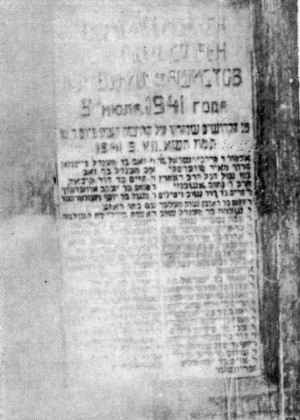
| The names of those who were shot are engraved on the tombstone of the communal grave |
[Page 216]
I Remember …
The second time that we left Sekurian, without knowing our destination, I looked at the images and could not believe that these were people that I knew. Is that Leike Gofman, our former neighbor ? Her husband, Pinchas Gofman, died in my arms. Now Leike is walking slowly, so that she should God forbid, not slip. Whoever slips, or leaves the line, takes their lives into their own hands. She did not even look at what was happening around her.
Almost all her children had emigrated to the Land of Israel, except one, Meir.
I was with my father at the Gofmans when we went to say goodbye, to one of the sons who were leaving. My father asked Meir, so, when will you join your brother ? Meir answered: Palestine is too small to accommodate all the Jews, and my home is here …
His first attempt to cross the border into Russia was unsuccessful. The second time, he crossed with his wife. Later, rumors spread that he was again amongst us. Once, Pinchas Gofman, his father was invited to the police station, and on the floor, in a dark corner, they showed him a person, bloodied and wrapped in rags. He was asked if that was his son. He answered that it was.
Meir was involved in illegal issues, and together with his wife, he even used the prison for unlawful purposes. After he was freed from prison, he tried to cross the Dniester River again. Although he encountered Romanian border guards, he managed to hide in corn fields. The next day however, the owner of the field discovered him and handed him over to the police.
Meir was tried as a dangerous spy and was thrown into prison, bound in chains. In the earthquake of September 1940, a stone was dislodged from a wall in the prison cell where Meir was sitting and killed him.
The illegal newspaper reported Meir's tragic death, in a few words.
A Few of Us Remained
In Khotyn, I was known by the nickname Yisrael Puzis. My father-in-law was the beadle in the Yatke synagogue, and my mother-in-law was the daughter of Bendet Melamed.
Most of my family perished during the Second World War. We were devastated and shattered. A few remained - one daughter Yaffe Taubman, came to Israel with the Youth-Immigration, and a second daughter is in Montevideo. Taube Vasserman and her family, and Chaim Vasserman are in Russia. They are all that survived.
When we were driven out of Khotyn and chased on the way to Sekurian, and from there to Ataki, and back again, pushed to the limit, our mother Sorre - was the first victim in our family. I managed to bury her in the Jewish cemetery.
My father Moshe Puzis, died near Nazaranitz. They did not allow us to catch our breath and chased us further, so that I could not even give my father a Jewish burial.
My brother Yehoshua died in Popovitsh, and his wife Chanah and their three children died in Kopaigorod.
The fact that the few of us left Kopaigorod alive, was a miracle. In Khotyn we found one great ruin. That was where we first learned that my brother Avrom and his wife, who lived in France, were deported to Auschwitz, and died there.
Our only consolation that remained for us, was to go to Israel, where we would be able to raise our child, who was then only one-and-a-half years old.
We came to the land in 1948 – during the war. This was, however, something completely different than dying like flies in the camps. During the 6-Day War, 19 years later, our son Avremele, also went to fight for our survival.
We are proud to be here, after so much suffering.
[Page 217]
|
|
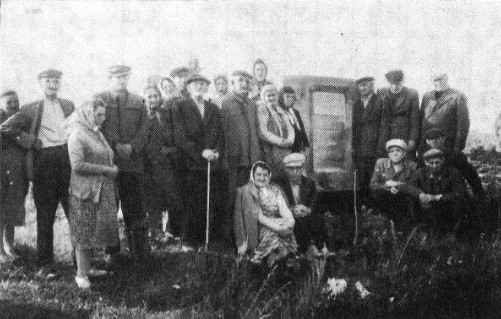
| Khotyn residents at the communal grave |
A List of Khotyn Martyrs, who Died in the Dzhurin Concentration Camp
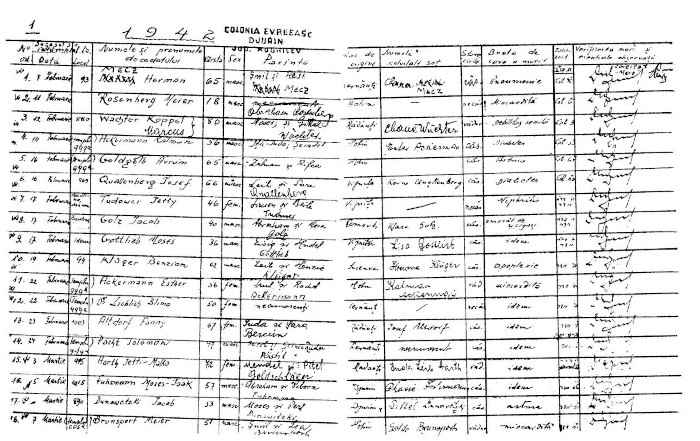
This list of the Khotyn martyrs comprises only those who were killed and were listed in the official government registry of the concentration camp in Dzhurin, in the Mogilev-Podolsk region (“Transnistra” during the Nazi occupation, that was once, and is today, in western Ukraine). I was also one of the prisoners in the camp, and the camp commander gave me the responsibility of recording the names of the dead in a register. The rescue of this register, that I still have in my possession today, endangered my life. It begins on 7th February 1942, and ends on the 19th March 1944, on the same day that the Red army captured Dzhurin and liberated the camp.
In this register, I also recorded the names of a small number of Khotyn martyrs that died in the camp prior to the 7th February 1942, based on personal testimonies. In reality however, the number of Khotyn fellow citizens that were exterminated in the Dzhurin camp, is much higher than this list.
The first transport of Jews deported from Khotyn – some 300 souls – was a band of survivors of the merciless extermination of the holy community of Khotyn, that made its way to Dzhurin in September 1941 after terrible torment and wanderings. There they actually renewed that hell in the Nazi Concentration camp of Dzhurin. These unfortunate “pioneers”, chased by cruel police guards, dragged themselves to the camp, naked, barefoot, emaciated, dejected skeletons, truly falling on their feet from lack of strength.
Most of these “guests” soon died in the first months, from hunger, cold, plagues, and neglect, before the register existed. The names of these first victims are therefore not recorded. Unfortunately their names are bogged down in the abyss of oblivion.
Other Khotyn martyrs whose names are also not recorded, were those that the Romanian police deported from Dzhurin for hard labor to the German concentration camps on the eastern side of the Bug River (Trichati, Varvarovka, Kuryovka, Nikolyev, Odessa etc.) The deportees never returned, and their remains were lost somewhere.
The later list, extracted from the register, includes personal details of the martyrs, as much as I was able to find out. It happened that the person who perished was the last twig of a slaughtered family and on no account was I able to find details, except for the name.
In this way, I see before me, in this somber list, a small section of the Book of Lamentations that is relevant to the destruction of Khotyn.
[Page 218]
|
|
| A page from the Register |
Translator's footnotes:
|
|
JewishGen, Inc. makes no representations regarding the accuracy of
the translation. The reader may wish to refer to the original material
for verification.
JewishGen is not responsible for inaccuracies or omissions in the original work and cannot rewrite or edit the text to correct inaccuracies and/or omissions.
Our mission is to produce a translation of the original work and we cannot verify the accuracy of statements or alter facts cited.
 Khotyn, Ukraine
 Yizkor Book Project
 JewishGen Home Page
Copyright © 1999-2026 by JewishGen, Inc.
Updated 05 Nov 2026 by JH