 |
|
|
[Page 177]
Translated by Esther Libby Raichman
Hashomer Ha'Tza'ir
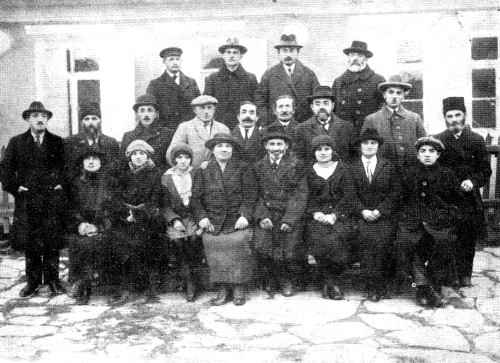
In the year 1917-1918, a scout organization was established in Khotyn, based on a model of the Romanian organization. A few members of this organization led by Abba Veisodler, the son of the well-known Zionist, Berel Veisodler established “Hashomer Ha'tza'ir” in 1922. The secretary was Monye Rotshtein. The organization had 70 to 80 members. The Khotyn branch, as well as all the branches in Bessarabia and Bukovina, belonged to the Tshernovitz headquarters.
The first Hachsharah [training facility for prospective emigrants to Palestine], was in Keshenev. In the summer the trainees worked in vineyards, and in the winter, they chopped wood for heating purposes. Later other training places were set up for agricultural work, for example, in Yass, at a farm belonging to the state. Khotyn members of Ha'shomer Ha'tza'ir were sent there by the “He'chalutz” organization.[1]
After arriving in the land, they were sent to kibbutz 3 in Afula, (Kibbutz A, in Bet-Alfa; Kibbutz B – in Mishmar Ha'emek; Kibbutz C – Haifa. They were also sent to Kibbutz Merchavyah, and the Russian kibbutz, that was then in Haifa and later moved to Afikim).
Monye Rotshtein was then the secretary of Kibbutz C. He wrote to Yitzchak ben Aharon in the administration in Tshernovitz and warned him about the split that was about to happen in the movement.
The Ha'shomer Ha'tza'ir Movement in Khotyn
Ha'shomer Ha'tza'ir youth organization was one of the most active in Khotyn. Its strength did not lie in the number of its members but in its quality. This was a movement with noble revolutionary Zionistic ideals that chose its members well, and accepted into its ranks, mostly young, intelligent students. The excursions, the dances, shared discussions at headquarters, as well as all the activities, created the power to attract people.
The Ha'shomer Ha'tza'ir was actually a legal, recognized Zionist movement in the country, but the government looked upon it, with mistrust, and suspected it of being communistic. The meetings were held in secret, or set up as study groups, because most of the members were students at the state high school; in fact, the secret that surrounded the meetings, united the members even more. One could rely on the fact that if they were found by the police, they would not break down, and no one would disclose anything. The word of their leader was holy for the members. Although there was a spirit of comradery among the younger and older members, they showed particular respect to their leader, as their ideological representative.
They had to be very careful not to be banned from attending school, for illegal activity. On one occasion, when the members distributed invitations to a Zionist meeting, the policemen who arrived and could read neither Yiddish nor Hebrew, thought that the invitations contained communistic propaganda, and until the matter was clarified, everyone was taken to the police quarters. The Commanding officer was not present, so they were detained the whole night. Dr Aryeh Nitzen (Tzanker), who was then among those arrested, told
[Page 178]
that he had in his possession, an almost revolutionary article, that was often written and passed along by members of Ha'shomer Ha'tza'ir, at that time. He tore small pieces of paper the entire night, chewed them and swallowed them, so that the article would not fall into the hands of the police.
The parents responded to the activities of their children, in different ways: some were against, some supported the idea, and some simply closed an eye. The first group, were afraid of the regime and were anxious that their children would be expelled from their school. The leaders were interested in seeing that the children would complete their high school education and take the Baccalaureate. At the same time however, they did not complain when a few students ceased their studies, believing that they needed to prepare for life on a kibbutz, where education was not the most important issue. There were also cases where children gave up their studies to devote themselves to the movement, against their parents' wishes.
In addition there were children from wealthy families who sincerely sought perfection in life, as well as children of religious parents who came to the movement consciously.
The desire to take part in a youth movement that fought for a better future, enriched the social lives of the youth. The intellectual level of the youth enabled serious discussions on various subjects and public issues, that drew large audiences, both from other youth movements, and from the wider community.
Members of Ha'shomer Ha'tza'ir engaged little with the youth of other movements, but there were also shared celebrations, mainly on Simchat Torah. Then the General-Zionists and the adults of other movements would organize a celebration in which all youth movements, participated, including Ha'shomer Ha'tza'ir. The latter added much to its overall success.
There was no regular contact with members in other places, because of differences of opinion. Yet, contact was maintained with members of nearby towns, and from time to time, also with members in Tshernovitz where Ha'shomer Ha'tza'ir was already well known. They also connected with members from other towns in Romania. There was a noticeable difference in education in various places, particularly regarding contact between girls and boys.
The relationships between Jewish and non-Jewish students in the high school, were generally correct, yet at times, non-Jewish students did not hide their antisemitic feelings. From time to time, rumors spread in the town that antisemitic groups were preparing to attack Jews. Then everyone, old and young, thought of how to defend themselves in case something happened.
Gradually, some of the members emigrated, and others travelled to Europe to continue their studies. The youth that remained felt that they no longer had a future in the town.
A large number of Khotyn members of Ha'shomer Ha'tza'ir went to the kibbutz soon after arriving in the land. It is understandable, however, that not all completed their stay; occasionally, due to the rigidity of the movement at that time, members who were severely restricted, did not envisage that they would have the opportunity to being educated, and reach their potential.
It is however, without doubt that the education that they acquired in Ha'shomer
|
|
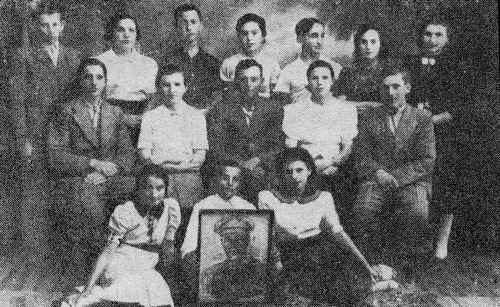
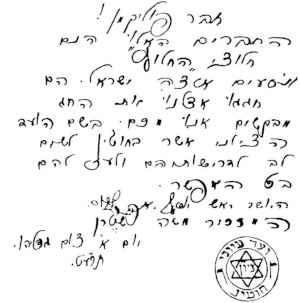
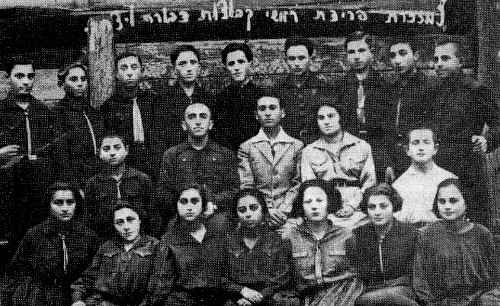
| [Text in picture: A Momento of the Departure of the Group Leaders Devorah and Yitzchak] |
[Page 179]
Ha'tza'ir was deeply engraved in their hearts, and they remained true to the ideals of Zionism and Socialism.
The Youth of Po'alei-Tzion
Advocate Moshe Feldman, Ezriel Yanover, Hershl Roichvarger, Chaim Shveiger and others, founded the right-wing of Po'alei-Tzion in Khotyn; its headquarters were in Keshenev. To ensure the growth of the movement, it was decided to establish a youth organization too, that would draw the youth from the poorer classes of the population. The youth were active in Keren Kayemet L'yisrael [Jewish National Fund], in “He'chalutz” and in Hachsharah.
It was decided to mobilize the youth into the ranks of Po'alei-Tzion, to rescue them from the communists who were very active. They had to be educated both in the spirit of Zionism and in the spirit of Socialism. Members of the movement were very carefully selected. Every evening, events took place in the club - lectures, literary courses, and also dances, and song. Many members had experienced pioneer training before emigrating to Israel.
Great interest was taken in the private lives of the young members, to assist them both materially and socially.
At the initiative of Dr Chursh, Azriel Yanover gathered 30 of the youth with skin blisters and travelled with them to Tshernovitz, where they were all cured. This is only one of many examples of the activities of the movement.
There were intense discussions in the town between the members of Po'alei-Tzion, and the members of the Zionist-Youth who were suspected of not putting sufficient emphasis on the Zionist aspect of their activities.
|
|
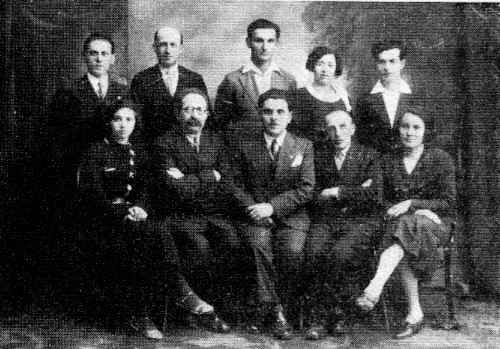
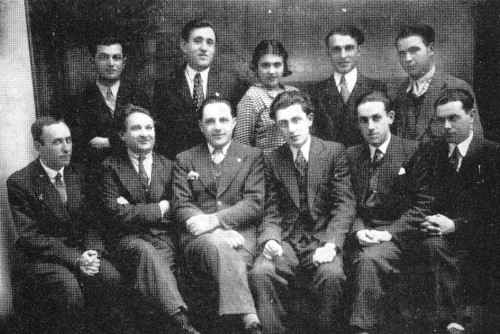
Sitting from right: P. Pekker, Y. Barg, Advocate Z. Roitman, E. Yanover, D. Rotshtein Standing from right: Sh. Yanover, A. Tantzer, A. Bronshtein, A. Zaltzman, Valkov |
Bet”ar[2] and the Revisionist Party
The growth of the national Zionist movement in Khotyn and its activities, reflect a rich and important chapter in the history of the town. Included in the ranks of the Zionist Revisionist organization and “Betar”, were adults and youth from all levels of the population. With their belief, faith, and understanding, they saw in Zionism, a source of inspiration and ongoing preparation for the return to the land of their forefathers.
This Zionism ceased to be a repetition of definitions and principles, and inactivity, but was transformed into a new cause, with the final goal of returning the Jewish people to the Land of Israel. The isolation of the town, and the material need of its inhabitants, led to a change of thinking among the people.
Due to this change, from the end of the 1920's the attitude toward the official Zionist movement in the town, in both the organizational and spiritual domain, was challenged, until it reached a complete break; at the same time, there developed and grew, the nucleus of the revisionist organization and “Betar”. Orders from the Zionist movement gave rise to a gradual distancing, both theoretically and practically, from all links with life in the diaspora. The members of “Betar” ranted continuously, introduced a dynamic content in Zionist thinking, and displayed a bold stand in debates in all circumstances. They began with the assimilated right and left, and ended with various mediators, including wavering Zionists.
As a result of this unequivocal identification with the Zionist order, the essence of the beliefs of the members of the movement changed. Each one was permeated by the conviction that he is about to be liberated from the diaspora complexities, from the split in his personality, concluding that the impulse to be active, arises from the definition “Shivat Tzion” [the return of the Jews to Zion]. This meant, straightening one's shoulders, freeing oneself from doubt, moving forward, determined to achieve one's goal.
[Page 180]
The Khotyn Jews, more so than Jews in other places, were proud of their achievements. And indeed, the administration of the movement and its central institutions did not spare their praise for these achievements. Faith and enthusiasm were typical of all members of the movement. At the same time as ideals were being formulated, and plans for the work were being crystalized, the organizational framework for the revisionist organization and Betar in Khotyn, was regulated.
The following excelled in their activity in the Revisionists political organization: Advocate Barak, Sholem Goldenberg, Heinech Sadovnik, Yankel Verdieger, Yakov Tutelman, Leibish Ludmir, Kilimacher, Advocate Fishler, Shlomo Furman (the red one), The following associates, should be mentioned: Dr Zeidman, Dr Chursh, N. Yakir.
Betar was established in Khotyn in 1927, with the following members: Froike Roitman, Shimon Veisberg, Yehudah Yurist, Yitzchak Roitman, Valye Zaltzman, Shmelke Veisbuch, Shlomo Furman, Yosef Zilberman etc.
Froike Roitman was appointed as the first leader, and together with rest of the members, he led a strong team that brought very good results.
After a year, the size of the meeting place was enlarged, and new leadership was elected: Advocate Mark Barak as honorary leader, Froike Roitman as leader, and members of the executive: Shimon Veisberg, Yitzchak Roitmam, Yehudah Yurist, and Yente Shtrikman.
After a long period of wandering, thanks to Dr Zeidman, the president of the community, the revisionist organization and Betar, were given a classroom in the “Talmud-Torah”, at a token fee, that included the right to use the large courtyard of the school. This was the first place where it was possible to concentrate on planning the activities for more than one or two months. They began regular club activities, and in the courtyard, they organized sporting programs and held large gatherings. This strengthened the movement from an organizational and representative point of view. Advocate Fishler, the leader of the unit in charge of propaganda, was supported in his determined work by members of the administration: Shimon Veisberg, Yehudi Yurist, Avrom Kirzshner, Mendl Elbiert, Dovid Sheinman, Avrom Grinovetzer, Ephraim Roitman, Shlomo Shitnovitzer, Siyoma Bakal, Yehudit Shochet, Mordechai Guterman, Devorah Kirzshner, Sarah Vasserman, Tsharne Kirzshner, Tzvi Kirzshner.
The efforts of Advocate Barak, president of the Revisionist organization in Khotyn, were extensive and inclusive. He succeeded in implementing the political discipline of national Zionism among the members of the movement. He was assisted by the older and devoted members; for example: Sholem Goldenberg, Leibish Ludmir, Heinech Sadovnik, Altman, and others.
It was of special significance that a group of high school students were attracted to the movement. They were: Izye Kaminetzky, Moshe Lerner, Yakov Derzshy, Shlomo Eidler, Bushka Goldenberg, Matye Gorgun, Yitzchak Koifman, A. Frenk, Volodya Roizman, and others.
After the framework of the organization had been consolidated, the influence of the association grew – and the actual activity of the national movement in Khotyn expanded, both in the political, and in the pioneering domain. It is worth mentioning certain events that raised the strength of the impact, and the proportions that the influence of the movement assumed.
The first major event was the emigration of members of Betar to the Land of Israel in 1931:
Shoshanah Pesach, Yenta Shtrikman, and Yosef Zilberman. In response to a request from their leader, Shoshanah and Yenta each sent a separate letter containing two orange leaves that were sewn into the national flag that was consecrated at the headquarters.
The Betar members Esther Berry, Tzila Vinegold, Tsharne and Devorah Kirzshner, and Yehudit Shochet, skillfully sewed the symbols and drew the slogans on the flag, under the guidance of the leader, Advocate Fishler, and a special committee, in which Yehudi Yurist, Shimon Veisberg, and Dovid Sheinman took part. The admo”r[3] Tversky agreed to the request of the leader at headquarters, to consecrate the flag in the courtyard of the synagogue. After a long struggle, a compromise was reached, between the principles of Jewish law and the desire to help; he decided that the flag, that looked like a type of embroidered tablecloth, should be spread out on the table in the synagogue during the reading [of the Torah]. The ceremony to sanctify the flag took place on a Sabbath, in the month of Nissan 5793 (1933), on the eve of the 18th Zionist conference. The members of Betar came to the sanctification. Everyone swore loyalty to the flag and what it symbolized.
In that same year, a campaign for the election of candidates to the Zionist congress took place in the town. After counting the voting papers in August 1933, it appeared that the national movement attained a great majority, approximately 50% more than all the other organizations together. This evoked great enthusiasm among all the members of the movement.
[Page 181]
|
|
In the middle is Tzvi Aminatze'ach (Kirzshner) |
When Shlomo Ben-Yosef, may the Lord avenge his blood, was hanged by the mandate government in the Land of Israel, a memorial service was held in the synagogue of the Talmud Torah, that excelled in its reverence and sanctity. A picture of the hero mounted in a black frame, with a burning candle on each side, was placed in front of the Holy Ark. A guard of honor of Betar members, changed every half hour. A representative of the town's administration and the commander of the military regiment in the town were invited to the memorial service. They came in formal dress and listened respectfully to the prayers. This demonstrated again that the events in the Land of Israel echoed strongly in the diaspora.
The activities of the Revisionist organization and Betar in Khotyn, unfolded in the years 1938-1939, under the sign of political Zionism, with the slogan: 'Strengthen the battle for the freedom of the homeland !' The most important leaders were Advocate Barak, who had returned from the world congress of the Revisionist organization – that took place in Vienna, and Advocate Fishler, who had returned from the world convention of Betar, that took place in Krakow. The activities concentrated on two areas: 1) emigration “af-al-pi”[4]; 2) IZL - Irgun Tzva'ei Le'umi[5].
The activities and the organizational responsibility were difficult material burdens for the Khotyn headquarters. However, they worked feverishly, under internal and external pressures. Advocate Fishler devoted himself totally to this work, in meetings with representatives from Betar in Bucharest, and emissaries from the Land of Israel, regarding problems arising from immigration. He relinquished his private work entirely.
People began to register for emigration, and for combat groups, at Khotyn headquarters. Ball-dances were organized to raise money, but despite the efforts of Advocate Barak, they brought little income.
In 1939, the first group emigrated: Avrom Kirzshner, Tzvi Kirzshner, and Sonia Lerner. Advocate Fishler gave Avrom Kirzshner two revolvers to take to the Land of Israel.
The youth of other organizations wanted to attach themselves to the groups of emigrants assisted by “Af-Al-Pi”. In subsequent groups, the following emigrated: Mordechai Guterman, Nachum Roitman, Chanah Telefus, Shlomo Eidler, Shlomo Kirzshner, Sarah Vasserman, Tzila Vinegold. Advocate Fishler accompanied the last group that emigrated at the beginning of spring in 1940, to the port of Constanta [in Romania, on the Black Sea]. On the way back, he was told to organize larger groups. He communicated this order to the leaders at headquarters, who began to organize the “evacuation” of all the members, under the leadership of Shimon Viseberg, Dovid Sheinman, and Syoma Bakal. Shimon Viseberg was appointed as the acting leader at headquarters.
The plan, however, did not materialize. In June 1940, two hours before the Soviets entered Khotyn, Advocate Fishler decided to gather a few members and flee … . The border guards and the police, however, prohibited movement in the town, particularly access to the lowest section where most of the residents lived. After he managed to meet Dovid Sheinman and hand over the contact addresses, Fishler left the town alone, bearing the flag of the headquarters, to take to the Land of Israel.
We recall the names of Betar members who died and were active in Khotyn headquarters before the Soviets entered: Avrom (Bushka) Goldenberg, Avrom Frenk, Mordechai (Motye) Gorgun, who belonged to the nucleus of A.TZ.L.[6] of Betar in Khotyn. The Betar members from the Khotyn headquarters who joined L.Ch.Y.[7] were, Avrom Kirzshner (Shoham) and Tzvi Kirzshner (amei- netzach). Yakov Derzshi (Yardeni) was also a member of A.TZ.L.
Among the members of the Khotyn headquarters, there was also Shlomo Shitnovitzer, a long-time leader of “Betar youth” in Khotyn, and later – the last commissioner of Betar in Romania. After he emigrated – he was chairman of an organization in Israel, of people who were originally from Khotyn. He was an asir tzion[8] and courageously defended the honor of his people and homeland, as one of the defendants in a trial against the Zionist movement in Romania, that was accused of allegedly agitating against the government and the regime.
[Page 182]
1929. When the news broke about events in Israel, Betar already existed. The leader Froike Roitman, together with his colleagues at headquarters, and the members Shimon Vineberg, Yehuda Yurist, and Yitzchak Roitman, who, with strong determination and belief, organized a mass gathering at which all the Zionist parties were present and expressed their bitterness against the mandate government at that time.
Betar led a strong propaganda campaign to publicize the innocence of Stavsky[9]. When the truth emerged, and the verdict was announced, that the members were not guilty – Betar called a mass gathering and demonstrated to the public that the whole affair was false.
|
|
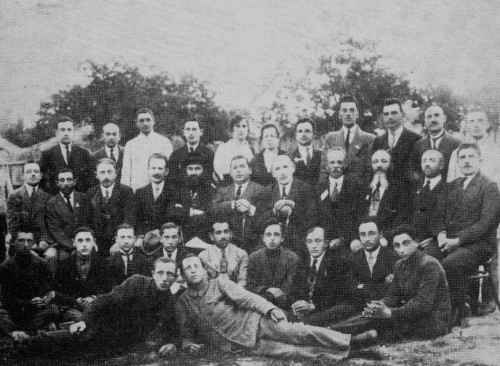
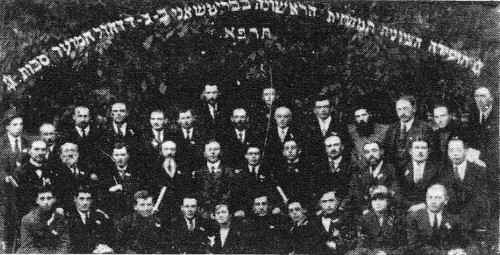
Lying in front from right: Zaltzman Eliezer, Y. Avner Barg Sitting below from right: Strakovsky M., Strakovsky Tzvi, Millman Mendl, Ezrachy (Zak) Monny, Stolyar Itamar, Duvshtar … Shlomo Sitting in the middle from right: Eppelboim Yosef, Vineshtok Mendl, Miller Motti, Dr Shvartzman, Berland, The Rabbi from Dobriban, Miller Smuel, Viseodler Dov, Telifus Mordechai, Sufenboim Mendl Standing from right: Bernshtein Tzvi, Shneiderzon Yo'el, Reins Natan, Viseman Moshe, Y, Aharon Lam, Malachi (Zaltzman) Devorah, Mrs Vineshtein, Roizman Moshe, Kurmansky Sh, Rechter N. V. … |
[Page 183]
Zionist-Youth
The association ‘Zionist-Youth’ was established in Khotyn in 1915. Its premises were in a rented hall belonging to Tzeitel Gitzis, mother of Yisroel Gitzis. The founders were: Avrom Bronshtein - chairman, Moshe Shtern – secretary. There were 60 members in the association. Lectures about Hebrew and Zionist literature, were held twice a week. Moshe Shtern was one of the most active speakers, an energetic young man who was served in many areas. He died in Romania during the Hitler's reign.
Among the activists of the Zionist-Youth Association were also Dovid Gornshtein and Elazar Zaltzman.
Ha'techiyah[11] and Gordonia[12]
The Ha'techiya organization led diverse and fruitful activities in all areas of Zionist life. The activists were: Avrom Volkov, Avner Bar”g, Esther Gofman, Perele (Pnina) Pekker, Advocate Roitman, Tzvi Rozenberg, and Zalman Shneider.
The organization “Ha'techiyah” was founded in 1920-1921 by Yitzchak-Meir Tissenboim, at his home. The founders were: Zalman Melamud, Avner Bar”g, Elazar Zaltzman, and Moshe Roitman. At the outset, there were only 20 – 25 members. This was a nucleus of people of high quality that drew members from other organizations.
The “Gordonia” organization was established in Khotyn by some of the members who were active in “Ha'techiyah”. They were active in all aspects of Zionist life, particularly in the cultural domain. There was a difference in the level of the youth who came from among the working classes, and those from Hashomer Ha'tza'ir, who came from the intellectual social classes.
In “Gordonia”, effort was made to encourage the members to grow accustomed to reading. Special emphasis was placed on the merits of pioneering and living in collective communities. Many of the members emigrated to the Land of Israel.
Zalman Shneider was the head of “Gordonia” in Khotyn, from 1931. His friends in the administration were: Tzvi Bierenboim, Tzvi Rozenberg, Chaim Zonnenshein, and Sonia Horovitz.
Advocate Roitman and Avrom Volkov excelled in their work. The most important topics in their discussions were: pioneering, Zionism, and socialism. The Keren Kayemet [Jewish National Fund] took an important part in cultural education.
|
|
“Dror” and Aryeh Fichman
Due to concerns for the next generation, the Po'alei-Tzion movement established a youth organization in 1934-1935, called “Dror” [Freedom], that had almost 200 members in Khotyn. At the head were: Monye Rapaport, Yudel Vasserman, and Avrom Vasserman. (The Germans killed both).
Many of its members participated in pioneer training at Gura-Humoriului in Bukovina and emigrated to the Land of Israel.
Aryeh Fichman played a central role in the movement. His maternal grandfather was a Bayon Chasid, and his father Tzvi Fichman, was an active Zionist in neighboring Lipkan[13].
In his youth, Aryeh Fichman, as most children from wealthy families, was in “Ha'noar Ha'tzioni”, but he was soon convinced that his place was among the working people, and he became a member of “Dror”. He was fanatical about the merit of the movement and took a stand against every compromise. He demanded from himself, and from others, the accomplishment of the ideals of the movement.
When the Romanian regime changed, and the Bessarabia branch had to go underground, Aryeh Fichman (his name in the underground was “Leibu”) was the spirit of the movement, and his visits to the branches aroused enthusiasm. At one of the decisive sessions of the “Dror” headquarters, he vehemently condemned the liquidation proposals for the movement that were made by one of his best friends. The movement was saved from liquidation at that time, thanks to his determination and powers of persuasion.
When a few pioneer training facilities of “He'chalutz” in Romania, were closed,
[Page 184]
the members of “Dror” were sent to the farms of “Habonim” in Transylvania, as they were the only ones that belonged to the United-Kibbutz organization. There was a great difference between the members of both movements, regarding language and awareness. The pioneers of “Habonim” spoke only Hungarian among themselves, while the members of “Dror” spoke Romanian and Yiddish. The Transylvanians regarded themselves as central European, and the members of “Dror” regarded themselves as Balkans. Aryeh Fichman removed the divisions between the two groups and brought them closer in spirit.
In order to immigrate, Aryeh Fichman enrolled fictitiously in the Hebrew University in Jerusalem and received a certificate from the Mandate government. He emigrated to the Land of Israel in 1939 and joined an agricultural working group from Magdi'el. After that, he transferred to a group colonizing the forests on the Carmel mountain and was one of the founders of Bet-Oren. He worked at building the paved road in Atlit and later at Neiboy.
The Kibbutz sent him to Jerusalem as a leader, and when the Second World War broke out, Aryeh Fichman voluntarily joined the British army, in the Jewish unit. When the idea arose of parachuting into enemy regions, Aryeh volunteered and trained in a course for parachutists. In October 1944, he flew to Romania with a fellow fighter Lyova Gokovsky, to show support for Jews who had found themselves under Nazi rule. The pilots however, erred, and both young men were dropped in the middle of the town, where they were arrested by the Romanian police.
The Romanian investigators could not extract a word from Aryeh and sent him to Germany to a camp of Hitler's Airforce, near Frankfurt. There German officers from aviation and from the Gestapo interrogated him. Over a period of three weeks, he was tortured and starved but they did not extract a word from him. After the intervention of the International Red Cross, they sent him back to Romania to a camp for prisoners. There he succeeded in contacting Lyova who was a patient in the military hospital in the same town. Aryeh was caught while trying to dig a tunnel to escape, and he was sent to a penal camp. When he returned from there, he had already met Lyova in the camp. Both began to prepare a new plan to escape from captivity and connected with the pioneering movement in the country. When Romania surrendered, Aryeh was transferred to Bucharest. At the command of his military unit, he left and arrived in the Land of Israel on the 18th August 1944.
Aryeh returned to his work on the kibbutz and for a time, became its co-ordinator. He was sent to a seminar in Ein Charod, to learn about kibbutz issues, and after a while, he became the leader of the seminar.
At a gathering that took place on 29th July 1954 in Magen[14], in memory of the parachutist Peretz Goldshtein, of blessed memory, a plane fell on the audience that had gathered, and killed 17 people, among them also Aryeh Fichman.
Wizo and Keren Kayemet L'yisrael
Members of the Wizo organization were active in Khotyn in many spheres: in the “Tarbut” schools, in the hospital, in social aid, and particularly in Keren Kayemet L'yisrael [Jewish National Fund – JNF].
Tova Appelboim was head of this organization. The following also need to be mentioned: Manya Fefferman, Chavah Viseman, Tzirrel Roizman, and Klara Vartikovsky. They all worked with devotion, each one applying their individual skill.
Golda Shute excelled in her work. She succeeded in everything that she undertook. When the Soviet authorities took possession of Bessarabia, she, together with her whole family were deported to Siberia, because of her Zionist activities. She was investigated and tortured, and to everything she answered “I was a Zionist, and I remain one. For this reason, I was deported to Siberia. You will not succeed in sending me any further”.
When she and her husband were no longer able to bear their suffering, they tried to poison themselves but were rescued. They both died after a short time, due to their great suffering.
The following members were part of the Wizo leadership: Rivkah Akselrod, Chavah Zeidler, Fanye Tissenboim, Itta Lerner, Devorah Starkovsky, Baya Glozgold, and Sarah Stolliar.
Yosef Appelboim
Yosef Appelboim (the son of Ephraim and Beila Appelboim) was born in Khotyn on the 5th December 1889. First, he studied in a cheder and later in high school. Due to the “Numerus Clausus”[15] he could not go to university. His Hebrew was excellent.
[Page 185]
At age 18, together with other youths, he began to be active in Zionism. Under Tsarist rule, he learned Hebrew in secret with others.
After the First World War, when the Romanians came to power, the Zionist organization was legally recognized. The Khotyn leader was Yosef Appelboim. He extended Zionist activity outside of khotyn, to Britshen, Novoselitz, Sekuren, Yedenetz, and Lipkan. Yosef Appelboim managed to collect funds in the entire vicinity for the Zionist organization and its institutions. He also dedicated much time and effort into the field of education in a Jewish environment, and in 1933, the “Tarbut” school was honored with a new building.
Yosef Appelboim managed to bring Zionist representatives into municipal institutions in khotyn and was in contact with Jewish non-Zionist organizations. In 1929-1930, when the Zionists in Romania decided to establish a Jewish political bloc, that would represent the Jewish minority in the Romanian parliament, then, thanks to the efforts of Yosef Appelboim, a Jewish representative was elected from the Khotyn area.
At the first meeting , after the Revolution of 1917, when all Jewish issues were taken over by Chana Reis, Yosef Appelboim was among those who demanded independence for the Jewish community, to wrest Jewish issues from people who maintained them as a monopoly.
After he returned from the Keshenev meeting, where representatives of the entire area participated, he organized the community and established new institutions, caring for the religious, cultural, and societal life of the Jewish population.
Although he was not a legal scholar, he developed a constitution for the community, with the help of Eizik Barag, and Leibush Ludmir. He managed to persuade the Jewish population to pay taxes to the community.
Always, when he returned from Keshenev, he would report to the Jews of Khotyn, about the events in the Jewish and Zionist world.
In the years 1919-1922, many refugees arrived in Khotyn from the Soviet Union, many of whom were active Zionists. The Khotyn Zionists, led by Yosef Appelboim, established a committee and attempted to arrange
|
|
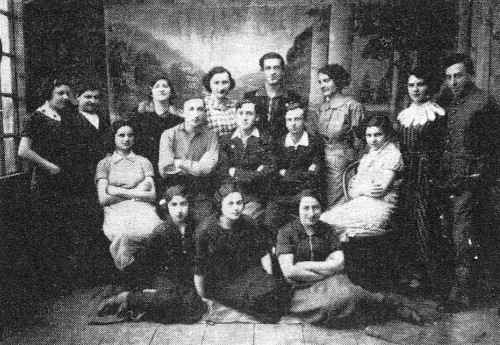
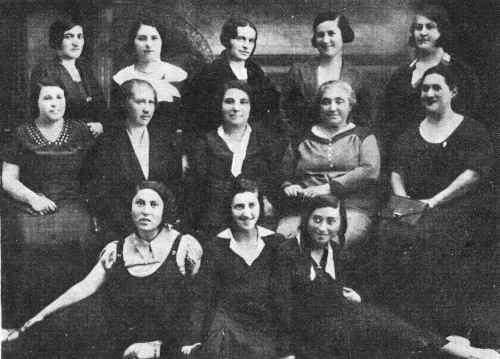
Standing from right: Akselrod Rivkah, Helman Gittel, Lerner Itta, Barak Rivkah, Veisman Chavah of blessed memory Seated: Glivsgold Baya of blessed memory, Rotshtein Batsheva of blessed memory, Appelboim Tovah, Vartkovsky Klara of blessed memory, Shabelman Polya of blessed memory Sitting below: Gitlis Strakovsky Devorah, Nitzan Manya, Shragai (Shteif) Penina |
[Page 186]
for the refugees to remain there or emigrate to the Land of Israel.
On the 20th June 1940, Yosef Appelboim was arrested together with other Zionist leaders in Khotyn. The Soviet authorities interrogated him for a whole year about his Zionist activities, and finally sentenced him to five years hard labor, in Siberia. He never returned from there.
His friends who were together with him in Siberia said that he did not despair and did not lose the hope that Jews would return to their land.
Rotshtein Family
Our parents did not leave us any treasures of gold and silver, not any fields nor any vineyards. Most were content that they were allowed to continue working, to earn a living, and raise their children to marry and do good deeds, in the poor homes that the Gentiles left behind for them.
In the ordinary weekday, of need and poverty, the light and joy of the Sabbath grew.
If the truth be told, not everything was gloomy in the diaspora. We delighted in our sweet childhood years, with the fragrant aromas of summer, with the poetic autumn, and with the clean whiteness of winter.
In the cold, frosty winters, one would see the shimmering light in the modest Jewish homes, without luxury, without splendor, but full of charm, that has remained in our memories to this day.
One of these houses on Meidan Street belonged to the Rotshtein family. The light and the charm of this house was greater and stronger because of the father – Bentzion, and the mother - Batsheva. The refinement of princes shone from their faces, although they were driven off from their father's table …
Everyone loved the Rotshtein couple, for their willingness to help people, for their affability, their simplicity. and their quality of being for the common people; these attributes radiated from their faces with a wonderful light. Their modest home was always open to anyone in need. There, youth would gather, and it would serve as a refuge for people who were having a hard time.
When their sons and daughter emigrated to the Land of Israel, and their house remained wrapped in longing, Bentzion preserved his refinement until, finally, in 1936, he and his wife also emigrated, and arrived with their special brightness, lighting up the kibbutz where their children were living.
The Rotshtein family did not remain intact during the Holocaust. In 1945, they discovered that their daughter Manye, and her husband Noach Gurvitz, perished in Auschwitz. In that same year, Bentzion Rotshtein also died. His wife Batsheva lived until 1955.
|
|
1921 |
Berel Vise'odler - a True Leader
There is a great difference between an active worker in our times, who follows a more or less, well-trodden path, than one 40 or 50 years ago, at the beginning of our struggle.
The Zionist organization in Khotyn was built on strong foundations. Each party had its own leaders, workers, idealists, and people who supported the parties between both world wars. Vise'odler was not an official Zionist leader in Khotyn, but in reality, he was the soul of Zionist life in our town.
We do not even remember what party he belonged to, perhaps the General-Zionists, but at the time, it was not important at all.
Berel Vise'odler believed in the Zionist ideal and became one of the first Zionist leaders in Khotyn. He loved the youth and hated glory. He was an example for everyone.
Vise'odler was not simply a worker, but an institution of his own, who devoted himself to Zionist life in Khotyn.
He also had ideological opponents, yet all of them saw in him, an ardent Zionist, and valued his accomplishments as an activist.
[Page 187]
Berel Vise'odler's Home
On Simchat Torah, Berel Vise'odler would invite all the established members of the “Sha'arei-Tzion” synagogue to his home.
On Simchat Torah in 1922-1923, when Jews were truly joyful, two Jews arrived unexpectedly to Berel's house – Matityahu Segal and Monye Zak (Mizrachi) – from Kamenetz-Podolsk, who had just furtively sneaked across the border. They came to Berel Vise'odler because they knew that with him, they would find a true Jewish and Zionist atmosphere.
Berel's wife Sima, always made an effort to help poor people. Everyone knew about her good deeds. If one of the women who baked bread and sold her bread at the market, became ill, Sima would roll up her sleeves, prepare and bake the dough so that the poor woman would not remain without an income.
Berel Vise'odler and his wife emigrated to the Land of Israel and continued to keep in contact with the Jews who remained in Khotyn.
Yosef Zeltzer
Yosef Zeltzer was born in Kliskovitz and raised in Khotyn. From his parents Sholem and Tzirrel Zeltzer, he absorbed the Jewish and Zionist atmosphere to which he was exposed. From his grandfather Reb Reuven Boim, a great scholar with broad horizons, he absorbed authentic Jewish roots. He completed his education in the town's library, by reading the periodicals, “Ha'zman”, “Ha'tzfirah”, “Ha'shilu'ach”, and by studying Hebrew literature. As he grew up in a family of working people, he grew close to Socialist Zionism.
When the Revolution broke out in 1917, he devoted himself totally to Jewish society as a whole, and was one of the founders of Zionist-Youth in Khotyn. Also abroad, where he studied, he continued his Zionist socialist activities, displaying courage and honor in the battle against antisemitism.
Yosef was proud of his sister Rivkah and his brothers Ezra and Eliyahu, who were among the first Khotyn pioneers that emigrated to the Land of Israel. He also dreamed of emigrating, but he died at a young age.
|
|
Yisroel Geller
Yisroel, Reb Itzik the ritual slaughterer's son, was educated in Ha'shomer Ha'tza'ir in the years 1924 to 1929. During that period, there were approximately 150 members in the movement, between the ages of 13 and 19, who had pioneering training and were preparing to emigrate.
In 1926, due to his activities, he was sent for pioneering training to Nipolokovitz, close to the Polish border. As in all training centres, he worked with a saw, for a property owner. After his training, Yisroel was sent to Keshenev, where he worked in the leadership of Ha'shomer-Ha'tza'ir, and in the headquarters of “He'chalutz”. In 1928, he was “organizer” of the movement throughout the country. He emigrated to the Land of Israel in 1929 and settled on kibbutz A.
Dr Yakov (Yasha) Lerner
Dr Lerner was a respected personality in community life in Khotyn, and in the Khotyn Zionist movement. He was exceptionally modest, unpretentious, and devoted, even in matters that concerned medicine.
Yakov (Yasha) Lerner met his future wife Itta Feldman, in the 20's, in Zionist circles. At the time, they were both still studying. She completed an agricultural degree. After completing their university studies, they returned to Khotyn with the intention of emigrating soon. In 1939, Itta Lerner travelled to Israel on a visit, to become familiar with
[Page 188]
|
the country where they wanted to settle. In the meantime, the Soviets arrived and nothing became of their plan.
During the Second World War, in Tyumen (Siberia), I went to great trouble to find out the address of Dr Lerner. He lived in some sort of hovel with broken doors and windows. I spent a week in his company, among the Khotyn residents that had been deported to Siberia. His door was open to everyone, Jew or non-Jew. His wife, Ittele, fulfilled the command of hospitality towards guests, with love.
Dr Lerner was deported to Siberia for his Zionistic activity, but particularly because he did not want to become an agent for the Enkavedde and spy on other doctors in the hospital. In 1941, he was invited to accept the leadership of the hospitals. He was highly praised for the strict order that he established in the hospital and was told that he is eligible to receive another mission, that is, to investigate the actions of his colleagues and report them wherever necessary. That was needed – he was told – because of “spiritual hygiene, to uncover the germs that nourish the soul of the country”. They made it clear that they knew of his wife's Zionist activity, and about her visit to the Land of Israel. However, they did not demand that he provide an answer immediately.
Two weeks after this discussion about the leadership of the hospitals, Dr Lerner was again invited to a meeting where they demanded a report about the other doctors. Dr Lerner said that he had no time for such matters, and to that, they answered that in Siberia, he would find the time. Almost right away, under shocking conditions, they sent him and his wife, from one place to another, in a sealed train carriage until they settled in Tyumen. They worked in forests and Itta broke her hand while engaged in hard labor. He was not allowed to practice medicine, because he did not manage to take his diploma with him. All attempts to have his diploma sent from Khotyn were futile. Finally, Dr Zeidman managed to send the diploma.
In the meantime, Dr Lerner found an article in a periodical about the Khotyn hospital written by an female inspector of the Khotyn Donor Institution. Dr Lerner turned to her and described his situation. After a short time, he was called to Tobolsk and work was arranged for him. He was even given a new diploma.
Dr Lerner and his wife Itta were tormented for their Zionist activity, and because they did not want to become an instrument in the hands of the Soviet authorities. That was against their conscience.
Their son, who studied medicine, had to renounce his parents to be able to continue his studies. He would meet his parents in secret.
Dr Lerner died in Tobolsk and his wife Itta, returned to Tyumen, to her son.
Dr Sheinberg
Dr Shmuel Sheinberg, the brother-in-law of Pinye Roizman (Rabbi Roizman's son), was born in Khotyn. In the years 1903-1904, he was already active in the Zionist organization. For six months of the year he studied at the university in Strasbourg, and for the next six months, he taught students, so that he could save the necessary funds to continue his studies.
He served in the Tsarist army and was therefore afraid to stay in Bessarabia after the Revolution. In 1918 he went to Greece and spent most of his life there. He even acquired a fine reputation there, as a doctor.
In a Hebrew letter that he wrote to Tzvi Bernshtein, he proved that he had not forgotten the knowledge that he had acquired in his childhood and still remembered the Talmudic tractate “Gittin” that he learnt with Fradkin, the teacher. Although he lived far from home, he observed his Judaism and remained loyal to the Zionist movement. He went to Israel a few times to visit his niece, the pharmacist Roizman, of Rechovot.
He wanted to write his memoirs of Khotyn, as he remembered it from his childhood, but he did not manage to do it.
[Page 189]
Oneg-Shabbat[17]
Every week an “Oneg-Shabbat” took place in the Tarbut synagogue. This was part of the Zionist activity in Khotyn. Many people came to enjoy an afternoon and hear commentaries on Jewish texts and wisdom.
Yitzchak Meir Tissenboim would explain his commentaries to the audience; Yechiel Kreitshmar would spread the sayings of our sages, of blessed memory (chaz”al); Mendl Vineshtok, the teacher, would bring news of the modern Jewish world.
Zalman Melamud would teach about the Prophets and the Writings.
And last but not least – Tzvi Shveiger. He studied passages from the Midrash with the audience. His sessions were always packed with people. It was like that since the world came into existence, as we find also in the Gemara, in the stories about Reb Abihu and Reb Chiya. The audience preferred the Midrash to the Halachah.
With great interest, people also heard news from the Land of Israel, not political – ordinary news. They wanted to know and hear about Israel.
The Oneg-Shabbat, that had been organized for many years in Khotyn by Yisroel-Avner Barag and Eliezer Zaltzman, was a truly spiritual joy for everyone.
|
|
| Khotyn Activists with Ze'ev Hornshtein and his family prior to their departure for the Land of Israel |
[Page 190]
|
|
Standing - from right to left:Sofenboim, Kagas, Berna Potkamin, Barg, Barlam Sitting: Adv. Shitnovetzer, Adv. Shammes, (unknown), Adv. Kerbis, Nakman, Engineer Dimitman |
Translator's footnotes:
|
|
JewishGen, Inc. makes no representations regarding the accuracy of
the translation. The reader may wish to refer to the original material
for verification.
JewishGen is not responsible for inaccuracies or omissions in the original work and cannot rewrite or edit the text to correct inaccuracies and/or omissions.
Our mission is to produce a translation of the original work and we cannot verify the accuracy of statements or alter facts cited.
 Khotyn, Ukraine
 Yizkor Book Project
 JewishGen Home Page
Copyright © 1999-2026 by JewishGen, Inc.
Updated 04 Oct 2026 by JH