 |
|
|
[Page 53]
Translated from Monica Devens
Synagogues in Khotyn
Although there is a difference between a synagogue, a Beit-Midrash, or a kloiz [=enclave], over time the domains became blurred and the separations between these terms were removed. The Beit-Midrash was dedicated to the study of Torah, but since Torah in Israel decreased due to concerns about livelihood, preference was given to the synagogue for prayer.
“Kloiz,” “Beit-Midrash,” “Synagogue,” and “House of Worship” are synonymous terms. “Kloiz,” a closed place, applied principally to yeshiva students who would close themselves up with the heads of the yeshiva, devoted almost exclusively to Torah study.
The synagogue or the kloiz held a fundamental place in the social and spiritual life of the Jew from the day of his birth to the day of his death. When a woman gave birth, the community would gather in the synagogue and pray for her well-being. When a son was born, they would bring him to the synagogue for the circumcision ceremony. When a daughter was born, her father would come up to the Torah to give her a name. When a son reached Bar Mitzvah age, he would come up to the Torah in the synagogue for the traditional ceremony of “Kiddush” and joy at the mitzvah. When the time came for him to marry, the Huppa [=wedding canopy] was generally set up in the synagogue. When a man was rescued from danger, he came up to the Torah to say Birkat Ha-Gomel [=the blessing of one rescued from danger]. When a person died, he was carried to the synagogue on the shoulders of those accompanying him to eulogize and to give him the last kindness.
Apart from these occurrences, there is a constant flow between the Jew and the synagogue: raising up the Beit-Midrash, morning and evening.
There were almost 30 synagogues in Khotyn, which were not only places for prayer, but rather meeting places for brothers and friends, a place of gatherings and lectures.
Obviously, argument was not missing from religious life, which should not be seen as a flaw in human society. The synagogue was the creative home of the nation, which was blessed with gifted leaders, with men of action and spiritual geniuses in all areas of life.
Sadigura Hasidim
In the synagogue of the Sadigura Hasidim, there were about 100 worshippers. The gabbai [=a synagogue functionary] was R' Leibush Bukartzki who, although not excelling in scholarship, had a good, warm Jewish heart. He owned a beer factory and took care of 10 sons and daughters. He fulfilled his task as gabbai with great decisiveness and succeeded in convincing the factory workers to support him in his function in the synagogue.
The shamash [=a synagogue functionary] was R' Itzik Dyuk, a childless man who barely earned a living.
The central figure in the synagogue, R' Yisrael Mordechai Strakovsky, was one of the central supports of the Sadigura Hasidim.
Boyan Hasidim
The kloiz was decorated with the accepted drawings, stars and the symbols of the tribes, the handwork of Shalom Farber (Lerner). Among the hundred worshippers of the synagogue, none were opposed to the rule of the main gabbai, Moshe Itzik Hirsch, a dictator who behaved resolutely and with a high hand. He earned a living from teaching, took care of the needs of the poor, and for this reason, was beloved by people. Who would dare to dismiss him from his position in the kloiz?
His help of the poor was extremely concrete: he used to chop down trees himself on their behalf and he was aided in this work by R' Nachman Shtulman, of the Sadigura Hasidim, who, although he did not have a nice voice, served as the Shaharit [=morning prayers] leader in the kloiz without expecting payment. Even though he was educated, he declined to engage in teaching because the Torah is not “an ax with which to dig” [=a tool for personal gain] and he earned a living through selling lime and plaster, with the business put on the shoulders of his wife, which was customary in those days among many families. Froike (Ephraim) Pesach, son of R' Avraham Chaim, was responsible for the eruv[=an area of a town marked by a wire within which certain activities are allowed on holy days] of Khotyn for his entire life. He was counted among the wealthy of the city and in the winter, he would distribute
[Page 54]
wood to the poor. His five daughters immigrated to Israel. One of them, Chava, was the first immigrant from the city of Khotyn, at the beginning of the century, and she was very proud of the fact that Moshe Sharett z”l [=former Israeli prime minister] also immigrated on this ship that set sail from Odesa.
Nissele (Nissan) Posek was famous in the entire area, with a reputation as a biblical scholar and an esteemed man. He ran a kind of rabbinic seminary and many of his students were, in fact, ordained, also due to the fact that he was careful to accept to his school only talented young people. The tuition was also pretty high by the standards of the day, 20 rubles per “session,” i.e. half-year. He was privileged to educate three generations.
And last but not least, by the eastern wall of the kloiz of the Boyan Hasidim, the rabbi, R' Shaulikel, with whom we began the section dedicated to the rabbis of the city of Khotyn.
An argument that arose concerning the ritual slaughterers caused a schism and quarrel and some of the Boyan Hasidim switched to the synagogue of the Sadigura Hasidim.
Chortkov [=Chortkiv] Hasidim
The first of the ADMORs [=Our Master, Our Teacher, and Our Rabbi] of Chortkov, R' David Moshe, son of R' Yisrael of Ruzhin, great-grandson and grandson of Dov-Ber, The Maggid of Mezhyrichi, having the most illustrious lineage, since the ADMOR of Nazarnitz [?], of the house of Tversky, belongs to the line of R' Nachum'ke Chernobyler.
Here are the outstanding figures of the Beit-Midrash of the Chortkov Hasidim: R' Zusia Bronstein, pursuer of charity and kindness, caring for the poor, among the first of the “Mizrachi” in Khotyn and among the honored activists of the community committee. R' Yossele Sofer, God-fearing, careful of simple commandments as of serious ones, engaged in holy work with awe and mercy, and frequently going to the mikveh [=ritual bath] in preparation for writing Torah scrolls. The melamed [=instructor], R' Yaakov Yosef, was a Torah reader. Shlomo Der Royter (the Red) was among the faithful of the House of Chortkov. His wife immigrated to America and he did not agree to her request to go there out of fear of going wrong. His grandson, Leib Khalfon, was a Communist and later rejected this idea. The gabbai [=synagogue functionary], R' Meir Perlman, a simple and devout Jew, would be in front of the ark on the High Holy Days leading Shaharit [=morning prayers], with the other prayer leaders to his right, R' Yitzhak Tenenboim and R' Shlomo Der Royter. Moshe Batelman, the son of Elisha Batelman, a modern man, used to travel to Odesa to bring back merchandise to Khotyn.
Mezshvoysher [=Medzhybizh?] Kloiz
On Shabbat and holidays, they were 50-60 worshippers and on weekdays, two or three minyans. When he visited Khotyn, the ADMOR, R' Yisrael'ke, would pray in this synagogue and arrange a meal, according to all the rituals of ceremony common to the ADMORs. These things took place before the First World War. Later, his son, R' Avraham'ele, would come to Khotyn from Tarnopol. He would stay with R' Yehoshua Scheinker, a furrier by profession. On Shabbat, R' Avraham'ele would pray at the Great Synagogue, as all honored visitors who came to Khotyn would do, but he would arrange the meal at the Brazniks [?] Kloiz in the middle of the city.
Of course, “arguments” were not terribly rare and sometimes it reached the point of fist fights. The market that was held near the kloiz every Monday led to fist fights more than once. A Jew who deceived his friend and, before him, bought produce from one of the gentiles on Monday would cause a controversy between them on Shabbat during services and many would be swept into the loud discussion. Truthfully, there was a healthy basis to this: it is forbidden to remain silent when injustice is done to someone - if, in fact, an injustice was proven - and one must establish morality, especially of people who come to pour out their heart before the Creator. From a communal viewpoint, there is something positive in this response.
In 1919, Mr. Gavriel Bernshtein of Kamenets-Podolsk settled in our city and when he heard about the arguments in the synagogue, he blamed the gabbais - Moshe Yossel Kizhner, Shlomo Zemach, Yeshaya Katz, and Naftali Edelman. In his opinion, there was one way out: remove all the gabbais from their positions and appoint instead people who were able to end all the conflict in the kloiz. As people say: the casual guest sees every defect …
A delegation was organized that went out to Ha-Rav Mita'am [=the rabbi appointed by the authorities to represent the community], Shmuel Hess, and suggested to him that there should be an election in the kloiz. The rabbi was willing and he passed the matter on to Bucharest. When permission came, elections were arranged in the kloiz and, under the supervision of Ha-Rav Mita'am and two or three policemen, new gabbais were chosen: Gavriel Bernshtein, Chaim Geyman, and Avraham Alter Wasserman. For greater security, a policeman who would supervise when it was necessary to instruct the gabbais was stationed in the area. However, tempers cooled and there was no need for the authority of the policeman.
The new gabbais did not look favorably upon the fact that eight of the Torah scrolls were tied with a special sash because they were defective and only the ninth Torah scroll was kosher for reading. It was decided to fix the situation. Gavriel Bernshtein brought a Torah scribe from Czernowitz [=Chernivtsi] and he put him up in his home at his own expense. After a rigorous examination, it became clear that the sole Torah scroll from which they regularly read was also defective. In a general meeting, the members of the kloiz obligated themselves to donate 15,000 leu to fix the scrolls. At that time, the ADMOR of Chortkov [=Chortkiv] came from Vienna to Czernowitz and many Hasids thronged to him. R' Gavriel, who was counted among one of the Hasids of the ADMOR, went to him and told him that he had been chosen as gabbai and had decided to fix the Torah scrolls. He asked the ADMOR to grant him a gold coin as a talisman, which would be wagered in a lottery in order to take on the holy work. The ADMOR agreed, as long as the coin was not Russian. R' Gavriel bought a gold Napoleon worth 850 leu and brought it to the ADMOR to bless it. Upon his return to Khotyn, a unanimous decision was taken to raffle off the coin and the owner of the ticket that won in the drawing would get the coin. Six hundred tickets were sold at a price of 20 leu per ticket. The first buyer was David Morgenshtern who bought 10 tickets. The one involved with the mitzvah tore off an additional ticket by mistake and David Morgenshtern didn't want to give it up. When the lot was drawn, it became clear that it was precisely this ticket, the eleventh, that had won and so David Morgenshtern was privileged to get the ADMOR's coin. Out of great joy, he donated an additional 1000 leu for this important purpose.
[Page 55]
The Mezshvoysher Kloiz excelled in simplicity and popularity, without a rabbi and without a sermonizer, and was dedicated solely to prayer. The gabbai, who was popular with the worshippers, took on all the tasks. Even on the High Holidays, there was no paid cantor. But there were two Torah readers: R' Gavriel Bernshtein and Yankel Endolkh. The nickname, Endolkh, came because of his work place at Endol [?] next to the Dniester. There were almost no circumcisions or weddings at the kloiz, only three celebratory feasts: the meal on the Shabbat prior to Selichot [=special prayers before the High Holidays], the feast of Hoshana Raba, and the feast of Simchat Torah. These feasts were held at the home of the gabbai, R' Gavriel Bernshtein, paid for by him and not by the kloiz. The income from pledges with difficulty financed the shamash, who had many children, but the home of the gabbai was always open for the pleasure of the shamash and the members of his household.
The House of Kosov
R' Nachman Kosover - a student friend of the Besht [= Israel Ba'al Shem Tov]. At the beginning, he was opposed to the Besht's approach and afterwards they reconciled, he spread the Torah of the Besht, and brought people over to his approach. Rabbi Yaakov Emden mentions him unfavorably in his book, “Hitabkut” [=Wrestling].
R' Baruch Kosover knew the Besht. He remained in Kosov for most of his life, even though he moved around a lot, led services for the High Holidays in Maramureş. There is no familial relationship between R' Baruch and the Kosov dynasty.
R' Menachem Mendel Hager he is the first generation of the Kosov dynasty. His father, who knew the Besht, is considered to be one of his students. In his time, the authorities asked the Jews to take family names for themselves. It is said that, at the moment when the clerk came to R' Yaakov Koppel Hasid in order to establish a family name, R' Yaakov Koppel Hasid thought out loud and said: I am a stranger [ger] in the land. The clerk thought that he was speaking of the desired name and wrote down: Hager. There are those who say that the clerk saw that R' Yaakov Koppel was thin and scrawny and he gave him the name: hager, meaning thin.
R' Menachem Mendel married the daughter of his uncle, Shaina Rachel, the daughter of R' Shmuel Zimel of Kosov, brother of the Tzaddik, well-known in his day, R' Yehoshua of Kosov. After the death of R' Zvi Hirsch, the Maggid of Nodvorna [=Nadvirna], R' Mendel was appointed rabbi.
R' Chaim Kosover, the author of “Torat Chaim” on the Torah, he is the second generation of the Kosov dynasty. His wife was of a distinguished lineage, both from her father's and her mother's sides. They had three sons and three daughters. The ADMOR chair passed to the eldest son, but it was his brother who founded the Vizhnitz [=Vyzhnytsya] branch.
R' Yaakov Shimshon he is the third generation of the Kosov branch. He was greatly admired by R' Chaim Zanzer [=Chaim Halberstam], author of “Divrei Chaim.”
R' Moshe Kosover he is the fourth generation of this dynasty. Through the influence of the ADMOR, R' Avraham Yaakov of Sadigura, he took over the ADMOR chair after his father and he was only twenty-one years old. He died in 1924 in Berlin and his coffin was brought to Kosov.
R' Chaim he is the fifth and last generation of this family. He studied in Budapest with R' Feivel Villig, the presiding judge of that city, and was ordained as a Moreh Hora'ah [=teacher of Jewish law]; he was also ordained by the presiding judge of Kitov [=Kuty], R' Yaakov Shor. R' Chaim studied violin with R' Chaim Nachman, head of the instrumentalists in Kitov. He came to his lessons on his father's carriage, that of R' Moshe'le, drawn by two horses. Today the violin has been silenced and the music of Kitov is no longer heard.
There were about 60 worshippers at the synagogue of the Kosov Hasidim, among them Avraham Pesach, his son-in-law, Hirschel Zipperstein, the cantor, and Leib Pesach.
Yatke [=butcher shop] Kloiz, so-called due to the many butcher shops in that street, and it was the largest kloiz in the city with the exception of the Great Synagogue.
Most of the worshippers were grocers and workers, residents of the surrounding area. The boundaries between the different classes were completely blurred in the synagogue, with only one single common sign: a Jew by all accounts. R' Chaim Roizman was also among the worshippers at this synagogue.
The gabbais: Elkana Shevelman, Isser Appelboim, David Wasserman, and Hirsch Weinberg.
Under Russian law, three people were responsible for the synagogue: the general gabbai, the scholar, knowing the law, and the treasurer. The wealthy Shevelman family took care of the needs of the kloiz and tried to beautify it.
There were two paid shamashes. They were accustomed to taking pledges when people came up to the Torah. There were two regular cantors for Shabbat and a choir, too, on holidays. The principal cantor was Moshe Chazan and Meir Der Royter (the Red) was the second cantor. Nevertheless, there were many Jews who were eager to go down before the ark and they were permitted to do so.
Once a tragic event occurred. Cantor Shtivel, who had a lovely voice, young and regular, opened the holy ark on one of the High Holidays and began to trill the prayer, “Shma Kolenu,” with great feeling. When he got to the phrase: “Turn us back to you, O Lord, and we will return,” he fell on the ground and his voice was silenced. He died three days later and he was only forty-eight years old. The verse, “Turn us back to you, O Lord,” is inscribed on his tombstone in the Khotyn cemetery.
The Kruzhok synagogue, also called Talmud Torah and “Kar Shul” [?]. The gabbais were: Chane Reiss, Chaim Wasserman, the head of the Talmud Torah, and Avraham Barak. Chane Reiss, with no wife and children, dedicated his entire life to community matters and, principally, to the synagogue.
Unlike his wealthy family members, Chane Reiss was not involved in banking. During his travels to Germany and Austria, he was influenced by the modern building style and he copied it in Khotyn. One can note the influence of modern construction in the Kruzhok synagogue, built between 1905-1908. He took care to bring the best cantors to the synagogue: the Lithuanian cantor Goichberg, Meir Steinberg, and Yisrael Serota. The conductor of the choir, which was organized by Chane Reiss, was Zanvil Miller and, after him, Shpizel and David Mazar. The worshippers were mostly from the wealthy classes, among them those who had assimilated. Chane Reiss tried to draw the youth to the synagogue and, to this end, he established cultural institutions in the synagogue building.
[Page 56]
|
|
In addition to cultural receptions - lectures, artistic readings, lessons - he also was concerned with dance evenings. The establishment of a wind orchestra, which counted close to 40 members in 1904, and had a second stage in 1910, was the height of his achievements. For a while, the conductor was Madenik and later, Aryeh Weinberg. This orchestra welcomed Prof. Chaim Weizmann when he visited Khotyn in 1918.
Brozhnik's Shul, across from Hirsch Rozenberg's bakery (Chinke die Bekerin) [Yiddish], was a synagogue for passers-by. They had several minyans daily so that anyone who had a Yahrzeit knew that they could always find a minyan there. The gabbai and cantor was Shimon Rokhverger.
David Shmuel Yaffe Shul, one of the oldest synagogues in the city. Most of its members were educated people, converts among them. His grandson was a representative in the “Duma” (Russian parliament) from the liberals. There were about 60 worshippers.
Itzik Isser's Shul was on the Street of the Tailors and the worshipper community - the simple people, about 80. The gabbais: Moshe Landau and Yaakov Wasserman; the prayer leader: Moshe Maler (Fishberg).
R' Alter Berish's Shul. R' Alter was the grandfather of R' Zusia Bronstein; there were several hundred worshippers there. R' Alter immigrated to Israel at the end of his life with his family, when he was 82. He settled in Tzfat and died there.
The Prayer House of the ADMOR or Rav Tversky's minyan. The minyan met in the ADMOR's residence, the home of Buzi Feldman. The ADMOR, R' Yisrael Mordechai Tversky, of the Chernobyl line, came to Khotyn around 1925. He was about 60 when the war broke out. He was killed along with his son, the ADMOR, R' Ahare'leh. The rebbetzin died in a concentration camp. His son, R' Yankele, was rescued from the concentration camp, immigrated to the United States, and settled in the Bronx. His daughter, Malka'le, also immigrated to the United States and married a cousin. His daughter, Sonia, married a lawyer in Khotyn and also immigrated to the United States.
The Culture Synagogue reflected the spirit of the new age. An atmosphere of the new Israel reigned in the synagogue and, for this reason, it was also called the synagogue of the Zionists. “Oneg Shabbat” became an important value in the cultural life of the city.
At the head of the synagogue committee stood the members Berl Weissolder, Shlomo Feldman, Moshe Weisman, and Elazar Zaltzman. Zalman Malamud was the cantor during the High Holidays and Torah reader, community activist, and treasurer of the Keren Kayemet [=Jewish National Fund]. He died in a concentration camp in 1941. His son was executed by the Communists as a Trotskyite. Despite the fact that Berl Weissolder was officially the principal gabbai, in fact he was the principal shamash because he was engaged in commerce. He organized the community life in the Sha'arei Tzion synagogue. He immigrated to Israel and his sons on the kibbutz continue his life's work.
The Great Synagogue was renovated in 1900 and had about 1000 seats. The dedicated and faithful guardian of this synagogue was Chane Reiss, who traveled at the time to Kishinev [=Chişinǎu], got a building permit, and also the funds required for the work. The work was done under the supervision of the contractor, Hirsch Podryadchik. The owner of the liquor factory, Lamech Miller, was one of the worshippers at this synagogue. The gabbais: Yisrael Gitsis (Starosta), Hirsch Stelmach (Limonchik), and Moshe-Yona Vinogarotzki. The Great Synagogue was burned at the beginning of 1944. There was also a Beit-Midrash next to the Great Synagogue. The gabbai: Shalom Schreier.
Velvel Beker's Shul, in the courtyard of the Great Synagogue; the gabbai: Yossel Perl'es.
[Page 57]
During the Nazi and Soviet regimes, the synagogues in the city of Khotyn were destroyed and devastated. Two synagogues survived: the Chirik [?] Kloiz and the “Kar Shul.” The Soviets outlawed synagogues and turned them into produce warehouses. All of the appeals and requests to return the prayer houses to the community were completely rejected. Berl Rozenberg agreed to arrange a minyan in his home for weekdays and Shabbat.
The Torah scrolls went up in flames along with the synagogues. A poor shoemaker, Christian, who lived near the Great Synagogue, went into the synagogue, surrounded by flames, and, in danger of his life, brought a Torah scroll out, which he guarded as the apple of his eye. Fearful of his neighbors, he hid the Torah scroll within a wall and plastered it from the outside. When the Jews returned from the concentration camps and services were arranged at the home of R' Berl Rozenberg (Kalishkevitzer), the shoemaker gave the Torah scroll as a present to the worshippers. He absolutely refused to accept any payment for it.
The ADMOR, R' Mote'le
From my first days, I was connected to the family of the ADMOR, R' Mote'le of Nazarnitz [?]. The place of our friendship - the city of Mohylev on the Dniester.
The rabbi's courtyard was next to my grandfather's house - on a hill in the middle of the city … In the winter, the hill was treacherous due to the frost and the slippery snowdrifts that came with dizzying speed. On the other hand, in the summer, a revivifying quiet reigned, surrounded by the smells of the Garden of Eden and the chirping of birds.
The rabbi's courtyard, with its buildings, mostly the Beit-Midrash, stood at the foot of the hill.
The rabbi and his family lived in a one-story house, close to the road. The people of the city would linger by the windows, which faced the road, mesmerized by the peace of the prayers, by the sweetness of the Hasidic melodies, and by the fervent devoutness with which they studied Torah.
The innocence of childhood was broken up by periods of difficult events. Due to the revolution, wicked and malicious governments sprang up once again: Petliura, Denikin, Hetman, and others like them. The status of the Jews was brought low, lawlessness reigned supreme, and hearts were filled with sadness.
Whoever had some money in his pocket tried to flee and the nearby Dniester was a great draw. During the 20s, there was border smuggling to Romania and, with a lot of money, some householders managed to get to freedom.
In the end, we found ourselves sitting on our suitcases in nearby Ataki [=Otaci], in Bessarabia, “refugees” filled with worry as to where to establish a new home.
The ADMOR's family was with us, too, surrounded by bundles and bags. The Hasids were most concerned about saving the many books and silver objects - the inheritance of the ADMOR dynasty. The rabbi sat among the bundles and packages, wrapped in tallit and tefillin, deep in prayer, while his spirit wafted in the upper worlds … surrounded by Jews excited to receive him in peace and to hear words of blessing and encouragement from him.
|
|
The rumor that the rabbi, R' Mote'le of Nazarnitz [?], had crossed the Dniester and intended to settle in Bessarabia spread at the blink of an eye. Khotyn was in luck and the rabbi chose it as his place of residence. Why Khotyn? A city with no train, cut off from the center, and close to the border of the country just now abandoned in fear and terror. Nevertheless, it's a fact that things were like that and the rabbi, R' Mote'le, became the ADMOR of Khotyn. The style of the Chernobyl dynasty began to put down roots and to gain a foothold in the beautiful and large city.
Life in the city was not easy. Since there was no railroad, people were forced to be tossed about for hour upon hour on faulty roads, vehicles sank into the potholes, they encountered the milestones, and the travelers arrived in Khotyn completely spent. Many obstacles stood in the way of a Hasid from another city who wanted to enjoy the light of the face of the rabbi and sit at his table.
In contrast to this, the joy and light rested in every corner of the large house that stood in the area that divided between the rich and the poor, between the city and the market place. Jews came and went, some to ask advice in a time of difficulty, some to get a blessing for healing and wishes for salvation, and the main point was to be with the rabbi at meal time.
He who was invited to the rabbi's for the holidays and discerned the light of the Shekhinah [=the Divine spirit], he who had the honor of reclining at the rabbi's table on the night of the Seder, always carried in his heart the memory of this rare event.
The radiance of majesty was in seeing the rabbi wrapped in the white “kittel” with the silver neckband, with the shtreimel made of badger fur on his head. Silver objects shone on the Seder table - the inheritance of
[Page 58]
his ancestors: the large round candlesticks with woven work, the tall etched silver goblets. Pitchers and decanters of silver and in the middle - the silver bowl in the form of a tower - truly a palace of silver.
And who will describe the everlasting joy and heartfelt happiness on the days of Simhat Torah? The people of the city came in droves, crowded onto the balconies, on the gallery of the porch, hanging from the window projections, in order to see how the rabbi took pleasure from the joy of the Torah. His dancing was fiery, full of emotion. With strength and vigor, he lifted the Torah scroll heavenward and, with submission and humility, prostrated himself with his nose to the ground.
The Jews of Bukovina and Galicia greatly respected the rabbi and were happy that a scion of the great Chernobyl line had settled among them, prepared to share with him from the great abundance with which they had been blessed.
I remember something that happened in the late 1930s. At a time when the rabbi was out of the city, some cars came with respected homeowners from Bukovina who tried to get the rebbetzin to influence the rabbi to settle in their towns. Why live in this forgotten corner, which does not allow his Hasids to come to the rabbi often, to have pleasure in the joy of the holiday and to pour out their hearts to him.
Jews from some cities in Romania, too, brought this same request to the rabbi. There were rumors that the rabbi had decided to settle in Yasi [=Iaşi], after they had made there all the necessary preparations.
However, a decision was taken that precisely in Khotyn would this exalted Jew be offered as a sacrifice.
The days of destruction arrived. In the beginning, when the Russians came, they behaved as always, uprooted entire families and exiled them and annihilated them. Then the city was conquered once again by the Romanians. Even before they deported all the Jews of the city to Transnistria, they brought the city's notables out and the rabbi, R' Mote'le, and his son, R' Aharon, at their head, and they executed them. The son, who had lived all his life with his family in Poland, was fated to be summoned to Khotyn in order to not leave his father alone at the end of his life - and together they went to face death.
The rebbetzin, Mrs. Sheva'le, was exiled to Transnistria together with her children as part of the general banishment. She died
|
|
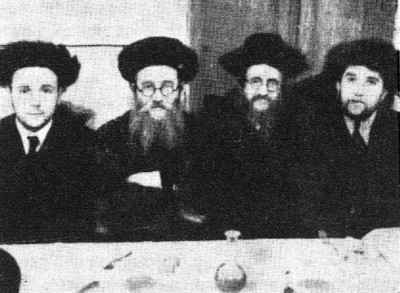
| From right to left: Arye'le Tversky, the brother of the rabbi Mote'le, the ADMOR R' Mote'le, Yanke'le Tversky |
somewhere along the way. The children remained alone and, after much wandering, came to Yampol [=Yampil], saved, and alive. The oldest sister, Sonia Roitman, the wife of the lawyer Roitman from Khotyn, became the head of the family, the matriarch.
The daughters live in the United States. The only surviving son, R' Yaakov, heir to this famous lineage, lives in New York and he is the son-in-law of the esteemed rabbi of Kapischnitz [=Kopychyntsi], R' Avraham z”l.
Four Generations of the Khotyn Rabbis
The Rabbi, Yisrael-Mordechai Strakovsky, a native of Chodorov [=Chodoriv], which is next to Kyov [=Kyiv], was one of the central supports of the Sadigura Hasidim, of noble quality. They say, following R' Nisse'leh Posek, that when R' Shaike came from Khotyn to Yasi [=Iaşi] and went into the home of the ADMOR of Sadigura, R' Avraham Yaakov, the ADMOR advised him to turn over the rabbinic seat in the city of Khotyn to R' Yisrael-Mordechai saying: his interior is not like his exterior, meaning his interior is more than his exterior.
R' Yisrael-Mordechai regularly prayed with the Sadigura Hasidim and only once a year, on Hoshana Raba, he habitually prayer with a separate minyan in the Beit-Midrash that was next to the Great Synagogue.
The ADMOR of Sadigura once said to one of his Hasids, a man from Khotyn: you don't have any need to come to me; don't you have R' Yisrael-Mordechai there in Khotyn.
The Rabbi, R' Shaulikel Strakovsky, came to the rabbinic seat while his father was still alive, the aforementioned R' Yisrael-Mordechai. After his father died, he was finally appointed in his place. The members of the community loved him and respected him and from this came the nickname that was attached to his name: Shaulikel. He was a contemporary of Nisseleh Posek. He was counted among the Boyan Hasidim and prayed in the synagogue of the Boyans. He was not accustomed to give sermons in front of the community and did not preach ethics. He captured the hearts of all by the glory of his personality. He embodied the commandment: and you shall meditate on it day and night, and he was a great Torah scholar. He wasn't only a man of the law, but rather also well-mannered.
As regards religious matters, he did not tend toward compromises, in his judgments with the ritual slaughterers, he relied solely on the law in order to resolve the issue at hand.
Out of love for humanity, he refused to listen to gossip concerning the members of his community.
Once his doctor said that a growth that had appeared on his gums was cancerous and he would need surgery. R' Shaulikel agreed to the operation only after the ADMOR endorsed the doctor's assessment.
Due to his meager salary, the rabbi lived in poverty.
The Rabbi, R' Chaim Roizman, served as a rabbi in Khotyn twice, first together with R' Shaulikel and later with the rabbi, R' Nachum. R' Chaim was counted among the Mitnagdim [=opponents] and prayed at the “Yatke Kloiz.” He was a great scholar, a basket full of books, which illuminated the paths of the law. His daughter married R' Yisrael Lerner, one of the outstanding melameds of the city. R' Chaim's son, Michael, was a mohel [=circumcizer].
[Page 59]
|
|
The Rabbi, R' Nachum Strakovsky, was involved in commerce in his youth and later served in the Khotyn rabbinate with his father, R' Shaulikel. R' Nachum earned a respected position both within the Jewish community and outside of it. Many non-Jews preferred to bring their disagreements to the rabbi for a decision without requiring legal proceedings. When matters between people were brought to the police, they would ask: have you already brought the matter to the Jewish rabbi? Because the rabbi was known for his sharp eye and his sharp judgment regarding arbitration matters, even though he refused to be the sole arbitrator and preferred that each party have their own arbitrator.
Because he was a seeker of peace, one of the disciples of Aharon ha-Cohen, divorces in the city did not increase during the time of the rabbi, R'Nachum's service. There was a disagreement in Zharzho's house concerning personal status. The peace of the household went wrong due to his being a Communist. The wife sued for a get [=divorce decree] and was refused. Through the involvement of the rabbi, the husband agreed to give his wife a divorce.
The rabbi was accustomed to traveling every year on Shavuot to the ADMOR of Boyan.
The rabbi, R' Nachum, hoped for a blend of religious and secular education. He himself had encountered difficulties when he had to appear before the authorities and needed a interpreter for his conversations with them. In order to secure a secular education in secondary school for his daughter, Dvora (who now lives in Haifa), the rabbi turned to the member of Parliament from Khotyn who tried with the appropriate authorities to grant the daughter permission to be excused from studies on Shabbat.
The Rabbi, R' Gedaliah Strakovsky, brother of the aforementioned, was also a Hasid of the Boyan ADMOR. He did not travel to the ADMOR on Shavuot, but rather at another time, in order to not leave his flock without a shepherd. He was an expert in Shas [=Mishna and Talmud] and Poskim [=Jewish law adjudicators] and excelled in his quiet manner and great patience. There were those who tried to provoke him with questions from various sources, but in the end, they left embarrassed because they didn't succeed in their attempts. R' Gedaliah died young, childless.
The Rabbi, R' Binyamin Leybendman, who married Dvora, the daughter of the rabbi, R' Nachum. He studied at the Maramureş yeshiva and was ordained by the rabbi, R' Meshullam Rot of Czernowitz [=Chernivtsi], and also had a high school diploma as an external student. The blend of the old and the new worked well in him. He was well-versed in world affairs, in Jewish history, and he used his knowledge in lectures before the Jewish community. Representatives of the authorities and the officer corps were quite amazed at the rabbi's appearances at official events. The rabbi was also fluent in Romanian. During the Russian regime, 1940-41, he was not harmed, but when the Romanians and Germans conquered the city, they put an end to his life along with the rest of the intelligentsia.
Ha-Rav Mita'am [=the rabbi appointed by the authorities to represent the community], Shmuel Chet (Hes), carrier of this title, a remnant from the days of the Tsar, had nothing to do with the prestigious position in the Jewish community, the position of rabbi. Only technical administrative matters fell within the authority of Ha-Rav Mita'am. The keepers of the tradition did not turn to Ha-Rav Mita'am on any religious matter. With the elimination of the regime of the Tsar, the position of Ha-Rav Mita'am became one without any ta'am at all.
Ha-Rav Mita'am tried to get permission to arrange for a huppa and for kidushin and, when permission was not given to him, he settled for technical office work.
Ha-Rav Mita'am in Khotyn was not religious.
When the Romanians produced the well-known order that the Jews had to prove their Romanian citizenship through documents, Dr. Zeidman, head of the community in Khotyn, delivered an ultimatum to Ha-Rav Mita'am in which he demanded that the archive connected to the registration of residents be transferred to the control of the community. Because he lacked any support, Ha-Rav Mita'am was forced to transfer his archive to the community.
By the way, none of the Jewish residents of Khotyn had their Romanian citizenship revoked.
A Dispute surrounding the Office of the Rabbinate - and its Tragic End
After the rabbi,, R' Gedaliah died, a rabbi from Hungary, R' Ashkenazi, was invited to our city for Shabbat. Sleepless [?], he decided to put forth his candidacy for the rabbinic office in Khotyn, which caused a sharp dispute in the community.
His followers, who sprung up overnight, especially among the workers, tried with all their might to install him in service to the community. The heads of the community were opposed, some on budgetary grounds and some on matters of principle: one cannot appoint someone to the position of rabbi who does not have an ordination diploma.
Because, in the meantime, the guest was engaged in unlicensed ritual slaughter in private houses in order to earn a living, they investigated him in order to catch him in his corruptions and blame him of depriving the community of income. So matters remained until the Russians came in 1940, which put an end to the dispute in a fundamental way by eradicating the community's right to existence. With the conquest of the city by the Romanians and Germans in 1941, a tragic turn occurred in the entire matter. One day, the leaders of the city were summoned to the high school auditorium. Two Germans appeared who gave the order that all the intellectuals, including rabbis and ritual slaughterers, should line up along one of the auditorium walls. Without hesitation, R' Ashkenazi lined up next to the rabbis and went with them on their last journey. On July 7, 1941, at 4 in the afternoon, they were all executed.
[Page 60]
The Ritual Slaughterers
There were 7 ritual slaughterers in Khotyn, respective to the needs of the community. One couldn't say that people chose this profession out of some special emotional leaning, but rather just from the need to make a living.
Among the ritual slaughterers were God-fearing Jews, knowledgeable, imbued with a love of living creatures, and having good values. The community took care for their livelihood. For this reason, there were no arguments between the ritual slaughterers and the butchers. Animal meat that was not kosher was sold to non-Jews and the butchers accepted the verdict.
In Khotyn, the matter of keeping kosher was just obvious. Thus one can understand the astonishment of a Jew from Khotyn who came to Israel and suddenly saw a sign in a butcher shop on which it was written in extra-large print: “kosher meat.” How is it that, in Israel, there's a need to announce to the public something that in the diaspora had the force of an axiom.
Mendel Shochet used to sit in the synagogue next to the rabbi, R' Yisrael-Mordechai, a Hasid from Sadigura, a blessed personality in the city of Khotyn. His wife, Mindel, was active in the affairs of the community.
Shlomo Shochet was accustomed to coming to the house of the rabbi on Erev Yom Kippur to slaughter the kapparot [=sacrificial chickens]. As a good Zionist, R' Shlomo visited his daughter in Israel at Sha'ar Ha-amakim. His son, Feibush, was also a ritual slaughterer as was his son-in-law, Shlomo Shochet from Berdichev, a Jew educated in the works of the Rambam [=Maimonides], especially “Moreh Nevuchim” [=Guide to the Perplexed]. His son, Zalman Shochet, and the ritual slaughter, Reuven, were poultry slaughterers. Pesach Shochet. Itzik Shochet, a native of Bessarabia, came to Khotyn in 1923 with his nine children. Because he was also ordained as a rabbi, they refused at first to accept him as a ritual slaughterer out of concern that he would also claim the rabbinic position. When they came to know that he had no intention of doing that, the obstacles were removed and he was appointed as a ritual slaughterer and a mohel [=circumcizer]. Aside from that, he engaged in arbitration and the parties relied on his honest intelligence and judgment in controversies. Non-Jews, too, would come to him with their complaints.
After Yankel Shochet died, his widow tried to have her son-in-law, Moshe Shochet, son of Alter, from Zhvanets, a Zinkov [=Zinkiv] Hasid, inherit her husband's place as ritual slaughterer. Not only did she not have any power in this matter, a serious dispute arose until intervention by the police. The conflict got worse and people from Zinkov would refuse to marry people from Khotyn.
The Portrait of Itzik Shochet
R' Yitzhak Geller, known by the nickname as R' Itzik Shochet, was a well-known figure in Khotyn, a man of dignified appearance and delicate soul. He didn't confine himself to the 4 pillars of Hasidism, but rather found a bridge of understanding to the young generation, absorbing into himself the values of the new spirit that blew in the world in those days.
Itzik, son of R' Yosef Berish, was born in Khotyn and acquired his knowledge of Torah among the students of the Beit-Midrash. At the age of 18, he married the daughter of R' Meir Shochet and went to live in Zhvanets in order to be close to his father-in-law. He lived there until 1907, when he had seven children.
Khotyn Hasids who used to travel to Boyan to spend time in the presence of the ADMOR would find accommodations along the way with R' Meir Shochet, who excelled in generous hospitality. His father-in-law's home was also a kind of Hasidic hotbed for R' Itzik Shochet. He became friendly with his brother-in-law, Reuven, one of the students of the genius, R' Tsirelson, and was captivated, like many of his generation, by the new Hebrew literature. He drew to him many of the Beit-Midrash regulars in order to thresh out as a group the many subjects that engaged them from their secret reading of the new books. This ideological circle also influenced R' Itzik Shochet who adopted for himself the way of thinking of the young generation. In his conversations and his arguments, R' Itzik mastered deliberation and debate, lending an ear to the words of his interlocutor and knowing how to always find the correct answer.
In 1907, he moved to a rural town, Kornesht [=Corneştis], and was self-employed as a ritual slaughterer, cantor, and rabbi, but he didn't succeed in adjusting to the place due to the lack of a Torah culture tradition. In 1919, he returned to Khotyn as a ritual slaughterer and mohel. In addition, he conducted study circles in his home and in the synagogue. He had a good temperament, was kind to people, and he would hum as he went along his way.
His sons were educated without coercion, rather with the approach of understanding the spirit of the young generation.
His daughter-in-law, the chair of WIZO [=Women's International Zionist Organization] in Bessarabia, who lived in Kishinev [=Chişinǎu], was instructed by her father to move to a different place from which she could immigrate to Israel. His descendants lay down roots in many different places in Israel: in Sha'ar Ha-amakim, in Givat Chaim, Ma'abarot, Haifa and more.
He himself never managed to see Israel. With the retreat of the Russians from Khotyn in 1941, he said to the members of his household sadly: now comes the end of Judaism … I am not able to witness this suffering.” The sole privilege that remained from R' Itzik Shochet was to be buried as a Jew, two or three days before the great and ugly slaughter that came upon the Jews of Khotyn with the coming of the Nazi soldiers.
Tashlich [=Rosh ha-Shanah ritual of casting off sins] in Khotyn
It's impossible to forget how the Jews of Khotyn went to “Tashlich.” Everyone in the city, from big to small, participated in this procession! Everyone marched to the famous fortress in Khotyn.
Everyone walked, true, but every person had his own style of walking. Hasids and people of action did not delay by the fortress, but rather continued to the river in order to say the prayers and to throw the sins into the depths. Afterwards, happy and kind-hearted, clean and free from sin, they went to the gabbai to toast “Le-Chaim,” to chat about community matters and to tell stories in praise of the rabbi, stories that elevated the soul and warmed the heart.
The skeptics, too, went to Tashlich - not a single person remained at home - but these were not strict about
[Page 61]
the ceremony and were satisfied with just the reward for walking. The young people who had completely abandoned the yoke of the commandments simply went to the fortress in order to have fun there - though on the face of it, they, too, went to Tashlich.
The sight of the rabbi who walked to Tashlich accompanied by the group of his Hasids was particularly lovely. They were all full of enthusiasm, listening to his words of Torah, and worries and difficulties were forgotten a little. A world that was entirely good.
Sometimes, a feeling of longing for the holidays of those days sneaks up in the heart, for Jewish communal life, for those customs in all their glory and splendor. It's truly painful that our children will not continue to see holidays like these. Too bad!
The Land of Israel and its Holiness
“And so we have heard: great ones in France and the Pharisees in the cities of Aspamia [=the ancient name for Spain] had a very honored custom: that their tables, upon which they fed the poor, when they passed away, they would make a coffin out of them in which they were buried … he shall take nothing of his labor in his hand, only good deeds and charity …”
From “The Flour Jar” by R' Bahya Ben Asher
(Lived in Spain from 1260 to 1340)
Many Jews immigrated to the Holy Land when they were old in order to be buried in the soil of Israel and to prevent desecration of their grave. These Jews were respected, but also aroused some jealousy on the part of community members.
R' Aizikel Goltsman (Holtsman), with beard and sidelocks, a tailor by profession, was known as an observer of the commandments. When he was about 70 years old, he decided to immigrate to Israel and, through this, captured the hearts of the people of Khotyn who came in droves to his house to say good-bye and to wish him: Go in Peace.
His family liked to tell the story that, among the few possessions that he took with him, was also the board of his work bench, upon which he cut cloth for garments. This board was destined to accompany him to the grave when he departed the world, as true testimony that he lived by the fruit of his labor.
|
[Page 62]
|
|
|
|
[=Stephen the Great Street] |
|
|
JewishGen, Inc. makes no representations regarding the accuracy of
the translation. The reader may wish to refer to the original material
for verification.
JewishGen is not responsible for inaccuracies or omissions in the original work and cannot rewrite or edit the text to correct inaccuracies and/or omissions.
Our mission is to produce a translation of the original work and we cannot verify the accuracy of statements or alter facts cited.
 Khotyn, Ukraine
 Yizkor Book Project
 JewishGen Home Page
Copyright © 1999-2026 by JewishGen, Inc.
Updated 29 Sep 2026 by JH