 |
|
|
[Page 199]
Translated by Theodore Steinberg
As there were in every shtetl, so there were in Amdur a number of people from the underworld: ruffians, arsonists, and horse thieves. I remember one such person: on Tuesday in the marketplace, he would get drunk, take off all his clothes, and roll in the snow. And that drunkard would intensely recite Psalms on Shabbos after mincha and cry out, “Save me, O Lord, from evildoers, protect me from the violent” [Psalm 140:2]. This saying of the Sages comes to mind: “Even the emptiest among you are as full of good deeds as a pomegranate is full of seeds” [Sanhedrin 37].
And while I remember Amdur drinkers, I will say a few words in general about those kinds of people, who were not lacking in my shtetl.
Eizhe-Mendel's office was full, day and night, with drunkards. Every disagreement over the prices of horses (Horses were bought and sold in that place.) would be settled there. People would exchange blows and then end with a drink. But seldom would a Jewish Amdur drunkard take drink without saying the proper blessing. Often people would first hit and strike, fight and swear about worldly situations, and finally make peace by the cask. People in Amdur would say, “People begin with a fight and end at the keg…”. Gentiles would drink in the taverns and Jews in the office.
I cannot overlook a certain type of drinker who got a reputation in Amdur with the daily scandals that he created in the streets. Always going around bloodied with a head split from blows that he exchanged with his brother, a horse thief. When one would lie on top of the
[Page 200]
other, hitting him on the head with a rock, the victim would yell, “Don't worry. People see. There are witnesses.” So how did he get his head split? People see. There are witnesses.
He would always lie drunk near the Duma. When the police chief would come, he would raise a cry about why people sold meat for so much money. He was a “Nicholas soldier,” and according to him the “king” had made a waiver for that kind of soldier, for buying meat without paying the meat tax.
Once a week, for Shabbos, he would buy a piece of lung and protest against the meat tax…And that poor Amdur drunkard on the Days of Awe would cry with bitter tears over the burning of the bulls that were brought as sin offerings in the Temple.
Translated by Theodore Steinberg
Many years passed before Amdur achieved the status of a “postal station,” like all similar cities. Earlier, people would send a letter for anyone in Amdur to the village of Prokopovitsh, to “volost” [the provincial subdivision], and once a week all the mail for Amdur would be sent on from there. At that time people in Amdur seldom used the official mail system. First of all, to whom did anyone write? All of Amdur's commercial ties were with Grodno or, at most, with Bialystok. Sending a note in the city or its “suburbs” to make a purchase from a business—people did that via the wagoneers. And come on—who needed personal letters? Nu, they would write on the envelope, “May this come, rise, reach the hand of so-
[Page 201]
and-so [This is a formula from a familiar prayer.]. At the top they would write “according to the doctrine of excommunication of Rabbeinu Gershom” [a rabbinic order forbidding the reading of someone else's mail]. Then they would give it to Meir Guzshikin or Hershel Shudyakin and—that was that…Often a letter would go from hand to hand, a letter which a young man wrote to his intended—a “love letter”—despite all the rabbinic interdictions on the envelope. An Mdur groom wrote to his bride in Krinik, “My heart is in Krinik, and I am in Amdur” [paraphrasing a famous poem by Yehuda Halevi]. I saw you in Krinik. I longer for you in Amdur, and I kissed you in the woods.” Such was the mail system in Amdur then. When Jewish emigration to America became sizeable and Amdur's young people left their birthplace, correspondence grew much larger and there was need for a local post office. After many petitions, Amdur received the happy news. Mail would be forwarded from Grodno twice a week. On the evening when the carriage would come with its bell, bringing mail, everyone would flock to Duvid Kantorczik's home, where the mail was delivered…Young women and men would use that opportunity to meet in the dark and say, “With much love” [another quotation from a prayer]. Strictly observant Jews began to mutter, “What's this! Young men and women going around half the night!” And Shmuel Markus, an iron merchant, a bit nutty, called out in the beis-medresh, “We have to cancel the mail!” to which Avraham Shloyme Tzines ironically responded, “It will get worse. They'll go on foot to Prokopovitsh and carry women off beyond the eruv…”
Who used to carry the mail before there was a post office in Amdur and after? We should remember the
[Page 202]
Amdur mail carrier. His name was Motke-Khaikl Voiks (an incorrect form of Volk or Volf)—he was terribly crippled: his right hand fused with his face and his elbow with his knee, and in addition a large hump on his back. Still, this strange being used to go back and forth between Amdur and Prokopovitsh to take mail and bring it back and then deliver it to the addressees. Those who had God in their hearts would give him a kopeck for a letter; most people just thanked him, and some gave nothing. And when the post office came officially to Amdur, he received nothing from the government because as a Jew, he was not permitted to have a paid government position, and he appeared under a Gentile name—“Riyar,” the wood chopper. That was the czarist regime. How did the cripple carry out his work? How did he have the strength to go with his fused hands and feet and serve the city almost for free? Inconceivable. Wonders and miracles! He was, in addition, totally observant, and as he hobbled around the city, he would never fail to pray with the congregation, and he enjoyed bouncing up and down when he said, “Holy, holy, holy.” Poor Jewish cripple! Where could we find a poet who could proclaim your industriousness, your excellence, your self-sacrifice. May my poor words serve as a memorial to your name.
Translated by Theodore Steinberg
It is assumed by Jews everywhere that the village Jews, the Yishuvniks, area just common people, crude and uncultured. Many stories are told about the conduct of these village Jews
[Page 203]
and many jokes have been told over the centuries at the expense of Yishuvniks and Jewish leaseholders of former times. Jews told good-natured jokes about how those village Jews conducted the seder or how they observed the Days of Awe when they came into the city. People would tell almost grotesque stories at their expense. But if I were to judge the Yishuvniks according to what I know from the Amdur region, my verdict would be quite different from the usual. And I do not think that the village Jews around Amdur were an exception. Many of those whom I knew were students of Torah, and some had noble traits and fine manners. I will provide some examples.
Moyshe-Yirmiya from Baranova settled in the large village of Baranova, a Jew in an environment of hundreds of farmers. None of them—literally, not a single one—could sign his name. As for reading, don't even mention it. Moyshe-Yirmiya ran the inn there and made a living from alcohol. He was ordained, a profound scholar with great skills. I would see him in the city when he would come for a yahrzeit or to hear the Megillah at Purim. For the High Holidays, there would be a minyan in the village neighborhood. Some weeks before I left Amdur, I was in Baranova to collect a debt from a Gentile. I went into Moyshe-Yirmiya's tavern. It was full of men and women, young and old, sitting around a large filthy table covered with crude, dirty round glasses, chattering about pigs, horses, cows, and calves. A big bumpkin had hit his father with the foot of a bench. The chaos was awful. I was shocked. But the “elder” had made peace, and it all ended with a bottle, as father and son kissed…The tavern
[Page 204]
was overseen by Moyshe-Yirmiya's wife. Moyshe-Yirmiya sat in a side room over a volume of Yoreh De'ah [a 14th-century book on Jewish laws] and looked into it. When he saw me, he called, “Nu, with the likeness of a donkey.” And truly, comparing that crowd to Moyshe-Yirmiya, people would have to agree with him. One could see two Baranovas, one superior and one inferior. Drunken Gentiles, a son giving his father a murderous blow, and the Yishuvnik with his volume…
So much for Moyshe-Yirmiya. But did Moyshe-Yirmiya raise children in the village in his image? Did that “Baranova scholar” leave even a single child about whom people could say that he is, at least, a continuation of Moyshe-Yirmiya? Unfortunately, no. I remember when he brought his son to the city for his bar mitzvah. That year, all the shuls and beis-medreshes in Amdur had been closed because they had not chosen the official gabbais who were responsible for making the “prayer for the government” on Shabbos and Yom in the proper places, so people went to pray in the Chasidic prayer house, which was counted as neither a shul nor a beis-medresh. Everyone was there for prayers. Someone called out, “Arise, young man…the son of Rav Moyshe-Yirmiya.” Nu, the rabbi's son, sadly, could not say the blessing for the Torah. People shook their heads and moaned, “Nu, a Yeshuvnik, poor thing.” The rabbi's Lazar remarked, “He will, with God's help, be the replacement for the rabbi in Baranova”…That village never produced a Torah scholar.
Shmuel-Rosha Prokopovitsher. Prokopovitsh was a village two viorsts from Amdur. The district office was there. It arbitrated all village disagreements. Or they ruled that this or that
[Page 205]
village Gentile deserved lashes. The accused had to go to Prokopovitsh to receive the prescribed lashes and then return to his village humiliated and repentant, like a newborn…
One Gentile returned after his lashes to Amdur to buy something. He was asked, “Fyodor, what's new?” He responded, “Nothing at all. I got twenty,” which meant that he had reeivevd twenty lashes.
In that village lived Shmuel-Rosha, a scholar and great preacher, according to reports from that time. He made an impression with his Purim sermons that were full of Talmud-lioke arguments. They were spicy and often grotesque, but always, naturally, according to the limits tolerated by Amdur's Jews on Purim. According to Shmuel-Yoshe's sermon, Ahashuerus fought with Haman over the Talmudic doctrine of “despair over a lost item” [Baba Metzia 21].and Shmuel-Rosha used Abaye and Rava [Talmudic sages], showing that both of those “idiots” forgot the Talmudic rule that in disputes between Abaye and Rava, halacha follows Rava except in six cases. So he thought that the Persian king [Ahashuerus] was right to sign Haman's order, because the Rashba [a medieval commentator] had one or another definition of “the law of the land is the law,” but so was Haman correct, because the Ritba [another commentator] disagrees…but the upshot was that Ahashuerus was “uncouth” and Haman was “trash” because they foresaw the half-shekel… [This whole thing is a complicated parody of a Talmudic argument that would be appropriate for Purim. It is not supposed to make ordinary sense.][a]
[Page 206]
Yekev Zak. People called him Yekev Zarubitsher, after the village where he lived. A tall, heavy fellow with a large mustache. His family name was Zak, a Kohen, which means “Zera kodesh” [sacred seed].[b] Other Jews with the same family name would write “Z'c,” an acronym for “priestly seed.” The rabbi's Lazar once said, “I don't know about his pedigree, but he's certainly a big sack [“zak” in Yiddish] with long ears”…He held the lease on a government position in the Amdur region. He always travelled in a carriage with a fine horse. He often went to Grodno. He was no hick. He spoke proper Russian. He often had a drink with the police chief, and his “sack” was never empty. On the High Holidays, he would pray in the Great Synagogue and would be given the honor of opening and closing the Ark for the Ne'ilah service and for “Atto horeyso” [another important prayer]. Since he was a Kohen, people would joke that the last section of the portion of Korach belonged to him. Because it spoke of the wealth of the Kohanim and the Levi'im and clearly says that the Levi'im should get “the produce of the threshing floor and the produce of the vat…” [Numbers 18:30].
I remember how his wife, Treyna, came at Pesach time to Moyshe Azhorer to bake matzo in the first oven, because it was more kosher…Who can appreciate those long ago Jewish aristocrats: holding a position, drinking with officials, playing cards with the high “authorities”, and worrying over matzo from the first oven, like a really observant Jew—extremely observant and religious. He sent his two sons, Moyshe and Heshel, to study in the city, but they were not Torah scholars. His second son studied with Avraham Kadish together
[Page 207]
with me. As soon as he entered the cheder, he showed the skill of standing on his head with his feet toward the ceiling. My holy rabbi, Rabbi Avraham Kadish, was shocked and cried out, “I don't want such a strange creature in my cheder.” Finally Hershel returned to Zaruvitsh. A few years later, I met him as he wore a sparkling visor, which at that time was considered a sign of debauchery…
Original footnotes:
Translator's footnote
Translated by Theodore Steinberg
I will also convey my memory of Amdur Gentiles. For a long time, for long generations, Jews and Gentiles lived together in Amdur. Jews worked for Gentiles and vice-versa. I do not remember any Gentile tailors. That profession remained in Jewish hands. There was one Gentile shoemaker in Amdur at that time. He lived at the start of the Gentile street. A Gentile with a large growth on his forehead. He was called Pani Yuli…and Jews gave him work. He was a specialist in soles and patches.
I will try to present a gallery of Amdur Gentiles who were tied to the town's Jews.
Casimir Colombish, a large Gentile with a long, crooked nose. All his days he was the “elder” among the townsmen and was considered a wealthy peasant. He was involved with all the Jewish interests in the city; a few times he showed animosity to the Jews, but he made peace with fate because Amdur society would not allow him to “spit in his pocket.”
For the whole time that I lived in Amdur
[Page 208]
Jews had the upper hand. It never happened that a non-Jew raised a hand against a Jew. When on a market day or when Gentile “recruits” wanted to start a fight with Jews, they would leave without hands or feet. After I left Amdur, it happened that one Sunday, Erev Yom Kippur, when drunken Gentiles started a fight with Jews, a Gentile woman was killed by a Jewish blow. The result was that many of the fighters fled to America. The case stirred up all of the surrounding villages. The official government newspaper in Grodno then began an antisemitic agitation. In official circles, this case was called “the Amdur Yom Kippur pogrom against Gentiles.”
Casimir Colombish had near his house a well with clean and tasty water. Fastidious Jews would use the water from this well to cook peas. Amdur's women would say that good peas could only be cooked with that water. Casimir's well was famous. Actually, Amdur did not have such good water. People even brought in Russians from deep insider Russia to dig a deep well in the market, but without success. It just happened that all of the Gentiles' wells had clean and tasty water; the Jews' wells were just the opposite.
So it would happen that during the week of Pesach, “the heavens would open”: everyone streamed to Casimir's well. The Gentile neighbors would water their horses there after they ate oats and barley also during the week of Pesach…Nu, it is easy to picture
[Page 209]
the situation: someone would find oats and barley in the well, people would announce in shul and in all the beis-medreshes, “Casimir's well is chametz,” after the women had already cooked Pesach meals. People ran to the rabbi with questions, and Jews cried out, “Chametz on Pesach!” Everyone who thought they were learned split hairs over the issue…and women wept lest they fall into Gehenna, God forbid, cut off in years. The whole city was turned upside-down. Naturally everyone blamed Casimir: Why had he allowed people to water horses by his well during the week of Pesach…Also the curses of the Torah fell on his head. Every year it was the same story: carrying on over Casimir's well. The rabbi's Elazar said that we should call the well “Quarrel,” because every year people would quarrel over it (a reference to Genesis 26:20).
Casimir was used to living with the city's Jews and took part in all their affairs. He was even involved in their religious affairs. I recall a characteristic case:
A certain young man named Kadish “Rascal,” who used to eat non-kosher kielbasa at that time, sixty years ago, smoked a cigarette on Shabbos. The whole city went crazy. Imagine, smoking on Shabbos! And Casimir Colombish was among the critics. He expressed his feeling in these words: “A plague on him. He smoked a cigarette on Shabbos. Feh. That's disgusting.”
By the way, people who later came to Argentina from Amdur told me that Kadish “Rascal”
[Page 210]
in later years became a penitent and would sit in the beis-medresh and listen to people study the Eyn Yakov.
Yoshke Narel—a Gentile mechanic and a wealthy peasant. Jews called him Pani Yania. Several times was the village mayor and considered himself a good neighbor. But he had a lot of dogs by his house and we Jewish children were always afraid of those dogs. As a mechanic, he spent his days fixing the fire truck, but when a fire would break out, the truck never worked…
I remember that in his courtyard, Yoshke had a whole “workshop, with all kinds of tools. When someone had to fix a machine (alas—Amdur machines) or any other difficult mechanical device, he had to come to Yoshke Narel and his “tools.” In Amdur there were no factories aside from Reuben's brewery. And I do not recall any machinery that was worthy of that name. But Yoshke would be summoned to the Krasnicki Courtyard (named for its owner, Count Krasnicki), where there was a whisky distillery or to Vateshtshina, where there was a large, modern water mill that operated on rollers and in which were arranged machines on spongy fabric.
There was in Amdur another Gentile family of mechanics
[Page 211]
who lived at the end of the Jewish street and the beginning of the Gentile street. They were called “the Mikolaytshiler.” They were quiet Gentile neighbors. They also considered themselves “Polish nobility.” They did not communicate too much with the Jews; they were a bit “stubborn.” But they never said a bad word about Jews. This all happened in those past times at the end of the previous century, when, morally and physically, the Jews had the upper hand. Generally Jews and Gentiles lived peacefully in Amdur until the Bialystok pogrom, organized by Stolypin, may his name be blotted out, and functionaries.
Josef Nalyeva. In order to make the gallery of Amdur Gentiles complete, I will also recall a disturbed Gentile…This Joseph Nalyeva had a fixation that everyone should call him “Josef Naprava” [Joseph to the right] —and if anyone made a mistake or purposely called him “Josef Nalyeva” [Joseph to the left], that person, according to him, deserved death…This craziness came from his military service. He could not tell the difference between right and left, for which he received severe punishment. He did all kinds of hard labor during his long years of military service, but he could never differentiate left from right. Finally he returned from the service with this craziness, that everyone must call him “Right.” It is easy to imagine what the young people of Amdur would do with this unfortunate Gentile. When he would appear in the street, he would cry out with tears in his eyes, “Joseph Naprava,” and to make him angry, the ruffians would shout, “Josef Nalyeva.” Windows would be broken as stones flew, and the street was in turmoil. It would happen that Noach the Deaf would meet Josef in the street, and the scene was perfect: on one side, people would
[Page 212]
tease Noach as a “Levi” in the middle of the street, and on the other they would shout “Josef Nalyeva”…A fight would break out from which few emerged unscathed. Usually it would happen after such a scene that both of these crazies would bewail their fate. Noach the Deaf would say to Josef, “G'vald! At least once a Levi,” and Josef would say, “What would it hurt them to say 'Naprava'”? It was tragic to see these two unfortunate souls in their sadness.
Translated by Theodore Steinberg
Encountering Gentile drunkards was no novelty in Amdur. It was perhaps an exception not to find drunk Gentiles. But there were, in my time, a couple of special drunkards whom it is appropriate to recall. One of named Lodish and the other was called Batshka. Both used to go hungry. One of them once told me that during the winter he ate tree bark and swelled up from it. And wonder of wonders!—they were both drunks. Where they found money for drink, no one knows. Lodish was quite religious. He would always stop to consider God's name. He was delighted by Godliness, as he would always cry out, “Thank God for God”; he was really ardent about the existence of God…His job was to make wooden yokes for pails of water, an “industry” that earned him enough to buy water for kasha. In the winter, his job was to run things for “Mottya Linik,” who Jew who braided rope.
His friend was Batshke, who earned money by making wooden rakes. He used to envy `his colleague Lodish, who knew how to count to ten…He could not understand how 6 and 4 added together amounted to 10. He could understand how a fiver and a fiver added together made a tenner, but 4 and 6 also made ten? No way…”That's a Jewish twist,” he would say in his Gentile language. What a Gentile scholar!
I was once out with my uncle, R` Mattes's R`Avraham, and we ran into Lodish and Batshke lying drunk on either side of the street. The rabbi jokingly said, “It starts with the jug (Lodish) and ends with the cask (Batshke).”
Ignashke—so he was called. He lived near Bregman's beis-medresh in the neighborhood of my grandmother Tuvya, a”h. He spoke Yiddish well, so that sometimes people did not know that he was not one of our brothers, the Children of Israel. Sometimes he was so immersed in conversation with Jews that people could hardly recognize that he was a Gentile. In the winter he worked at driving oxen from Amdur to Vilna. The reward for such hard and thankless work was negligible; and when he would arrive in the evening at a Jewish shtetl with his oxen, he would leave the animals in the street and enter the beis-medresh to warm up; and often he would sleep there all night. The people in the shteetls around Amdur knew him well and called him ”the Amdur Yeshiva Boy.” People would joke and ask him why he did not have special “eating days” with the locals [as yeshiva boys did]. But then the Gentile would appear and answer that he only went to the beis-medresh at night…
[Page 214]
Since he was a close neighbor of Bregman's beis-medresh, at night he would steal wood that lay in the vestibule, and when he was caught, he would swear by his “portion in the World to Come” that he would henceforth be good and religious…
I will not omit another drunken Gentile. His name was Ivan Kalenki. He was a cripple with twisted hands and a foot that dragged. He was big fellow. For Jews, he would have been a “holy man”; for them, every such thing counted—as Isaac Mayer Dick [a popular Jewish writer] had published…
I remember an episode from my youth. One Friday night at home, the glass on a lamp broke, and we were afraid of a fire. We needed Kalenki's help: to go with my father to the store (my father, z”l, had a store), and bring back a new glass. This was a hard process. [Because of Shabbos stringencies] we had to hint to him that he should light a fire so he could see in order to get a glass. To say it clearly was out of the question. To tell a Gentile to do some forbidden labor on Shabbos is not permitted. As soon as he came home, we had him stand on a chair. The broken glass was still hot, and when he touched it, he broke the new glass as well. We had to end our meal by the light of the Shabbos candles. Kalenki left with singed hands, but he did get payment: a glass of whisky and some challah…He was so happy that after Shabbos he asked if we would break a glass next Shabbos..,
Yevushah the Shabbos Goya—she also should be remembered. Her main job was—in the winter to heat ovens for Shabbos
[Page 215]
in Jewish homes. She did this for many homes, and she used to lose track of where she had begun earlier and where later, which she had to know in order to shut the flues. And in the middle of things she would get drunk, so that the oven would get cold, raising a hue and cry. People would freeze because it was so cold outside. I remember how we children would fiddle with the flues, holding on with a piece of cloth and closing the chimney. The thing was not so easy. My father, a”h, would complain, “It is forbidden because of the laws of Shabbos,” and my mother, a”h, would mutter, “We'll end up in Gehenna because of that drunk,” after which she would add, “We're with them in exile”…Yes, my dear mother: Yevushah, who used to get up at dawn during the cold of winter to heat our oven for Shabbos so that we could lie on our warm couches, for which she received a piece of challah and three kopecks—for her we remained in exile. Not for nothing was there a joke among Jews. When we will be in our own country, we'll heat the oven for the Gentiles so that they can sit quietly on their own warm couches…
Translated by Theodore Steinberg
For the whole time that I remember, Amdur had only a single police officer. This was the “uradnik”—a kind of sergeant who oversaw the city and its surroundings. There was also a “village elder” for the non-Jews and a Jewish “constable” or “sotske”, that is, someone who oversaw ten or
[Page 216]
a hundred. All of these positions had a village character. With only a small break, the “uradnik” was for all his days a certain Strauss, a Gentile, who could barely sign his name and was for forty years in charge of Amdur. He spoke Yiddish and would say about himself, “The earl understands the language.” He knew the taste of Jewish blows. After he had several times interfered with Amdur thieves, in the middle of the night they put a bag over his head and beat him with rocks. He knew who had beaten him, but he kept silent because he knew that he could do little against these Amdur ruffians.
On Sundays, when the Gentiles would come to the city from the villages in order to go to church, stores had to remain closed at least until mid-day. Nu, so what did they do when all their revenue was gone before people went to church? The Jews of Amdur had an idea. They had to deal with Strauss—and with two pounds of sugar loaf as a gift, everything became kosher and proper. When Jews would fight with Gentiles and the latter would leave with split heads, no Jew was ever detained. It is said that Amdur's Jews were in exile with the Gentiles, but that is far from the truth. The Jews had the upper hand. This was so until the pogrom of 1905. Then another regime began.
Amdur belonged to the Krinik-Berestovits-Amdur region, which had a commissar whose residence was in the first of those cities, because in that city were many leather factories whose employees had to be watched. I remember well the last commissar, Kirkevitsh, who used to come
[Page 217]
once a month, to the market on Tuesday, when there was horse trading. Gentiles from the surrounding villages, horse dealers from the surrounding towns, along with various Roma with black beards and fiery, thievish eyes. “Their voices reached the sky.” People bargained and bickered; horses jumped and danced; one fellow would deceive another; one said that the horse he bought is blind in one eye and another showed that the horse that was sold had a hot potato on his behind that made him jump and dance, but he was really an old corpse. It came to dangerous blows and a whole to-do. In the midst of all this, in rides Kirkevitsh riding on a fiery steed with a whip in his hand, crying out angrily, “What is this? A horse convention?” And then his whip flicks over the heads of Roma and Gentiles, right and left. They scream, “Let's get out of here before we die,” and the market empties out. Kirkevitsh never raises raises his hand against a Jew, even when he deals with Jewish drunkards or thieves. It once happened that a well-known Amdur drunk yielded to temptation on a market day in Krinik, and he was seized and beaten. Then Kirkevitsh came riding in with two constables and used his whip, not on the Jew but on the Krinik Roma, yelling, “Don't you dare. He's an authentic Amdur drunkard…
Amdur's Jews used to say, “Kirkevitsh isn't a bad official, but, strangely, he allows no garbage near his home…Nu, such a decree! It is
[Page 218]
truly said that policeman was dedicated to cleanliness and was the first to begin paving the streets of Amdur. May his name receive redemption through my recollections. “Habona, too, is remembered for good” [a reference to Esther 7:9].
My holy birth city! Let my writings be a memorial to you and to the life of your former Jewish residents, who were so brutally and barbarically killed by the apocalyptic Ashmodei [a demon from Jewish lore].
[Page 219]
|
|
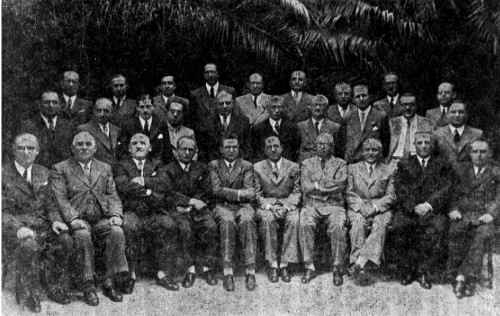
| In the photograph you can see R` Yedidiah Efron with prominent leaders of the Argentine Zionist Federation; among them are: Mordechai Rozorski, Yosef Litzki, Yakov Bronfman, Vulf Nisenzon, Nachman Gezang, Shmuel Rabinovitsh, Y. Shotlender, Yosef Mendelssohn, Yitzchak Kaplan, Binyamin Rinski, Avraham Lutzkind, Yosef Groysman |
|
|
JewishGen, Inc. makes no representations regarding the accuracy of
the translation. The reader may wish to refer to the original material
for verification.
JewishGen is not responsible for inaccuracies or omissions in the original work and cannot rewrite or edit the text to correct inaccuracies and/or omissions.
Our mission is to produce a translation of the original work and we cannot verify the accuracy of statements or alter facts cited.
 Indura, Belarus
 Yizkor Book Project
 JewishGen Home Page
Copyright © 1999-2026 by JewishGen, Inc.
Updated 23 Jul 2026 by JH