 |
|
[Page 45]
Translated by Yocheved Klausner
Jewish Amdur, the little town where I was born, was wiped out from the face of the earth by the hand of “Satan the destroyer” together with the thousands of towns and villages in the old home. Amdur was situated in the heart of the Grodno Gubernia, where Jewish families lived during hundreds of years and produced a great number of Rabbis, scholars, writers, poets and other well–known personalities. The little shtetl Amdur, which was no more than a small dot on the map of the Lithuanian Gubernias, was the whole world in the hearts of the local Jews.
Geographical Location of AmdurAs mentioned, Amdur was in the heart of the Grodno Gubernia, not far from the capital Grodno, or, as it was sometimes called by the Lithuanian Jews – Horodna. Since Grodno was an important town of Torah study and great rabbis, it was sometimes called by the Hebrew name Har Adonai.[1]
[Page 46]
In the neighborhood of Amdur, other towns – larger and smaller – were situated: Koznice, Adelsk (a very small shtetele!), Sokolka, Krynki, Swislocz – the Jews called it Shishlewitz – Berestovitz, Wolkovisk, Luna, Skidel, Wolp, Ros and others.
The writer of these lines is 55 years away from the era that he is trying to depict. During this time, Amdur passed through many hands. In 1895, when I left Amdur, it was under the rule of the Russian Czar. During WWI it was occupied by the Germans and later by the Bolsheviks, and after the peace treaty was signed it was allotted to Poland. In the Second World War it passed again from country to country, and today – if it still exists – it is under Russian Soviet rule. It can be said that geographically and politically it is part of Russia.
Amdur, an Important Locality in the Past
I do not possess documents or other writings concerning the importance of Amdur as a political, social and commercial center. Old Jewish men would tell me that in the past, when Grodno was under Polish rule (until 1772, when Poland was divided between Russia, Germany and Austria), Amdur was known also by the name “Little Danzig”…
[Page 47]
It was common knowledge that Amdur was once the capital of Poland, and the Sejm convened there in a historic session, at the time of the battle between Poland and Lithuania. This “Polish Rule” in Amdur lasted only one night; still it may be considered as a stroke of luck for a shtetl…
I would like to remark here that a copy of an Amdur Jewish Community register has been found in the library of the historian and philosopher Shimon Dubnov. The register contained episodes and events in the Jewish community until 1824. Unfortunately this copy – like so many Jewish valuable documents – was destroyed by the Nazi beasts.
The Number of the Amdur Jewish Population
Statistics, or keeping track of the number of Jews in the shtetlach was considered by the Jews unnecessary. According to the Talmud, it was forbidden to perform a census among Jews. So who would think of finding out how many Jews were living in Amdur at any time?… I don't know the number of Jews in town before WWII, but in my time the estimate was 200 Jewish families. If we consider 5 souls per family, we would have about one thousand Jews in Amdur by the end of the 19th century.
Amdur Streets
To speak about “streets” in Amdur would be an overstatement. There were three “main” streets: one was the Grodno Street, the other was the Volkowice Street and the third was the Krienky Street. All three were named after the three larger towns in the Grodno Gubernia. There was akso the Myestchanski Street, but we have given it a different name – we called it the Goyishe Gass[2] This street we shall describe separately, below.
The three main streets mentioned above were long, and the houses stood in a straight line, more or less. However, in the other streets the houses seemed as if someone has just scattered them here and there, without any plan. One of the neighborhoods in town was called “Mitzkrinak.” I cannot determine the origin of this name, but it was said that it came from the Polish “Njemetzki Rinak,” which meant “the German market” – the reason being the symmetrical shape of the houses and the fact that the place was always clean…
Almost all the houses were made of wood and most of them were covered with straw, a reason for the many fires in town. During the sixteen years that I lived in Amdur, I lived through many such fires, which have deeply influenced my childhood years. One of them, the most terrible of all, has left the population literally with only their shirts on their backs. The entire town went up in smoke.
[Page 49]
The fire started in 1882, when I was only four years old and I remember it as if it were happening today. In Amdur they even counted the years from that time on: this or that event was a number of years before the fire or a number of years after the fire… Amdur had its own unique calendar – the “fire–calendar.”
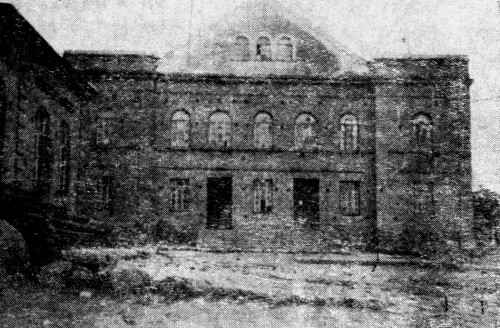
Before I left Russia to go to Argentina, they began building brick houses in Amdur. Henech Lichnyaver and Yankel Farfels built two large houses, and later the Great Synagogue [di groise shul] and the Beit Hamidrash [house of learning] were rebuilt, brick walls and a tin roof.
The Goyishe Gass
The street at the far end of the town was the Myestchanski Street. As fitting its nickname, all its residents were Christians, while most of the streets in the center of town were inhabited by Jews. These were two entirely separate worlds. True – we lived, traded and worked together, we were neighbors; but we were strangers to each other – Jews were strangers to Christians as were Christians to Jews. The Christian street ran as an extension of the Jewish street. Yet, as long as we, Jewish boys, would walk along the “Jewish area” all was good and well; but as soon as we
[Page 50]
“trespassed” into the Christian area, we felt right away that we were in galut[3] – not at home… A strange thing: in the entire town – actually in the entire town – where the Jews lived there was not one dog in sight; as soon as one crossed the border into the Christian area dogs ran around and barked – and what can be the feeling of young Jewish children among “goyish” dogs?…
It was typical, even among Jewish farmers, living in the villages, that very seldom a dog was seen around the house.
Well, well. Shem and Cham, Jacob and Esau, brothers of the same parents, and still so different.
|
|
| The Amdur Synagogue and the Beit Hamidrash (on the left) |
[Page 51]
The Great Synagogue and the Batei Midrash
Amdur possessed a Great Synagogue [Groise Shul], three “Houses of Learning” [Batei Midrash] and a Hassidic synagogue.
After the great fire in 1882, the Great synagogue was rebuilt. In was now a very beautiful building, tall and spacious, constructed according to the architecture of religious buildings of that time. I remember that people would come from the neighborhood towns and villages to see and admire it. The Torah Ark and the platform where the Torah was read – gifts from two well-to-do Jews in town – were artistic masterpieces. The synagogue was the pride of the Amdur Jewish Community.
The great Bet Hamidrash could accommodate almost all Amdur Jews. Its artistic furniture was decorated with carvings of fruits and flowers. The initiator of this artistic work was a young man called “Itche the bachelor.” He was not married, obviously, and entirely devoted to religious art. This “artist” reminds me of another “artist” in town, also unmarried and with a nickname – “Shaul the spinster.” These two “artists” had to endure the mockery of the town people, who insisted on making a shiduch [match] between the “bachelor” and the “spinster”…
The other two Batei Midrash were named after the two rich Jews who donated money to build them: Sender's Bet Hamidrash and Bergman's Bet Hamidrash.
[Page 52]
In the old home, rich Jews were interested in having their name remembered, and for this purpose they gave money to build schools, Batei Midrash, synagogues, Talmud-Torahs, Yeshivas and other institutions. We had in Grodno, for example, the Soloveitchik Bet Midrash and the Bergman Talmud Torah, combined with the Yeshiva; in Vilna – Rav Meile's Kloiz and so in the other towns and shtetlach in the “old world.”
The Hassidic synagogue served as a center for the Hassidim in town, who belonged to various Rebbes. There were the Slonim Hassidim, the Stolin, the Kobrin, the Karlin, the Kock and the Nowyminsk Hassidim. Most of them were learned in the Torah; the Kocker Hassidim were real scholars: Efraim Abes and Leibe Chana-Etes in particular.
Since, however, in later years the difference between Hassidim and Mitnagdim diminished, some of the Hasidim prayed in the “regular” synagogues, so that not always a minyan could be assembled in the Hassidic synagogue, especially in the winter, when there was not enough wood to warm up the place. The story went, that in the place where the Hassidic synagogue stood, had once been the Hassidic Shtiebl of R'Chaim Chaika from Amdur, a good Hassidic Jew who conducted a Hassidic “Court.” Amdur was the greatest Hassidic center in Lithuania, at the time when the war between the two Jewish sects – Hassidim and Mitnagdim – was at its peak.
[Page 53]
In addition to the above-mentioned synagogues, there were many minyanim in our town, where Jews would assemble and pray betzibur [prayer quorum, lit. “with the public or community]. In the summer, we could hear through the open windows how Jews sang their Sabbath and Holiday prayers. I remember four minyanim: Motye the butcher's, Yankel-Moishe the tailor's, Leizer Shaul's and Yakov-Yosef's, both of them turners (lathe operators).
Translator's Footnotes
by Yedidya Efron
Translated by Theodore Steinberg
There was an old rule for Jews in the past: The rabbi makes the city known, not the other way around.
People say that Rabbi Eizil Kharif, the Slonim rabbi, once said to the balabatim of Slonim, “You make me a rabbi? Under no circumstances!! I make Slonim a city – and I made you Slonim's balabatim.” Similarly, Amdur's great rabbis gave Amdur its reputation as a city and a center for Torah. We know a number of great rabbis who served in my birth city and who were famous for their great learning and brilliance, as well as for their energetic way of life and sterling qualities. I will cite some of them:
R' Shmuel – Was a rabbi in Amdur about 200 years ago. He was the author of the book “The Responses of Shmuel.” After serving as rabbi in Amdur, he took the same position in Minsk. He was a grandson of the great, eminent scholar and author of “The House of Shmuel” who was thought to be the “chief instructor” at that time in Lithuania. Avraham Liesen stemmed from the family of “The Responses of Shmuel.” He died in 5537 (1777).
R' Moyshe son of Eliezer Lipman – Rabbi in Amdur and also preacher.
[Page 55]
He made a 6,000-year calendar, published in Grodno in 1789.
R' Issar, or, as people called him at that time, “The Great Rav Issar” because of his brilliance and also because of his certainty.
Amdur elders used to say that their grandfathers would tell them wonderful stories about R' Issar. He was famous as a brilliant rabbi. After his death, the people of Amdur did not have another rabbi because no rabbi dared to assume the rabbinical position of the deceased giant. Such things often happened in Lithuanian cities. Many years passed before the great genius and righteous man R' Avraham Ezra haCohen said that he would take on the rabbinic position in Amdur. It is appropriate to speak of him a bit longer. In his younger years he was a friend of R' Yitzchak Elkhanan, z”l; he came as a son-in-law to my great-great-grandfather R' “Motshe Tzines” and after that he became the rabbi in Ostrin, near Amdur (at that time in the Vilna Gubernia). Some rabbis at that time did not want to give him smikha, but R' Binyamin Korngold, chief rabbinic decisor in Grodno, gave him smikha, saying, “Really a mixed-up head, but very great,” so that he would do it. He was rabbi in Ostrin for several years. It happened that one very knowledgeable man, a great scholar, caught him in a teaching question, and the president of the community council in that city denounced him in shul before Kol Nidre, saying that the rabbi “fed the community non-kosher food.” R' Avraham Ezra then left on foot for Grodno, taking in his sack the lung in question to R' Binyamin'ke Korngold. The Grodno rabbinical decisor said it was kosher. But R' Avraham Ezra, z”l, understood that R' Binyamin's seal of kashrus
[Page 56]
was only a concession, but the fact was that his critic had been correct; actually the right decision was what the scholar had ruled. (It was the custom in making decisions on easy questions to rule according to the first judgment as a sign of respect for the authority of the rabbi.). He then cried out, “It seems that I cannot learn enough!” and immediately after the Days of Awe he left Ostrin and went to study. Earlier he had suggested to the rebbetzin that she should get a divorce, a suggestion that she dismissed. She said, “How could I depart from such a holy person?” – My poor aunt! (She was my aunt.). In short, he went to the shtetl of Rebsevitsh, Minsk Gubernia, where he spent more than 9 years, studying day and night. It would take up too much space to describe the story of his travails during those long years of exile. It would require a longer work, which I may write when I have the opportunity. His name has long been revered in Rebsevitsh. The place where he stood – the Jews of Rebsevitsh would say in awe-struck tones that during the whole time he studied there, he remained standing – for more than 9 years was fenced off. People would point with their fingers: that's the holy spot where the Amdur genius would stand.
After much negotiation, he became the rabbi of Amdur, remaining in the rabbinical seat for more than 40 years. He conducted rabbinical affairs authoritatively. People feared his word as they feared fire, and they would tremble before his curse, like the bite of a fox, which, according to the Talmud, is quite poisonous.
In the Lithuanian rabbinic world, he was considered a strict fanatic: he was referred to as Shammai, who, in comparison to his opponent Hillel, was called in the Talmud a
[Page 57]
real stickler. He was a strict fanatic and inflexible in religious matters. Rabbi from that time said that he had not adjusted to that century and his conduct was more like an echo of at least a century earlier. But his virtues were so great that even the liberals of his time – the so-called free spirits of that era in Amdur – agreed that they were elevated and pure. There was no equal to his pure, truthful thought. If he had to deal with his own child or a friend or even the wealthiest citizen in the city on whom his income depended, he would speak out forcefully. When his gifted son, R' Avigdor, z”l, wanted his father to give him smikha, he was opposed, because he said his son was too young (17 years old). So R' Avigdor went to Novoridok to R' Yitzchak Elkhanan, z”l, and got his smikha from him.
When two wedding were scheduled in the city on the same evening, one by a poor woodchopper and the other by R' Avraham Ezra's brother-in-law, the richest man in the city, and when the latter ordered his son's to take precedence, R' Avraham Ezra ordered that the wedding of the woodchopper's son should come first, and he went to celebrate with the poor couple. He then said that the rich man had no lack of relatives, but the poor man did. Yankel Viriker – that was the brother-in-law, the rich man – then made some impolite comments about the rabbi, who immediately proscribed him, and the rich fellow had to come to the shul and be reprimanded. When it happened that after the wedding, the son-in-law died and then
[Page 58]
the rich man's ship with grain sank on the way from Grodno to Kovna, the Jews of Amdur said, “Nu, if he started up with the Tzadik, things would turn out badly… ”. He very seldom spent time with the rich men; when he wanted conversation, he would go among the working men or watchmakers and spend time with them. On the other hand, there was in the city a well-known thief, who had 6 sons, all pickpockets. The father was also an informer and an arsonist, before whom the whole town trembled, and furthermore, he was also a Kohen… So R' Avraham Ezra drove him away from the Holy Ark on Shemini Atzeres during the Priestly Blessing, saying to him, “Get off the bima, you empty thing” – an expression against a Kohen who profanes the office of a Kohen. Everyone then immediately followed suit, and no one protested. The arsonist, who had intimidated everyone, was defeated by the Tzadik. So strong and large was the authority of Avraham Ezra. When the Russian Orthodox church was built in Amdur, a Jewish contractor was involved with the project. Since many Christians were involved in that project, especially in the decorative aspects, which required skilled craftsmen, the work proceeded on Shabbos which displeased R' Avraham Ezra, z”l. “That means a Jew is involved.” On Purim, the Jewish contractor sent 25 rubles for shalach-manos, and the Amdur authority immediately sent the gift back to him, responding, “I am a rabi for Jews, not Gentiles.”
It is appropriate to keep two things in mind: at that time – 80 years ago – 25 rubles was a considerable sum. Avraham Ezra was a man in need – as one can imagine – and not to accept shalach-manos from such a Jew, a contractor
[Page 59]
who allowed Gentiles to work on a church on Shabbos! And, on the other hand: a Jew who was a contractor at that time was not a true God-fearing man, and so he thought he should send shalach-manos to the rabbi. Such past times!
When a decree was issued to cut beards and sidelocks in the time of Nicholas II, on one Shabbos the police superintendent came to the rabbi with two Gentiles with the intention of cutting his beard and sidelocks. Naturally he refused, and when they wanted to force him, he raised up the heavy table in his dining room and amazed the accomplices. The operation was not carried out. That night, people went to Grodno to the district police chief, and with a hundred rubles they ended the affair. R' Avraham Ezra naively declared, “I did it full of joy, because I wanted to stay alive, 'To die and not live.'” [Based on a Talmudic passage that says there are certain sins one must not commit even if doing so costs one one's life.]. The threat of violence was no exception… Amdur's elders have told me that R' Avraham Ezra, z”l, showed extraordinary physical strength in lifting that heavy table.
Hundreds of episodes are told about the Amdur rabbi that confirm his greatness, but it is not possible to tell them all here because of lack of space. R' Avraham Ezra died before night on Shabbos Parsha Noach. The funeral occurred on the following evening. His son-in-law, Baruch ben-Tzion Mishkovsky, was then the rabbi in the town of Most, near Nieman. The burial was delayed until R' Baruch could be brought –
[Page 60]
in accordance with R' Avraham Ezra's will – and at the open grave, his son-in-law was given the rabbinical certificate. And everyone congratulated the deceased. So was it done in Jewish communities in the old world in such cases.
A huge monument was built over R' Avraham Ezra's grave. In accordance with his will, a place was left next to his grave for the rebbetzin, who died many years later – as a reward for accompanying him throughout his life in joys and troubles. The monument had to be cleaned occasionally from the many notes that people left there begging for his intercession with God for all their sorrows and misfortunes. The general Amdur world, when they recalled R' Avraham Ezra, never said his name, calling him instead “the Tzadik.” This happened while he was still alive, and it continued after his death. R' Avraham Ezra died at the beginning of 5646 (1886). His name was widespread in Amdur, especially in the Efron family. All the boys who were born in that year were given his name. On the day of his funeral, a great number of rabbis from the area around Amdur came, and all eulogized him. As I said, he died before the evening of Shabbos Parsha Noach. At mincha, began to read Parsh Lech-Lecha. In his eulogy, they Sventzianer Maggid cried out, “And God said to Abraham, get thee out of thy land,” having in mind that He called Avraham away to another country.
He left behind a book in manuscript called “The Craftsman and the Locksmith,” ion which he answers and comments on different areas of Talmud. I have leafed through it. His son-in-law has it, and it has never been published.
[Page 61]
|
|
|
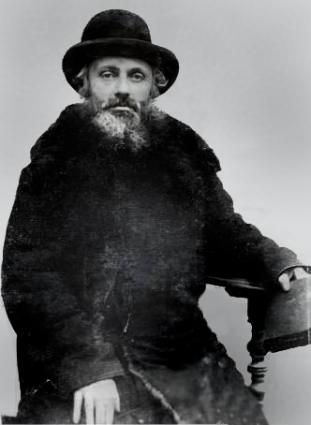
Rabbi Baruch ben-Tzion Mishkovsky, z”l, long-time
rabbi of Amdur, on of R' Noach Chaim, brother of R' Menachem-Mendel Ostrinsky,
z”l (the Stutshiver Rabbi), son-in-law of the Gaon and Tzadik R' Avraham
Ezra, z”l, former rabbi of Amdur
|
[Page 62]
Together with R' Avraham Ezra, the great and distinguished scholar R' Issar served as religious judge in Amdur – we think that he was related to the great R' Issar, z”l. R' Avraham Ezra used to consult with him about all difficult questions, and he was the rabbi's right hand in everything that pertained to the rabbinate. There were moments when R' Issar was not completely happy maintaining that “the Rabbi takes a salary and I decide issues… ”. But there was never an open conflict between these two rabbinical giants in Amdur. The two of them worked to handle all of the religious needs of the city. R' Issar was the rabbi of my father, z”l, who told me about an episode that happened one Friday night at the city mikveh, an episode that casts a light on the former lives of Jews. There was a suspicion that the mikveh lacked the proper amount of water that the decisor had ordered for the immersion of dishes, which caused a commotion in the community. People had already announced in the shul and the beis-medreshes that the mikveh was not kosher. The rabbi and R' Issar were distraught, and that night and all of Shabbos they had no desire to eat. After a great deal of investigation, they figured out that the mikveh had the right cubic mass of water and – joy and celebrations for the Jews…
As I already said, after the Gaon's death, his son-in-law, R' Baruch ben-Tzion Mishkovsky, took the rabbinical seat. He was the son of R' Noach Chaim and a brother of R' Menachem Mendel Ostrinsky, former rabbi in Stutshin; also from the Eisenshtat brothers, rabbis in Lekhewitsh and Leeds (England). He was the rabbi in Amdur for 20 years. He was a great preacher, writer, and scholar. There were in Amdur many claimants to rabbinical
[Page 63]
positions, numerous candidates great scholars with many virtues. There was no lack of conflicts on the part of the claimants. It even happened that R' Baruch Ayin – about whom I well speak later – challenged him on an issue and the matter was brought before R' Leib Zalmans of Grodno, the greatest decisor in Grodno Gubernia. (What happened to the great father-in-law also happened to his son-in-law.). The decisor favored R' Baruch ben-Tzion, and R' Leib-Zalman, z”l, said, “Rabbi Baruch ben-Tzion is true and his interpretation of Torah is true; the Torah shall go forth from Zion. (Don't forget that both the rabbi and his opponent were called Baruch, and the first was also called ben-Tzion [son of Zion]).
Everyone, then, came under the governance of the rabbi – and the city of Amdur was quiet [a reference to the Book of Esther]. He was the rabbi in Amdur for 20 years, and he died when I was already in Argentina. He put out a book called “The Sayings of Baruch” with an endorsement from the famous Tzadik and scholar R' Baruch Turover. It should be remembered that the collaborator on the Argentinian “Yivo-Archive,” Pani Rems, was a grandson of the Amdur rabbi Baruch ben-Tzion. He left 3 son: one, Noach Chaim, was my friend, was the rabbi in Glasgow, England [sic]; a second, Avigdor, a brilliant rabbi, was killed by the Hitlerists, may their names be blotted out; and a third, Avraham Ezra, is a merchant in Glasgow. He also had several gifted daughters.
After R' Baruch, the rabbinical position in Amdur was occupied by R' Reuven Katz, a student of the Mir Yeshiva. He was a great scholar and authority. Today he is the chief rabbi in Petach Tikvah (Israel).*
[Page 64]
I correspond with him. I know that he received smikha from the scholar Radbaz (abbreviation for R' Yakov-Duvid ben Zev), Rabbi Eliyahu Baruch Kamay, R' Eliezer Rabinovitsh, and others. He is the author of the book “The Mandrakes of Reuven,” “The Banner of Reuven,” and of many rabbinical articles.
Editor's footnote
* Now deceased
|
JewishGen, Inc. makes no representations regarding the accuracy of
the translation. The reader may wish to refer to the original material
for verification.
JewishGen is not responsible for inaccuracies or omissions in the original work and cannot rewrite or edit the text to correct inaccuracies and/or omissions.
Our mission is to produce a translation of the original work and we cannot verify the accuracy of statements or alter facts cited.
 Indura, Belarus
 Yizkor Book Project
 JewishGen Home Page
Copyright © 1999-2026 by JewishGen, Inc.
Updated 20 May 2026 by LA