|
|
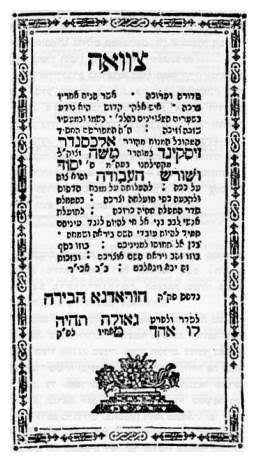
| Title page of R. Alexander Zuskind's Testament |
|
|
[Columns 59-60]
Translated by Guillermo Levrio
At the end of 1764 the Polish government conducted a general census of its Jewish population in the hope of increasing the Jewish tax, the poll tax, and collecting it directly from them. The result did not fulfill the authorities' expectations, because the Jews concealed people from the enumerators. A total of 157,649 Jews were counted throughout the Grand Duchy of Lithuania, of whom 2,418 lived in Grodno and its surroundings.[1] By comparison, Brisk and its surroundings had 3,175, and Vilna 3,390.[2]
According to this census, Grodno was then the third-largest Jewish community in Lithuania and one of only twelve communities in all Poland with more than two thousand people.[3] It appears that even at this time Jews already constituted a majority of the city's inhabitants.[4]
The disputes with the Christian townspeople continued for decades, until the final partition of Poland. The townspeople repeatedly renewed their demands that the government restrict Jewish rights to engage in commerce and crafts. As late as the beginning of the 1790s the municipality issued new decrees of this kind.[5]
The burden of taxes and debts upon Lithuania's Jews in general and Grodno's Jews in particular continued to grow. In 1764 the Polish government abolished central and district Jewish autonomy, including the Council of the State of Lithuania, in order to extract ever larger sums from the Jews. All the debts of the Grodno district were then imposed upon the Grodno community. By 1766 those debts amounted to 488,032 złoty,[6] while the community's entire annual income did not exceed 21,000 złoty and its population, as noted above, was only 2,418.
Some of these obligations, it will be recalled, resulted from the extortion of Jesuit priests and monks, who used false accusations to compel the Jews to sign promissory notes for sums they had never borrowed. The community was now required to pay high interest on all these debts, accumulated over a long period.
Stanisław August Poniatowski, king of Poland from 1764 to 1795, was a liberal man who spent much of his reign in Grodno and was inclined to assist the Jews. He appointed a commission to find a source from which the community could repay these obligations. In February 1766 the commission reduced interest on the debt to four percent. It decreed that “the source of this money shall be a tax imposed upon all food eaten and every beverage drunk” by the Jews, on condition that the proceeds be paid only to an agent appointed by the government.[7]
In 1768 King Poniatowski appointed Antoni Tyzenhaus, treasurer of Lithuania and governor of the Grodno district, as agent for the tax upon the city's community. Over fourteen years, through 1781, Tyzenhaus succeeded in extracting more than 600,000 złoty in principal and interest from the Grodno community, leaving it utterly impoverished.
In the end Tyzenhaus himself became entangled in unpaid debts and went bankrupt. His estates were seized, and the Grodno community also brought a claim in court for the share due to it. The court awarded the community only 225,000 złoty, in return for which it transferred to Grodno two of Tyzenhaus's estates in the Pinsk district. They remained in the community's possession for only four years, for they were later confiscated by the Russian authorities, as will be described below.[8]
The Blood Libel of 1790
The internal confusion in the Polish kingdom during the final years before its partition strengthened the Jesuits, who instigated a blood libel in Grodno in which R. Eliezer ben Solomon of Virbalis, near the Prussian border, died in sanctification of the Divine Name. Legends that circulated in Grodno told the story as follows.
Before Passover in 1788, a Christian girl went to dig sand from one of the hills near the city. A large mass broke loose, fell upon her, and crushed and buried her. R. Eliezer, who was passing at the time, tried unsuccessfully to save her. Jesuits who came by accused him of deliberately killing the girl in order to use her blood for Passover.
R. Eliezer was imprisoned and held for more than two years. He was tortured in an attempt to force him to confess. Fear and turmoil among Grodno's Jews grew ever greater, while the community's funds flowed into Jesuit pockets. The investigators accepted bribes and were replaced one after another. After the Jesuits had emptied the communal treasury and failed to persuade R. Eliezer either to confess or to convert, they sentenced him, contrary to the king's wishes, to be cut into four pieces in the form of a cross.
On the second day of Shavuot 1790 the sentence was carried out publicly before thousands of Christian spectators who had gathered for the spectacle. The four parts of his body were hung at the four approaches to the city to fill the Jews with dread. On the eighth of Sivan they were brought to Jewish burial in Grodno “with weeping and wailing and bitter lamentation,” and a memorial stone was erected over the grave. The Grodno community established an ordinance that the martyr's soul was to be commemorated in every house of prayer in the city on the second day of Shavuot each year.[9]
During the Kościuszko Uprising
In the city of Grodno, occupied by the Russians as early as 1792, the tragedy of Poland's second partition was sealed in 1793 by the
[Columns 61-62]
“silent Sejm,” which met in the New Castle, King Poniatowski's residence.
During the Kościuszko Uprising, Grodno Jews served in the city guard and in the “people's levy.”[10] Two prominent Jewish merchants, among them Joseph Yozel Rubinowicz, supplied cloth to the insurgent army.[11] The community as a whole endeavored to meet the rebels' demands and even assessed a sum of money for them.[12]
At the same time, Grodno's Jews disagreed among themselves about their attitude toward the uprising. It became necessary to “awaken” patriotic feelings among them and “instruct” them in the idea that “their own welfare is also bound up with the prosperity of the fatherland.” They were also threatened with punishment and exposure as enemies of the homeland if they did not fulfill the task imposed upon them.[13]
The rebel authorities in the Grodno district prohibited the use of Hebrew in correspondence sent through the mail. Under threat of punishment, rabbis were required to help enforce this order, so that “the Jews shall convey nothing to the enemy.”[14] After the defeat, the vanquished Poles also intended to take revenge upon the Jews of Grodno and attack them, as they had done in Vilna,[15] but they did not carry out their plan.
A Period of Development
Antoni Tyzenhaus, treasurer of Lithuania and governor of the Grodno district, was a man of considerable initiative who did much to lift the city from its decline. He sought to expand commerce and established many enterprises devoted to industry, science, and various forms of education. He built housing for the workers in his factories and impressive public buildings, among them the municipal theater. He cultivated ornamental gardens and established a model agricultural estate near the city on the royal property known as Stanisławowo.[16] He also published Grodno's first newspaper in 1779–1780 and a medical weekly in 1792.[17]
Tyzenhaus established the industrial enterprises that made Grodno the manufacturing center of the entire region, including Białystok,[18] at two opposite ends of the city. One group stood three kilometers away at Łosośna, across the Niemen. The other lay northeast of Grodno, beyond the Horodniczanka stream, in Horodnica, then a small village. This district, later one of the finest parts of Grodno, came to be known as the New World, or Nay-Velt in Yiddish.
According to the historian Raphael Mahler,[19] Tyzenhaus was among those magnates who favored making Jewish labor more productive in order to improve the Jews' economic condition, but also to increase the profits of the magnates themselves. His enterprises therefore absorbed Jewish workers and helped them enter new occupations. As Yitzhak Schiper notes, Jews worked there in casting and weaving. Tyzenhaus also employed Jewish women in their homes, processing yarn for the textile factory he founded in Grodno.[20]
In 1772 Tyzenhaus brought a German from Nuremberg to teach Jews the art of bookkeeping and to introduce “German order” into their trade. He also brought Jewish typefounders to the city to work for the government printing house he had acquired from the Jesuits. More will be said about this later.
Economic activity in the city did indeed increase during this period, and Jewish life reflected the change. A list prepared by Grodno's communal leaders of those able and unable to pay the poll tax contains several instructive details concerning the economic condition of the city's Jews at the time.
Of the 1,809 people on the list, 405, or 22.37 percent, were identified as having no source of livelihood at all. In contrast to approximately 178 families engaged in commerce, 138 artisans were counted. They included fifty-seven tailors and hatmakers; twenty-nine workers in the food trades, such as bakers and butchers; eleven shoemakers; ten barbers and hairdressers; five fishermen; two metal casters; two builders; two tinsmiths; two glaziers; three bookbinders; and others.[21]
The same list also records a Jewish banker in Grodno, Yankel Itzkovich–a rare phenomenon at the time.
Other records from this period mention Jewish wholesalers who supplied tobacco on a large scale to the government tobacco factory operating in Grodno at the end of the eighteenth century. Among them was the great businessman R. Joseph Yozel Rubinowicz, mentioned above, who was a regular supplier to King Poniatowski and his court. These suppliers imported tobacco from Ukraine, within the borders of Russia. A Grodno merchant who exported Russian tobacco through Poland to Prussia is also mentioned.[22] This was the beginning of Jewish participation in Grodno's tobacco trade, which in time would occupy a central place in the city's industry.
The name of Joseph Yozel ben Reuben Katz Rubinowicz, who died in 1810, was remembered with gratitude by the Jews of his city. Because of his closeness to the royal court, he had, according to the inscription on his tombstone in Grodno's cemetery, “done good for the Children of Israel and saved them from evil decrees before kings and princes.”[23] He was exceedingly wealthy, an owner of estates and extensive property, and gave generously from his fortune to Jewish institutions.[24] His “hands and house” were also “opened wide to the poor and needy.”
Jewish physicians educated at universities also appeared in Grodno for the first time during this period. Felix Solomonowicz, a Jewish doctor of medicine who practiced in Grodno, is mentioned as early as 1765. A second Jewish physician, Bar Michalowicz, practiced in the city beginning in 1790. He studied at the University of Vilna and received his medical doctorate from the academy in
[Columns 63-63]
Königsberg in 1786. King Stanisław August appointed him a physician to the royal court.[25]
A third physician who spent his final years in Grodno and died there in 1797 was R. Judah ben Mordechai Halevi Horowitz,[26] a Torah scholar and prolific Hebrew author who was among the forerunners of the Haskalah. He studied medicine in Padua, Italy, and served for many years as physician to the Vilna community. He knew several languages well and traveled extensively, a rare thing for a Lithuanian Jew of that period.
The Last Chief Rabbis of Horodna
After R. Moses Joshua Horowitz, the rabbinical throne of Grodno and its district passed to R. Eliezer ben Tzvi Hirsch. He had previously been head of the rabbinical court in Orla and wrote Mahadura Kama u-Batra on the entire Talmud, as well as works on Maimonides and Tur Orach Chaim. One of the greatest scholars of his generation, he took part in the controversy with the Hasidim. He died in Grodno in 1791. Approbations he issued there survive from 1781 through 1789.[27]
He was succeeded as rabbi of Grodno and its district by R. Benjamin ben R. Aaron Brauda. He was one of the leading rabbis of his generation and a wealthy man. He died in Grodno in 1818 at the age of seventy-three. Approbations he signed in the city date from 1795 through 1818.[28]
His accession was connected with a dispute over the office between his supporters and those loyal to R. Tanchum, son of Grodno's preceding rabbi, R. Eliezer ben Tzvi Hirsch. During his father's lifetime, R. Tanchum had already served as head of the sitting rabbinical court, an official chosen only by the judges as their presiding member or foremost scholar and whose authority was limited. R. Benjamin's election as rabbi of Horodna was also supported by King Poniatowski, who signed his writ of appointment.
The chief rabbi's authority within the community embraced, as is well known, not only religious questions such as the laws of what was permitted and forbidden and monetary disputes between one person and another, but also economic and public affairs. The chief rabbi was elected by the entire community, and the community usually invited to the office a rabbi from afar who had already acquired a great reputation elsewhere.
Because of the bitter controversy that arose over this office, no one in Grodno after R. Benjamin Brauda was again given the title of chief rabbi. Grodno was by no means the only community in which this occurred.
The Controversy Between Hasidim and Mitnagdim
People from Grodno played an active part in the bitter controversy between the Hasidim and their opponents at the end of the eighteenth century. Around 1772 a group of Hasidim in the city publicly burned the pamphlet Zemir Aritzim ve-Charvot Tzurim, which the preacher R. David of Maków had printed on the instruction of the rabbis of the “states” of Lithuania, Reisen, and Samogitia. It contained letters, proclamations, and bans against the Hasidim by the Vilna Gaon and others.
Simon Dubnow[29] and the historian of Lithuanian Hasidism Ze'ev Rabinowitsch believed that the men who burned the pamphlet in Grodno were followers of R. Chaim Chaika of Indura, near Grodno. R. Chaim Chaika, a disciple of the Maggid of Mezeritch and R. Aaron of Karlin, was then the only Hasidic tzaddik in northern Lithuania, and Indura was the center of Hasidism in the region.
The leaders of the “states” that had published and circulated the pamphlet intended to punish the men who burned it in Grodno, but refrained. Some of the Hasidim in the city possessed influence in noble households or among Polish officials, and punishing them might have exposed the Mitnagdim to denunciation before the authorities.
When the second ban against the Hasidim was proclaimed in 1781 by the Vilna Gaon and his circle, however, Grodno's Mitnagdim, led by the rabbi of the city and district, R. Eliezer ben Tzvi Hirsch, moved to give it force and authority. In Elul 1781 emissaries from Vilna came to the fair at Zelwa in the Grodno district, where rabbis and communal representatives from various towns had assembled to deliberate on the governance of the communities. The emissaries urged them to support the Vilna Gaon and to ostracize and excommunicate the Hasidim.
R. Eliezer ben Tzvi Hirsch and other community leaders then issued a proclamation that “no person shall travel to a place of the Hasidim to associate with them, nor stand within four cubits of them,” and in particular that no one should “lodge in the holy community of Indura.”
A severe ban was proclaimed against the Hasidim, and a circular was sent to the smaller communities subject to the principal communities, ordering their exclusion. The leaders of the Grodno community also signed it, with R. Eliezer at their head.[30]
Men of Distinction
Among the distinguished figures who lived in Grodno at the end of the eighteenth century and exerted a moral influence upon the members of their own community and beyond it, the foremost place belongs to R. Alexander Zuskind ben Moses, known as “R. Alexander Zuskind of Horodna,” author of Yesod ve-Shoresh Ha-Avodah. Professor Joseph Klausner,[31] one of his descendants, writes that we know almost nothing about the events of his life. A passage in one of his books, the Testament, section 24, suggests that he did not wish to hold rabbinical office and instead engaged in commerce; this was also the tradition preserved in his family. There is also testimony that he grew up in Ruzhany.[32]
Many legends circulated among the people about him as a righteous and holy man. After his death in 1794, the ohel erected over his grave in Grodno became a place visited by people from the surrounding region, who came to pray for the dangerously ill and to ask that his merit protect them.
One legend concerned an act R. Alexander Zuskind performed during the blood libel in
[Columns 65-66]
Grodno described above. Joseph Yozel Rubinowicz, who had access to the court of King Stanisław Poniatowski, informed him that while the martyr R. Eliezer of Virbalis was in prison, the Jesuits offered to release him and clear him of the accusation that he had killed the Christian girl for her blood at Passover if he would convert to Christianity.
R. Alexander Zuskind urged Joseph Yozel to use all his influence to obtain permission for him to visit the prisoner in his cell. Once permission was granted, he went to strengthen the captive's spirit and encouraged him to surrender his life in sanctification of the Divine Name. R. Eliezer agreed. R. Alexander Zuskind then summoned his courage and placed himself in danger by attending the execution. He wished to hear the blessing pronounced by the man going to his death in sanctification of the Divine Name, as he had taught R. Eliezer, and to answer “Amen.”[33]
Professor Tzvi Hermann Schapira, one of the originators of the Jewish National Fund and the Hebrew University, related another incident in R. Alexander Zuskind's life. R. Alexander Zuskind traveled from Grodno to Germany to collect money for the Jewish settlement in the Land of Israel. He was imprisoned because sending funds from Germany abroad without permission was prohibited. He spent a year and a half in prison before the Jews of Grodno succeeded in ransoming him at great expense. Immediately after his release he resumed collecting money for the poor of the Land of Israel. When he was warned of the danger, he answered that those “who dwell before the Lord in the Holy Land” should not be left to starve because of it.
Three of R. Alexander Zuskind's works were printed:
Some editions of Yosha include, among its sections, corrections to errors in Rashi's commentary on all the Prophets and Writings. They also contain explanations of the boundaries of the Land in the Book of Joshua and descriptions of the form of the Temple found in Kings and Ezekiel, together with a general map of the boundaries of the Land of Israel and a specific map of the Book of Joshua. These maps were taken from Ketzot Aretz by R. Joshua Feivel ben Israel of Tarnogród, published in Żółkiew in 1772.
|
|
| Title page of R. Alexander Zuskind's Testament |
In his Testament, R. Alexander Zuskind calls upon his sons to keep far from vain pursuits, especially controversy and groundless hatred. He repeatedly speaks with sorrow and pain of the desolation of the Land of Israel generally and of the holy city of Jerusalem in particular. In Yosha he extols “the great merit of dwelling in the Land of Israel.” At the end of his Testament he demands of his sons “that your desire to travel to the Holy Land remain constant.”
Yosha exerted great influence upon certain circles of
[Columns 67-68]
observant Jews, Mitnagdim and Hasidim alike, both within and beyond Lithuania. It became a kind of Shulchan Aruch for daily conduct. Some of the greatest Jewish authorities of later generations, including the Chafetz Chaim of Radun, established regular group study of the book, a tradition that has continued in Israel to the present day.[34]
It is related that the Vilna Gaon said of R. Alexander Zuskind that some authors are greater than their works, while some works are greater than their authors; R. Alexander Zuskind was as great as his book, and his book as great as R. Alexander Zuskind.[35]
Among Horodna's halakhic authorities at the end of the eighteenth and beginning of the nineteenth century, R. Daniel ben Jacob, known as R. Danielka, was especially renowned. He wrote Chamudei Daniel: Novellae on Shulchan Aruch, Yoreh De'ah, Concerning the Laws Required for Halakhic Rulings, published in Horodna in 1810. He held his office in Grodno for about forty years, until his death and burial there in 1807. One of the leading halakhic authorities of his generation, he was distinguished by his uprightness, humility, and charity toward the community's poor. He shared his bread with them while himself making do with the barest minimum.[36]
The Social-Welfare Society
The earliest surviving records of a social-welfare society in Grodno, apart from the burial society, date from the end of the eighteenth century. The organization was called the Holy Society for Visiting the Sick and carried on work of considerable scope and importance.
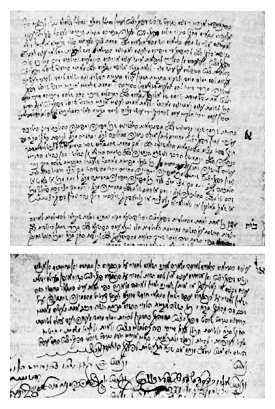
The society's register is the only Grodno document collection of its kind to have reached us.[37] Its earliest signed entry dates from 1770. Another entry, from 1779, records a meeting of the members of the Visiting the Sick Society convened to reinforce its regulations. The organization had apparently been founded considerably earlier. It established a special house in which the ill could be treated “under the supervision of an expert physician.” Under its rules, the house trustee was required to report twice daily to the officer serving for the month on the overall condition of the charitable hospital and, in particular, on the health of the patients lying there. The officers served in monthly rotation.
The Visiting the Sick Society thus provided hospitalization in its own building for patients who required it and arranged visits to them, paying particular attention to the poor. It engaged physicians and granted them a monopoly on medical practice within the Grodno community under defined terms that guaranteed free treatment for the poor upon presentation of a note from the society. It made similar contracts with midwives to assure help for women in childbirth who lacked means. In the same way it provided medicines of various kinds to the poorer classes.
A second sphere of the society's work was the care of local and itinerant beggars and the regulation of the days of the week on which each group was permitted to go from door to door. “Able-bodied persons fit for some occupation are not permitted” to beg at all, one of its regulations declared. Its arrangements extended from lodging the poor in the guesthouse and hosting them on Sabbaths and festivals to providing wagons that carried wandering beggars onward to other Jewish communities once their allotted stay had ended.
|
|
| Excerpts from the register of Grodno's Visiting the Sick Society, 1819 |
The obligation to host a poor person for a Sabbath or festival meal, on presentation of a plet, a ticket issued by the society to be given to the host, apparently remained in force for generations. Abraham Shalom Friedberg, the Grodno writer, relates in his memoirs:[38]
“On Sabbaths, every Jew was under a sacred obligation to gather one of the poor to his table and satisfy him with his bounty. With my own eyes I saw in the Great Synagogue of my native city a black board hanging on one of the pillars of the bimah toward the west. Upon it, in white letters and in Yiddish, was written: ‘He does not wish to accept a ticket for the Sabbath.’
[Columns 69-70]
This was a communal ordinance for punishing anyone who looked grudgingly upon his poor brother, sent to him by the communal leaders to eat at his table on the Sabbath.
“In those days no Jew, whoever he might be, would have dreamed of avoiding public worship in his established place. The pillar against which he leaned in the house of God during prayer thus became his ‘pillar of shame,’ because he had dared to close his hand against his destitute brother.”
The Visiting the Sick Society financed its work through weekly membership dues, known as vokher; collection of donations in a pushke, or charity box, in householders' homes, houses of prayer, celebrations, and funerals; and special assessments. Among the last were “half a percent from weddings”; a tax upon every Jewish-owned ship and cargo boat passing through Grodno on the Niemen to or from Königsberg, departing from the city, or arriving there; and a tax upon timber rafts brought to Grodno for sale. In times of financial pressure, an assessment was also placed upon kosher meat.
The society sought to strengthen its position by accepting endowments of capital and income-producing property. Among those who left it such property was the wealthy Joseph Yozel Rubinowicz, mentioned above.
Its internal regulations were particularly detailed. They defined the member's duties, including those assumed during the admission ceremony, as well as his right to elect the society's officers and be elected to office. Special rules governed supervision of the society's finances and the prevention of any abuse in this sphere.
The final entry in the Visiting the Sick register was written in 1890, 120 years after the first. It also perpetuated the names of the society's officers and activists–honored members of the community who performed its charitable work.
Grodno–the Birthplace of Hebrew Printing in Lithuania
Grodno was the birthplace of Hebrew printing in Lithuania. The first Hebrew books in the country were printed there, and there arose the nucleus of the Romm printing and publishing house, which played an important part in the history and development of the Hebrew book and in the spiritual life of the Jews of Lithuania and the whole Russian Empire.
The father of Hebrew printing in Lithuania was the typefounder R. Nachum, also known as R. Menachem Nachum, ben Ezekiel of Sokal in Galicia. He was invited to Grodno by Antoni Tyzenhaus, treasurer of Lithuania, discussed above. As part of his broad plans for Grodno's economic, cultural, and educational renewal, Tyzenhaus purchased for the state treasury the Jesuits' printing house in the city. He also planned to add a Hebrew department, which he regarded as a profitable enterprise. In 1785 he therefore brought to Grodno R. Nachum, whose reputation as a master craftsman preceded him, together with his sons and grandsons, who were also printers.
|
|
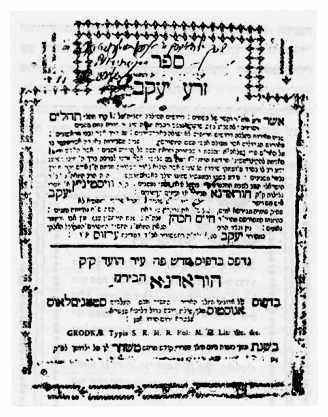
| Title page of the first Hebrew book printed in Grodno, 1788 |
In 1788 the first Hebrew books appeared from Grodno's royal printing house:
[Columns 71-72]
Horowitz, preacher and halakhic authority of the holy community of Indura, which appeared in 1789; the Mishnah with the commentary Kav Ve-Naki, published in 1792, by the Grodno author R. Elisha ben Abraham, already mentioned above; and the Testament of R. Alexander Zuskind of Horodna, published in 1794.
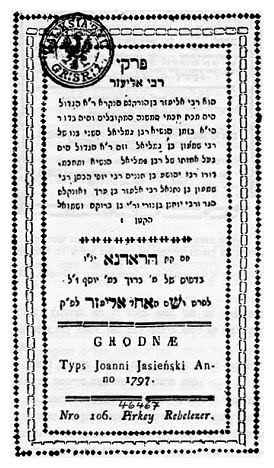
R. Baruch, who owned Grodno's principal bookshop, laid the foundation in 1789 for a Hebrew press
|
|
| Title page of Pirkei de-Rabbi Eliezer, printed in Grodno by Baruch ben Joseph, known as Baruch Mas of the Romm family |
in the nearby town of Ozyory. There he began printing small Hebrew books by hand for other publishers, identifying Horodna as the place of printing on their title pages.
At the end of 1794 the Polish nobleman Jan Jasieński received a government concession to open a new printing house in Grodno, which printed Hebrew books from its inception. Jasieński took two Jewish booksellers into partnership, one of them the R. Baruch mentioned above.
Following Russia's conquest of Lithuania, an order was issued on October 30, 1794, requiring all the printing houses in Lithuania to be gathered in Grodno. This was intended to permit the Russian governor of Lithuania, whose seat was in the city, to supervise them. The order was rescinded in 1796.
Jasieński's press worked intensively. The running numbers placed in the Latin portion of the title pages show that it printed approximately 112 books in about three years, a notable accomplishment for the period. Among them was Yesod ve-Shoresh Ha-Avodah by R. Alexander Zuskind of Horodna, issued in 1795 by the editor Benjamin ben Jacob Bishka of Horodna.[39]
In 1799 the two presses that printed Hebrew books were transferred to Vilna. Hebrew printing in Grodno nevertheless continued afterward, as will be described below.
Original footnotes
|
|
JewishGen, Inc. makes no representations regarding the accuracy of
the translation. The reader may wish to refer to the original material
for verification.
JewishGen is not responsible for inaccuracies or omissions in the original work and cannot rewrite or edit the text to correct inaccuracies and/or omissions.
Our mission is to produce a translation of the original work and we cannot verify the accuracy of statements or alter facts cited.
 Hrodna, Belarus
 Yizkor Book Project
 JewishGen Home Page
Copyright © 1999-2026 by JewishGen, Inc.
Updated 09 Nov 2026 by JH