 |
|
|
[Page 423]
by Mikhel Margolin
Translated by Odelia Alroy
A. Poale-Zion of Bobruisk (Youth)
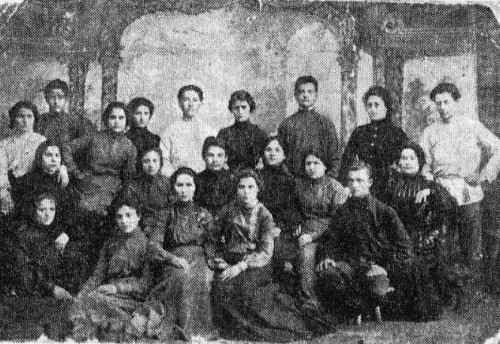
The youth organization “Poale-Zion” [Workers of Zion] in Bobruisk numbered several hundred young boys and girls between 15 and 18 years old—an excellent group who were eager to learn whatever was taught in the self-educational clubs. Elihu Naiman, who was the leader of the organization, stuffed the material used for overshoes, was an intelligent worker, a good speaker and he was good at organizing the youth, but when it came to political activities, the director was the “private committee” which was waiting for instruction. The organization was divided into groups which would meet separately several times a week except for Shabbos, when there would be general meetings. During the winter the meetings would take place in homes, in summer in the field or forest, outside the city. It was nice to see how the young people would go to the meeting places after lunch on Shabbos, on the other side of the Berezina, among the hay fields. They would get to the river, rent small boats, for 5-6 people and row across the river -and then they would first go a few verst on foot until they reached the spot. They sat in a circle, some would lean against the trees and the meeting would begin. Between speeches there would often be singing. They would sing softly as is fitting for groups that do their work secretly. They were Jewish songs, revolutionary songs by Avrom Reisen and H.D. Nomberg. Reisen's song was very popular:
“Roar, roar harsh winds
Now is your season.
The winter will not last long
Summer isn't far.”
It is understood that we interpreted the song as we wanted: Now is the time of harsh winds—
arrests, deportations, hard labor but summer is not far—the revolution is coming. Just the same, there was little concern with revolution in the first days of “Poale Zion.” The main work consisted of spreading the ideas of Labor Zionism.
B. Elections for the Zionist Congress
At the time of elections for one of the Zionist Congresses a fight broke out between two candidates—Levkovitch and Elihu Naiman. Both wanted to go to the Congress and both were deserving—at the same time as that issue, another question came up: will the Poale Zion of Bobruisk be allowed to vote or not? Levkovitch's side argued that they wouldn't —they were too young and they would not be allowed to go to the ballot box. Elihu Naiman
[Page 424]
and his backers argued the other way, that the Bobruisk Poale Zion would be given the right to vote. Both Levkovitch and Naiman were understandably not so concerned with the good of the “Poale-Zion” of Bobruisk. It was known that the “Poale Zion” of Bobruisk would vote for Naiman.
C. General Poale-Zion
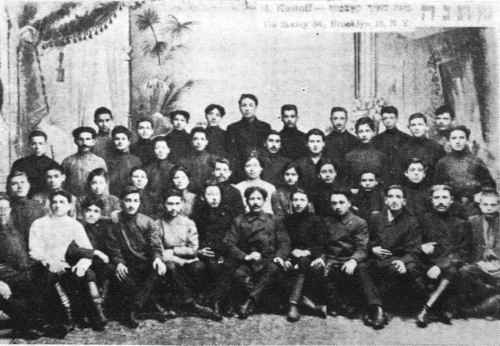
The General Poale-Zion considered itself as one of the strongest Jewish labor organizations in Russia. It had its dedicated activists-workers and intellectuals. The Bobruisk branch—about three or four hundred members—was divided into independent groups of ten members in each group. At the illegal meetings of the groups which devoted themselves to education, they studied economics, cultural history and Jewish history. If anything stuck to the students from all the learning, I'm doubtful. Tired after a full day's work and dragging around in the exchange in the evening, they had little strength to concentrate on the lessons. But to prepare some twenty odd residences for all the groups, and we had to change locations each week, because we were afraid of being caught-and preparing some twenty odd teachers was enough hard work and required much effort and exertion. I remember that in the winter days, dressed in a white jacket and boots, with a stick in hand, I was running around looking for locations. Only in the house of Moshke Miliniki and his two sisters, the bakers, did we have a steady meeting place. Aside from that, we had to run around from one teacher to another, giving them the addresses of the meeting places and the lesson plans of the students in each group. All had to be done secretly-we must not fail.
After an entire day tramping through the Bobruisk mud, I would return home in the evening and fall asleep exhausted.
D. Putting together the Secret Committee
The self-education group scheduled secret meetings, which were appropriate for the individual groups. From the leaders of the secret meetings they would put together the secret committee.
It was one of the hardest assignments. The electors were not allowed to know who had been elected. First they would select a trustee
[Page 425]
as head of the committee, who was in fact the leader of the organization. Every “secret meeting” sent a representative to the electors. The elections were held in the following manner: each elector wrote the name of a party member who he recommends as a member of the secret committee on a piece of paper and gave the paper to the trustee. That way the trustee was the only one who knew, by the papers, who was elected to the committee. The members, who participated in the secret meetings, didn't even know who was selected from their ranks as electors, because the selections were made in this way. The participants in the secret—meetings wrote the names of the candidates who they proposed on notes and secretly gave them to the trustee, who would tally the votes, and according to the count, write down who was in the group of electors.
At that time, when Yankel Paritsher—a student—was the trustee, it happened that a friend at the time of the voting of the secret committee, didn't write his name on a note, leaving it to Yankel to decide on a candidate in the committee. I was the youngest member—just a boy—and for the first time I felt lost among the older members, active party members, workers and students.
E. The Exchange
The larger the organization, the more important it was, the bigger part of the main street it occupied. The “Bund” which was at Muraviavska St., was the largest in Bobruisk. It stretched from Belinsky's porcelain business until the Turkish bakery, noisy and lively. The other side of the street, from Barash's Pharmacy until the end was occupied by the “Poale-Zion.” Later it transferred to Shosi St. The exchange was the vital nerve, the pulse of each party. This was the place of discussion, meeting, debating about ideas and work conflicts and sometimes getting even with whomever one needed to. An organized group was always there, ready for whatever.
People walked back and forth, up and down, in the area of their exchange, talking, screaming, droning and it seemed that the street was swarming in one bi beehive. And if a Poale-Zionist wandered into a Bundish exchange or in reverse, he'd be surrounded by a group who would try to convince him, loudly with quotations from books and speeches, which one had never seen or read, that his party is correct and the others not.
And if it would happen that the Bundist couldn't counter the Poale-Zionist, he'd let out with a proven weapon. Even Nardov himself couldn't find a difference between these points and so forth, which was enough so that the “enemy” would give in.
The exchange was also popular with the police. They knew each one and they knew to which group he belonged and they guaranteed that there would be no getting lost.
F. Illegal Meetings
Because of the constant lurking danger by the Czarist spies, we had to conduct all party business in secret and all meetings were organized quite stealthily. That wasn't easy. To organize and conduct general meetings with the participation of a hundred people, or
[Page 426]
an assembly of two parties (often between the Bund and Poale-Zion) in order to discuss a joint activity or a discussion of ordinary problems the organizers needed to show professional talent, not only for secrecy, also security and stealth. The most important was to choose such a house for the meeting, which had many exits and was in a labyrinth of streets. Such houses are most often in the outskirts, the poorest part of town. There in a carpenters shop, which met the requirements the general meetings would take place.
For security, we would begin the meetings by telling the people that if there should be a slip, they shouldn't be afraid and get into a panic, but each should say that he came accidentally, because someone had invited him, but he didn't know what for.
The person who took upon himself the responsibility for everyone was Chaim K. I remember that I was jealous, that he was given the privilege to be the sacrifice for everyone. Once I asked Chaim to give me the responsibility to be the scapegoat. He looked at me with sad, fatherly eyes and said: “Wait Mikhailke, your day will come. You will bear the burden of responsibility. Meanwhile it's too soon for you.”
Aside from the shops, we would also hold meetings in the barracks. That was the good idea of some of our members who lived near the barracks and saw how they empty out, when the soldiers leave for maneuvers in the summer. The members decided to use these empty barracks for Poale-Zion meetings. In order to make them more secure, we would station patrols the entire way from the barracks to the police stations. There were quite a few couples in the organization. It was not secret and they would stroll in the streets and enjoy each other—each couple had a pair of boards and in the event of danger, a show of police or soldiers on the way to the barracks was enough for a couple to start clapping the boards, and as quick as an eye blink the signals went form one couple to another until it reached the meeting. Upon hearing, the people assembled would disperse orderly in the streets, and when the police arrived, there was no trace of the meeting. More than one discovery by the police was averted on account of our loving couples, who the police never suspected were guarding the illegal meeting.
G. Meetings in the Forest
In summer we would move our meetings beyond the town into the forests. Some members would locate a suitable place in a nearby wood, which we could approach from various sides. Shabbos , after lunch, we would leave the town on the pretense of strolling in the woods. The guards would climb the trees and suing binoculars watch in the direction of the town. Once, in the midst of a meeting, the guards sent an alarm that police and soldiers are approaching the wood.
Those at the meeting then decided not to disperse and not to spread out into the forest via the secret passageways and paths, as usual in such an event, but instead in an organized fashion to oppose the police and set tows—the girls in the middle—armed with sticks we set out back to town, opposite the oncoming police.
[Page 427]
Some of the intellectuals who were with us, proposed running away, because they would have suffered more by an arrest than the rest. Btu they relented. We approached the police and the police approached us. We were almost ready for a war to break out…suddenly to our great amazement, the police turned their backs on us and marched into town. What was the reason for their going back remained a mystery. On the way, the police beat two members and arrested several others. In town, the news had already spread, that the meeting was uncovered and they awaited us in chains. When they saw us coming with a police guard, healthy and lively, they rejoiced. The pair arrested were freed the next morning.
In general, very few meetings fell through. If not for the spies, the police would never have traced our secret work.
H. Fighting Groups
The fighting groups, a decided group in the organization, had its own laws and discipline. Not everyone was deserving of being taken into this very secret group, which carried out one of the most important functions in the activities of the organization.
The fighting groups would capture members arrested by the police; while they were being transported, get even with strikebreakers and “teach” the bosses.
I remember a piece “of work” by the fighting group, during a strike by the pharmacists. All the pharmacy owners gave into the demands of the strikers, except one, a Pole. It was a beautiful evening, the sun had not yet set, but the street was empty. My friends and I were wandering about the exchange. Suddenly a member of our group, Reuvke, came over to us and whispered a secret to each of us that we should leave here as quickly as possible. In a while we heard the shatter of glass—that had been done by Reuvke and his friends, breaking the windows of the Poles pharmacy. By the time the police master and the Cossacks came, there was no trace of Reuvke and his gang.
The police master was angry, cursed, but it didn't help. The perpetrators weren't caught.
The pharmacist after this episode was no longer stubborn and gave into the demands of the strikers.
I. The Self Defense Organization
The self-defense, as opposed to the fighting groups, was a broad based organization. Nevertheless, the fighting groups were the heart, the foundation of the self-defense. The Bobruisker organization was armed with a few old guns and small bombs, which were never used. The bombs were stored in the Slobodka Talmud Torah in the attic. A spy told the police the spot and the gendarme came especially from Minsk to uncover the arsenal.
Fortunately, the fighting groups had removed them the day before—indeed just one day before—no more, they had taken them to another spot and the gendarme was disappointed.
What happened was that at first they went straight to the attic where they found nothing and so they tore apart the walls, destroying the whole roof. But the bombs weren't there. They left Bobruisk angrily.
We, the youth of the self-defense group, would get up each morning before daybreak and would travel far beyond the town to learn how
[Page 428]
|
|
to shoot the old guns. We would gather in the hayfields where no one saw us and we would set up a board and take aim at it or a tree. Bentche Rachlin was our teacher. Where he learned how to shoot, no one knew.
It seemed like a child's game, but we took it seriously and diligently learned how to shoot. The force that led us to organize ourselves in a self-defense group was the Kishinev pogrom, which shook us all to the depths of our souls. Different rumors spread about the destruction of the community, one worse than the next. We felt a shame and a sorrow that we had not opposed the pogrom makers, that we allowed ourselves to be slaughtered like sheep. We very much wanted to get even with those who made the pogrom—kill them and show that we can fight. And when a short time after the pogrom, Chaim Nachman Bialik published a poem that made a strong impressing. Bialik accused us, the young people of cowardice in sticking out our necks to the executioner. Bialik's poem worked better than one hundred agitators—it woke in us national self-worth and urged us to fight for our lives. It also had a strong effect on the citizens. They began to treat us with respect and were drawn to us. The saw a point to us, and the wealthy began to support the fund for self-defense.
J. Zubatovshtshina
The Zubatovshchina movement got its name from its founder, Polkovnik [Colonel] Zubatov, who was chief of the Moscow police force.
[Page 429]
His plan to form a new workers organization, which would fight for economic rights again the exploiters, was a well thoughts out plan to diver the working masses from the political battle against Czarism and to snare the workers in the police net. Outwardly the movement seemed to be innocent and logical. Indeed many workers, devoted and honest activists, turned to this group.
Zubatov promised his followers: help from the government, improvement in the economic situation of the workers, help for the strikers in their battle for better working conditions. He only demanded that the battle carry only an economic character, that is, halting the political battle against Czarism. Then the movement would get all the privileges of a legal organization.
The Bund came out with a warning not to be taken in, led a thorough discussion with the supporters of the new workers movement. But it didn't help. They were dazzled by the first well-organized aims.
In Bobruisk the union of clerks—a few hundred people—joined the Zubatovtze side and they immediately declared a strike. It was a shame to see how the leaders of the strike rode around with the police master in one wagon, protected by the police and they carry on a strike.
The police kept their word. They supported the strikers. Members of the revolutionary parties looked at this spectacle with disappointment and gritted their teeth. The strike was led with a heavy hand, with terror. At Belinsky's porcelain business, they broke several cartons of porcelain and the police stood by silently.
At the end it came to pass as it had to—as had been planned. When the strikers began to win in the economic battle, the police stopped the incendiary acts and went to the side of the bosses and then there was a conflict between the Zubatovtzes and the police. The strike was over and there were arrests. Who the activist were, the Czarist agents now knew…. The organization fell apart and a number of the members came over to us, the Poale-Zion, and some to the Bund.
K. The First Demonstration
The committee of the Poale-Zion party decided to organize a protest demonstration on the anniversary of the Kishinev pogrom. All the members of the Poale-Zion were requested to come to the big shul on Shosi on Shabbos morning and to pretend that they came to pray. After prayers, when the congregation would start to leave for home, they would lock the door and not let anyone out. One of our comrades would go up on the stage (bimah) and talk about the Kishinev pogrom. After the speech, we would go onto the street, on the Shosi, and demonstrate. The town was sunken in mud and the Shosi was the only place where it was possible to have a demonstration.
The plan was carried out just as it had been thought out. At about 10-11, the comrades started to gather in the shul. Those praying wondered why so many young people had come to pray and took pleasure in that. The crowd was in a holiday mood. When they were finished with their prayers and wanted to leave, some strong young men blocked the exit and asked the people to wait—and by the time they looked around, one
[Page 430]
of our comrades was already on the stage, rapped the lectern for the quiet and began his talk. He talked about the Kishinev pogrom, about self-defense, mentioned Bialik's poem and the crowd was confused, not knowing what was happening. Some were angry; some were pleased by the antics. After the speech, the doors were opened and we went out first, planted ourselves on the Shosi, unfurled the flags and started singing, as we march onto the street. We went in set rows and the crowd around us grew bigger and bigger, encouraged us, clapped “Bravo.” We were smeared with mud, from our heads to our toes, and like agitated devils, we marched through the street. Several comrades took guns out of their pockets and began shooting in the air, in order to liven things up, and it was lively. That is how we marched for a half hour. Suddenly from nowhere, Cossacks appeared and began to beat us with whips, chasing us into courtyards and we fled. Comrades hid wherever they could: in courtyards, over fences and they scattered in all corners. There were no arrests that I can remember. We only were very frightened.
That was the only demonstration I took part in. I ran home. Old man Rendel already knew everything and when I came home sweaty and tired and caked with mud, Rendel came over to me. Not harshly, not punishingly, but fatherly, even with humor. First, he decided that I should change my clothes, freshen up, clean the mud off my boots and calm down—today he is not letting me out of the house. I can do whatever I want: lie down or go to work. And if the police come to ask for me, he'll say that I'm sleeping or working. I listed. How I listened!
The demonstration was wonderful. Everyone talked about it. Everyone like the idea of meeting in shul, locking the door and not letting the congregants go home—that worked. The police were annoyed: an unheard of scandal—to pull it off right under their noses and to have a demonstration with flags, with song and even shooting and no one caught in the middle of the day.
In the evening, the “Bund” organized a demonstration on Muriavoskva St., but it wasn't successful. Only a few people participated in the demonstration and the effect was small. Understandably, we teased with the Bund and threw it up to them, that they couldn't organize a demonstration….
L. The Opposition
Every party had an opposition. It was enough for a few dissatisfied people to get together—and there was an opposition. And the opposition would be organized with all the details of a proper organization: with its own committees, its own meetings and its own leaders. It was in short; an organization with in an organization. At that time I participated in the opposition of the Bobruisk, Poale-Zion. It is understood, we also had demands. The requests were very “original” no more, no less.: “Down with the white collars and cuffs.” We couldn't think of anything smarter, so that was the issue. In reality, the reason was because of other things, pure and simple. We
[Page 431]
went about pompous, unhappy and with complaints for the committee: “What do you mean, such work is going on and we, the poor masses, don't know about it.” When there was no important news, “no revolutions are carried out silently.” It never even occurred to us….life was always secretive and that led us to think that something was always brewing…. Something was always happening that they are not telling us about and we wanted to know it all. We didn't want anything kept from us. Curiosity raged and the thirst for secrets was great. In truth, the committee people didn't have secrets—and their replies, their swearing that they have nothing to tell worked like oil on fire. The more they answered, the less they were believed, and the more they answered. In short, our opposition grew. We had the majority of the organization. We would hold separate meetings. We had a separate committee—and the main point—we also developed a conspiracy. And when the opposition group declared, down with the white collar and cuffs, it was an opposition within an opposition. …In a word, our committee began to negotiate with the committee of the organization. In truth, we didn't even know what to negotiate about. But it was an opposition, we tried to negotiate, evening after evening we had meetings, which lasted a long time. Eliezer Shine was the leader of the committee, a loyal Jew, a scholar, but with all his learning, he accomplished little. His opposition was as strong as iron, and there was nothing to be done. I remember certain evenings when we had long discussions and fiery debates and didn't resolve anything, so we began to demand there be a vote as to whether we should maintain the opposition or give it up. There were comrades, who thought we should give up the opposition and make peace with the committee. So we voted and it came out that the majority wanted to retain the opposition, in no way to abandon it. After the election, when Eliezer Shine saw that he had lost, he asked for an opportunity to say a few words, before he pared from us. It is understood that his request was granted. He began quietly, soothingly and at the same time he was punishing. His words are etched into my mind “As you know—he began—I am a strong believer in the Torah—all that Moshe, our teacher, wrote in the holy Torah, is right and clever. There are no extra words. There is no thought, which is incorrect. But I have one though that I can't get rid of. How each of you knows there are more fools than wise men. Sometimes, you have to direct a clever man when there are fools all around. When voting, you have to side with the minority that is the cleverer. Why our teacher Moshe sided with the majority is a mystery for me. I don't begin to understand why one should follow the majority “what the fools say” and he finished as quietly as he had begun.
A queer mood settled over everyone. The room was quiet. No one spoke, as though
Eliezer had given us a sharp blow, which made us mute. In the few minutes of quiet, we thought it over. I came to myself first,
[Page 432]
the leader of the opposition…. Ashamed, I went over to Shine and extended my hand, a sign that I give in—no more opposition! Others followed my example. There were those who were unhappy with our stand, screaming that we had spoiled it for them, but it didn't help. The opposition was broken.
M. The First Proclamation
I remember until today how they brought me the first proclamation, a single copy and told me that I should print a hundred copies to distribute among my friends—That was a proclamation from Yekaterinoslav.
How to print several hundred copies, I had no idea? After a long search, I found that one needs a hectograph. We were afraid to buy one so it came out that we would make a hectograph ourselves. We went to a friend, who studied with the pharmacist, and asked him to teach us to make a hectograph. He knew a bit and he learned a bit from the pharmacist or others and in short, he gave us the instructions for putting together the hectograph. First, we went to a tinsmith and put together the tin materials, next we bought gelatin; and other materials. We bought everything in a different place, in order not to arouse any suspicion. And, we made a hectograph, which worked very well. We got a bottle of special gold ink and some new feathers and we took to our work. Like religious Jews at the last prayer on Yom Kippur, we trembled before our holy work. We worked with special paper, decorated the top of the proclamation and began printing. We printed and put the printed pages all over the room so they wouldn't stick to each other and smear. We were almost done with our work and we felt so good: the first proclamation done with our own hands.
Suddenly— we were disheartened! We were discovered! On the oven, which was divided from our room by only half, a wall, sat the landladies daughter, her head stuck into our room and she is looking at what we are doing. My speech stopped from fear. What had happened! And the little girl winked impishly with her dark eyes and laughed. From fear I was unable to speak. I imagined what kind of fate I would have from my landlady! I'd at least have to find another room.
The landlady had an idea that we were up to something illegal. Our tiptoeing about, locking the room, hushing, had brought out the thought, and she sent her daughter to see what we were doing.
She gave us a lecture, punished us for going in such a direction: “You'll get caught in the end. And what will happen then? do you think they will pinch your cheek or pat hour head? What if your father and mother knew! They would…. meanwhile, I'll ask you to clean out this stuff. There must be no trace left.”
I obeyed—. I was happy that I got away with only a bit of fright. I was ready for a scandal. I thought she would throw my things out the street and that I'd have to look for another place to spend the night.
[Page 433]
It came out better than I thought it would. I got a lecture, heard the woman's big mouth, gathered my proclamations and all was quiet—just as though nothing happened.
N. Herzl's Death
Workers left their work, storekeepers closed their shops and everyone ran into the street. No one could sit in one spot, alone with their sorrow. They didn't want to believe that it was true. They ran to the Dobkins, to Yitzhok Isaac Estrin—one to another to ask, to be sure if it's true. No one wanted to believe it. Herzl died and the people cried. There was no way to console them in their sorrow. The crown had been torn from their head.
After 3 days they decided to hold a service in Bobruisk in which the whole town would participate. But where would we find such a risky place to hold the whole town? In the cemetery on the outskirts there was an empty field and on that field they would hold the service. It was announced in the synagogues that everyone should come to the field where they could pay tribute to the great Herzl. And that is what happened. That day the whole town gathered on the field. Everyone went. Old and young, man and wife, school children in set lines in a sorrowful procession. Even the poor women, the beggars from the outskirts, wrote a sign of mourning on a piece of torn sheet, tacked to two poles.
In the midst of the memorial demonstration a friend came and warned me that the Bundists had come to the service and they wanted to demonstrate. I didn't want to believe it. That could lead to a bloody fight. I went to look for the leaders of the Bund. I found Nomke from Paritch and appealed to him, telling him this was not the place for a demonstration, but he answered me curtly “That's how it is going to be.” I went looking for other activists. I went to other friends, asking them not to provide, but it didn't help. The members of “Poale Zion” were also looking for a fight, like the Bundists. At the end of the service the Zionist leaders decided that since there was such a crowd at a Jewish gathering, we should say a blessing for the Czar. As soon as the Bundists heard Nicolai, they began to scream from all corners of the field in agitated voices: “Down with the Czar,” “Let there be freedom,” and other slogans of that sort. And before I left that tumult, I saw them beating up one another, the Poale-Zion and the Bund. The police had a chance to get involved in restoring order—and they hit both sides.
There were some curious developments at the time of this tragic incident. I remember how a member of the Poale-Zion was fighting with someone from the Bund and a policeman ran over to separate them. The Bundist stopped fighting and started screaming in the policeman's ear, loudly “Down with the Czar, Up for freedom.” The policeman, a friendly man, thought it was funny and started to laugh: “You are a fool—he said to the Bundist—why are you yelling at me “Down with the Czar.” Go to Petersburg and yell and if you accomplish anything in Petersburg, and change things there, things will be different. Don't be silly, go home, he appealed to the fighters. But it didn't help. They keep fighting and how they fought!
That is how the memorial for the great leader Dr. Herzl ended. The story of blessings the Czar angered everyone. A few people, wanted to ingratiate themselves with the authorities and that led to the fight. A few people were arrested and as usual in such instances,
[Page 434]
everything was done to free them, whether they were Bundists or Poale-Zion.
O. The Soviet Socialist Movement
The Soviet Socialist Movement, from its first beginnings, began little by little. Almost unnoticed, it began to spread its influence over the ranks of the Poale-Zion organization.
The ideas and territorialism found a way to all branches of bosses, citizens and workers.
The Poale Zion movement was for the most part swallowed up by Soviet Socialists, except perhaps in south Russia where the head of the organization was. Ber Borochov was the only bright star of the group. When the intellectuals, Syrkin and Yakov Leshchinsky at the head, stood up to the SS. they took the territorial stand. In Bobruisk there developed a lively activity in the SS.
I had a friend, Davidke Fialkov, from Pinsk. One day I began to notice that my friend seems to have a secret that he is hiding from me. Until we both met at a meeting of the newly forms SS. We then laughed at each other about our conspiracy.
P. After the Revolution
I returned to Bobruisk, returned to the exchange. Again among old friends, everything the same, but nothing the same. Things were quieter—not what it had been. The noisy, turbulent life of a year and a half ago had disappeared. A large number of the comrades were swept up in the storm of emigration and left for big, rich America. The emigration wrecked the ranks of the organization. The best comrades left, fled—the ranks thinned. After the first great enthusiasm, there was a lull. The failure of the revolution
|
|
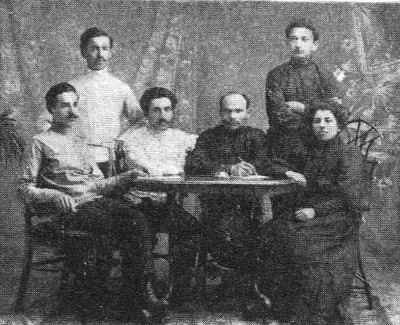
Standing: ? Chaim Tomshov |
was felt by all the revolutionary parties. The Poale Zion” movement still had momentum—but it was the momentum of inertia, from the strength which had been amassed in the good years. But the decline was beginning to be apparent. Boys and girls began to carry fiddles and mandolins, played music and looked for places to dance. The hot rivalry between the Bundists and Soviet Socialists eased. The exchanges became sparser; they had thrown off the pack of idealism; life became empty.
(January 1906)
by Ben-Zion Dinur
Translated by Mira Eckhaus
After the Hummel Conference, I was assigned several trips: lectures, participation in debates with parties, and some organizational matters related to “self-defense”. In these trips I was particularly impressed by my visit to Babruysk. There was a meeting of our party members and debates with the members of “Poalei Zion” from Minsk, who denied the “class war” and opposed participation in the political struggle and undermined the sovereignty of the Zionist element in the movement. Negotiations were held on unification, and the debate was to clarify things and bring them closer to us. On behalf of our party, Alter Yaffe - a member of the center of our party - and I were to participate. In connection with my mission in matters of “self-defense”, I was accompanied to the train station by Comrade Kuropatkin. This was the party nickname of Polyakov (nephew of the Russian Jewish writer Polyakov Litovtsev), who was active and effective in “self-defense” on behalf of the party. Kuropatkin's specialization was - equipping the defense companies of the party with our own manufactured bombs. He excelled in agility and physical strength, in courage and composure. Once (in Cherkasy, Kiev region), he dismantled in broad daylight, in the city park, on one of the benches, a bomb, which he felt was heating up and could explode, while at the same moment he was eating a watermelon, grapes and a loaf of white bread… And this happened during the time when (after the dissolution of the First Duma) battlefield military courts, which were required to execute anyone found in possession of a weapon, were operating in the country… - I became friends with him, and he also took care of all the “arrangements” for my trip to Babruysk. I left Hommel on Thursday, January 5. In the waiting room of the train station, there was an outburst, scolding and swearing, shouting and cursing by an army officer against the Jews. On the advice of my companion, we went outside, and waited there until the train arrived. - The following day, on Saturday night, a large meeting was held in one of the synagogues in the city, at which the “Poalei Zion” of the “Minsk direction” argued with the S.S. members.
|
|
On behalf of “Poalei Zion” appeared their local leader – Plotkin. I believe he argued that every party should establish one principal criterion, not two. The difference between “Poalei Zion” and the socialist Zionists is that “Poalei Zion” had one criterion for examining all things, which was the Zionist criterion. They rejected the significance of “class war” within the Jewish context and argued that national unity should be fostered. - The speaker asked: “If there were elections for the “State Duma” in Babruysk, who would you choose: a Jewish Zionist or a Social-Democratic Russian?” - Alter answered in a long speech, in which he repeated this question itself, to prove how important the socialist criterion was in this particular case. - The speech was combined with numerous examples from everyday reality, according to which it was explained and proven how important it was for the Jewish worker that his representative be a socialist. - In my response, I continued Alter's course of ideas in order to prove that even from the point of view of protecting the national interests of the Jews, the matter should not be discussed in such a simplistic manner. After all, we are interested in a political representation that will guarantee changes and transformations in the regime, and not in representatives who will shout “Enough”! And from this point of view, it certainly cannot be stated at all that a Jewish representative guarantees the interests of the Jews, while a non-Jewish representative does not. I illustrated this point with examples from the realm of “self-defense”, showing that the inclusion of non-Jews is precisely one of the conditions for its success. I was told that our “coordination” in the debate satisfied the members: we “beat” our opponents while bringing them closer through propaganda.
Around the synagogue stood “guards”, composed mainly from female members, who were tasked with announcing if the police were approaching. - Among those standing guard were Sarah Schmuckler,
[Page 436]
Leah Miron (Katznelson) and other members, even few who were in my “circle” in Chorul.
However, during that visit to Babruysk, I was deeply impressed by a conversation with the female members of the movement about the status of the female member in our workers' movement. The conversation took place on Saturday morning, in the apartment of the photographer Chaim Katznelson, Berl's older brother. The entrance to the apartment was through a semi-dark corridor, the stairs inside of which led up to the second floor, where the photographer's apartment and place of work were. I remember how irritated I was by the strange creaking of the door when it opened and the faint groans of the stairs when someone stepped on them. Among the female members who participated in this conversation were Sarah Schmuckler, Leah Miron (Katznelson), Batya Lipshitz (Shein), Rachel Katznelson (Shazer) and others, whom I saw among the “guards”.
I preceded the conversation with a short lecture on “the moral and spiritual development of the individual as a condition for the realization of socialism”. I tried to explain that the realization of socialism from an organizational and economic point of view by the seizure of power will not change much in life if it is not preceded, or if it is not at least accompanied, by fundamental changes in the intellectual level and moral character of the individual, and I stated that one of the hallmarks of progress in this direction is the state of society in the movement; and in this respect it has a special destiny in the movement (I repeated the lecture in various forms, and even published its essence in Russian in an article in the newspaper “The echoes of Kiev” in the summer of 1906). The conversation of the female members was lively, but I felt that some of them paid a lot of attention… to my shabby coats. And indeed, this coat deserved a lot of attention in terms of its “respectable age” and also in terms of its color: it became greenish, with no trace of its original color. Sarah Schmuckler even spoke to me indirectly and gently about the matter. I explained to her that there are three factors to the poor condition of my coat: practical, principled, and cunning. The coat has served me faithfully for many years, and as I have no other coat, it is not practical to throw away a poor coat when you have no substitute. In principle, I do not receive a salary from the party; I do not want to be a party professional. I only receive travel expenses in case that my personal means are not enough to cover them. The source of my income is lectures and classes that I give to small groups. Thus, in Lubny I held a course of lectures and discussions on “Social ideals and political regimes”. Each participant put in three rubles - and if he didn't have the money, his friends paid the amount for him. This brought me about twelve rubles a month… which was not much, even though I didn't have to pay rent. And thirdly, I said, from a tactical point of view, my shabby coat is a precious treasure; it protects me. The police who want to arrest me - and I know they want to - don't imagine that this poor young man in a shabby coat from the days of Methuselah, with a scarf around his neck like a “yeshiva boy”, is the same “dangerous and important revolutionary agitator, so to speak”, whom they were looking for… -
I don't know if my explanation put Sarah's mind at ease. But for many years her lovely image stood before my eyes, laughing at my explanations with a natural and good youthful laugh - and her eyes were sad and full of sorrow.
On my way to the train, I had an interesting conversation with the coachman. I felt that he wanted to ask me something and was hesitating about it. I treated him in the manner of “ve'at ptach lo” (you shall open the way for him)…,I asked him about the news in Babruysk, and he began to present to me the troubles of the Jews all year round in Babruysk; “the greatest of which was the lack of rest and the nonsense of the numerous parties in the city: Zionists and socialists, Poalei Zion and S.S., Sejmists and Territorialists, Social Democrats and Socialist Revolutionaries, and within each and every party, there were factions (kloyztsn), sects, shades, and hues - one can go really crazy. And what do they all want? Only to save the Jews! And I want to say - and he turns to me - please have a little sense of purpose from you, young men. The Jews will sort out their own affairs! Don't worry too much!” I asked him: Were you in the Beit Midrash yesterday during the debate between Poalei Zion and the S.S.? – “Of course! I heard your “sermon”. - You spoke to the point and briefly. I do not agree. I think what is written in the Psalms is true: “Do not trust the Gentiles!” Or “There is no faith in the Gentiles”. - Are you one of “Poalei Zion”? – “No, just a Jew. – “After all, your words had some merit, but your predecessor's words were irritating! Indeed, a clever Jew, but dangerous!” And the coachman did not stop humming: “Save Jews! - Save yourselves, we will take care of ourselves!”
(Dr. Zvi Prozhinin)
by Dovid Shimoni
Translated by Mira Eckhaus
I have known Avraham Zvi Prozhinin since childhood. Prozhinin also used to visit in the “Intellectual Courtyard” opposite the house where my parents lived. Among the other educated young people who frequently visited that courtyard, he was also not absent. However, his visits were rare, since he studied at the university in Königsberg, and would only come to his house during the months off from studies. My friend Mula Serlin would always be the first to joyfully inform me of Prozhinin's arrival, since his parents' apartment was located at the back of that same “Intellectual Courtyard”. Mula Serlin was an incomparably innocent and kind-hearted boy, and although he was a year or two older than me, he had a certain respect for me, because by then I was already writing poems. He didn't excel in his studies at all, and I am sure that my poems didn't interest him at all, and even if I showed him a poem sometimes, I knew in advance that he wouldn't understand what was written in it, but he was happy that his younger friend was a “poet”. Once, he snatched a song out of my hand and started running off, shouting back from the street that he'd give it back to me in a moment. And indeed, a short time later he returned with a cheerful face, and told me that he had shown my poem to Avraham Hirschl Prozhinin, who was currently in the apartment of Shimonke Tsesnes, the prominent person of the people who attended the “Intellectual Courtyard”, and Avraham Hirschl read the poem and found it good. I didn't know who was Avraham Hirschl Prozhinin until then, and I had not even heard of him, but my friend Mula told me that he had known him for a long time, maybe a year or more, and that this Avraham Hirschl is no less than a student studying medicine in Königsberg, and although he does not wear a uniform (in Ashkenazi countries students did not wear uniforms), he is nevertheless a student in every sense of the word, and he has another great virtue that he knows how to joke like no other. He possessed another quality: that of being an ardent Zionist who struck fear into all manner of opponents of Zionism–of whom the “Intellectual Courtyard” was full. And also, Shimonke Tsesnes himself, whose authority is second to none,
|
|
S. Ginzburg, Y. Davidson, Y.L. Dubrov, the Prozhinin brothers |
[Page 438]
says of Avraham Hirsch that he is a serious man. The fact that the man who praised my poetry is a student greatly impressed me, although on the other hand I regretted that he was not wearing a uniform (after all, if he had worn a uniform - blue hat and shiny buttons - his opinion of my poetry would have received additional reinforcement and authority). However, I was most happy that Avraham Hirsch was an ardent Zionist who struck fear into all manner of opponents of Zion. Oh! I have already had a lot of trouble with opponents of Zion. True, I was merely a lad and would not have dared debate the great minds of the generation–the Bundists, the Iskraists, and the pioneers, with their matted quiffs and shirts bound by fringed girdles. They were all wondrous intellectuals and distinguished scholars, to whom all wisdoms and sciences were laid bare, and they rained fire and brimstone upon the Holy Tongue and the Land of Israel. Yet my young heart grieved within me. If I were not afraid of exaggeration, I would say that “my heart was bleeding”. My strength was not great in wisdom and science, but I loved the Land of Israel and the Holy Language, and anyone who offended them was like offending the apple of my eye. Luckily, I often had the opportunity to hear from the mouths of my older brother's friends (and they were already real “externs”, completely grown-up people, some of whom have already reached the age of sixteen or seventeen!) things as bitter as wormwood and as blunt as sword stabs against all that was dear to me. And once, when I could not bear it any longer, I did something I had never done before: I wrote a poem in Yiddish with the explicit intention that these “unlearned fools”–these licentious men who mock all that is dear to me, and among whom are those who cannot even comprehend a Hebrew verse properly–would read in a language they understand what my heart harbors toward them! I sent the poem in the utmost secrecy to the editorial office of a certain newspaper, hoping that once printed, it would open the eyes of the blind and, with its flame, melt the oppressive layer of ice heavy upon the freezing hearts of the exile-addled fools. Alas! Regrettably, our generation was not deemed worthy, and this poem–the first of the few I ever wrote in Yiddish–never saw the light of day. Hence, my joy grew boundlessly upon hearing that Avraham Hirshl was a brave fighter, feared by all the enemies of Zion. He is no simple nobody like me; he, thank God, is a student in Königsberg! It is indeed a pity that students in the land of Ashkenaz do not wear uniforms, nevertheless…
Was it really the month of spring when Mula Serlin first told me about Prozhinin? Or my personal acquaintance with him was in the spring? In any case, whenever I remember Prozhinin, something springy, new, fresh comes to mind. The snow is melting, the streets are full with cheerful puddles, the sky is rising, turning blue, and the remnants of the clouds that wander through them only further highlight the joy and tenderness of the spring blue. It is very possible that Prozhinin came to his parents' house for Passover, and when he visited his friends and companions in the “Intellectual Courtyard”, I would often see him, and that is why his appearance was associated in my imagination with something of Passover Eve, with something joyful and delightful. Of course, at first, I did not dare to approach him closely, even though I had a foothold in the “Intellectual Courtyard”, and even though I already knew that he had a positive opinion of my poems. Would it be reasonable that I, a brat who had not yet reached the Bar Mitzvah age, would go and introduce himself to a student from Königsberg, whom Shimonke Tsesnes himself testifies to as a serious man? But what reason would not do, Mula Serlin did. Once, while I was in the “Intellectual Courtyard”, Mula approached me alongside a stoutly built man–though not tall of stature–possessing sharp, piercing eyes. He pointed at me before the young man and solemnly declared: This is the one who wrote the poems. I already knew before whom I was standing, but when he extended his hand to me and smiled at me in a friendly way, I immediately felt, despite the cheerful and sharp sparks that flickered in his sharp eyes, which could also be interpreted as glints of mockery, that he could really become a friend of mine.
And from then on, for several years, as the spring month approached, when “the flowers appeared on the earth and the time of singing had come” - the voice of the turtle-dove was heard in our courtyard. And it was none other than the voice of my devoted friend Mula Serlin, a voice announcing that Avraham Hirschl had already come for Passover, and had already visited the “Intellectual Courtyard”, and had already told many interesting things there and plenty of jokes, which the entire people in the courtyard burst into laughter at. But besides the jokes, Avraham Hirschl also brought with him from abroad some important information about Zionism and the Land of Israel. He had already had several passionate conversations and several heated debates with the “anti”, that is, anti-Zionists, and he dealt them a crushing defeat. Many of them do indeed hold a grudge against him for this, but he is not at all impressed by them and continues to beat them as much as they are able to absorb. And Mula encouraged and urged me: “Why are you being so shy? Come and listen and see! He also asked me about you. Aren't you a member of our courtyard? If you have a new poem - that would be great! You can show it to him!” Here it is fitting to note
[Page 439]
that in the meantime, in the natural course of things, I had already grown somewhat and passed the age of Bar Mitzvah. I do not know whether it was bashfulness or arrogance, but in any case, when Mula offered that I take a new poem with me to show the guest, my face betrayed a certain reluctance, as if I wished to say: “What do you truly take me for? Some mere child? A schoolboy excelling in his studies, whom the rabbi drags around on Shabbats to the householders for an ‘auf-farhern’ (that is, to test the boy's knowledge and thereby demonstrate the rabbi's own teaching prowess)?” Though I said nothing, the look on my face must have betrayed what was stirring within me, for he hastened to reply: “Yet even without a poem it will be fine! Come!” I did let him urge me a little longer. Of course, there was no more talk of a “new poem”, but finally he tempted me and I agreed to come, because I really wanted to be tempted. Seeing and hearing Prozhinin was a great pleasure for me; I enjoyed his sharpness and wit, but mostly I wanted to hear first-hand information about the Land of Israel, and he was my first source. It was clear to me that the paths of the Land of Israel were no less clear to him than the paths of the sky were to Shmuel Yerichina. He could tell exactly not only how many dunams there were in each settlement in the Land of Israel, but also how many vines and almonds there were. Every time I saw and heard him, it seemed to me that he came not from Königsberg, but from the Land of Israel. It was solely out of deference (as he was twelve or thirteen years older than me) that I refrained from asking him also about the exact number of mules, donkeys, goats, and chickens belonging to each and every farmer. In my heart, I was certain that this too was well known to him.
The years passed, Prozhinin had already completed his studies, and after serving for some time as a doctor in a nearby town, he moved to Babruysk to practice his profession there. During these years, I became close to him, and he also became very close to my family, and when I was staying in my hometown, I would see him almost every day. He had his own private carriage, quite polished, with a special coachman. In this carriage, I sometimes had to accompany him on his way to his patients, and wait for him in the carriage while he treated his patients, since he did not have time to finish the conversation with me during our last meeting. And the conversation, as usual, revolved around the affairs of the Land of Israel, and of course it does not tolerate delay. He could talk about the Land of Israel from morning to evening, and from evening to morning.
A few years ago, in the early days of the State, an acquaintance told me of his visit to Krakow after the Holocaust. There he met a certain yeshiva student who pleaded with him to enable his immigration to the Land of Israel. In the course of their conversation, the young man said with great innocence that he did not know by what merit - perhaps only by the merit of his ancestors who died for Kiddush Hashem - the Holy One, blessed be He, had favored him with a spark of Moses, for his love for the Land of Israel was boundless and without reservation. My acquaintance who told me this story, a practical and smart man, could not hide his excitement at meeting that young man. He felt in all his speech a deep sincerity and a mysterious enthusiasm that cannot be expressed in words. This story of my acquaintance also made a strong impression on me, which I gave some expression to in the poem “Spark of Moses”. When I write this article in memory of Pruzhinin, I recall that young man from Krakow. The “Spark of Moses” also flickered in the soul of Avraham Zvi, who was gifted to an incomparable degree with this special talent, the talent of love for the Land of Israel. And Prozhinin was far from religiosity, far from messianic mysticism. Isn't this really some kind of special talent, according to the wonderful expression of Shalom Ashe, “A talent for the Land of Israel”?
Along with his love for the Land of Israel, he had another great love in his heart, the love for nature. He was perhaps the only Jew in his city of Babruysk who knew the name of every tree, every vegetable, and every flower, and could distinguish between the birds according to their flying and chirping. I, who was also known to have a great affection for nature, was often ashamed and embarrassed in his presence, for despite the greatness of my love, I was ignorant of all the details. He often told me that it was only through the tricks of fate that he became a doctor, when in fact he should have been a farmer. Although I did not agree with the first half of his argument, since I thought he was an excellent doctor (he was my family's doctor in Russia, and more than once he treated me when I was very ill), I had no doubt that he had a special tendency towards agriculture, and would certainly have excelled in this field if he had pursued it. The deep pleasure with which he spoke of the “dunams” would certainly also have been derived from his love for Mother Earth. And this love for nature was also connected with his love for naturalness, for normality, for the health of body and mind, especially the health of the latter. The peculiar Jewish nervousness would drive him absolutely crazy. He was a compassionate and kind-hearted man, full of love and compassion for the suffering. Nevertheless, he would get angry at imaginary patients, at the timid and cowardly, and more than once, with his very own hands, he would forfeit his practice
[Page 440]
and turn his most lucrative patients against him–those affluent patrons who possessed ample means. One can only wonder that, despite all his “rigidity” in relation to imaginary patients, many came to him, and even those who were burned by his lack of courtesy and who were expelled, believed in his medical ability with unwavering faith. And indeed, just as he was irritated and angry with imaginary patients, so he knew how to devote himself with all his soul to every serious patient, without sparing his time and effort, and without paying attention to compensation. From his friends and acquaintances, he did not want to receive any payment at all for his treatment, and his friends and acquaintances were very many…
During World War I, he was called up for military service, and worked as the chief physician at the military hospital on the grounds of the Babruysk fortress. Among the soldiers he treated was for a time a “special patient”, an extremely old man who had served in the army of Nicholas I, and thanks to his service, he was always admitted free of charge to the military hospital when sick. I had known this old gentile, who was almost eighty years old, and perhaps even past it, since my childhood, he would go begging from door to door among the Jewish homes, and at times also served in the role of a “Shabbos goy”. He always wore a military cap, and he was treated with respect by both adults and children. A “Nikolai soldier” - It is no small matter! And here Prozhinin had the opportunity to treat this old man in the hospital, and he ordered him to be fed soup and chicken meat. But the old man rebelled against this “diet”, he demanded instead sour cabbage and spelt porridge with fat. When Prozhinin approached his bed, he shouted towards him: Am “Am I a Jew that I should eat chicken?”
This rebuke of the great old man caused Prozhinin a greatest pleasure; he told me about it more than once and each time with special pleasure. This old man's aversion to chicken, regarding it as unmanly fare, a dish for the weak and spoiled, appealed to him greatly. He probably wanted very much that the sick of the people Israel would learn from this old man and do the same. And then it happened that I was seriously ill with dysentery, I will never forget Prozhinin's treatment. When I began to recover, he allowed me to eat chicken soup. However, I longed for something more substantial. But when I said to him in the language of the veteran Nikolai soldier: “Am I a Jew that I should eat chicken?”, he burst into laughter of pleasure, but his laughter did me no good: apart from chicken soup and toasts, he did not allow me to eat anything… I was forced to surrender to him, and as compensation, he told me in detail about everything that was happening in the Land of Israel, since during the days of my serious illness I was unable to even read a newspaper.
But even when I was healthy and I read newspapers, I would receive news about the Land of Israel mainly from Prozhinin. In fact, I also read the things that Prozhinin told me about, but he probably absorbed and studied them all in a different way, in an intensive and thorough way. When he explained things, brief and obscure news or dry, abstract numbers would take on flesh and sinew; the dunams were transformed into villages, settlements, fields yielding bread, and bustling life… I remember that when I was a “subtenant” in my apartment in Moscow during the very days of the struggle between Kerensky's provisional government and the Bolsheviks, while bombs were exploding around our house, and bullets were hitting the walls of the house (we were then, as it were, under siege and for almost two weeks we could not go outside), Prozhinin talked to me all day long about only one thing: the Balfour Declaration and what was expected of this declaration for the people of Israel…
Prozhinin's influence on all who knew him, and especially in his youth, was strong not only because in all his words there was always a great sincerity and spiritual truth. To a large extent, this was also due to his outstanding talent for illustrating his ideas and giving them artistic expression. He especially excelled in his satirical attacks on all those who say and do not do, on all those who make empty promises and talk nonsense. As a man of the people, he had no fondness for vulgarity, just as he could not bear weakness. But above all, he detested snobbery, boastful pretense, detachment, and hypocrisy of every shape, kind, and color and from all sides: right and left. With great skill he would imitate the national “rich man” who kindly allowed himself to be elected as a delegate to the Zionist Congress, since he was going to the medical springs this summer anyway, or the puffed-up leftist, who admired himself for the extremeness of his leftism and exalted his revolutionary eloquence. He would present to his listeners a vast gallery of different types of characters, their speech and the way they spoke, their habits and their facial expressions. But often, when the audience responded with laughter of artistic delight, his face would be serious and he would angrily exclaim: “cholera”!… This outcry was, of course, directed toward all those
[Page 441]
upon whom he wielded the whip of his ridicule; yet through his angry outcry, it was clear that “even in laughter the heart may ache”.
More than once I said to him that although he was a good physician and could certainly have been a successful farmer as well, there was no doubt that with his very own hands he had squandered his primary talent - his gift as a satirical actor; yet he himself dismissed all his talents with disdain. Perhaps he would only acknowledge one talent of his, that is “A talent for the Land of Israel”, but I never mentioned this talent to him.
As I was finishing writing this article, the radio played a recorded description of the opening of the 12th conference of the Field Crops Growers Association, which was held a few days ago in Kiryat Haim. My heart gladdened upon hearing of our progress in what seemed to me the core, the very pillar of our existence (the Hebrew field!); upon hearing the encouraging and joyful figures (millions of dunams of cultivated land, ever-growing yields, an abundance of work implements - a great portion of which are produced in the country - new crop varieties, and the beginnings of industrial agriculture). And suddenly my heart was pinched with pain: If Prozhinin was alive, I could talk to him about this… He would illuminate and explain things to me even more illustratively, with greater clarity, and the things would certainly come out of his mouth happier and more joyful than they were given by the lecturers…
But I will no longer discuss this topic with Prozhinin. Rest in peace dear and beloved friend, and may the clods of earth, which you loved so much, be sweet to you!…
|
|
JewishGen, Inc. makes no representations regarding the accuracy of
the translation. The reader may wish to refer to the original material
for verification.
JewishGen is not responsible for inaccuracies or omissions in the original work and cannot rewrite or edit the text to correct inaccuracies and/or omissions.
Our mission is to produce a translation of the original work and we cannot verify the accuracy of statements or alter facts cited.
 Bobruisk, Belarus
 Yizkor Book Project
 JewishGen Home Page
Copyright © 1999-2026 by JewishGen, Inc. Updated 30 Sep 2026 by JH