Youth Organizations {Cont.}
[Page 289]
“Freiheit” – “Dror” [Freedom]
by Eliezer Karni (Krzeznicki)
Translated by Nitsa Bar-Sela z”l
The “Freiheit” movement stemmed from the dreams of energetic youth
who searched for ways of self expression and for an outlet to their perplexity
regarding political and social problems that afflicted the whole Jewish public.
The absorption of concepts from the fountains of the popular Jewish Będzin
culture was a major factor in uniting the youth and in their contribution to
the public life, which strengthened the endurance of Będzin's Jews in their
various struggles. This movement was preceded by other youth movements, which
attracted boys and girls of various social classes. However, none of them had
penetrated the hearts of the youth as significantly as this one. Youth
movements which alienated themselves from national and Zionistic aspirations
and ignored the social problems of the youth and the origins of their classes
could not appeal to the great masses of the youth. Therefore, no other youth
movement could succeed as much as “Freiheit”. It imbued the youth
with social-Zionist ideals of self fulfillment and pioneering.
“Freiheit” was founded in 1926 in Warsaw, and soon after became a
mass youth movement. When the breach in the Poalei Zion [Socialist Zionists] movement
occurred, a vacuum in the Jewish street resulted and it was necessary to re-build
everything anew.
In fact, many heated discussions among the different parts of the divided
movement preceded the mending of this breach. They took place in the pine
forests of the village of Zabkowice (14 kilometers from Będzin) on Sundays
during the summer months. Those forests absorbed the stormy controversies
during most hours of the day. Leaving the city, even for one day, to the open
air had its beneficial effect towards uniting the urban Jewish youth and
filling them with a fresh new spirit.
These meetings and the groups of the youth of Zion were the foundations of the
“Freiheit” movement, which during the years won the hearts of many
groups of the Będzin youth, under the guidance of those members of the party of
Poalei Zion [Socialist Zionists] who remained loyal to the principles of the movement. The
first branches were created. One by one boys and girls from the remotest
corners convened in order to spend time together, sing, discuss ideological
issues, go on hikes and so on. All these became indelible experiences which
left deep imprints in their hearts and strengthened their devotion to the
movement which they considered the epitome of their life.
[Page 290]
It was only natural that this movement would generate its own guides, leaders
and directors. And indeed, very quickly, some young people who were
ideologically mature tried and also succeeded in distinguishing themselves from
the others.
The attempts of the Communist party to penetrate the socialist youth movement and
undermine it from within did not skip “Freiheit” in Będzin. Things reached the
stage where the underground organization of the Communist movement managed to get a hold
on some youth in our Histadrut[1], but
fortunately, it was found out before the communists managed to consolidate
their influence and their attempts were warded off.
In order to offer our members a more thorough ideological recognition and education, clubs were
formed on Borochov[2],
Syrkin[3] and more, in which the participants
learned the principles of the labor Zionism and the development of the labor movement in
Eretz Israel. They read together from the writings of Otto Bauer[4],
Kautsky[5] and others.
There were also general discussions and balls of “Questions and Answers”.
The activity was held in the “Freiheit” hall, in the cellars of the
Piekarski house on Modrzejowska Street, which swarmed with people and stormed
with loud voices every evening, until very late, and during holidays – all
day long as well. So many young men and women gathered there that there was no
choice but conduct the club activities in private houses, and in the summer
months – on the hill (“górka”), which was covered with
trees and padded with grass and surrounded the ancient castle.
The most significant change in the movement occurred when the riots of 1929
broke out in Eretz Israel. The attitude of the Communists and the
“Bund”, their publications and their performances acted contrary to
their intentions. Now their true nature was revealed. The resentment was
particularly strong among the “Freiheit” members, whose pioneering
roots were profound and who saw their future in Eretz Israel.
Many youngsters, who until now felt some closeness to the movements of Zion
haters, moved away from them and joined us throughout the days of the riots and
also after them. Many of them also prepared to go to training farms (kibbutz
hachshara) and eventually immigrate to Eretz Israel.
Our movement was the only one in town that met non-Jewish socialist youth
movements. We maintained contacts with the socialist Polish youth although Zion
haters kept trying to sabotage them. We had always felt that we must explain to
the gentiles our pioneering Zionist entity, which the Jewish communists and
“Bund” people resented.
Our movement found itself growing up, conquering and undertaking the burden of
responsibility towards its trainees. As a movement of grown-up members, we
could not neglect hundreds of youngsters who had difficulties integrating in
our framework. Therefore, we founded the “Freier Scouts” – a
free Scouts movement, and so, we enlarged the educational framework of the
Zionist-socialistic movement by adding the group of the juniors.
Members of “Freiheit”, under the leadership of Miriam Najman, devoted
themselves to educating this group of youngsters, whose members had originated
from the “Heder” and come from homes of laborers, who had not been
able to care for their children's education. Somehow, we did not attract school
graduates. Only very few of them joined us.
In order to strengthen the informative and educational activities, we had to do
much more than hold meetings in the evening after a work day. Hence, we
organized seminars that lasted one or two weeks in villages, and which hosted
delegates of the labor party from Eretz Israel such as Tabenkin[6],
Sherf and others.
Years went by, the boys and the girls became young men and women and it was
decided to move them up into the party. But this decision created an open
rebellion: tens of members refused and insisted on their right to remain in
“Freiheit”, which they felt attached to and in which they found
themselves fulfilled. It took a lot of coaxing and compromising, to find a
solution to this problem, which almost created a real crisis.
|
|
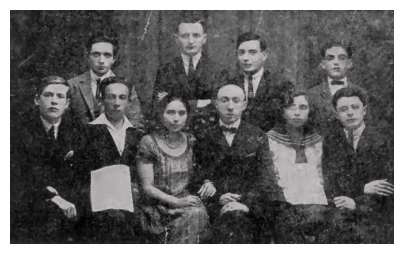
| Members of the “Freiheit” committee |
|
Standing from right: Lajbl Kokotek, Mordechai Brajner, Ben Zion Klajnman,
Benjamin Adlerflygel
Seated: Icchak Szajnman, Fersztenfeld, Mordechai Tenenbaum,
Hinde Tenenbaum, Heniek Tenenbaum, Israel Cwajgenbaum
|
[Page 291]
We had a special experience when we set a training group of Ha-Kibbutz
Ha-Me'uhad[7]
[United Kibbutz movement] in our town. We helped the kibbutz
members in finding work, but they also helped us considerably with guiding and
teaching. In time, this kibbutz developed a very firm hold in our town and
became well-known. During the Nazi regime its members headed the underground
movement.
A few years before the war, our movement united with “Hechalutz
Hatzair”. In the magazine “Zaglembier Leben” (number 17, 1939)
we read about another district convention of “Freiheit – Hechalutz
Hatzair” in Będzin: “In this convention two hundred members of the
two senior groups who were about to graduate participated. It was stated that
the bloody riots in Eretz Israel would not deter us. On the contrary – we
were up and ready to immigrate. We would join the fighters and workers in Eretz Israel. The convention dealt with issues of the movement, around which heated
discussions started. The main question was – going out on pioneer
training. And indeed, right there and then tens of members enlisted for
immediate training. In the evening, there was a solemn ceremony to conclude the
convention, which raised our spirits towards our future mission.”
This is how the “Freiheit” youth movement was born and developed in
Będzin. Ex- members of the movement who live in Israel now, are still grateful
to their movement which is no more.
A Regional Meeting of “Freiheit” in Będzin
Translated by Nitsa Bar-Sela z”l
|
This report was published in “Zaglembier Zeitung”, number 34, 1938,
signed by Zvi, probably Zvi Szpringer or Zvi Poliwoda, of the
“Freiheit” and the Kibbutz leaders in Będzin. Both were excellent
young men who risked their lives for their sacred cause. (The editor)
|
More than two hundred young active members of the various branches of
“Freiheit” in Zaglembie, gathered for two days in the decorated hall
of “Hapoel” in Będzin for their annual regional meeting, which
concluded the successful summer camp of the movement in the area.
The subject of the meeting was the bloody riots in Eretz Israel which had lasted
two years already, since 1936. The Head of the Histadrut in Będzin, M.
Poliwoda, greeted the members. All the participants marched in front of the
national flags and the meeting opened with the songs of “Hashvuah”
and “Tehezaknah”.
Herszl Szpringer (one of the leaders of Kibbutz “Dror” in Będzin, a
fighter and organizer of the underground, who died as a hero – the
copier), eulogized the victims who fell during the bloody riots in Eretz Israel.
His eulogy was made while the audience was standing in mourning.
The delegate of the center, Chrzanowski, gave a lecture on “The pioneer
movement in view of the present situation”. In his comprehensive lecture
the speaker included all the problems which occupied the Jewish world in the
Diaspora and in Eretz Israel at the time, and called the young to gather around
the flag of the active pioneer movement. Many participated in the vivid
discussion that followed the lecture.
In the evening, a graduation ceremony was held under the slogan: “To
training!” Szpringer, Poliwoda, Rzezak and Szwarckop made speeches.
The interesting meeting, which marked another step in the development of
“Freiheit” in Będzin, ended in singing and dancing the
“Hora”[8]
until the very late hours of the night.
|
|
|
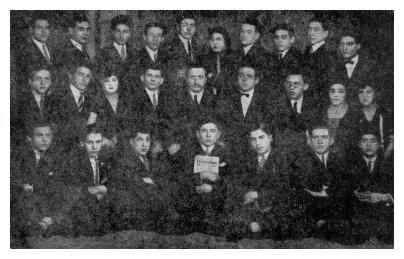
“Poale Zion” – Socialist
Zionists with Berl Loker, 1926 |
Translator's Footnotes
-
Histadrut (Hebrew) – General Federation of Labor, Israeli
workers' union return
-
Ber (Dov) Borochov (1881-1917) – Russian Jewish Socialist
Zionist thinker and leader return
-
Nachman Syrkin, (1868-1924) born in Mogilev, Belorussia; first
ideologist and leader of Socialist Zionism return
-
Otto Bauer (1881-1938), son of a Jewish industrialist; Austrian
socialist leader; first foreign minister of the Austrian Republic (1918-1919)
return
-
Karl Kautsky (1850-1938) German-Austrian socialist, born in Prague
return
-
Yizhak Tabenkin (1887–1971), labor leader in Eretz Israel
return
-
Ha-Kibbutz Ha-Me'uhad, a union of kibbutzim in Israel founded
at a conference in Petah Tikvah in 1927, established primarily by pioneers
of the Third Aliyah return
- Hora – folk dance of Israel, performed in a linked circle
return
This material is made available by JewishGen, Inc.
and the Yizkor Book Project for the purpose of
fulfilling our
mission of disseminating information about the Holocaust and
destroyed Jewish communities.
This material may not be copied,
sold or bartered without JewishGen, Inc.'s permission. Rights may be
reserved by the copyright holder.
JewishGen, Inc. makes no representations regarding the accuracy of
the translation. The reader may wish to refer to the original material
for verification.
JewishGen is not responsible for inaccuracies or omissions in the original work and cannot rewrite or edit the text to correct inaccuracies and/or omissions.
Our mission is to produce a translation of the original work and we cannot verify the accuracy of statements or alter facts cited.
 Będzin, Poland
 Yizkor Book Project
 JewishGen Home Page
Yizkor Book Director, Lance Ackerfeld
This web page created by Osnat Ramaty
Copyright © 1999-2026 by JewishGen, Inc.
Updated 16 Jul 2026 by LA