 |
|
[Page 72]
by M. W. Kaminski
Translated by Gloria Berkenstat Freund
Based on an earlier translation by Rachel Fassler
The Jewish professional movement in Będzin, all told, is some 30 years old.
The first inklings of a plan to organize a professional movement began in 1905-1906. Until then, there had not been any sort of corporate body that dealt with various divisions of opinion between workers and owners (bosses). In most cases, the master craftsman used to make decisions by himself in disputes between the master craftsman and his apprentices. He was not only the employer at that time but also the educator and master over the personal life of his “boys.” There wasn't, by the way, a great class difference between the Jewish master craftsmen and the apprentices at that time. They led the same lifestyle, had the same cultural needs, living conditions and, mostly, the apprentices became members of the master craftsmen's families.
The work itself would begin on Shabbat at the sighting of the first three stars and ended Friday evening just before the lighting of the candles. There was a short break to quickly eat a meal, to go to evening prayers and a break late at night for a few hours of sleep.
At that time, the apprentices – mainly those who came from outside looking for work – had severe problems dealing with the “voyle yingen” [“decent boys” – used to denote wild young men] of Będzin who extorted “payments” out of the poor apprentices seeking work with local master craftsmen. The “shtarke” [strong ones] also used to act as arbitrators in disputes between master craftsmen and the apprentices. Only with the rise of the socialist parties and the professional trade movement was the domination of the “strong ones” abolished.
The Zionist Socialists were the first who organized a professional union of painters, coachmen, those employed in trade in Będzin. Later, the Social Democrats started [unions] for the carpenters and the mill workers (metal) and the Poalei Zion [workers of Zion – Labor Zionists] started other unions. During the years 1905/6, the Bund was not yet operating in our city as an organized party.
It is clear that the unions mentioned did not have the appearance and character that the professional unions have today. The leadership as well as their activity was chaotic; strikes took place sporadically; agreed salaries weren't adhered to because the Tsarist regime would not tolerate any free discussions – even in the purely professional field. Due to this, we see in the last two years that with the revival of reaction and the simultaneous banishment of the most important social activists, the unions quickly fell apart and until 1915 there was no trace of any kind of professional organization in Zagłębie.
During the German occupation, the rise of the professional movement began at a fast tempo.
Thus, Poalei Zion [Labor-Zionists] was the first to begin to organize the trade employees, who in a short time numbered 300 members. This union did not exist for long due to the fact that the type of members in those times were not yet prepared to support their own interests through a professional union.
The same happened to the painters' union, which for the most part consisted of young members with whom it was initially difficult to establish a professional union. At the time, the leather workers were the best organized (also by Poalei Zion). Almost 100% of this trade were members of their union and over the years they maintained their organization's discipline. This fact gave them the possibility of strengthening their own organization as well as maintaining the demands they had won. This situation continues to the present day. Naturally, in the midst of the generally weakly pulsating communal life in the country, this union also was weakened, but they tried to maintain their organization.
The porters' union had a completely different character and a different sense of collective organization. It was difficult to interest them in communal matters. They were strongly united and as an entity they came and went from the political organizations with which they were affiliated.
The first organizer of the porters was Poalei Zion. At around the same time, the private men's and women's tailors also were organized by them.
The first activity that the union undertook ended fatally for the organization itself. The demands that they sought met a stubborn resistance on the part of the employers, who declared a lockout and as a result the campaign was lost. A result of this failure was the establishment of the first cooperative of women's tailoring workers, which soon became private, however, and because of this the organization failed.
The previously mentioned organizations were in spite of everything a favorable and creative factor in the political power for the building of the Poalei Zion Party.
In 1917, the needle workers again were organized, this time under the influence of the Bund, which over the course of two years of activity in Będzin managed to absorb as members almost all the workers associated with the clothing trade. In addition to tailors, members of the needle workers were also hatmakers, milliners, furriers, corset-makers, underwear seamstresses and so on. The union numbered more than 350 members, among them a certain number of non-Jews. In contrast, it was difficult organizing the factory tailors.
[Page 73]
The Needle [Trades] Union actually served as a pattern for all professional
unions in Zagłębie. This union was the first to introduce a 46-hour
work week with flexible wages. The exemplary discipline and the outstanding
organization were the best means to bind the members to their union.
The initiative to create a local central council for the professional unions needs to be added to the activities of the Needle Trades Union. However, for reasons of a political nature, nothing came of the matter.
Around 1924-25, the decline began of this powerful union, which had in its ranks almost all of the needle workers, independent of their political beliefs, and, thanks to this, had enjoyed great strength in the professional area.
After the split in the Poalei Zion movement into right and left, the Right Poalei Zion founded a separate professional union to which belonged furriers and several dozen tailors.
Part of the needle trades branch was also organized as a separate professional union that had no connection to the central professional administrative body. However, the remnants of the above-mentioned abandoned needle trades union still found themselves under the influence of the Bund.
Despite all attempts and efforts to unite this real and driving force that could have served as a pillar of fire for the entire professional movement in Będzin, it was not successful.
The Bakers Union belonged to one of the well-built professional unions that could actually be considered as the oldest in the area of Zagłębie.
The membership here is, unlike other unions, truly unique. Here we find mostly people who had dozens of years of heavy toiling behind them, as wage workers with the smallest chances of becoming independent. The beautiful tradition of allowing people who did not have a stable workplace to work one or two days a week had been firmly established for dozens of years. The fair distribution of work found its true expression here.
The unrestrained unity among the bakery workers was older than today's modern organized professional union.
The Bakers Union is completely free of political allegiances. Therefore, we can see it at various times associated with various parties – sometimes with the Bund, sometimes with Poalei Zion Left and, today, we find it under the influence of the P.P.S. (Polska Partia Socjalistyczna [Polish Socialist Party]).
The Bakers Union is not purely Jewish. It counts approximately 70 members, among them a large number of non-Jews.
Relations among the members are friendly and, with small exceptions, the union, as a whole, takes very little part in communal campaigns.
As has already been mentioned above, the Right Poalei Zion also began to organize a professional union.
The first union, founded in 1930, consisted of approximately 50 furrier workers. The union carried out a series of campaigns with certain successes, among them: collective agreements with the givers of work, an eight-hour workday, a hundred percent reward for [overtime] and so on.
Although the union is small in number, it is, however, well-disciplined and stubbornly holds the positions it has won.
|
|
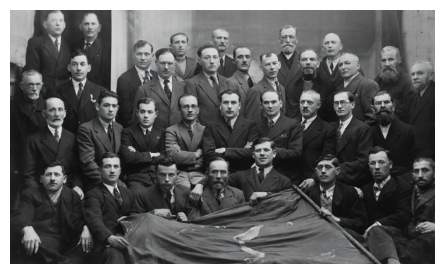
| The Carriers [Porters] Union |
[Page 74]
In 1934, the Barbers Union, which had belonged to the Left Poalei Zion in the
years 1917-1918, also reorganized.
The union members were composed of a young component and because of this it was difficult to carry out whatever unified action there was. The union numbered approximately 50 weakly disciplined members, for whom it was hard to support the professional movement.
The union for the nutrition branch consisted of two sections:
In 1937, the Transport Workers Union, which was divided into three sections, was
reorganized:
The porters contingent, in the great majority old with long traditions, always had a certain understanding of collectivization. Their employment itself demanded close cooperation and, as a result, the collective distribution of income system arose. In addition, there was the feeling of responsibility and care for the full support of the families of those members who became sick. The porters were strongly disciplined and in time they also developed an interest in communal campaigns in which they took an active part.
A group of 70 trade employees were also organized by Right Poalei Zion, under the name rufers [callers]. Actually, this group cannot be classified as trade employees, because their task consisted only of calling-in to the various businesses the customers who came from elsewhere to make their purchases in Będzin. The task of the rufers ended when the customer entered the business and, if he bought something, the rufers received a certain fee from the merchant; they did not receive a steady salary.
The situation of the rufers was very difficult because this group received random earnings. They could not make use of any social help because they did not have any wage work and no employment.
As has already been mentioned, the first attempts to organize the trade employees was made in the years 1905-1906 by the S.S. [Zionist Socialist Party]. However, for the already emphasized reasons, the union did not last long.
The second attempt in 1915-1916 by Poalei Zion did not have any success.
The subsequent efforts in 1925-1927 and later also did not have any positive results.
In 1935, there was success in reviving the professional union of trade and office workers with all of their sections, which were well organized and continued to develop.
The union, as a whole, without political leanings, to which approximately 260 members with various political allegiances belonged, recorded small successes on economic terrain, but the communal campaigns of a general character represented something important.
The Construction Union was founded in 1905-1906 by the Social Democrats and crumbled in the reactionary years of 1907-1908.
In 1917-1918, it was organized again by the Social Democrats and was active for a longer time with success.
During recent years, it got smaller for various reasons until it came to the final disbanding of the Construction Union by the regime.
Today, the Jewish construction workers (actually the carpenters) are a section of the General Construction Union of bricklayers, woodworkers, painters, pavers and ceramic workers.
In 1925 the print workers in Będzin found themselves in a miserable situation. The work conditions were simply unbearable. A wave of so-called “apprentices” came to the printing shops and this threatened to make the situation even worse.
Thanks to the initiative of a group of print workers, a division of the Central Professional Union of Print Workers in Poland was founded, which immediately took on tangible work that consisted of first organizing all printers and bookbinding workers in the city. A series of successful campaigns was carried out with the purpose of bringing in an eight-hour work day, normalizing the wages according to qualifications and regulating the attitude of those providing work in relation to the young [workers]. All of the campaigns and strikes brought victories.
The Printers Union during its three-year existence (1925-1928) carried on cultural work and with this obtained the sympathy of the entire local working class at that time.[1]
Although Będzin was not an avowed Jewish worker center, the organized Jewish workers lay their stamp on the economic and cultural life, not only in our city, but also on all of Jewish Zagłębie.
The Będzin Jewish working class had a glorious past of struggle against tsarist oppression. It gave, along with the Polish proletariat, its bloody contribution on the altar of Polish liberation.
Translator's footnote:
by J. Wygodzki
Translated by Gloria Berkenstat Freund
In the tragic year 1916, at the time when the World War raged with its entire
fiendish force and shook the foundation of the old world, a small group of
idealists, a sort of “ten idle men,” gathered, consisting of the
following people: Berysz Preger, Jeszaja Hendl Erlich, Salomon Gutman, Mosze
Szajn, M. Aronowicz, Eliezer Rubinlicht, Jicchak Wygodzki, Mosze Kalman Erlich,
Majer Potasz, Engineer Szymon Zmudzki, Mosze Grundman and others who after a
comprehensive deliberation decided to create a Jewish national gymnazie [high
school] in Będzin.
After much effort and intervention with the occupying regime of the time, a written concession to open a gymnazie under the historic name of “Yavne” [religious Zionists], was successfully received. The founders generated a large sum among themselves and the next year, 1917, three extensions and two normal classes were opened at Kołłątaja Street, no. 45 with the yearly right to continue to open additional classes up to the eighth grade. A supervisory council was created of the above mentioned men with Salomon Gutman as chairman and new members also worked together with Jeszaja Rotner as vice chairman and Mosze Kronental. Dr. Noach Braun (now an instructor at the Jerusalem University) was engaged as the director of the gymnazie. In the first year, the teaching institution went along a difficult, torturous road because of the small number of students. This happened as a consequence of the ignorance about the gymnazie on the part of the rich assimilated classes who sent their children to non-Jewish schools that had public rights.
The dismal situation constantly worsened and because of the difficult material condition, the best pedagogic powers, such as Dr. Sztajnberg, Dr. Barasz, Dr. Metalman, Dr. Infeld, and others, left the school. As a consequence of the intensely mournful situation, the supervisory council came together for a meeting in the office of the “brothers Szajn” in 1925 in order to consider the question of liquidating the school. The supervisory council gave an account of the seriousness of the problem and after long, passionate debates it was decided not to permit a liquidation that would throw an eternal stigma on the residents of Jewish Będzin.
With renewed strength the supervisory council set about to make the situation financially sound and first of all the members assessed themselves with large sums for that purpose. The chairman, Saloman Gutman, and the “brothers Szajn” particularly distinguished themselves. Gutman pledged to pay 3,000 zlotys yearly in addition to supporting 10 students with tuition and the brothers, Chaim and Jicchak Szajn, in addition to frequent large donations, obligated themselves to support several students. At the social events that took place twice a year for the benefit of the school, the wives, Cesia Szajn and the wives of Szlomo Frenkl and of Henrik Inwald, particularly excelled in their self sacrificing participation.
An action on behalf of the gymnazie was also undertaken at the local city council and at the kehila, which was crowned with appropriate success. New members were also incorporated into the supervisory council, among whom the social worker, Szlomo Frenkl and the energetic communal leaders, Abram Przesznik, Wolf Rechnic and others, particularly distinguished themselves. Also Majer Potasz, the school worker, voluntarily announced that he would be the administrator. And from that moment a new epoch for the school began. There were giant steps in the development and their frequency grew considerably. There were many effects from receiving the right to coeducation, but a great hindrance to the further development of the gymnazie was not possessing any public rights because the students had to attend a non-Jewish school for the baccalaureate exams and the result was such that of eight students who approached the exams, only one received a baccalaureate. It was understandable that the situation undermined the further development of the school and it could not long endure.
|
|
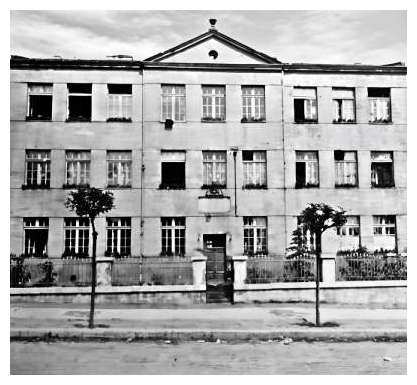
| The front part of the gymnazie named after Fürstenberg |
|
JewishGen, Inc. makes no representations regarding the accuracy of
the translation. The reader may wish to refer to the original material
for verification.
JewishGen is not responsible for inaccuracies or omissions in the original work and cannot rewrite or edit the text to correct inaccuracies and/or omissions.
Our mission is to produce a translation of the original work and we cannot verify the accuracy of statements or alter facts cited.
 Będzin, Poland
 Yizkor Book Project
 JewishGen Home Page
Copyright © 1999-2026 by JewishGen, Inc.
Updated 29 Oct 2026 by OR