 |
|
[Page 9]
by D. L.
Translated by Rita Ratson
Donated by Erin Einhorn
The thought of issuing the almanac or “Pinkas” is not a new one. The
idea evolved years ago, and was ready to be printed, but the outbreak of the
Second World War made this work impossible to complete.
In 1929, Szymon Rotenberg began writing the story of Jewish Zagłębie in general, and his birth city of Będzin. He alone, for over 10 years had researched in the archives of the records of Zagłębie and the works of Polish historians and old records of the Chevra Kaddisha [burial society] and local Jews who were knowledgeable. Szymon Rotenberg researched everything that had been previously written about Zagłębie and her principal city and when after 10 years of work he completed this monumental work, which filled 500 pages in an album format, it reached the stage when this book was ready to be printed.
When the terrible tragedy of the war destroyed Jewish Zagłębie, the “Zagłębie Almanach” also died. I don't know if anyone from Będzin read the “Zagłębie Almanach”.
It seems that I was the only person from Będzin to have seen this monumental work, completed and in print.
Rotenberg's younger brother – Hersz Lajb – had a print shop in the house I lived in, on 56 Malachowski (Street). Here Szymon Rotenberg printed three copies of the book. I remember how Szymele, as we used to call him, used to come to the print shop every day to help his brother with this work. Every day he brought new documents, erased and added to complete defects (missing pieces of information) to the already printed pages. His brother's protests did not help; that this work would never be completed.
Szymele did not tire in continuously printing and reprinting. I remember his joy when a new idea was successful – in explaining a legend or to insert a small story of Będzin life.
Finally, the book was completed and ready for printing in 1939. Of the three proof copies that he printed, he gave one to the “Starosta” (district head) of Będzin for the Polish censorship, without which we were not allowed to print. The second copy he divided into sections and sent it to Będzin people throughout the world. Sadly, I was unsuccessful in finding the distributed pages (sections), except for a few pages which his brother in Paris had, and which M. Hampel in Israel possessed.
The third copy he kept for himself, and waiting for confirmation from the Polish censor, in order to begin printing the “Zagłębie Almanach”. The horrific war broke out and the printing of the book was not a consideration due to the fact that the Germans did not allow Jewish books to be printed.
The last time I met with Szymele Rotenberg was on July 30, 1943, in the ghetto in front of the house where the youth club met. We sat together, the author of these lines, Israel Gertler, and S. Rotenberg, and discussed how to save the writings (the work) from disappearing. We had already set ourselves to the task of accounting for our time, for we had already come to the conclusion that the days of the ghetto were numbered and that we stood before total annihilation; to which we thought: maybe one of us will remain alive and then we'll know where to find this book.
We decided that Israel Gertler should bring a milk can on the following day, into which we wanted to put the “Almanach” and also the diary that Szymon Rotenberg wrote in the ghetto. Unfortunately, we were unable to put this plan into effect, because in the morning the “Aussiedlung” (deportation) had already taken place. The last Będzin Jews were taken away by force to the Auschwitz gas chambers.
A week later, I managed to return to the ghetto where 150 Jews still remained. They had the task of liquidating Jewish property. Because of the fact that these Jews were involved in this task, they were entitled to live a further four months.
I immediately went up to Rotenberg's apartment and looked where the “Almanach” should have been. However, I didn't find the book. Only after the war, when I came to live in Israel, I wrote a letter to the survivors in Będzin. I asked them to look for the lost “Almanach”; unfortunately without success. After extended investigation together with Bendiner people who were living in Israel, I determined that the “Almanach” was located with a certain Mr. R. I consulted Rabbi Hager, of blessed memory. With the help of the “Irgun Ole Zagłębie” (Association of Zaglembian Immigrants) we managed to retrieve the book from Mr. R. It was shown that this was the copy that the “Starosta” had previously received. Polish officials found the book after the war. They thought that it was a religious book and handed it over to the Jewish committee. Unfortunately, we weren't entirely content at having found the book. From the monumental work on Zagłębie Jewry, which had around 500 pages, only 100 pages remained. It seems that those people who had the book in their possession didn't look after it. A momentous work, containing ten years' research on Zaglembian Jewry, has been lost.
We hereby publish the part of the book that was saved as written by S. Rotenberg, of blessed memory, without changing the order in which prepared. We owe this to the holy memory of Szymon Rotenberg. We have merely carried out a few corrections and added several remarks.
by Szymon Rotenberg
Translated by Gloria Berkenstat Freund
|
|
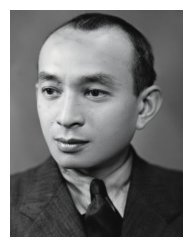
| Szymon Rotenberg |
Historical review of the oldest times until the rise of resurrected Poland
|
Various names from the city of Będzin. – The rise of the settlement
and its character. – The wooden and stone castle. – The founding of
the city and the erection of a protective wall around it. – Będzin,
under an official royal supervision, develops into an important trade center.
– The number of houses and residents in 1549. – The taxes that the
city paid then. – The decline of the city after the Swedish War. –
The number of houses with residents and the taxes that they paid in 1789.
– The development of the city in 1826. – Będzin under the
Prussian occupation and during Napoleon's reign. – The decline in the city
after the uprising of 1831. – The resurrection during the uprising of
1863. – The participation of the Będzin population in the uprising.
– The later years.
|
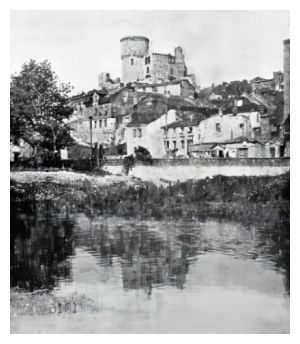
Before we approach the story of the Jews of Będzin, we will first give a historical overview about the establishment of the city. Będzin is the regional capital of the district of Kielce. The city lies on the left bank of the “Shvartzer Przemsza” (Black Przemsza River) and at the foot of the great ruins of the old castle. In the 14th century the city was called Bondien; in the 15th century: Bondin and Bondzin; in 16th and 17th century: Bendin and Bendzim. Beginning in the 18th century: Będzin.
Będzin is one of the oldest cities in Poland. The settlement probably arose here at the end of the 11th century. The population, which occupied itself with carrying goods on the Przemsza and with fishing, settled around the fortress, which was situated on a high rocky mountain. During the time of Bolesław the Shy (1238-1279), a wooden castle was built on the ruins of the fortress with strongly constructed foundations and fortresses. Bolesław took the settlement around the castle under his protection, giving the settlement the character of a village with the right to have a market.
Choosing this particular place for a settlement was not accidental because in the old times, a stream flowed here that led from the Przemsza to the Warta River and from there, through the Oder (Odra) River to the Vistula River. In addition to this, the oldest overland route that connected Krakow with Greater Poland through Silesia ran through Będzin.
To begin with, the Polish King Kazimierz the Great, who understood the importance of the mountain as a strategic point, demolished the wooden fortress, and in 1358, in its place erected a mighty stone castle that stood guard over the Polish border, protecting them from attacks by the Germanized and aggressive people from Silesia. This was a giant castle built of stone – a three-story fortress and four-meter [over 13 feet] thick outside walls; a 10-12 meter [over 32-39 foot] high wall surrounded the castle. In this particular period, the city still did not possess ramparts; only earthen walls with wooden gates: when Kazimierz the Great founded the city, he moved the residents there from the earlier Będzin, which was located in the Małobądz region of today. A defensive stone wall was probably built in the year 1364 and its remnants exist until the present day. In Zamkowa Street are buildings that were built upon the ruins of these walls. In the Zaułek alleyways, too, and at the old Jewish cemetery in Zawale Street, and in recent years, one could see traces of the walls.
Będzin, as a border city, lying at a point where trade roads crossed that led in various directions, was found under a special royal supervision; thanks to this, the city grew rapidly in prosperity and became an important trade center. On the basis of privileges given by Kazimierz IV Jagiellończyk (Casimir IV Jagiellon) in 1464, Będzin received the right to own a salt camp; each merchant who brought salt to Silesia was under the threat of a high penalty for avoiding Będzin and had to spend three days in the city and sell salt. It is interesting that in 1540 approximately 100 houses with 800 residents are found in Będzin; at the same time Kielce had 84 houses with approximately 600 residents. The royal inspectors who came to Będzin in 1564 to demand taxes for the royal treasury designated that the butchers need to give 24 stones of tallow (a stone = 32 pounds), 16 bakers up to five silver groshn, 10 shoemakers up to four silver groshn. The city bath [had to give] two grzywna (a grzywna = 48 silver groshn), the beer brewery two grzywna, the wooden and clay vessels shops two grzywna for trading five times at the fair.
Large fairs would take place in Będzin where merchants from distant Breslau would come to sell their goods and to buy Polish goods. Thus the city grew and became one of the richest cities, but lying near the German border, it would be ruined by barbaric German attacks that reached the rich border cities. The Swedish
[Page 11]
wars caused a thorough decline for Będzin. The former shine and prosperity
disappeared. Commerce and craft fell sharply. In 1673, the city numbered only
40 houses with 346 residents. The reason for this was that a significant number
of artisans left the city. In 1683, the Polish king, Jan III Sobieski, passed
through Będzin with his army. The king, who had hurried to help the city
of Vienna which was besieged by the Turks, lingered in the local castle for a
short time. In memory of King Sobieski's stay in Będzin, a memorial was
erected then which remains to the present day at Kołłątaja Street 45. The last
audit that was carried out in 1789 showed that there were then 279 houses in
Będzin with more than 1,200 residents who paid 27 gildn and 15 groshn
ground tax and 200 gildn trade tax. The Jewish butchers (there mainly were no
Christian [butchers] then in Będzin) paid 253 gildn and 10 groshn
slaughtering tax and the kehile [organized Jewish community] paid 700 gildn for
the synagogue.
Initially, in the third decade of the 19th century, when they began to mine coal around Będzin and in 1825 there arose zinc smelters, the city again began to develop.
Administratively, Będzin belonged to the Siewierz District (Powiat) in New Silesia during the period of Prussian rule from 1795 to 1807. Following the Prussian withdrawal and Napoleon's decree establishing six departments in the newly formed Duchy of Warsaw, Będzin became part of the Lelów-Siewierz District. In 1808, the town was assigned to the Pilica District. Following a second administrative reorganization in 1813, Będzin was integrated into the Olkusz District.
After the uprising of 1831, the city fell into apathy. The Russian regime did not permit initiatives to better the situation in the city. In 1858, when representatives of the Warsaw-Vienna railroad directorship, which had begun to build the Ząbkowice-Sosnowiec line, arrived the city was again revived, but after this the city again fell into indifference, from which it burst out during the historic events of 1863.
At the moment when the uprising started, the city suddenly came to life. A large number of the city population, among them a significant number of Jews, appeared with weapons in their hands against the tsarist oppressors.
On the 5th of May 1864, not far from the city, a clash of Polish rebels with the Russians took place. A large number of residents took an animated part on the rebels' side. The stubborn struggle ended with the defeat of the Russians.
The insurrectionist fatalities were buried at the same location (near today's train station) and, later, a Christian chapel was erected there as a memorial. Because the Christian chapel hindered movement, in 1936 it was removed and near the location, a little to the side, a memorial for the insurrectionist fatalities was erected which depicts the “Holy Mother.”
Something must be mentioned about so-called Soberke.
On the left side of the road that leads from Będzin to Czeladź, one could still see the ruins of the old building that the local population called Soberke.
The name originates from the tsarist regime wanting to settle a certain number of noble, Polish families there, outside the area around the Nieman River, who were sentenced to forced labor in the Zagłębie coal mines because of their participation in the uprising of 1831.
Earlier, the mentioned symbol of tsarist rule had been completely removed; in later years, a Russian pay office was located there.
The later years brought almost nothing new. At the head of the municipal self-managing committee were nominated burmistrzes [mayors] who were more interested in their own matters than those of the city.
A beautiful page of history was carried out by the Zagłębie labor force in 1905-1907 when they appeared against the members of the tsarist underground.
From August 1914 to the end of 1918, Będzin found itself under the German (partially also under the Austrian occupation) that, with authentic Prussian Junker brutality oppressed the local population.
|
When did the Jews appear in the territory of Zagłębie? – Their
employment, number of Jews. – The increase in the number of Jews in
Będzin to the end of the 13th century. – The Jewish Kehile in Poland.
– The Będzin deputy to the Council of the Four Lands. – Polish
Jews under the direct supervision of the king. – The Jewish courts. –
The limitations for Jews and the first privileges. – Będzin Jews in
trade. – The Statue of Kalisz. – The later privileges. – The
intensive fight by the Będzin Jews for their rights and the reasons for
it. – The Codex Law. – The chimney tax. – The
“invention” of Będzin Jews. – The “revolution” of
Będzin Jews. – Christian “booksellers.”
|
Jews appeared on the soil of Zagłębie for the first time in March 1226. At first, the newly arrived Jews were employed in agriculture and, with the remaining citizens, they were obligated to pay a tithe.
It is significant that in the same year that the Jews appeared in Zagłębie, the Opoler Prince designated a number of Jews who went through Silesia.
We cite here a document that speaks clearly about this. From the year 1227. (Aronins: Regesten Nr. 408)
“According to the requirement and confirmation of the Opeler Prince and after listening to the knowledgeable, the Breslau Bishop, Wawrzyniec designated anew the old and just payment in Rozenberg and Siewierz. According to this, one must pay in Rozenberg for women
[Page 12]
|
|
|||
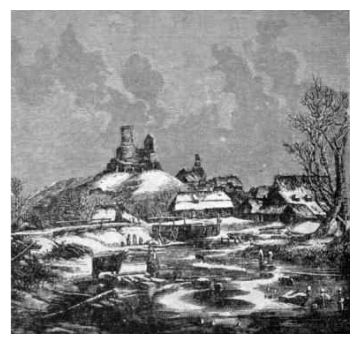
| Podzamcze Street in 1936 | Around the foothills of the castle in 1867 | |||
|
|
|||
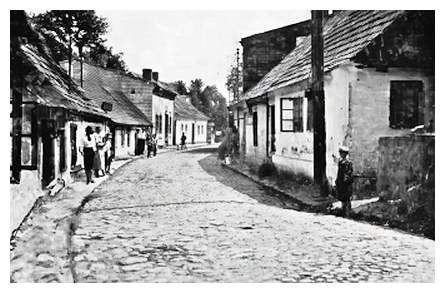
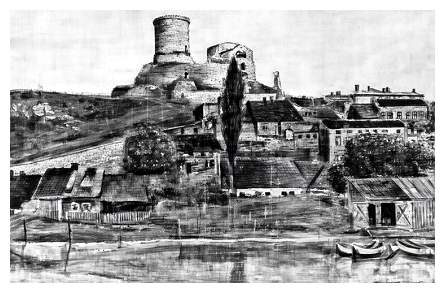
| A fragment of Podzamcze Alley (under the mountain) 1936 | The castle in 1916 Oil painting by Artur Wiener |
[Page 13]
and farmhands who were taken to be sold, one szkojec silver[a];
one also has to pay that much for Jews, although they are not taken to be sold. Foreign
riders or fusgayer [those on foot] with goods, paid from wherever they might
come and independent of kind, both Christian and Jew, two Opoler groshn, as
opposed to travelers paying nothing. The same in connection with riders and
those on foot, Christians and Jews from Siewierz.”
We read about Jewish peasants on a parchment from 1227 who till the duke's estates in the area of Bytom and pay tithes of bales to the Breslau Bishop.
A significant number of Jews came to Będzin at the end of the 13th century. At the beginning of the 14th century, Jews left agriculture and began to be employed in trade. They opened small shops and also began exchanging money.
In the 17th century, the responsa of the Bach [Bayit Chadash – Joel Sirkis] mentions the holy community of Będzin in connection with testimony.[b]
The highest authority from each Jewish settlement was the kehile [organized Jewish community] which was elected by the most respected members of the middle class. At the head of each kehile was a rabbi and a sindik (a judicial advisor). In later times, we find sub-kehilus [plural of kehile] in even the smallest towns that were subject to the nearest kehilus.
In the second half of the 17th century, Będzin sent its own representative to Krakow for the Jewish national land representation that was called the Va'ad Arba Arazot [the Council of the Four Lands]. The Będzin delegate to the Council in 1666 was named Reb Yisroel ben [son of] Shmuel (Samuelewicz).
The Jews in Poland were thought of as foreigners. For this reason, they were abandoned directly by the king who designated the provincial governors as his representatives. The provincial governors again, in such cities as Będzin, turned the power over to the village elders. Because of this, the Jews were not subject to the municipal court.
First, the Jews were sentenced by a Jewish court. There was a right to appeal against the judgement of the Jewish Beis Din [religious court] to the wojewoda [province] or village elder and finally to the king.
The Jewish court consisted of a rabbi and aldermen (sitting in the court) who were delegated by the kehile. All conflicts between a Christian and a Jew were also decided, first by a Jewish court, but with the participation of a provincial governor or a village elder.
The trials usually took place in the synagogue where the metrical records were preserved. The jail, which the Jews had to support on their own account, was also located at the synagogue. A court meeting without the participation of the aldermen was impossible.
In 1591, instructions for the Jewish court were hung in the Będzin synagogue. These instructions consisted of 12 points and were written in the Hebrew and Polish languages.
The Będzin Jews gave the provincial governor 100 gildn as well as 10 pounds of saffron and cinnamon yearly for the trials that he personally led. If this was a tax or a voluntary gift is unknown.
In the beginning, the Będzin Jews were severely limited in their rights. They were permitted to live in limited areas of the city and there were certain days designated for them for business. The number of goods with which they were permitted to trade was limited. When they felt stronger, before the time of Kazimierz Jagiellon, they endeavored – along with the Krakow Jews – to receive various privileges. Their efforts were crowned with success and, in 1453, Kazimierz Jagiellon granted them their privileges.
The privileges permitted the local Jews to be occupied in trade with foreign goods, but only wholesale. They were also permitted to trade in Polish goods, but the number of articles with which they could trade was greatly limited.
The Jews had to pay a higher payment for foreign goods than Christian merchants.
That Będzin Jews already took an active role in foreign trade is shown by the fact that in 1695 a Będzin merchant named Moshe Będziner is mentioned at the Leipzig Fair.
The first known privilege was the so-called “Kalisz Privilege” issued by Prince Bolesław the Pious in 1264.
According to the Kalisz Statute, the Jews were the property of the King (slaves of the state treasury); they were obligated to pay the prince taxes. Therefore, they benefited from his support. The privilege insured the Jews personal and general support as well as the security of individual and communal possessions. One of the most important statute directives was the decision that is supported by a papal bull of Pope Innocent III that rejects the malevolent blood libel accusation.
The later privileges from Kazimierz the Great were edited according to the model of the Kalisz Statute, which carried strong opposition on the part of the Catholic clergy who strove to keep the Jews apart from the Christian population.
In 1527, Zigmunt I, with a special privilege, put the Jewish merchants on an equal basis with the Christians in regard to the number, pay, taxes and so on. Approximately 15 years later, we see Jews as lessees of taverns and alcohol distilleries, as tenants of butcher shops and mills as well as tax collectors of royal payments.
In the time of King Stefan Batory, the Będzin Jews received permission to live in the center of the city as well as to trade at the market equally with the Christian merchants.
In 1592, the Będzin city hall received an order
[Page 14]
from Zigmund III to defend the local Jews against injustices and attacks, as
well as to preserve the rights that they had been given.
Mainly, the Jews in Poland received their freedom at the time of Władyslaw I, who made them equal in respect to the rights of the remaining citizens of the country.
One of the great Jewish achievements was the abolition of the so-called Codex Law[c] through Jan Sobieski.
Each time a new king stepped onto the Polish throne, the Będzin Jews immediately sent a delegation to him with a petition to acknowledge the already received rights. The same happened after the rule in the Polish capital was taken over by Jan Sobieski. However, this time the Jewish representatives returned with nothing because the king was occupied with important matters and the approval of the rights was put aside until later. However, the Będzin kehile did not neglect the matter and 11 years later, they acquired a fresh parchment with the acknowledgement of their rights.
Today, this parchment is located at the Będzin city hall where it is protected in an iron, fireproof safe that is sealed with sealing wax.
After Stanisław August Poniatowski crossed the threshold of the throne, a deputation of Będzin Jews traveled to Warsaw with the old parchments in order for the king to certify them. The deputation returned in 1766 with a new parchment that contained many old and new privileges.
The mentioned parchment is 80 centimeters long and 35 centimeters wide [about 31 and a half inches by 13.8 inches], with a cord seal that is partially damaged. It is located in the Będzin archive and it is signed by the king as well as certified by the royal vice notary, Augustin Korytowski.
To explain the intensive mobility of the Będzin Jews in the matters of their old and new rights we have to look at the existing laws under which they were placed. We should consider that from the oldest times on, the Jews could settle only in designated regions, that they were not permitted to come to the market and that they were not permitted to enter the surrounding streets, that trade was severely limited, that they were forbidden to trade in the suburbs and in the villages. Consequently, because they had to pay all kinds of state and communal taxes at a much larger percent than the other residents, we can no longer wonder about the extraordinarily liveliness of the Będzin Jews in weaving for themselves even more new privileges.
The Będzin Jews and the people from Krakow made use of formidable energy to abrogate the mentioned Codex Law. This law established that after the death of a Jew, as a foreigner, his property goes into the possession of the king, that if a Jew commits an ordinary crime, he is judged by a court; the Codex Law robbed him of his possessions. True, the Codex Law also applied with respect to the non-Jews, but only when there were no heirs up the eighth level of kinship.
In their struggle for a better future, the Będzin Jews often made use of various original ideas in order to avoid the special difficult laws that were designated for them.
It is known that in Poland a tax existed in the past that was called the “chimney tax.” This tax obligated every Jew in Poland to pay 30 groshn for each chimney in their house (non-Jews paid six groshn). However, necessity makes for inventiveness; the Będzin Jews first got the ingenious idea of combining several ovens in one chimney. However, this “invention” was discovered; the guilty ones were driven from the city and their houses were confiscated according to the directives of the Codex Law.
In defense of their rights, the local Jews did not balk at even appearing against the Va'ad Arba Arazot [the Council of the Four Lands] when it acted against their interests. Thus in 1666, a “revolution” broke out among the Będzin Jews against the Council and it led to intervention by the castle garrison.
The matter is thus:
After the Swedish Wars, a tax was placed on the Polish citizens to pay the outstanding debt of salaries for the soldiers. A number of military divisions received assignats [promissory paper currency] from the state treasury, which the Jews of the country were supposed to cover. As often happened, the divisions were used to get the money from the Jews. The Council of the Four Lands suddenly decided to buy up all of the assignats. For this purpose, the Council borrowed from the royal secretary, Kazimierz Kowalkowski, the sum of 26,000 Polish gildn. The debt was supposed to be paid through a money collection among the Jewish masses in Poland, which was proclaimed by the Council. The Będzin Jews were among the first who brought their portion, being sure that with this, the matter would be taken care of. However, a short time later, they learned that the debt was not paid and that the Jewish leaders had issued a Chirograph [a legal document written on a single piece of parchment multiple times] (a signed writing) that said that if the designated terms were not paid back, Kowalkowski had the right to rob the entire kingdom, to catch, arrest and torture each Jew for as long as the debt was not repaid threefold. In addition, if the loan was not repaid, the royal secretary could confiscate all of the possessions of the Jews in Poland, close their synagogues and houses of prayer, drive them out of their houses and settle Christians in them.
When the Będzin kehile learned about the writing, it mobilized its members who besieged the house of their representative to the Council in order to take revenge on him for his betrayal. The besieged deputy who was in his own house on S&#dss;awkowska Street (Kołłątaja today) called the municipal guard for help, but before it came, he was severely beaten and his residence demolished. As fear arose
[Page 15]
of unrest, a self-adjudicated court brought the matter to the burmistrz [mayor]
who called to the castle garrison for help in suppressing the “revolution.”
The epilogue of the event was the following: The deputy, Yisroel Salomonowicz, was
thrown out of his office and driven from the city along with his family.
A similar “revolution” was created by the Będzin Jews a little earlier, in 1539, because of religious books. King Zigmund I issued a privilege to the members of a certain Polish family that gave them the exclusive right to sell all religious books, such as siddurim [prayer books], makhzorim [High Holiday prayer books], selikhos [books of penitential prayers] hagaddos [books for Passover Seders] and so on to the Jews in the Krakow Województwo [province]. However, it appeared that the Jews thought of this act as a desecration of their religion and when the traders came to Będzin to sell the books they were attacked by the local Jews who took the books from them and publicly burned them. It was because of this that a great tumult arose and there was an intervention by the castle garrison.
|
Where did the first Będzin Jews live? – The wooden synagogue. –
The cemetery at Zawale Street. – The burial tax and a big trial because of
it. – The Będzin Jewish kehila and the societies of the 16th
century. – The Hasidim and the yeshiva at the Będzin synagogue. – The
popular rabbi, Reb Nusan Majteles. – The clothing of the Polish Jews in the
16th and 17th centuries. – Będzin Jews as lessees
and innkeepers. – The new synagogue. – The most respected Będzin
Jews up to the end of the 18th century. – The cemetery below the castle mountain.
– Headstones with Polish eagles. – The various Będzin rabbies from
1765-1864. – The situation of the Polish Jews during the Duchy of Warsaw.
– A Prussian law that strictly limited Jews to get married. – The
first tsarist decrees. – Będzin becomes a district city.
|
The first group of Jews who came to Będzin settled outside the walls and ramparts of the city in the area of today's Zaułek Street and in the lowest part of the Mandrzewer Street. Later, those arriving settled in the area of today's Zawale Street and, finally, in the area of today's Ribna and Berek Joselewicz (earlier Kazanska) Streets.
In the 15th century, a wooden synagogue was erected on Berek Joselewicz Street. At the same time, a cemetery, which partly exists to this day, was created behind a protective wall of the city on Zawale Street.[d] There were burials at this cemetery until about 1831. Not only the Jewish dead from Będzin were buried here, but also from the entire area, such as Mysłowice, Bytom, Tychy, Chorzów and Szielce.
Because the cemetery was on municipal terrain from which the city managing committee had to pay a tithe to the church parish, [starting] in 1588, the Będzin kehile had to provide the church fund with a special tax that was called a “burial tax,” for each individual corpse.
A disagreement often arose between the pleban [parish priest] and the Będzin kehile on the basis of the tithe and “burial tax.”
It happened that the Bytom Jews, to avoid paying the tax, brought their corpses in secret for burial at the Będzin cemetery. The Będzin kehile did not rush with the payment of the tax, which it could not demand from the Bytom Jews. Because of this, the Będzin pleban, Jan Kotulecki, accused the kehile of abuse against the existing laws. As a witness, the priest presented a Jewish woman who confirmed under oath that on the 5th of May 1687 strange Jews had come to Będzin and buried their corpses at the cemetery there.
The trial extended over the course of eight years and reached the office of the Krakow bishop.
In order to clear up the matter, in 1692 the Krakow bishop delegated the Mysłowice pleban Stanisław Zigmuntowicz, as arbiter and in 1694 the Grodziec priest, Mikołaj Jeziorkiewicz. The latter heard various witnesses and ordered several Mysłowice Jews to swear in the synagogue; the Bytom Jews mainly did not submit.
After investigating the entire matter, a finding was released according to which the Będzin kehile was obligated to pay the required tax and “burial tax.” However, it is unknown whether the trial ended with this judgment.
All of Jewish life in Będzin and its surroundings was concentrated at the synagogue at Berek Joselewicz Street.
A rabbi and four dayanim [religious judges] were at the head of the kehile, whose first obligation was to stand watch for community interests, which consisted of various societies. In the 16th century, the following seven societies were at the Będzin synagogue: Khevre Kadishe [Burial Society], Talmud Torah [free school for poor children] Bikor Kholim [Society for Visiting the Sick], Maoz Ladel (which provided poor people with food), Hakhnasat Kalah [Society to Aid Poor Brides], Malbish Arumim [Society to Provide Clothing for the Poor] and Halvoes Kheyn (a kind of gemiles khesed kase – interest-free loan fund). A gabbai [manager of an institution] was the head of each society.
The enumerated societies functioned well and their great number is explained by the fact that as a border city, many refugees who were persecuted in the neighboring countries came to Będzin and found a temporary place of refuge here.
Because of the great influx of foreign Jews, the Będzin kehile often found itself in a difficult material situation and had to turn to loans in order to save its brothers in need.
In addition to the usual khederim [religious primary schools], there was also a large yeshiva [religious secondary school] at the Będzin synagogue.
Rabbi, Reb Nusan Majteles, who was then the head of the yeshiva was very popular: in 1589 when Będzin
[Page 16]
was endangered by the military of Maximilan the Austrian; the rabbi collected
50 ducats from among the Będzin Jews and gave them to the castle elder to
fortify the city walls. Reb Nusan died at 105 and was brought to burial at the
old cemetery at Zawale Street.
It must be mentioned that at the same cemetery rest the bones of the well-known emissaries, Shlomo Markowicz and Yohonatan Samuelewicz, who with great effort and mortal danger brought the privileges that were certified in the old laws. These privileges were signed in writing by the King Jan Sobieski III.
Until 1538, the Będzin Jews – just as the other Jews in Poland – dressed the same way as the Christian population. Firstly, the Piotrków Statute ordered the Jews, under the threat of a monetary penalty, to wear berets, caps or other hats of a yellow color.
It is difficult to establish how many Jews were in Będzin as well as all of Poland in the 16th century. Because of a high head tax that reached three gildn for each soul, the Jews did not provide the correct number of members of their communities. In addition to this, political and religious reasons also contributed here. Because of this, the Jews in Poland tried to have a ryczałt (a one-time payment) designated for them. Their efforts had success and [they] prevailed upon the Sejm [Polish parliament] in 1590 to abolish the individual demand of a head tax, designating a ryczałt of 20,000 zlotes yearly for all Jews in the kingdom.
In the [first] half of the 18th century, the Będzin Jews made up a majority of the city residents. All butcher shops, inns and taverns were in their hands. In addition to this, they held the lease of the beer brewery for the sum of 1,379 gildn, the village elder's mills for 56 gildn and the castle gardens for 54 gildn. At the same time, they started to build a new synagogue at the Synagogue Street, on the same spot where it stands today. A Jewish jail also was located in the basement of the synagogue.
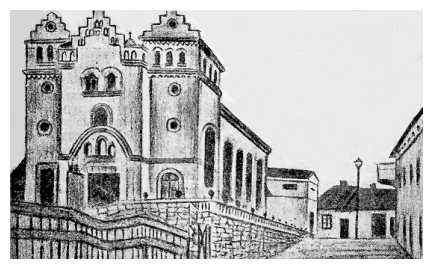
The synagogue was wooden in its first form; in 1881, it was taken apart and on the same spot, the present synagogue was erected of stone and brick.
In 1921, the synagogue was restored and the entrance through the barrier along the south wall was removed.
In 1925-26, the synagogue was painted and decorated by the artist-painters Moshe Apelbaum, Shmuel Cigler and the metal sculptor Chaim Chanft.
The painting and sculpture in the synagogue are on a high artistic level. This was determined by a series of artists and art critics who visited the synagogue.
Reproductions of the work is located in Jerusalem, in the Tel Aviv Museum, as well as in the Scientific Institute (YIVO [Yiddisher Visnshaftlekher Institut – Jewish Scientific Institute] in Vilna).
Among to the most respected Będzin Jews at the end of the 18th century were Hershl and Dovid Aronowicz, Yakov Lewkowicz, Meir Szpira, Hershl Rubin, Yakov Erlich, Yitzhak Gitler, Shimeon Landner, Leib Zendlowicz, Wolf and Dovid Brauner.
From the Responsa in Noda BiYehudah [Known in Judah by Rabbi Yehezkiel haLevi Landau[e] we learn that in 5535 (1775) there was a rabbi named Reb Meir in Będzin. From other sources, we learn that Reb Meir used the surname Urbach.
It is written in the Pinkes of the Khevre Kadishe that in 5525 (1725), this society elected Rabbi, Reb Moshe as chief gabbai. In the same Pinkes, Rabbi, Reb Tobya was the chief gabbai in 5543 (1783) and, in 5544-5556 [1784-1796], his son Reb. Dovid.
After Reb Dovid, Rabbi, Reb Moshe Hamburger, a brother-in-law of Rabbi, Reb Elimelekh of Lizhensk, was Będzin Rabbi over the course of 30 years.
|
|
|
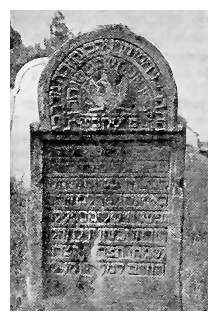
A headstone with a Polish eagle from the year 5603 (1843) |
In the pinkesim [pinkes – record of the Jewish community; pinkesim – plural] of the Khevre Tilim [Psalm Society], the Khevre Hitim [society for providing food for the needy] and the Khevre Kadishe [Burial Society] we find in the years 5567-5597 (1807-1835) the signature of the rabbi named Reb Menakhem Nakhum Rozanes, who later was the rabbi in Będzin.
At that time, the cemetery under the castle mountain was funded.[f]
We read about this in the pinkes of the Khevre Kadishe, that in 5591 (1831), a plot for a cemetery was purchased from the municipal residents for 300 gildn. In addition, they needed to pay 20 gildn a year for the plot.
Several headstones with Polish eagles are located on this cemetery. One version [says] the eagles on the headstones were made at the request of the Polish population because the deceased had earned them on behalf of the Polish uprisings in years 1831 and 1863.
[Page 17]
In the same pinkes is mentioned that in 1831 in Będzin over the course of
two weeks, more than 100 Jewish souls perished in a fire that reigned then, as
well as because of the uprising of that year.
After Reb Nakhum Rozanes, Reb Avraham Hirsh Rozanes was for a short time the rabbi in Będzin. For unknown reasons, this rabbi was persecuted by a number of the members of the middle class and was finally driven out of the city.
Later, Rabbi, Reb Berish Herciger was the Będzin rabbi. We find his signature in the pinkes of the Khevre Hachnosas Kallah [Society to Help Poor Brides], which was founded in 5602 (1842).
Rabbi Herciger died on the 25th of Sh'vat 5606 ([21] February 1846) and was buried at the cemetery under the castle mountain. An ohel [small structure containing a grave, usually of a prominent person] was erected over his grave.
In 5579 (1839), Reb Avrahamele Bornsztajn, the famous gaon [sage, scholar] and founder of the Sochaczewer dynasty, was born. He was a son of the Bialer Rabbi, Reb Zev Wolf and a son-in-law of the Kocker Rabbi, Reb Mendele. The Sochaczewer Rabbi's mother, Dobrisz, was the daughter of the local resident, Reb Mordekhai Hersh Erlich.
At the time of the Duchy of Warsaw (1807-1813), the Jews in Poland were limited in their political and citizen rights. The old Prussian law that forbid every Jew to marry without special permission from the regime remained in effect. A Jew who wanted to marry had to, according to the law mentioned, possess capital of a thousand thaler; he had to be 25-years old and the candidate for marriage was obligated to show that his father and grandfather were residents of his birth city.
When Poland went over to tsarist hands after the Congress of Vienna (1815), a law was issued in 1823 according to which no foreign traveling Jews were allowed to settle in Będzin without special permission from the central regime because the city was located in the 21 verst [66 miles/1.06 kilometers] border strip. Therefore, Jews had to settle in the area around Będzin that was further than 21 verst from the German or Austrian border.
Because of the severe law, at that time, the villages Sielce, Mondrzew, Łagisza, Goździków, Siewierz, Szczemieszyce, Sławków and so on belonged to the Będzin kehile. Będzin then numbered 2,440 Jews and 1,780 Christians.
The mentioned law was abolished by Tsar Alexander II.
In 1867, Będzin became a powiat [county] city which was awarded to Piotrków gubernia [county]; until then the city belonged to the Okluz Powiat and to the [text is missing].
The statistics for the year 1880 show that there were 5,424 residents in Będzin, 3,000 of them Jews.
Today, the residents in Będzin and its surroundings number approximately 50,000, of them circa 24,000 Jews.[g]
|
Rabbi, Reb Chaim Dovid Langfus. – The house of prayer. – The kehila
budget in 1854. – The Jewish communal tax in 1855. – The dozores in
1848. – The denunciation of the dozores. – A lawsuit against the
khevra kadishe. – The various candidates for the Będzin rabbinical
seat. – Reb Itshele Kimelman as Będzin rabbi. – The dozores of
that time. – The rapid development of Będzin and the number of Jews
in 1897. – The death of Reb Itshele Kimelman. – Reb Yisakhar Berish
Graubart is hired as the rabbi in Będzin. – The dozores of that time.
– Rabbi Graubart as a well-known rabbinical authority and communal
activist. – Reb Yisakhar Berish Graubart is delegated to the Petersburg
Rabbinical Conference. – The Będzin rabbi demands an education tax
for rabbis. – The intervention on the part of the Ger. –
Characteristics of Rabbi Graubart. – Reb Yisakhar Berish as a member of
various communal organizations. – The death of the rabbi. – The
rabbinical election of 1913. – The two candidates and the results of the
voting. – The Piotroków governor annuls the election. – The second
election and the third candidate. – Rabbi Jekutiel Zalman Graubart is
elected as Będzin rabbi.
|
In 1850, the Sieradz Rabbi, Reb Chaim Dovid Langfus was elected as the Będzin rabbi, for whom there was designated a yearly salary of 180 rubles in addition to a free apartment and other rabbinical income.
Rabbi Langfus occupied the Będzin rabbinical seat over the course of 14 years. He died on the 10th of December 1864 at the age of 60 and was buried at the cemetery under the castle mountain.
During the time of Rabbi Langfus, the new house of prayer was built (1859), which cost approximately 2,500 rubles.
The location where the house of prayer is located belonged to Wolf Feldman, who donated it to the kehile.
The previous house of prayer was much smaller than the one today and was located right next to the eastern wall of the wooden synagogue.
The entire kehile budget for 1854 reached 672 rubles. A part of the budget was covered by the income from the mikvah [ritual bath] and from other sources such as, for example, from house number 120 at the Jewish Street (Shul Street) that was registered by the Będzin butcher Hershl Chrzanowski on behalf of the kehile, Chrzanowski also made a gift of a Torah scroll to the synagogue on the condition that they would maintain his yahrzeit [anniversary of a death]. Middleclass members from the area provided for the remaining part of the budget.
The entire Jewish community tax for 1855 reached 495 rubles. There were then 374 registered taxpayers in Będzin, of whom only 29 members of the middle-class paid; the remainder were disqualified as being poor.
The following dozores [members of the Jewish communal council] were elected in Będzin in 1848: Ayzyk Bialer, Ahron Nunberg, Hershl Londner, Bendet Fiszl and Ovadia Szancer.
In 1856, a certain Leib Potak unexpectedly brought an accusation to the Radom governor that the dozores Hershl Londner, Bendet Fiszl and Ovadia Szancer were taking various monies for themselves.
[Page 18]
It led to an investigation that established that Leib Potak's accusation was
malevolent. Because of this, Potak was accused of responsibility for
evil-minded slander and false accusations.
This did not hinder Leib Potak in being elected as a dozores in 1859.
A very characteristic trial against the Khevre Kadishe [burial society] took place in Będzin in the years 1854-55.
The story is thus:
In August 1853 a Breslau Jew named Yakov Rajchman bathed in the Grziczow River and drowned. When the corpse was brought to Będzin, the Khevre Kadishe let it lay until it received 130 reichsthaler from the drowned man's son-in-law. Hendl Erlich took this money and the corpse was buried.
This infuriated the city and the entire Khevre Kadishe was denounced to the government and an investigation was made against the gabba'im [sextons] (1854). Hendl Erlich was strongly directed to pay the money, which reached 17 rubles, to the state treasury.
On January 28, 1855, the trial took place against the previously mentioned members of the “Chevra Kadisha” before a so-called “simple police court” in Alksch, and the members were acquitted due to lack of evidence.
The Radom governor ordered the Olkusz provincial chief to put Hendl Erlich into military confinement at his expense and said he should remain there until Erlich gave back the burial money.
The Będzin burmistrz [mayor], to whom the chief turned to carry out the order, did not rush with the confinement, wanting to wait for the result of the investigation that was carried out by two jurisdictions, by the administrative and court regimes.
On the 28th of January 1855, the trial against the above-mentioned gabba'im of the Khevre Kadishe took place in the so-called “Fundamental Police Court” in Oklusz and the gabba'im were freed because of a lack of evidence.
However, the governor did not take into account the verdict of the court and ordered that without fail Hendl Erlich should be ordered through a military [guard] to give back the burial money. He also made a severe accusation against the burmistrz for neglecting the prosecutions and made him responsible for the consequences.
In the meantime, Hendl Erlich died and the burmistrz quartered a military [guard] with his son, Dovid Erlich.
On 24 April 1856, Dovid Erlich turned to the Olkusz chief with a request to be freed from being quartered with the troops, presenting a document that the drowned Wenzl's son-in-law certified that with good will he had come to an agreement with Hendl Erlich about the 130 reichsthaler burial money.
In addition to this, Dovid Erlich provided a bill that he found after his father's death on which the expenses for the funeral and burial of the deceased Rajchman were listed. And as it showed in this document that his father had paid out all of the money that he had received from the deceased man's son-on-law for the needs of the deceased, the village chief prolonged the quartering until a clarification of the entire matter arrived.
In August 1856, the burmistrz gave the chief an answer that Hendl Erlich had the full right to use the burial money according to the judgment because Wenzl had permitted him to so in writing.
What more happened with the matter in the administrative regime is not known. The military confinement was probably withdrawn because of the amnesty for the coronation of Alexander II.
|
|
| The Great Synagogue in 1910 |
[Page 19]
After the death of Rabbi Langfus, the Będzin kehile was not inclined to
hire a new rabbi because it did not have the means to do so. The kehile asked
the government to permit it to substitute the deceased rabbi with the dayan
[religious judge], Reb Dovid Szlezinger, who was already the Będzin
moyre-hoyroe [one able to rule on matters of rabbinical law] since 1849.
However, the Radom governor in no way wanted to agree that the Dayan Szlezinger should become the rabbi and he urgently demanded that the Będzin kehile in a short time present a candidate for the Będzin rabbinical seat who had been in Będzin for a designated time.
In 1865, the Będzin kehile proposed as a candidate, the Szczekociny Rabbi, Reb Meir England, who had been living in Będzin for a certain time.
In the meantime, Rabbi England went back to Szczekonciny to conclude his private business and he died there.
The kehile then proposed as a candidate the Piotrków moyre-hoyroe, Reb Itshele Kimelman, who in 1866 took over the Będzin rabbinical seat with a 360-ruble salary in addition to a free residence and other income.
During the time of Reb Itshele, the dozores in Będzin were Eliezer Rinski, Mordekhai Plesner, Moshel Herman and Berish Sztatler.
Będzin then started to develop strongly thanks to the increased coal production and iron industry that brought about an abundance of income for all residents of the entire area. The population in Będzin increased greatly and reached circa 24,000 in 1897, of those 11,000 Jews, that is more than 45% of the general population.
Rabbi Kimelman died on the 30th of June 1893.
After Rabbi Itshele's death, the Rabbi, Reb Yehoshele Telner was a temporary replacement.
On the 2nd of September 1893, approximately 300 artisans who were then represented in the city, chose as rabbi the – since 1887 – Siedlcer Rabbi, Reb Yisakhar Berish Graubart.
The kehile committed to pay the rabbi a yearly salary of 1,500 rubles, in addition to this, 800 rubles for moving from Siedlce to Będzin and 400 rubles for a rabbi in Sosnowiec, which was then considered a village and belonged to the Będzin provinces. In December 1893, Rabbi Yisakhar Berish Graubart took over the Będzin rabbinical seat.
The dozores during the time of Rabbi Graubart were the following: Berish Sztatler, Ruwin Liwer, Yehosha Leib Wajngart, Avrahamele Tropauer and Yeshaya Rotner.
Rabbi Graubart was included among the most esteemed rabbis in Poland. His name was known far outside the border of the country. He was known in the rabbinical world as a sage and proficient; rabbis in the country and abroad turned to him with questions. A large number of his answers were published in a separate book: She'elot u-Teshuvot [questions and answers] Divre Yisakhar [collection of responsa by Rabbi Graubart].
Rabbi Graubart also showed great agility and insight with communal questions. We encounter his name with almost every community leader meeting or rabbinical meeting. Very often, the meetings took place at his initiative and under his chairmanship (Piotrków 1909, Warsaw 1910 and so on.) At the Petersburg conference, which the tsarist premier and oppressor of the Jews, [Pyotr] Stolypin, called together in 1910, ostensibly to reform Jewish life, Rabbi Graubart – as one of 15 delegates from all of Poland – took an active part. He also was chairman of various commissions. His worldly view and position towards the matters considered there is interesting. For example, Rabbi Graubart particularly interceded because the rabbis would have to have a certain record of education, although from various sides, including the Gerer, they tried to prevail with the rabbi, telegraphing him in Petersburg that he should vote against it. However, Reb Yisakhar Berish was motivated in his position that it is disrespectful for a rabbi to come to a translator when he needed to defend the religion or the people.
Rabbi Graubart was, despite being a rabbinical authority, absolutely not a fanatic. He was a man with a strong intelligence and, simultaneously, a man with an impressive external appearance. Because he also was an affable person, he had great popularity both among Jews and Christians, who very often came to him about legal matters.
In our city, the rabbi was one of the first co-founders of various philanthropic and religious institutions such as the Linas HaKholim [assistance for the poor], Linas Hatzedek [hospitality for strangers], Malbish Arumim [Society to Provide Clothing for the Poor], Khevre Eruvin [society managing the supervision of the eruv – a symbolic enclosure allowing observant Jews to carry objects outside on the Sabbath] and so on.
Rabbi Graubart died in Breslau on the 12th of December 1913. He was buried in Będzin and an ohel [small structure containing a grave, usually of a prominent person] was erected over his grave.
On the 30th of December 1913, voting for the rabbinate took place. Two candidates figured in [the voting]: Reb Yekutial Zalman Graubart, a son of the deceased Będzin Rabbi, Reb Yisakhar Berish, and the Wyszogród Rabbi Bornsztajn, who was supported by the Sochatchower Hasidim.
Of the 1,062 voters, 707 voted. Of these votes, Rabbi Graubart received 478 and Rabbi Bornsztajn 229. Thus Reb Yekutial Zalman, with a large majority of the votes, was elected as the Będzin rabbi.
Because of a protest by the opposition that the newly-elected rabbi was not yet old enough, the Piotrków governor annulled the election and designated a new one on the 20th of June 1914.
At the second election, the Modrzew Rabbi Englard was a candidate in addition to the Wyszogród Rabbi and Rabbi Graubart.
As a result, Rabbi, Reb Yekutial Zalman Graubart again received a large majority and was designated as the Będzin rabbi.
Rabbi Graubart occupied the Będzin rabbinical seat until September 1920. Later, he moved to America and today he is a rabbi in Brooklyn.[h]
[Page 20]
1. Zionists
|
The first Zionists and their activity. – The first premises of the
Zionists. – Zionists found the “German Synagogue.” – The
number of Colonial Bank shares that were sold then in Będzin. – The
young Zionists and their activity. – Zionist literature is smuggled from
Germany to Russia. – The first Hovevei Zion conference in Katowice. –
The 25th anniversary conference.
|
Belonging to the first Zionists in our city were: Sh. Wdowinski, Yakov Sztatler, Wolf Ber Fiszel, J. Godlfeld, Wilbuszewicz, Shlomoh Frenkl, Yawec and Berish Kahan.
No legal Zionist organization existed during tsarist times. All of the activity mainly consisted of collecting money for the National Fund and for the Odesa Committee. In addition to the Zionists mentioned, also active in this activity were the Mizrakhists Berish Preger, Sholem Klajner and Yeshaya Khendl Erlich.
During the last years before the [First] World War, the work of the Odesa Committee was carried out by A.K. Liwer, Avraham Liwer and Nuta Londner.
The first premises for the Zionists (actually for Mizrakhists) was located in Kalman Langer's house at the new market (today Gutman house). There also was a minyon [10 men necessary for prayer] for praying there, named Hakneset Orkhim [welcoming guests]. Later, a separate minyon was created of religious Zionists who were concentrated at the Kheder Metuken [Reformed School] of Yitzhak Fink, in Nakhum Cukerman's house.
The so-called Deitche Shul [German school or synagogue] was founded by the Zionists in which there also was a library. Various lectures, mainly by Berish Preger, were given there.
In 1898, 700 shares of the Colonial Bank were sold in Będzin for the sum of 7,000 rubles.
The young Zionists, to whom belonged Meir Swarc, Elimelekh Ratner, A.K. Liwer, Tevl Klajnman, Avraham Liwer, A.M. Watnberg, Bertshe Janowski, Avraham Ptasznik, Yehezkal Lasker, Yehuda Szniur, Mordekhai Wajnrib, Itshe Ber Kokotek, Moshe Preger and Nuta Lander, excelled with great activities.
Besides Zionist activities, the young people also carried on cultural work in the form of lectures on Tanakh [Torah, Prophets and Writings] themes which took place every Shabbos [Sabbath] at the Mizrakhi premises.
Yeshaya Wdowinski, Wrancberg and others were among the lecturers.
Courses for the Yiddish and Poland languages were also created. Meir Szwarc taught Yiddish and Karol Trapauer, Polish.
Since before the [First] World War, the Zionist activity in Russia was made very difficult, a problem arose about how to provide the Russian Central Committee with Zionist literature, which was then printed in Germany.
According to the instructions of the Zionist leaders, Janowski (Petersburg) and Goldberg (Vilna) held consultations in Katowice among the Zionists there; Dr. Wajsman and Arnold Wajner with the Zagłębie Zionist
|
|
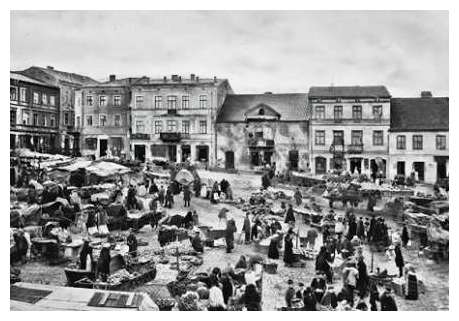
| The old market 75 years ago |
[Page 21]
leaders: Yisroel Moshe Wajnrib, Berish Tencer (Sosnowiec), A.K. Liwer and Tevl
Klajnman (Będzin). It was decided that Klajnman should establish contact
with the smuggler who should for a designated price provide the literature to
Będzin. A.K. Liwer's task was to take care of the transports to Russia
according to the specified addresses from Cologne.
The Zionist literature was sent through the office of the Jewish National Fund in Cologne to the address of the Katowice Zionist activist, Lawyer Dr. Wajsman (today he lives in Bytom)[i] and from there the transport was smuggled to Będzin.
In such a manner, thousands of packets of Zionist literature were sent out to Russia over the course of two years from the Ząbkowice post, through the intermediary of A.K. Liwer.
Later, when the work became very complicated, the National Fund Central [Office] in Cologne itself made the postal packets, addressed them and, as the sender, [the National Fund Central] gave them to A.K. Liwer.
In 1914, a transport of such ready-made packets was uncovered at the border in Czeladź, As A.K. Liwer figured as the sender on the packets, the Russian gendarmerie began to search for Liwer, who meanwhile was in hiding. Because a short time after this event the [First] World War broke out, it did not come to a trial.
The first Hovevei Zion [Lovers of Zion] conference took place in Katowice on the 18th of Khesvan 5645 (November 1884).
On the 28th of Khesvan 5670 (November 1909) the 25th anniversary conference took place in Katowice at which delegates from Zagłębie also took part.
|
The first religious Zionists and their activity. – The Mizrakhi leader,
Rabbi Nissenbaum comes to Będzin in 1889. – His impact. – Rabbi
Nissenbaum and Berish Prager ask Rabbi, Reb Yisakhar Graubart for permission to
give a sermon. – The Mizrakhi activists at that time.
|
Religious Zionists existed in Będzin in 1898 but, first in 1908, they were grouped in their own premises.
The Mizrakhists carried out cultural activity in the form of Shiuri Talmud [Talmudic lessons]. In addition to this, they carried out conspiratorial Zionist-Mizrakhi work.
In his work, Ale Heldi [Pages of My World], the well-known Mizrakhi activist, Rabbi Yitzhak Nissenbaum, wrote that when he came to Będzin in the winter of 1899, waiting for him at the train station was a Jew, aged 41, dressed in long clothing, in a Jewish cap and shiny boots who introduced himself as Berish Preger. The author further writes that when he ate at Reb Berish Preger's [house], he noticed that his wife and daughter were not sitting together with the men, but in a separate room. Berish Preger questioned how a rabbi, a scholar, permitted himself to pray without a gartl [cloth belt worn by pious men].
|
|
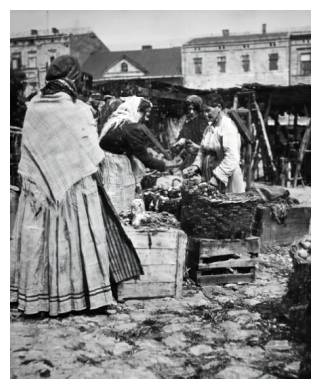
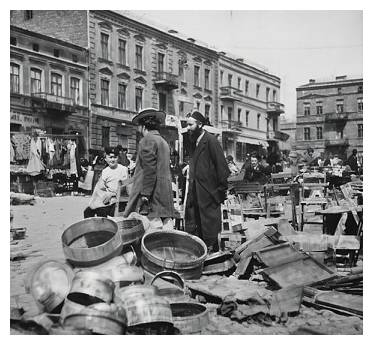
| The trade at the old market 75 years ago |
According to what Rabbi Nissenbaum writes, for the first time in life, he found himself in the environment of pure Polish Jews and all of this that he saw and heard was for him – a Russian Jew – absolutely new.
Rabbi Nissenbaum and Berish Preger also went to Rabbi Reb, Yisakhar Berish Graubart for permission to give a sermon. Rabbi Nisenbaum writes that Rabbi Graubart was a hidden [follower of] Hovevei Zion and he willingly gave him permission.
Among the esteemed Mizrakhi activists were Berish Preger, Yeshaya Hendl Erlich, Beniamin Yitzhak Szpiro, Sholem Klajner, Leibush Dimant, Iser Hirszon, Yakov Najmark, Yehiel Naperszek and Shlomo Rapaport.
|
The P.Z. organization in 1905 and its activity. – The Będzin delegate
to the P.Z. Conference in Warsaw. – The delegate Y. L. Fajner put 300
rubles at the disposal [of Poalei Zion] for the creation of a P.Z. publication.
– Fajner “specializes” in smuggling socialist activists abroad.
– The gathering of the Będzin executive committee. – The arrest
of Hershl Sztatler. – The first active P.Z. worker. – The first
Będzin group that traveled to Eretz Yisroel in 1906.
|
In the beginning of 1905, we find a Poalei-Zion [P.Z. – Marxist-Zionists] organization in Będzin that counted a large number of members. The P.Z. was very active during the October Revolution of that year; they issued various calls and demonstrated under their own flag.
As delegate to the P.Z. conference, which took place
[Page 22]
in December 1905 in Warsaw, Yehuda Leib Fajner was elected very clandestinely.
Będzin delegates gave a report from the P.Z. group there. It was shown that in addition to animated activities carried out by the group, it also was the strongest financially in the country. While the treasuries of other organizations were mainly empty or possessed minimal sums, the Będzin organization had at its disposal a sum of 300 rubles. This sum was placed at the disposal of a fund to create a P.Z. publication.
Fajner also “specialized” in smuggling abroad Socialist activists who were persecuted by the tsarist regime. So, for example, in 1907, he smuggled the following P.Z. leaders: Ber Borochov and his wife, Ben Tzwi Jarblum, the wife of Yitzhak Tabenkin and [Alexander] Chashin. In addition to this, a group of activists from other socialist groupings.
The executive committee of the P.Z. organization consisted of the following three members: Y.L. Fajner, Tevl Klajnman and Hershl Sztatler. The latter, before carrying on revolutionary activity, organized strikes and spread illegal literature; [he was] arrested in October 1907 and imprisoned in Sosnowice police custody.
According to an order from the tsarist Internal Ministry, Sztatler was sentenced to a three-year banishment to the Arkangelsk gubernia [province]. The punishment was later changed to leaving the borders of Russia.
To the first active P.Z. workers we must also add the following people: Henrikh Wolf, Manasha Hamburger (was arrested for 16 months for political activity), Meir Nusan Klajnman, Chaim Perec, Moshe Wajsler, Shimkha Lustik, Moshe and Mordekhai Sztajnfeld, Miss Kurland, Meir Cimberknop, Avraham Miechower, Ahron Szwajcer, Bela Szajntal, Sura Leah Blat, Karol Sztatler (then still a young student), the Hampel siblings and the Sznajderman siblings.
The first group of Będziners who traveled to Eretz Yisroel in 1906 consisted of Eliezar Hampel, Moshe Sztajnfeld, the Hampel sisters, Arye Szwajcer, Yosef Kaluczinski, the brothers, Shlomo and Dov Sznajderman, and Meir Nusan Klajnman.
|
The S.S. creates a professional union. – The most respected S.S.
activists. – Walter Szalc recruits members for the S.D. among the Jewish
youth. – The active S.D. workers. – Members of the Bund carry out
energetic revolutionary activity. – A Jewish self-defense. – The
struggle with the brawlers. – The berzes [exchange]. – The
assassination of Jakubik. – The killing in the Ger shtibl [one-room
synagogue].
|
The S.S. also carried out strong activity in Będzin then. Thanks to them, a professional union was created of trade employees, painters and wagon drivers.
Among the most esteemed S.S. activists were Meir Szwarc, Moshe Merkin (from Sosnowice), Alter Tenenbaum, Yakov and Chaiml Sztatler, Adele Erlich, Maks Aronowicz, Herman Sztrachlic, Meir Potasz, Cesha Zmigrod, Roman Nunberg, Regina Preger and Yisroel Dovid Szajer (the latter was exiled to Astrakhan for three years).
A strong group also educated the Social Democrats. The first, who recruited members among the Jewish young people for the S.D., was Walter Szolc.
Belonging to the active S.D. workers were: Engineer Henrikh Majteles, Manya Szerling, Dentist Maleva, Ph.d. Samek Wajnciher, Irena Fride, Adele Mandlkorn, Motl Tenenbaum, Moshe Fuksbrauner, Bela Sukenik, Leibl Oronow and Moshe Frochcwajg.
The Bund, as an organization, did not exist then in Będzin. However, it was present in individual Bundists who carried out animated revolutionary activity. They were organizing strikes and spreading illegal literature.
The Jewish Socialist parties carried out strong anti-pogrom agitation and also organized self-defense. In the most dangerous moments, armed young people stood on guard and protected the Jewish population from hooligan assaults. They also led a fight and eradicated the so-called voyle yungen [tough youths] who terrorized the Jewish population and, particularly, the Jewish artisans from outside who came to Będzin to work. The poor workers had to pay a “duty” to the mentioned loafers; otherwise, the artisans could not be sure of their lives.
The so-called berzes [“exchanges” for ideas] existed in Będzin in 1905-1906. These were certain locations in the city where the young strolled and where party activists recruited new members. This was done because there was always danger in a meeting place of being discovered by a tsarist spy. The berzes were mainly active on the Shabbos [Sabbath] evening. Discussions were carried out and revolutionary literature was spread.
Among the tsarist police in Będzin, the older policeman Jakubik, against whom an assassination attempt had been made, excelled in his brutality in relation to the revolutionary young.
The unfolding of events of the assassination attempt happened thus:
On a Shabbos day in August 1906, at around 10 o'clock in the morning, the city suddenly shuddered from a frightening bang. It was learned later that this was from a bomb that was thrown on Sławkower Street (today Kołłątaja) at the above-mentioned policeman.
The assassination attempt was carried out by the members of the terrorist group of the P.P.S. (Polish Socialist Party), which had sentenced Jakubik to death.
A terrible turmoil arose right after the bomb was thrown and the people who were in the street quickly hurried to their homes.
[Page 23]
|
|||
| The trade at the new market 25 years ago | |||
|
|||
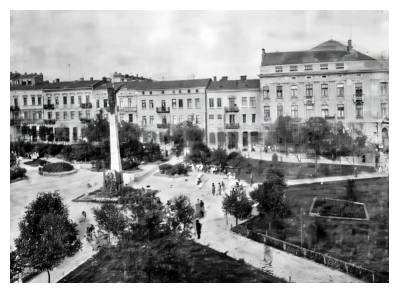
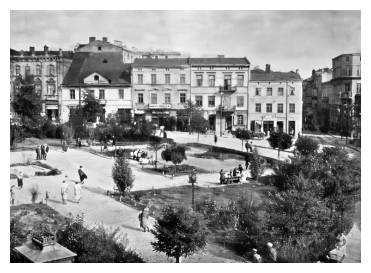
| The new market (3rd of May Square) in 1937 | |||
|
|||
| The old market in 1937 |
[Page 24]
After a short time, a squadron (100) of Cossacks appeared in the city who shot
at everyone who they met on the road. Approximately seven Jewish souls
perished, among them women and children.
In the winter of 1907, various Jewish socialist groupings arranged a discussion in the Gerer shtibl [small, one-room synagogue]. The tsarist police suddenly attacked the meeting because of a provocation and shot at everyone. Several Jewish young people perished as a result of the shooting.
|
The tsarist government begins an offensive against the revolutionary movement.
– A mass emigration, as a consequence of the repressions. – The
crisis of the Jewish socialist parties. – The emigration from
Zagłębie. – The Yiddishist movement among the democratic
intelligentsia.
|
After the stormy October events, the tsarist government, which had recovered from the blow that it received, went on the offensive and took revenge with cruel repressions against those taking part in the revolutionary movement. A series of arrests, persecutions, banishments and sadistic tortures began. In the name of Tsar Batuishka [Father Tsar], the wild Black Hundreds [ultra-nationalist, antisemitic, monarchist groups] began to arrange pogrom rampages across the entire Tkhum haMoyshev [Pale of Settlement].[k]
Emigration increased parallel with the strengthening of the reaction. A strong emigration from Zagłębie and from Będzin, in particular, went to various countries; however, mainly to America, so that today, many well-organized Zagłębie landsmanshaftn [organizations of people from the same towns] are found in many countries, which count thousands of members.
After the catastrophe of the Revolution of 1905, the Jewish socialist parties, thanks to the police repressions, the emigration and the withdrawal of the intelligentsia, which had earlier taken an active role in the movement, experienced a severe crisis.
The cultural movement, the so-called Yiddishism [linguistic and cultural movement promoting the use of the Yiddish language], which found many followers among the working intelligentsia, became very popular in Jewish life during the years of the reaction.
The earlier party activists and the young in Będzin grouped around the music and singing union, HaZamir, which stood on a very high cultural level.
A revival of the Jewish workers movement was seen in 1913 that, however, again fell into a depression at the beginning of the [First] World War.
1. The Citizens Committee
|
The founding of a Jewish truth committee. – Jewish representatives are
invited in the morning. – The composition of Jewish representatives.
– The work division in the reorganized committee. – The leaders of
the separate committees. – The short existence of the committees. –
The Polish-Jewish food supply committee. – The education of two
sub-committees. – The Jews become abused and create their own committee.
The existence of the Jewish food supply committee. – A characteristic
fact. – Dr. Wajnciher at the head of social protection. – The
composition of the food supply committee.
|
On the first day of August 1914, just as the Russians left Będzin, a group of citizens headed by the Endekes [Polish antisemitic nationalist party], without the participation of the Jews, gathered at the city hall and created the so-called “Citizens Committee of the City of Będzin.” They cultivated the municipal regime and created a citizens' militia. At the head of the institution mentioned stood the Endeke Noblin.
On the second day, after the rise of the Jew-free Citizens Committee, its members realized that it was impossible to run the municipal economy without the participation of the Jews. Consequently, the committee was forced to turn to Jewish society to send representatives to the committee.
The Jewish representation had the following composition: Dr. Wajnciher, Lawyer Rider, Gustav Wajnciher, Yeshaya Rotner and so on.
The reorganized committee allocated the work among themselves in such a manner that several members were involved with public security, creating a citizen militia; another group was employed with the food supply of the city and there also was created the so-called “Citizens Committee for Administrative Matters of the City.”
These particular committees immediately began their work. Noblin was at the head of public safety. Dr. Wajnciher was involved with social protection, Gustav Wajnciher with the food supply.
The existence of the mentioned committee was relatively short. In addition to the committees of social support and food supply, the functions of the remaining committees were taken over by the German occupation regime. The reason for this we have to seek in the fact that the occupiers cared very little about the food supply and social support of the civilian population in the occupied areas.
At the beginning, the food supply committee was a joint one and representatives from both the Jewish and the Polish population took part in it.
However, it immediately showed that even with the application of maximum frugality according to a system of cards, the food supply would last for six weeks at most.
At the request of the Christian representative, two sub-committees were created – a Jewish one and a Christian one
[Page 25]
and the food was distributed in equal portions for both committees.
The distribution, however, was not fair because the Christian population, which only consisted of a third of the city residents, received just as many products as the Jews who were up to two-thirds of the general population.
This fact forced the Jewish sub-committee to detach itself from the general [committee] and to create for itself its own organization that would provide for an appropriate food supply for the Jewish population in Będzin. This happened three months later after the rise of the general committee.
The Jewish food supply committee existed for seven years, from 1914 to 1921.
It is worth mentioning the following characteristic case:
In Autumn 1916, when there was a lack of potatoes for the Christian committee and their members were threatened with hunger, the Jewish committee placed their supply at the disposition of the entire Będzin population. It was announced by the Poles that every citizen, without regard to religion, would, after providing an official list of their family members, receive the appropriate number of potatoes.
At the head of social protection, which was concentrated with the Jewish charitable institutions, stood Dr. Wajnciher.
The charitable institution also gave out free portions of food for the poor. The society maintained constant contact with the Jewish food supply committee.
The food supply committee consisted of the following members: Gustav Wajnciher (chairman), Avraham Liwer, Yehiel Wolf Kowalski, L. Rubinlicht, Engineer Kh. Majteles, L. Nowogrudzki, Shlomo Frenkl and Zigmunt Inwald.
|
The Dozór Bóźniczy [supervisory board of a synagogue] during
the Russian times. – The occupiers begin to be interested in the kehilus
[plural of kehile]. – A group of village [Jewish] communities are
allocated to Będzin. – The occupation regime nominates a kehile
managing committee. – A normal and special budget. – The kehile
election of 1918. – The kehile secretary, Pesakhzon, carries on a struggle
against the special tax. – Pesakhzon brings order to the announcements.
– The founding of the new cemetery on Czeladzka Road.
|
Until the [First] World War, a Dozór Bóźniczy existed according to Russian laws. The city hall took care of the kehile treasury and the books.
At the moment of the outbreak of the war, everything stopped. This standstill lasted until June 1916, when the German occupation force began to take an interest in the kehilus. At that time, the civil managing committee in Warsaw worked out the so-called “Beseler Statute” for the kehilus.[12]
Named for General [Hans Hartwig von] Beseler who was the general governor in Warsaw during the German occupation.
Allocated to Będzin were: Czeladź, Siewierz and an entire group of village communities as well as half of Ząbkowice, Dąbrowa and the other half of Ząbkowice fell from Będzin because it belonged to the Austrian occupation area.
The kehile managing committee that was nominated by the occupation regime consisted of the following people: Paltiel Unger, Yehiel Wolf Kawalski, Chaim Dovid Rozenblum and Dodl Sercacz. The latter, because of his great age, resigned from his office and, in time, Jakov Gutman was designated in his place.
In order to bring order to the finances, the county office decided to create, in addition to the usual budget, also a special budget to cover the expenses of maintaining the Jewish sick who, according to an old Russian law it was an obligation of the kehile to take care.
It must be mentioned that the city hall treasury paid for the Christian sick.
The special budget reached 10,000 marks, which at the time was a very large sum.
In 1918, kehile elections were designated according to the Bezeler Statute which, however, was later annulled by the supervisory regime.
Thus, until the new election according to the Polish Statute, the previously nominated dozores served, or their representatives.
When Yitzhak Pesakhzon took over the office of secretary of the Będzin kehile in 1917, he began an energetic fight against the illegal “special tax” to heal the Jewish sick. The matter was transferred to the civil managing committee in Warsaw and after a long lawsuit, the Będzin kehile was freed from the scandalous tax.
In 1921, the [metrical] books were taken from the rabbinate and were moved to the kehile.
Thanks to Secretary Pesakhzon, order was brought to the [records]. Until then, Jewish names were entered in a mocking manner and incorrectly written. For example, they wrote Icek instead of Yitzhak, Moszek instead of Moshe and so on. Now, this was all improved.
The procedure to register births and weddings and registering cases of death was made easier. A minimal payment was designated and the poor were mainly freed of making the payment]. These changes created an opportunity to record everyone without regard to position.
Thanks to the effort of Dozore Chaim Dovid Rozenblum, the new cemetery on the Czeladź road was founded at that time and a firm, fixed tax on kosher meat was designated for the cemetery lot according to a particular division.
|
JewishGen, Inc. makes no representations regarding the accuracy of
the translation. The reader may wish to refer to the original material
for verification.
JewishGen is not responsible for inaccuracies or omissions in the original work and cannot rewrite or edit the text to correct inaccuracies and/or omissions.
Our mission is to produce a translation of the original work and we cannot verify the accuracy of statements or alter facts cited.
 Będzin, Poland
 Yizkor Book Project
 JewishGen Home Page
Copyright © 1999-2026 by JewishGen, Inc.
Updated 04 Oct 2026 by OR