 |
|
|
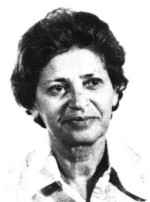
by Fania Lanir
Translated by Jerrold Landau
|
|
I was the youngest of the six children in the Golubti family. My father, Leibush Golubti, was a wealthy grain merchant and a functionary in the Jewish community. A traditional, nationalist atmosphere prevailed in the house. Only two members of the household joined active Zionism: my oldest brother Ben Tzion of blessed memory, and I, the youngest. My brother was active in Tzeirei Tzion [Young Zion], and I joined the Hamaccabi Hatzair chapter in 1920. The movement was parallel to Hashomer Hatzair. The prime mover was a youth named Marenfeld who parted ways with Hashomer Hatzair because he did not accept the single-minded pioneering ethos of that movement.
The ideas that directed Marenfeld were general education, personal development, and support of the Zionist idea. The activities were conducted in Hebrew, and most of the members were graduates of the Hebrew gymnasium [high school]. There was no connection between this movement and the Maccabi sports organization.
The movement disbanded after a year and a half of existence, and the members all went their own ways. After some time, one of them became famous – Leonia Oigenstein, who later became one of the elders of the Romanian Communist Party. He changed his name to Leonte Răutu (apparently after the Răut, the muddy river near the city of Beltz)[1].
I was the only one of the members of Maccabi Hatzair who ended up in Hashomer Hatzair. It was not long before I was swept along with the stream of those going out to pioneering hachshara in the farms of old Romania.
I recall that my father, having no choice, made peace with my brazen step, but my mother took issue with her refined, youngest daughter who went out to work in the field like the daughters of farmers. One of my brothers calmed her with the following words, “In any case, Fania will not persevere with this. After the first harvest weighs on her shoulders, she will return home to the bosom of Mother.”
His prophecy was not fulfilled. I worked in hachshara like all the young women and men – in the vineyard and the field, as was demanded of us.
In the meantime, news reached us from Beltz that one of the alumni of the chapter had decided to transfer his pioneering hachshara to Holland. This was Yitzchak Lerner (Lanir) who heard about the Organization for Hachshara of Chalutzim in that country. He did not deliberate for long. He arose and went there. He worked with one of the farmers, and even lived in his house. At night, he studied in an agricultural school. Moshe Nagirner (Nahir) followed after him. I too was swept up in that spirit. I left my hachshara site and also went to Holland. I was one of four girls from all of Europe who was accepted on probation for several months in order to determine if girls were able to withstand that assignment. The fourth person who followed that path to Holland was Yaakov Levin, who was also an alumnus of the chapter. We were eighteen or nineteen years old at that time, when we went to an unknown land. Nevertheless, we withstood the test beyond anything anyone imagined, especially due to the connection with home that continued. Three of the four of us joined a Hashomer Hatzair kibbutz in the Land, at Magdiel – currently [at] Shaar Ha'amakim.
[Page 319]
The three of us continued to work in agriculture. Yitzchak Lanir even worked for many years in the agricultural office, in the land-protection branch. He continues in his position to this day. Moshe Nahir was a field worker and fisherman in the kibbutz. He later became a manager in the agricultural section in the district council of Zvulun.
I, the writer of these lines, worked for long years as a vegetable grower, and I directed the childhood education sector. This was my path out of Beltz, through the farms of Holland, to the fields of Shaar Ha'amakim.
Translator's footnote:
|
|
JewishGen, Inc. makes no representations regarding the accuracy of
the translation. The reader may wish to refer to the original material
for verification.
JewishGen is not responsible for inaccuracies or omissions in the original work and cannot rewrite or edit the text to correct inaccuracies and/or omissions.
Our mission is to produce a translation of the original work and we cannot verify the accuracy of statements or alter facts cited.
 Bălţi, Moldova
 Yizkor Book Project
 JewishGen Home Page
Copyright © 1999-2026 by JewishGen, Inc.
Updated 10 Mar 2026 by LA