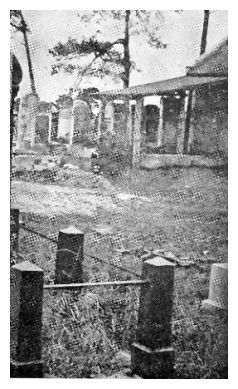
of the Rebbes of the Radomsko dynasty in the cemetery
|
[Page 104]
by Shlomo Krakovski
Translated by Sara Mages
A long, one-story building, which occupied a large part of Jerudliana Street
(in Yiddish: Stok Gesl – Stock alleyways), was the rabbi's Beit Midrash.
It contained three halls, one larger than the other. The large hall, which was
several dozen meters long, was used for prayer, especially on the Shabbat and
holidays, and only during the summer. In the winter it was almost closed, and
no one entered it because of the extreme cold that prevailed there. Because of
its size it was very difficult to heat it. The other two halls, which were
smaller, were mainly dedicated to Torah study and also to prayer.
In the days when the Old Beit Midrash of Tiferet Shlomo zt”l was in good condition it served as the main Beit Midrash in the city. Every morning and evening several minyanim prayed there, one after the other, and yeshiva students studied there during the rest of the day. But, over the years, when it became necessary to demolish it due to its age, they built the New Synagogue. The Old Synagogue was turned into Beit Midrash – Koppel's Beit Midrash – and then the worshippers moved to the New Beit Midrash. The young men, the students, were divided into two parts. The majority moved to the Rabbi's Beit Midrash, while a small part moved to Koppel's Beit Midrash.
If my memory serves me correctly, about a hundred young men from the city and a small number from other cities, those called Ochelei Yamim[1], studied in both Batei Midrash. Besides the young men a certain number of “sons-in-laws,” who were supported by their father-in-law, always studied in Beit HaMidrash. In addition to them, there were also several elderly Jews, the rabbi's Hasidim from other cities, who were left without family and a home, and their sons could not support them due to their poverty. These Jews used to come to the rabbi in Radomsk around the month of Elul. The most agile of them came to Beit HaMidrash before Tisha B'Av and, as usual, stayed to find shelter with the rabbi until after Chanukah. Then, they left the city for a few weeks and went on a tour of the country's cities to grant the Radomsker Hasidim with the mitzvah of Hachnasat Orchim[2] and sometimes also the mitzvah of Hachnasat kallah[3]. For Passover they returned “home,” that is, to Beit HaMidrash in Radomsk and remained there again until after the holiday of Shavuot.
One of these Jews was Reb Yakov Dovid Najszteter z”l. I find it my duty to mention him here, even if only briefly, because he was my teacher. When I moved from the cheder of R' Hirsh Yosef z”l to Beit HaMidrash, I studied under him for a whole year. Besides the fact that this Jew was a passionate Hasid, devoted to his rabbi with his heart and soul and believing in him with complete faith, he was also an outstanding scholar well-versed in the Six Orders of the Mishnah and Poskim. But his poverty outweighed both his piety and his erudition many times over. His apartment was a tiny room, a very narrow space in Beit HaMidrash building next to the courtyard. About eighty percent of the small room was taken by a giant stove which was closed all year round. It was opened only once a year, the day after the Shabbat before Passover for the baking of Matzah Shmura[4] for the rabbi and a few of his close associates who came especially to Radomsk to participate in this mitzvah and to be rewarded with a few matzot for the Seder…
In the remaining area of the room were: a “sleep bench,” a small
table and a broken chair. That was all the furniture in the room. What did he
live on? Truthfully, he only lived on the Sabbath, when he ate at the rabbi's
table with the rest of the “residents.” On Sunday, and also on the
gentiles' holidays, when my father z”l stayed at home (he was in the
forest all week long), he always invited him after Mincha and Maariv prayers
for dinner which, in those days, was the main meal. The rest of the week he
lived and supported himself on two rubles a month – the tuition from me and
from a friend of mine, and from a few kopecks a week that the Hasidim from
other cities left for him when they came to the rabbi for the Sabbath…
Besides him, there were always several other Jews like him who wandered around
Beit HaMidrash in Radomsk: R' Binyamin-Levi from Sosnowiec, R' Binyamin who
lead the prayers
[Page 105]
on the Sabbath in the rabbi's minyan. R' Yakov-Dovid of Wolborz a
bitter and sullen Jew who always grumbled about
“a nation or to a man, alike” [Job 34:29]. “Crazy Meir'l”
whose imagination was always full of hallucinations on Guta Reichtman, Leizer
Reichtman's widow, who was supposedly his fiancée, and, in a few weeks,
he will marry her in accordance with Jewish law. And so on and so forth. All
were poor and hungry, especially for bread. And if no one from Beit HaMidrash
invited them for a meal, only dry bread with onions and a cup of
“tea” they bought from the “lame” barber, was their daily
food… Berish the lame was one of the teachers in the city, and due to his old
age and illness he could not continue teaching. He opened a so-called
“cafe” in Beit HaMidrash, in other words, he had a large samovar that
boiled all day and some biscuits that he sold to students and from that he
“earned a living”… Another Jew, Feibish Nosek,” sold apples to
the students, but only rotten, there was never a fresh and whole apple in his
basket…
But, if these Jews lacked food to satisfy their hunger, they never felt a lack of spiritual food. All the days they sat and studied, a Gemara page with commentaries, a chapter from the Mishnah or Ein Yaakov[5]. Between chapter to chapter they “enjoyed” stories about Hasidim and tzadikim[6], sometimes to the point of forgetting the “existing reality”…
Apart from them were several elderly men who spent all their days in Beit HaMidrash. They prayed, studied, and participated in conversations about rabbis, about the righteous of the world and about their miracles and wonders.
I will mention several of them: Tuvia the gabbai, Yosel Zinger, Avraham-Leib (father of the well-known Koppel), all three served Tiferet Shlomo zt”l. The elderly Yitzhak-Fibel, great grandfather of Ben-Zion Grosman. “Nabiala,” whose pockets were always full of miracles and wonders about tzadikim. He always argued with his friends about the wording, claiming that his wording was correct and strongly rejecting the wordings of the others. Fischel Khaper, a poor and destitute Jew but with an incomparably sharp mind, and more and more.
And I will also mention here several young men my age who were closer to me: Yankel Sofer (Leib Fishel's, Hatomi's father), one of the most outstanding young men who were in Beit HaMidrash at that time. Yitzhak Gnendel, son of Meir the milkman. On the other hand, Meir's wife ,Gnendel, was a woman of valor whose name rose to fame throughout Shul-Gasse [Synagogue Street], and more than her name – her mouth was “sweeter than honey.” She used to severely criticize, while distributing milk to her customers, all the students of the Beit HaMidrash not exactly in a positive way except, of course, her son. Although her son was among the most outstanding students in Beit HaMidrash, he knew nothing other than the Gemara, and he was in terms of “like father like son.” He sat all day and studied while chewing on a piece of rope, or a piece of paper, and was not interested in anything. Gershon, son of the rabbi (uncle of Tzvi Meir Rabinowicz) was a very talented young man, excelled in his quick grasp and even more in his perseverance. Avraham Tyl (my cousin) was as diligent as Gershon. However, while it was possible to discuss other matters such as Hibat Zion, general politics and current affairs with Gershon, my cousin found no interest in anything outside of the Gemara. This young man was a strange and unique character. Entire weeks could go by without him opening his mouth. If you asked him a question, he answered correctly, if you did not ask him, he did not open his mouth. On his own initiative, he did not say a word, entered, kissed the mezuzah, went to the bookcase, took out the Gemara, and began to sway. The time had come to stop, he closed the Gemara, put it back in its place, kissed the mezuzah and left…
Meir Dovid (I don't remember his surname) was the brother of Herschel the crazy (the violinist). Moshe Luria, son of Yoske Lorye, already belonged to the maskilim [enlightened] in Beit HaMidrash. He was my neighbor. His family lived in the same house that my parents lived in. We both “sinned” together for several hours each day, ignoring the Torah, engaging in other studies and reading “unlawful books.” Among the maskilim were also Dovid Shlomo Zandberg son of Nechamya Zandberg. Dovid Shlomo had a special room in his father's apartment on Stzalkowske Street at the corner of Dluga. We gathered there often, read books and newspapers and spent a few hours together.
I don't remember if in my time were other young men in Beit HaMidrash who came from homes such as Nechamya Zandberg, who at that time was already one of the city's richest men, and if there were others their number was very small. Most of the students in Beit HaMidrash were from middle-class and even from poorer families. In those days there were no jobs for these young men in the city in those and only poor families gave their sons to the craftsmen.
A Jew with means, even to a limited extent, preserved the “family honor” and, as much as possible, strove for his son to be a scholar. By the way, there was also a calculation about the hope that such a son would be taken as a son-in-law to a wealthy family. He will receive meals and accommodation for a few years, and then his father-in-law will give him a decent dowry and help him get by and to establish himself… a hope that sometimes came true.
There were families in Radomsk who sent several sons to Beit HaMidrash: three, four, five, and even six. In the six years that I stat in Beit HaMidrash, I studied with the six sons of Icik Zilberszac: Dovid Zalman (was blind in one eye). Leibish (later had a haberdashery shop), Henech (son-in-law of the Rabbi of Będzin), Yeshayahu Elia and Zusman. Or with the three sons of Yosel Rozensztajn: Itshl, Henek, Shlomo and Elihu. Or with the three sons of Raphael Rapaport: Mendel, Haim and Berish. I think I also studied for a certain period of time with another of his sons who was older than Mendel.
When I imagine to myself during these days of Elul the appearance of the Beit Midrash during the months of Elul in those days, when the house was filled day by day, more and more, with the atmosphere of the approaching High Holidays when new faces of guests appeared in it, mainly from estates of “Melech Avyon”[7] (Galicia). They arrived in Radomsk by carts from Przedbórz to prepare for the High Holidays or, at least, to say the first Selichot[8] together with the rabbi. My spirit enwrapped itself upon me…what is this Beit Midrash today, what is happening in it and in great many Batei Midrash like it at this moment?…
Oh! “Our heritage has been turned over to strangers, our houses to
aliens…” [Lamentations 5:2]
They saw a miracle in the sacred handwriting of HaGaon the tzadik Reb Shlomo of Radomsk, author of “Tiferet Shlomo.”. Wherever his handwriting is found, the ink has not faded, nor has its appearance changed to this day. Everyone who sees the writing will say that it was written today and was signed today. And there are sone letters, the body of which were written by others, and only the signature is that of the tzadik, and behold, the entire writing is already faded and damaged and its inscription not visible. And his signature remains valid, without change and without smeared ink.
And they said that this testifies to the strength of his holiness and his
purity, and his righteousness that endures forever. And this matter is hinted
at in the Book of Esther: “For no document written in the king's name and
sealed with his ring can be revoked.” A script written in sacredness, in
the name of the King of the World, or sealed in holiness, cannot be returned,
and is always alive and well.
|
by Arye Albert
Translated by Sara Mages
HaRav Yehoshua Nachum Rabinowicz
|
HaRav Yehoshua Nachum Rabinowicz, son of R' Tzvi Meir Rabinowicz the Rabbi of
Radomsk, is the only “grandson,” a descendant of R' Shlomo HaCohen
who remained alive in Israel. R' Yehoshua Nachum was among the first immigrants from Radomsk
to Eretz Yisrael, and he has lived there for over thirty years. All the time he
did not seek a rabbinical office and not honorary positions, but rather engaged in crafts,
small trade and clerical work and made a living from his hard labor.
R' Yehoshua Nachum is a Jew of good character, hospitable and compassionate, humble and modest in his behavior. However, when you start talking to him about the Radomsker “court” and the city, he immediately reveals to you an old world in all its glory. He knows how to tell about his Hasidic ancestors, the righteous and holy, humble and God-fearing, and when he tells it, a heartbreaking sigh is heard from him about the secularity of our lives in comparison to life “then.” |
Women's hats – gentile constitutions
On Shabbat Shuvah[1] I heard one of the sermons of my father, HaRav HaGaon the tzadik R' Tzvi Meir zt”l, president of the court of the community of Radomsk. In his sermon, he demanded that women not wear hats, since it is in terms of “You shall not walk in their constitutions.”
Mishmeret HaKodesh
My father, HaRav HaGaon R' Tzvi Meir zt”l, founded the society of Mishmeret HaKodesh [“The Holy Guard”] at the Great Synagogue in Radomsk, whose members' task was to supervise that the worshippers wouldn't talk during the prayer.
A slaughterer must be God-fearing and not “modern”
I remember a time when a slaughterer wanted to be accepted for the position of ritual slaughterer in Radomsk, but my father, HaRav HaGaon R' Tzvi Meir zt”l, refused to accept him because the slaughterer had started practicing “modernity,” such as a hard collar etc. My father zt”l said: “a slaughterer must be God-fearing and not “modern.”
An exemplary act of Tiferet Shlomo
And I heard this from the elders of Radomsk: once came to Tiferet Shlomo zt”l a doctor from Breslau [Wroclaw] who had a mute son and asked for healing. The rabbi told him to stay with him on the Holy Sabbath with the boy.
After the kiddush my grandfather zt”l gave the boy wine and recited the blessing Borei Pri HaGafen [“Who creates the fruit of the vine”] with him. When the boy repeated the word olam [the world] after him he was frightened and amazed and it was a wonder.
My grandfather promised the doctor that the boy would speak on the condition that he would grow his beard. After a while, this doctor built a Beit Midrash for Tiferet Shlomo in Radomsk.
Laying Tefillin
When I became “Bar Mitzvah,” I was with my father zt”l at R' Meir Rozebom z”l in the village of Przedbórz that belonged to him. My father stayed there to recover from an illness. My father zt”l lay Tefillin on my arm and my head and told me: when my father, “Tiferet Shlomo,” lay tefillin on me he blessed me: “May you be blessed to lay tefillin all the days of your life and may no harm befall you” – I convey this blessing to you. And indeed, his words were fulfilled in me.
Parting from R' Shlomo Hazan z”l
I remember the time when R' Shlomo Hazan z”l was ill and the doctors ordered him to travel to Vienna for treatment. My father, HaRav HaGaon R' Tzvi Meir zt”l, was also sick at that time. R' Shlomo Hazan came to part from my father – and they parted in great weeping. Since then I have not seen him again.
Translator's footnote:
by Zeev Saba
Translated by Jerrold Landau
For all his days, he was called Der Amshinover Rebbe, that is the Rebbe from
Amshinov [Mszczonów], even though he lived in Radomsko for most of his
life and did not leave it until the day of his death. However, there is no
doubt that the title of Rebbe was fitting for him.
His wonderful image remains etched in my mind from my youth until today. I recall my first “meeting” with him 35 or 36 years ago, when I was still a tender lad, immersed in games, running around with my friends, as mischievous as I was, in the Rebbe's courtyard. We were all immersed in games. Some of us regarded ourselves as the “horse” and others as the “wagon driver,” some as the “robber” and others as the “police officer.” The game was in full force, the faces were fiery, and the voices reached the midst of the heavens. Suddenly, everything became quiet. Reb Avrahamel put his head out of one of the windows in the green house and silenced us all with a single reprimand.
Even though the reprimand was delivered in the melody of the Gemara [commentaries on the Torah], as if it emanated from his mouth as a casual statement, it was sufficient to bring us all back from the world of horses. We again turned into good-mannered, quiet Jewish lads.
At times, we encountered him as he was walking through the courtyard. This was always with quick steps, almost running. During these meetings, we instinctively turned toward him with awe and honor. When we looked at his thin body covered with a silk cloak, with his wide, white forehead, every one of us sought a hiding place in a corner as if we were afraid to meet the gaze of his penetrating, burning eyes.
In general, the regular people, simple folk of the poor of the nation, clung to him. As the years went on, he became the rabbi of the simple folk.
There is no doubt that Reb Avrahamel himself caused the prominent people of the
city to abandon him. He surrounded himself with a quorum of indigents –
[Page 107]
the ten loafers of the city as we called them – this was his entourage,
and he never separated from them.
It is possible that the death of his only son Yankele at an early age influenced him to leave the “courtyard” of joy of Hassidism and Hassidic melody. Sadness and devotion pervaded within the walls of the house and never left him on weekdays, festivals or Sabbaths.
It was as if all connection to this world and its desires were suppressed within him. Reb Avrahamel sat day and night connected to a book, immersed in the study of Torah.
The poverty that pervaded strongly in his house did not affect him at all – these things did not disturb his thinking. He was disturbed by the spirit of Judaism that was increasingly disappearing from Jewish youth in the city. It was sufficient for one of his Hassidim to come and inform him that some of the women who came to see the Hakafot [circular procession with the Torah scrolls] on Simchat Torah [holiday commemorating the completion of the yearly reading of the Torah and the start of the reading for the new year] night passed through the threshold of the hall designated for men to cause him to arise and run to the synagogue, as if consumed by fire and flames, ascend to the bimah [platform from which the Torah is read] and scream out with weeping about the terrible sin that was liable to cause a disaster in the city. There was no shortage of cases where the night of Simchat Torah turned into the night of Tisha B'Av [the 9th of Av], until he succeeded in chasing out the women.
It would also happen that he found out that one of the Jewish barbershops continued to work late on the eve of the Sabbath. He would rise up and run to the offending barbershop, leading a group of his Hassidim, and cause a commotion. Nothing prevented him from standing on guard for the Sabbath – neither the police nor the court.
Once, a Jewish basketball team played against a gentile team on the Sabbath. Reb Avrahamel found out. He did not think too much. He burst through the playing field, stood in the center and did not allow the game to continue until the Jewish team left the field.
Reb Avrahamel won the hearts of Jewish Radomsko through such deeds. It was impossible to not value his deeds, faith and dedication to his religion with heart and soul.
Thus did years pass for Reb Avrahamel through poverty and modesty, always connected to the Gemara and immersed in sadness. Only his grandson, the son of his only daughter who was married to the Rebbe of Otwock, succeeded at times in bringing a smile to the sad face of his grandfather.
When Radomsko was conquered by the Germans, and during the terrible period of their rule, Reb Avrahamel's situation was far worse than the situation of other Jews, as he was a man immersed in books, far from life and its struggles, and lacking any way of getting accustomed [to the situation]. In addition, all the enemies of the Jews knew of the Rebbe's court, and saw it as some sort of spiritual fortress that must be destroyed.
The troubles and tribulations took their toll. People were busy with themselves and their troubles, and at times forgot about the helpless Rebbe.
Nevertheless, we should note that many of the Jews of the city restricted bread from their own mouths and shared their bread with the Rebbe. After some time, the Jewish council also allotted the Rebbe a set stipend, even though it was too meager for him. Here is the place to note that there were also several wealthy gentile farmers who, from time to time, gave Reb Avrahamel some potatoes, beets, carrots, etc. However, the Rebbe, in his own way, distributed the produce he received to those who were poorer, even though he himself was hungry for bread.
In the difficult winter of 1940, the first cohort of deportees from £ódŸ reached the city. Among the sea of deportees there were many who were ill, elderly, and children. The house of the Rebbe of Amshinov was open wide to these unfortunate people. The Rebbetzin's kitchen bustled with poor mothers and their children from morning until late at night. In addition to the Polish enemies of the Jews, there were several Volksdeutschen [ethnic Germans] in Radomsko who were enlisted into the local police when the Germans conquered the city. They afflicted the Jews with wanton wrath. To compound the tribulation, the police station was set up in Humblet's house in the Jewish area. That was the headquarters of tribulations.
I recall one evening when the civic police, along with the S.S. men, broke into Feivel Bogainsky's home, where we were sitting as a group of friends. As angels of destruction, they burst into the home and forced us all to go out to the street. When I left the house, I saw that the snow-covered street was full of Jews. My heart foretold evil. By chance, we were standing next to the window of the Rebbe. Jews, persecuted up to the neck, were streaming along from all sides. The murderers returned and counted, 500, 600, 700, but Pincher, the head of the murderers, screamed along that they must bring no fewer than 1,000 Jews.
As this was taking place, one of the Volksdeutschen approached Pincher and pointed to the lit window, saying in garbled German, “Here lives the Rabbiner.” The murderer Pincher was full of anger. He approached the first row, took out four people, and commended them to bring the Rebbe within six minutes.
By chance, the four were people were raised in the vicinity of the Rebbe. They were Avraham Binem Eisen, Berish Herbert, Yaakov Eichner, and the writer of these lines. The four of us were like stone, and we could not move from the place. The murderers stared at us and we stared at them, but we did not move from the place. We advanced to the other side of the Rebbe's house with warnings and beatings that were rained on top of our heads. We stopped for a moment when we reached the door as we listened to the quiet Gemara melody bursting forth from inside. When Pincher saw the ray of light emanating from the blinds, he pointed his gun and warned, “He is not yet asleep, the dog.” He then shot inside through the window. We all stood paralyzed. After a second, we heard weak, slow footsteps. Pincher broke into the door that opened with a gun in his hands, and we behind him. I will never forget the scene that I saw. Pincher, with the gun perched on his arms, stopped, as if he had lost the power of speech. Reb Avrahamel stood in front of him, with a pale face. His large eyes were perplexed. He was covered in white clothes, his long tallis was spread over his chest, and its tzitzit [fringes attached to prayer shawls] reached his white socks. I felt as if an invisible battle between two opposing forces was taking place. Both stood silently, staring at each other. Slowly, the murderer lowered his gun, and began to retreat backward without averting his gaze at the face of the Rebbe. He stopped at the door and asked us quietly, “Is this the rabbi?” When one of us responded affirmatively, Pincher said, “Fool such as you, this is a man of God and not an ordinary human.” He left the house partially immersed in thoughts.
Of course, we breathed calmly for being saved from the tragedy in that manner.
However, miracles do not always occur. The situation of two police officers, the Volksdeutsch, Abramowicz and Nelner, was more serious. As they were looking for a Jewish victim, they encountered the house of the Rebbe and found him sitting with a book, as was his custom. The two murderers began to rain beatings upon him. In his anger, one of them, Nelner, took a match and ignited the Rebbe's beard. In his terrible pain, the Rebbe uttered the curse to the murderer, “Let your hand be cut off, and you will not continue.”
People gathered when they heard the Rebbe's screams of pain. After intercession and giving a bribe of several hundred zlotes, they succeeded in saving the Rebbe.
The Rebbe lay in bed for several weeks, and the two murderers continued their “pleasant” deeds until their luck took a turn to the worse. The two were caught for theft and were removed from the police. Having no choice, they returned to their former professions, from before they attained greatness. Abramowicz returned to gardening and Nelner, who set the beard of the Rebbe on fire, returned to his workplace as a worker without specialty at the carpentry workshop of Tahonet Mundos.
One day, as he was working at the saw, Neler's hand was caught between the gears and half of it was completely crushed.
This news spread quickly in the city. Many saw this as caused by the Rebbe's
curse, and hoped that revenge would catch up with all the Germans for their
torture of the Jews. After a few weeks, when Nelner was discharged from the
hospital with half of his hand amputated, I was witness to the scene where the
two of them went to the Rebbe and pleaded with him to forgive them for their
deeds. However, the Rebbe did not want to listen to this. The two wept, offered
money and expressed their regret, but the Rebbe stood firm in his refusal. The
pleas and efforts of the two murderers lasted for more than an hour, until
[Page 108]
the Rebbe said he would forgive them, after the involvement of those close to
the Rebbe. From among them, I recall Reb Yitzhak Rubin, Yitzhak and
Aharon-Yidel Landau, Dovid Yechiel Zinger, Yechezkel Frentke, Yisroel Gliksman
and others. The Rebbe forgave them but under no circumstances wanted to extend
a hand to them.
In the meantime, the situation of the Jewish ghetto grew worse. The decrees became progressively stronger and crueller, to the point where life became unbearable. The Rebbe, himself broken and weakened, attempted with all his energy to comfort them all. Those who complained to him about their tribulations found words of comfort and support.
In 1942, when death began to stalk through all the Jewish cities and towns, the Rebbe received the bitter news that his son-in-law, the son of the Rebbi of Otwock, was murdered along with his entire family in the city of Otwock. With a heavy heart, he informed his daughter, the wife of the murdered man, who was in his house throughout the wartime period, about this. They slunk down onto the low chairs and sat shiva [seven-day period of mourning] with groans and broken hearts.
|
|
The Ohel [structure over a grave]
of the Rebbes of the Radomsko dynasty in the cemetery |
On the third day after receiving this news, the Rebbe called a minyan
[10 men required for prayer] of Jews to his home for the Minchah
[afternoon prayers] and Maariv [evening prayers] services. He recited
Kaddish [Mourner's prayer] with a quiet voice, saturated with grief. He remained
standing at the podium after the service, with his head between his hands and
his body shaking from weeping. Suddenly, he turned his face to the
congregation, and began to sing a song full of devotion with a quiet voice. All
those gathered were surprised at this sudden change. Their gaze was fixed on
the visage of the Rebbe. Through his fiery face and his shining eyes, it was
possible to understand that the Rebbe had overcome the Satan, and he saw the
approaching redemption through the eyes of his spirit. The Rebbe became silent
and commanded that the Rebbetzin and his daughter be summoned, and that they
bring his young, three-year-old grandson, as well, to light candles and bring a
snack. After setting the table, the Rebbe sat at the head with his young
grandson Shlomole on his lap, and began to bless him with a trembling voice
that he merit comforts and to greet the face of the Messiah. With a rising
voice, he called out, “Mazel Tov [congratulations], Mazel Tov
Jews, the dynasty of Worka and Otwock will not be cut off. From now until age
120, Shlomole will occupy the rabbinic seat of Otwock.” Those gathered
drank a Lechayim [to life] toast, and blessed the Rebbe and his grandson with eyes full of
tears. Wailing and weeping broke out among the women, and he called upon those
gathered to strengthen themselves, for it is a joyous day today, and in the
merit of the young Tzadik [righteous man], innocent of all sin, God will
have mercy upon the Nation of Israel… “Drink Lechayim,
Jews!…” Heartrending groans burst forth from his mouth…
The terrible news about the emissaries of death began to arrive with silent steps. The heart refused to believe that there was indeed no escape. At first, all types of remedies were prancing around behind me. For a full measure of money, Jews obtained various certificates and workplaces, where they could, so to speak, find protection from the terrible decree.
During that period, two days after Rosh Hashanah [Jewish New Year holiday], the head of the Judenrat [Jewish council established by the Germans] Mr. Gutstat and Yosef Peinski appeared at the house of the Rebbe. They both brought the Rebbe a certificate of passage and money, and advised him to leave the city and travel to Pilica. The Rebbe looked at them with extinguished eyes and asked in astonishment, “Why should I leave the city in which I have lived for more than half my life?” The two began to explain to him that the aktion [action – usually a deportation] had already taken place in Pilica, and life would be more secure there, whereas Radomsko was still before the aktion, and who knows what was awaiting its residents. It would be better, therefore, for the Rebbe and his family to leave here in advance. The Rebbe listened but did not grasp why he should suddenly leave the city and become the rabbi in Pilica. And the rabbi of Pilica, what would be with the rabbi of Pilica? This was the first time that Mr. Peinski was in the house of the Rebbe, and he had never exchanged a word with him. He stood there astonished at the sight of the man refusing to save himself from danger, who was stubborn and did not want to accept the certificate for which many would have paid all of their belongings to obtain. Peinski the assimilationist, a good person and a good Jew, attempted to explain to the Rebbe the severity of the situation. He said, “We do not want to chase the Rebbe out of the city, but the entire Jewish population in the city is in great danger, and it is our wish that the Rebbe be saved from this danger.”
As soon as Peinski finished his words, the Rebbe jumped from his place and shouted, “What are you saying? All the Jews of the city are in danger, and I shall leave them? Such a thing will not be. I was able to live together with all these Jews, and I am able to die together with them.” As he was speaking, he ripped up the certificate which was in front of him on the table into shreds, as he declared, “Thus shall the decree against all the Jews be ripped up!”
On October 9, 1942, I saw the Rebbe of Amshinov for the last time among a crowd of thousands of Jews who were gathered in the square next to the communal council building.
The aktion was in full force. When the chief slaughterer Kampinik ordered all of them to sit, the Rebbe of Amshinov was the only one who remained standing, as he cast his gaze upon the entire community.
On October 12, the Rebbe was sent to the gas chambers in the Treblinka
extermination camp along with all the Jews of Radomsko. There he breathed out
his holy soul along with all the Jews.
by Yehezkel Grosman
Translated by Sara Mages
In these lines the writer wants to describe the world of a boy about five to
eight years old, as it appeared in his eyes at the beginning of the 1920s.
The world is divided into two: Jews and “gentiles.” The gentiles, who integrate into the life of the Jews, such as the gentile nanny, the yard keeper, the shoppers – are part of everyday life. On the other hand, the gentiles who are etched in the mind appear in prominent images: a group of soldiers chasing Jews, catch an old man and tear off his beard. Regular fights between the cheder boys and groups of shkotzim [gentile boys].
The Jewish world was reflected in the shtiebel.
The shtiebel is a place of worship in an ordinary living room, which was dedicated for this purpose by the homeowner, Reb Hersheli Grosman on 16 Stacja Gas. It was named the “Radomsker Shtiebel,” that is to say, for the Hasidim of the Radomsker Rabbi. However, it was not a special place of worship for the Hasidim, nor did it have a special connection with the rabbi after whom it was named.
Rabbi Hersheli's prayer was quiet, with concentration and standing upright that expressed respect, as were all his manners. He left his mark on the character of the shtiebel and prevented Hasidic exaggerations or deviations. As usual, the prayer didn't start before the arrival of Rabbi Hersheli, who was punctual and loved order. Only in the case of illness, and such, he didn't arrive on time.
To the boy, the shtiebel seemed large and almost encompassed the entire world, when later there was not a single synagogue, or other public building, throughout his adult life. The Holy Ark, the cantor's lectern, the Holy Table and several tables with benches around them, and finally the sink. Each of the shtiebel's parts was full of comprehensive and different content and meaning. The crowd around each table was diverse and symbolized each group with its own unique characters. The people will be described here only as they appeared to the boy, without considering their appearance as it became clear to him during his adulthood.
Yechiel Shlomo Shitenberg was Baal Musaf[1] and Baal Keriah[2]. He was the one who designated the shtiebel its sublime place. On the High Holidays, during the Untanneh Tokef[3] prayer, when the worshipers, wrapped in kittels [white robes], stood still and trembling, and the cantor's quiet and awe-struck voice proclaimed: “And the great shofar will be sounded and a still, thin voice will be heard. Angels will be frenzied”… the boy saw in his vision the connecting path extending from the shtiebel to the Seventh Heaven – the seat of Ribono Shel Olam [“Master of the Universe”] who passes sentence on every soul.
His prayer on Shalosh Regalim[4], “You have chosen us” and “Joy to your city and joy to your land,” induced good spirit and joy on the boy. He was usually dressed in a suit or new shoes in honor of the holiday. He knew that at the end of the prayer awaited him at home an egg pancake on Passover, apple cake, apple and honey that he would eat in the decorated sukkah on the holiday of Sukkot, and cheesecake on Shavuot when paper soldiers are glued on the windows decorated with greenery.
On the holidays, in the hours before the Mincha prayer, the worshippers gathered in the shtiebel around a keg of beer, drank lechaim [to life], smoked cigarettes, talked leisurely, told stories of old times and sang alternately.
On Simchat Torah the boy held the Torah scroll with joy and pride during the hakafot[5], and recited the blessings of the aliyah[6] to the Torah that he studied before the holiday. The cantor's singing “Rejoice and be glad in the Simchat Torah,” filled the shtiebel, and all the hearts in it, with joy and cheerfulness.
And here is a day different from all holidays, which symbolized and immortalized in the boy's heart the bitter uniqueness of the fate of his people. Startled and frightened, he saw the worshipers arriving in ragged weekday clothes, without a facial expression of Shabbat and holiday to an unlit shtiebel. The regular light was also extinguished. the chairs were upside down like at the house where people congregate to recite Kaddish for a deceased person. Silence prevailed, the cantor's wailing voice, quite, a voice of silence and sorrow, brings before their eyes the burning Temple and its falling walls. The cantor's voice turned in the boy's ears into the wail of Rachel Imeinu[7].
In the boy's eyes, the audience was ranked according to a fixed scale of ranks – in his opinion then, a fixed world order. At the table, between the lectern and the Holy Ark, mostly sat the cantors who led the Shacharit [morning], and Mincha [afternoon] prayers, and also those who knew how to lead a sing-along. The second ranking was – Cohanim, Levites and simple Jews. And finally, according to the reading segments they received for their aliyah to the Torah. There were those who always read the Haftarah[8] or the sixth segment, and there were those who only received the fourth.
The shape of the shtiebel and its surroundings was permanent and changed according to regular Sabbath, holidays and special days. On the Sabbath the congregation was regular. The regular guests, who came from outside the city for the anniversary of a relative's death, were well known. There were those who especially came from the city's outskirts to this shtiebel. On the High Holidays famous people joined the congregation among them assimilated Jews.
The shtiebel's atmosphere changed according to fixed forms also during the prayer. In the morning the worshippers passed through the long yard with their sons who held the tallitot. There were those who arrived early and others who always arrived after the prayer had begun. All those who came to the shtiebel stood crowded together with their sons by their side during the recitation of the Kadusha prayer. At the conclusion of the Torah reading, during the Haftarah, some of the worshippers stood in the entrance hall and some outside. On the Hight Holidays, and during the commemoration of souls, the women gathered in the entrance hall and in the neighboring apartment across from the shtiebel.
The division of voices during the various prayers, and the singing, was also constant. From every corner of the shtiebel the worshipper, whose place was there, accompanied the cantor. The voice of a yeshiva student, the voice of a boy, and from a certain corner always emerged the Amen, yehei shmei rabba [“Amen, His Name should become great”] of Hersheli Brachia's.
The space is too limited to contain descriptions of various cantors, and certain other people, who had a significant impact on the shtiebel.
The longing for Zion and Jerusalem merged into every prayer and singing. The shout, “Next year in Jerusalem,” sounded after Shema Yisrael [“Hear, O Israel”] at the end of the Ne'ila[9] prayer. But most of them didn't get there.
Translator's Footnotes
|
JewishGen, Inc. makes no representations regarding the accuracy of
the translation. The reader may wish to refer to the original material
for verification.
JewishGen is not responsible for inaccuracies or omissions in the original work and cannot rewrite or edit the text to correct inaccuracies and/or omissions.
Our mission is to produce a translation of the original work and we cannot verify the accuracy of statements or alter facts cited.
 Radomsko, Poland
 Yizkor Book Project
 JewishGen Home Page
Copyright © 1999-2026 by JewishGen, Inc.
Updated 27 Jan 2026 by OR